|
시장보고서
상품코드
2123269
스테아르산 마그네슘 시장 : 점유율 분석, 업계 동향과 통계, 성장 예측(2026-2031년)Magnesium Stearate - Market Share Analysis, Industry Trends & Statistics, Growth Forecasts (2026 - 2031) |
||||||
 Mordor Intelligence
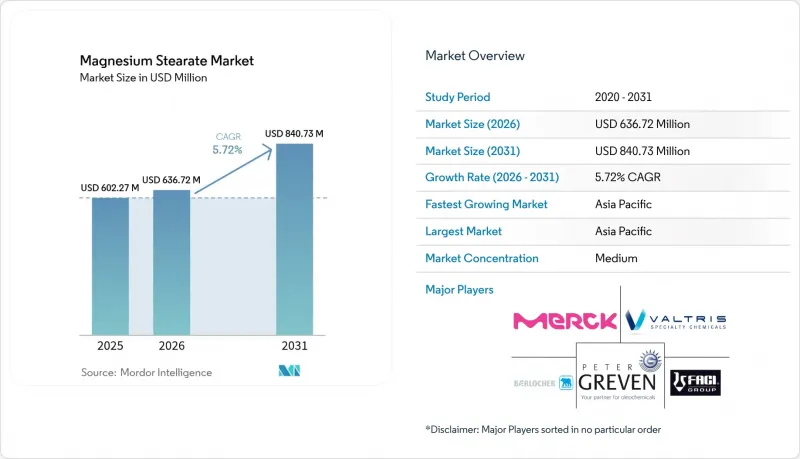
스테아르산 마그네슘 시장 규모는 2025년 6억 227만 달러에서 2026년에는 6억 3,672만 달러로 확대되어 2026년부터 2031년까지 CAGR 5.72%로 성장을 지속하여, 2031년에는 8억 4,073만 달러에 이를 것으로 예측됩니다.
본 보고서는 최종 사용자 산업별(제약, 식품 및 음료, 퍼스널케어, 플라스틱, 기타 최종 사용자 산업) 및 지역별(아시아태평양, 북미, 유럽, 남미, 중동 및 아프리카)로 구분되어 있습니다. 스테아르산 마그네슘 시장 규모 및 전망은 상기 모든 부문에 대해 매출액(백만 달러)으로 제시되어 있습니다.
세계 스테아르산 마그네슘 시장 동향 및 인사이트력
고형 제제 분야의 연속 생산 라인으로의 전환 가속화
화이자(Pfizer)와 일라이 릴리(Eli Lilly)와 같은 대형 제조업체들은 현재 통합형 스키드에서 정제의 혼합, 압축, 코팅을 수행하는 상업용 연속 제조 설비를 가동하고 있으며, 과거에는 부형제의 편차를 숨기기 위해 발생하던 생산 중단을 없애고 있습니다. 좁은 입자 크기 분포와 안정적인 지방산 비율을 보장할 수 있는 스테아르산 마그네슘 시장 진출기업들은 우선 공급업체로서의 지위를 확보하고 있습니다. 이는 어떠한 편차라도 과도한 윤활성을 유발하여 인장 강도에 악영향을 미칠 위험을 높이기 때문입니다. 규제 당국은 연속 생산 공장의 승인 심사 기간을 단축함으로써 이러한 전환을 뒷받침하고 있으며, 이는 고사양 첨가제에 대한 수요를 더욱 공고히 하고 있습니다. 연속 제조 공정에서는 중요한 품질 특성에 대한 각 투입물의 영향이 확대되기 때문에 일류 구매자들은 견고한 인라인 분석 도구를 갖춘 기업으로만 공급업체 목록을 좁히고 있습니다.
클린 라벨 뉴트라슈티컬을 겨냥한 비건/팜 프리 등급의 등장
소비자들은 유효 성분과 마찬가지로 부형제의 원산지도 엄격하게 검토하고 있으며, 이로 인해 기능성 식품 제품 처방 개발자들은 가능한 한 동물성 또는 팜유 유래 스테아르산염의 사용을 중단하고 있습니다. Biogrund사와 같은 공급업체는 기존의 윤활 성능을 유지하면서 비건 표시 및 ‘지속 가능한 팜유에 관한 원탁 회의(RSPO)’ 이니셔티브도 준수하는 식물 유래 등급인 ‘CompactCel LUB’를 상품화했습니다. 기능적 동등성으로 인해 재처방의 장벽은 낮아졌지만, 제조업체들은 여전히 파일럿 시험을 통해 유동성, 압축성, 용해성을 검증하고 있으며, 이를 통해 분석 기관의 시험 수익이 유지되고 있습니다. 소매업체들은 자사 브랜드 보충제에 대해 부형제의 투명성을 의무화함으로써 이러한 움직임을 뒷받침하고 있으며, 비용에 민감한 프라이빗 브랜드 제조업체들조차도 인증된 비건 원료로의 전환을 촉진하고 있습니다.
엄격한 팜유 추적성 규제가 원재료 비용을 상승시키고
유럽연합(EU)의 산림 파괴 규제와 이와 병행하여 진행되는 미국 세관의 감사로 인해, 스테아르산 제조업체는 팜유 유래 스테아르산을 1톤마다 기록해야 할 의무가 있습니다. 규정 준수를 위해서는 위성 감시, 동위원소 지문 분석, 블록체인을 통한 기록 관리가 필요하며, 이로 인해 조달 비용이 증가하여 소규모 정유시설 입장에서는 그 부담을 감당하기 어려운 상황이 되고 있습니다. 말레이시아 팜유 위원회 등의 기관이 요구하는 분석 요건으로 인해 검사 빈도가 높아지고, 검사 기관에 대한 설비 투자가 증가하며, 리드타임이 길어지고 있습니다. 그러나 대형 다국적 기업들은 윤리적 조달을 우선시하는 퍼스널케어 브랜드를 대상으로, 인증된 지속 가능한 첨가제를 프리미엄 가격에 판매함으로써 비용을 회수하고 있습니다.
부문 분석
2025년, 스테아르산 마그네슘 시장의 매출액 중 의약품 용도가 43.62%를 차지했습니다. 이는 수십 년에 걸친 규제 당국의 승인 및 비용 효율적인 성능에 기인합니다. 정제, 캡슐, 과립에는 일반적으로 2% 미만의 농도로 이 첨가제가 함유되어 있지만, 경구용 고형 제제의 생산량이 방대하기 때문에 누적 사용량은 여전히 높은 수준을 유지하고 있습니다. 기존 제품의 처방을 변경하려면 새로운 생물학적 동등성 데이터 세트가 필요하기 때문에 브랜드 제조업체와 제네릭 제조업체는 기존의 스테아르산 마그네슘 등급을 유지하고 있으며, 이 부문은 단기적인 대체 위험으로부터 보호받고 있습니다. 한편, 프레스드 파우더나 드라이 샴푸의 신제품 출시로 견인되는 퍼스널케어 사업은 연평균 성장률(CAGR) 6.12%로 가장 빠른 성장 궤도를 보이고 있습니다. 이러한 성장은 규모는 작지만 고가대의 화장품 등급에 대한 수요를 창출하고 있습니다.
식품 및 음료 배합 제조업체들은 가루 설탕, 베이킹 믹스, 분말 음료 베이스에서 이 분말을 고결 방지제 및 유동화제로 사용하고 있습니다. 배합 비율이 낮더라도 확실한 수분 제어를 통해 컨베이어의 처리 능력과 소비자의 따르기 용이성을 모두 충족시키는 상황에서 스테아르산 마그네슘은 필수적인 존재가 되고 있습니다. 플라스틱 가공업체들은 열안정화 폴리염화비닐(PVC) 분야에서 틈새 시장을 개척하고 있으며, 특히 보닛 내부의 고온에 노출되는 전기차 배선에서 활용되고 있습니다. 시장 점유율은 미미하지만, 이러한 용도는 수익원의 다각화에 기여하며 의약품 시장의 변동에 대한 의존도를 낮추고 있습니다. 이러한 추세들이 맞물려, 스테아르산 마그네슘 시장 전체를 특정 수직 시장 수요 급변으로부터 보호하고 있습니다.
지역별 분석
아시아태평양은 2025년에 매출의 41.12%로 1위를 차지하며, 2031년까지 연평균 성장률(CAGR) 6.01%를 나타낼 것으로 예측되어 스테아르산 마그네슘 시장의 핵심으로 자리 잡고 있습니다. 중국의 금속 마그네슘 생산 능력은 2024년에 24.5% 급증하여 102만 톤을 넘어섰으며, 이는 지역 내 원료 공급을 뒷받침하고 있습니다. 동시에, 인도의 위탁 개발 및 제조 기관(CDMO)은 아프리카 및 라틴아메리카 수출을 위해 정제 생산량을 확대하여 윤활유 수요를 더욱 끌어올렸습니다. 동남아시아 국가들은 소비지 및 2차 가공 거점으로서 혜택을 보고 있으며, 베트남과 인도네시아는 인근 동남아시아국가연합(ASEAN) 시장에 공급하는 비용 경쟁력 있는 배합 서비스를 제공합니다.
북미는 여전히 기술의 선구자로서, 미국 식품의약국(FDA)의 승인을 받은 여러 연속 생산 공장을 보유하고 있으며, 부형제 규격에 관한 엄격한 기준을 제시하고 있습니다. 구매자들은 미국 약전(USP), 유럽 약전(EP), 일본 약전(JP)의 각 규격에 대한 완벽한 준수를 강력히 요구하고 있어, 공급업체들은 통일된 문서 패키지를 유지할 수밖에 없는 상황입니다. ‘클린 라벨’ 추진은 미국에서 더욱 두드러지며, 미국의 천연 제품 소매업체들은 동물 유래 스테아르산염을 배제하고 있으며, 공급업체들에게 인증된 비건 제품 라인으로의 전환을 촉구하고 있습니다. 유럽도 이러한 품질 요구 사항을 반영하는 한편, 지속가능성에 대한 심사를 강화하고 있으며, 구매 결정에 앞서 팜유 공급망 감사 및 수명 주기 평가를 의무화하고 있습니다.
남미, 중동 및 아프리카는 전 세계 도입 비율에서 전체적으로는 작지만, 그 비율은 증가 추세에 있습니다. 브라질 국가위생감시청(ANVISA)의 제네릭 의약품 신속 승인 제도가 정제 생산을 뒷받침하고 있는 반면, 사우디아라비아와 남아프리카공화국의 공공 입찰에서는 가능한 한 현지 조달을 우선하고 있습니다. 그러나 분산된 현지 생산 능력에는 고급 분석 장비가 부족한 경우가 많아, 턴키 방식의 품질 서비스를 제공하는 다국적 공급업체에게는 비즈니스 기회가 되고 있습니다. 판매량은 적지만, 이 지역들은 리스크 분산이 가능하며, 1인당 의료비가 증가함에 따라 장기적인 성장이 예상됩니다.
기타 혜택:
- 엑셀 형식 시장 예측(ME) 시트
- 3개월간의 애널리스트 지원
자주 묻는 질문
목차
제1장 서론
제2장 조사 방법
제3장 주요 요약
제4장 시장 구도
제5장 시장 규모와 성장 예측
제6장 경쟁 구도
제7장 시장 기회와 향후 전망
JHSAccording to Mordor Intelligence, the magnesium stearate market size is expected to grow from USD 602.27 million in 2025 to USD 636.72 million in 2026 and is forecast to reach USD 840.73 million by 2031 at 5.72% CAGR over 2026-2031.
This report is Segmented by End-User Industry (Pharmaceutical, Food & Beverage, Personal Care, Plastics, and Other End-User Industries) and Geography (Asia-Pacific, North America, Europe, South America, and Middle-East and Africa). The Market Size and Forecasts for Magnesium Stearate Market are Provided in Revenue (USD Million) for all the Above Segments.
Global Magnesium Stearate Market Trends and Insights
Accelerated Shift to Continuous-manufacturing Lines in Solid-dose Pharma
Large producers such as Pfizer and Eli Lilly now run commercial continuous-manufacturing assets that blend, compress, and coat tablets in integrated skids, eliminating stoppages that once masked excipient variability. Magnesium stearate market participants able to guarantee narrow particle-size distributions and stable fatty-acid ratios secure preferred-supplier status because any deviation escalates the risk of lubrication overshoot that damages tensile strength. Regulators back the switch by shortening approval review times for continuous plants, further entrenching high-specification excipient demand. Continuous processing magnifies every input's contribution to critical-quality attributes, encouraging tier-one buyers to pare their vendor lists to firms with robust in-line analytical tools.
Emergence of Vegan / Palm-free Grades Targeting Clean-label Nutraceuticals
Consumers scrutinize excipient origins as closely as active ingredients, prompting nutraceutical formulators to abandon animal-derived or palm-based stearates where feasible. Suppliers such as Biogrund commercialized CompactCel LUB, a vegetable-sourced grade that matches traditional lubrication yet aligns with vegan labeling and Roundtable on Sustainable Palm Oil commitments . While functional equivalence lowers reformulation hurdles, manufacturers still validate flow, compressibility, and dissolution in pilot runs, sustaining testing revenues for analytical houses. Retailers amplify momentum by mandating excipient transparency for store-brand supplements, nudging even cost-sensitive private-labelers toward certified vegan inputs.
Stringent Palm-oil Traceability Regulations Increasing Input Costs
The European Union's deforestation regulation and parallel the United States Customs audits oblige stearate producers to document every tonne of palm-derived stearic acid. Compliance entails satellite monitoring, isotopic fingerprinting, and blockchain recordkeeping, driving procurement overheads that smaller mills struggle to absorb. Analytical mandates from bodies like the Malaysian Palm Oil Board have raised testing frequency, adding laboratory capital expense and elongating lead times . Larger multinationals, however, recoup costs by marketing certified-sustainable excipients at premiums to personal-care brands prioritizing ethical sourcing.
Other drivers and restraints analyzed in the detailed report include:
- Rising Intake of Oral-Solid-Dosage Forms in Low-income Economies
- Rapid Expansion of Cosmetic Pressed-powder Lines
- Adoption of Sodium Stearyl Fumarate as a High-performance Clean-label Alternative
For complete list of drivers and restraints, kindly check the Table Of Contents.
Segment Analysis
In 2025, pharmaceutical applications accounted for 43.62% of the Magnesium Stearate market revenue, underscoring decades of regulatory acceptance and cost-efficient performance. Tablets, capsules, and granules integrate the excipient at concentrations usually below 2%, yet cumulative volumes remain high due to sheer output of oral-solid doses. Because reformulating legacy products demands new bioequivalence dossiers, brand and generic manufacturers retain existing stearate grades, insulating this segment from short-term substitution risk. Meanwhile, the personal care business, anchored by pressed-powder and dry shampoo launches, shows the fastest trajectory at a 6.12% CAGR. This growth adds premium-priced, cosmetic-grade volumes, albeit from a smaller base.
Food and beverage formulators employ the powder as an anti-caking and flow agent in icing sugar, baking mixes, and powdered drink bases. Even at low inclusion rates, dependable moisture control renders magnesium stearate indispensable where conveyor throughput and consumer pour-ability intersect. Plastics processors have carved a niche in heat-stabilized Polyvinyl Chloride (PVC), particularly for electric-vehicle wiring that experiences higher under-hood temperatures. Although representing a modest slice, this outlet diversifies revenue streams and lowers reliance on pharmaceutical cycles. Collectively, these patterns safeguard the broader magnesium stearate market against demand shocks in any single vertical.
Complete Report Scope:
- By End-User Industry
- Pharmaceutical
- Food & Beverage
- Personal Care
- Plastics
- Other End-iser Industries (Paints & Coatings, etc.)
- By Geography
- Asia-Pacific
- China
- Japan
- India
- South Korea
- ASEAN Countries
- Rest of Asia-Pacific
- North America
- United States
- Canada
- Mexico
- Europe
- Germany
- United Kingdom
- France
- Italy
- Spain
- Russia
- NORDIC Countries
- Rest of Europe
- South America
- Brazil
- Argentina
- Rest of South America
- Middle East and Africa
- Saudi Arabia
- South Africa
- Rest of Middle East and Africa
- Asia-Pacific
Geography Analysis
Asia-Pacific led with 41.12% revenue in 2025 and is on track for a 6.01% CAGR through 2031, making it the linchpin of the magnesium stearate market. China's magnesium-metal capacity surged 24.5% in 2024, surpassing 1.02 Million tonnes and cushioning regional raw-material supply. Concurrently, India's contract-development and manufacturing organizations ramped tablet output for exports to Africa and Latin America, further lifting lubricant demand. Southeast Asian nations benefit as both consumption and secondary processing hubs, with Vietnam and Indonesia offering cost-advantaged blending services that feed neighboring Association of Southeast Asian Nations (ASEAN) markets.
North America remains a technology pacesetter, hosting several Food and Drug Administration (FDA)-approved continuous-manufacturing plants that set stringent excipient specification benchmarks. Buyers insist on full United States Pharmacopeia (USP), European Pharmacopoeia (EP), and Japanese Pharmacopoeia (JP) monograph compliance, compelling vendors to maintain harmonized documentation packs. Clean-label advocacy is more pronounced in the United States, where natural-product retailers blacklist animal-derived stearates, nudging suppliers toward certified vegan lines. Europe mirrors these quality demands and intensifies sustainability scrutiny, compelling palm-supply chain audits and life-cycle assessments before purchasing decisions.
South America, the Middle East, and Africa collectively contribute a smaller but rising parcel of global uptake. Brazil's Agencia Nacional de Vigilancia Sanitaria (ANVISA) fast-track for generic approvals fuels tablet output, while Saudi Arabian and South African public tenders prioritize local sourcing where feasible. However, fragmented local production capacity often lacks advanced analytical instruments, creating opportunity for multinational suppliers offering turnkey quality services. Despite lower volume, these geographies offer risk diversification and long-run upside as healthcare spend per capita climbs.
- Baerlocher GmbH
- FACI Corporate S.p.A.
- Huzhou City Linghu Xinwang Chemical Co., Ltd
- IRRH Specialty Chemicals
- James M. Brown Ltd.
- Kemipex
- Kirsch Pharma GmbH
- Merck KGaA
- MLA Group of Industries
- NB Entrepreneurs
- Nimbasia
- Peter Greven GmbH & Co. KG
- Roquette Freres
- Struktol Company of America, LLC
- Thermo Fisher Scientific Inc.
- Valtris Specialty Chemicals
Additional Benefits:
- The market estimate (ME) sheet in Excel format
- 3 months of analyst support
TABLE OF CONTENTS
1 Introduction
- 1.1 Study Assumptions & Market Definition
- 1.2 Scope of the Study
2 Research Methodology
3 Executive Summary
4 Market Landscape
- 4.1 Market Overview
- 4.2 Market Drivers
- 4.2.1 Accelerated Shift to Continuous-manufacturing Lines in Solid-dose Pharma
- 4.2.2 Emergence of Vegan/palm-free Grades Targeting Clean-label Nutraceuticals
- 4.2.3 Rising Intake of Oral Solid Dosage Forms in Low-income Economies
- 4.2.4 Polyvinyl Chloride (PVC) Heat-stabilization Demand in Electric-vehicle Wire Harnesses
- 4.2.5 Rapid Expansion of Cosmetic Pressed-powder Lines
- 4.3 Market Restraints
- 4.3.1 Stringent Palm-oil Traceability Regulations Increasing Input Costs
- 4.3.2 Adoption of Sodium Stearyl Fumarate as a High-performance Clean-label Alternative
- 4.3.3 Quality-variance Risk From Micro-scale Suppliers
- 4.4 Value Chain Analysis
- 4.5 Porter's Five Forces
- 4.5.1 Bargaining Power of Suppliers
- 4.5.2 Bargaining Power of Consumers
- 4.5.3 Threat of New Entrants
- 4.5.4 Threat of Substitute Products and Services
- 4.5.5 Degree of Competition
5 Market Size & Growth Forecasts (Value)
- 5.1 By End-User Industry
- 5.1.1 Pharmaceutical
- 5.1.2 Food & Beverage
- 5.1.3 Personal Care
- 5.1.4 Plastics
- 5.1.5 Other End-iser Industries (Paints & Coatings, etc.)
- 5.2 By Geography
- 5.2.1 Asia-Pacific
- 5.2.1.1 China
- 5.2.1.2 Japan
- 5.2.1.3 India
- 5.2.1.4 South Korea
- 5.2.1.5 ASEAN Countries
- 5.2.1.6 Rest of Asia-Pacific
- 5.2.2 North America
- 5.2.2.1 United States
- 5.2.2.2 Canada
- 5.2.2.3 Mexico
- 5.2.3 Europe
- 5.2.3.1 Germany
- 5.2.3.2 United Kingdom
- 5.2.3.3 France
- 5.2.3.4 Italy
- 5.2.3.5 Spain
- 5.2.3.6 Russia
- 5.2.3.7 NORDIC Countries
- 5.2.3.8 Rest of Europe
- 5.2.4 South America
- 5.2.4.1 Brazil
- 5.2.4.2 Argentina
- 5.2.4.3 Rest of South America
- 5.2.5 Middle East and Africa
- 5.2.5.1 Saudi Arabia
- 5.2.5.2 South Africa
- 5.2.5.3 Rest of Middle East and Africa
- 5.2.1 Asia-Pacific
6 Competitive Landscape
- 6.1 Market Concentration
- 6.2 Strategic Moves
- 6.3 Market Share(%)/Ranking Analysis
- 6.4 Company Profiles (includes Global level Overview, Market level overview, Core Segments, Financials as available, Strategic Information, Market Rank/Share for key companies, Products & Services, and Recent Developments)
- 6.4.1 Baerlocher GmbH
- 6.4.2 FACI Corporate S.p.A.
- 6.4.3 Huzhou City Linghu Xinwang Chemical Co., Ltd
- 6.4.4 IRRH Specialty Chemicals
- 6.4.5 James M. Brown Ltd.
- 6.4.6 Kemipex
- 6.4.7 Kirsch Pharma GmbH
- 6.4.8 Merck KGaA
- 6.4.9 MLA Group of Industries
- 6.4.10 NB Entrepreneurs
- 6.4.11 Nimbasia
- 6.4.12 Peter Greven GmbH & Co. KG
- 6.4.13 Roquette Freres
- 6.4.14 Struktol Company of America, LLC
- 6.4.15 Thermo Fisher Scientific Inc.
- 6.4.16 Valtris Specialty Chemicals
7 Market Opportunities & Future Outlook
- 7.1 White-space & Unmet-Need Assessment
- 7.2 Microencapsulation Technology Enhancing Magnesium Stearate's Performance