
|
시장보고서
상품코드
2123271
디지털 거래 관리(DTM) 시장 : 시장 점유율 분석, 업계 동향 및 통계, 성장 예측(2026-2031년)Digital Transaction Management (DTM) - Market Share Analysis, Industry Trends & Statistics, Growth Forecasts (2026 - 2031) |
||||||
 Mordor Intelligence
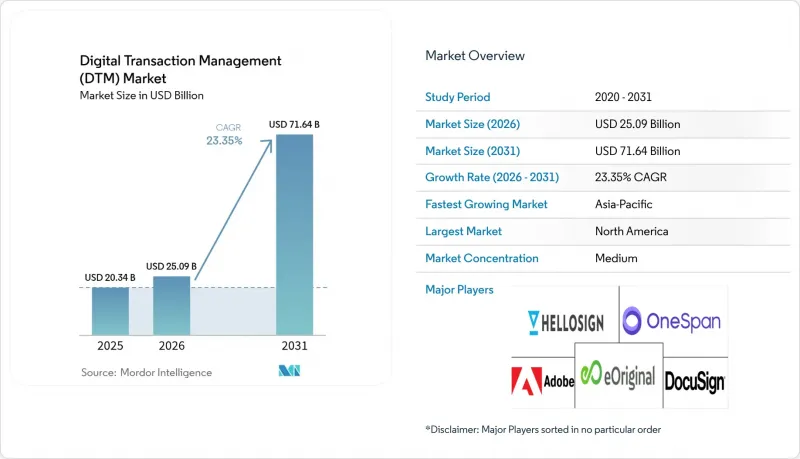
Mordor Intelligence에 의하면, 디지털 거래 관리 시장 규모는 2025년에 203억 4,000만 달러로 평가되었고, 2026년에는 250억 9,000만 달러로 추정되며, 2031년까지 716억 4,000만 달러에 이를 것으로 예측됩니다.
예측 기간(2026-2031년) 동안 연평균 성장률(CAGR)은 23.35%가 될 것으로 전망됩니다.
본 보고서는 구성 요소별(솔루션, 서비스), 도입 형태별(클라우드, 온프레미스), 조직 규모별(중소기업, 대기업), 최종 사용자 산업별(은행, 금융 서비스·보험, 헬스케어 및 생명과학 등), 지역별로 분류되어 있습니다. 시장 예측은 금액(달러) 기준으로 제시되어 있습니다.
세계의 디지털 거래 관리(DTM) 시장 동향 및 인사이트
규제 대상 산업에서의 전자 서명 도입 가속화
현재 미국의 선거 규정에서는 43개 주에서 전자 서명이 허용되고 있으며, 교통부는 약물 검사 기록에 있어 전자 증명을 법적으로 유효한 것으로 간주하는 개정안을 최종 조정 중입니다. 이러한 선례들은 법적 개방성에 대한 남아있는 회의론을 불식시키고, 기업이 규정 준수를 유지하면서 문서 처리 주기를 75% 단축할 수 있음을 보여줍니다. 예를 들어, 대규모 의료 서비스 제공업체는 적격한 전자 서명을 활용하여 우편으로 인한 지연 없이 주를 넘나드는 동의서를 동기화하고 있으며, 이를 통해 환자 만족도를 높이고 관리상의 부담을 줄이고 있습니다.
BFSI 및 정부 기관에서의 계약 수명주기 종단 간 자동화로의 전환
은행들은 2만 건 이상의 유효한 계약을 동시에 처리하고 있으며, 감독 체계가 미흡할 경우 최대 9%의 수익 손실에 노출될 수 있습니다. 블록체인을 기반으로 한 ‘Citi Token Services’의 도입은 실시간 결제가 어떻게 운영 위험을 줄이고 재무 담당자에게 운전 자본 측면의 이점을 제공하는지를 보여줍니다. 정부 기관도 이를 본받아 조달 문서를 검색 가능한 저장소에 일원화함으로써, 거의 즉각적인 정책 감사를 가능하게 하고 부정행위를 줄이고 있습니다. 이러한 움직임은 단순한 전자 서명을 넘어선 종합적인 자동화가 왜 CIO에게 예산 편성상 필수 항목이 되고 있는지를 여실히 보여주고 있습니다.
복잡한 국경을 넘는 암호 서명에 관한 규제
eIDAS는 ‘적격 전자 서명’에 최고의 증명력을 인정하고 있지만, EU 역외에서의 상호 인정은 여전히 불균일한 상황입니다(helpx.adobe.com). 게다가 GDPR(EU 개인정보보호규정)과 같은 데이터 주권에 관한 규제는 미국의 CLOUD법에 기반한 역외 적용 요구와 상충됩니다(isaca.org). 이러한 분산된 상황은 법률 자문 비용을 증가시키고, 다국적 워크플로우를 지원하려는 공급업체 시장 진출 계획을 지연시키며, 결과적으로 디지털 거래 관리 시장의 단기적 성장을 둔화시키고 있습니다.
부문 분석
솔루션 부문은 2025년 매출의 69.25%를 차지했지만, 서비스 부문은 2031년까지 연평균 성장률(CAGR) 27.62%로 확대될 것으로 예상되며, 이는 디지털 거래 관리 시장 내에서 가장 높은 성장률입니다. 레거시 시스템을 업그레이드하는 금융 기관의 경우, 사내에 규제에 관한 전문 지식이 부족한 경우가 많으며, 이는 통합, 규정 준수 및 관리형 지원에 대한 수요를 부추기고 있습니다. 2024년의 한 사례에서는 컨설팅 팀이 전자 서명 워크플로를 핵심 뱅킹 원장과 통합한 결과, 처리 오류와 운영 비용이 감소했습니다.
솔루션 분야는 정체되어 있지 않습니다. 블록체인 모듈은 위변조가 불가능한 감사 추적을 통합하고, AI 기반 분류 기능은 데이터 수집을 자동화합니다. 각 벤더사는 HIPAA 및 SOC 2를 즉시 준수하는 산업별 템플릿을 출시하여 의료 및 금융 분야 고객의 가치 실현 시간을 단축하고 있습니다. 그러나 미션 크리티컬한 워크플로의 복잡성으로 인해 외부 전문가에 대한 지속적인 의존이 필요하며, 이것이 서비스 수익의 성장 곡선을 뒷받침하고 있습니다.
2025년에는 클라우드 플랫폼이 75.40%의 점유율을 차지했으며, 해당 연도의 연평균 성장률(CAGR) 25.6%를 고려할 때, 클라우드 도입을 통한 디지털 거래 관리 시장 규모는 2031년보다 훨씬 이전에 2배로 성장할 가능성이 있습니다. 기업들은 구독형 요금 체계, 신속한 프로비저닝, 그리고 ISO 27001 및 FedRAMP 감사를 통과한 인증 데이터센터를 중요하게 여기고 있습니다. 현재 멀티 클라우드 아키텍처는 기밀 데이터를 로컬 소버린 클라우드로 라우팅하는 동시에 퍼블릭 인프라에서 버스트 용량을 확보함으로써 민첩성과 규정 준수의 균형을 맞추고 있습니다.
국방, 중요 인프라 및 일부 금융 기관에서는 여전히 온프레미스 도입이 나타나고 있지만, 이러한 구매자조차도 방화벽 내부에서 클라우드 기능을 재현하는 하이브리드 제어 플레인을 채택하고 있습니다. 암호화 키 관리, 기밀 컴퓨팅, 제로 트러스트 프레임워크가 성숙해짐에 따라 완전한 클라우드 전환에 대한 저항감은 줄어들고, 클라우드 도입 증가 추세는 지속될 것입니다.
지역별 분석
2025년, 북미는 디지털 거래 관리 시장 매출의 29.85%를 차지했습니다. 전자 기록에 관한 법적 명확성이 확립됨에 따라 민간 부문과 연방 정부 모두에서 도입이 가속화되고 있습니다. 미국 교통부가 검토 중인 전자 약물 검사 양식에 관한 규정은 디지털 신뢰에 대한 규제 측면의 지속적인 강화를 보여줍니다(federalregister.gov). 마찬가지로, 미국의 의료 규정 준수 로드맵도 이용을 가속화하고 있으며, 의료 서비스 제공업체들은 HIPAA 준수 전자 서명 스택을 활용하여 청구 처리를 효율화하고 있습니다(iclg.com). 이 지역에 본사를 둔 기술 공급업체들은 서비스 품질을 차별화하고 고액의 라이선스 비용을 정당화할 수 있는 AI 기능을 지속적으로 전개하고 있습니다.
아시아태평양은 연평균 성장률(CAGR) 27.8%를 기록하며 가장 빠르게 성장하는 시장입니다. 이 지역에서는 전 세계 디지털 결제의 절반 이상이 처리되고 있으며, B2C 전자상거래 규모는 2027년까지 4조 유로(4조 3,000억 달러)를 넘어설 것으로 예측됩니다(tmcnet.com). 인도의 ‘통합 결제 인터페이스(Unified Payments Interface, UPI)’는 연간 거래 건수 2,000억 건 이상을 목표로 하고 있어, 확장성이 뛰어난 서명 엔진에 대한 수요가 높아지고 있습니다. 호텔·관광, 물류, 행정 분야에서도 모바일 우선 소비자층에 대응하기 위해 디지털 계약 도입이 진행되고 있습니다. 규제의 차이는 여전히 남아 있지만, 인도네시아 등 일부 국가에서는 기본적인 동의 원칙이 충족된다면 디지털 계약을 인정하고 있어(mondaq.com), 규제의 점진적인 조화가 진행되고 있음을 보여줍니다.
유럽에서는 조화로운 eIDAS 제도의 혜택을 받고 있으며, 인증된 전자 서명은 자필 서명과 동등한 효력을 갖습니다(helpx.adobe.com). 향후 시행될 eIDAS 2.0 규정과 EU 디지털 ID 지갑은 국경을 초월한 원활한 서명을 실현하여 시장의 신뢰를 더욱 높이고 있습니다. 라틴아메리카, 중동 및 아프리카에서는 규모는 작지만 높은 성장률을 기록하고 있습니다. 브라질과 걸프 국가들의 정부 디지털화 프로그램과 광대역 접속 확대가 맞물려, 이들 지역의 디지털 거래 관리 업계에 유리한 환경이 조성되고 있습니다.
기타 혜택 :
- 엑셀 형식 시장 예측(ME) 시트
- 3개월간의 애널리스트 지원
자주 묻는 질문
목차
제1장 서론
제2장 조사 방법
제3장 주요 요약
제4장 시장 구도
제5장 시장 규모 및 성장 예측
제6장 경쟁 구도
제7장 시장 기회 및 향후 전망
AJY 26.09.07According to Mordor Intelligence, the digital transaction management market size was valued at USD 20.34 billion in 2025 and estimated to grow from USD 25.09 billion in 2026 to reach USD 71.64 billion by 2031, at a CAGR of 23.35% during the forecast period (2026-2031).
This report is Segmented by Component (Solutions, Services), Deployment Mode (Cloud, On-Premise), Organization Size (Small and Medium Enterprises, Large Enterprises), End-User Industry (Banking, Financial Services and Insurance, Healthcare and Life Sciences, and More), and Geography. The Market Forecasts are Provided in Terms of Value (USD).
Global Digital Transaction Management (DTM) Market Trends and Insights
Accelerating E-Signature Adoption Across Regulated Industries
U.S. election rules now allow e-signatures in 43 states, and the Department of Transportation is finalizing amendments that treat electronic attestations as legally valid for drug-testing records. These precedents demonstrate how statutory openness removes residual skepticism, letting enterprises shorten document cycles by 75% while maintaining compliance. Large health providers, for example, rely on qualified electronic signatures to synchronize cross-state consent forms without postal delays, thereby elevating patient satisfaction and trimming administrative overhead.
Shift Toward End-to-End Contract Lifecycle Automation in BFSI and Government
Banks process more than 20,000 active contracts simultaneously, exposing them to revenue leakage of up to 9% when oversight is weak. The rollout of blockchain-backed Citi Token Services shows how real-time settlement can shrink operational risk and unlock working-capital benefits for treasurers. Government agencies follow suit by centralizing procurement documents into searchable repositories, enabling near-instant policy audits and mitigating fraud. Together, these moves underscore why holistic automation-beyond simple e-signatures-is becoming mandatory budgeting line-item for CIOs.
Complex Cross-Border Crypto-Signature Regulations
eIDAS assigns top evidentiary weight to Qualified Electronic Signatures, yet mutual recognition outside the EU remains uneven (helpx.adobe.com). Additionally, data sovereignty mandates such as GDPR conflict with extraterritorial requests under the US CLOUD Act (isaca.org). This patchwork raises legal counsel costs and elongates go-to-market plans for providers trying to support multinational workflows, therefore tempering the digital transaction management market's near-term acceleration.
Other drivers and restraints analyzed in the detailed report include:
- Generative-AI Assistants Reducing Document Turn-Around Times
- Digital Identity Frameworks Catalyzing Adoption
- Limited 5G / Edge Infrastructure in Rural Areas Slowing Mobile DTM Usage
For complete list of drivers and restraints, kindly check the Table Of Contents.
Segment Analysis
Solutions generated 69.25% of 2025 revenue, but services are forecast to expand at a 27.62% compound rate to 2031, the highest within the digital transaction management market. Financial institutions upgrading legacy stacks often lack in-house regulatory expertise, fueling demand for integration, compliance, and managed support. Example engagements in 2024 reduced processing errors and operating expense when consultancy teams unified e-signature workflows with core banking ledgers.
The solutions category is not stagnant; blockchain modules embed immutable audit trails while AI classification automates data capture. Vendors release vertical-specific templates that satisfy HIPAA and SOC 2 out-of-the-box, shortening time-to-value for healthcare and finance clients. Nevertheless, the intricate nature of mission-critical workflows implies ongoing reliance on external specialists, which sustains the services revenue curve.
Cloud platforms held 75.40% share in 2025, and their 25.6% CAGR means the digital transaction management market size for cloud deployments could double well before 2031. Enterprises value subscription pricing, rapid provisioning, and certified data centers that pass ISO 27001 and FedRAMP audits. Multi-cloud architectures now route sensitive data to local sovereign clouds while reserving burst capacity on public infrastructure, balancing agility with compliance.
On-premise installations still exist for defense, critical infrastructure, and select financial institutions, yet even these buyers adopt hybrid control planes that mirror cloud features behind the firewall. As encryption key management, confidential computing, and zero-trust frameworks mature, resistance to full cloud conversion will erode, maintaining the upward bias in cloud uptake.
Complete Report Scope:
- By Component
- Solutions
- Services
- By Deployment Mode
- Cloud
- On-premise
- By Organization Size
- Small and Medium Enterprises
- Large Enterprises
- By End-user Industry
- Banking, Financial Services and Insurance
- Healthcare and Life Sciences
- Retail and E-commerce
- Government and Public Sector
- IT and Telecommunications
- Education
- Other End-user Industries
- By Geography
- North America
- United States
- Canada
- Mexico
- Europe
- United Kingdom
- Germany
- France
- Italy
- Rest of Europe
- Asia-Pacific
- China
- Japan
- India
- South Korea
- Rest of Asia-Pacific
- South America
- Brazil
- Argentina
- Rest of South America
- Middle East
- United Arab Emirates
- Saudi Arabia
- Rest of Middle East
- Africa
- South Africa
- Rest of Africa
- North America
Geography Analysis
North America generated 29.85% of digital transaction management market revenue in 2025. Mature legal clarity around electronic records encourages both private-sector and federal adoption. The U.S. Department of Transportation's pending rule on electronic drug-testing forms demonstrates continuous regulatory reinforcement of digital trust (federalregister.gov). Healthcare compliance roadmaps in the United States similarly accelerate usage, as providers exploit HIPAA-compatible e-signature stacks to streamline claims (iclg.com). Technology vendors headquartered in the region continue to roll out AI features that differentiate service quality and justify premium licensing.
Asia-Pacific is the fastest-growing arena with a 27.8% CAGR. The region processes more than half of the world's digital payments, and B2C e-commerce is projected to exceed EUR 4 trillion (USD 4.3 trillion) by 2027 (tmcnet.com). India's Unified Payments Interface aims beyond 200 billion annual transactions, intensifying demand for scalable signature engines. Hospitality, logistics, and public administration segments likewise embrace digital contracts to keep pace with a mobile-first consumer base. Regulatory heterogeneity remains, yet countries such as Indonesia recognize digital contracts provided core consent principles are satisfied (mondaq.com), signaling gradual convergence.
Europe benefits from the harmonized eIDAS regime, where qualified electronic signatures hold equivalence with handwritten ones (helpx.adobe.com). The forthcoming eIDAS 2.0 provisions and the EU Digital Identity Wallet promise seamless cross-border signing, reinforcing market confidence. Latin America and the Middle East and Africa record smaller baselines but high growth rates. Government digitization programs in Brazil and Gulf economies, coupled with expanding broadband access, create favorable conditions for the digital transaction management industry in those territories.
- Adobe Inc.
- DocuSign, Inc.
- Dropbox, Inc.
- Nintex Global Ltd.
- Namirial S.p.A.
- OneSpan Inc.
- Wolters Kluwer N.V.
- Entrust Corporation
- SignEasy Inc.
- Mitratech Holdings Inc.
- Sertifi, Inc.
- Thales Group (Gemalto N.V.)
- Nitro Software Ltd.
- airSlate Inc.
- PandaDoc Inc.
- Conga (Apttus Corporation)
- Zoho Corporation Pvt. Ltd.
- ZorroSign, Inc.
- Topaz Systems Inc.
- InfoCert S.p.A.
- AssureSign LLC
- eOriginal, Inc.
Additional Benefits:
- The market estimate (ME) sheet in Excel format
- 3 months of analyst support
TABLE OF CONTENTS
1 INTRODUCTION
- 1.1 Study Assumptions and Market Definition
- 1.2 Scope of the Study
2 RESEARCH METHODOLOGY
3 EXECUTIVE SUMMARY
4 MARKET LANDSCAPE
- 4.1 Market Overview
- 4.2 Market Drivers
- 4.2.1 Accelerating E-Signature Adoption Across Regulated Industries
- 4.2.2 Shift Toward End-to-End Contract Lifecycle Automation in BFSI and Government
- 4.2.3 Mandatory Remote-Work Compliance Spurring Cloud-Based DTM Uptake
- 4.2.4 Generative-AI Assistants Reducing Document Turn-Around Times
- 4.2.5 Click-Wrap Acceptance Driving E-Commerce Conversion in Asia
- 4.2.6 Digital Identity Frameworks (eIDAS 2.0, Aadhaar, NID) Catalyzing Adoption
- 4.3 Market Restraints
- 4.3.1 Complex Cross-Border Crypto-Signature Regulations
- 4.3.2 High Cost of Qualified Remote ID Assurance in Emerging Markets
- 4.3.3 Fragmented Legacy Core-Banking Workflows Hindering Full Automation
- 4.3.4 Limited 5G / Edge Infrastructure in Rural Areas Slowing Mobile DTM Usage
- 4.4 Value Chain Analysis
- 4.5 Technological Outlook
- 4.6 Porter's Five Forces Analysis
- 4.6.1 Bargaining Power of Suppliers
- 4.6.2 Bargaining Power of Buyers
- 4.6.3 Threat of New Entrants
- 4.6.4 Threat of Substitutes
- 4.6.5 Intensity of Competitive Rivalry
- 4.7 Macroeconomic Trend Impact Assessment
- 4.8 Investment Analysis
5 MARKET SIZE AND GROWTH FORECASTS (VALUE)
- 5.1 By Component
- 5.1.1 Solutions
- 5.1.2 Services
- 5.2 By Deployment Mode
- 5.2.1 Cloud
- 5.2.2 On-premise
- 5.3 By Organization Size
- 5.3.1 Small and Medium Enterprises
- 5.3.2 Large Enterprises
- 5.4 By End-user Industry
- 5.4.1 Banking, Financial Services and Insurance
- 5.4.2 Healthcare and Life Sciences
- 5.4.3 Retail and E-commerce
- 5.4.4 Government and Public Sector
- 5.4.5 IT and Telecommunications
- 5.4.6 Education
- 5.4.7 Other End-user Industries
- 5.5 By Geography
- 5.5.1 North America
- 5.5.1.1 United States
- 5.5.1.2 Canada
- 5.5.1.3 Mexico
- 5.5.2 Europe
- 5.5.2.1 United Kingdom
- 5.5.2.2 Germany
- 5.5.2.3 France
- 5.5.2.4 Italy
- 5.5.2.5 Rest of Europe
- 5.5.3 Asia-Pacific
- 5.5.3.1 China
- 5.5.3.2 Japan
- 5.5.3.3 India
- 5.5.3.4 South Korea
- 5.5.3.5 Rest of Asia-Pacific
- 5.5.4 South America
- 5.5.4.1 Brazil
- 5.5.4.2 Argentina
- 5.5.4.3 Rest of South America
- 5.5.5 Middle East
- 5.5.5.1 United Arab Emirates
- 5.5.5.2 Saudi Arabia
- 5.5.5.3 Rest of Middle East
- 5.5.6 Africa
- 5.5.6.1 South Africa
- 5.5.6.2 Rest of Africa
- 5.5.1 North America
6 COMPETITIVE LANDSCAPE
- 6.1 Market Concentration
- 6.2 Strategic Moves
- 6.3 Market Share Analysis
- 6.4 Company Profiles (includes Global Level Overview, Market Level Overview, Core Segments, Financials as Available, Strategic Information, Market Rank/Share for Key Companies, Products and Services, and Recent Developments)
- 6.4.1 Adobe Inc.
- 6.4.2 DocuSign, Inc.
- 6.4.3 Dropbox, Inc.
- 6.4.4 Nintex Global Ltd.
- 6.4.5 Namirial S.p.A.
- 6.4.6 OneSpan Inc.
- 6.4.7 Wolters Kluwer N.V.
- 6.4.8 Entrust Corporation
- 6.4.9 SignEasy Inc.
- 6.4.10 Mitratech Holdings Inc.
- 6.4.11 Sertifi, Inc.
- 6.4.12 Thales Group (Gemalto N.V.)
- 6.4.13 Nitro Software Ltd.
- 6.4.14 airSlate Inc.
- 6.4.15 PandaDoc Inc.
- 6.4.16 Conga (Apttus Corporation)
- 6.4.17 Zoho Corporation Pvt. Ltd.
- 6.4.18 ZorroSign, Inc.
- 6.4.19 Topaz Systems Inc.
- 6.4.20 InfoCert S.p.A.
- 6.4.21 AssureSign LLC
- 6.4.22 eOriginal, Inc.
7 MARKET OPPORTUNITIES AND FUTURE OUTLOOK
- 7.1 White-Space and Unmet-Need Assessment