

|
시장보고서
상품코드
2123273
심장 재동기 요법(CRT) 시장 : 점유율 분석, 업계 동향과 통계, 성장 예측(2026-2031년)Cardiac Resynchronization Therapy (CRT) - Market Share Analysis, Industry Trends & Statistics, Growth Forecasts (2026 - 2031) |
||||||
 Mordor Intelligence
심장 재동기 요법 시장 규모는 2025년에 50억 3,000만 달러로 평가되었고 2026년 52억 5,000만 달러에서 2031년까지 65억 1,000만 달러에 이를 것으로 예측되며, 예측 기간(2026-2031년) CAGR은 4.39%를 나타낼 전망입니다.
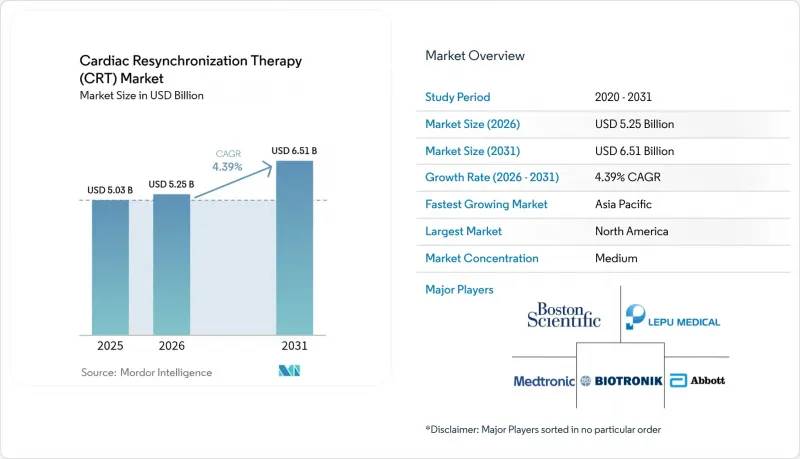
본 보고서는 기기 유형(CRT-제세동기, CRT-페이스메이커), 최종 사용자(병원 및 심장 센터 등), 용도(심실 비동조증 등), 기술(기존의 양심실 페이싱 등), 지역(북미, 유럽, 아시아태평양, 중동 및 아프리카, 남미)별로 분류되어 있습니다. 시장 전망은 금액(달러) 기준으로 제시되어 있습니다.
전 세계 심장 재동기 요법(CRT) 시장 동향 및 인사이트
심부전 및 기타 심장 질환의 부담 증가
현재 심혈관 질환으로 인한 사망자 수는 연간 2,050만 명에 달하며, 그 중 80% 이상이 저·중소득 국가에서 발생하고 있습니다. 박출률 저하형 심부전의 유병률 확대로 인해 적격 환자가 지속적으로 증가하여 심장 재동기 요법(CRT) 시장을 확대시키고 있습니다. 아시아태평양의 도시 지역에서는 도시형 식생활과 운동 부족을 요인으로 40대 성인의 심부전 발생률이 증가하고 있습니다. CRT는 심부전 관련 입원을 30-40% 감소시키기 때문에 국제 지침에서 1차 선택 기기 치료법으로 자리 잡고 있습니다. 심초음파 검사의 고도화와 AI를 활용한 바이오마커 선별을 통해 잠재적인 전도 지연이 발견됨에 따라, 치료 대상이 되는 환자층이 확대되어 기기 수요를 지속적으로 뒷받침하고 있습니다.
급속히 증가하는 고령 인구와 앉아 지내는 생활 방식
모든 지역에서 고령화가 진행되고 있지만, 아시아태평양에서는 매년 고령자 수의 절대값이 가장 크게 증가하고 있습니다. 이에 따라 젊은 층의 운동 부족이 더해져 평생에 걸친 심혈관 질환의 위험이 높아지고 있습니다. 중국과 인도 정부는 CRT를 보장하는 공적 보험의 적용 범위를 확대되고 있습니다. 이는 장기적인 시뮬레이션을 통해 CRT가 반복적인 입원을 대체함으로써 5년간의 관리 비용이 40% 절감된다는 사실이 입증되었기 때문입니다. 이로 인해 심장 재동기 요법(CRT) 시장은 특히 외래 시술 방식에 따른 입원 기간 단축과 고령의 복잡한 사례를 대응하기 위한 의료 자원 확보를 통해 시장 규모와 정책적 지원 양쪽 모두를 확보하고 있습니다.
엄격한 다지역 규제 요건과 장기적인 승인 절차
미국 FDA는 신규 CRT 승인에 12-18개월이 소요된다고 밝혔으며, 한편 유럽의 MDR에서는 세계 신청에 대해 1,000만 달러를 초과하는 시판 후 조사 비용이 추가로 발생합니다. 이러한 투자는 신생 기업들의 진입을 주저하게 하고, 비용 절감으로 이어지는 혁신의 확산을 지연시키고 있습니다. 배터리 수명에 관한 요건과 리드 절연 시험 프로토콜의 지역별 차이로 인해 지역별 고유 SKU가 불가피하게 되어 재고 관리의 복잡성이 증가하고 있습니다. 그 결과, 제품 출시는 수익성이 높은 지역에 집중되고 있으며, 저소득 국가로의 심장 재동기 요법(CRT) 시장 확대가 둔화되고 있습니다.
부문 분석
CRT-제세동기는 부정맥으로 인한 사망을 방지하고 심장 재동기를 도모하는 이중 역할을 수행하며, 2025년 전 세계 매출의 71.22%를 차지했습니다. 종합적인 보호 기능 덕분에 고위험 심부전 환자에 대한 의료진의 선호도가 확고해졌습니다. 그럼에도 불구하고, 지침이 경미한 박출률 저하까지 적용 범위를 확대함에 따라 CRT-페이스메이커는 연평균 성장률(CAGR) 4.96%로 성장하고 있습니다. 리드리스 CRT-P 기기는 수술 시간을 단축하고 감염 위험을 줄여주므로, 외래 진료 센터에 더 안전한 외래 치료 경로를 제공합니다. 두 범주 모두에 통합된 AI 기반 최적화 펌웨어는 임상적 가치에 대한 인식을 높여 가격 프리미엄을 정당화하고 있습니다. 동반 질환 프로파일이 부정맥 위험이 낮은 방향으로 변화함에 따라, 2028년 이후에는 CRT-D의 채택이 정체될 가능성이 있으며, 그 결과 기기 선택 알고리즘이 대신 심박조율기를 제안하게 될 것입니다.
금액 기준으로 볼 때, CRT-페이스메이커 하위 부문은 2031년까지 4억 5,500만 달러 증가할 것으로 예측되며, ICD를 통한 쇼크 요법에 적합하지 않은 환자나 심장 재동기 요법의 혜택을 받을 수 있는 사용자를 흡수하게 될 것입니다. 방실결절 절제술을 받은 환자를 위해 맞춤화된 첨단 단일실 CRT-P 시스템은 개인 맞춤형 치료를 두드러지게 하고 있습니다. 한때 프리미엄 기능이었던 원격 모니터링 기능은 현재 표준 사양이 되었으며, 제품 간 차별화가 균일화되면서 심장 재동기 요법 시장은 서비스 기반의 경쟁으로 전환되고 있습니다. 벤더의 전략으로는 기기와 구독형 분석 서비스를 결합하는 사례가 늘어나고 있으며, 일회성 하드웨어 판매를 지속적인 수익원으로 전환하고 있습니다.
2025년에는 복잡한 이식 수술에 여전히 고도의 영상 진단, 마취 및 집중 모니터링이 필요하기 때문에 병원 및 심장 센터가 전 세계 수술 건수의 69.78%를 차지했습니다. 이러한 시설들은 연간 수술 건수의 3분의 1을 차지하는 업그레이드 및 제너레이터 교체를 주도하고 있습니다. 그러나 외래수술센터(ASC)의 연평균 성장률(CAGR)이 5.44%인 것은 지불 기관이 시설 이용료 인하를 원하고 있음을 나타냅니다. 의식 하 진정 요법을 동반한 간소화된 CRT-P 이식 수술을 통해 당일 퇴원이 가능해져, 중증도 높은 환자를 위한 병상을 확보할 수 있습니다. 이에 대응하여 병원 측은 의뢰 환자를 유지하기 위해 병원 내에 외래 진료동을 설치하는 등의 조치를 추진하고 있습니다.
재택 및 원격 모니터링 환경은 아직 발전 단계에 있지만, 전략적으로 중요한 채널을 형성하고 있습니다. 클라우드 대시보드는 임계값의 변화를 임상의에게 알리고, 진료소를 방문하지 않고도 약물 용량 조정이나 펌웨어 미세 조정이 가능하게 합니다. 향후 원격 조정을 통해 대면 후속 관리를 40% 줄일 수 있어 인력 부족 문제를 완화하는 동시에, 공급업체와 의료 제공업체 간의 관계를 강화하게 될 것입니다. 조사 기관 및 학술 기관은 사례 수는 적지만, 전도계 페이싱에 대한 최초의 인간 임상시험을 통해 미래의 진료 방식을 형성하고, 장기적인 제품 로드맵에 영향을 미치며, 간접적으로 심장 재동기 요법 업계를 생리학적 페이싱의 기준으로 이끌고 있습니다.
지역별 분석
북미는 2025년 매출의 45.02%를 차지했습니다. 이는 공공 및 민간 보험사가 CRT에 대해 수량 제한 없이 보험 적용을 하고 있으며, 미국에서 1,500개 이상의 이식 센터가 운영되고 있기 때문입니다. 메디케어는 기기 비용과 이식 비용을 보장하여 고령자들이 폭넓게 이용할 수 있도록 하고 있습니다. 한편, 재향군인부(VA) 시설에서는 통합 조달을 통해 새로운 알고리즘을 신속하게 도입하고 있습니다. 캐나다의 각 주에서는 단일 지불자 제도 하에서 CRT 비용이 충당되고 있으나, 기기 선정 위원회가 대폭적인 가격 할인을 협상하고 있습니다. 멕시코에서는 확대되는 중산층이 사립 병원을 이용하고 있으며, 리드리스 CRT-P는 15%의 가격 프리미엄을 적용받아 도입되었으나 대기 명단은 발생하지 않았습니다.
유럽에서는 시장이 성숙한 상황에서 꾸준한 성장이 나타났습니다. 독일은 시술 건수에서 선두를 달리고 있으며, 원격 모니터링이 대면 검사를 대체함에 따라 입원 일수가 단축되고, DRG(진단 관련 그룹) 제도에 따른 인센티브가 이를 뒷받침하고 있습니다. 영국 NHS의 일원화된 입찰 제도는 단가를 억제하면서도 공급업체에 대한 안정적인 대량 발주를 보장하고 있습니다. 프랑스에서는 병원에 대한 보상금을 6개월간 재입원율에 연동시키는 일괄 지급 제도를 시범 도입하고 있으며, 이로 인해 예측 분석 플랫폼의 도입이 촉진되고 있습니다. 동유럽 국가들에서는 EU의 결속 기금을 활용하여 카테터실 설비를 갱신하고 있어, 심장 재동기 요법(CRT)의 잠재 시장이 확대되고 있습니다.
아시아태평양은 가장 빠른 성장 궤도를 그리고 있으며, 2031년까지의 연평균 성장률(CAGR)은 6.03%로 예측됩니다. 중국의 의료기기 입찰에서는 국산 부품 사용률의 하한선이 규정되어 있어, 다국적 기업이 현지 기업과 공동 생산을 하도록 유도하고 있습니다. 인도의 ‘아유슈만 바라트’ 제도에서는 2급 도시 병원의 CRT-P 비용이 환급 대상이 되어, 농촌 지역으로의 보급 범위가 확대되고 있습니다. 일본은 경험이 풍부한 전기생리학자와 고령화가 진행되는 인구 구조를 배경으로, 생리학적 페이싱을 조기에 도입하고 있습니다. 한국의 국민건강보험은 AI를 통해 최적화된 CRT 조정을 승인하고 있어, 소프트웨어 모듈 시장 침투를 가속화하고 있습니다. 베트남, 인도네시아, 필리핀에서는 1인당 소득 증가와 고가 심장 임플란트를 포함한 정부 보험의 확대에 힘입어 두 자릿수 성장이 예상됩니다.
중동 및 아프리카에서는 도입 속도가 완만한 수준에 그치고 있습니다. 걸프협력회의(GCC) 회원국에서는 리야드, 아부다비, 도하의 3차 의료 센터를 대상으로 고급 CRT-D 모델이 수입되고 있습니다. 남아프리카에서는 민간 보험사가 CRT를 제한적으로 보장하는 반면, 공립 병원은 기증자 프로그램에 의존하고 있습니다. 공급망 제약과 이식 수술 담당 의사 부족으로 인해, 이 대륙의 다른 지역에서는 도입 대수 증가세가 억제되고 있습니다. 남미에서는 브라질이 도입을 주도하고 있으며, ANVISA(브라질 국가위생감독청)가 현지 조립 펄스 제너레이터의 승인을 가속화하고 있는 반면, 아르헨티나에서는 수입 허가 지연으로 인해 대기 목록이 길어지고 있습니다.
기타 혜택:
- 엑셀 형식 시장 예측(ME) 시트
- 3개월간의 애널리스트 지원
자주 묻는 질문
목차
제1장 서론
제2장 조사 방법
제3장 주요 요약
제4장 시장 구도
제5장 시장 규모와 성장 예측
제6장 경쟁 구도
제7장 시장 기회와 향후 전망
JHS 26.09.09According to Mordor Intelligence, the cardiac resynchronization therapy market size was valued at USD 5.03 billion in 2025 and estimated to grow from USD 5.25 billion in 2026 to reach USD 6.51 billion by 2031, at a CAGR of 4.39% during the forecast period (2026-2031).
This report is Segmented by Device Type (CRT-Defibrillators, CRT-Pacemakers), End User (Hospitals & Cardiac Centres, and More), Application (Intraventricular Dyssynchrony, and More), Technology (Conventional Bi-Ventricular Pacing, and More), and Geography (North America, Europe, Asia-Pacific, Middle East & Africa, South America). The Market Forecasts are Provided in Terms of Value (USD).
Global Cardiac Resynchronization Therapy (CRT) Market Trends and Insights
Rising Burden of Heart Failure & Other Cardiac Disorders
Cardiovascular disease now causes 20.5 million deaths each year, and more than 80% occur in low- and middle-income countries. The widening prevalence of reduced ejection-fraction heart failure enlarges the cardiac resynchronization therapy market by continually adding eligible candidates. Asia-Pacific cities show increasing heart-failure incidence among adults in their 40s, triggered by urban diets and limited exercise. CRT lowers heart-failure-related admissions by 30-40%, making it a first-line device therapy in international guidelines. Enhanced echocardiography and AI-enabled biomarker screening uncover latent conduction delays, expanding the treatable cohort and underpinning sustained device demand.
Rapidly Expanding Geriatric Population and Sedentary Lifestyles
Every region is ageing, yet Asia-Pacific adds the largest absolute number of elders annually. Concomitant sedentary behaviour in younger demographics intensifies lifetime cardiovascular risk. Governments in China and India are scaling public insurance that covers CRT because long-term modelling shows a 40% drop in five-year management costs when CRT replaces repeated hospitalizations . The cardiac resynchronization therapy market thereby gains both volume and policy support, especially as outpatient implant pathways shorten stay lengths and free capacity for older complex cases.
Stringent Multi-Region Regulatory Requirements and Lengthy Approval Cycles
The United States FDA demands 12-18 months for novel CRT clearances, while Europe's MDR adds post-market surveillance costs exceeding USD 10 million for a global filing . These investments deter start-ups and delay diffusion of cost-saving innovations. Variations in battery longevity mandates or lead insulation test protocols force region-specific SKUs, ballooning inventory complexity. Consequently, first launches concentrate in high-margin territories, slowing cardiac resynchronization therapy market expansion into lower-income countries.
Other drivers and restraints analyzed in the detailed report include:
- Break-through Product Innovations
- Favourable Reimbursement & Heart-Failure Mandates in OECD Nations
- AI-Driven CRT Optimisation & Predictive Analytics Platforms
- Commercialisation of Leadless & Modular CRT Systems in Emerging Markets
- High Procedure/Device Cost & Limited Implanter Skill Base
- Supply-Chain Vulnerability for Rare-Earth Magnets and Semiconductor ICs
- Rising Clinical Scrutiny of Non-Responder Rates Spurring Conduction-System Pacing Substitutes
For complete list of drivers and restraints, kindly check the Table Of Contents.
Segment Analysis
CRT-Defibrillators generated 71.22% of 2025 global revenue, reflecting their dual role in halting arrhythmic death and resynchronising ventricles. Their comprehensive protection cements physician preference for high-risk heart-failure patients. Nevertheless, CRT-Pacemakers are rising at a 4.96% CAGR as guidelines broaden to milder ejection-fraction impairment. Leadless CRT-P devices shorten theatre time and cut infection risk, giving ambulatory centres a safer outpatient path. AI-driven optimisation firmware bundled into both categories is enlarging perceived clinical value and justifying price premiums. CRT-D adoption may plateau past 2028 as comorbidity profiles shift toward lower arrhythmia risk, prompting device-selection algorithms to propose pacemakers instead.
In monetary terms, the CRT-Pacemaker sub-segment is forecast to add USD 455 million by 2031, capturing users unsuitable for ICD shocks yet benefiting from ventricular resynchronisation. Advanced single-chamber CRT-P systems tailored to atrioventricular node ablation recipients highlight personalised therapy. Remote-monitoring connectivity features, once premium, are now standard, equalising differentiation and pushing the cardiac resynchronization therapy market toward service-based competition. Vendor strategies increasingly pair devices with subscription analytics, converting episodic hardware sales into annuity revenue.
Hospitals & Cardiac Centers held 69.78% of global procedures in 2025 because complex implants still need advanced imaging, anaesthesia, and intensive monitoring. They dominate upgrades and generator replacements, which account for one-third of annual volume. However, the 5.44% CAGR in Ambulatory Surgical Centers shows payer appetite for lower facility fees. Simplified CRT-P implants with conscious sedation allow same-day discharge, freeing inpatient beds for acuity-heavy cases. Hospitals respond by setting up on-site outpatient wings to retain referrals.
Home & Remote Monitoring Settings form a nascent but strategic channel. Cloud dashboards alert clinicians to threshold changes, enabling drug titration or firmware tweaks without clinic visits. Over time, remote adjustments could cut in-person follow-ups by 40%, easing workforce constraints while solidifying vendor-provider relationships. Research & Academic Institutes, though small in volume, shape future practice through first-in-human trials of conduction-system pacing, influencing longer-term product roadmaps and indirectly steering the cardiac resynchronization therapy industry toward physiologic pacing norms.
Complete Report Scope:
- By Device Type
- CRT-Defibrillators (CRT-D)
- Transvenous CRT-D
- Sub-cutaneous CRT-D (S-ICD)
- CRT-Pacemakers (CRT-P)
- Single-chamber CRT-P
- Dual/Biventricular CRT-P
- CRT-Defibrillators (CRT-D)
- By End User
- Hospitals & Cardiac Centres
- Ambulatory Surgical Centres
- Home & Remote Monitoring Settings
- Research & Academic Institutes
- By Application
- Intraventricular Dyssynchrony
- Interventricular Dyssynchrony
- Atrioventricular Dyssynchrony
- By Technology
- Conventional Bi-ventricular Pacing
- His-Bundle Pacing (HBP)
- Left Bundle Branch Area Pacing (LBBAP)
- By Geography
- North America
- United States
- Canada
- Mexico
- Europe
- Germany
- United Kingdom
- France
- Italy
- Spain
- Rest of Europe
- Asia-Pacific
- China
- Japan
- India
- Australia
- South Korea
- Rest of Asia-Pacific
- Middle East & Africa
- GCC
- South Africa
- Rest of Middle East & Africa
- South America
- Brazil
- Argentina
- Rest of South America
- North America
Geography Analysis
North America commanded 45.02% of 2025 revenue because public and private payers reimburse CRT without volume caps, and more than 1,500 implants centres operate across the United States. Medicare covers device and implantation fees, ensuring broad access for seniors, while Veterans Affairs facilities adopt new algorithms rapidly through centralised procurements. Canadian provinces fund CRT under single-payer plans, though device selection committees negotiate aggressive discounts. Mexico's growing middle class uses private hospitals where leadless CRT-P launches at a 15% price premium, yet faces no waiting lists.
Europe delivered steady growth under mature conditions. Germany leads procedure counts, aided by DRG incentives that reward shorter stays when remote monitoring replaces in-person checks. The United Kingdom's NHS centralised tendering lowers per-unit costs but guarantees high vendor volumes. France pilots bundled payments linking hospital bonuses to six-month readmission rates, nudging adoption of predictive-analytics platforms. Eastern European nations are upgrading catheter labs with EU cohesion funds, expanding the reachable cardiac resynchronization therapy market.
Asia-Pacific posts the fastest trajectory, 6.03% CAGR through 2031. China's device tenders specify domestic content thresholds, encouraging multinationals to co-manufacture with local firms. India's Ayushman Bharat scheme reimburses CRT-P at tier-II city hospitals, enlarging rural reach. Japan adopts physiologic pacing early thanks to experienced electrophysiologists and an ageing demographic profile. South Korea's national insurance approves AI-optimised CRT adjustments, speeding market penetration of software modules. Vietnam, Indonesia, and the Philippines witness double-digit growth from rising per-capita incomes and government insurance expansions that include high-value cardiac implants.
The Middle East & Africa region records moderate uptake. Gulf Cooperation Council states import premium CRT-D models for tertiary centres in Riyadh, Abu Dhabi, and Doha. South Africa's private insurers cover CRT selectively, while public hospitals rely on donor programmes. Supply-chain constraints and limited implanter availability cap volume growth elsewhere on the continent. South America sees Brazil leading adoption as ANVISA accelerates approvals for locally-assembled pulse generators, while Argentina's import-licence delays lengthen waiting lists.
- Abbott Laboratories
- Medtronic
- Boston Scientific
- BIOTRONIK
- MicroPort
- Lepu Medical
- MEDICO
- Integer Holdings
- OSYPKA MEDICAL GmbH
- Shree Pacetronix
- LivaNova
- Koninklijke Philips
- EBR Systems
- MicroTransponder Inc.
- Biotronik's Acutus JV
- Sorin Group (now part of LivaNova)
Additional Benefits:
- The market estimate (ME) sheet in Excel format
- 3 months of analyst support
TABLE OF CONTENTS
1 Introduction
- 1.1 Study Assumptions & Market Definition
- 1.2 Scope of the Study
2 Research Methodology
3 Executive Summary
4 Market Landscape
- 4.1 Market Overview
- 4.2 Market Drivers
- 4.2.1 Rising Burden Of Heart Failure & Other Cardiac Disorders
- 4.2.2 Rapidly Expanding Geriatric Population And Sedentary Lifestyles
- 4.2.3 Break-Through Product Innovations
- 4.2.4 Favourable Reimbursement & HF Disease-Management Mandates In Oecd Nations
- 4.2.5 AI-Driven CRT Optimisation & Predictive Analytics Platforms
- 4.2.6 Commercialisation Of Leadless & Modular CRT Systems In Emerging Markets
- 4.3 Market Restraints
- 4.3.1 Stringent Multi-Region Regulatory Requirements And Lengthy Approval Cycles
- 4.3.2 High Procedure/Device Cost & Limited Implanter Skill Base
- 4.3.3 Supply-Chain Vulnerability For Rare-Earth Magnets And Semiconductor Ics
- 4.3.4 Rising Clinical Scrutiny Of Non-Responder Rates Spurring CSP Substitutes
- 4.4 Value / Supply-Chain Analysis
- 4.5 Technological Outlook
- 4.6 Regulatory Landscape
- 4.7 Porter's Five Forces Analysis
- 4.7.1 Threat of New Entrants
- 4.7.2 Bargaining Power of Buyers/Consumers
- 4.7.3 Bargaining Power of Suppliers
- 4.7.4 Threat of Substitute Products
- 4.7.5 Intensity of Competitive Rivalry
5 Market Size & Growth Forecasts (Value)
- 5.1 By Device Type
- 5.1.1 CRT-Defibrillators (CRT-D)
- 5.1.1.1 Transvenous CRT-D
- 5.1.1.2 Sub-cutaneous CRT-D (S-ICD)
- 5.1.2 CRT-Pacemakers (CRT-P)
- 5.1.2.1 Single-chamber CRT-P
- 5.1.2.2 Dual/Biventricular CRT-P
- 5.1.1 CRT-Defibrillators (CRT-D)
- 5.2 By End User
- 5.2.1 Hospitals & Cardiac Centres
- 5.2.2 Ambulatory Surgical Centres
- 5.2.3 Home & Remote Monitoring Settings
- 5.2.4 Research & Academic Institutes
- 5.3 By Application
- 5.3.1 Intraventricular Dyssynchrony
- 5.3.2 Interventricular Dyssynchrony
- 5.3.3 Atrioventricular Dyssynchrony
- 5.4 By Technology
- 5.4.1 Conventional Bi-ventricular Pacing
- 5.4.2 His-Bundle Pacing (HBP)
- 5.4.3 Left Bundle Branch Area Pacing (LBBAP)
- 5.5 By Geography
- 5.5.1 North America
- 5.5.1.1 United States
- 5.5.1.2 Canada
- 5.5.1.3 Mexico
- 5.5.2 Europe
- 5.5.2.1 Germany
- 5.5.2.2 United Kingdom
- 5.5.2.3 France
- 5.5.2.4 Italy
- 5.5.2.5 Spain
- 5.5.2.6 Rest of Europe
- 5.5.3 Asia-Pacific
- 5.5.3.1 China
- 5.5.3.2 Japan
- 5.5.3.3 India
- 5.5.3.4 Australia
- 5.5.3.5 South Korea
- 5.5.3.6 Rest of Asia-Pacific
- 5.5.4 Middle East & Africa
- 5.5.4.1 GCC
- 5.5.4.2 South Africa
- 5.5.4.3 Rest of Middle East & Africa
- 5.5.5 South America
- 5.5.5.1 Brazil
- 5.5.5.2 Argentina
- 5.5.5.3 Rest of South America
- 5.5.1 North America
6 Competitive Landscape
- 6.1 Market Concentration
- 6.2 Market Share Analysis
- 6.3 Company Profiles (includes Global level Overview, Market level overview, Core Segments, Financials as available, Strategic Information, Market Rank/Share for key companies, Products & Services, and Recent Developments)
- 6.3.1 Abbott Laboratories
- 6.3.2 Medtronic plc
- 6.3.3 Boston Scientific Corporation
- 6.3.4 BIOTRONIK SE & Co. KG
- 6.3.5 MicroPort Scientific Corporation
- 6.3.6 Lepu Medical Technology Co., Ltd.
- 6.3.7 MEDICO S.p.A.
- 6.3.8 Integer Holdings Corporation
- 6.3.9 OSYPKA MEDICAL GmbH
- 6.3.10 Shree Pacetronix Ltd.
- 6.3.11 LivaNova PLC
- 6.3.12 Koninklijke Philips N.V.
- 6.3.13 EBR Systems Inc.
- 6.3.14 MicroTransponder Inc.
- 6.3.15 Biotronik's Acutus JV
- 6.3.16 Sorin Group (now part of LivaNova)
7 Market Opportunities & Future Outlook
- 7.1 White-space & Unmet-Need Assessment


