|
시장보고서
상품코드
2123288
5G 기업 시장 : 점유율 분석, 업계 동향과 통계, 성장 예측(2026-2031년)5G Enterprise - Market Share Analysis, Industry Trends & Statistics, Growth Forecasts (2026 - 2031) |
||||||
 Mordor Intelligence
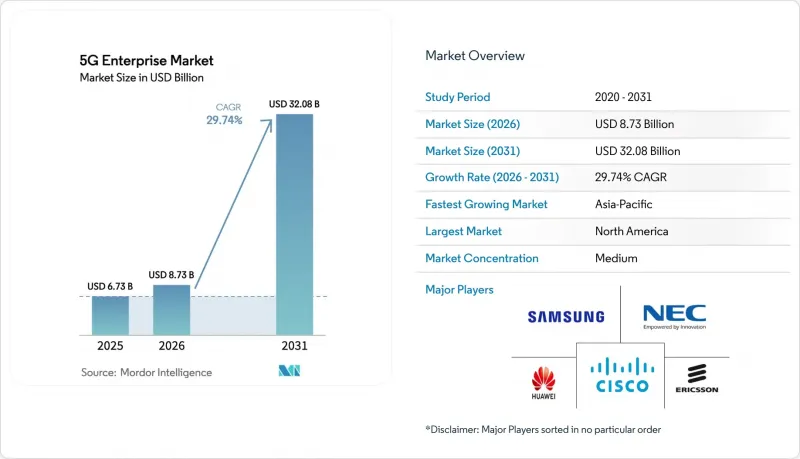
5G 기업 시장 규모는 2025년에 67억 3,000만 달러로 평가되었고 2026년 87억 3,000만 달러에서 2031년까지 320억 8,000만 달러에 이를 것으로 예측되며, 예측 기간(2026-2031년) CAGR은 29.74%를 나타낼 전망입니다.
본 보고서는 통신 인프라의 유형(5G 무선 액세스 네트워크(RAN), 5G 코어 네트워크 등), 도입 형태(프라이빗 5G 네트워크, 퍼블릭 5G 네트워크 등), 주파수 대역의 라이선싱 형태(라이선스 주파수 대역, 비라이선스/공유 주파수 대역, 혼합 라이선싱),기업 업종(IT 및 통신, BFSI 등), 그리고 지역별로 분류되어 있습니다. 시장 예측은 금액(달러) 기준으로 제시되어 있습니다.
전 세계 5G 엔터프라이즈 시장 동향 및 인사이트
비면허/공유 주파수 대역의 개방이 기업의 접속 환경을 일변화시킬 것
규제 당국에 의한 중파 대역 주파수의 개방으로, 과거 주파수 사용료를 꺼리던 기업들에게도 프라이빗 5G 구현이 가능해졌습니다. 미국에서는 시민 대역 무선 서비스(CBRS)가 이미 25만 대 이상의 산업용 기기 활성화를 지원하고 있으며, 유럽의 3.8-4.2GHz 대역에서도 유사한 체계가 추진되고 있습니다. 지멘스는 규제 조화가 진행됨에 따라 2025년 중 도입이 시범 단계에서 본격적인 전개로 전환될 것으로 예측했습니다. 유연성 향상으로 인해 공장, 물류 허브, 에너지 시설에서는 통신 구역을 맞춤 설정할 수 있게 되어 가동 시간과 보안이 향상됩니다. 또한, 공유 스펙트럼은 무선 장비, 엣지 코어, 관리 도구를 턴키 키트로 패키지화하는 ‘네트워크 인 어 박스(Network-in-a-Box)’ 벤더 생태계의 성장도 촉진하고 있습니다. 이러한 시너지 효과로 인해 5G 엔터프라이즈 시장에 진입할 잠재 고객층이 확대되고, 공급업체의 수익화까지 소요되는 기간이 단축됩니다.
엣지 컴퓨팅과 네트워크 슬라이싱이 엔터프라이즈 아키텍처를 재정의한다.
기업들은 지연 시간에 민감한 워크로드가 연결된 자산으로부터 수 미터 범위 내에 배치되도록 네트워크 재구축을 추진하고 있습니다. T-Mobile과 같은 통신 사업자들은 긴급 대응 요원을 위한 우선 슬라이스를 통해 이 개념을 입증하고 있습니다. 현재 47개의 통신 사업자 그룹이 개발자에게 슬라이스 구성 정보를 공개하는 API 표준화를 추진하여 오케스트레이션 부담을 줄이고 있습니다. 전용 슬라이스와 On-Premise 컴퓨팅 노드를 결합함으로써 제조업체는 의사결정 루프를 1밀리초 미만으로 단축할 수 있어, 동기식 로봇 제어 및 비전 검사가 가능해집니다. Wray Castle의 조사에 따르면, 네트워크 슬라이싱을 통해 전체 주파수 대역의 이용률을 40% 향상시킬 수 있다고 합니다. 이러한 이점은 운영 비용(OpEx) 절감으로 직결되며, 5G 엔터프라이즈 시장에서 프라이빗 엣지 아키텍처의 가치 제안을 강화하고 있습니다.
높은 CAPEX와 통합의 복잡성이 도입을 지연시킵니다.
스탠드얼론형 5G 코어, 멀티밴드 무선, 산업용 게이트웨이를 도입하면 중규모 브라운필드 도입에서도 수백만 달러 규모의 비용이 발생할 수 있습니다. 2024년 Kyndryl의 조사에 따르면, 많은 기업이 레거시 SCADA 및 MES 계층의 마이그레이션 계획을 수립할 때까지 프로젝트를 연기하고 있는 것으로 나타났습니다. Open RAN은 벤더의 다양성을 약속하는 한편, 『Open RAN Integration Playbook』에서도 지적된 바와 같이 새로운 상호운용성 테스트의 필요성을 야기하고 있습니다. 현금 흐름의 급증을 완화하기 위해 지출을 CAPEX에서 OPEX로 전환하는 ‘Network-as-a-Service’ 모델이 등장하고 있지만, 서비스 수준 보장에 대한 명확성은 여전히 제각각입니다. 이러한 재정적·기술적 정체로 인해 이익률이 극히 낮은 부문의 초기 성장이 억제되고 있습니다.
부문 분석
5G 무선 액세스 네트워크 부문은 엔드포인트를 연결하는 데 필수적인 역할을 수행하고 있음을 반영하여, 2025년에는 매출의 35.45%를 차지하며 최대 점유율을 기록했습니다. 이러한 기반 투자를 통해 통신 사업자와 통합 업체는 커버리지 의무의 수익화에서 선도적인 입지를 확보했습니다. 기업 내 결정론적 성능에 대한 수요가 증가함에 따라, 현재는 클라우드 네이티브 5G 코어에 관심이 집중되고 있으며, 그 연평균 성장률(CAGR)은 31.88%로 전망됩니다. 스탠드얼론 방식의 도입이 시험 단계를 벗어나면서, 5G 엔터프라이즈 시장 내 코어 솔루션의 규모는 급속히 확대될 것으로 예측됩니다. 네트워크 기능 가상화(NFV)를 통해 기업은 로우코드 정책 엔진, 통합 과금, AI 기반 보증 기능을 쉽게 도입할 수 있어 사이트당 ARPU 향상을 촉진합니다.
트랜스포트 및 백홀은 절대적인 규모는 작지만 빠르게 진화하고 있습니다. 에릭슨과 주니퍼, ECI 텔레콤간의 제휴 등은 셀 사이트와 데이터센터 간의 대용량 패킷 전송에 대한 수요를 뒷받침하고 있습니다. E-밴드 및 신흥 W-밴드 링크는 멀티 기가비트 처리량을 실현하여 고밀도 산업 단지의 광섬유를 보완합니다. 이러한 혁신을 통해 과거 원격 비전 분석을 저해하던 병목 현상이 해소됩니다. 그 결과, 코어 및 전송 부문은 긴밀하게 연계되어 5G 엔터프라이즈 시장 내 두 부문의 합산 점유율을 확대되고 있습니다.
2025년에는 사내 구축이 매출의 37.60%를 차지하며, On-Premise 제어를 선호하는 경향이 더욱 강화되었습니다. 연평균 성장률(CAGR) 35.48%의 속도로 프라이빗 구축 분야의 5G 엔터프라이즈 시장 규모는 두 배로 증가할 전망이며, 이를 주도하는 것은 결정론적 서비스 품질(QoS)을 중시하는 공장, 병원, 물류 야드입니다. 2024년 ‘Digitalization World’ 조사에 따르면, 2027년까지 전 세계 프라이빗 5G 매출은 60억 달러에 달할 것으로 예측됩니다. 반면, 퍼블릭 5G는 마이크로 지연 시간 요구 사항보다 커버리지의 폭이 우선시되는 이용 사례에 적합합니다.
하이브리드 모델도 주목을 받고 있습니다. 기업들은 기밀성이 낮은 트래픽에는 퍼블릭 슬라이스를 활용하는 한편, 로봇이나 AGV(자동 운반차)를 위해 캠퍼스 전체에 마이크로 코어를 확보하고 있습니다. 뉴트럴 호스트 솔루션을 통해 시설 소유주는 인프라 비용을 분담할 수 있으며, 멀티테넌트 방식을 통한 신속한 커버리지 구축이 가능해집니다. 이러한 접근 방식을 통해 통신 사업자는 풀스택을 재구축하지 않고도 새로운 수직 시장에 진입할 수 있으며, 5G 엔터프라이즈 시장 전반에 걸친 수익원을 확대할 수 있습니다.
지역별 분석
북미는 조기 주파수 대역 할당과 활발한 시스템 통합 생태계의 지원에 힘입어 2025년 매출 점유율 37.10%를 기록하며 지역별 최대 점유율을 차지했습니다. 미국에서는 제조업체의 76%가 사설 네트워크 구축을 계획하고 있지만, 최근의 정책 전환으로 인해 단기적인 열의는 11% 하락했습니다. 90억 달러 규모의 공공 자금 지원 제안은 5G 광대역을 농촌 지역까지 확대하는 것을 목표로 하고 있으며, 이를 통해 고객 기반이 확대될 것입니다. 캐나다는 인더스트리 4.0 테스트베드에 대한 강력한 인센티브를 제공합니다. 이러한 노력들이 결합되어, 북미의 통신망 구축 목표가 성숙해 가는 가운데 그 주도적 지위를 더욱 공고히 하고 있습니다.
아시아태평양은 2031년까지 연평균 성장률(CAGR)이 32.88%로 가장 빠른 성장세를 보이고 있습니다. 중국의 ‘5G+스마트 팩토리’ 프로그램은 처리량 향상 및 결함 감소 측면에서 정량화 가능한 성과를 보여주고 있습니다. 일본과 한국은 오랜 기간 축적된 산업 자동화 문화를 활용하여 기존의 린(Lean) 생산 방식 셀에 5G를 접목하고 있습니다. 인도의 통신 부문 인력 부족 규모는 240만 명을 넘어섰으며, 정책 입안자들은 재교육 캠페인을 통해 이 문제에 대응하고 있습니다. 인력 제약이 있음에도 불구하고 장비 가격 하락으로 인해 중견 기업의 도입이 촉진되고 있습니다.
유럽은 통신 사각지대가 있음에도 불구하고 견고한 기반을 유지하고 있습니다. 독일에서는 업계 선구자들에게 3.8-4.2GHz 대역의 주파수 라이선스를 직접 경매를 통해 매각함으로써 캠퍼스 네트워크 시범 사업이 확대되었습니다. EU 전역의 표준 통합으로 장비 인증 절차가 간소화되었으나, 총 설비 투자액은 7년 만에 감소하여 579억 유로를 기록했습니다. 오픈 RAN 및 엣지 클라우드 프로젝트가 신규 진출기업을 유치하며 경쟁의 다양화를 촉진하고 있습니다. GSMA는 2030년까지 5G가 유럽 GDP에 1,600억 유로 이상 기여할 것으로 예측했습니다. 이러한 수치는 비록 고르지 않지만 꾸준한 진전을 뒷받침하고 있습니다.
중동 및 아프리카에서는 사우디아라비아의 새로운 주파수 대역 경매를 필두로 모멘텀이 강화되고 있으며, 이는 노키아의 2024년 4분기 벤더 매출을 9% 끌어올렸습니다. 라틴아메리카는 여전히 도입 초기 단계에 있지만, 광업 및 농업용 위성을 활용한 5G 커버리지의 혜택을 누리고 있습니다. 전반적으로 전 세계 수요의 다양화로 인해 5G 기업 시장은 광범위한 확장을 위한 기반을 다지고 있습니다.
기타 혜택:
- 엑셀 형식 시장 예측(ME) 시트
- 3개월간의 애널리스트 지원
자주 묻는 질문
목차
제1장 서론
제2장 조사 방법
제3장 주요 요약
제4장 시장 구도
제5장 시장 규모와 성장 예측
제6장 경쟁 구도
제7장 시장 기회와 향후 전망
JHS 26.09.09According to Mordor Intelligence, the 5G enterprise market size was valued at USD 6.73 billion in 2025 and estimated to grow from USD 8.73 billion in 2026 to reach USD 32.08 billion by 2031, at a CAGR of 29.74% during the forecast period (2026-2031).
This report is Segmented by Communication Infrastructure Type (5G Radio Access Networks [RAN], 5G Core Networks, and More), Deployment Mode (Private 5G Networks, Public 5G Networks, and More), Spectrum Licensing Type (Licensed Spectrum, Unlicensed/Shared, and Mixed Licensing), Enterprise Vertical (IT and Telecommunication, BFSI, and More), and Geography. The Market Forecasts are Provided in Terms of Value (USD).
Global 5G Enterprise Market Trends and Insights
Release of Unlicensed/Shared Spectrum Transforms Enterprise Access
Regulators opening mid-band frequencies have made private 5G viable for firms that once shied away from spectrum fees. In the United States, the Citizens Band Radio Service has already supported more than 250,000 industrial device activations, encouraging similar frameworks in Europe's 3.8-4.2 GHz band. Siemens anticipates deployments moving from pilots to scale during 2025 as harmonization progresses. Greater flexibility allows factories, logistics hubs, and energy sites to customize coverage footprints, improving uptime and security. Shared spectrum also stimulates a growing ecosystem of network-in-a-box vendors that package radios, edge cores, and management tools as turnkey kits. The cumulative effect is a wider funnel of prospects entering the 5G enterprise market, accelerating time to revenue for suppliers.
Edge Computing and Network Slicing Redefine Enterprise Architectures
Enterprises are refactoring networks so that latency-sensitive workloads sit within meters of connected assets. Operators such as T-Mobile illustrate the concept through priority slices for first responders. Forty-seven operator groups are now standardizing APIs that expose slice configuration to developers, lowering orchestration effort. Combining dedicated slices with on-premises compute nodes helps manufacturers push decision loops below 1 ms, enabling synchronous robotics and vision inspection. A Wray Castle study indicates network slicing can boost overall spectrum utilisation by 40%. These gains feed directly into OpEx savings, reinforcing the value proposition of private-edge architecture inside the 5G enterprise market.
High CAPEX and Integration Complexity Slow Adoption
Standalone 5G cores, multi-band radios, and industrial gateways can push a mid-sized brown-field deployment into multi-million-dollar territory. A 2024 Kyndryl survey showed many firms deferring projects until they blueprint migration paths for legacy SCADA and MES layers. Open RAN promises vendor diversity yet introduces fresh interoperability testing, as flagged by the Open RAN Integration Playbook. Network-as-a-Service models are emerging to smooth cash-flow peaks by shifting spend from capex to OpEx, but clarity around service-level commitments still varies. This financial and technical inertia trims early growth in segments with razor-thin margins.
Other drivers and restraints analyzed in the detailed report include:
- Industrial IoT Accelerates Manufacturing Transformation
- Net-Zero Mandates Drive Energy-Optimized Deployments
- Scarcity of 5G/OT Engineering Talent Creates Implementation Bottleneck
For complete list of drivers and restraints, kindly check the Table Of Contents.
Segment Analysis
The 5G Radio Access Network segment generated the largest slice of revenue in 2025 at 35.45%, reflecting its indispensable role in linking endpoints. This foundational investment gave operators and integrators a head starts in monetizing coverage obligations. Rising enterprise need for deterministic performance now shifts attention to cloud-native 5G cores, which are on course for a 31.88% CAGR. The 5G enterprise market size for core solutions is projected to expand sharply as standalone deployments move beyond trials. Network function virtualization lets firms bolt on low-code policy engines, converged charging, and AI-driven assurance, driving higher ARPU per site.
Transport and backhaul, though smaller in absolute terms, are evolving rapidly. Partnerships such as Ericsson with Juniper and ECI Telecom confirm demand for high-capacity packet transport between cell sites and data centers. E-band and emerging W-band links unlock multi-gigabit throughput, complementing fibre in dense industrial parks. These innovations reduce bottlenecks that once throttled remote-vision analytics. As a result, core and transport segments are becoming tightly coupled, expanding their combined wallet share inside the 5G enterprise market.
Private deployments captured 37.60% of revenue in 2025, reinforcing the preference for on-premises control. With a 35.48% CAGR, the 5G enterprise market size for private deployments is set to multiply, led by factories, hospitals, and logistics yards that value deterministic Quality of Service. A 2024 Digitalization World survey forecasts global private-5G revenues at USD 6 billion by 2027. Contrast that with public 5G, which suits use cases where coverage breadth outweighs micro latency needs.
Hybrid models are also standing out. Enterprises employ public slices for non-sensitive traffic while reserving a campus-wide micro-core for robotics or AGVs. Neutral-host solutions enable venue owners to share infrastructure costs, facilitating rapid multi-tenant coverage. This approach helps operators penetrate new verticals without redeploying full stacks, broadening addressable revenue streams across the 5G enterprise market.
Complete Report Scope:
- By Communication Infrastructure Type
- 5G Radio Access Networks (RAN)
- 5G Core Networks
- Transport/Backhaul Networks
- By Deployment Model
- Private 5G Networks
- Public 5G Networks
- Hybrid/Shared Networks
- By Spectrum Licensing Type
- Licensed Spectrum
- Unlicensed/Shared (e.g., CBRS, LAA)
- Mixed Licensing
- By Enterprise Vertical
- IT and Telecommunications
- BFSI
- Manufacturing - Discrete
- Manufacturing - Process
- Retail and E-commerce
- Healthcare
- Energy and Utilities
- Transportation and Logistics
- Other Verticals
- By Geography
- North America
- United States
- Canada
- Mexico
- South America
- Brazil
- Argentina
- Rest of South America
- Europe
- United Kingdom
- Germany
- France
- Italy
- Spain
- Russia
- Rest of Europe
- Asia-Pacific
- China
- India
- Japan
- South Korea
- ASEAN
- Rest of Asia-Pacific
- Middle East and Africa
- Saudi Arabia
- United Arab Emirates
- South Africa
- Nigeria
- Rest of Middle East and Africa
- North America
Geography Analysis
North America commanded the largest regional footprint at 37.10% revenue share in 2025, anchored by early spectrum releases and active systems-integration ecosystems. The United States sees 76% of manufacturers planning private networks, though a recent policy shift caused an 11% dip in short-term enthusiasm. Public funding proposals worth USD 9 billion aim to extend 5G broadband into rural zones, which will widen the customer base. Canada follows with strong incentives for Industry 4.0 testbeds. Together, these initiatives reinforce leadership even as North American coverage ambitions mature.
Asia-Pacific is the fastest climber with a 32.88% CAGR through 2031. China's 5G+ Smart Factory programs show quantifiable gains in throughput and defect reduction. Japan and South Korea exploit longstanding industrial automation cultures, layering 5G over existing lean-manufacturing cells. India's telecom-sector skills gap tops 2.4 million workers, which policy makers address via reskilling campaigns lightreading. Despite talent constraints, lower equipment prices bolster adoption among mid-tier enterprises.
Europe retains a solid foothold despite coverage gaps. Germany's auction of 3.8-4.2 GHz licenses directly to industry pioneers expanded campus network pilots. Pan-EU harmonization simplifies device certification, although total capital investment slid for the first time in seven years to EUR 57.9 billion. Open RAN and edge cloud projects attract new entrants, fueling competitive variety. GSMA expects 5G to contribute over EUR 160 billion to European GDP by 2030. These figures underscore steady, if uneven, progression.
The Middle East and Africa witness growing momentum led by Saudi Arabia's fresh spectrum auctions, driving vendor revenue up 9% in Q4 2024 for Nokia. Latin America remains in the early adoption phase but benefits from satellite-backed 5G coverage for mining and agriculture. Collectively, global demand diversity positions the 5G enterprise market for broad-based expansion.
- Cisco Systems
- Ericsson
- Huawei Technologies
- Nokia
- NEC Corporation
- Samsung Electronics
- ZTE Corporation
- Qualcomm
- Intel Corporation
- Hewlett Packard Enterprise (Aruba)
- Dell Technologies
- Juniper Networks
- Mavenir
- Rakuten Symphony
- CommScope
- ATandT
- Verizon Communications
- Deutsche Telekom AG
- Siemens AG
- Fujitsu
Additional Benefits:
- The market estimate (ME) sheet in Excel format
- 3 months of analyst support
TABLE OF CONTENTS
1 INTRODUCTION
- 1.1 Study Assumptions and Market Definition
- 1.2 Scope of the Study
2 RESEARCH METHODOLOGY
3 EXECUTIVE SUMMARY
4 MARKET LANDSCAPE
- 4.1 Market Overview
- 4.2 Market Drivers
- 4.2.1 Release of unlicensed/shared spectrum for industrial sites
- 4.2.2 Edge computing and network-slicing enable ultra-low-latency apps
- 4.2.3 Industrial-IoT boom in smart manufacturing plants
- 4.2.4 Net-zero mandates drive real-time energy-optimised private 5G
- 4.2.5 Convergence of 5G and TSN for deterministic control in brown-fields
- 4.2.6 5G non-terrestrial networks extend seamless enterprise coverage
- 4.3 Market Restraints
- 4.3.1 High CAPEX and integration complexity
- 4.3.2 Scarcity of 5G/OT engineering talent
- 4.3.3 Fragmented device-certification ecosystem
- 4.3.4 Local-spectrum rules hinder multi-national roll-outs
- 4.4 Value/Supply-Chain Analysis
- 4.5 Regulatory Landscape
- 4.6 Technological Outlook
- 4.7 MEC and 5G Technical Standards Analysis
- 4.8 Porter's Five Forces Analysis
- 4.8.1 Threat of New Entrants
- 4.8.2 Bargaining Power of Buyers
- 4.8.3 Bargaining Power of Suppliers
- 4.8.4 Threat of Substitutes
- 4.8.5 Competitive Rivalry
5 MARKET SIZE AND GROWTH FORECASTS (VALUE)
- 5.1 By Communication Infrastructure Type
- 5.1.1 5G Radio Access Networks (RAN)
- 5.1.2 5G Core Networks
- 5.1.3 Transport/Backhaul Networks
- 5.2 By Deployment Model
- 5.2.1 Private 5G Networks
- 5.2.2 Public 5G Networks
- 5.2.3 Hybrid/Shared Networks
- 5.3 By Spectrum Licensing Type
- 5.3.1 Licensed Spectrum
- 5.3.2 Unlicensed/Shared (e.g., CBRS, LAA)
- 5.3.3 Mixed Licensing
- 5.4 By Enterprise Vertical
- 5.4.1 IT and Telecommunications
- 5.4.2 BFSI
- 5.4.3 Manufacturing - Discrete
- 5.4.4 Manufacturing - Process
- 5.4.5 Retail and E-commerce
- 5.4.6 Healthcare
- 5.4.7 Energy and Utilities
- 5.4.8 Transportation and Logistics
- 5.4.9 Other Verticals
- 5.5 By Geography
- 5.5.1 North America
- 5.5.1.1 United States
- 5.5.1.2 Canada
- 5.5.1.3 Mexico
- 5.5.2 South America
- 5.5.2.1 Brazil
- 5.5.2.2 Argentina
- 5.5.2.3 Rest of South America
- 5.5.3 Europe
- 5.5.3.1 United Kingdom
- 5.5.3.2 Germany
- 5.5.3.3 France
- 5.5.3.4 Italy
- 5.5.3.5 Spain
- 5.5.3.6 Russia
- 5.5.3.7 Rest of Europe
- 5.5.4 Asia-Pacific
- 5.5.4.1 China
- 5.5.4.2 India
- 5.5.4.3 Japan
- 5.5.4.4 South Korea
- 5.5.4.5 ASEAN
- 5.5.4.6 Rest of Asia-Pacific
- 5.5.5 Middle East and Africa
- 5.5.5.1 Saudi Arabia
- 5.5.5.2 United Arab Emirates
- 5.5.5.3 South Africa
- 5.5.5.4 Nigeria
- 5.5.5.5 Rest of Middle East and Africa
- 5.5.1 North America
6 COMPETITIVE LANDSCAPE
- 6.1 Market Concentration
- 6.2 Strategic Moves
- 6.3 Market Share Analysis
- 6.4 Company Profiles {(includes Global level Overview, Market level overview, Core Segments, Financials as available, Strategic Information, Market Rank/Share, Products and Services, Recent Developments)}
- 6.4.1 Cisco Systems
- 6.4.2 Ericsson
- 6.4.3 Huawei Technologies
- 6.4.4 Nokia
- 6.4.5 NEC Corporation
- 6.4.6 Samsung Electronics
- 6.4.7 ZTE Corporation
- 6.4.8 Qualcomm
- 6.4.9 Intel Corporation
- 6.4.10 Hewlett Packard Enterprise (Aruba)
- 6.4.11 Dell Technologies
- 6.4.12 Juniper Networks
- 6.4.13 Mavenir
- 6.4.14 Rakuten Symphony
- 6.4.15 CommScope
- 6.4.16 ATandT
- 6.4.17 Verizon Communications
- 6.4.18 Deutsche Telekom AG
- 6.4.19 Siemens AG
- 6.4.20 Fujitsu
7 MARKET OPPORTUNITIES AND FUTURE OUTLOOK
- 7.1 White-space and Unmet-need Assessment