

|
시장보고서
상품코드
2123301
LTE 및 5G 방송 시장 : 점유율 분석, 업계 동향과 통계, 성장 예측(2026-2031년)LTE And 5G Broadcast - Market Share Analysis, Industry Trends & Statistics, Growth Forecasts (2026 - 2031) |
||||||
 Mordor Intelligence
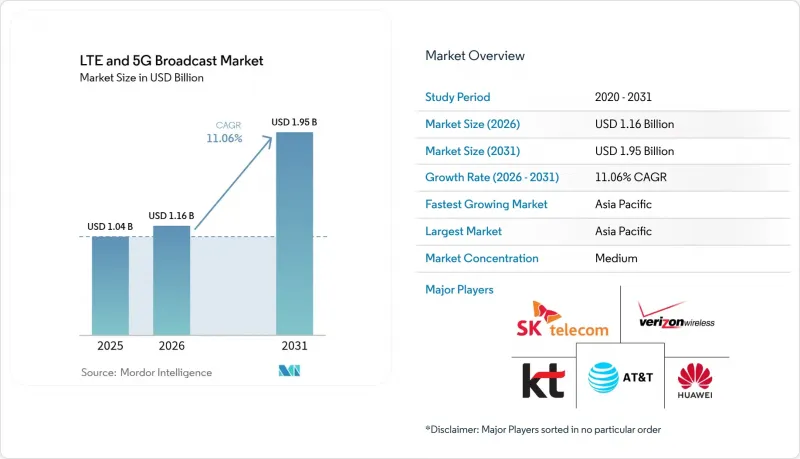
Mordor Intelligence에 의하면, 2026년 LTE 및 5G 방송 시장 규모는 11억 6,000만 달러로 추정되고 있어 2025년 10억 4,000만 달러에서 확대해, 2031년에는 19억 5,000만 달러에 이를 것으로 예측됩니다.
2026년부터 2031년까지 연평균 성장률(CAGR) 11.06%로 성장할 것으로 전망됩니다.
본 보고서는 용도(공공 안전, 커넥티드카, 광고 등),방송 기술(LTE EMBMS, 5G FeMBMS 등), 주파수 대역(Sub-6GHz(6GHz 미만), L-밴드(1-2GHz) 등), 최종 사용자(모바일 네트워크 사업자, 자동차 OEM 등), 지역별로 분류되어 있습니다.
전 세계 LTE 및 5G 방송 시장 동향과 인사이트
모바일 동영상 및 라이브 이벤트 스트리밍에 대한 수요 증가
모바일 시청자들이 4K, 360도, 증강현실(AR) 컨텐츠를 요구함에 따라, 통신 사업자들은 유니캐스트의 혼잡을 완화하기 위해 멀티캐스트로 전환하고 있습니다. Deutsche Telekom과 Ericsson은 유로 2024의 무선 카메라를 위해 25밀리초 미만의 지연 시간과 500 Mbps의 업링크를 실현하여 전문 제작 분야에서 실용성을 입증했습니다. 말레이시아는 네트워크 슬라이싱된 5G 링크를 통해 건국 기념일 퍼레이드를 스트리밍으로 중계하며, 피크 부하 시에도 안정적인 화질을 확보했습니다. 방송 사업자들은 현재 카메라 1대당 50 Mbps의 지속적인 업링크를 요구하고 있지만, 이 요건은 여러 시청자가 동일한 멀티캐스트 스트림을 공유할 때만 충족됩니다. Verizon은 자사의 프라이빗 5G 방송 제품군에 AI 기반의 관객 밀도 인식 기능을 추가하여 비트레이트를 실시간으로 미세 조정할 수 있게 했습니다.
5G 지원 기기의 보급률 급증
NTT 도코모는 5G 독립형(SA) 방식으로 6.6Gbps의 다운링크를 실증하며, 고비트레이트 방송 수신을 지원할 수 있는 단말기 준비가 완료되었음을 보여주었습니다. BMW는 방송 컨텐츠 스트리밍 및 동시 펌웨어 업데이트를 가능하게 하기 위해 2025년형 모든 차종에 5G 안테나를 탑재할 예정입니다. 중국이 하이엔드 스마트폰에 700 MHz 대역 지원을 의무화함에 따라 FeMBMS 수신이 가능한 단말기의 보급 기반이 확대되고 서비스 제공이 가속화되었습니다. 방송 전용 칩셋은 여전히 부족하지만, 자동차 인포테인먼트 공급업체들이 주도적으로 이를 탑재하고 있어 일반 소비자로의 보급을 위한 발판을 마련하고 있습니다.
방송 지원 업그레이드에 따른 고액의 설비 투자
멀티캐스트 컨트롤러 추가, 안테나 재조정, 고밀도 mm파 스몰셀 구축으로 인해 데이터 통신 전용 5G에 비해 사이트당 비용이 50% 증가할 가능성이 있습니다. 노키아는 통신 사업자들이 자금을 확보하기 위해 방송용 모듈 도입을 미루면서 2024년 장비 수주가 부진했다고 지적했습니다. 경기장에 필수적인 mm파 방송에는 Sub-6GHz 대역에 비해 1.5-2배의 기지국이 필요해 예산을 더욱 압박하게 됩니다. 일부 통신 사업자는 단계적 구축 방식을 채택하여, 피크 시간대 동영상 트래픽의 70%를 처리하는 셀의 10%에서만 브로드캐스트를 활성화하고 있으나, 이러한 전략으로 인해 전국적인 커버리지 실현까지의 기간이 길어지고 있습니다.
부문 분석
라이브 이벤트 스트리밍은 일정한 품질 수준이 보장되어야 하는 주요 스포츠 및 문화 행사 방송을 활용함으로써 2025년 매출의 27.32%를 계속 차지했습니다. 한편, 커넥티드카는 자동차 제조업체들이 수백만 대의 차량에 동시에 무선 업데이트를 배포하도록 추진하고 있어 2031년까지 연평균 성장률(CAGR) 11.93%를 기록할 전망입니다. 이는 유니캐스트 네트워크로는 확장이 어려운 과제입니다. BMW의 5G를 전면적으로 탑재한 모델 라인업과 테슬라의 공장 내 프라이빗 네트워크는 생산 분석과 차량 내 인포테인먼트 분야에서 브로드캐스트가 수행하는 이중적인 역할을 보여줍니다. LTE 및 5G 방송 시장은 원격 진단, V2X 안전 메시지, 그리고 사용자의 조작이 필요 없는 지도 데이터 업데이트를 지원합니다.
공공 안전 분야에서도 새로운 성장의 길이 열리고 있습니다. FirstNet의 업그레이드를 통해 멀티캐스트를 통한 드론 영상 및 실시간 바디캠 영상이 추가되어, 긴급 대응 요원의 상황 인식 능력이 향상되고 있습니다. 모바일 TV와 주문형 비디오(VOD)는 선거 밤과 같은 갑작스러운 트래픽 급증 상황에서 백홀 부하를 줄이기 위해 방송에 의존하고 있는 반면, 광고 네트워크는 전국적인 동영상 스트림에 지역 한정 제안을 삽입하는 위치 기반 멀티캐스트 광고를 시범적으로 도입하고 있습니다. 이러한 다양한 이용 사례가 용도 계층의 다양성을 공고히 하여, 단일 부문 장애에 대한 복원력을 유지하고 있습니다.
LTE eMBMS는 선행된 도입 실적을 바탕으로 2025년에도 LTE 및 5G 방송 시장 점유율의 60.25%를 계속 차지하고 있지만,통신 사업자들이 기존 5G 코어 네트워크에 Release 18 소프트웨어를 오버레이함에 따라, 5G FeMBMS는 연평균 13.94%의 성장률을 기록하고 있습니다. 차이나 모바일(China Mobile)의 100개 도시 서비스 개시는 FeMBMS의 확장성을 입증한 것이며, 2025년까지 커버리지를 3배로 확대하겠다는 계획은 그 적극적인 일정을 여실히 보여주고 있습니다. 통신 사업자들은 시청자 수가 일정 기준에 도달했을 때 FeMBMS가 유니캐스트와 멀티캐스트를 원활하게 전환하는 기능을 높이 평가하고 있으며, 이를 통해 1메가헤르츠 단위의 대역폭을 최적화하고 있습니다.
ATSC 3.0 하이브리드 방송은 지상파 미디어 플레이어들에게 모바일 전송 시장에 진출할 기회를 제공합니다. 2026년 월드컵까지 전국적으로 ATSC 3.0을 도입하겠다는 브라질의 로드맵과 미국에서 진행 중인 FCC의 시험은 셀룰러와 지상파 표준이 융합되고 있음을 보여줍니다. 릴리스 18의 AI 스케줄러는 셀 에지에서 패킷 손실을 줄이고 이동성을 향상시킵니다. 이러한 이점은 LTE 및 5G 구현 모두에서 누릴 수 있습니다. 디바이스 생태계가 성숙해짐에 따라, 향후 10년 동안 전환에 관한 논의는 공존에서 LTE eMBMS의 단계적 폐지 계획으로 전환될 것입니다.
지역별 분석
아시아태평양은 2025년 매출의 37.65%를 차지하며, 연평균 성장률(CAGR) 14.12%로 성장하고 있습니다. 중국, 일본, 한국의 정부 주도 5G-Advanced 구축에는 도입 초기부터 멀티캐스트 기능이 포함되어 있습니다. 차이나 모바일(China Mobile)은 100개 도시를 커버하고 있으며, 2025년에는 300개 도시로 확대할 예정입니다. 이 플랫폼을 통해 UHD 스트리밍, 산업용 IoT 및 대규모 경보 전송 서비스를 제공합니다. 일본의 통신 사업자들은 2024년에 기지국을 20% 증설하며, 인구 밀집 도시 지역에서의 방송을 위해 미드밴드와 밀리파를 결합하고 있습니다. 한국에서는 소비자 대상 서비스에 더해, 공장용 프라이빗 5G 도입을 지원하고 있으며, 제조 및 물류 분야에서의 방송 기술 채택을 가속화하고 있습니다.
북미는 2위를 차지하고 있으며, FirstNet Authority의 80억 달러 규모의 10개년 계획이 원동력이 되고 있습니다. 이 계획에는 방송 중심의 5G 기능 강화에 투입될 63억 달러가 포함되어 있습니다. 주요 자동차 업체(Ford, GM, Tesla)는 공장 내 로봇을 동기화하고 야간에 차량에 소프트웨어를 배포하기 위해 프라이빗 5G를 도입하고 있습니다. 디바이스 생태계는 성숙해졌으나, 설비 투자(CapEx) 억제로 인해 전국 규모의 방송 기능 급속한 업그레이드는 제한되고 있습니다.
유럽에서는 규제 조화가 진행되고 있습니다. 유럽방송연합(EBU)이 주도하는 5G와 위성을 결합한 하이브리드 방식의 시범 사업은 EU 그린딜의 에너지 목표를 준수하면서 지방 지역의 통신 커버리지 격차를 해소하고 있습니다. 독일은 자동차 분야의 방송 통합을 주도하고 있으며, BMW의 5G 연결 계획은 조립 라인과 판매 후 업데이트를 모두 포괄하고 있습니다. 중동 및 아프리카, 남미와 같은 소규모 지역에서는 5G의 전반적인 도입 일정과 유사한 경향이 관찰됩니다. 주파수 경매가 조기에 종료된 지역에서는 규모는 소규모이긴 하지만, 18개월 이내에 방송 시범 운영이 시작되고 있습니다.
기타 혜택:
- 엑셀 형식 시장 예측(ME) 시트
- 3개월간의 애널리스트 지원
자주 묻는 질문
목차
제1장 서론
제2장 조사 방법
제3장 주요 요약
제4장 시장 구도
제5장 시장 규모와 성장 예측
제6장 경쟁 구도
제7장 시장 기회와 향후 전망
JHS 26.09.09According to Mordor Intelligence, LTE and 5G broadcast market size in 2026 is estimated at USD 1.16 billion, growing from 2025 value of USD 1.04 billion with 2031 projections showing USD 1.95 billion, growing at 11.06% CAGR over 2026-2031.
This report is Segmented by Application (Public Safety, Connected Vehicles, Advertising, and More), Broadcast Technology (LTE EMBMS, 5G FeMBMS, and More), Frequency Band (Sub-6 GHz (less Than 6 GHz), L-Band (1-2 GHz), and More), End User (Mobile Network Operators, Automotive OEMs, and More), and Geography.
Global LTE And 5G Broadcast Market Trends and Insights
Rising demand for mobile video and live event streaming
Operators pivot to multicast to curb unicast congestion as mobile viewers demand 4K, 360-degree, and augmented-reality feeds. Deutsche Telekom and Ericsson delivered sub-25 ms latency and 500 Mbps uplinks for Euro 2024 wireless cameras, proving viability for professional production. Malaysia streamed its National Day parade over a network-sliced 5G link, ensuring stable quality even at peak load. Broadcasters now request 50 Mbps sustained uplink per camera, a requirement met only when several viewers share the same multicast flow. Verizon has added AI-based audience-density recognition inside its private 5G broadcast suite to fine-tune bitrate in real time.
Surge in 5G-enabled device penetration
NTT Docomo demonstrated 6.6 Gbps downlink on 5G Stand-Alone, signaling handset readiness for high-bitrate broadcast reception. BMW equips all 2025 models with 5G antennas to stream broadcast content and push simultaneous firmware updates. China's mandate that premium phones support 700 MHz expanded the installed base capable of FeMBMS reception, accelerating service availability. While broadcast-specific chipsets remain scarce, automotive infotainment suppliers are integrating them first, creating a beachhead for wider consumer adoption.
High CapEx for broadcast-capable upgrades
Adding multicast controllers, re-tuning antennas, and deploying dense mmWave small cells can raise per-site cost by 50% versus data-only 5G. Nokia noted weaker equipment orders in 2024 as operators deferred broadcast modules to preserve cash. mmWave broadcast, essential for stadiums, needs 1.5-2X more base stations than Sub-6 GHz, further stretching budgets. Some carriers adopt phased rollouts, enabling broadcast only on 10% of cells that carry 70% of peak video traffic, yet this tactic elongates nationwide coverage timelines.
Other drivers and restraints analyzed in the detailed report include:
- Spectrum-efficiency gains via 5G FeMBMS multicast
- Emergency-alert modernization mandates
- Limited chipset/device support for FeMBMS
For complete list of drivers and restraints, kindly check the Table Of Contents.
Segment Analysis
Live Event Streaming retained 27.32% of 2025 revenue by exploiting marquee sports and cultural broadcasts that demand guaranteed quality levels. Still, Connected Vehicles will post a 11.93% CAGR through 2031 as automotive OEMs push over-the-air updates to millions of cars simultaneously, a task unicast networks struggle to scale. BMW's fully 5G-equipped model line and Tesla's factory private networks show broadcast's dual role in production analytics and in-vehicle infotainment. The LTE and 5G broadcast market underpins remote diagnostics, V2X safety messages, and map data refresh without user intervention.
A second growth lane appears in public safety. FirstNet's upgrade adds multicast drone imagery and real-time body-camera feeds that improve situational awareness for first responders. Mobile TV and video on demand rely on broadcast to reduce backhaul in flash-crowd situations like election nights, while advertising networks test location-based multicast spots that insert local offers into a national video stream. These varied use cases cement application-layer diversity and maintain resilience against single-segment downturns.
LTE eMBMS still commands 60.25% of the LTE and 5G broadcast market share in 2025 on the strength of earlier deployments, yet 5G FeMBMS grows 13.94% annually as operators overlay Release 18 software onto existing 5G cores. China Mobile's 100-city launch validated FeMBMS scalability, and plans to triple coverage by 2025 illustrate aggressive timelines. Operators appreciate FeMBMS's seamless switch between unicast and multicast when audience thresholds are met, thereby optimizing every megahertz.
ATSC 3.0 hybrid broadcast gives terrestrial media companies an entry point to mobile distribution. Brazil's roadmap to nationwide ATSC 3.0 by the 2026 World Cup and ongoing FCC trials in the United States demonstrate convergent cellular-terrestrial standards. Release 18's AI schedulers cut cell-edge packet loss and boost mobility, benefits that accrue across both LTE and 5G implementations. As device ecosystems mature, the transition narrative will shift from coexistence to sunset planning for LTE eMBMS in the next decade.
Complete Report Scope:
- By Application
- Public Safety
- Connected Vehicles
- Live Event Streaming
- Mobile TV Streaming
- Advertising
- Content/Data Delivery
- Video on Demand
- By Broadcast Technology
- LTE eMBMS
- 5G FeMBMS
- ATSC 3.0 Hybrid Broadcast
- By Frequency Band
- Sub-6 GHz (<6 GHz)
- L-Band (1-2 GHz)
- mmWave (>24 GHz)
- By End User
- Mobile Network Operators
- Media and Entertainment Firms
- Automotive OEMs
- Public Safety Agencies
- Others
- By Geography
- North America
- United States
- Canada
- South America
- Brazil
- Rest of South America
- Europe
- Germany
- United Kingdom
- France
- Rest of Europe
- Asia Pacific
- China
- Japan
- South Korea
- India
- Rest of Asia Pacific
- Middle East and Africa
- United Arab Emirates
- Saudi Arabia
- South Africa
- Rest of Middle East and Africa
- North America
Geography Analysis
Asia Pacific commands 37.65% of 2025 revenue and grows at 14.12% CAGR. Government-backed 5G-Advanced rollouts in China, Japan, and South Korea embed multicast from day one. China Mobile's coverage of 100 cities, expanding to 300 in 2025, serves UHD streaming, industrial IoT, and mass alerts on the same platform. Japanese operators added 20% more base stations in 2024, pairing mid-band with mmWave for broadcast in dense metros. South Korea complements consumer focus with private 5G grants for factories, accelerating broadcast adoption in manufacturing and logistics.
North America ranks second, propelled by the FirstNet Authority's USD 8 billion ten-year plan, including USD 6.3 billion earmarked for broadcast-centric 5G enhancements. Automotive majors-Ford, GM, Tesla-install private 5G to synchronize plant robots and push software to vehicles overnight. The device ecosystem is mature, yet CapEx discipline tempers rapid nationwide broadcast upgrades.
Europe advances on regulatory harmonization. The European Broadcasting Union's hybrid 5G/satellite pilot reduces rural coverage gaps while complying with EU Green Deal energy targets. Germany leads automotive broadcast integration; BMW's 5G connectivity plan covers both assembly lines and post-sale updates. Smaller regions-Middle East, Africa, South America-mirror overall 5G timelines; where spectrum auctions conclude early, broadcast trials begin within 18 months, albeit at modest scale.
- Huawei Technologies Co. Ltd.
- ZTE Corporation
- Ericsson AB
- Nokia Corp.
- Qualcomm Technologies Inc.
- Samsung Electronics Co. Ltd.
- KT Corporation
- Verizon Communications Inc.
- AT&T Inc.
- China Unicom (HK) Ltd.
- SK Telecom Co. Ltd.
- KDDI Corporation
- Telstra Corp. Ltd.
- Reliance Jio Infocomm Ltd.
- Rohde and Schwarz GmbH
- Enensys Technologies SA
- Harmonic Inc.
- Ateme SA
- MediaTek Inc.
- Rohde & Schwarz GmbH & Co KG
Additional Benefits:
- The market estimate (ME) sheet in Excel format
- 3 months of analyst support
TABLE OF CONTENTS
1 INTRODUCTION
- 1.1 Study Assumptions and Market Definition
- 1.2 Scope of the Study
2 RESEARCH METHODOLOGY
3 EXECUTIVE SUMMARY
4 MARKET LANDSCAPE
- 4.1 Market Overview
- 4.2 Market Drivers
- 4.2.1 Rising demand for mobile video and live event streaming
- 4.2.2 Surge in 5G-enabled device penetration
- 4.2.3 Spectrum-efficiency gains via 5G FeMBMS multicast
- 4.2.4 Emergency-alert modernization mandates (3GPP Rel-17+)
- 4.2.5 Automotive OTA updates leveraging broadcast channels
- 4.2.6 Hybrid satellite-to-mobile (NTN) convergence
- 4.3 Market Restraints
- 4.3.1 High CapEx for broadcast-capable upgrades
- 4.3.2 Fragmented spectrum and regulatory uncertainty
- 4.3.3 Limited chipset/device support for FeMBMS
- 4.3.4 Edge-caching and Wi-Fi offload diluting ROI
- 4.4 Value Chain Analysis
- 4.5 Regulatory Landscape
- 4.6 Technological Outlook
- 4.7 Porter's Five Forces Analysis
- 4.7.1 Threat of New Entrants
- 4.7.2 Bargaining Power of Buyers
- 4.7.3 Bargaining Power of Suppliers
- 4.7.4 Threat of Substitutes
- 4.7.5 Competitive Rivalry
- 4.8 Investment and Funding Trends
5 MARKET SIZE AND GROWTH FORECASTS (VALUE)
- 5.1 By Application
- 5.1.1 Public Safety
- 5.1.2 Connected Vehicles
- 5.1.3 Live Event Streaming
- 5.1.4 Mobile TV Streaming
- 5.1.5 Advertising
- 5.1.6 Content/Data Delivery
- 5.1.7 Video on Demand
- 5.2 By Broadcast Technology
- 5.2.1 LTE eMBMS
- 5.2.2 5G FeMBMS
- 5.2.3 ATSC 3.0 Hybrid Broadcast
- 5.3 By Frequency Band
- 5.3.1 Sub-6 GHz (<6 GHz)
- 5.3.2 L-Band (1-2 GHz)
- 5.3.3 mmWave (>24 GHz)
- 5.4 By End User
- 5.4.1 Mobile Network Operators
- 5.4.2 Media and Entertainment Firms
- 5.4.3 Automotive OEMs
- 5.4.4 Public Safety Agencies
- 5.4.5 Others
- 5.5 By Geography
- 5.5.1 North America
- 5.5.1.1 United States
- 5.5.1.2 Canada
- 5.5.2 South America
- 5.5.2.1 Brazil
- 5.5.2.2 Rest of South America
- 5.5.3 Europe
- 5.5.3.1 Germany
- 5.5.3.2 United Kingdom
- 5.5.3.3 France
- 5.5.3.4 Rest of Europe
- 5.5.4 Asia Pacific
- 5.5.4.1 China
- 5.5.4.2 Japan
- 5.5.4.3 South Korea
- 5.5.4.4 India
- 5.5.4.5 Rest of Asia Pacific
- 5.5.5 Middle East and Africa
- 5.5.5.1 United Arab Emirates
- 5.5.5.2 Saudi Arabia
- 5.5.5.3 South Africa
- 5.5.5.4 Rest of Middle East and Africa
- 5.5.1 North America
6 COMPETITIVE LANDSCAPE
- 6.1 Market Concentration
- 6.2 Strategic Moves
- 6.3 Market Share Analysis
- 6.4 Company Profiles (includes Global level Overview, Market level overview, Core Segments, Financials as available, Strategic Information, Market Rank/Share for key companies, Products and Services, and Recent Developments)
- 6.4.1 Huawei Technologies Co. Ltd.
- 6.4.2 ZTE Corporation
- 6.4.3 Ericsson AB
- 6.4.4 Nokia Corp.
- 6.4.5 Qualcomm Technologies Inc.
- 6.4.6 Samsung Electronics Co. Ltd.
- 6.4.7 KT Corporation
- 6.4.8 Verizon Communications Inc.
- 6.4.9 AT&T Inc.
- 6.4.10 China Unicom (HK) Ltd.
- 6.4.11 SK Telecom Co. Ltd.
- 6.4.12 KDDI Corporation
- 6.4.13 Telstra Corp. Ltd.
- 6.4.14 Reliance Jio Infocomm Ltd.
- 6.4.15 Rohde and Schwarz GmbH
- 6.4.16 Enensys Technologies SA
- 6.4.17 Harmonic Inc.
- 6.4.18 Ateme SA
- 6.4.19 MediaTek Inc.
- 6.4.20 Rohde & Schwarz GmbH & Co KG
7 MARKET OPPORTUNITIES AND FUTURE OUTLOOK
- 7.1 White-space and Unmet-need Assessment


