|
시장보고서
상품코드
2123303
컨테이너 보안 시장 : 점유율 분석, 업계 동향과 통계, 성장 예측(2026-2031년)Container Security - Market Share Analysis, Industry Trends & Statistics, Growth Forecasts (2026 - 2031) |
||||||
 Mordor Intelligence
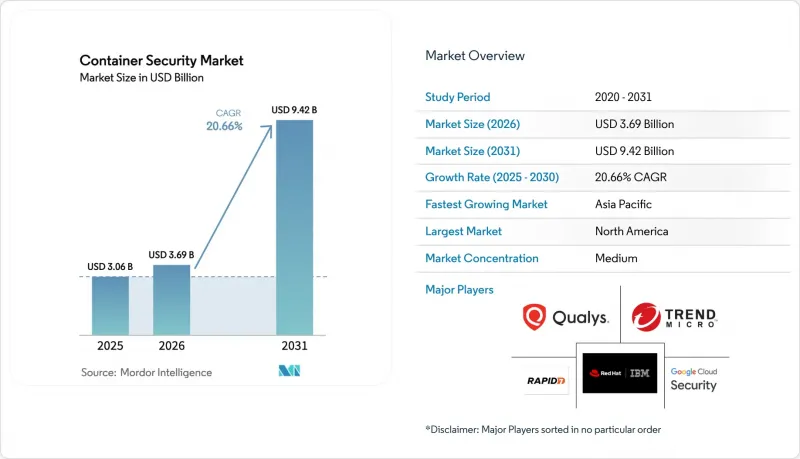
Mordor Intelligence에 의하면, 컨테이너 보안 시장 규모는 2025년에 30억 6,000만 달러로 평가되었고 예측 기간(2026-2031년)에서 CAGR 20.66%로 확대되어 2026년 36억 9,000만 달러에서 2031년에는 94억 2,000만 달러에 이를 전망입니다.
본 보고서는 구성 요소(플랫폼/소프트웨어, 서비스), 조직 규모(대기업, 중소기업), 도입 형태(클라우드, On-Premise), 보안 대책(이미지 스캔 및 취약점 관리 등), 최종 사용자 산업(IT 및 통신, BFSI 등), 지역(북미 등)별로 분류되어 있습니다. 시장 전망은 금액(달러) 기준으로 제시되어 있습니다.
세계 컨테이너 보안 시장 동향 및 인사이트
하이브리드 및 멀티 클라우드 컨테이너 워크로드 도입 확대
현재 기업의 80%가 2개 이상의 퍼블릭 클라우드에 걸쳐 워크로드를 실행하고 있으며, 이로 인해 신원 관리가 세분화되고 설정 오류 위험이 증가하고 있습니다. 보안 팀은 AWS, Azure, Google의 정책을 단일 대시보드 내에서 통합할 수 있는 Kubernetes 포지션 관리 도구를 원하고 있습니다. NIS2에서는 중요 인프라에 대한 공급망 평가가 의무화되어 있으므로, 멀티 클라우드 사용자는 컨테이너 레지스트리에 출처 추적 및 암호학적 증명 기능을 추가해야 합니다. PCI-DSS 4.0에서는 지속적인 모니터링 요건이 일시적인 컨테이너로까지 확대됨에 따라, 하이브리드 환경 전반에 걸친 실시간 가시성에 대한 수요가 증가하고 있습니다. 이에 따라 금융 기관 및 결제 처리 업체들은 통합 스캔 기능과 런타임 분석에 막대한 투자를 하고 있습니다.
마이크로서비스 및 DevSecOps 파이프라인으로의 급속한 전환
GitHub의 Advanced Security for Azure DevOps에서는 풀 리퀘스트 내 시크릿 스캔 및 종속성 검토 기능이 도입되어, 코드 커밋부터 시정 조치까지의 시간 지연이 단축되었습니다. 개발자가 차질 없이 규칙을 적용할 수 있도록, 팀은 Open Policy Agent나 어드미션 웹훅을 사용하여 정책을 코드화해야 합니다. AI 및 머신러닝 컨테이너는 전년 대비 5배 증가했으며, 공격자들이 데이터 유출을 목적으로 감지하려는 새로운 추론 API가 드러나고 있습니다. eBPF 프로브를 통한 런타임 이상 감지는 시스템 호출 동작을 기준으로 분석하여 암호화폐 채굴이나 권한 상승을 감지하지만, 오탐을 제한하기 위한 모델 조정은 여전히 어렵습니다.
DevOps 팀의 컨테이너 보안 기술 부족
세계 사이버 보안 인력 부족은 480만 명에 달하며, 쿠버네티스 전문 지식을 갖춘 인력은 더욱 희소합니다. DevOps 엔지니어는 위협 모델링 기술이 부족한 경우가 많으며, 포드에 익숙하지 않은 분석가는 감사 로그 해석에 어려움을 겪고 있습니다. 현재 관리형 쿠버네티스 서비스에는 강화된 기본 설정이 내장되어 있지만, 새로운 공격 체인에 대해서는 여전히 인간의 판단이 필수적입니다. 교육 프로그램은 분기별로 출시되는 쿠버네티스 릴리스를 따라가지 못하고 있어, 많은 기업이 모니터링 및 포렌식 작업을 외부에 위탁할 수밖에 없는 상황입니다.
부문 분석
플랫폼 및 소프트웨어 제품은 2025년 매출의 63.13%를 차지하며 컨테이너 보안 시장 규모를 주도하고 있습니다. 이미지 스캔, 접근 제어, eBPF 런타임 모니터링을 제공하는 통합 제품군이 주류를 이루고 있는 것은 구매자들이 정책 수립 및 규정 준수 보고를 위해 단일 인터페이스를 선호하기 때문입니다. 매니지드 서비스는 연평균 성장률(CAGR) 21.41%를 나타낼 것으로 예측되며, 기업들이 규칙 조정 및 연중무휴 24시간 사고 대응을 공급업체에 위탁하는 경향으로 인해 시장 전체 성장률을 상회할 것으로 전망됩니다. 전문 서비스는 마이크로서비스용 위협 모델링 및 최소 권한 정책 설계에 중점을 두고 있습니다. 이러한 아웃소싱 추세는 사내 전문 지식의 부족을 부각시키는 동시에, 서비스 제공업체를 지속적인 보안 개선을 위한 전략적 파트너로 자리매김하고 있습니다.
Aqua Security, Sysdig, Palo Alto Networks는 컨설팅을 제품 구독과 함께 제공하고 있는 반면, 클라우드 제공업체들은 프리미엄 요금제에 자문 지원을 포함하고 있습니다. 그 결과, 컨테이너 보안 시장은 순수한 소프트웨어 제공에서 플랫폼과 관리형 감지 및 대응(MDR)을 융합한 하이브리드형 제공 모델로 계속 전환되고 있습니다.
규제 대상 산업에서는 프리미엄 솔루션이 필요한 수백 개의 클러스터가 운영되고 있기 때문에 2025년 지출의 71.28%를 대기업이 차지하고 있습니다. 이러한 구매자들은 컨테이너 텔레메트리 데이터를 SIEM 및 SOAR와 통합하여 시정 조치를 신속하게 수행하고 있습니다. 대조적으로, 중소기업은 매니지드 쿠버네티스에 포함된 경량 스캐너나 클라우드 네이티브 정책을 선호합니다. 클라우드 공급자가 기본 보호 기능을 통합함으로써 기능 격차가 해소되고 진입 장벽이 낮아지기 때문에 이 부문은 연평균 성장률(CAGR) 22.93%를 달성할 것으로 예측됩니다.
중소기업은 Wiz와 같은 벤더가 제공하는 에이전트리스 스캔을 활용하여 전담 인력을 배치하지 않고도 CI 파이프라인에 보안 기능을 직접 통합하고 있습니다. Falco와 같은 커뮤니티 프로젝트는 스타트업 기업에 라이선스 비용 없이 기본적인 런타임 방어 기능을 제공하여, 제한된 예산을 성장에 투자할 수 있도록 하고 있습니다. 기능의 대중화로 인해 컨테이너 보안 업계의 고객 기반이 확대되고 있으며, 수익원도 대기업 고객에만 의존하지 않는 다양한 구조로 변화하고 있습니다.
지역별 분석
북미는 기업이 DevSecOps의 모든 단계에서 컨테이너 보안 시장의 통제 조치를 도입하도록 의무화하는 엄격한 HIPAA, PCI-DSS 및 SOC 2 규정 덕분에 2025년 매출의 42.42%를 차지했습니다. 미국의 하이퍼스케일러는 네이티브 기능을 번들로 제공하여 도입을 가속화하고 있는 반면, 캐나다의 은행들은 OSFI의 사이버 보안 지침을 충족하기 위해 포지션 관리를 도입하고 있습니다. 멕시코의 제조업체들은 니어쇼어링의 진전을 배경으로 컨테이너화된 용도를 도입하고, 공급망을 보호하기 위해 보안 스캔을 채택하고 있습니다.
아시아태평양은 2031년까지 연평균 22.64%의 성장이 예상됩니다. 중국의 주권 클라우드 지침은 국내 스택을 의무화하고 있으며, 이는 쿠버네티스 설정을 국가 표준에 부합하도록 하는 로컬 보안 플랫폼에 대한 수요를 견인하고 있습니다. 인도의 디지털 공공 인프라에서는 시민을 위한 서비스가 컨테이너화되고 있으며, 그 규모가 확대됨에 따라 런타임 가시화의 자동화가 필수적입니다. 일본의 공장 및 한국의 통신 사업자들은 IoT 및 5G를 위해 엣지 쿠버네티스를 채택하고 있으며, 지연 시간에 민감한 트래픽을 보호하기 위해 경량 eBPF 텔레메트리에 의존하고 있습니다. 호주 규제 당국은 On-Cloud험에 관한 지침을 발표하고, 각 은행에 쿠버네티스 포지션 관리 도입을 촉구하고 있습니다.
유럽에서는 2024년 10월에 발효된 NIS2의 혜택을 받고 있으며, 이 규제로 인해 27개국 모든 관리형 서비스 제공업체에 대한 요구 사항이 확대되었습니다. 독일의 BaFin 규정과 영국의 운영 복원력 프레임워크는 컨테이너에도 적용되어 플랫폼 투자를 촉진하고 있습니다. 프랑스의 의료 데이터 규제에서는 컨테이너가 환자 기록에 접근하기 전에 암호학적 인증을 수행해야 합니다. 남유럽에서는 통신 사업자들이 처리량에 맞추어 최적화된 런타임 보호 기능을 갖춘 컨테이너화된 5G를 구축하고 있어 시장이 활기를 띠고 있습니다.
중동에서는 사우디아라비아의 ‘비전 2030’과 UAE의 디지털화 방침을 배경으로 움직임이 가속화되고 있으며, 정부 및 공공기관이 강력한 보안이 필요한 클라우드 네이티브 플랫폼으로의 전환을 추진하고 있습니다. 튀르키예의 금융 규제 당국은 컨테이너 보안 도입을 촉진하는 클라우드 프레임워크를 수립하고 있습니다. 아프리카는 여전히 초기 단계에 있습니다. 남아프리카공화국의 은행은 런타임 분석을 시범 도입하고, 나이지리아의 핀테크 기업은 에이전트리스 스캐너를 활용하며, 이집트는 서비스의 디지털화를 추진하고 있지만, 기술 인력 부족으로 인해 성장세가 주춤하고 있습니다. 남미에서는 브라질 은행들이 결제 업무에 쿠버네티스를 도입함에 따라 시장이 확대되고 있지만, 통화 변동성으로 인해 대규모 초기 투자는 자제되고 있습니다.
기타 혜택:
- 엑셀 형식 시장 예측(ME) 시트
- 3개월간의 애널리스트 지원
자주 묻는 질문
목차
제1장 서론
제2장 조사 방법
제3장 주요 요약
제4장 시장 구도
제5장 시장 규모와 성장 예측
제6장 경쟁 구도
제7장 시장 기회와 향후 전망
JHS 26.09.09According to Mordor Intelligence, the container security market size was valued at USD 3.06 billion in 2025 and is estimated to grow from USD 3.69 billion in 2026 to reach USD 9.42 billion by 2031, at a CAGR of 20.66% during the forecast period (2026-2031).
This report is Segmented by Component (Platform/Software and Services), Organization Size (Large Enterprise, and Small and Medium Enterprises), Deployment (Cloud, and On Premise), Security Control (Image Scanning and Vulnerability Management, and More), End User Industry (IT and Telecom, BFSI, and More), and Geography (North America, and More). The Market Forecasts are Provided in Terms of Value (USD).
Global Container Security Market Trends and Insights
Rising Adoption of Hybrid and Multi-Cloud Container Workloads
Eighty percent of enterprises now run workloads across two or more public clouds, which fragments identity management and multiplies misconfiguration risk. Security teams seek Kubernetes posture-management tools that normalize AWS, Azure, and Google policies inside one dashboard. NIS2 requires supply-chain assessments for critical infrastructure, so multi-cloud users must add provenance tracking and cryptographic attestation to container registries. PCI-DSS 4.0 extends continuous monitoring mandates to ephemeral containers, reinforcing demand for real-time visibility across hybrid estates. Financial institutions and payment processors therefore invest heavily in unified scanning and runtime analytics.
Rapid Shift Toward Microservices and DevSecOps Pipelines
GitHub's Advanced Security for Azure DevOps introduced secret scanning and dependency review within pull requests, shrinking the gap between code commit and remediation. Teams must codify policies using Open Policy Agent or admission webhooks so developers can consume rules without friction. AI and machine-learning containers grew fivefold year over year, exposing new inference APIs that attackers probe for data exfiltration. Runtime anomaly detection through eBPF probes baselines syscall behavior and flags cryptomining or privilege escalation, but tuning models to limit false positives remains difficult.
Shortage of Container-Security Skillsets in DevOps Teams
The global cybersecurity talent gap stands at 4.8 million, and Kubernetes expertise is even rarer. DevOps engineers often lack threat-modeling skills, and analysts unfamiliar with pods struggle to interpret audit logs. Managed Kubernetes services now embed hardened defaults, yet human judgment remains vital for novel attack chains. Training programs cannot match quarterly Kubernetes releases, forcing many enterprises to outsource monitoring and forensics.
Other drivers and restraints analyzed in the detailed report include:
- Mandatory Security Mandates (PCI-DSS 4.0, NIS2, SBOM)
- Rising Frequency of Supply-Chain Attacks on Container Images
- Operational Complexity of Multi-Cloud and Multi-Cluster Estates
For complete list of drivers and restraints, kindly check the Table Of Contents.
Segment Analysis
Platform and software offerings led the container security market size with 63.13% of 2025 revenue. Integrated suites delivering image scanning, admission control, and eBPF runtime monitoring dominate because buyers prefer a single interface for policy creation and compliance reporting. Managed services are projected to grow at a 21.41% CAGR, outpacing overall growth as enterprises hire providers to tune rules and triage incidents 24/7. Professional engagements focus on threat modeling and least-privilege policy design for microservices. This outsourcing trend highlights the shortage of in-house expertise and positions service providers as strategic partners in continuous security improvement.
Aqua Security, Sysdig, and Palo Alto Networks bundle consulting with product subscriptions, while cloud providers wrap advisory support into premium tiers. As a result, the container security market continues shifting from pure-play software toward hybrid delivery models that blend platforms with managed detection and response.
Large enterprises represented 71.28% of 2025 spending because regulated verticals maintain hundreds of clusters that require premium solutions. These buyers integrate container telemetry with SIEM and SOAR to speed remediation. Small and medium enterprises, in contrast, favor lightweight scanners and cloud-native policies that ship with managed Kubernetes. The segment is expected to deliver a 22.93% CAGR as cloud providers embed default protection, closing capability gaps and lowering barriers to entry.
SMEs tap agentless scanning from vendors like Wiz, anchoring security directly in CI pipelines without dedicated staff. Community projects such as Falco give startups baseline runtime defense at zero licensing cost, letting scarce budgets fund growth. The democratization of functionality broadens the container security industry customer base and diversifies revenue away from only large buyers.
Complete Report Scope:
- By Component
- Platform / Software
- Services
- By Organisation Size
- Large Enterprises
- Small and Medium Enterprises
- By Security Control
- Image Scanning and Vulnerability Management
- Runtime Protection and Anomaly Detection
- Compliance and Configuration Management
- By Deployment
- Cloud-Based
- On-Premise
- By End-User Industry
- IT and Telecom
- BFSI
- Retail and e-Commerce
- Healthcare and Life Sciences
- Industrial and Manufacturing
- Other End-User Industries
- By Geography
- North America
- United States
- Canada
- Mexico
- South America
- Brazil
- Argentina
- Rest of South America
- Europe
- Germany
- United Kingdom
- France
- Italy
- Spain
- Rest of Europe
- Asia Pacific
- China
- Japan
- India
- South Korea
- Australia
- Rest of Asia Pacific
- Middle East
- Saudi Arabia
- United Arab Emirates
- Turkey
- Rest of Middle East
- Africa
- South Africa
- Nigeria
- Egypt
- Rest of Africa
- North America
Geography Analysis
North America delivered 42.42% of 2025 revenue thanks to stringent HIPAA, PCI-DSS, and SOC 2 rules that force enterprises to deploy container security market controls in every DevSecOps stage. U.S. hyperscalers accelerate adoption by bundling native features, while Canada's banks implement posture management to satisfy OSFI cyber guidelines. Mexico's manufacturers, bolstered by nearshoring, deploy containerized apps and adopt security scanning to protect supply chains.
Asia-Pacific is forecast to grow at 22.64% through 2031. China's sovereign-cloud directives require domestic stacks, driving demand for local security platforms that map Kubernetes settings to national standards. India's digital public infrastructure containerizes citizen services, introducing scale that mandates automated runtime visibility. Japan's factories and South Korea's telecoms use edge Kubernetes for IoT and 5G, relying on lightweight eBPF telemetry to guard latency-sensitive flows. Australia's regulators issued cloud-risk guidelines, prompting banks to adopt Kubernetes posture management.
Europe benefits from NIS2, which took effect in October 2024 and expands requirements to every managed-service provider across 27 states. Germany's BaFin rules and the UK's operational resilience framework extend to containers, driving platform investments. France's health-data regulations demand cryptographic attestation before containers touch patient records. Southern Europe experiences uplift as telcos deploy containerized 5G with runtime protection tuned for throughput.
The Middle East accelerates under Saudi Arabia's Vision 2030 and UAE digital mandates, pushing government and state entities onto cloud-native platforms that need robust security. Turkey's financial regulators craft cloud frameworks that spur container security adoption. Africa remains early stage; South African banks pilot runtime analytics, Nigerian fintechs use agentless scanners, and Egypt digitalizes services, though skills gaps slow momentum. South America grows as Brazil's banks embrace Kubernetes for payments, but currency volatility tempers large upfront commitments.
- Google LLC
- Red Hat, Inc.(IBM Corporation)
- Trend Micro Incorporated
- Qualys, Inc.
- Rapid7, Inc.
- SUSE LLC
- Mirantis, Inc.
- Thales S.A.
- Sysdig, Inc.
- Anchore, Inc.
- Palo Alto Networks, Inc.
- Tenable, Inc.
- AccuKnox, Inc.
- Tigera, Inc.
- VMware, Inc.
- Microsoft Corporation
- Capsule8, Inc.
- Fidelis Cybersecurity, Inc.
- Aqua Security Software Ltd.
- Wiz, Inc.
- Orca Security, Inc.
Additional Benefits:
- The market estimate (ME) sheet in Excel format
- 3 months of analyst support
TABLE OF CONTENTS
1 INTRODUCTION
- 1.1 Study Assumptions and Market Definition
- 1.2 Scope of the Study
2 RESEARCH METHODOLOGY
3 EXECUTIVE SUMMARY
4 MARKET LANDSCAPE
- 4.1 Market Overview
- 4.2 Market Drivers
- 4.2.1 Rising Adoption of Hybrid and Multi-Cloud Container Workloads
- 4.2.2 Rapid Shift Toward Microservices and DevSecOps Pipelines
- 4.2.3 Mandatory Security Mandates (PCI-DSS 4.0, NIS2, SBOM)
- 4.2.4 Rising Frequency of Supply-Chain Attacks on Container Images
- 4.2.5 Proliferation of Edge and 5G Container Runtimes
- 4.2.6 Hardware-Level Container Isolation Innovations
- 4.3 Market Restraints
- 4.3.1 Shortage of Container-Security Skillsets in DevOps Teams
- 4.3.2 Operational Complexity of Multi-Cloud and Multi-Cluster Estates
- 4.3.3 Alert-Fatigue and False-Positive Overload
- 4.3.4 Advanced Container-Escape Kill-Chains
- 4.4 Impact of Macroeconomic Factors on the Market
- 4.5 Industry Value Chain Analysis
- 4.6 Regulatory Landscape
- 4.7 Technological Outlook
- 4.8 Porter's Five Forces Analysis
- 4.8.1 Bargaining Power of Suppliers
- 4.8.2 Bargaining Power of Buyers
- 4.8.3 Threat of New Entrants
- 4.8.4 Threat of Substitute Products
- 4.8.5 Intensity of Competitive Rivalry
5 MARKET SIZE AND GROWTH FORECASTS (VALUE)
- 5.1 By Component
- 5.1.1 Platform / Software
- 5.1.2 Services
- 5.2 By Organisation Size
- 5.2.1 Large Enterprises
- 5.2.2 Small and Medium Enterprises
- 5.3 By Security Control
- 5.3.1 Image Scanning and Vulnerability Management
- 5.3.2 Runtime Protection and Anomaly Detection
- 5.3.3 Compliance and Configuration Management
- 5.4 By Deployment
- 5.4.1 Cloud-Based
- 5.4.2 On-Premise
- 5.5 By End-User Industry
- 5.5.1 IT and Telecom
- 5.5.2 BFSI
- 5.5.3 Retail and e-Commerce
- 5.5.4 Healthcare and Life Sciences
- 5.5.5 Industrial and Manufacturing
- 5.5.6 Other End-User Industries
- 5.6 By Geography
- 5.6.1 North America
- 5.6.1.1 United States
- 5.6.1.2 Canada
- 5.6.1.3 Mexico
- 5.6.2 South America
- 5.6.2.1 Brazil
- 5.6.2.2 Argentina
- 5.6.2.3 Rest of South America
- 5.6.3 Europe
- 5.6.3.1 Germany
- 5.6.3.2 United Kingdom
- 5.6.3.3 France
- 5.6.3.4 Italy
- 5.6.3.5 Spain
- 5.6.3.6 Rest of Europe
- 5.6.4 Asia Pacific
- 5.6.4.1 China
- 5.6.4.2 Japan
- 5.6.4.3 India
- 5.6.4.4 South Korea
- 5.6.4.5 Australia
- 5.6.4.6 Rest of Asia Pacific
- 5.6.5 Middle East
- 5.6.5.1 Saudi Arabia
- 5.6.5.2 United Arab Emirates
- 5.6.5.3 Turkey
- 5.6.5.4 Rest of Middle East
- 5.6.6 Africa
- 5.6.6.1 South Africa
- 5.6.6.2 Nigeria
- 5.6.6.3 Egypt
- 5.6.6.4 Rest of Africa
- 5.6.1 North America
6 COMPETITIVE LANDSCAPE
- 6.1 Market Concentration
- 6.2 Strategic Moves
- 6.3 Market Share Analysis
- 6.4 Company Profiles (includes Global Level Overview, Market Level Overview, Core Segments, Financials as Available, Strategic Information, Market Rank/Share for Key Companies, Products and Services, and Recent Developments)
- 6.4.1 Google LLC
- 6.4.2 Red Hat, Inc.(IBM Corporation)
- 6.4.3 Trend Micro Incorporated
- 6.4.4 Qualys, Inc.
- 6.4.5 Rapid7, Inc.
- 6.4.6 SUSE LLC
- 6.4.7 Mirantis, Inc.
- 6.4.8 Thales S.A.
- 6.4.9 Sysdig, Inc.
- 6.4.10 Anchore, Inc.
- 6.4.11 Palo Alto Networks, Inc.
- 6.4.12 Tenable, Inc.
- 6.4.13 AccuKnox, Inc.
- 6.4.14 Tigera, Inc.
- 6.4.15 VMware, Inc.
- 6.4.16 Microsoft Corporation
- 6.4.17 Capsule8, Inc.
- 6.4.18 Fidelis Cybersecurity, Inc.
- 6.4.19 Aqua Security Software Ltd.
- 6.4.20 Wiz, Inc.
- 6.4.21 Orca Security, Inc.
7 MARKET OPPORTUNITIES AND FUTURE OUTLOOK
- 7.1 White-Space and Unmet-Need Assessment