|
시장보고서
상품코드
2123313
통신 API 시장 : 점유율 분석, 업계 동향과 통계, 성장 예측(2026-2031년)Telecom API - Market Share Analysis, Industry Trends & Statistics, Growth Forecasts (2026 - 2031) |
||||||
 Mordor Intelligence
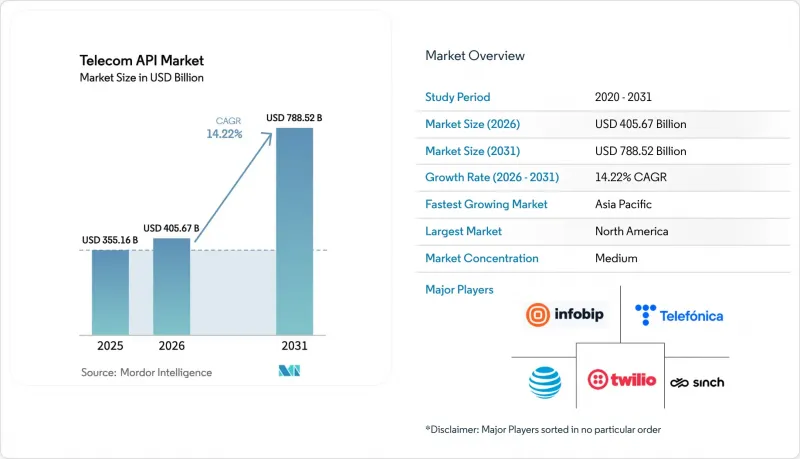
Mordor Intelligence에 의하면, 통신 API 시장 규모는 2025년 3,551억 6,000만 달러에서 2026년에는 4,056억 7,000만 달러에 이르고, CAGR 14.22%로 확대되어 2031년까지 7,885억 2,000만 달러에 이를 것으로 예측됩니다.
이는 단순한 연결 서비스에서 표준화된 애플리케이션 프로그래밍 인터페이스(API)를 통해 네트워크 기능을 수익화하는 플랫폼형 비즈니스 모델로의 구조적 전환을 여실히 보여줍니다.
본 보고서는 서비스 유형(메시징/SMS·MMS·RCS API, 음성/IVR 및 음성 제어 API 등),도입 유형(하이브리드, 멀티클라우드 등), 최종 사용자(기업 개발자, 통신사 내부 개발자 등), 비즈니스 모델(통신사와의 직접 연계, 애그리게이터 주도형 CPaaS 등), 그리고 지역별로 분류되어 있습니다. 시장 예측은 금액(달러) 기준으로 제시되어 있습니다.
세계 통신 API 시장 동향 및 인사이트
네트워크 API의 Open Gateway 및 CAMARA에 의한 표준화
72개 통신사 그룹이 GSMA Open Gateway에 참여함에 따라, 번호 검증, SIM 스왑, 단말기 위치 정보 및 온디맨드 품질 평가 API에 대한 단일 통합 카탈로그가 작성되었으며, OAuth 2.0 토큰을 통해 이용할 수 있게 되었습니다. 한때 15건에 달하는 양자 간 계약 협상을 해야만 했던 기업들도 현재는 단 한 번의 통합으로 해결할 수 있게 되어, 조달 주기가 분기 단위에서 몇 주 단위로 단축되었습니다. 영국, 브라질, 스페인, 독일에서 Vodafone 및 Telefonica의 상용 서비스 개시는 상업적 실현 가능성을 입증했을 뿐만 아니라, API 요청·응답 구문을 하이퍼스케일러의 관행에 부합하도록 조정하여 클라우드 네이티브 개발자의 인지적 부담을 줄였습니다. ETSI GS OPG 002 규정에 따라 JSON Web Token을 통한 보안과 RESTful 설계가 공식적으로 확립되어, 규제 당국이 코어 네트워크 기능을 필수적인 디지털 인프라로 취급할 수 있게 되었습니다. 그 결과, 통신 사업자는 수동적인 대역폭 도매업체에서 트랜잭션당 요금을 청구할 수 있는 능동적인 플랫폼 오케스트레이터로 전환했습니다. AWS 및 마이크로소프트와의 수익 분배를 둘러싼 분쟁은 여전히 계속되고 있지만, 표준화된 API 덕분에 전 세계적인 확장성의 주요 제약 요인은 제거되었습니다.
기업 내 CPaaS 도입 급증
Twilio, Sinch, Infobip의 2024년 총 매출액은 35억 달러를 넘어섰으며, 이는 기업들이 모놀리식 음성·SMS 번들 대신 프로그래밍 가능한 통신으로 전환하고 있음을 보여줍니다. WhatsApp Business API를 이용하는 소매업체들은 현재 고객 서비스 대응의 40%를 비동기 채널을 통해 처리하고 있으며, 콜센터 처리 시간을 18분 단축하고 건당 인건비를 12달러 절감하고 있습니다. Twilio의 Segment 통합은 고객 데이터 그래프와 프로그래밍 가능한 API를 연동하여, 결제 포기 후 90초 이내에 장바구니 포기 고객에게 접근할 수 있게 해줍니다. Infobip의 생성형 AI 봇은 자연어를 분석하여 결제 및 위치 정보 API를 자동으로 호출하므로, 전문 지식이 없는 개발자도 쉽게 활용할 수 있습니다. 개인정보 보호 규제가 강화되는 가운데, 기업들은 사후적으로 규정 준수를 처리하기보다는 API 계층에 동의 관리 및 암호화를 내장한 CPaaS 제공업체를 선호하는 추세입니다.
레거시 OSS 및 BSS 업그레이드의 병목 현상
클라우드 네이티브 API 공개에는 실시간 과금 및 정책 엔진이 필요하지만, 모놀리식 시스템의 마이그레이션에는 5,000만-2억 달러의 비용이 들고 3년에서 5년이 소요됩니다. SOAP 기반 인터페이스에서는 동적 네트워크 슬라이싱에 필요한 밀리초 단위의 이용 데이터를 전달할 수 없습니다. TM Forum Open APIs를 채택한 150개 통신 사업자 중 완전한 준수를 달성한 곳은 고작 22%에 불과합니다. 이는 수십년전의 맞춤형 코드가 리팩토링을 복잡하게 만들고 있기 때문입니다. 자본 지출(Capex)이 부족한 지역 통신사는 CPaaS 애그리게이터에 의존하고 있으며, 사실상 API를 통한 수익 창출 기회를 포기하고 있습니다. 노키아와 화웨이의 컨테이너화된 BSS 마이크로서비스를 통해 단계적인 전환이 가능하지만, 전환 기간 중 듀얼 스택 운영으로 인해 운영 비용(OpEx)이 최대 25% 증가합니다.
부문 분석
결제 API는 2026년부터 2031년까지 연평균 성장률(CAGR) 14.88%로 확대되어 전체 통신 API 시장의 성장률을 상회할 것으로 전망됩니다. 2025년, 메시징은 통신 API 시장 점유율의 37.82%를 유지했습니다. 이는 애플이 iOS 18에서 RCS를 채택하여 아이폰과 안드로이드 간 통신에서 리치 미디어 사용을 가능하게 했기 때문입니다. 음성, WebRTC, 위치 정보 서비스는 옴니채널 상거래를 보완하는 한편, 가입자 ID API는 SMS를 통한 일회용 비밀번호의 번거로움을 해소했으며, 동남아시아의 은행 시범 프로젝트에서는 신규 계좌 개설 시간을 90초로 단축했습니다.
MTN Mobile Money의 2억 개 계정과 Vodafone M-Pesa의 가맹점용 API는 카드 결제 경로를 우회함으로써 비용을 대폭 절감하고, 전자상거래의 확장이 가능함을 입증하고 있습니다. Orange Money와 Mastercard의 제휴를 통해 60초 내 송금이 가능해졌으며, 2024년 통신사 청구 방식의 수익은 80억 달러에 달했고, 신흥 지역의 디지털 컨텐츠 전환율을 30% 끌어올렸습니다. 나이지리아의 PSB나 인도의 UPI와 같은 상호 운용성 관련 규제로 인해 ISO 20022 준수가 요구되고 있으며, 통신 사업자들은 결제 시스템의 현대화를 서둘러야 하는 상황에 놓여 있습니다. IoT 연결 및 부정 감지 API는 틈새 시장을 대상으로 하고 있지만, 교차 판매의 가능성을 넓히고 있습니다.
2025년에는 통신 사업자들이 핵심 인증 기능을 On-Premise에 유지하면서 개발자용 게이트웨이를 퍼블릭 클라우드에 배치함에 따라, 하이브리드 배포가 통신 API 시장 규모의 56.82%를 차지했습니다. 한편, 쿠버네티스(Kubernetes) 기반 서비스 메시가 AWS Wavelength, Azure for Operators, Google Distributed Cloud Edge 간에 트래픽을 라우팅하고, 락인(lock-in)을 피하며 지연을 최적화함으로써 멀티클라우드는 연평균 성장률(CAGR) 15.34%로 성장할 전망입니다.
다운타임 위험도 다양화를 촉진하고 있습니다. AWS는 2024년에 14시간의 서비스 중단을 기록했습니다. Red Hat OpenShift는 멀티클라우드의 복잡성을 추상화하여 도이치 텔레콤이 며칠 만에 새로운 리전에 API를 배포할 수 있도록 지원합니다. 데이터 주권을 확보하기 위해 Gaia-X에서 영감을 받은 유럽 호스팅형 마켓플레이스가 등장했지만, 개발자들은 여전히 폭넓은 도구 선택권을 원하며 미국의 하이퍼스케일러를 선호하고 있습니다. 프라이빗 클라우드나 완전한 On-Premise 솔루션은 데이터 상주 요건에 얽매인 국방, 의료, 중요 인프라 분야에서 여전히 남아 있지만, FedRAMP 및 ISO 27001 인증 획득으로 인해 이러한 저항 세력은 점차 줄어들고 있습니다.
지역별 분석
2025년, 북미는 통신 API 시장 규모의 38.73%를 차지했습니다. Verizon ThingSpace에는 1만 5,000명의 기업 개발자가 등록되어 있으며, AT&T의 Live Video API는 42개 주에서 원격 의료 세션을 지원하고, T-Mobile은 12개 대도시권에서 5G 스탠드얼론 슬라이스를 상용화했습니다. 네트워크당 200만-500만 달러로 추정되는 FCC의 보안 요건도 API의 신뢰성을 높이고 있습니다. Rogers와 Bell은 Open Gateway에 참여했으며, America Movil은 멕시코 전역에서 통신사 결제 API의 시범 운영을 실시하여 은행 계좌가 없는 계층으로부터의 수익 창출을 도모했습니다.
아시아태평양은 2031년까지 연평균 성장률(CAGR) 15.32%를 나타낼 것으로 예측됩니다. Reliance Jio의 5G 독립형 가입자 수는 2024년 9월까지 1억 명을 돌파했으며, 이 회사의 엣지 컴퓨팅 API는 AR 소매 및 실시간 번역을 가능하게 하고 있습니다. 차이나 모바일은 5G 연결 건수가 5억 건에 달했으며, 교통 관제를 위한 네트워크 슬라이싱 API를 도입하기 위해 12억 달러 규모의 스마트 시티 계약을 체결했습니다. 인도의 TRAI는 투명한 API 요금표 도입을 의무화한 반면, 싱텔과 맥시스는 동남아시아 물류 사업자를 대상으로 위치 정보 및 QoS(서비스 품질) API를 제공했습니다. NTT 도코모와 SK 텔레콤은 소비자용 요금보다 40% 높은 가격으로 설정된 공장 자동화용 슬라이스를 통해 수익을 창출하고 있으며, Samsung Electronics가 제공하는 엣지 노드를 통해 지연 시간 12밀리초의 게임 스트리밍이 가능해졌습니다.
유럽에서는 규제와 혁신의 균형이 이루어지고 있습니다. GDPR(EU 개인정보보호규정)(일반 데이터 보호 규정)과 디지털 시장법은 각각 ‘프라이버시 바이 디자인’과 비차별적인 API 접근을 의무화하고 있어, 신뢰 체계를 표준화하는 동시에 규정 준수 부담을 가중시키고 있습니다. 도이치 텔레콤, 오렌지, 텔레포니카, 보다폰이 공동으로 운영하는 마켓플레이스는 CPaaS 애그리게이터로부터 이익률을 되찾는 것을 목표로 하고 있습니다. 보더폰 UK의 서비스 개시로 개발자들은 48시간 이내에 CAMARA API 프로비저닝이 가능해졌습니다. 중동의 통신 사업자들은 해외 거주자를 위한 송금용 결제 API를 도입하여 2024년에 40억 달러 규모의 거래를 처리했습니다. 아프리카의 MTN은 전자지갑 이용을 대폭 확대했으며, 남미의 텔레포니카 브라질은 농업 기술(AgriTech) 스타트업에 메시징 및 위치 정보 API를 제공함으로써 지역별 다각화를 두드러지게 했습니다.
기타 혜택:
- 엑셀 형식 시장 예측(ME) 시트
- 3개월간의 애널리스트 지원
자주 묻는 질문
목차
제1장 서론
제2장 조사 방법
제3장 주요 요약
제4장 시장 구도
제5장 시장 규모와 성장 예측
제6장 경쟁 구도
제7장 시장 기회와 향후 전망
JHS 26.09.07According to Mordor Intelligence, the telecom API market size reached USD 405.67 billion in 2026 from USD 355.16 billion in 2025, and is projected to register a 14.22% CAGR to touch USD 788.52 billion by 2031, underscoring a structural pivot from connectivity-only offerings toward platform business models that monetize network capabilities through standardized application programming interfaces.
This report is Segmented by Service Type (Messaging/SMS-MMS-RCS API, Voice/IVR and Voice Control API, and More), Deployment Type (Hybrid, Multi-Cloud, and More), End-User (Enterprise Developer, Internal Telecom Developer, and More), Business Model (Direct Carrier Exposure, Aggregator-Led CPaaS, and More), and Geography. The Market Forecasts are Provided in Terms of Value (USD).
Global Telecom API Market Trends and Insights
Open Gateway and CAMARA Standardization of Network APIs
The GSMA Open Gateway enrollment of 72 operator groups created a single federated catalog of number-verification, SIM-swap, device-location and quality-on-demand APIs, enforceable through OAuth 2.0 tokens. Enterprises once forced to negotiate fifteen bilateral contracts now integrate once, shrinking procurement cycles from quarters to weeks. Vodafone and Telefonica commercial launches in the United Kingdom, Brazil, Spain and Germany proved commercial feasibility and aligned API request-response syntax with hyperscaler conventions, lowering cognitive overhead for cloud-native developers. ETSI GS OPG 002 rules formalized JSON Web Token security and RESTful design, helping regulators treat core network capabilities as essential digital facilities. Operators have consequently shifted from passive bandwidth wholesalers to active platform orchestrators able to charge per-transaction fees. Although revenue-share disputes with AWS and Microsoft persist, standardized APIs have removed the primary inhibitor to global scalability.
Surge in CPaaS Adoption among Enterprises
Twilio, Sinch, and Infobip reported combined 2024 revenue above USD 3.5 billion, indicating that enterprises gravitate toward programmable communications rather than monolithic voice and SMS bundles. Retailers using WhatsApp Business API now route 40% of customer-service interactions through asynchronous channels, lowering call-center handle time by 18 minutes and labor cost by USD 12 per ticket. Twilio's Segment integration bridges customer-data graphs with programmable APIs, enabling abandoned-cart outreach within 90 seconds of checkout drop-off. Infobip's generative-AI bots parse natural language to automatically invoke payment or location APIs, thereby widening access for non-specialist developers. As privacy regulations tighten, enterprises favor CPaaS providers that embed consent management and encryption in the API layer rather than bolt-on compliance.
Legacy OSS and BSS Upgrade Bottlenecks
Cloud-native API exposure demands real-time billing and policy engines, yet migrating monolithic systems costs USD 50-200 million and takes three-to-five years. SOAP-based interfaces cannot relay per-millisecond usage data required for dynamic network-slicing. Only 22% of the 150 operators that adopted TM Forum Open APIs achieved full compliance because decades-old custom code complicates refactoring. Regional carriers lacking capex rely on CPaaS aggregators, effectively ceding API monetization. Containerized BSS microservices from Nokia and Huawei allow phased migration, yet dual-stack operations raise opex by up to 25% during transition.
Other drivers and restraints analyzed in the detailed report include:
- Monetization Pressure on 5G Driving QoS-on-Demand APIs
- Telco-Fintech Push Catalyzing Carrier-Billing and Payment APIs
- Escalating API-Security Breaches and Signaling Fraud
For complete list of drivers and restraints, kindly check the Table Of Contents.
Segment Analysis
Payment APIs are set to rise at a 14.88% CAGR from 2026-2031, outpacing the telecom API market. Messaging retained 37.82% of the telecom API market share in 2025 because Apple adopted RCS in iOS 18, enabling rich media across iPhone-Android exchanges. Voice, WebRTC, and location services complement omnichannel commerce, while subscriber identity APIs eliminate SMS one-time-password friction, cutting onboarding time to 90 seconds in Southeast Asian banking pilots.
MTN Mobile Money's 200 million accounts and Vodafone M-Pesa's merchant APIs prove that bypassing card rails can slash costs and broaden ecommerce. Orange Money-Mastercard integration accelerated 60-second remittances, and carrier billing generated USD 8 billion in 2024 revenue, lifting digital-content conversions by 30% in emerging regions. Interoperability mandates, such as Nigeria's PSB and India's UPI, require alignment with ISO 20022, pushing operators to modernize their settlement systems. IoT connectivity and fraud-detection APIs address smaller niches but add cross-sell potential.
Hybrid deployments owned 56.82% of telecom API market size in 2025 as carriers kept core authentication on-premises while placing developer gateways in public clouds. Multi-cloud, however, will expand at a 15.34% CAGR as Kubernetes-based service meshes route traffic across AWS Wavelength, Azure for Operators and Google Distributed Cloud Edge, avoiding lock-in and optimizing latency.
Downtime risk also drives diversification; AWS logged 14 hours of outages in 2024. Red Hat OpenShift abstracts multicloud complexity, letting Deutsche Telekom push APIs to new regions in days. Gaia-X inspired European-hosted marketplaces for data sovereignty, yet developers still gravitate toward U.S. hyperscalers for tooling breadth. Private-cloud and fully on-prem solutions linger in defense, health and critical-infrastructure sectors bound by residency mandates, though FedRAMP and ISO 27001 certifications shrink these holdouts.
Complete Report Scope:
- By Service Type
- Messaging / SMS-MMS-RCS API
- Voice / IVR and Voice Control API
- Payment API
- WebRTC API
- Location and Mapping API
- Subscriber ID Management and SSO API
- Other Service Types
- By Deployment Type
- Hybrid
- Multi-cloud
- Other Deployment Modes
- By End-User
- Enterprise Developer
- Internal Telecom Developer
- Partner Developer
- Long-tail Developer
- By Business Model
- Direct Carrier Exposure
- Aggregator-led CPaaS
- Platform-as-a-Service (PaaS)
- API Marketplace / Exchange
- By Geography
- North America
- United States
- Canada
- Mexico
- South America
- Brazil
- Argentina
- Rest of South America
- Europe
- Germany
- United Kingdom
- France
- Italy
- Spain
- Rest of Europe
- Asia-Pacific
- China
- Japan
- India
- South Korea
- ASEAN
- Rest of Asia-Pacific
- Middle East and Africa
- Middle East
- Saudi Arabia
- United Arab Emirates
- Rest of Middle East
- Africa
- South Africa
- Nigeria
- Rest of Africa
- Middle East
- North America
Geography Analysis
North America contributed 38.73% of telecom API market size in 2025. Verizon ThingSpace enrolled 15,000 enterprise developers, AT&T Live Video APIs underpinned telehealth sessions in 42 states and T-Mobile commercialized 5G standalone slices in 12 metropolitan areas. FCC security mandates, estimated at USD 2-5 million per network, also enhance API trustworthiness. Rogers and Bell joined Open Gateway, and America Movil piloted carrier-billing APIs across Mexico to monetize the unbanked.
Asia Pacific is forecast to post a 15.32% CAGR through 2031. Reliance Jio's 5G standalone base exceeded 100 million users by September 2024, its edge-computing APIs enable AR retail and real-time translation. China Mobile reached 500 million 5G connections and signed USD 1.2 billion in smart-city contracts to deploy network-slicing APIs for traffic control. India's TRAI mandated transparent API rate cards, while Singtel and Maxis exposed location and QoS APIs to logistics providers in Southeast Asia. NTT Docomo and SK Telecom monetize factory automation slices priced 40% above consumer rates, and Samsung-powered edge nodes enable 12-millisecond latency gaming streams.
Europe balances regulation and innovation. GDPR and the Digital Markets Act obligate privacy-by-design and nondiscriminatory API access, respectively, standardizing trust frameworks while raising compliance overhead. The Deutsche Telekom-Orange-Telefonica-Vodafone marketplace aims to recapture margin from CPaaS aggregators. Vodafone United Kingdom's launch allowed developers to provision CAMARA APIs within 48 hours. Middle East operators deploy payment APIs for expatriate remittances, processing USD 4 billion in 2024 transactions. Africa's MTN generated significant wallet activity, and South America's Telefonica Brasil exposed messaging and location APIs to agritech startups, highlighting regional diversification.
- AT&T Inc.
- Telefonica, S.A.
- Twilio Inc.
- Infobip d.o.o.
- Sinch AB
- Verizon Communications Inc.
- Orange S.A.
- Deutsche Telekom AG
- Ribbon Communications Inc.
- Huawei Technologies Co., Ltd.
- Telefonaktiebolaget LM Ericsson
- Cisco Systems, Inc.
- Google LLC
- Vodafone Group Plc
- Nokia Corporation
- Vonage Holdings Corp.
- MessageBird B.V.
- Bandwidth Inc.
- Telnyx LLC
- Syniverse Technologies LLC
- Route Mobile Limited
- Tata Communications Limited
- TeleSign Corporation
Additional Benefits:
- The market estimate (ME) sheet in Excel format
- 3 months of analyst support
TABLE OF CONTENTS
1 INTRODUCTION
- 1.1 Study Assumptions and Market Definition
- 1.2 Scope of the Study
2 RESEARCH METHODOLOGY
3 EXECUTIVE SUMMARY
4 MARKET LANDSCAPE
- 4.1 Market Overview
- 4.2 Market Drivers
- 4.2.1 Surge in CPaaS adoption among enterprises
- 4.2.2 Open Gateway and CAMARA standardization of network APIs
- 4.2.3 Monetisation pressure on 5G driving QoS-on-demand APIs
- 4.2.4 Edge-computing workloads need low-latency slicing APIs
- 4.2.5 Gen-AI-assisted developer tools lowering entry barriers
- 4.2.6 Telco-fintech push catalysing carrier-billing/payment APIs
- 4.3 Market Restraints
- 4.3.1 Escalating API-security breaches and signalling fraud
- 4.3.2 Legacy OSS/BSS upgrade bottlenecks
- 4.3.3 Margin compression from OTT CPaaS competitors
- 4.3.4 Unclear revenue-share models with hyperscalers
- 4.4 Industry Value Chain Analysis
- 4.5 Regulatory Landscape
- 4.6 Technological Outlook
- 4.7 Porter's Five Forces Analysis
- 4.7.1 Bargaining Power of Suppliers
- 4.7.2 Bargaining Power of Buyers
- 4.7.3 Threat of New Entrants
- 4.7.4 Intensity of Competitive Rivalry
- 4.7.5 Threat of Substitute Products
- 4.8 Pricing Analysis
- 4.9 API Use Cases in Telecom Industry
5 MARKET SIZE AND GROWTH FORECASTS (VALUE)
- 5.1 By Service Type
- 5.1.1 Messaging / SMS-MMS-RCS API
- 5.1.2 Voice / IVR and Voice Control API
- 5.1.3 Payment API
- 5.1.4 WebRTC API
- 5.1.5 Location and Mapping API
- 5.1.6 Subscriber ID Management and SSO API
- 5.1.7 Other Service Types
- 5.2 By Deployment Type
- 5.2.1 Hybrid
- 5.2.2 Multi-cloud
- 5.2.3 Other Deployment Modes
- 5.3 By End-User
- 5.3.1 Enterprise Developer
- 5.3.2 Internal Telecom Developer
- 5.3.3 Partner Developer
- 5.3.4 Long-tail Developer
- 5.4 By Business Model
- 5.4.1 Direct Carrier Exposure
- 5.4.2 Aggregator-led CPaaS
- 5.4.3 Platform-as-a-Service (PaaS)
- 5.4.4 API Marketplace / Exchange
- 5.5 By Geography
- 5.5.1 North America
- 5.5.1.1 United States
- 5.5.1.2 Canada
- 5.5.1.3 Mexico
- 5.5.2 South America
- 5.5.2.1 Brazil
- 5.5.2.2 Argentina
- 5.5.2.3 Rest of South America
- 5.5.3 Europe
- 5.5.3.1 Germany
- 5.5.3.2 United Kingdom
- 5.5.3.3 France
- 5.5.3.4 Italy
- 5.5.3.5 Spain
- 5.5.3.6 Rest of Europe
- 5.5.4 Asia-Pacific
- 5.5.4.1 China
- 5.5.4.2 Japan
- 5.5.4.3 India
- 5.5.4.4 South Korea
- 5.5.4.5 ASEAN
- 5.5.4.6 Rest of Asia-Pacific
- 5.5.5 Middle East and Africa
- 5.5.5.1 Middle East
- 5.5.5.1.1 Saudi Arabia
- 5.5.5.1.2 United Arab Emirates
- 5.5.5.1.3 Rest of Middle East
- 5.5.5.2 Africa
- 5.5.5.2.1 South Africa
- 5.5.5.2.2 Nigeria
- 5.5.5.2.3 Rest of Africa
- 5.5.5.1 Middle East
- 5.5.1 North America
6 COMPETITIVE LANDSCAPE
- 6.1 Market Concentration
- 6.2 Strategic Moves
- 6.3 Market Share Analysis
- 6.4 Vendor Capability Matrix
- 6.5 Key Case Studies of Major Vendors
- 6.6 Company Profiles (includes Global level Overview, Market level overview, Core Segments, Financials as available, Strategic Information, Market Rank/Share for key companies, Products and Services, and Recent Developments)
- 6.6.1 AT&T Inc.
- 6.6.2 Telefonica, S.A.
- 6.6.3 Twilio Inc.
- 6.6.4 Infobip d.o.o.
- 6.6.5 Sinch AB
- 6.6.6 Verizon Communications Inc.
- 6.6.7 Orange S.A.
- 6.6.8 Deutsche Telekom AG
- 6.6.9 Ribbon Communications Inc.
- 6.6.10 Huawei Technologies Co., Ltd.
- 6.6.11 Telefonaktiebolaget LM Ericsson
- 6.6.12 Cisco Systems, Inc.
- 6.6.13 Google LLC
- 6.6.14 Vodafone Group Plc
- 6.6.15 Nokia Corporation
- 6.6.16 Vonage Holdings Corp.
- 6.6.17 MessageBird B.V.
- 6.6.18 Bandwidth Inc.
- 6.6.19 Telnyx LLC
- 6.6.20 Syniverse Technologies LLC
- 6.6.21 Route Mobile Limited
- 6.6.22 Tata Communications Limited
- 6.6.23 TeleSign Corporation
7 MARKET OPPORTUNITIES AND FUTURE OUTLOOK
- 7.1 White-space and Unmet-need Assessment