
|
시장보고서
상품코드
2123317
서버용 마이크로프로세서 시장 : 점유율 분석, 업계 동향과 통계, 성장 예측(2026-2031년)Server Microprocessor - Market Share Analysis, Industry Trends & Statistics, Growth Forecasts (2026 - 2031) |
||||||
 Mordor Intelligence
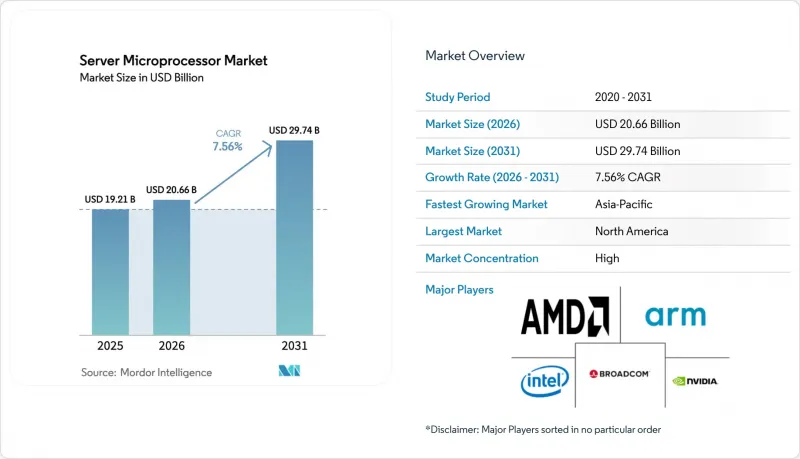
Mordor Intelligence에 의하면, 서버용 마이크로프로세서 시장 규모는 2025년 192억 1,000만 달러, 2026년 206억 6,000만 달러에서 2031년까지 297억 4,000만 달러로 확대된다고 예측되고 있어 2026년부터 2031년까지 CAGR 7.56%를 기록할 전망입니다.
본 보고서는 프로세서 유형(APU, CPU, GPU 등), 명령어 세트 아키텍처(x86, ARM, RISC-V 등), 코어 수 구분(8코어 이하, 9-32코어 등),제조 공정 노드(7nm 이하, 8-14nm 등), 최종 사용자 산업(하이퍼스케일 클라우드 제공업체, 엔터프라이즈 데이터센터 등), 지역별로 분류되어 있습니다. 시장 전망은 금액(달러) 기준으로 제시되어 있습니다.
전 세계 서버용 마이크로프로세서 시장 동향 및 인사이트
고성능이자 에너지 효율이 뛰어난 CPU에 대한 수요 증가
데이터센터 운영업체의 경우, 하이퍼스케일 시설의 총 소유 비용(TCO) 중 에너지 비용이 30% 이상을 차지하게 되면서, 조달을 와트당 성능 지표와 직접 연계하고 있습니다. 이에 대응하여 각 벤더들은 전력 소비를 3분의 1로 줄이면서 벡터 처리량을 2배로 높이는 3나노미터 공정으로 제조된 반도체를 통해 대응하고 있습니다. AWS의 Graviton4 인스턴스는 동등한 x86 가상 머신에 비해 30% 더 뛰어난 비용 효율성을 보여주고 있으며, 주류 클라우드 워크로드에서 Arm 기반 설계의 유효성이 입증되었습니다. 인텔의 제온 6 시에라 포레스트(Xeon 6 Sierra Forest) 변형 제품은 205와트의 TDP 목표를 달성하기 위해 효율 코어만 채택하여, 대규모 코드 재작성 없이도 지속가능성 요건을 충족하고 있습니다. 공조 시설이 갖춰진 홀에서 실외 캐비닛으로의 전환을 추진하는 통신 사업자들은 더욱 엄격한 전력 소비 제한을 요구하고 있으며, 이에 대응하기 위해 칩 제조업체들은 패키지 내 전압 조정기 및 동적 파워 게이팅 기능을 통합하고 있습니다. 이러한 변화로 인해 서버용 마이크로프로세서 시장은 순수한 클럭 속도가 아닌 전력 소비에 최적화된 아키텍처로 계속 전환되고 있습니다.
전 세계 하이퍼스케일 데이터센터의 확대
2024년부터 2025년까지 900곳 이상의 하이퍼스케일 시설이 가동을 시작했으며, 누적 설비 투자액은 2,000억 달러를 넘어섰습니다. 이는 사우디아라비아, 인도,북유럽 국가에서 저비용 재생에너지망 근처에 캠퍼스를 구축하는 사업자들이 주도한 결과입니다. 랙 설계에서는 하나의 인터포저 위에 CPU, GPU, 네트워크 가속 타일을 수용하는 멀티 소켓 보드가 중시되고 있으며, 이로 인해 열 결합이 강화되어 고도의 패키징 기술이 요구되고 있습니다. AWS, Google, Meta 각사는 새로운 웹 서비스 처리 능력의 최소 3분의 1을, 실리콘 부품 원가 절감이 예상되는 Arm 기반 프로세서로 전환하고 있습니다. 신흥 시장에서는 개인정보 보호법 조정에 따라 데이터의 현지 보관이 의무화되어 있어, 사업자들은 컴퓨팅 클러스터를 지역별로 복제해야 하며, 이로 인해 소켓 총 수요가 더욱 확대되고 있습니다. 이러한 추세가 진행됨에 따라 서버용 마이크로프로세서 시장은 수량 탄력성과 가격대 확대라는 혜택을 누리고 있습니다.
지속되는 반도체 공급망 혼란
TSMC의 3나노미터 생산 라인은 2025년 3분기에 85%의 가동률을 기록했으나, 웨이퍼 수요가 공급을 20% 상회하면서 리드타임이 16주로 연장되었습니다. EUV 장비에 대한 수출 규제로 인해 중국의 팹은 최첨단 노드를 따라잡지 못하고 있으며, 생산 능력이 분산되고 비상용 재고에 대한 리스크 프리미엄이 상승하고 있습니다. 삼성의 게이트 올 어라운드(GAA) 공정의 양산화와 인텔의 18옹스트롬 계획은 여전히 소규모인 탓에, 단 한 번의 지진이나 지정학적 긴장 고조만으로도 전 세계 서버용 칩 생산량의 절반 이상이 정체될 우려가 있습니다. 각 벤더들은 추가 비용을 계약 가격에 직접 전가하고 있으며, AMD의 2025년 2분기 매출 총이익률은 웨이퍼 긴급 납품 수수료로 인해 200 베이시스 포인트 하락했습니다. 설계 팀은 다이를 성숙한 공정 노드에서 제조되는 더 작은 칩렛으로 분할하고 있지만, 이 전략은 패키징의 복잡성을 증가시켜 새로운 지연 요인을 초래하고 있습니다.
부문 분석
2026년부터 2031년까지 GPU 출하량은 연평균 성장률(CAGR) 8.72%로 확대되어 AI 추론이 텐서 엔진으로 전환됨에 따라 CPU가 차지하던 70.53%의 매출 점유율 격차가 축소되었습니다. 이러한 추세로 인해 서버용 마이크로프로세서 시장은 2031년까지 변혁기가 지속될 전망입니다. NVIDIA Blackwell과 같은 GPU는 NVLink를 통해 Arm 기반 Grace CPU와 결합함으로써 20 페타플롭스의 FP4 성능을 실현하고, PUE 1.3 미만의 목표를 뛰어넘는 랙 설계를 가능하게 하고 있습니다. FPGA는 출하 대수 면에서는 여전히 틈새 시장이지만, 암호화 오프로드 및 압축에 필수적이며, 클라우드 사업자의 CPU 사이클을 30% 절감해 줍니다. 팬이나 디스크리트 카드의 도입이 현실적이지 않은 어플라이언스 슬롯에서는 통합형 APU 설계가 경쟁 우위를 점하고 있습니다. Google이나 AWS의 ASIC 가속기는 특정 추론 패턴에서 GPU에 비해 와트당 성능이 2-3배 우수합니다.
이종 칩렛 패키지를 통해 벤더는 CPU, GPU, 네트워크 다이를 단일 히트 스프레더 아래에 배치할 수 있게 되어, 마스크 비용을 절감하고 시장 출시 시간을 단축할 수 있습니다. 따라서 서버용 마이크로프로세서 업계는 모놀리식 코어 수 경쟁에서 실리콘 면적 효율을 극대화하는 혼합 다이 포트폴리오 전략으로 전환하고 있습니다. 기존 CPU의 매출은 정체 추세를 보이고 있지만, 가속기의 평균 판매 가격이 높기 때문에 서버용 마이크로프로세서 시장 전체는 성장을 지속하고 있습니다. 조달 팀은 소켓 단가가 아닌 랙 전체의 비용을 평가하게 되었으며, 이를 통해 통합 스택을 제공하는 벤더는 수년에 걸친 공급 계약을 체결할 수 있게 되었습니다.
x86은 2025년에도 64.91%의 점유율을 유지하며 기업 소프트웨어 호환성의 기반으로 남아 있지만, Arm은 신규 소켓의 4분의 1을 차지하고, RISC-V는 하이퍼스케일러의 지지를 얻고 있는 로열티 프리 모델을 통해연평균 성장률(CAGR) 7.97%를 나타낼 것으로 예측됩니다. 퀄컴의 15억 달러 규모 벤타나(Ventana) 인수는 Arm의 라이선스 비용 급등에 대한 헤지 전략으로서, 기존 모바일 분야 선도 기업이 서버 시장에 진출하려는 움직임을 시사하고 있습니다. 중국이 개방적인 거버넌스를 선호하는 태도는 반도체 주권 목표와 부합하기 때문에 국내 벤더들은 클라우드 구축에 있어 RISC-V에 주력하고 있습니다.
경쟁의 초점은 프런트엔드 성능이 아닌 생태계 도구와 롱테일 소프트웨어 지원으로 옮겨가고 있으며, 저비용 RISC-V 보드는 마이크로서비스 및 캐싱 계층에서 신뢰할 수 있는 선택지로 자리 잡고 있습니다. Arm이 클라우드용 맞춤형 실리콘으로 성공을 거둔 것은 범용 칩 공급업체의 이익률을 위협하고 있지만, 설계의 다양성을 뒷받침하는 동시에 서버용 마이크로프로세서 시장이 단일 벤더에 대한 종속을 피할 수 있도록 보장하고 있습니다. 표준화 기구들은 용도 전환 시간을 단축하기 위해 ISA(명령어 세트 아키텍처) 간 펌웨어 인터페이스 통합을 추진하고 있으며, 이를 통해 예측 기간 동안 서버용 마이크로프로세서 업계의 호황이 지속될 전망입니다.
지역별 분석
북미는 AWS, Azure, Google Cloud, Meta의 연간 800억 달러가 넘는 하이퍼스케일 설비 투자에 힘입어 2025년 매출의 39.52%를 차지했습니다. CHIPS법에 따른 527억 달러 상당의 우대 조치는 2030년까지 최첨단 로직 반도체의 20%를 국내로 환원하는 것을 목표로 하고 있지만, 국내 웨이퍼 비용은 아시아의 팹에 비해 최대 40% 높은 수준을 유지하고 있어 매출 총이익률에 압박을 가하고 있습니다. 캐나다와 멕시코는 USMCA의 무역 규정을 활용한 백엔드 조립 및 테스트 업무를 통해 생산량을 더욱 확대되고 있습니다.
아시아태평양은 중국의 국내 Arm 및 RISC-V 추진, 인도의 127억 달러 규모 AWS 투자, 그리고 동남아시아에서 AWS 중립형 코로케이션의 성장에 힘입어 연평균 성장률(CAGR) 9.11%라는 가장 높은 성장세를 보일 것으로 예측됩니다. 알리바바(Alibaba)와 텐센트(Tencent) 등 중국의 하이퍼스케일러들은 이미 자체 개발한 128코어 Arm 프로세서를 도입하여, 수출 규제에도 불구하고 기술적 대등성을 보여주고 있습니다. 일본과 한국은 서버용 CPU 설계보다는 메모리나 파운드리 서비스에 주력하고 있지만, 칩 주권을 목표로 한 지역적 지원 조치의 혜택을 받고 있습니다.
유럽, 남미, 중동 및 아프리카 수요는 전체의 4분의 1 미만이지만, 데이터 주권 관련 법률에 따라 기밀성이 높은 워크로드를 현지에서 저장해야 하는 의무가 부과됨에 따라 수요가 확대되고 있습니다. EU의 430억 유로 규모의 칩 법은 독일과 이탈리아의 파브(반도체 제조 공장)에 자금을 지원하고 있지만, 해당 지역은 여전히 서버 프로세서의 대부분을 아시아의 수탁 제조에 의존하고 있습니다. 중동의 NEOM 캠퍼스나 UAE의 AI 투자 사례에서는 주변 기온이 높기 때문에 수냉식 랙이 필요하며, 이는 비용 증가를 초래하는 한편 지역적 전문화를 촉진하고 있습니다. 남미의 성장은 광섬유 인프라 개선에 달려 있으며, 아프리카의 초기 단계 시장에서는 전력망의 신뢰성이 향상될 때까지 재생 x86 장비에 의존하고 있습니다.
기타 혜택:
- 엑셀 형식 시장 예측(ME) 시트
- 3개월간의 애널리스트 지원
자주 묻는 질문
목차
제1장 서론
제2장 조사 방법
제3장 주요 요약
제4장 시장 구도
제5장 시장 규모와 성장 예측
제6장 경쟁 구도
제7장 시장 기회와 향후 전망
JHS 26.09.09According to Mordor Intelligence, the server microprocessor market size is projected to expand from USD 19.21 billion in 2025 and USD 20.66 billion in 2026 to USD 29.74 billion by 2031, registering a CAGR of 7.56% between 2026 to 2031.
This report is Segmented by Processor Type (APU, CPU, GPU, and More), Instruction-Set Architecture (x86, ARM, RISC-V, and More, Core-Count Bracket (Less Than or Equal To 8 Cores, 9-32 Cores), and More), Fabrication Process Node (Less Than or Equal To 7nm, 8-14nm, and More), End-User Industry (Hyperscale Cloud, Enterprise, and More), and Geography. The Market Forecasts are Provided in Terms of Value (USD).
Global Server Microprocessor Market Trends and Insights
Rising Demand for High-Performance, Energy-Efficient CPUs
Data-center operators are linking procurement directly to performance-per-watt metrics because energy now represents more than 30% of total cost of ownership in hyperscale facilities. Vendors have responded with silicon fabricated at 3 nanometers that cuts wattage by a third while doubling vector throughput. AWS Graviton4 instances show 30% better price-performance over comparable x86 virtual machines, validating Arm-based designs in mainstream cloud workloads. Intel's Xeon 6 Sierra Forest variant relies exclusively on efficiency cores to hit a 205-watt TDP target, supporting sustainability mandates without major code rewrites. Telecom operators substituting outdoor cabinets for air-conditioned halls are demanding even tighter envelopes, so chipmakers are integrating on-package voltage regulators and dynamic power-gating functions. These shifts ensure that the server microprocessor market continues to migrate toward architectures optimized for watts rather than pure clock speed.
Expansion of Hyperscale Data Centers Worldwide
More than 900 hyperscale facilities entered service during 2024-2025, and cumulative capital expenditure topped USD 200 billion, led by operators locating campuses near low-cost renewable energy grids in Saudi Arabia, India, and the Nordics. Rack designs emphasize multi-socket boards that host CPU, GPU, and network acceleration tiles on one interposer, tightening thermal coupling and demanding advanced packaging expertise. AWS, Google, and Meta have each shifted at least 1/3 of their new web-serving capacity to Arm-based processors that promise lower silicon bill of materials. Emerging markets are mandating local data residency under converging privacy laws, so operators must replicate compute clusters regionally, further expanding total socket demand. As this footprint grows, the server microprocessor market benefits from volume elasticity and a broader price band.
Ongoing Semiconductor Supply-Chain Disruptions
TSMC's 3 nanometer lines ran at 85% utilization in Q3 2025, yet wafer demand exceeded supply by 20%, lengthening lead times to 16 weeks. Export restrictions on EUV tools block Chinese fabs from matching leading-edge nodes, fragmenting capacity, and raising risk premiums on contingency inventory. Samsung's gate-all-around ramp and Intel's 18-angstrom plan remain subscale, so a single earthquake or geopolitical flare-up could choke more than half of global server chip output. Vendors pass surcharges straight into contract pricing; AMD's Q2 2025 gross margin slid 200 basis points due to expedited wafer fees. Design teams are splitting dies into smaller chiplets made on mature nodes, but that strategy increases packaging complexity and yields new sources of delay.
Other drivers and restraints analyzed in the detailed report include:
- Cloud-Based AI and ML Workload Proliferation
- 5G-Enabled Edge-Computing Roll-outs
- Strict Data-Center Sustainability Regulations
For complete list of drivers and restraints, kindly check the Table Of Contents.
Segment Analysis
GPU shipments expanded at an 8.72% CAGR during 2026-2031 and cut into the CPU's 70.53% revenue lead as AI inference migrated to tensor engines, a trend that will keep the server microprocessor market in transition through 2031. GPUs like NVIDIA Blackwell now deliver 20 petaflops FP4 performance while paired with Arm-based Grace CPUs over NVLink, enabling rack designs that beat sub-1.3 PUE targets. FPGAs remain niche in unit terms but are critical for encryption offload and compression, trimming CPU cycles by 30% for cloud operators. Integrated APU designs are a winning edge in appliance slots where fans and discrete cards are impractical. ASIC accelerators from Google and AWS achieve 2-3 times better performance per watt than GPUs for specific inference patterns.
Heterogeneous chiplet packages enable vendors to slot CPUs, GPUs, and network dies under a single heat spreader, shaving mask costs and improving time-to-market. The server microprocessor industry therefore pivots from monolithic core count races to mixed-die portfolio strategies that maximize silicon area efficiency. Legacy CPU revenues are flattening, but the overall server microprocessor market continues to grow because accelerators carry higher average selling prices. Procurement teams are evaluating total rack cost rather than socket price, enabling vendors that deliver integrated stacks to secure multiyear supply agreements.
x86 retained 64.91% share in 2025 and remains the compatibility anchor for enterprise software, yet Arm captured a quarter of new sockets, and RISC-V is projected to grow at a 7.97% CAGR on a royalty-free model that resonates with hyperscalers. Qualcomm's USD 1.5 billion Ventana acquisition signaled traditional mobile leaders entering the server space to hedge against rising Arm license fees. China's preference for open governance aligns with its semiconductor sovereignty objectives, so domestic vendors are betting on RISC-V for cloud build-outs.
The competitive narrative now hinges on ecosystem tooling and long-tail software support rather than front-end performance, positioning low-cost RISC-V boards as credible for microservices and caching tiers. Arm's success in bespoke cloud silicon threatens merchant suppliers on margin, but it validates the diversity of design and ensures that the server microprocessor market avoids single-vendor lock-in. Standardization groups are aligning firmware interfaces across ISAs to shorten application migration times, which should keep the server microprocessor industry dynamic through the forecast period.
Complete Report Scope:
- By Processor Type
- APU
- CPU
- GPU
- FPGA
- ASIC Accelerators
- By Instruction-Set Architecture
- x86
- ARM
- RISC-V
- Power
- SPARC and Others
- Consumer Electronics
- By Core-Count Bracket
- Less Than or Equal to 8 Cores
- 9-32 Cores
- 33-64 Cores
- More than 64 Cores
- By Fabrication Process Node
- Less Than or Equal to 7 nm
- 8-14 nm
- 15-28 nm
- More than 28 nm
- By End-User Industry
- Hyperscale Cloud Providers
- Enterprise Data-Centers
- Telecom/ Edge Operators
- HPC and Supercomputing
- Other End-User Industries
- By Geography
- North America
- United States
- Canada
- Mexico
- South America
- Brazil
- Argentina
- Rest of South America
- Europe
- Germany
- United Kingdom
- France
- Italy
- Spain
- Rest of Europe
- Asia-Pacific
- China
- Japan
- India
- South Korea
- ASEAN
- Rest of Asia-Pacific
- Middle East
- Saudi Arabia
- United Arab Emirates
- Rest of Middle East
- Africa
- South Africa
- Nigeria
- Rest of Africa
- North America
Geography Analysis
North America generated 39.52% of 2025 revenue, bolstered by more than USD 80 billion in annual hyperscale capital expenditure from AWS, Azure, Google Cloud and Meta. CHIPS Act incentives worth USD 52.7 billion aim to reshore 20% of leading-edge logic by 2030, yet domestic wafer costs remain up to 40% higher than Asian fabs, pressuring gross margins. Canada and Mexico add incremental volume through back-end assembly and test operations that leverage USMCA trade provisions.
Asia-Pacific is projected to post the fastest 9.11% CAGR, driven by China's domestic Arm and RISC-V initiatives, India's USD 12.7 billion AWS investment and Southeast Asia's neutral colocation growth AWS. Chinese hyperscalers such as Alibaba and Tencent already deploy in-house 128-core Arm processors, demonstrating technology parity despite export controls. Japan and South Korea focus on memory and foundry services rather than server CPU design, but still benefit from regional stimuli targeting chip sovereignty.
Europe, South America, the Middle East, and Africa collectively hold under one-quarter of demand yet are expanding as data-sovereignty laws force local storage of sensitive workloads. The EU's EUR 43 billion Chips Act funds fabs in Germany and Italy, though the region still relies on Asian contract manufacturing for most server processors. The Middle East's NEOM campus and UAE AI investments require liquid-cooled racks due to ambient temperatures, adding cost premiums but fostering regional specialization. South American growth hinges on improved fiber infrastructure, while Africa's nascent market leans on refurbished x86 equipment until grid reliability improves.
- Intel Corporation
- Advanced Micro Devices, Inc.
- NVIDIA Corporation
- Arm Ltd.
- Broadcom Inc.
- Marvell Technology, Inc.
- Ampere Computing LLC
- International Business Machines Corporation
- Huawei Technologies Co., Ltd.
- Fujitsu Limited
- Samsung Electronics Co., Ltd.
- Taiwan Semiconductor Manufacturing Company Limited
- Texas Instruments Incorporated
- MediaTek Inc.
- Alibaba Group Holding Ltd. (T-Head)
- SiFive, Inc.
- Graphcore Limited
- Socionext Inc.
- Tenstorrent Inc.
- Ventana Micro Systems Inc.
- Oracle Corporation
Additional Benefits:
- The market estimate (ME) sheet in Excel format
- 3 months of analyst support
TABLE OF CONTENTS
1 INTRODUCTION
- 1.1 Study Assumptions and Market Definition
- 1.2 Scope of the Study
2 RESEARCH METHODOLOGY
3 EXECUTIVE SUMMARY
4 MARKET LANDSCAPE
- 4.1 Market Overview
- 4.2 Market Drivers
- 4.2.1 Rising Demand for High-performance, Energy-efficient CPUs
- 4.2.2 Expansion of Hyperscale Data-centers Worldwide
- 4.2.3 Cloud-based AI/ML Workload Proliferation
- 4.2.4 5G-enabled Edge-computing Roll-outs
- 4.2.5 Chiplet-based Modular Design Adoption
- 4.2.6 Government Semiconductor-sovereignty Programs
- 4.3 Market Restraints
- 4.3.1 Declining on-prem Enterprise Server Budgets
- 4.3.2 Ongoing Semiconductor Supply-chain Disruptions
- 4.3.3 Escalating Licensing Costs of Proprietary ISAs
- 4.3.4 Strict Data-center Sustainability Regulations
- 4.4 Industry Value Chain Analysis
- 4.5 Regulatory Landscape
- 4.6 Technological Outlook
- 4.7 Porter's Five Forces Analysis
- 4.7.1 Bargaining Power of Suppliers
- 4.7.2 Bargaining Power of Buyers
- 4.7.3 Threat of New Entrants
- 4.7.4 Threat of Substitutes
- 4.7.5 Intensity of Competitive Rivalry
5 MARKET SIZE AND GROWTH FORECASTS (VALUE)
- 5.1 By Processor Type
- 5.1.1 APU
- 5.1.2 CPU
- 5.1.3 GPU
- 5.1.4 FPGA
- 5.1.5 ASIC Accelerators
- 5.2 By Instruction-Set Architecture
- 5.2.1 x86
- 5.2.2 ARM
- 5.2.3 RISC-V
- 5.2.4 Power
- 5.2.5 SPARC and Others
- 5.2.6 Consumer Electronics
- 5.3 By Core-Count Bracket
- 5.3.1 Less Than or Equal to 8 Cores
- 5.3.2 9-32 Cores
- 5.3.3 33-64 Cores
- 5.3.4 More than 64 Cores
- 5.4 By Fabrication Process Node
- 5.4.1 Less Than or Equal to 7 nm
- 5.4.2 8-14 nm
- 5.4.3 15-28 nm
- 5.4.4 More than 28 nm
- 5.5 By End-User Industry
- 5.5.1 Hyperscale Cloud Providers
- 5.5.2 Enterprise Data-Centers
- 5.5.3 Telecom/ Edge Operators
- 5.5.4 HPC and Supercomputing
- 5.5.5 Other End-User Industries
- 5.6 By Geography
- 5.6.1 North America
- 5.6.1.1 United States
- 5.6.1.2 Canada
- 5.6.1.3 Mexico
- 5.6.2 South America
- 5.6.2.1 Brazil
- 5.6.2.2 Argentina
- 5.6.2.3 Rest of South America
- 5.6.3 Europe
- 5.6.3.1 Germany
- 5.6.3.2 United Kingdom
- 5.6.3.3 France
- 5.6.3.4 Italy
- 5.6.3.5 Spain
- 5.6.3.6 Rest of Europe
- 5.6.4 Asia-Pacific
- 5.6.4.1 China
- 5.6.4.2 Japan
- 5.6.4.3 India
- 5.6.4.4 South Korea
- 5.6.4.5 ASEAN
- 5.6.4.6 Rest of Asia-Pacific
- 5.6.5 Middle East
- 5.6.5.1 Saudi Arabia
- 5.6.5.2 United Arab Emirates
- 5.6.5.3 Rest of Middle East
- 5.6.6 Africa
- 5.6.6.1 South Africa
- 5.6.6.2 Nigeria
- 5.6.6.3 Rest of Africa
- 5.6.1 North America
6 COMPETITIVE LANDSCAPE
- 6.1 Market Concentration
- 6.2 Strategic Moves
- 6.3 Market Share Analysis
- 6.4 Company Profiles (includes Global level Overview, Market Level Overview, Core Segments, Financials as Available, Strategic Information, Market Rank/Share for Key Companies, Products and Services, and Recent Developments)
- 6.4.1 Intel Corporation
- 6.4.2 Advanced Micro Devices, Inc.
- 6.4.3 NVIDIA Corporation
- 6.4.4 Arm Ltd.
- 6.4.5 Broadcom Inc.
- 6.4.6 Marvell Technology, Inc.
- 6.4.7 Ampere Computing LLC
- 6.4.8 International Business Machines Corporation
- 6.4.9 Huawei Technologies Co., Ltd.
- 6.4.10 Fujitsu Limited
- 6.4.11 Samsung Electronics Co., Ltd.
- 6.4.12 Taiwan Semiconductor Manufacturing Company Limited
- 6.4.13 Texas Instruments Incorporated
- 6.4.14 MediaTek Inc.
- 6.4.15 Alibaba Group Holding Ltd. (T-Head)
- 6.4.16 SiFive, Inc.
- 6.4.17 Graphcore Limited
- 6.4.18 Socionext Inc.
- 6.4.19 Tenstorrent Inc.
- 6.4.20 Ventana Micro Systems Inc.
- 6.4.21 Oracle Corporation
7 MARKET OPPORTUNITIES AND FUTURE OUTLOOK
- 7.1 White-space and Unmet-Need Assessment