

|
시장보고서
상품코드
2123329
고에너지 레이저 시장 : 점유율 분석, 업계 동향과 통계, 성장 예측(2026-2031년)High Energy Lasers - Market Share Analysis, Industry Trends & Statistics, Growth Forecasts (2026 - 2031) |
||||||
 Mordor Intelligence
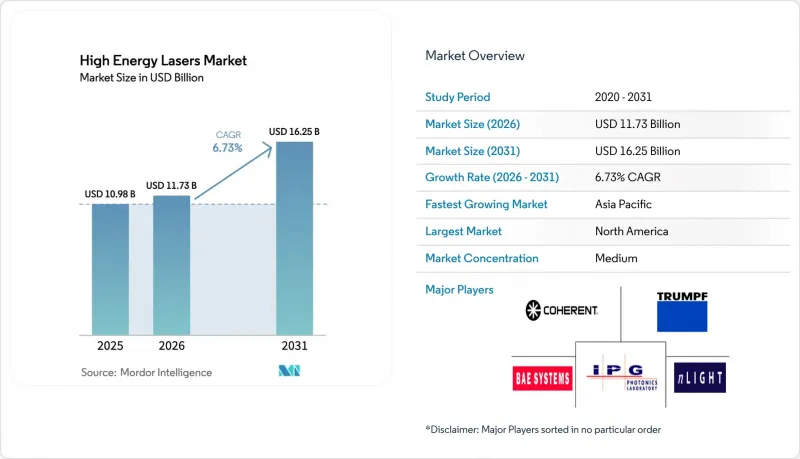
Mordor Intelligence에 의하면, 고에너지 레이저 시장 규모는 2025년 109억 8,000만 달러에서 2026년에는 117억 3,000만 달러로 확대되어 2031년까지 162억 5,000만 달러에 이를 것으로 예상되고 있어 2026년부터 2031년까지 CAGR 6.73%로 성장할 전망입니다.
본 보고서는 용도(절단, 용접, 천공 등), 레이저 유형(가스, 화학, 엑시머, 고체 등), 출력(10kW 이하, 11-50kW, 51-100kW, 100kW 초과),플랫폼(육상 시스템, 해군 시스템 등), 최종 사용자(방위, 산업 제조, 항공우주 및 항공 등), 그리고 지역별로 분류되어 있습니다. 시장 예측은 금액(달러)으로 표시되어 있습니다.
세계 고에너지 레이저 시장 동향 및 인사이트
주요국의 지향성 에너지 국방 예산 확대
저가 드론과 로켓으로 인해 미사일 창고가 포화 상태에 이르렀기 때문에 각국의 국방부는 조달 자금을 레이저 기술로 전환하고 있습니다. 미국은 2024년 4월, 이스라엘의 ‘아이언 빔(Iron Beam)’에 12억 달러를 배정했는데, 이 금액은 많은 요격 시스템 관련 예산을 상회하는 규모입니다. 인도는 해군 및 국경 경비용으로 30kW 및 300kW 프로토타입에 자금을 지원하고 있는 반면, 한국은 자국의 20kW 블록 I 시스템 양산을 위해 1억 3,200만 달러를 발주했습니다. 이러한 예산 배분을 통해 고에너지 레이저 시장은 단발적인 실증 실험이 아닌, 수년에 걸친 꾸준한 프로그램 자금 조달 체제가 갖춰지고 있습니다.
기존 탄약과 비교한 발사체당 비용 절감에 대한 수요
레이저는 군사 경제에 혁명을 일으키고 있으며, 미사일 1발당 수만 달러가 들던 비용을 1발당 전력비가 고작 한 자릿수 금액으로 대폭 절감하고 있습니다. 예를 들어, 아이언 돔 시스템의 1발당 비용은 약 5만 달러인 반면, 아이언 빔 시스템을 통한 요격 비용은 불과 약 2달러로 추정됩니다. 마찬가지로, 영국의 드래곤파이어 레이저 무기 시스템도 1발당 한 자릿수 대라는 동등한 비용 효율성을 보여주고 있습니다. 이러한 운영비의 획기적인 절감은 특히 중요 인프라를 표적으로 삼는 드론 떼로 인한 지속적인 과제에 직면해 있는 중동 국가들로부터 큰 관심을 받고 있습니다. 비용 대비 효과가 높고 효율적인 레이저 시스템을 배치할 수 있는 능력은 이러한 위협에 대처하는 데 있어 전략적 우위를 제공합니다. 또한, 공급망이 짧고 탄약 비축량이 많다는 장점 덕분에 레이저는 해군 함정에게 특히 매력적인 선택지가 되고 있습니다. 이러한 함정들은 탄약 고갈이 임무 성공을 위태롭게 할 수 있는 빈번한 교전 시나리오에서 운용되는 경우가 많기 때문에 레이저 기술의 도입은 매우 중요한 고려 사항이 됩니다.
고습도 또는 먼지가 많은 환경에서의 열 번짐 제한
고습도 조건에서는 고도 5-8km 범위 내에서 대기 난류로 인해 빔 강도가 최대 40%까지 크게 저하될 가능성이 있습니다. 이러한 빔 강도의 급격한 저하는 운용상의 문제를 야기하며, 운영자는 시스템의 신뢰성과 유효성을 확보하기 위해 예비 요격기를 준비할 수밖에 없게 됩니다. 적응형 광학 기술은 난류의 영향을 보정함으로써 이 문제 해결에 기여할 수 있지만, 이를 도입하면 시스템의 중량과 비용이 증가합니다. 이러한 추가 요인들은 궁극적으로 시스템 전체의 기동성과 효율성을 저해하여 운영자에게 더 큰 제약을 가하게 됩니다.
부문 분석
2025년에는 자동차 제조업체와 항공우주 분야 제조업체들이 합금 재료의 정밀 트리밍에 파이버 빔을 채택함에 따라, 절단, 용접, 천공이 고에너지 레이저 시장에서 42.70%라는 압도적인 점유율을 차지했습니다. 이 부문의 부상은 산업용 응용 분야에서 정밀도와 효율성을 실현하는 데 있어 고에너지 레이저가 수행하는 매우 중요한 역할을 부각시키고 있습니다. 한편, 통신 플랫폼은 8.12%의 연평균 성장률(CAGR)을 기록하며 성장세를 보이고 있습니다. 이러한 성장은 위성 사업자들이 테라비트급 크로스링크를 추구하고 있음을 보여주며, 이를 통해 혼잡한 무선 주파수를 회피하고 데이터 전송 능력을 향상시킬 수 있게 됩니다. 이러한 변화는 업계의 변천을 여실히 보여줄 뿐만 아니라, 공급업체의 수익원을 기존의 제조업 경기 순환에 대한 의존에서 벗어나 확장시키는 결과로 이어집니다. 수익원의 다각화는 장기적으로 시장 참여자들에게 안정성과 성장 기회를 가져다줄 것으로 예측됩니다.
통신 기술의 채택 확대에 따라, 좁은 선폭 이미터나 인듐 인화물 변조기와 같은 부품에 대한 수요가 증가하고 있습니다. 이러한 부품들은 현대 통신 네트워크에서 점점 더 중요해지고 있는 고성능 광 시스템을 구현하는 데 필수적입니다. 특히, Coherent는 급증하는 수요에 대응하기 위해 2025년에 이러한 핵심 부품의 생산량을 3배로 확대했습니다. 또한, 군사 분야의 대역폭 요구 사항도 이러한 추세를 뒷받침하고 있습니다. 현재 광 단말기는 매우 중요한 역할을 수행하고 있으며, 저궤도 위성 군집에서 수집된 정찰 데이터를 불과 몇 초 만에 지상의 분석 담당자에게 전송하고 있습니다. 이 기능 덕분에 킬 체인이 단축되고 의사 결정 과정이 신속해짐에 따라 군사 작전의 효율성이 크게 향상됩니다. 민간용과 군용 응용 분야의 융합은 다양한 시장 수요에 대응하는 데 있어 고에너지 레이저 기술의 전략적 중요성을 더욱 부각시키고 있습니다.
파이버 레이저는 2025년에 고에너지 레이저 시장 점유율의 55.71%를 차지할 것이며, 40% 이상의 전기-광 변환 효율이 기존의 가스식 및 화학식 장치를 능가하고 있어 2031년까지 연평균 성장률(CAGR) 7.23%로 성장할 전망입니다. 스펙트럼 결합 기술을 통해 통합 업체는 물리적 설계 변경 없이 모듈을 적층할 수 있어 비반복 설계 비용을 절감할 수 있습니다.
자유전자 레이저나 화학 레이저와 같은 대체 기술은 크기나 독성 등의 문제로 인해 여전히 연구실의 틈새 분야에 머물러 있습니다. 상용화 준비가 미흡하기 때문에 조달 담당자들은 파이버 레이저 도입에 주력하고 있으며, 이로 인해 규모의 경제가 강화되어 산업 고객에게 와트당 가격이 하락하고 있습니다.
지역별 분석
2025년, 북미는 고에너지 레이저 시장 매출의 40.01%를 차지했습니다. 이는 해군의 HELIOS나 육군의 간접 사격 방어 능력(Indirect Fire Protection Capability)과 같은 미국 국방부의 이니셔티브에 힘입은 결과입니다. 이 지역에서 고에너지 레이저의 산업 도입은 자동차 화이트 바디 용접이 주목받고 있는 중서부나 터빈 가공이 활발한 남동부에서 특히 두드러집니다. 한편, 캐나다의 전략가들은 광활하고 외딴 지역에 위치한 요격 시스템의 재보급에 수반되는 물류 문제를 해결하기 위해 북극권에 레이저 기지 설치를 검토하고 있습니다.
아시아태평양은 중국의 비용 효율적인 광섬유 생산과 인도의 자체 자금으로 개발된 30kW 및 300kW 무기(2억 달러의 투자로 뒷받침됨)에 힘입어 연평균 성장률(CAGR) 7.47%라는 세계 최고 수준의 성장률을 자랑하고 있습니다. 이 지역의 급속한 확장은 2024년 한국이 20kW 레이저를 도입함으로써 더욱 두드러졌으며, 이는 해당 지역의 기술력 향상을 입증하고 있습니다. 또한, 일본의 전기기기 제조업체들은 자동화를 목적으로 레이저를 점점 더 많이 활용하고 있는데, 이는 노동력 부족에 대처하는 동시에 고에너지 레이저 시스템에 대한 안정적이고 신뢰할 수 있는 베이스로드 수요를 확보하기 위한 전략적 움직임입니다.
유럽에서는 다양한 동향이 관찰됩니다. 독일의 공작기계 수출업체들은 산업용 판매를 뒷받침하는 데 중요한 역할을 하고 있는 반면, 영국의 드래곤파이어(Dragonfire)는 2025년에 해상 시험을 성공적으로 완료하여 해당 지역의 방위 능력에 있어 주목할 만한 성과를 거두었습니다. 그러나 남유럽 국가들의 예산 제약과 엄격한 수출 규제로 인해 해당 지역의 고에너지 레이저 시장 전반의 성장세는 둔화되고 있습니다. 중동에서는 2025년 이스라엘이 ‘아이언 빔(Iron Beam)’의 운용을 시작한 데 더해, 걸프 국가들이 유사한 첨단 방위 시스템 도입에 점점 더 많은 관심을 보이고 있어, 고에너지 레이저 기술의 채택이 급속히 가속화되고 있음을 시사합니다. 아프리카와 남미에서는 시장 개발이 여전히 초기 단계에 머물러 있지만, 브라질의 급성장하는 항공우주 산업은 레이저 구동 적층 가공 기술의 미래 거점으로 유망시되고 있으며, 향후 몇 년 동안 해당 지역의 산업 성장에 크게 기여할 가능성이 있습니다.
기타 혜택:
- 엑셀 형식 시장 예측(ME) 시트
- 3개월간의 애널리스트 지원
자주 묻는 질문
목차
제1장 서론
제2장 조사 방법
제3장 주요 요약
제4장 시장 구도
제5장 시장 규모와 성장 예측
제6장 경쟁 구도
제7장 시장 기회와 향후 전망
JHS 26.09.09According to Mordor Intelligence, the high energy lasers market size is expected to increase from USD 10.98 billion in 2025 to USD 11.73 billion in 2026 and reach USD 16.25 billion by 2031, growing at a CAGR of 6.73% over 2026-2031.
This report is Segmented by Application (Cutting, Welding and Drilling, and More), Laser Type (Gas, Chemical, Excimer, Solid State, and More), Power Output (Up To 10 KW, 11-50 KW, 51-100 KW, and Above 100 KW), Platform (Land, Naval, Airborne, and Space), End User (Defense, Industrial, Aerospace, Research, Telecom, and More), and Geography. The Market Forecasts are Provided in Value (USD).
Global High Energy Lasers Market Trends and Insights
Escalating Directed-Energy Defense Budgets Among Major Powers
Defense ministries are reallocating procurement funds toward lasers because inexpensive drones and rockets saturate missile magazines. The United States appropriated USD 1.2 billion for Israel's Iron Beam in April 2024, a figure that eclipses many interceptor line items.India is financing 30 kW and 300 kW prototypes for naval and border security, while South Korea placed a USD 132 million order for serial production of its 20 kW Block I system. These budgets position the High Energy Lasers Market for steady multi-year program funding rather than sporadic demonstrations.
Demand for Cost-Per-Shot Reduction Compared to Conventional Munitions
Lasers are revolutionizing military economics, significantly reducing costs from tens of thousands of dollars per missile to mere single-digit electricity expenses per shot. For example, each round of the Iron Dome system costs approximately USD 50,000, whereas interceptions carried out by the Iron Beam system are estimated to cost just about USD 2. Similarly, the UK's DragonFire laser weapon system demonstrates comparable single-digit cost efficiency. This dramatic reduction in operational expenses has garnered significant interest from Middle-Eastern nations, particularly due to their ongoing challenges with persistent drone swarms targeting critical infrastructure. The ability to deploy cost-effective and efficient laser systems offers a strategic advantage in addressing these threats. Additionally, the benefits of short supply chains and enhanced magazine depth make lasers an especially compelling option for naval ships. These vessels often operate in high-tempo engagement scenarios where the risk of ammunition depletion could compromise mission success, making the adoption of laser technology a critical consideration.
Thermal Blooming Limitations in High-Humidity or Dusty Environments
Under high humidity conditions, atmospheric turbulence can significantly reduce beam intensity by as much as 40% at altitudes ranging between 5-8 km. This substantial reduction in beam intensity creates operational challenges, compelling operators to maintain backup interceptors to ensure system reliability and effectiveness. Although adaptive optics can help address this issue by compensating for the effects of turbulence, their implementation introduces additional weight and cost to the system. These added factors ultimately compromise the mobility and efficiency of the overall setup, posing further constraints for operators.
Other drivers and restraints analyzed in the detailed report include:
- Rapid Advancements in Beam-Combining and Thermal Management Techniques
- Integration of AI-Enabled Targeting for Precision and Low-Collateral Damage
- Stringent Export Control Regimes on Directed-Energy Technologies
For complete list of drivers and restraints, kindly check the Table Of Contents.
Segment Analysis
In 2025, cutting, welding and drilling held a dominant 42.70% share of the High Energy Lasers Market, driven by automakers and aerospace fabricators turning to fiber beams for precise alloy trimming. This segment's prominence highlights the critical role of high-energy lasers in achieving precision and efficiency in industrial applications. Meanwhile, communications platforms are on the rise, boasting an 8.12% CAGR. This growth underscores satellite operators' pursuit of terabit cross-links, allowing them to bypass congested radio frequencies and improve data transmission capabilities. Such a shift not only highlights the evolving landscape but also broadens revenue streams for suppliers, moving away from the traditional cyclical manufacturing reliance. The diversification of revenue pools is expected to provide stability and growth opportunities for market players in the long term.
The growing adoption of communications is bolstering the demand for components like narrow-linewidth emitters and indium phosphide modulators. These components are essential for enabling high-performance optical systems, which are increasingly critical in modern communication networks. Notably, Coherent ramped up its output of these critical components threefold in 2025 to meet the surging demand. Furthermore, military bandwidth requirements underscore this trend; optical terminals are now pivotal, transmitting reconnaissance data from low-Earth-orbit constellations to ground analysts in mere seconds. This capability significantly enhances the efficiency of military operations by compressing kill chains and enabling faster decision-making processes. The crossover between commercial and military applications further emphasizes the strategic importance of high-energy laser technologies in addressing diverse market needs.
Fiber lasers secured 55.71% High Energy Lasers Market share in 2025 and will expand at 7.23% CAGR through 2031 as electrical-to-optical conversion efficiencies above 40% outclass legacy gas and chemical units.Spectral combining lets integrators stack modules without physics rewrites, trimming non-recurring engineering costs.
Free-electron and chemical alternatives linger in laboratory niches because of size and toxicity hurdles. Their limited field readiness keeps procurement officers centered on fiber pathways, reinforcing economies of scale that lower price per watt for industrial customers.
Complete Report Scope:
- By Application
- Cutting, Welding and Drilling
- Military and Defense
- Communications
- Other Applications
- By Laser Type
- Gas Lasers
- Chemical Lasers
- Excimer Lasers
- Solid State Lasers
- Fiber Lasers
- Free-Electron Lasers
- Other Laser Types
- By Power Output
- Up to 10 kW
- 11-50 kW
- 51-100 kW
- Above 100 kW
- By Platform
- Land-Based Systems
- Naval Systems
- Airborne Systems
- Space-Based Systems
- By End User
- Defense
- Industrial Manufacturing
- Aerospace and Aviation
- Research Institutions
- Telecommunications
- Other End-Users
- By Geography
- North America
- United States
- Canada
- Mexico
- South America
- Brazil
- Argentina
- Rest of South America
- Europe
- Germany
- United Kingdom
- France
- Italy
- Spain
- Rest of Europe
- Asia Pacific
- China
- Japan
- South Korea
- India
- Australia
- New Zealand
- Rest of Asia-Pacific
- Middle East and Africa
- Middle East
- United Arab Emirates
- Saudi Arabia
- Turkey
- Rest of Middle East
- Africa
- South Africa
- Nigeria
- Kenya
- Rest of Africa
- Middle East
- North America
Geography Analysis
In 2025, North America secured 40.01% of the High Energy Lasers Market revenue, bolstered by Pentagon initiatives like the Navy's HELIOS and the Army's Indirect Fire Protection Capability. The region's industrial adoption of high-energy lasers is particularly evident in the Midwest, where automotive body-in-white welding has become a focal point, and in the Southeast, where turbine machining activities are thriving. Meanwhile, Canadian strategists are exploring the establishment of Arctic laser sites to address the logistical challenges associated with resupplying interceptors across vast and remote distances.
Asia-Pacific, led by China's cost-effective fiber production and India's self-funded 30 kW and 300 kW weapons (backed by a USD 200 million investment), boasts the world's fastest growth at a 7.47% CAGR. The region's rapid expansion is further highlighted by South Korea's deployment of a 20 kW laser in 2024, which underscores the increasing technological capabilities within the area. Additionally, Japanese electronics firms are increasingly turning to lasers for automation purposes, a strategic move aimed at countering labor shortages while ensuring a steady and reliable base-load demand for high-energy laser systems.
Europe presents a mixed bag of trends. Germany's machine-tool exporters play a significant role in underpinning industrial sales, while the United Kingdom's DragonFire successfully completed sea trials in 2025, marking a notable achievement in the region's defense capabilities. However, Southern Europe's budget constraints and stringent export regulations have tempered the overall momentum of the high-energy lasers market in the region. In the Middle East, Israel's operationalization of the Iron Beam in 2025, along with Gulf states' increasing interest in acquiring similar advanced defense systems, signals a rapid acceleration in the adoption of high-energy laser technologies. Africa and South America remain in the nascent stages of market development; however, Brazil's burgeoning aerospace sector shows promise as a potential future hub for laser-driven additive manufacturing, which could significantly contribute to the region's industrial growth in the coming years.
- TRUMPF Pvt. Ltd.
- IPG Photonics Corporation
- Coherent Corp.
- nLIGHT, Inc.
- BAE Systems plc
- ALLTEC GmbH
- Lockheed Martin Corporation
- Applied Companies, Inc.
- The Boeing Company
- Lumentum Holdings Inc.
- Bystronic Laser AG
- Wuhan Raycus Fiber Laser Technologies Co., Ltd.
- Raytheon Technologies Corporation
- Northrop Grumman Corporation
- Han's Laser Technology Industry Group Co., Ltd.
- General Atomics
- Rheinmetall AG
- Thales Group
- MBDA
- Leonardo S.p.A.
Additional Benefits:
- The market estimate (ME) sheet in Excel format
- 3 months of analyst support
TABLE OF CONTENTS
1 INTRODUCTION
- 1.1 Study Assumptions and Market Definition
- 1.2 Scope of the Study
2 RESEARCH METHODOLOGY
3 EXECUTIVE SUMMARY
4 MARKET LANDSCAPE
- 4.1 Market Overview
- 4.2 Market Drivers
- 4.2.1 Escalating Directed-Energy Defense Budgets Among Major Powers
- 4.2.2 Rapid Advancements in Beam-Combining and Thermal Management Techniques
- 4.2.3 Demand for Cost-Per-Shot Reduction Compared to Conventional Munitions
- 4.2.4 Naval Fleet Modernization Programs Adopting High Energy Laser CIWS
- 4.2.5 Integration of AI-Enabled Targeting for Precision and Low-Collateral Damage
- 4.2.6 Commercial Space Industry Interest in Laser-Based Communication Relays
- 4.3 Market Restraints
- 4.3.1 Thermal Blooming Limitations in High-Humidity or Dusty Environments
- 4.3.2 Stringent Export Control Regimes on Directed-Energy Technologies
- 4.3.3 Fragility of Optical Components Under High-Power Cycling
- 4.3.4 Grid Power and Platform Power Supply Constraints in Forward Deployments
- 4.4 Industry Value-Chain Analysis
- 4.5 Regulatory Landscape
- 4.6 Technological Outlook
- 4.7 Porter's Five Forces Analysis
- 4.7.1 Bargaining Power of Buyers
- 4.7.2 Bargaining Power of Suppliers
- 4.7.3 Threat of New Entrants
- 4.7.4 Threat of Substitutes
- 4.7.5 Competitive Rivalry
5 MARKET SIZE AND GROWTH FORECASTS (VALUE)
- 5.1 By Application
- 5.1.1 Cutting, Welding and Drilling
- 5.1.2 Military and Defense
- 5.1.3 Communications
- 5.1.4 Other Applications
- 5.2 By Laser Type
- 5.2.1 Gas Lasers
- 5.2.2 Chemical Lasers
- 5.2.3 Excimer Lasers
- 5.2.4 Solid State Lasers
- 5.2.5 Fiber Lasers
- 5.2.6 Free-Electron Lasers
- 5.2.7 Other Laser Types
- 5.3 By Power Output
- 5.3.1 Up to 10 kW
- 5.3.2 11-50 kW
- 5.3.3 51-100 kW
- 5.3.4 Above 100 kW
- 5.4 By Platform
- 5.4.1 Land-Based Systems
- 5.4.2 Naval Systems
- 5.4.3 Airborne Systems
- 5.4.4 Space-Based Systems
- 5.5 By End User
- 5.5.1 Defense
- 5.5.2 Industrial Manufacturing
- 5.5.3 Aerospace and Aviation
- 5.5.4 Research Institutions
- 5.5.5 Telecommunications
- 5.5.6 Other End-Users
- 5.6 By Geography
- 5.6.1 North America
- 5.6.1.1 United States
- 5.6.1.2 Canada
- 5.6.1.3 Mexico
- 5.6.2 South America
- 5.6.2.1 Brazil
- 5.6.2.2 Argentina
- 5.6.2.3 Rest of South America
- 5.6.3 Europe
- 5.6.3.1 Germany
- 5.6.3.2 United Kingdom
- 5.6.3.3 France
- 5.6.3.4 Italy
- 5.6.3.5 Spain
- 5.6.3.6 Rest of Europe
- 5.6.4 Asia Pacific
- 5.6.4.1 China
- 5.6.4.2 Japan
- 5.6.4.3 South Korea
- 5.6.4.4 India
- 5.6.4.5 Australia
- 5.6.4.6 New Zealand
- 5.6.4.7 Rest of Asia-Pacific
- 5.6.5 Middle East and Africa
- 5.6.5.1 Middle East
- 5.6.5.1.1 United Arab Emirates
- 5.6.5.1.2 Saudi Arabia
- 5.6.5.1.3 Turkey
- 5.6.5.1.4 Rest of Middle East
- 5.6.5.2 Africa
- 5.6.5.2.1 South Africa
- 5.6.5.2.2 Nigeria
- 5.6.5.2.3 Kenya
- 5.6.5.2.4 Rest of Africa
- 5.6.5.1 Middle East
- 5.6.1 North America
6 COMPETITIVE LANDSCAPE
- 6.1 Market Concentration
- 6.2 Strategic Moves
- 6.3 Market Share Analysis
- 6.4 Company Profiles (includes Global Level Overview, Market Level Overview, Core Segments, Financials as available, Strategic Information, Market Rank/Share, Products and Services, Recent Developments)
- 6.4.1 TRUMPF Pvt. Ltd.
- 6.4.2 IPG Photonics Corporation
- 6.4.3 Coherent Corp.
- 6.4.4 nLIGHT, Inc.
- 6.4.5 BAE Systems plc
- 6.4.6 ALLTEC GmbH
- 6.4.7 Lockheed Martin Corporation
- 6.4.8 Applied Companies, Inc.
- 6.4.9 The Boeing Company
- 6.4.10 Lumentum Holdings Inc.
- 6.4.11 Bystronic Laser AG
- 6.4.12 Wuhan Raycus Fiber Laser Technologies Co., Ltd.
- 6.4.13 Raytheon Technologies Corporation
- 6.4.14 Northrop Grumman Corporation
- 6.4.15 Han's Laser Technology Industry Group Co., Ltd.
- 6.4.16 General Atomics
- 6.4.17 Rheinmetall AG
- 6.4.18 Thales Group
- 6.4.19 MBDA
- 6.4.20 Leonardo S.p.A.
7 MARKET OPPORTUNITIES AND FUTURE OUTLOOK
- 7.1 White-Space and Unmet-Need Assessment


