|
시장보고서
상품코드
2123340
구내염 치료 시장 : 점유율 분석, 업계 동향과 통계, 성장 예측(2026-2031년)Mouth Ulcer Treatment - Market Share Analysis, Industry Trends & Statistics, Growth Forecasts (2026 - 2031) |
||||||
 Mordor Intelligence
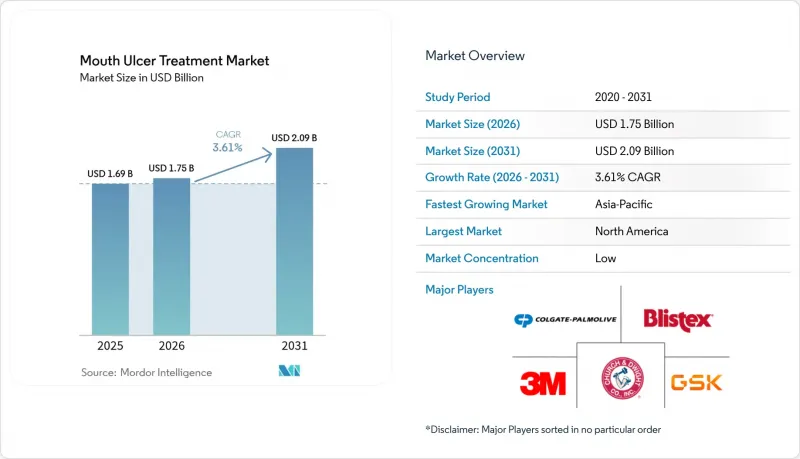
Mordor Intelligence에 의하면, 2026년 구내염 치료 시장 규모는 17억 5,000만 달러로 추정되고 있어 2025년 16억 9,000만 달러에서 성장하여 2031년에는 20억 9,000만 달러에 이를 것으로 예측됩니다.
2026년부터 2031년까지의 연평균 성장률(CAGR)은 3.61%가 될 것으로 전망됩니다.
본 보고서에서는 시장을 약물 분류(항균제, 항히스타민제, 진통제, 코르티코스테로이드, 기타), 제형(스프레이, 가글, 젤, 기타), 적응증(아프타성 구내염, 구강 편평태선, 기타),및 지역(북미, 유럽, 아시아태평양, 중동 및 아프리카 등)별로 분류하고 있습니다. 시장 예측은 금액(달러) 기준으로 제시되어 있습니다.
전 세계 구내염 치료 시장 동향 및 인사이트
무설탕·허브 유래 일반의약품 젤의 부상
소비자들은 식물 유래 또는 무설탕 젤을 점점 더 선호하고 있으며, 이에 따라 제조업체들은 최신 점막 접착성 기제와 궁합이 좋은 유제놀이나 플라보노이드 등의 식물성 유효 성분에 대한 투자를 서두르고 있습니다. 임상 검증을 통해 효능이 입증되었으며, 규제 당국 및 처방 의사의 엄격한 심사 기준도 충족하고 있습니다. 시장을 선도하는 기업들은 투명한 표시, 임상 데이터, 그리고 텔레파마시의 성장에 발맞춘 편리한 포장을 통해 타사와의 차별화를 꾀하고 있습니다.
자가면역 질환 유병률 증가
인구 증가와 고령화에 따라 자가면역 질환의 발생률이 상승하고 있으며, 구강 편평태선 및 아프타성 구내염의 사례가 증가하고 있습니다. 침식성 편평태선에서 토파시티닙의 성공이 보여주듯이, 표적화된 저분자 요법을 통해 치료는 광범위한 항염증 요법에서 정밀한 접근 방식으로 전환되고 있습니다. 전신 면역학 파이프라인에서 구강 병변용 외용제 적응증이 확대됨에 따라, 포트폴리오 간의 시너지 효과가 나타나고 있습니다.
OTC 제품의 상품화로 인해 가격이 낮은 수준으로 유지
특허 만료 및 바이오시밀러의 진입으로 인해 평균 판매 가격은 50% 가까이 하락했으며, 명확한 임상적 우위성이나 편의성의 이점이 입증되지 않는 한 프리미엄 가격을 책정할 여지는 제한적입니다. 제조업체들은 제형 개선을 통해 제품 수명을 연장하고 있지만, 소매업체들은 자체 브랜드 제품과의 가격 균일화를 통해 매장 판매 가격을 억제하고 있습니다.
부문 분석
진통제는 의사의 높은 인지도와 OTC 시장에서의 폭넓은 접근성을 바탕으로 2025년 구내염 치료 시장에서 38.22%의 점유율을 유지했습니다. 그러나 이 부문의 선두 위상은 위협받고 있으며, 마취제가 연평균 성장률(CAGR) 4.03%로 성장을 지속하고, 있습니다. 이는 환자들이 일상생활을 지탱해 주는 신속한 마비 효과를 선호한다는 점을 반영합니다. 아시클로버와 클로베타졸을 배합한 나노섬유 복합 플랫폼은 병변 치유에 뛰어난 효과를 보여주고 있어, 구내염 치료 시장에서 복합 제제의 중요성을 부각시키고 있습니다.
매출 측면에서 볼 때, 마취제의 성장은 치과 의료 기관과의 제휴 및 즉각적인 증상 완화를 조언하는 디지털 트리아지 앱에 힘입어 구내염 치료 시장 규모에 대한 기여도를 높이고 있습니다. 코르티코스테로이드 제제는 안전성에 대한 논란이 있음에도 불구하고 면역매개성 구내염 치료에 여전히 필수적인 반면, 항균제는 2차 감염에 대한 틈새 용도로 사용되고 있습니다.
지역별 분석
북미는 충실한 보험 적용 범위, 전문의 네트워크 및 마케팅 규모 덕분에 2025년 시장 가치의 38.21%를 차지했습니다. 소매 약국에서는 AI를 활용한 상담용 리플릿의 동봉이 점점 늘어나고 있어 프리미엄 포지셔닝을 강화하고 있습니다. 미국은 1인당 지출액이 가장 높은 반면, 캐나다의 환급 제도 개혁으로 인해 OTC(일반의약품) 이용 확대가 촉진되고 있습니다.
아시아태평양은 중국과 인도의 도시화, 구강 건강 캠페인, 규제 합리화에 힘입어 2031년까지 연평균 성장률(CAGR) 5.44%라는 최고 수준을 기록하고 있습니다. 베이징이 수립한 2027년 개혁 청사진은 심사 주기 단축을 약속하고 있어, 혁신적인 스프레이 제제 및 필름 제제 시장 출시를 가속화할 가능성이 있습니다. 말레이시아의 국가 구강 보건 전략 계획은 구내염 예방 및 조기 치료에 대한 지역적 정책의 중점을 더욱 강조하고 있습니다. 현지 생산 거점을 통해 비용이 절감되어 판매량 확대를 뒷받침하고 있습니다.
유럽에서는 증거 기반 지침이 임상적으로 입증된 제품을 권장하고 있어 꾸준한 성장이 이어지고 있습니다. 국경을 초월한 온라인 약국에 관한 지침으로 인해 온라인 판매 점유율 확대가 촉진되고 있지만, 엄격한 광고 규제로 인해 소비자를 대상으로 한 직접적인 홍보의 유연성은 제한되고 있습니다. 시장 진입은 새로운 투여 시스템에 대한 실제 세계 데이터(REW)를 평가 대상으로 하는 의료 기술 평가(HTA) 결과에 좌우됩니다.
기타 혜택:
- 엑셀 형식 시장 예측(ME) 시트
- 3개월간의 애널리스트 지원
자주 묻는 질문
목차
제1장 서론
제2장 조사 방법
제3장 주요 요약
제4장 시장 구도
제5장 시장 규모와 성장 예측
제6장 경쟁 구도
제7장 시장 기회와 향후 전망
JHS 26.09.09According to Mordor Intelligence, mouth ulcer treatment market size in 2026 is estimated at USD 1.75 billion, growing from 2025 value of USD 1.69 billion with 2031 projections showing USD 2.09 billion, growing at 3.61% CAGR over 2026-2031.
This report Segments the Industry Into Drug Class (Antimicrobial, Antihistamine, Analgesics, Corticosteroids, Other Drug Classes), Formulation (Sprays, Mouthwash, Gels, Other Formulations), Indication (Aphthous Stomatitis, Oral Lichen Planus, Other Indications) and Geography (North America, Europe, Asia-Pacific, Middle East and Africa and More). The Market Forecasts are Provided in Terms of Value (USD).
Global Mouth Ulcer Treatment Market Trends and Insights
Rise in Sugar-Free & Herbal OTC Gels
Consumers increasingly choose plant-derived and sugar-free gels, pushing manufacturers to invest in botanical actives such as eugenol and flavonoids that pair well with modern muco-adhesive bases. Clinical validation supports efficacy, addressing regulatory and prescriber scrutiny. Market leaders differentiate through transparent labeling, clinical dossiers, and convenient packaging aligned with tele-pharmacy growth.
Growing Prevalence of Autoimmune Disorders
Enhanced and aging demographics lift autoimmune disease incidence, increasing oral lichen planus and aphthous ulcer cases. Targeted small-molecule therapies, illustrated by tofacitinib success in erosive lichen planus, shift treatment from broad anti-inflammatory regimens to precision approaches. Cross-portfolio synergies emerge as systemic immunology pipelines adapt topical formulations for oral lesion
OTC Product Commoditization Keeps Prices Low
Patent expiries and biosimilar entry drop average selling prices by nearly 50%, limiting premium scope unless backed by clear clinical or convenience advantages. Manufacturers lengthen life-cycles through reformulations, but retailers use private-label parity to restrain shelf prices.
Other drivers and restraints analyzed in the detailed report include:
- E-commerce Proliferation Boosting Self-Medication
- Advances in Muco-Adhesive Drug-Delivery Films
- Safety Concerns Over Long-Term Corticosteroid Use
For complete list of drivers and restraints, kindly check the Table Of Contents.
Segment Analysis
Analgesics retained 38.22% of the mouth ulcer treatment market in 2025, benefiting from physician familiarity and broad OTC access. The segment's lead, however, is challenged as anesthetics log a 4.03% CAGR, reflecting patient preference for rapid numbness that supports daily function. Combination nanofiber platforms delivering acyclovir plus clobetasol demonstrate superior lesion resolution, underlining the role of co-formulations in the mouth ulcer treatment market.
In revenue terms, anesthetic expansion translates into a rising contribution to the mouth ulcer treatment market size, propelled by dentistry partnerships and digital triage apps that advise immediate symptomatic relief. Corticosteroid brands remain indispensable for immune-mediated ulcers despite safety debate, while antimicrobial agents occupy niche use against secondary infection.
Complete Report Scope:
- By Drug Class
- Analgesics
- Corticosteroids
- Antimicrobials
- Antihistamines
- Anesthetics
- Other Drug Classes
- By Formulation
- Ointments & Creams
- Gels
- Mouthwashes & Rinses
- Sprays
- Lozenges
- Other Formulations
- By Ulcer Type
- Aphthous Stomatitis
- Oral Lichen Planus
- Others
- By Geography
- North America
- United States
- Canada
- Mexico
- Europe
- Germany
- United Kingdom
- France
- Italy
- Spain
- Rest of Europe
- Asia-Pacific
- China
- India
- Japan
- South Korea
- Australia
- Rest of Asia-Pacific
- South America
- Brazil
- Argentina
- Rest of South America
- Middle East and Africa
- GCC
- South Africa
- Rest of Middle East and Africa
- North America
Geography Analysis
North America contributed 38.21% of 2025 value through robust insurance coverage, specialist networks, and marketing scale. Retail pharmacies increasingly co-pack AI-guided consultation leaflets, reinforcing premium positioning. The United States posts the highest per-capita spend, while Canada's reimbursement reforms encourage expanded OTC usage.
Asia-Pacific registers the top 5.44% CAGR through 2031, driven by urbanization, oral health campaigns, and regulatory streamlining in China and India. Beijing's 2027 reform blueprint promises faster review cycles, likely accelerating innovative spray and film launches. Malaysia's National Oral Health Strategic Plan further underscores regional policy focus on mouth ulcer prevention and early treatment. Local manufacturing hubs reduce cost, supporting volume penetration.
Europe sustains steady growth as evidence-based guidelines promote clinically proven products. Cross-border e-pharmacy directives foster online share gains, although strict advertising codes cap direct-to-consumer promotional flexibility. Market access hinges on health-technology-assessment outcomes that reward real-world evidence for novel delivery systems.
- GlaxoSmithKline
- Colgate-Palmolive Company
- Sun Pharmaceuticals Industries
- Pfizer
- Blistex
- Church & Dwight
- Bristol-Myers Squibb
- Taro Pharmaceutical Industries Ltd.
- Bausch Health
- 3M
- Teva Pharmaceutical Industries
- Reckitt Benckiser Group
- Novartis
- Sanofi
- Prestige Consumer Healthcare
- EUSA Pharma
- Himalaya
- Dr. Reddy's Laboratories Ltd.
- Johnson & Johnson Consumer Health
- Procter & Gamble
- Dexcel Pharma
Additional Benefits:
- The market estimate (ME) sheet in Excel format
- 3 months of analyst support
TABLE OF CONTENTS
1 Introduction
- 1.1 Study Assumptions & Market Definition
- 1.2 Scope of the Study
2 Research Methodology
3 Executive Summary
4 Market Landscape
- 4.1 Market Overview
- 4.2 Market Drivers
- 4.2.1 Rise in sugar-free & herbal OTC gels
- 4.2.2 Growing prevalence of autoimmune disorders
- 4.2.3 E-commerce proliferation boosting self-medication
- 4.2.4 Advances in muco-adhesive drug-delivery films (2025+)
- 4.2.5 AI-driven personalised oral-care regimens
- 4.2.6 Microbiome-targeted therapeutics pipeline
- 4.3 Market Restraints
- 4.3.1 OTC product commoditisation keeps prices low
- 4.3.2 Safety concerns over long-term corticosteroid use
- 4.3.3 Regulatory hurdles for novel biologic topicals
- 4.3.4 Under-diagnosis in low-income regions
- 4.4 Value / Supply-Chain Analysis
- 4.5 Regulatory Landscape
- 4.6 Technological Outlook
- 4.7 Porter's Five Forces
- 4.7.1 Bargaining Power of Buyers
- 4.7.2 Bargaining Power of Suppliers
- 4.7.3 Threat of New Entrants
- 4.7.4 Threat of Substitutes
- 4.7.5 Competitive Rivalry
- 4.8 Pricing Analysis
5 Market Size & Growth Forecasts (Value)
- 5.1 By Drug Class
- 5.1.1 Analgesics
- 5.1.2 Corticosteroids
- 5.1.3 Antimicrobials
- 5.1.4 Antihistamines
- 5.1.5 Anesthetics
- 5.1.6 Other Drug Classes
- 5.2 By Formulation
- 5.2.1 Ointments & Creams
- 5.2.2 Gels
- 5.2.3 Mouthwashes & Rinses
- 5.2.4 Sprays
- 5.2.5 Lozenges
- 5.2.6 Other Formulations
- 5.3 By Ulcer Type
- 5.3.1 Aphthous Stomatitis
- 5.3.2 Oral Lichen Planus
- 5.3.3 Others
- 5.4 By Geography
- 5.4.1 North America
- 5.4.1.1 United States
- 5.4.1.2 Canada
- 5.4.1.3 Mexico
- 5.4.2 Europe
- 5.4.2.1 Germany
- 5.4.2.2 United Kingdom
- 5.4.2.3 France
- 5.4.2.4 Italy
- 5.4.2.5 Spain
- 5.4.2.6 Rest of Europe
- 5.4.3 Asia-Pacific
- 5.4.3.1 China
- 5.4.3.2 India
- 5.4.3.3 Japan
- 5.4.3.4 South Korea
- 5.4.3.5 Australia
- 5.4.3.6 Rest of Asia-Pacific
- 5.4.4 South America
- 5.4.4.1 Brazil
- 5.4.4.2 Argentina
- 5.4.4.3 Rest of South America
- 5.4.5 Middle East and Africa
- 5.4.5.1 GCC
- 5.4.5.2 South Africa
- 5.4.5.3 Rest of Middle East and Africa
- 5.4.1 North America
6 Competitive Landscape
- 6.1 Market Concentration
- 6.2 Market Share Analysis
- 6.3 Company Profiles (includes Global level Overview, Market level overview, Core Segments, Financials as available, Strategic Information, Market Rank/Share for key companies, Products & Services, and Recent Developments)
- 6.3.1 GlaxoSmithKline plc
- 6.3.2 Colgate-Palmolive Company
- 6.3.3 Sun Pharmaceutical Industries Ltd.
- 6.3.4 Pfizer Inc.
- 6.3.5 Blistex Inc.
- 6.3.6 Church & Dwight Co., Inc.
- 6.3.7 Bristol-Myers Squibb Company
- 6.3.8 Taro Pharmaceutical Industries Ltd.
- 6.3.9 Bausch Health Companies Inc.
- 6.3.10 3M Company
- 6.3.11 Teva Pharmaceutical Industries Ltd.
- 6.3.12 Reckitt Benckiser Group plc
- 6.3.13 Novartis AG
- 6.3.14 Sanofi S.A.
- 6.3.15 Prestige Consumer Healthcare Inc.
- 6.3.16 EUSA Pharma
- 6.3.17 Himalaya Wellness Company
- 6.3.18 Dr. Reddy's Laboratories Ltd.
- 6.3.19 Johnson & Johnson Consumer Health
- 6.3.20 Procter & Gamble Company
- 6.3.21 Dexcel Pharma
7 Market Opportunities & Future Outlook
- 7.1 White-space & Unmet-Need Assessment