

|
시장보고서
상품코드
2123341
경비 약물 전달 시장 : 점유율 분석, 업계 동향과 통계, 성장 예측(2026-2031년)Nasal Drug Delivery - Market Share Analysis, Industry Trends & Statistics, Growth Forecasts (2026 - 2031) |
||||||
 Mordor Intelligence
Mordor Intelligence에 의하면, 경비 약물 전달 시장 규모는 2025년 819억 6,000만 달러에서 2026년에는 880억 2,000만 달러로 확대되어 2026년부터 2031년까지 CAGR 7.39%로 성장을 지속하여, 2031년에는 1,257억 1,000만 달러에 이를 것으로 예측됩니다.
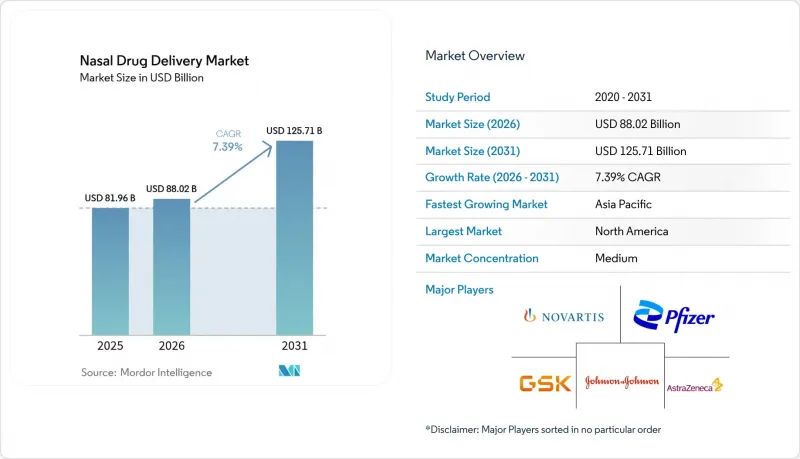
본 보고서는 제형(스프레이, 비강용액·액제, 젤,건조 분말, 기타), 용기 유형(비가압 용기, 가압 용기), 치료 용도(비염, 코막힘, 천식, 통증 관리 등), 최종 사용자(병원, 재택치료 등), 지역(북미, 유럽 등)별로 분류되어 있습니다. 시장 예측은 금액(달러) 기준으로 제시되어 있습니다.
전 세계 경비 약물 전달 시장 동향 및 인사이트
알레르기성 비염 및 만성 부비동염 유병률 증가
알레르기성 비염 및 만성 부비동염의 부담이 증가함에 따라 비강 내 치료에 대한 수요는 견조한 추세를 보이고 있습니다. 2024년 3월, FDA는 비폴립이 동반되지 않은 만성 비부비동염에 대한 플루티카손 프로피오네이트(XHANCE)를 승인하여, 염증이 발생한 비점막을 표적으로 하는 호기 전달 기술의 유효성을 입증했습니다. 3상 임상시험 데이터에서는 증상이 현저히 완화되고 악화 빈도가 감소한 것으로 나타났으며, 이에 따라 해당 호흡기 시장의 범위가 확대되고 있습니다. 파이프라인 프로그램에는 IL-4 수용체 단일클론 항체인 스타포키바트 등의 생물학적 제제도 포함되어 있습니다. 이 약물은 후기 임상시험에서 비증상 및 안증상 점수를 개선하여 표적형 비강 면역 요법의 새로운 부류를 시사하고 있습니다.
자가 투여의 확산
규제 당국은 현재 환자 스스로의 투여를 지지하고 있습니다. 2024년 9월, FDA는 FluMist의 가정 내 사용을 승인했습니다. 이는 자가 투여가 승인된 최초의 백신입니다. 사용성 연구를 통해 모든 연령대에서 안전한 투여가 확인되었으며, 주사에 대한 불안이나 진료소 예약 대기 시간과 같은 병목 현상이 해소되었습니다. 유사한 설계 원칙에 따라 개발된 neffy는 의료진의 감독 없이 응급 시 에피네프린 투여를 가능하게 하여, 주사 기구 사용을 꺼리는 사람들에게 큰 진전을 가져왔습니다. 병원 약사가 진행하는 교육 프로그램을 통해 올바른 사용법을 철저히 지도함으로써, 기기 혁신과 실제 사용 환경에서의 복약 순응도 간의 피드백 루프가 강화되고 있습니다.
과다 사용으로 인한 합병증: 약물성 비염
혈관 수축제의 장기 사용은 반동성 비충혈을 유발할 가능성이 있습니다. 조사에 따르면, 캐나다 이비인후과 의사의 75%가 현재의 경고 문구가 불충분하다고 생각하며, 환자의 30% 가까이가 상담을 받았음에도 불구하고 일반 의약품 스프레이 사용을 중단하지 못하고 있습니다. 중증의 경우, 비갑개 축소술이 필요해져 치료의 복잡성과 비용이 증가합니다.
부문 분석
2025년 현재, 스프레이 제제는 경비 약물 전달 시장의 42.68%를 차지하고 있으며, 이는 수십 년에 걸친 임상적 정착도를 반영합니다. 그러나 기업들이 항체와 펩타이드를 안정화하기 위해 동결건조법 및 분무건조법을 활용함에 따라, 건조 분말은 연평균 10.24%의 성장률을 보일 것으로 예측됩니다. 박막 형태의 동결건조 단일클론 항체는 냉장 보관이 필요 없이 효과적인 에어로졸 성능을 발휘합니다. 호흡 작동식 주입기와 점막 부착성 부형제를 조합함으로써 체류 시간이 더욱 연장됩니다. 비강 스프레이는 소아과 분야에서 여전히 중요한 역할을 하고 있는 반면, 젤 제제는 점막과의 지속적인 접촉이 필요한 만성 질환에 대응하고 있습니다. 각 투여 형태는 저마다 다른 임상적 요구를 충족시키고 있지만, 분말 제제는 안정성과 환자 편의성을 모두 충족시킴으로써 가장 높은 성장세를 보이고 있습니다.
경비 약물 전달 시장에서 건조 분말 시장 규모는 가장 빠른 속도로 확대될 것으로 예상되지만, 스프레이는 계속해서 기본 매출을 지탱하고 있습니다. 제품 설계는 현재 입자 형태와 일관된 투여량을 연계하는 품질 설계(Quality by Design) 프레임워크를 중심으로 진행되고 있습니다. 나노 캐리어가 함유된 분말은 백신, 유전자 치료, 뇌를 표적으로 하는 종양 치료로 치료의 영역을 넓히고 있습니다. 이러한 균형 잡힌 포트폴리오를 통해 제조업체는 성숙한 대량 생산 분야와 높은 성장이 예상되는 혁신적인 분야 사이에서 위험을 분산할 수 있습니다.
비가압형 제제는 저비용 및 단순한 설계 덕분에 2025년 매출의 61.63%를 차지했습니다. 반면, 가압식 시스템은 생물학적 제제에서 정확하고 재현성 있는 투여량이 요구되는 경우가 많기 때문에 연평균 성장률(CAGR) 9.55%의 성장 궤도에 올라 있습니다. Aptar사의 SipNose 기술 인수는 취약한 단백질을 보호하는 소프트 미스트 플랫폼에 대한 자신감을 보여줍니다. Bespak사의 맞춤형 밸브는 더욱 높은 정밀도를 실현하고 있습니다. 동시에, NasaDose와 같은 단일 투여 장치는 무균성을 향상시키기 때문에 응급 상황 시 신경계용 스프레이로 매력적입니다.
경비 약물 전달 시장이 진화함에 따라, 용기 선택은 분자의 복잡성에 점점 더 좌우되고 있습니다. 대형 항체는 분무 형태를 보장하고 전단 응력을 최소화하는 가압식 기기에 적합합니다. 저분자 화합물이나 충혈 완화제는 가격에 민감하기 때문에 펌프식 스프레이가 주류를 이루고 있습니다. 이러한 상반된 요구로 인해 공급업체는 이중 생산 라인을 유지하면서 복합 제품 규정을 충족하기 위해 품질 관리를 강화해야 합니다.
지역별 분석
북미는 성숙한 규제 체계, 조기 도입에 적극적인 보험사, 그리고 알레르기성 비염의 높은 유병률을 배경으로 2025년에도 38.15%의 시장 점유율을 유지했습니다. 또한 이 지역은 FDA의 적극적인 개입을 반영하여 고분자 비강용 바이오의약품의 첫 번째 시장으로 기능하고 있습니다. 유럽은 견고한 보험 환급 제도를 바탕으로 그 뒤를 따르고 있지만, 제네릭 의약품에 의한 가격 억제 영향으로 성장세는 다소 완만해지고 있습니다. 그러나 엄격한 의료기기 관련 지침 덕분에 특수 설계된 복합 제품을 위한 프리미엄 시장은 유지되고 있습니다.
아시아태평양은 연평균 성장률(CAGR) 9.87%라는 눈부신 성장 동력이 되고 있습니다. 2024년 6월 중국에서 우울증 치료제로 에스케타민 비강 스프레이가 승인된 것은 중추신경계 바이오의약품의 개발 경로를 확고히 하고, 치료되지 않은 거대한 시장 부문을 개척했습니다. 일본은 ‘빠른 추격자’로서의 입지를 확립하고 있으며, 2024년 Aculys Pharma사가 디아제팜 승인을 신청한 것은 향후 비강 투여형 발작 응급 치료제의 출시를 예고합니다. 호주 역시 바늘을 사용하지 않는 에피네프린 제제의 승인을 신속하게 진행함으로써 이러한 추세를 반영하고 있습니다.
중동 및 아프리카에서는 콜드체인의 지속적인 구축이 진행되고 있어, 이를 통해 열에 취약한 생물학적 제제를 주요 도시 지역으로 공급할 수 있게 되었습니다. 남미에서는 호흡기 질환 발생률이 높고 외래 진료소가 혼잡하기 때문에 자가 투여가 가능한 스프레이 제제의 매력이 높아지고 있습니다. 공급망이 성숙해짐에 따라 경비 약물 전달 시장은 현지 생산과 규제의 조화를 통해 지리적 확장 범위를 계속 넓혀 나갈 것입니다.
기타 혜택:
- 엑셀 형식 시장 예측(ME) 시트
- 3개월간의 애널리스트 지원
자주 묻는 질문
목차
제1장 서론
제2장 조사 방법
제3장 주요 요약
제4장 시장 구도
제5장 시장 규모와 성장 예측
제6장 경쟁 구도
제7장 시장 기회와 향후 전망
JHS 26.09.09According to Mordor Intelligence, the nasal drug delivery market size is expected to grow from USD 81.96 billion in 2025 to USD 88.02 billion in 2026 and is forecast to reach USD 125.71 billion by 2031 at 7.39% CAGR over 2026-2031.
This report is Segmented by Dosage Form (Sprays, Drops & Liquids, Gels, Dry Powders and Others), Container Type (Non-Pressurized Containers and Pressurized Containers), Therapeutic Application (Rhinitis, Nasal Congestion, Asthma, Pain Management and More), End User (Hospitals, Home Health Care and More) and Geography (North America, Europe, and More). The Market Forecasts are Provided in Terms of Value (USD).
Global Nasal Drug Delivery Market Trends and Insights
Increasing Prevalence of Allergic Rhinitis & Chronic Sinusitis
The rising burden of allergic rhinitis and chronic sinusitis sustains steady demand for intranasal therapies. The FDA cleared fluticasone propionate (XHANCE) for chronic rhinosinusitis without nasal polyps in March 2024, validating exhalation-delivery technology that targets inflamed nasal tissue. Phase 3 data show marked symptom relief and fewer exacerbations, broadening the addressable respiratory market. Pipeline programs extend to biologics such as stapokibart, an IL-4 receptor monoclonal antibody that improved nasal and ocular scores in late-stage trials, pointing to a new class of targeted intranasal immunotherapies.
Growing Adoption of Self-Administration Practices
Regulators now back patient-handled delivery. In September 2024 the FDA authorized FluMist for at-home use, the first vaccine approved for self-administration. Usability studies confirmed safe delivery across age brackets, removing both needle anxiety and clinic scheduling bottlenecks. Similar design principles guided neffy, which enables emergency epinephrine without medical supervision, a meaningful advance for people who avoid injectors. Education programs from hospital pharmacists reinforce correct technique, tightening the feedback loop between device innovation and real-world adherence.
Overuse Complications Causing Rhinitis Medicamentosa
Prolonged vasoconstrictor use can trigger rebound congestion. Surveys show 75% of Canadian otolaryngologists think current warning labels are insufficient, and nearly 30% of patients cannot stop over-the-counter sprays despite counseling. Severe cases call for surgical turbinate reduction, adding complexity and cost.
Other drivers and restraints analyzed in the detailed report include:
- Rising Patient Preference for Needle-Free Routes
- Regulatory Approvals of Large-Molecule Biologics Via Intranasal Route (2025+)
- Patent Cliff For Leading Allergic-Rhinitis Brands (2025-27)
For complete list of drivers and restraints, kindly check the Table Of Contents.
Segment Analysis
Sprays owned 42.68% of the nasal drug delivery market in 2025, reflecting decades of clinical familiarity. Dry powders, however, are projected to grow 10.24% annually as firms harness freeze-drying and spray-drying methods to stabilize antibodies and peptides. Thin-film freeze-dried monoclonal antibodies achieve effective aerosol performance without refrigeration. Breath-actuated insufflators, combined with mucoadhesive excipients, further lift residence time. Drops retain a role in pediatrics, while gels cater to chronic cases needing sustained mucosal contact. Each modality meets distinct clinical needs, yet powders capture the highest forward momentum by marrying stability with patient convenience.
The nasal drug delivery market size for dry powders is set to expand at the fastest clip, whereas sprays continue to anchor baseline revenue. Product design now centers on Quality by Design frameworks that link particle morphology to consistent dosing. Nanocarrier-loaded powders push the therapeutic frontier into vaccines, gene therapy, and brain-targeted oncology. This balanced portfolio lets manufacturers hedge mature volume against high-growth innovation streams.
Non-pressurized formats delivered 61.63% of 2025 sales due to low cost and simple design. Pressurized systems are on a 9.55% CAGR trajectory because biologics often need exact, repeatable doses. Aptar's acquisition of SipNose technology signals confidence in soft-mist platforms that protect fragile proteins. Bespak's customizable valves add another layer of precision. At the same time, unit-dose devices such as NasaDose improve sterility, making them attractive for emergency neurologic sprays.
As the nasal drug delivery market evolves, container choice increasingly follows molecule complexity. Large antibodies favor pressurized devices that guarantee plume geometry and minimal shear stress. Small molecules and decongestants stay in pump sprays for price sensitivity. The push-pull dynamic means suppliers must maintain dual manufacturing lines while upgrading quality control to meet combination-product regulations.
Complete Report Scope:
- By Dosage Form
- Sprays
- Drops & Liquids
- Gels
- Dry Powders
- Others
- By Container Type
- Non-Pressurized Containers
- Pressurized Containers
- By Therapeutic Application
- Rhinitis
- Nasal Congestion
- Asthma
- Pain Management
- Vaccination
- Others
- By End User
- Hospitals
- Home Health Care
- Ambulatory Surgery Centers
- Specialty Clinics
- By Geography
- North America
- United States
- Canada
- Mexico
- Europe
- Germany
- United Kingdom
- France
- Italy
- Spain
- Rest of Europe
- Asia-Pacific
- China
- Japan
- India
- Australia
- South Korea
- Rest of Asia-Pacific
- Middle East and Africa
- GCC
- South Africa
- Rest of Middle East and Africa
- South America
- Brazil
- Argentina
- Rest of South America
- North America
Geography Analysis
North America retained 38.15% market share in 2025 on the back of a mature regulatory framework, early adopter payers, and high allergic-rhinitis prevalence. The region also acts as the first launch pad for large-molecule nasal biologics, reflecting strong FDA engagement. Europe follows with robust reimbursement structures, yet growth is more measured as generics temper price points. Stringent device guidelines, though, preserve premium space for engineered combination products.
Asia Pacific is the standout growth engine at a 9.87% CAGR. China's June 2024 approval of esketamine nasal spray for depression validated the route for central-nervous-system biologics and unlocked a sizeable untreated segment. Japan positions itself as a fast follower: Aculys Pharma's diazepam filing in 2024 signals future intranasal seizure-rescue launches. Australia mirrors these trends by fast-tracking needle-free epinephrine.
Middle East and Africa benefit from ongoing cold-chain upgrades that allow sensitive biologics to reach major urban centers. In South America, high respiratory-disease incidence and crowded outpatient clinics strengthen the appeal of self-administered sprays. As supply chains mature, the nasal drug delivery market will continue to widen its geographic footprint through localized manufacturing and regulatory harmonization.
- Solventum
- Neurelis Inc.
- AptarGroup Inc.
- AstraZeneca
- BD (Becton, Dickinson & Co.)
- GlaxoSmithKline
- Johnson & Johnson
- Merck
- Novartis
- Pfizer
- Teva Pharmaceutical Industries
- Cipla
- Bausch Health
- OptiNose Inc.
- Impel NeuroPharma Inc.
- Kurve Technology Inc.
- Recipharm
- Sun Pharma Industries Ltd.
- Hikma Pharmaceuticals
- Dr. Reddy's Laboratories Ltd.
- Sandoz Group
Additional Benefits:
- The market estimate (ME) sheet in Excel format
- 3 months of analyst support
TABLE OF CONTENTS
1 Introduction
- 1.1 Study Assumptions and Market Definition
- 1.2 Scope of the Study
2 Research Methodology
3 Executive Summary
4 Market Landscape
- 4.1 Market Overview
- 4.2 Market Drivers
- 4.2.1 Increasing Prevalence Of Allergic Rhinitis & Chronic Sinusitis
- 4.2.2 Growing Adoption Of Self-Administration Practices
- 4.2.3 Rising Patient Preference For Needle-Free Routes
- 4.2.4 Regulatory Approvals Of Large-Molecule Biologics Via Intranasal Route (2025+)
- 4.2.5 Pandemic-Driven Cold-Chain Cost-Saving Push
- 4.2.6 Sensor-Enabled Smart Nasal Devices For Adherence Tracking
- 4.3 Market Restraints
- 4.3.1 Overuse Complications Causing Rhinitis Medicamentosa
- 4.3.2 Patent Cliff For Leading Allergic-Rhinitis Brands (2025-27)
- 4.3.3 Cold-Chain Integrity Risk For Temperature-Sensitive Biologics
- 4.3.4 Stringent Regulations
- 4.4 Value / Supply-Chain Analysis
- 4.5 Regulatory Landscape
- 4.6 Technology Outlook
- 4.7 Porter's Five Forces Analysis
- 4.7.1 Bargaining Power of Suppliers
- 4.7.2 Bargaining Power of Buyers
- 4.7.3 Threat of New Entrants
- 4.7.4 Threat of Substitutes
- 4.7.5 Intensity of Competitive Rivalry
5 Market Size and Growth Forecasts (Value-USD)
- 5.1 By Dosage Form
- 5.1.1 Sprays
- 5.1.2 Drops & Liquids
- 5.1.3 Gels
- 5.1.4 Dry Powders
- 5.1.5 Others
- 5.2 By Container Type
- 5.2.1 Non-Pressurized Containers
- 5.2.2 Pressurized Containers
- 5.3 By Therapeutic Application
- 5.3.1 Rhinitis
- 5.3.2 Nasal Congestion
- 5.3.3 Asthma
- 5.3.4 Pain Management
- 5.3.5 Vaccination
- 5.3.6 Others
- 5.4 By End User
- 5.4.1 Hospitals
- 5.4.2 Home Health Care
- 5.4.3 Ambulatory Surgery Centers
- 5.4.4 Specialty Clinics
- 5.5 By Geography
- 5.5.1 North America
- 5.5.1.1 United States
- 5.5.1.2 Canada
- 5.5.1.3 Mexico
- 5.5.2 Europe
- 5.5.2.1 Germany
- 5.5.2.2 United Kingdom
- 5.5.2.3 France
- 5.5.2.4 Italy
- 5.5.2.5 Spain
- 5.5.2.6 Rest of Europe
- 5.5.3 Asia-Pacific
- 5.5.3.1 China
- 5.5.3.2 Japan
- 5.5.3.3 India
- 5.5.3.4 Australia
- 5.5.3.5 South Korea
- 5.5.3.6 Rest of Asia-Pacific
- 5.5.4 Middle East and Africa
- 5.5.4.1 GCC
- 5.5.4.2 South Africa
- 5.5.4.3 Rest of Middle East and Africa
- 5.5.5 South America
- 5.5.5.1 Brazil
- 5.5.5.2 Argentina
- 5.5.5.3 Rest of South America
- 5.5.1 North America
6 Competitive Landscape
- 6.1 Market Concentration
- 6.2 Market Share Analysis
- 6.3 Company profiles (includes Global level Overview, Market level overview, Core Segments, Financials as available, Strategic Information, Market Rank/Share for key companies, Products and Services, and Recent Developments)
- 6.3.1 Solventum
- 6.3.2 Neurelis Inc.
- 6.3.3 AptarGroup Inc.
- 6.3.4 AstraZeneca PLC
- 6.3.5 BD (Becton, Dickinson & Co.)
- 6.3.6 GlaxoSmithKline PLC
- 6.3.7 Johnson & Johnson Services Inc.
- 6.3.8 Merck & Co., Inc.
- 6.3.9 Novartis AG
- 6.3.10 Pfizer Inc.
- 6.3.11 Teva Pharmaceutical Industries Ltd.
- 6.3.12 Cipla Ltd.
- 6.3.13 Bausch Health Companies Inc.
- 6.3.14 OptiNose Inc.
- 6.3.15 Impel NeuroPharma Inc.
- 6.3.16 Kurve Technology Inc.
- 6.3.17 Recipharm AB
- 6.3.18 Sun Pharma Industries Ltd.
- 6.3.19 Hikma Pharmaceuticals PLC
- 6.3.20 Dr. Reddy's Laboratories Ltd.
- 6.3.21 Sandoz International GmbH
7 Market Opportunities and Future Outlook
- 7.1 White-Space and Unmet-Need Assessment


