

|
시장보고서
상품코드
2123349
휴대폰 반도체 시장 : 점유율 분석, 업계 동향과 통계, 성장 예측(2026-2031년)Mobile Phone Semiconductor - Market Share Analysis, Industry Trends & Statistics, Growth Forecasts (2026 - 2031) |
||||||
 Mordor Intelligence
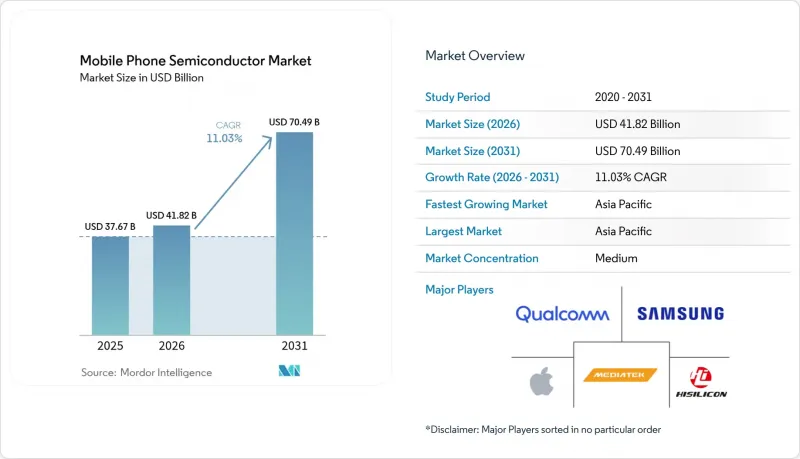
Mordor Intelligence에 의하면, 2026년 휴대폰 반도체 시장 규모는 418억 2,000만 달러로 추정되고 있어 2025년 376억 7,000만 달러에서 확대해, 2031년에는 704억 9,000만 달러에 이를 것으로 예측됩니다.
2026년부터 2031년까지의 연평균 성장률(CAGR)은 11.03%를 나타낼 전망입니다.
본 보고서는 구성 요소(모바일 프로세서, 메모리 IC, 로직 IC, 아날로그 IC, 전원 관리 IC, RF IC 및 커넥티비티 IC, 디스플레이 드라이버 IC, 오디오 IC, 센서), 기술 노드(28nm 등), 그리고 지역별로 분류되어 있습니다. 시장 전망은 금액(달러) 기준으로 제시되어 있습니다.
전 세계 휴대폰 반도체 시장 동향 및 인사이트
5G 스마트폰의 보급
5G 지원 단말기의 출하 대수가 급증함에 따라, 휴대폰 반도체 시장은 계속해서 높은 성장 궤도에 올라 있습니다. Qualcomm의 X85 모뎀은 10 Gbps의 피크 처리량을 실현하고 AI를 활용한 신호 처리 기능을 탑재하고 있어, 이로 인해 RF 프런트엔드 모듈 1개당 달러 환산 비용이 약 20% 증가했습니다. 4G에서 5G로의 전환에는 멀티밴드 파워 앰프, Sub-6GHz 및 mm파(mmWave) 안테나, 그리고 더욱 엄격한 열 관리가 필요하며, 이 각각이 다이 면적 증가로 이어지고 있습니다. 삼성의 엑시노스 모뎀 5400은 2024년에 위성 폴백 기능을 도입하여 외딴 지역에서도 지속적인 연결을 보장했습니다. 이러한 요구 사항으로 인해 모뎀용 7nm 공정 및 관련 RF 트랜시버용 성숙한 28nm 공정의 웨이퍼 시작 수가 증가하고 있으며, 하나의 휴대폰 SKU가 종종 4개의 서로 다른 공정 노드에서 웨이퍼를 조달하고 있는 실태가 부각되고 있습니다. 그 결과, 아시아태평양 파운드리 업체들의 팹 가동률은 높은 수준을 유지하고 있으며, 휴대폰 반도체 시장에 긍정적인 영향을 미치는 공급 압력이 지속되고 있습니다.
디바이스 내 AI/ML 채택 확대
AI 추론은 지연 시간 단축과 개인정보 보호를 목적으로 디바이스 내부로 이전되고 있으며, 이에 따라 애플리케이션 프로세서의 연산 밀도 목표가 높아지고 있습니다. MediaTek의 MT6825는 클라우드 기반 추론에 비해 40%의 에너지 절약 효과를 입증하여, 로컬 처리에 따른 비용상의 이점을 부각시켰습니다. 뉴럴 엔진은 단일 기판 위에서 CPU, GPU, 이미지 신호 프로세서, 5G 베이스밴드와 공존해야 하며, 이것이 치플릿 기반 SoC 설계를 촉진하고 있습니다. 애플의 최신 A 시리즈 프로세서에는 대규모 언어 모델을 로컬에서 실행하는 AI 가속기가 통합되어 있으며, 이에 따라 안드로이드 벤더들은 45 TOPS를 실현하는 전용 텐서 유닛으로의 전환을 추진하고 있습니다. 이 기능에서는 더 많은 SRAM과 고속 칩 간 상호 연결이 활용되기 때문에 로직과 메모리를 근접하게 배치하는 첨단 패키징 기술에 대한 수요가 높아지고 있습니다. 그 결과, 1대당 실리콘 실적가 확대되어 휴대폰 반도체 시장의 매출이 두 자릿수 성장을 유지하고 있습니다.
공급망의 주기성과 가격 압박
메모리 및 아날로그 반도체의 경기 순환은 휴대폰 반도체 시장에 변동을 초래하고 있습니다. DRAM 가격 하락에 따라 마이크론(Micron)의 2025년 1분기 매출은 15% 감소했습니다. 이는 단 한 분기 만에 전체 밸류체인의 이익률이 훼손될 수 있음을 보여줍니다. 휴대폰의 계절적 생산 확대는 호황과 불황의 변동 폭을 확대시켜, 2차 공급업체를 재고 충격에 노출시키고 있습니다. 수요가 정점에 달했을 때 자금을 조달하는 경우가 많은 생산 능력 확충은 수요가 정상화되는 바로 그 시점에 시장에 공급 과잉을 초래합니다. 그 결과 발생하는 공급 과잉은 평균 판매 가격을 끌어내리지만, 동시에 업계 재편을 유발하여 시간이 지남에 따라 시장 집중도를 높이고 있습니다.
부문 분석
2025년, 모바일 프로세서는 휴대폰 반도체 시장에서 32.80%의 시장 점유율을 유지하며, 점점 더 소형화되는 기판 공간 내에서 AI 추론, 5G 연결, 이미지 처리 파이프라인, 센서 융합을 조정하는 아키텍처의 핵심으로서의 위상을 강조했습니다. 이 부품 등급과 관련된 휴대폰 반도체 시장 규모는 치플릿(chiplet) 및 첨단 패키징 기술이 통합 밀도의 추가적인 향상을 주도함에 따라 2031년까지 연평균 성장률(CAGR) 10.88%로 확대될 것으로 예측됩니다. 연평균 성장률(CAGR) 12.60%로 가장 높은 성장률을 보이는 센서 분야는 멀티모달 생체 인증, 대기질 추적, 그리고 AI 어시스턴트에 요구되는 상황 인식에 대한 수요 증가에 부응하고 있습니다.
메모리 IC는 고대역폭 DRAM을 통해 AI 네이티브 워크로드를 지원하는 반면, 로직 IC는 좁은 AI 커널의 부하를 경감하는 도메인 특화형 가속기로 진화하고 있습니다. 디지털화의 진전이 가속화되는 가운데에서도 아날로그 IC는 신호 조정에서 여전히 중요한 역할을 수행하고 있습니다. 전원 관리 IC의 복잡성은 멀티 스탠다드 급속 충전 및 AI 엔진에 맞춘 동적 전압 스케일링으로 인해 증가하고 있습니다. RF 및 커넥티비티 IC에는 현재 Wi-Fi 7 및 Bluetooth 5.4가 통합되어 있으며, 조만간 위성 송수신기도 통합될 예정이어서 단말기 1대당 BOM(부품표) 비용이 증가하고 있습니다. 디스플레이 드라이버 IC에는 가변 리프레시 레이트 기능이 내장되어 있으며, 오디오 IC에는 비디오 게임 및 몰입형 미디어의 동향에 부응하는 공간 재생 기능과 온칩 노이즈 캔슬링 DSP가 탑재되어 있습니다.
지역별 분석
아시아태평양은 깊이 뿌리내린 제조 클러스터, 정부의 우대 조치, 그리고 휴대폰 조립 거점과의 근접성을 배경으로 2025년 휴대폰 반도체 시장에서 53.90%의 점유율을 차지했습니다. 중국은 2024년, 주로 전원 관리 및 연결 장치를 공급하는 28nm 노드에서 웨이퍼 생산 능력을 13% 증가한 월 860만 장으로 확대했습니다. 대만은 TSMC를 통해 고성능 로직 분야를 장악하고 있는 반면, 한국은 삼성과 SK하이닉스를 통해 메모리 분야를 선도하고 있습니다. 인도가 대규모 조립 거점으로 부상함에 따라 현지 테스트 및 패키징에 대한 부수적인 수요가 발생하고 있으며, 이 지역은 세계 평균을 상회하는 연평균 성장률(CAGR) 12.05%를 나타낼 것으로 전망됩니다.
북미에서 휴대폰 반도체의 입지는 설계 IP 분야의 리더십과 CHIPS법에 힘입어 촉진된 새로운 팹 투자에 달려 있습니다. TSMC의 애리조나 공장은 2025년 초에 4nm 공정 생산을 시작하여 미국의 고급 휴대전화 브랜드에 생산 능력을 제공합니다. 인텔이 오하이오주에서 추진하는 200억 달러 규모의 확장 계획에는 모바일용으로 최적화된 생산 능력 구축이 포함되어 있지만, 아시아 경쟁사들에 비해 비용 면에서의 역풍은 여전히 비교적 강한 상황입니다. 이 지역은 IP 관리 강화와 설계 센터 및 첨단 제조 라인 간의 연구개발 주기 단축이라는 이점을 누리고 있습니다.
유럽은 전략적 자율성과 환경적 지속가능성을 우선시하고 있습니다. EU의 칩스법은 2030년까지 세계 시장 점유율 20% 달성을 목표로 하고 있으며, 휴대폰보다 자동차용 및 산업용 칩에 더 많은 자금을 배정하고 있습니다. 세계파운드리와 UMC의 합병 협상은 전 세계 수탁 제조 능력의 10%를 통합하고, 지정학적으로 균형 잡힌 브랜드를 구축하는 것을 목표로 하고 있습니다. 중동 및 아프리카에서는 휴대전화 공급업체의 다각화에 따라 후공정 조립 사업의 전망이 밝아지고 있습니다. 남미는 여전히 최종 조립 단계에 머무르는 소규모 진출 지역이지만, 무역 협정의 개선을 통해 향후 테스트 및 패키징 사업이 유치될 가능성이 있습니다.
기타 혜택:
- 엑셀 형식 시장 예측(ME) 시트
- 3개월간의 애널리스트 지원
자주 묻는 질문
목차
제1장 서론
제2장 조사 방법
제3장 주요 요약
제4장 시장 구도
제5장 시장 규모와 성장 예측
제6장 경쟁 구도
제7장 시장 기회와 향후 전망
JHS 26.09.09According to Mordor Intelligence, the mobile phone semiconductor market size in 2026 is estimated at USD 41.82 billion, growing from 2025 value of USD 37.67 billion with 2031 projections showing USD 70.49 billion, growing at 11.03% CAGR over 2026-2031.
This report is Segmented by Component (Mobile Processors, Memory ICs, Logic ICs, Analog ICs, Power Management ICs, RF ICs and Connectivity ICs, Display Driver ICs, Audio ICs, and Sensors), Technology Node ( 28 Nm), and Geography. The Market Forecasts are Provided in Terms of Value (USD).
Global Mobile Phone Semiconductor Market Trends and Insights
Proliferation of 5G Smartphones
Surging shipment volumes of 5G handsets continue to propel the mobile phone semiconductor market onto a high-growth trajectory. Qualcomm's X85 modem delivers 10 Gbps peak throughput and incorporates AI-assisted signal processing, increasing RF front-end module dollar content by nearly 20% per unit. The leap from 4G to 5G requires multi-band power amplifiers, sub-6 GHz and mmWave antennas, and tighter thermal management, each of which adds die area. Samsung's Exynos Modem 5400 introduced satellite fallback in 2024, ensuring continuous connectivity in remote areas. These requirements amplify wafer starts at 7 nm for modems and at mature 28 nm for companion RF transceivers, underlining how a single handset SKU often pulls wafers from four distinct process nodes. Consequently, fab utilization at APAC foundries remains elevated, sustaining supply pressure that benefits the mobile phone semiconductor market.
Rising Adoption of On-Device AI/ML
AI inferencing is migrating on-device to reduce latency and maintain privacy, thereby increasing compute density targets for application processors. MediaTek's MT6825 demonstrated 40% energy savings compared to cloud-based inference, highlighting the cost advantages associated with local processing. Neural engines must coexist with CPUs, GPUs, image signal processors, and 5G basebands on a single substrate, driving chiplet-based SoC designs. Apple's latest A-series processor integrates AI accelerators that execute large language models locally, prompting Android vendors to pivot toward dedicated tensor units that deliver 45 TOPS. This functionality utilizes more SRAM and high-speed inter-chip interconnects, driving demand for advanced packaging that keeps logic and memory in proximity. The outcome is a wider silicon footprint per handset, reinforcing double-digit revenue expansion for the mobile phone semiconductor market.
Supply-Chain Cyclicality and Pricing Pressure
Memory and analog cycles inject volatility into the mobile phone semiconductor market. Micron's Q1 2025 revenue slipped 15% as DRAM prices softened, showing how a single quarter can erode margins across the value chain. Seasonal handset ramps amplify boom-bust swings, leaving tier-2 suppliers exposed to inventory shocks. Capacity builds, often funded during peak demand, flood the market just as demand normalizes. The resultant oversupply compresses average selling prices, yet simultaneously sparks consolidation that nudges the market toward higher concentration ratios over time.
Other drivers and restraints analyzed in the detailed report include:
- Growing Memory Content Per Handset
- High-Refresh OLED Displays
- Geopolitical Export Restrictions
For complete list of drivers and restraints, kindly check the Table Of Contents.
Segment Analysis
Mobile processors retained a 32.80% market share of the mobile phone semiconductor market in 2025, underscoring their status as architectural hubs that coordinate AI inference, 5G connectivity, imaging pipelines, and sensor fusion within an increasingly compact board footprint. The mobile phone semiconductor market size associated with this component class is forecast to grow at an 10.88% CAGR through 2031, as chiplets and advanced packaging drive another wave of integration density. Sensors, the fastest-growing component group with a 12.60% CAGR, meet the rising demand for multimodal biometric authentication, air-quality tracking, and contextual awareness required by AI assistants.
Memory ICs anchor AI-native workloads through higher-bandwidth DRAM, while Logic ICs evolve into domain-specific accelerators that offload narrow AI kernels. Analog ICs still matter for signal conditioning even as digital take-over accelerates. Power management IC complexity increases with multi-standard fast charging and dynamic voltage scaling tailored to AI engines. RF and connectivity ICs now integrate Wi-Fi 7, Bluetooth 5.4, and soon satellite transceivers, swelling per-handset BOM. Display driver ICs incorporate variable refresh intelligence, and Audio ICs feature spatial playback and on-chip noise cancellation DSPs that align with trends in videogames and immersive media.
Complete Report Scope:
- By Component
- Mobile Processors
- Memory ICs
- Logic ICs
- Analog ICs
- Power Management ICs
- RF ICs and Connectivity ICs
- Display Driver ICs
- Audio ICs
- Sensors (Motion sensors, Environmental Sensors, Positioning Sensors, Image Sensors, Biometric Sensors, etc.)
- By Technology Node
- < 3 nm
- 3 nm
- 5 nm
- 7 nm
- 16 nm
- 28 nm
- > 28 nm
- By Geography
- North America
- United States
- Canada
- Mexico
- South America
- Brazil
- Argentina
- Rest of South America
- Europe
- Germany
- United Kingdom
- France
- Italy
- Spain
- Rest of Europe
- Asia-Pacific
- China
- Japan
- South Korea
- India
- Singapore
- Australia
- Rest of Asia-Pacific
- Middle East and Africa
- Middle East
- Saudi Arabia
- United Arab Emirates
- Turkey
- Rest of Middle East
- Africa
- South Africa
- Nigeria
- Egypt
- Rest of Africa
- Middle East
- North America
Geography Analysis
The Asia-Pacific region held 53.90% of the mobile phone semiconductor market in 2025, driven by its deeply entrenched manufacturing clusters, government incentives, and proximity to handset assembly centers. China increased its installed wafer capacity by 13% to 8.6 million wafers per month in 2024, primarily at 28 nm nodes that supply power-management and connectivity devices. Taiwan dominates high-performance logic via TSMC, while Korea leads memory through Samsung and SK Hynix. India's ascent as a large-scale assembly hub is creating adjacent demand for local test and packaging, stamping the region with a forecast 12.05% CAGR that exceeds the global baseline.
North America's mobile phone semiconductor footprint hinges on design IP leadership and new fab investments catalyzed by the CHIPS Act. TSMC's Arizona plant began 4 nm production in early 2025, offering capacity to premium U.S. handset brands. Intel's USD 20 billion Ohio expansion envisions mobile-optimized capacity, although cost headwinds remain relatively higher compared to its Asian peers. The region benefits from tighter IP control and shorter R&D loops between design centers and advanced manufacturing lines.
Europe prioritizes strategic autonomy and environmental sustainability. The EU Chips Act aims for a 20% global market share by 2030, allocating more funds toward automotive and industrial chips than handsets. GlobalFoundries-UMC merger talks aim to consolidate 10% of othe worldwide contract capacity, providing a brand with geopolitical balance. The Middle East and Africa offer prospects for back-end assembly as mobile phone vendors diversify. South America remains a modest participant, capped at final assembly, yet improving trade pacts could eventually draw test and package operations.
- Qualcomm Incorporated
- MediaTek Inc.
- Samsung Electronics Co., Ltd.
- Apple Inc.
- HiSilicon Technologies Co., Ltd.
- UNISOC Technologies Co., Ltd.
- Intel Corporation (Foundry Services)
- Advanced Micro Devices, Inc.
- NVIDIA Corporation
- Texas Instruments Incorporated
- Analog Devices, Inc.
- Skyworks Solutions, Inc.
- Qorvo, Inc.
- Murata Manufacturing Co., Ltd.
- NXP Semiconductors N.V.
- STMicroelectronics N.V.
- Infineon Technologies AG
- Micron Technology, Inc.
- SK hynix Inc.
- Kioxia Corporation
- Sony Semiconductor Solutions Corporation
- ON Semiconductor Corporation
- Dialog Semiconductor GmbH
- Cirrus Logic, Inc.
- Rohm Co., Ltd.
Additional Benefits:
- The market estimate (ME) sheet in Excel format
- 3 months of analyst support
TABLE OF CONTENTS
1 INTRODUCTION
- 1.1 Study Assumptions and Market Definition
- 1.2 Scope of the Study
2 RESEARCH METHODOLOGY
3 EXECUTIVE SUMMARY
4 MARKET LANDSCAPE
- 4.1 Market Overview
- 4.2 Market Drivers
- 4.2.1 Proliferation of 5G smartphones
- 4.2.2 Rising adoption of on-device AI/ML
- 4.2.3 Growing memory content per handset
- 4.2.4 High-refresh OLED displays
- 4.2.5 Satellite connectivity enablement
- 4.2.6 Fan-out wafer-level SiP adoption
- 4.3 Market Restraints
- 4.3.1 Supply-chain cyclicality and pricing pressure
- 4.3.2 Geopolitical export restrictions
- 4.3.3 Sub-5 nm thermal/yield challenges
- 4.3.4 OEM consolidation trimming TAM for tier-2 vendors
- 4.4 Industry Value Chain Analysis
- 4.5 Regulatory Landscape
- 4.6 Technological Outlook
- 4.7 Porter's Five Forces Analysis
- 4.7.1 Threat of New Entrants
- 4.7.2 Bargaining Power of Buyers
- 4.7.3 Bargaining Power of Suppliers
- 4.7.4 Threat of Substitutes
- 4.7.5 Intensity of Competitive Rivalry
- 4.8 Impact of Macroeconomic Trends on the Market
5 MARKET SIZE AND GROWTH FORECASTS (VALUES)
- 5.1 By Component
- 5.1.1 Mobile Processors
- 5.1.2 Memory ICs
- 5.1.3 Logic ICs
- 5.1.4 Analog ICs
- 5.1.5 Power Management ICs
- 5.1.6 RF ICs and Connectivity ICs
- 5.1.7 Display Driver ICs
- 5.1.8 Audio ICs
- 5.1.9 Sensors (Motion sensors, Environmental Sensors, Positioning Sensors, Image Sensors, Biometric Sensors, etc.)
- 5.2 By Technology Node
- 5.2.1 < 3 nm
- 5.2.2 3 nm
- 5.2.3 5 nm
- 5.2.4 7 nm
- 5.2.5 16 nm
- 5.2.6 28 nm
- 5.2.7 > 28 nm
- 5.3 By Geography
- 5.3.1 North America
- 5.3.1.1 United States
- 5.3.1.2 Canada
- 5.3.1.3 Mexico
- 5.3.2 South America
- 5.3.2.1 Brazil
- 5.3.2.2 Argentina
- 5.3.2.3 Rest of South America
- 5.3.3 Europe
- 5.3.3.1 Germany
- 5.3.3.2 United Kingdom
- 5.3.3.3 France
- 5.3.3.4 Italy
- 5.3.3.5 Spain
- 5.3.3.6 Rest of Europe
- 5.3.4 Asia-Pacific
- 5.3.4.1 China
- 5.3.4.2 Japan
- 5.3.4.3 South Korea
- 5.3.4.4 India
- 5.3.4.5 Singapore
- 5.3.4.6 Australia
- 5.3.4.7 Rest of Asia-Pacific
- 5.3.5 Middle East and Africa
- 5.3.5.1 Middle East
- 5.3.5.1.1 Saudi Arabia
- 5.3.5.1.2 United Arab Emirates
- 5.3.5.1.3 Turkey
- 5.3.5.1.4 Rest of Middle East
- 5.3.5.2 Africa
- 5.3.5.2.1 South Africa
- 5.3.5.2.2 Nigeria
- 5.3.5.2.3 Egypt
- 5.3.5.2.4 Rest of Africa
- 5.3.5.1 Middle East
- 5.3.1 North America
6 COMPETITIVE LANDSCAPE
- 6.1 Market Concentration
- 6.2 Strategic Moves
- 6.3 Market Share Analysis
- 6.4 Company Profiles (includes Global level Overview, Market level overview, Core Segments, Financials as available, Strategic Information, Market Rank/Share for key companies, Products and Services, and Recent Developments)
- 6.4.1 Qualcomm Incorporated
- 6.4.2 MediaTek Inc.
- 6.4.3 Samsung Electronics Co., Ltd.
- 6.4.4 Apple Inc.
- 6.4.5 HiSilicon Technologies Co., Ltd.
- 6.4.6 UNISOC Technologies Co., Ltd.
- 6.4.7 Intel Corporation (Foundry Services)
- 6.4.8 Advanced Micro Devices, Inc.
- 6.4.9 NVIDIA Corporation
- 6.4.10 Texas Instruments Incorporated
- 6.4.11 Analog Devices, Inc.
- 6.4.12 Skyworks Solutions, Inc.
- 6.4.13 Qorvo, Inc.
- 6.4.14 Murata Manufacturing Co., Ltd.
- 6.4.15 NXP Semiconductors N.V.
- 6.4.16 STMicroelectronics N.V.
- 6.4.17 Infineon Technologies AG
- 6.4.18 Micron Technology, Inc.
- 6.4.19 SK hynix Inc.
- 6.4.20 Kioxia Corporation
- 6.4.21 Sony Semiconductor Solutions Corporation
- 6.4.22 ON Semiconductor Corporation
- 6.4.23 Dialog Semiconductor GmbH
- 6.4.24 Cirrus Logic, Inc.
- 6.4.25 Rohm Co., Ltd.
7 MARKET OPPORTUNITIES AND FUTURE OUTLOOK
- 7.1 White-space and Unmet-Need Assessment


