

|
시장보고서
상품코드
2123350
수술용 드레싱 시장 : 점유율 분석, 업계 동향과 통계, 성장 예측(2026-2031년)Surgical Dressing - Market Share Analysis, Industry Trends & Statistics, Growth Forecasts (2026 - 2031) |
||||||
 Mordor Intelligence
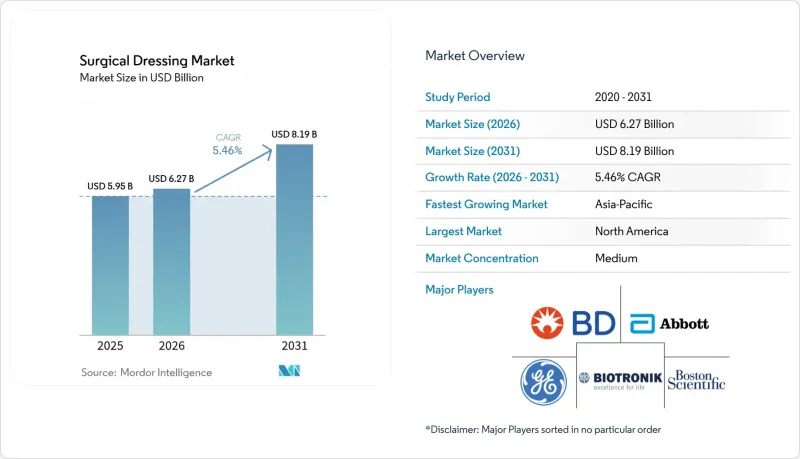
Mordor Intelligence에 의하면, 수술용 드레싱 시장 규모는 2025년 59억 5,000만 달러에서 2026년에는 62억 7,000만 달러로 확대되어 2026년부터 2031년까지 CAGR 5.46%로 성장을 지속하여, 2031년에는 81억 9,000만 달러에 이를 것으로 예측됩니다.

본 보고서에서는 업계를 제품별(1차 드레싱, 2차 드레싱), 용도별(궤양, 화상, 장기 이식 등), 최종 사용자별(병원 및 진료소, 외래수술센터(ASC) 등), 상처 유형별(급성 상처, 만성 상처),소재별(천연섬유 등), 그리고 지역별로 분류하고 있습니다. 시장 규모 및 전망은 금액(미 달러) 기준으로 제시되어 있습니다.
전 세계 수술용 드레싱 시장 동향 및 인사이트
고령화와 만성 상처 증가
만성 상처는 이미 전 세계적으로 4,000만 명 이상에게 영향을 미치고 있으며, 미국의 의료 시스템에는 매년 280억 달러 이상의 비용 부담을 안겨주고 있습니다. 당뇨병과 말초동맥질환은 궤양 위험을 높이기 때문에 국제 당뇨병 족부 워킹그룹(IWGD)은 치유되지 않는 궤양에 대해 옥타황산 수크로스 드레싱의 사용을 권장하고 있습니다. 메디케어 보고서에 따르면, 수급자의 10.5%가 만성 상처를 앓고 있으며, 이는 과도한 의료 자원을 소모하고 있기 때문에 보험사들은 치유 기간을 단축하는 치료법을 환영하고 있습니다. 메타분석에 따르면, 첨단 드레싱은 기존 거즈에 비해 상처 표면 폐쇄를 평균 1.09일 앞당기고 통증 점수를 낮추는 것으로 나타났습니다. 이러한 인구통계학적 요인으로 인해 수술용 드레싱 시장에서는 첨단 제품이든 표준 제품이든 경기 침체의 영향을 덜 받는 안정적인 수요가 뒷받침되고 있습니다.
외래 및 재택 치료로의 전환
외래 시설로의 치료 전환에 따라, 더 오랜 기간 부착할 수 있고 자가 관리를 간소화하는 드레싱에 대한 수요가 증가하고 있습니다. WoundConnect와 같은 원격 모니터링 플랫폼은 임상의가 매일 병원을 방문하지 않고도 치유 경과를 파악할 수 있게 하여, 병원 이용률을 최대 15%까지 감소시킵니다. 새로운 CMS 코드(G0541, G0542)에서는 원격 의료를 통해 제공되는 간병인을 위한 상처 관리 교육 비용이 지급되므로, 재택 관리가 촉진되고 있습니다. Solventum사의 ‘V.A.C. Peel &Place’ 드레싱은 7일간 착용과 2분의 적용 시간을 가정하여 설계되었으며, 외래 진료로의 전환에 부합하는 제품의 대표적인 예입니다. 이러한 요인들이 복합적으로 작용하여, 수술용 드레싱 시장 전반에서 장기 착용형이며 전문 지식이 크게 필요하지 않은 솔루션에 대한 수요가 증가하고 있습니다.
엄격한 다관할구역에 걸친 규제 절차
EU 의료기기 규정에서는 현재 종합적인 임상 평가와 시판 후 조사가 의무화되어 있어, 승인까지 12-18개월의 추가 기간과 막대한 비용이 소요되고 있습니다. FDA는 항균 드레싱을 클래스 I에서 클래스 II 또는 III로 재분류하는 것에 대해 협의 중이며, 이로 인해 많은 기존 제품들이 더욱 엄격한 시판 전 심사 대상이 될 가능성이 있습니다. 일본은 G7 국가 중 의료기기 승인까지 소요되는 기간이 가장 길며, 의약품 및 의료기기 종합기구(PMDA)에 따르면 평균 24-36개월이 소요됩니다. 소프트웨어가 내장된 스마트 드레싱은 사이버 보안 측면에서 추가적인 심사의 대상이 되고 있어, 중소기업에게는 큰 과제가 되고 있습니다. 이러한 장벽으로 인해 수술용 드레싱 시장에서 신기술 도입이 지연되고 있습니다.
부문 분석
2025년, 1차 드레싱은 상처 부위에서 중심적인 역할을 수행하고 있기 때문에 수술용 드레싱 시장 매출의 65.98%를 차지했습니다. 하이드로겔 및 알긴산염 계열 제품은 이상적인 수분 균형을 유지하고 있으며, 최근 임상시험에서 거즈에 비해 상처 봉합이 1.09일 빨라지는 것으로 나타났습니다. 현재 필름 드레싱에는 눈에 보이는 증상이 나타나기 전에 감염을 감지하는 인쇄형 pH 센서가 내장되어 있어, 임상의에게 조기 경보의 이점을 제공합니다. 고흡수성 폴리머를 사용한 폼 드레싱은 폴 하트만(Paul Hartmann)사가 실리콘 폼의 꾸준한 보급에 힘입어 상처 치료 분야에서 6억 890만 유로의 매출을 기록한 데 따라 시장 점유율을 확대했습니다. 2차 드레싱은 다층적인 치료 프로토콜에서 더 높은 흡수성과 고정성이 요구됨에 따라 연평균 성장률(CAGR) 5.98%로 가장 빠르게 성장하고 있습니다. 각 기업은 허약한 환자의 피부 부담을 줄이면서도 7일간 착용에 견딜 수 있는 밀폐성을 유지할 수 있도록 접착 가장자리의 개선을 추진하고 있습니다.
블루투스 연결이 가능한 스마트 1차 드레싱은 배터리 수명 및 비용 제약으로 인해 여전히 틈새 시장에 머물러 있지만, 재향군인 병원에서 실시된 파일럿 연구에서는 환자 만족도가 높은 것으로 나타났습니다. 합성 폴리머 필름이 여전히 판매량의 대부분을 차지하고 있지만, 필요에 따라 항균제를 방출하는 생체공학 기반 셀룰로오스 복합재가 임상의들의 관심을 끌고 있습니다. 가치 기반 계약에서는 재입원율이 낮은 점이 높이 평가되므로, 구매자들은 기능성 드레싱의 높은 단가와 입증된 총 의료비 절감 효과를 저울질하며 검토하고 있습니다. 끊임없는 혁신을 통해 1차 드레싱은 수술용 드레싱 시장의 최전선에 계속해서 자리 잡고 있습니다.
2025년 수술용 드레싱 시장 규모 중 궤양 치료가 31.02%를 차지하고 있으며, 이는 고령화 사회에서 욕창 및 정맥성 궤양이 지속적으로 부담으로 작용하고 있음을 반영합니다. 한편, 당뇨병 관련 수술은 연평균 성장률(CAGR) 5.79%로 가장 빠르게 성장하는 이용 사례가 되고 있습니다. 국제 당뇨병성 족부 병변 워킹그룹(IWGDF)은 현재, 표준 치료를 4주간 시행해도 신경 허혈성 궤양의 치유가 정체될 경우, 수크로스 옥타설페이트 드레싱의 사용을 권장하고 있습니다. 심혈관 수술 후의 음압 요법으로 인해 적용 범위는 더욱 확대되고 있습니다.
화상 치료는 여전히 은 함침형 제품에 의존하고 있지만, 최적의 이온 방출량에 대한 논의는 계속되고 있습니다. 장기 이식 환자들은 육아종 형성을 촉진하면서도 기회감염을 예방할 수 있는 고성능 드레싱을 원하고 있습니다. 보험사는 고가의 드레싱을 여러 번 사용하는 것을 승인할 때 사진 증빙이나 디지털 면적 측정을 점점 더 요구하고 있으며, 이로 인해 공급업체들은 스마트 제품에 이미지 촬영 기능을 탑재해야 하는 압박을 받고 있습니다. 이러한 진화하는 요구 사항은 수술용 드레싱 시장 전체에서 전문 분야의 성장 전망을 뒷받침하고 있습니다.
지역별 분석
북미는 계속해서 주도적인 위치를 유지하고 있으며, 2025년에는 수술용 드레싱 시장의 41.72%를 차지할 것으로 예측됩니다. 메디케어 및 민간 보험사의 관대한 보험 급여 덕분에, 치유 기간 단축 및 내원 횟수 감소로 이어지는 기술이 높이 평가받고 있습니다. 2025년, 미국 국방부는 스미스 앤 네퓨(Smith & Nephew)사에 음압 요법 시스템과 관련된 7,500만 달러 규모의 계약을 수주했습니다. 이는 정부가 첨단 치료법에 신뢰를 두고 있음을 보여줍니다. 특정 피부 대체재를 상처 관리 제품으로 분류하는 CMS(미국 의료보험·의료서비스센터)의 최근 정책 전환으로 인해 청구 절차가 간소화되어 프리미엄 제품의 보급이 가속화되고 있습니다. 또한, Aurase Wound Gel과 같은 세포 치료제에 대한 FDA(미국 식품의약국)의 패스트트랙 지정은 생물학적 혁신에 대한 규제 당국의 지지를 보여줍니다.
아시아태평양은 가장 급속한 성장을 보이고 있으며, 2031년까지 연평균 성장률(CAGR) 6.88%로 성장할 전망입니다. 중국의 2024년 의료기기법은 품질 관리를 강화하는 한편, 국가약품감독관리국(NMPA)을 통해 긴급히 필요한 제품에 대한 신속 심사 절차를 마련하고 있습니다. 인도의 의료기기 홍보에 관한 자율 규제 규정은 윤리적인 마케팅과 보다 명확한 표시를 장려하여 임상의들의 신뢰도를 높이는 데 기여하고 있습니다. 일본의 400억 달러 규모 의료기기 시장은 고령화와 국민건강보험제도로 인해 수요가 뒷받침되며 성장을 이어가고 있지만, 승인까지의 장기화가 신속한 시장 출시를 저해하고 있습니다. 호주에서는 특정 해외 승인을 상호 인정함으로써, 이미 FDA 승인을 획득한 상처 드레싱의 등록 절차가 신속화되어 수출업체에 혜택을 주고 있습니다.
유럽에서는 규정 준수 비용의 상승에도 불구하고, ‘의료기기 규정(MDR)’ 하에서 꾸준한 성장이 나타나고 있습니다. 임상 데이터 및 시판 후 조사에 조기에 투자해 온 기업들은 이제 경쟁 우위를 확보하고 있습니다. 하트만(Hartmann)사는 병원의 입찰로 인한 가격 압박이 있었음에도 불구하고, 실리콘 폼의 보급에 힘입어 2024년 상처 관리 분야에서 4.4%의 유기적 성장을 기록했습니다. 북유럽 국가들의 지속가능성 목표에 따라 순환 경제 정책에 부합하는 생분해성 드레싱의 시범 도입이 진행되고 있습니다. 브렉시트 이후, 영국 제조업체들은 CE 마크와 UKCA 마크를 별도로 신청해야 하여 절차가 복잡해졌지만, 한편으로는 국내 혁신 보조금의 활성화도 촉진하고 있습니다. 모든 하위 지역에서 다양한 환급 제도에 따라 지역별 경제적 근거가 요구되고 있어, 공급업체는 각 지불자 제도에 맞추어 가치 관련 자료를 조정할 수밖에 없는 상황입니다.
기타 혜택:
- 엑셀 형식 시장 예측(ME) 시트
- 3개월간의 애널리스트 지원
자주 묻는 질문
목차
제1장 서론
제2장 조사 방법
제3장 주요 요약
제4장 시장 구도
제5장 시장 규모와 성장 예측
제6장 경쟁 구도
제7장 시장 기회와 향후 전망
JHS 26.09.07According to Mordor Intelligence, the surgical dressings market size is expected to grow from USD 5.95 billion in 2025 to USD 6.27 billion in 2026 and is forecast to reach USD 8.19 billion by 2031 at 5.46% CAGR over 2026-2031.
This report Segments the Industry Into by Product (Primary Dressing, Secondary Dressing), by Application (Ulcers, Burns, Organ Transplants, and More), by End-User (Hospitals/Clinics, Ambulatory Surgical Centers, and More), Wound Type (Acute Wounds and Chronic Wounds), Material (Natural Fibers, and More), and Geography. The Market Sizes and Forecasts are Provided in Terms of Value (USD).
Global Surgical Dressing Market Trends and Insights
Aging Population & Rise in Chronic Wounds
Chronic wounds already affect more than 40 million people worldwide and cost the United States healthcare system over USD 28 billion each year . Diabetes and peripheral arterial disease elevate ulcer risk, prompting the International Working Group on the Diabetic Foot to recommend sucrose octasulfate dressings for non-healing ulcers . Medicare reports that 10.5% of beneficiaries present with chronic wounds but generate outsized resource use, so payers welcome therapies that shorten healing time. Meta-analyses show advanced dressings can accelerate closure by an average of 1.09 days and lower pain scores versus traditional gauze. This demographic driver supports steady, recession-resistant demand across advanced and standard products in the surgical dressings market.
Shift Toward Outpatient & Home-Based Care
Procedure migration to ambulatory sites raises need for dressings that stay in place longer and simplify self-care. Remote monitoring platforms such as WoundConnect help clinicians oversee healing progress without daily visits, reducing hospital utilization by up to 15%. New CMS codes (G0541, G0542) pay for caregiver wound-care training delivered via telehealth, incentivizing home-based management. Solventum's V.A.C. Peel & Place dressing, designed for seven-day wear and two-minute application, typifies products tailored to the outpatient shift. These factors collectively lift demand across the surgical dressings market for extended-wear, low-skill solutions.
Stringent Multi-Jurisdiction Regulatory Pathways
The EU Medical Device Regulation now demands comprehensive clinical evaluation and post-market surveillance, adding 12-18 months and significant expense to approval timelines. The FDA is consulting on reclassifying antimicrobial dressings from Class I to Class II or III, which could shift many legacy products into a stricter pre-market review. Japan continues to post the longest med-tech approval lag among G7 countries, averaging 24-36 months according to its Pharmaceuticals and Medical Devices Agency. Smart dressings that incorporate software draw additional cybersecurity scrutiny, challenging smaller firms. These hurdles slow roll-out of novel technologies within the surgical dressings market.
Other drivers and restraints analyzed in the detailed report include:
- Product Innovations in Antimicrobial & Bio-Active Dressings
- Reimbursement Expansion for Advanced Dressings (US, EU)
- Price Erosion from Tender-Driven Hospital Procurement
For complete list of drivers and restraints, kindly check the Table Of Contents.
Segment Analysis
Primary dressings generated 65.98% of surgical dressings market revenue in 2025 due to their central role at the wound bed. Hydrogel and alginate variants maintain an ideal moisture balance, and recent trials show a 1.09-day faster closure versus gauze. Film dressings now house printed pH sensors that flag infection ahead of visible symptoms, giving clinicians an early-warning advantage. Foam dressings with super-absorbent polymers gained share after Paul Hartmann reported EUR 608.9 million in wound revenue on strong silicone-foam uptake. Secondary dressings grow fastest at 5.98% CAGR because layered protocols call for added absorption and securement. Companies refine adhesive borders to reduce skin trauma in frail patients while retaining seal integrity for seven-day wear.
Smart primary dressings capable of Bluetooth connectivity remain a niche, limited by battery life and cost, yet pilot studies in veteran hospitals show high patient satisfaction. Synthetic polymer films still dominate volume but bio-engineered cellulose composites that release antimicrobials on demand capture clinician interest. As value-based contracts reward lower readmissions, purchasers weigh the higher unit price of active dressings against demonstrated reductions in total care costs. Continuous innovation keeps primary dressings at the forefront of the surgical dressings market.
Ulcer care contributed 31.02% to the surgical dressings market size in 2025, reflecting the ongoing burden of pressure and venous ulcers among aging populations. Yet diabetes-related surgery represents the fastest-growing use case at 5.79% CAGR. The International Working Group on the Diabetic Foot now endorses sucrose octasulfate dressings when neuro-ischemic ulcers stall after four weeks of standard care. Negative-pressure therapy after cardiovascular procedures further broadens application scope.
Burn treatment remains dependent on silver-impregnated options, but debate over optimal ion release persists. Organ-transplant recipients demand high-performance dressings that guard against opportunistic infections while promoting granulation. Payers increasingly require photographic proof and digital planimetry to authorize multiple high-cost dressing applications, pushing suppliers to embed image-capture tools within smart products. These evolving needs reinforce growth prospects for specialty segments within the wider surgical dressings market.
Complete Report Scope:
- By Product
- Primary Dressing
- Film Dressing
- Hydrogel Dressing
- Hydrocolloid Dressing
- Foam Dressing
- Alginate Dressing
- Other Primary Dressings
- Secondary Dressing
- Absorbents
- Bandages
- Adhesive Tapes
- Protectives
- Other Secondary Dressings
- Primary Dressing
- By Application
- Ulcers
- Burns
- Organ Transplants
- Cardiovascular Surgery
- Diabetes-Related Surgery
- Other Applications
- By End-User
- Hospitals & Clinics
- Ambulatory Surgical Centers
- Home-Care & Other End-Users
- By Wound Type
- Acute Wounds
- Chronic Wounds
- By Material
- Natural Fibers
- Synthetic Polymers
- Bio-engineered / Composite
- By Geography
- North America
- United States
- Canada
- Mexico
- Europe
- Germany
- United Kingdom
- France
- Italy
- Spain
- Rest of Europe
- Asia-Pacific
- China
- Japan
- India
- Australia
- South Korea
- Rest of Asia-Pacific
- Middle East & Africa
- GCC
- South Africa
- Rest of Middle East & Africa
- South America
- Brazil
- Argentina
- Rest of South America
- North America
Geography Analysis
North America maintains leadership, holding 41.72% of the surgical dressings market in 2025. Robust reimbursement under Medicare and private payers rewards technologies that shorten healing or reduce clinic visits. The Department of Defense in 2025 awarded Smith+Nephew a USD 75 million contract for negative-pressure systems, signaling government confidence in advanced modalities. Recent CMS policy shifts that classify certain skin substitutes as wound management products simplify billing, fostering faster uptake of premium offerings. FDA fast-track designations for cellular therapies such as Aurase Wound Gel indicate regulatory support for biologic innovation.
Asia-Pacific is the fastest-growing region, expanding at a 6.88% CAGR through 2031. China's 2024 medical device law tightens quality management while setting accelerated review lanes for urgently needed products via its National Medical Products Administration. India's voluntary code on medical device promotion encourages ethical marketing and clearer labeling, improving clinician trust. Japan's USD 40 billion device market grows as its aging population and universal coverage sustain demand, although lengthy approval timelines constrain rapid launches. Australia's recognition of select overseas approvals speeds registration for dressings that already hold FDA clearance, benefiting exporters.
Europe records steady growth under the Medical Device Regulation despite higher compliance costs. Companies that invested early in clinical data and post-market surveillance now gain a competitive edge. Hartmann reported 4.4% organic wound-care growth in 2024, aided by silicone foam uptake, even as hospital tenders drove pricing pressure. Sustainability goals in Nordic countries have prompted pilots of biodegradable dressings, aligning with circular-economy policies. Post-Brexit, UK manufacturers must file separate CE and UKCA submissions, adding complexity but also stimulating domestic innovation grants. Across all sub-regions, diverse reimbursement schemes require localized economic evidence, compelling suppliers to tailor value dossiers to each payer system.
- 3M
- Smiths Group
- Molnlycke Health Care
- Convatec
- Coloplast
- Cardinal Health
- Medtronic
- Medline Industries
- Johnson & Johnson
- B. Braun
- Hollister
- Hartmann Group
- Lohmann & Rauscher GmbH
- Urgo Medical
- BSN medical (Essity)
- Acelity (KCI) - 3M Advanced Wound Care
- Derma Sciences (Integra LifeSciences)
- Winner Medical Co.
- Advancis Medical
- Medipur
Additional Benefits:
- The market estimate (ME) sheet in Excel format
- 3 months of analyst support
TABLE OF CONTENTS
1 Introduction
- 1.1 Study Assumptions & Market Definition
- 1.2 Scope of the Study
2 Research Methodology
3 Executive Summary
4 Market Landscape
- 4.1 Market Overview
- 4.2 Market Drivers
- 4.2.1 Ageing population & rise in chronic wounds
- 4.2.2 Shift toward outpatient & home-based care
- 4.2.3 Product innovations in antimicrobial & bio-active dressings
- 4.2.4 Reimbursement expansion for advanced dressings (US, EU)
- 4.2.5 Growth of surgical volumes in emerging Asia
- 4.2.6 Integration of smart/IoT sensors in dressings
- 4.3 Market Restraints
- 4.3.1 Stringent multi-jurisdiction regulatory pathways
- 4.3.2 Price erosion from tender-driven hospital procurement
- 4.3.3 Supply-chain volatility in specialty polymers & fibers
- 4.3.4 Clinical data gaps limiting adoption of "smart" dressings
- 4.4 Value / Supply-Chain Analysis
- 4.5 Regulatory Landscape
- 4.6 Technological Outlook
- 4.7 Porter's Five Forces Analysis
- 4.7.1 Threat of New Entrants
- 4.7.2 Bargaining Power of Buyers
- 4.7.3 Bargaining Power of Suppliers
- 4.7.4 Threat of Substitutes
- 4.7.5 Intensity of Competitive Rivalry
5 Market Size & Growth Forecasts (Value)
- 5.1 By Product
- 5.1.1 Primary Dressing
- 5.1.1.1 Film Dressing
- 5.1.1.2 Hydrogel Dressing
- 5.1.1.3 Hydrocolloid Dressing
- 5.1.1.4 Foam Dressing
- 5.1.1.5 Alginate Dressing
- 5.1.1.6 Other Primary Dressings
- 5.1.2 Secondary Dressing
- 5.1.2.1 Absorbents
- 5.1.2.2 Bandages
- 5.1.2.3 Adhesive Tapes
- 5.1.2.4 Protectives
- 5.1.2.5 Other Secondary Dressings
- 5.1.1 Primary Dressing
- 5.2 By Application
- 5.2.1 Ulcers
- 5.2.2 Burns
- 5.2.3 Organ Transplants
- 5.2.4 Cardiovascular Surgery
- 5.2.5 Diabetes-Related Surgery
- 5.2.6 Other Applications
- 5.3 By End-User
- 5.3.1 Hospitals & Clinics
- 5.3.2 Ambulatory Surgical Centers
- 5.3.3 Home-Care & Other End-Users
- 5.4 By Wound Type
- 5.4.1 Acute Wounds
- 5.4.2 Chronic Wounds
- 5.5 By Material
- 5.5.1 Natural Fibers
- 5.5.2 Synthetic Polymers
- 5.5.3 Bio-engineered / Composite
- 5.6 By Geography
- 5.6.1 North America
- 5.6.1.1 United States
- 5.6.1.2 Canada
- 5.6.1.3 Mexico
- 5.6.2 Europe
- 5.6.2.1 Germany
- 5.6.2.2 United Kingdom
- 5.6.2.3 France
- 5.6.2.4 Italy
- 5.6.2.5 Spain
- 5.6.2.6 Rest of Europe
- 5.6.3 Asia-Pacific
- 5.6.3.1 China
- 5.6.3.2 Japan
- 5.6.3.3 India
- 5.6.3.4 Australia
- 5.6.3.5 South Korea
- 5.6.3.6 Rest of Asia-Pacific
- 5.6.4 Middle East & Africa
- 5.6.4.1 GCC
- 5.6.4.2 South Africa
- 5.6.4.3 Rest of Middle East & Africa
- 5.6.5 South America
- 5.6.5.1 Brazil
- 5.6.5.2 Argentina
- 5.6.5.3 Rest of South America
- 5.6.1 North America
6 Competitive Landscape
- 6.1 Market Concentration
- 6.2 Market Share Analysis
- 6.3 Company Profiles (includes Global level Overview, Market level overview, Core Segments, Financials as available, Strategic Information, Market Rank/Share, Products & Services, Recent Developments)
- 6.3.1 3M Company
- 6.3.2 Smith & Nephew Plc
- 6.3.3 Molnlycke Health Care AB
- 6.3.4 ConvaTec Group Plc
- 6.3.5 Coloplast A/S
- 6.3.6 Cardinal Health Inc.
- 6.3.7 Medtronic Plc
- 6.3.8 Medline Industries LP
- 6.3.9 Johnson & Johnson (Ethicon)
- 6.3.10 B. Braun SE
- 6.3.11 Hollister Inc.
- 6.3.12 Paul Hartmann AG
- 6.3.13 Lohmann & Rauscher GmbH
- 6.3.14 Urgo Medical
- 6.3.15 BSN medical (Essity)
- 6.3.16 Acelity (KCI) - 3M Advanced Wound Care
- 6.3.17 Derma Sciences (Integra LifeSciences)
- 6.3.18 Winner Medical Co.
- 6.3.19 Advancis Medical
- 6.3.20 Medipur
7 Market Opportunities & Future Outlook
- 7.1 White-Space & Unmet-Need Assessment


