

|
시장보고서
상품코드
2123356
위식도 역류질환 시장 : 점유율 분석, 업계 동향과 통계, 성장 예측(2026-2031년)Gastroesophageal Reflux Disease - Market Share Analysis, Industry Trends & Statistics, Growth Forecasts (2026 - 2031) |
||||||
 Mordor Intelligence
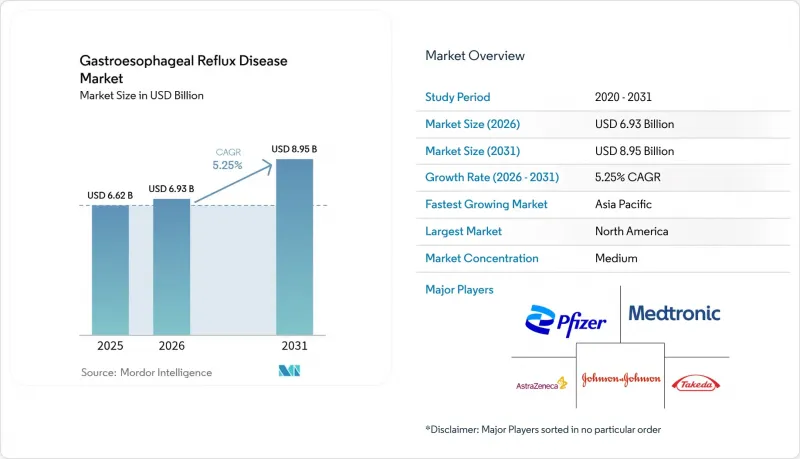
Mordor Intelligence에 의하면, 위식도 역류질환(GERD) 시장 규모는 2025년 66억 2,000만 달러, 2026년 69억 3,000만 달러에서 2031년까지 89억 5,000만 달러로 확대된다고 예측되고 있어 2026년부터 2031년까지 연평균 복합 성장률(CAGR)은 5.25%를 나타낼 전망입니다.
본 보고서는 솔루션 유형(진단 (내시경 검사, pH 및 임피던스 모니터링 등), 치료 (약물 요법 등)), 질환 표현형(NERD 등), 치료 라인(1차 선택 경험적 치료 등), 환자층(소아, 성인, 고령자),최종 사용자(병원 등), 지역(북미 등)별로 분류되어 있습니다. 시장 전망은 금액(달러) 기준으로 제시되어 있습니다.
전 세계 위식도 역류질환(GERD) 시장 동향 및 인사이트
비만과 고령화로 인한 GERD 유병률 상승
2024년, 전 세계 비만율은 미국 성인의 42.4%에 달하며, 65세 이상 고령자는 전 세계 인구의 17.3%를 차지하고 있어, 이로 인해 역류성 식도염의 발생률이 상승하고 있습니다. 내장 지방은 복강 내 압력을 상승시켜 하부 식도 괄약근의 일시적인 이완을 유발합니다. 이것이 비만 수술 대상자에서 동년배 대조군의 10%에 비해 미란성 식도염 유병률이 30%를 초과하는 이유입니다. 일본에서는 평균 수명의 연장과 칼슘 채널 차단제 사용 증가에 따라, 2020년부터 2025년까지 70세 이상 시민의 GERD 진단 건수가 18% 증가했습니다. 중국에서는 서유럽화된 식생활과 장시간 앉아 있는 사무직 업무를 배경으로, 2023년부터 2025년까지 1선 도시에서 역류성 식도염 진료 건수가 22% 급증했습니다. 이러한 인구 동향은 고령자용 제제 및 바렛 식도증의 경과 관찰에 대한 지속적인 수요를 뒷받침하고 있습니다.
산 분비 억제제의 일반의약품(OTC) 판매 현황 및 제네릭 의약품 보급률
2025년, 미국 내 PPI(양성자 펌프 억제제) 판매량 중 일반의약품인 오메프라졸 및 에소메프라졸이 35%를 차지하며, 공식적으로 진단받은 치료 대상 사례를 넘어 수요가 확대되었습니다. 2024년, 인도산 제네릭 판토프라졸은 20mg당 0.05달러 미만으로 판매되어, 이로 인해 2급 도시 전체의 약국 매출이 28% 증가했습니다. 브라질에서는 2025년 8월에 판타프라졸의 OTC 판매가 승인되었으며, 유통업체들은 이러한 변화로 인해 2년 이내에 국내 소비량이 15% 증가할 것으로 전망하고 있습니다. 경쟁으로 인해 브랜드 제품의 이익률이 압박받는 한편(프로토닉스의 매출액은 판매량이 정체된 상태임에도 불구하고 2025년에 12% 감소했습니다), 오리지널 제약사들은 PCAB 및 알긴산염 복합제로의 전환을 추진하고 있습니다.
PPI의 장기 사용에 따른 안전성 우려가 규제 당국의 면밀한 검토를 불러일으키고 있습니다.
유럽의약품청(EMA)은 2025년 1월, 3개월 연속 사용 후 발생하는 저마그네슘혈증에 대해 경고하는 새로운 PPI 첨부 문서를 지시했습니다. JAMA Internal Medicine지에 게재된 7만 3,000명의 사용자를 대상으로 한 코호트 연구에서는 치매 발병 위험비가 1.44인 것으로 나타났으며, 이에 따라 2025년 9월 FDA가 자문위원회를 통한 검토를 시작했습니다. 2025년 말까지 미국 1차 진료 의사 중 54%가 합병증이 없는 GERD 발병 후 12주 이내에 PPI 용량을 점진적으로 줄이려고 시도하고 있으며, 이는 2023년의 38%에서 증가한 수치입니다. 일본 규제 당국은 현재 시판 후 5년간의 골밀도 조사를 의무화하고 있어, 소규모 제네릭 제약사에 부담을 주고 있습니다.
부문 분석
내시경 검사, 임피던스 pH 모니터링, 압력 측정 및 영상 진단은 2026년부터 2031년까지 합계 연평균 성장률(CAGR) 9.33%로 확대되어, 위식도 역류질환 시장 전체의 5.25%라는 성장 속도의 거의 2배에 달했습니다. 이러한 호조세는 감염 방지 대책의 의무화로 인해 의료기관이 1회당 300-500달러 상당의 일회용 내시경을 도입하게 된 점과, 고액 치료를 시행하기 전에 난치성 표현형을 특정하는 클라우드 연동형 검사가 보급된 점을 반영한 것입니다. 치료제 분야는 2025년에도 여전히 매출의 84.32%를 차지하고 있으며, 그 원동력은 저가형 양성자 펌프 억제제와 아직 발전 단계에 있지만 급속히 보급되고 있는 칼륨 경쟁형 산 분비 억제제(KCAB) 계열로, 이들은 중증 미란성 식도염 분야에서 시장 점유율을 확대되고 있습니다.
진단 분야의 호재는 50세 이상 만성 역류성 식도염 환자에 대해 3년마다 바렛 식도 모니터링을 권장하는 지침 개정에 따라 더욱 강화되고 있습니다. 이 프로토콜에 따라 북미에서만 약 210만 건의 검사 대상이 확대될 것으로 예측됩니다. 복강경 위저부 접합술, 내시경 하 봉합술, 자기 괄약근 강화술,고주파 절제술과 같은 의료기기 및 시술 분야는 2024년부터 2025년까지 지역 의료기관에서의 시술 건수가 29% 증가했음을 보여주는 메디케어 청구 데이터에 힘입어, 3차 의료기관에서 외래 수술실로 전환되었습니다. 디지털 테라퓨틱스 시장 규모는 여전히 작지만, 2025년에는 140만 건의 다운로드를 기록했습니다. 또한 초기 연구 결과에 따르면, 스마트폰을 활용한 자세 교정을 통해 PPI(양성자 펌프 억제제)의 1일 복용량을 줄일 수 있는 것으로 나타났으며, 독일의 보험사는 현재 이 지표를 만성 질환 코드 하에서 보험 적용 대상으로 포함하고 있습니다.
비궤양성 역류질환은 2025년 매출의 67.25%를 차지했습니다. 이는 높은 유병률과 반복 처방에 따른 수익으로 이어지는 만성 약물 요법에 대한 의존에 힘입어, 위식도 역류질환 시장에서 가장 큰 연간 수익원이 되고 있습니다. 로스앤젤레스 분류의 A-D 등급으로 정의되는 미란성 식도염은 합병증이 없는 나머지 사례를 차지하며, 의료기기 사용을 촉진했습니다. 이는 등급 C 및 D 병변에서 약물 요법으로 조절이 어려워진 경우, 종종 위저부 접합술이나 LINX 이식술이 시행되기 때문입니다.
바렛 식도 및 기타 합병증을 동반한 GERD 표현형은 2024년 지침에 따라 남성의 선별 검사 시작 연령이 50세로 낮아지고, 장상피화생을 92% 근절하는 고주파 절제술 프로토콜이 권장됨에 따라,2031년까지 연평균 성장률(CAGR) 8.53%로 확대되고 있습니다. 메디케어 보험 수리 담당자의 추산에 따르면, 인구 기반 바렛 식도 프로그램이 승인될 경우,연간 80만 건의 내시경 검사가 추가될 것이며, 이러한 급증으로 인해 2028년 위식도 역류질환(GERD) 시장 규모에 진단 관련 증분 수익으로 약 3억 2,000만 달러가 더해질 전망입니다. 병기가 낮은 NERD 환자는 내시경 검사 횟수가 적고(5년간 환자 1인당 0.3회), 반면 시판되는 PPI나 알긴산염 제제의 처방 횟수가 많아집니다. 이러한 추세는 대부분의 신흥 경제국에서 제네릭 의약품 판매량이 브랜드 의약품 처방량을 4대 1의 비율로 상회하고 있는 제네릭 의약품 제조업체들에게 유리하게 작용할 것입니다.
지역별 분석
2025년, 북미는 매출의 37.34%를 차지하여 다른 어떤 지역보다 훨씬 더 큰 비중을 차지했습니다. 이 시장은 보험사의 높은 보장률, PCAB의 조기 도입, 그리고 자기 괄약근 강화술 시술 시설 기반의 풍부함으로 인해 혜택을 받고 있습니다. 또한, 감염과 관련된 법적 위험이 예방적 조달을 촉진하고 있기 때문에 일회용 내시경의 보급도 이 지역에서 가장 빠르게 진행되고 있습니다. ASC(외래수술센터(ASC))로의 전환이 가장 두드러지는 곳은 텍사스주, 플로리다주, 캘리포니아주이며, 이 지역들은 필요성 증명서(Certificate of Need)에 관한 규제가 완화되어 있어 시설의 수용 능력을 신속하게 증감시킬 수 있습니다. PCAB 처방 건수는 증가 추세에 있지만, 단계적 치료(스텝 테라피) 규정에 따라 저비용 PPI가 1차 선택 약물로 계속해서 지배적인 위치를 차지하고 있습니다. 이러한 사실은 전반적인 가격 상승을 억제하는 한편, 위식도 역류질환(GERD) 시장에서 단위당 회전율을 높이고 있습니다.
아시아태평양은 중국과 인도에서의 비만 증가에 더해, 공공 프로그램을 통한 바렛 식도 선별 검사의 시범 도입으로 지방 병원에 대한 내시경 검사 수요가 확대되고 있어, 2031년까지 연평균 성장률(CAGR)이 7.42%로 세계에서 가장 빠른 속도로 성장할 전망입니다. 중국에서는 10개 성을 대상으로 한 시범 사업을 통해 2027년까지 50만 건의 내시경 검사가 공공 자금으로 지원될 예정이며, 이에 따라 Aohua 등 현지 제조업체들이 공급 체계를 정비하고 있는 수요가 창출될 것입니다. 인도에서는 2025년에 제네릭 PPI 수출액이 4억 2,000만 달러에 달할 전망이며, 국내 시장에서는 1달러 미만의 가격 책정에도 불구하고 국내 기업들에게 세계 진출 기회와 높은 이익률을 가져다주고 있습니다. 일본에서는 지난 10년 동안 PCAB의 보급이 진행되어 왔으며, 2025년에는 보노플라잔이 GERD 신규 치료 시작의 40%를 차지할 것으로 예상되어, 이는 광역 지역에서의 도입을 위한 모범 사례가 되고 있습니다.
유럽의 성숙한 PPI 시장에서는 매출 성장률이 한 자릿수 초반으로 둔화되고 있지만, 일회용 내시경과 PCAB가 다시 탄력을 받고 있습니다. 독일, 영국, 프랑스에서는 감염 예방 예산이 배정되어 일회용 내시경 구매가 가속화되고 있는 반면, 남유럽 및 동유럽 시장에서는 자본적인 이유로 재사용 가능한 내시경의 사용이 계속되고 있습니다. 유럽의약품청(EMA)에 의한 규제 통일화로 의료기기 승인이 가속화되고 있지만, 동시에 안전성에 관한 경고도 증가하고 있어, 이것이 PPI의 장기 투여 일수를 단축하는 요인이 되고 있습니다. 남미에서는 꾸준한 확장이 관찰되지만, 보험 급여 상한선으로 인해 성장에 제동이 걸리고 있습니다. 브라질에서는 ANVISA의 2025년 규제 변경 이후 OTC PPI의 보급률이 상승했으나, 고가 의료기기는 여전히 비급여 진료 영역에 머물러 있습니다.
중동 및 아프리카는 3차 소화기 의료 거점에 투자하는 고소득 걸프협력회의(GCC) 회원국과, 내시경 부족으로 어려움을 겪는 사하라 이남 경제권으로 나뉩니다. 나이지리아에서는 2025년 공립 병원의 62%에서 4주 이상 지속된 소모품 재고 부족이 보고되었습니다. 사하라 이남 아프리카에서는 주민 100만 명당 평균 0.8대의 내시경이 이용되고 있는 반면, OECD 회원국에서는 100만 명당 47대입니다. 이러한 구조적 장벽으로 인해 검진은 질병의 후기 단계로 제한되고 있으며, 해당 지역의 위식도 역류질환(GERD) 시장에서는 의약품 판매량이 계속해서 높은 수준을 유지하고 있습니다.
기타 혜택:
- 엑셀 형식 시장 예측(ME) 시트
- 3개월간의 애널리스트 지원
자주 묻는 질문
목차
제1장 서론
제2장 조사 방법
제3장 주요 요약
제4장 시장 구도
제5장 시장 규모와 성장 예측
제6장 경쟁 구도
제7장 시장 기회와 향후 전망
JHS 26.09.09According to Mordor Intelligence, the gastroesophageal reflux disease market size is projected to expand from USD 6.62 billion in 2025 and USD 6.93 billion in 2026 to USD 8.95 billion by 2031, registering a CAGR of 5.25% between 2026 to 2031.
This report is Segmented by Solution Type (Diagnostics [Endoscopy, PH & Impedance Monitoring, and More], Therapeutics [Phramacological and More]), Disease Phenotype (NERD, and More), Line of Therapy (First-Line, and More), Patient Demographics (Pediatric, Adult, Geriatric), End User (Hospitals, and More), and Geography (North America, and More). Market Forecasts are Provided in Value (USD).
Global Gastroesophageal Reflux Disease Market Trends and Insights
Rising GERD Prevalence from Obesity and Ageing
Global obesity reached 42.4% of U.S. adults in 2024, while those aged >=65 formed 17.3% of the world's population, intensifying reflux incidence. Visceral fat raises intra-abdominal pressure and drives transient lower-esophageal sphincter relaxations, explaining why bariatric-surgery candidates show erosive esophagitis prevalence above 30% versus 10% in age-matched controls. Japan logged an 18% rise in GERD diagnoses among citizens over 70 between 2020 and 2025 as life expectancy lengthened and calcium-channel-blocker use climbed. China saw reflux consultations surge 22% in tier-1 cities from 2023-2025 amid Westernized diets and sedentary office work. These demographics underpin sustained demand for geriatric-friendly formulations and Barrett's surveillance.
OTC Availability and Generic Penetration of Acid Suppressants
Over-the-counter omeprazole and esomeprazole captured 35% of U.S. PPI unit volume in 2025, enlarging the treated pool beyond formally diagnosed cases. Indian generic pantoprazole sold below USD 0.05 per 20 mg dose in 2024, spurring a 28% pharmacy-sales jump across tier-2 cities. Brazil permitted OTC pantoprazole in August 2025, a change distributors expect to lift national consumption 15% within two years. While price competition trims branded margins-Protonix revenue slipped 12% in 2025 despite flat volume-innovators are pivoting to PCABs and alginate blends.
Long-Term PPI Safety Concerns Triggering Regulatory Scrutiny
The European Medicines Agency ordered new PPI labels in January 2025 warning of hypomagnesemia after three months of continuous use. A JAMA Internal Medicine cohort of 73 000 users showed a 1.44 hazard ratio for dementia, prompting FDA advisory review in September 2025. By late 2025, 54% of U.S. primary-care doctors attempted PPI tapering within 12 weeks of uncomplicated GERD onset, up from 38% in 2023. Japan's regulator now demands five-year post-marketing bone-density studies, straining smaller generic makers
Other drivers and restraints analyzed in the detailed report include:
- Breakthroughs in Minimally Invasive Anti-Reflux Devices and Diagnostics
- Surge in Single-Use Endoscopy Driven by Infection-Control Mandates
- Rapid Price Erosion Following Blockbuster Patent Expiries
For complete list of drivers and restraints, kindly check the Table Of Contents.
Segment Analysis
Endoscopy, impedance-pH monitoring, manometry, and imaging together expanded at a 9.33% CAGR between 2026 and 2031, almost double the 5.25% pace of the overall Gastroesophageal Reflux Disease market. This outperformance reflects infection-control mandates that nudged providers toward single-use scopes priced at USD 300-500 per use and cloud-linked tests that clarify refractory phenotypes before high-cost interventions. Therapeutics still delivered an 84.32% revenue contribution in 2025, anchored by low-priced proton-pump inhibitors and an embryonic but fast-moving potassium-competitive acid-blocker class that wins share in severe erosive esophagitis.
The diagnostic tailwind is strengthened by guideline changes recommending Barrett's surveillance every three years for chronic reflux patients aged >50, a protocol that widens the procedure pool by an estimated 2.1 million cases in North America alone. Device and procedural lines-laparoscopic fundoplication, endoscopic suturing, magnetic sphincter augmentation, and radiofrequency ablation-migrated from tertiary centers to ambulatory surgical suites, helped by Medicare claims that showed a 29% jump in community facility volumes between 2024 and 2025. Digital therapeutics remain small but logged 1.4 million downloads in 2025, and early evidence suggests smartphone-based posture coaching can cut daily PPI use, a metric payers in Germany now reimburse under chronic-disease codes.
Non-erosive reflux disease contributed 67.25% of 2025 revenue, sustained by high prevalence and chronic pharmacotherapy dependence that translates into repeat prescription income, the single largest annuity line in the Gastroesophageal Reflux Disease market. Erosive esophagitis, defined by Los Angeles grades A-D, supplied the remainder of uncomplicated cases and spurred device usage, as grade C and D lesions often trigger fundoplication or LINX implantation when pharmacologic control stalls.
Barrett's esophagus and other complicated GERD phenotypes are advancing at an 8.53% CAGR through 2031 after 2024 guidelines lowered the male screening age to 50 and endorsed radiofrequency ablation protocols that record 92% intestinal-metaplasia eradication. Medicare actuaries estimate that a population-based Barrett's program would insert 800 000 extra endoscopies annually if approved, a surge that would add roughly USD 320 million in incremental diagnostic revenue to the Gastroesophageal Reflux Disease market size for 2028. Down-staged NERD users generate fewer scopes-0.3 per patient over five years-but higher OTC PPI and alginate turns, a pattern that benefits generics producers whose volumes outstrip branded scripts four-to-one in most emerging economies.
Complete Report Scope:
- By Solution Type
- Diagnostics
- Endoscopy
- pH & Impedance Monitoring
- Manometry
- Imaging & Ancillary Tests
- Therapeutics
- Phramacological
- Proton Pump Inhibitors (PPIs)
- Potassium-Competitive Acid Blockers (PCABs)
- Histamine-2 Receptor Antagonists (H2RAs)
- Others (Combinational Formulations, Prokinetic Agents, Alginates)
- Device / Procedural
- Laparoscopic Fundoplication
- Anti-Reflux Endoscopic Suturing / Plication
- Magnetic Sphincter Augmentation
- Transoral Incisionless Fundoplication (TIF)
- Others (Radio-Frequency Ablation, LES Electrical Stimulation)
- Lifestyle & Digital Therapeutics
- Phramacological
- Diagnostics
- By Disease Phenotype
- Non-Erosive Reflux Disease (NERD)
- Erosive Esophagitis (Grades A-D)
- Barrett's Esophagus / Complicated GERD
- By Line of Therapy
- First-Line Empiric Management
- Maintenance / Step-Down Therapy
- Refractory / Rescue Treatment
- By Patient Demographics
- Pediatric (0-17 yrs)
- Adult (18-64 yrs)
- Geriatric (65 yrs +)
- By End User
- Hospitals
- Ambulatory Surgical Centres
- Specialty / GI Clinics
- Home-care Settings
- By Geography
- North America
- United States
- Canada
- Mexico
- Europe
- Germany
- France
- United Kingdom
- Italy
- Spain
- Rest of Europe
- Asia-Pacific
- China
- Japan
- India
- South Korea
- Australia
- Rest of Asia-Pacific
- Middle East & Africa
- GCC
- South Africa
- Rest of Middle East & Africa
- South America
- Brazil
- Argentina
- Rest of South America
- North America
Geography Analysis
North America contributed 37.34% revenue in 2025, far ahead of any other region. The market benefits from high payer coverage, early PCAB uptake, and a deep installer base for magnetic sphincter augmentation. Single-use endoscopy also penetrates fastest here because legal exposure around infection drives proactive procurement. ASC migration is most pronounced in Texas, Florida, and California, where light certificate-of-need barriers allow rapid capacity swings. Although PCAB scripts accelerate, step-therapy rules keep low-cost PPIs dominant first line, a fact that tempers overall price lifts yet boosts unit turns in the Gastroesophageal Reflux Disease market.
Asia-Pacific is on track for a 7.42% CAGR through 2031, the quickest worldwide, as obesity rises in China and India and public programs pilot Barrett's screening that funnels more scopes into provincial hospitals. China's ten-province pilot will finance 500,000 endoscopies by 2027, creating volume that local manufacturers such as Aohua are ready to supply. India exported USD 420 million in generic PPIs during 2025, handing domestic firms global reach and margin despite sub-dollar pricing at home. Japan shows a decade-deep PCAB curve, with vonoprazan cornering 40% of new GERD starts in 2025, an adoption blueprint for the wider region.
Europe's mature PPI environment slows top-line growth to low single digits, yet single-use scopes and PCABs revive momentum. Germany, the United Kingdom, and France allocate infection-prevention budgets that speed disposable scope buys, whereas southern and eastern markets stick with reused fleets for capital reasons. Regulatory coherence under the European Medicines Agency accelerates device approvals but also amplifies safety alerts that trim long-term PPI days-of-therapy. South America's expansion is steady but capped by reimbursement ceilings; Brazil's OTC PPI penetration rose after ANVISA's 2025 rule change, but high-cost devices stay a private-pay preserve.
The Middle East and Africa fracture into high-income Gulf Cooperation Council states investing in tertiary GI hubs and sub-Saharan economies plagued by endoscope shortages. Nigeria reported more than four-week consumable stock-outs at 62% of public hospitals in 2025. Sub-Saharan Africa averages 0.8 scopes per million inhabitants, compared with 47 per million in OECD peers, a structural obstacle that confines screening to late-stage disease and keeps pharmaceutical volume high in the regional Gastroesophageal Reflux Disease market.
- AstraZeneca
- Bayer
- Boston Scientific
- Cipla
- Dr. Reddy's Laboratories
- Eisai
- EndoGastric Solutions
- EndoStim BV
- FUJIFILM
- GlaxoSmithKline
- Ironwood Pharmaceuticals
- Johnson & Johnson (Incl. Ethicon & Torax)
- Mederi Therapeutics
- Medtronic
- Novartis
- Olympus
- Perrigo Company
- Pfizer
- Phathom Pharmaceuticals
- Sanofi
- Sun Pharmaceuticals Industries
- Takeda Pharmaceutical Co.
- Teva Pharmaceutical Industries
Additional Benefits:
- The market estimate (ME) sheet in Excel format
- 3 months of analyst support
TABLE OF CONTENTS
1 Introduction
- 1.1 Study Assumptions & Market Definition
- 1.2 Scope of the Study
2 Research Methodology
3 Executive Summary
4 Market Landscape
- 4.1 Market Overview
- 4.2 Market Drivers
- 4.2.1 Rising GERD Prevalence from Obesity & Ageing
- 4.2.2 OTC Availability & Generic Penetration of Acid Suppressants
- 4.2.3 Breakthroughs in Minimally Invasive Anti-Reflux Devices & Diagnostics
- 4.2.4 Surge In Single-Use Endoscopy Driven by Infection-Control Mandates
- 4.2.5 Commercialization of Potassium-Competitive Acid Blockers (PCABS)
- 4.2.6 AI-Enabled Ph-Wearables Powering Tele-Gastroenterology Services
- 4.3 Market Restraints
- 4.3.1 Long-Term PPI Safety Concerns Triggering Regulatory Scrutiny
- 4.3.2 Rapid Price Erosion Following Blockbuster Patent Expiries
- 4.3.3 Weak Reimbursement for Novel Anti-Reflux Procedures in EMs
- 4.3.4 Supply-Chain Fragility for Endoscopy Consumables in LMICs
- 4.4 Value / Supply-Chain Analysis
- 4.5 Regulatory Landscape
- 4.6 Technological Outlook
- 4.7 Porter's Five Forces Analysis
- 4.7.1 Bargaining Power of Suppliers
- 4.7.2 Bargaining Power of Buyers
- 4.7.3 Threat of New Entrants
- 4.7.4 Threat of Substitutes
- 4.7.5 Intensity of Competitive Rivalry
5 Market Size & Growth Forecasts (Value in USD)
- 5.1 By Solution Type
- 5.1.1 Diagnostics
- 5.1.1.1 Endoscopy
- 5.1.1.2 pH & Impedance Monitoring
- 5.1.1.3 Manometry
- 5.1.1.4 Imaging & Ancillary Tests
- 5.1.2 Therapeutics
- 5.1.2.1 Phramacological
- 5.1.2.1.1 Proton Pump Inhibitors (PPIs)
- 5.1.2.1.2 Potassium-Competitive Acid Blockers (PCABs)
- 5.1.2.1.3 Histamine-2 Receptor Antagonists (H2RAs)
- 5.1.2.1.4 Others (Combinational Formulations, Prokinetic Agents, Alginates)
- 5.1.2.2 Device / Procedural
- 5.1.2.2.1 Laparoscopic Fundoplication
- 5.1.2.2.2 Anti-Reflux Endoscopic Suturing / Plication
- 5.1.2.2.3 Magnetic Sphincter Augmentation
- 5.1.2.2.4 Transoral Incisionless Fundoplication (TIF)
- 5.1.2.2.5 Others (Radio-Frequency Ablation, LES Electrical Stimulation)
- 5.1.2.3 Lifestyle & Digital Therapeutics
- 5.1.2.1 Phramacological
- 5.1.1 Diagnostics
- 5.2 By Disease Phenotype
- 5.2.1 Non-Erosive Reflux Disease (NERD)
- 5.2.2 Erosive Esophagitis (Grades A-D)
- 5.2.3 Barrett's Esophagus / Complicated GERD
- 5.3 By Line of Therapy
- 5.3.1 First-Line Empiric Management
- 5.3.2 Maintenance / Step-Down Therapy
- 5.3.3 Refractory / Rescue Treatment
- 5.4 By Patient Demographics
- 5.4.1 Pediatric (0-17 yrs)
- 5.4.2 Adult (18-64 yrs)
- 5.4.3 Geriatric (65 yrs +)
- 5.5 By End User
- 5.5.1 Hospitals
- 5.5.2 Ambulatory Surgical Centres
- 5.5.3 Specialty / GI Clinics
- 5.5.4 Home-care Settings
- 5.6 By Geography
- 5.6.1 North America
- 5.6.1.1 United States
- 5.6.1.2 Canada
- 5.6.1.3 Mexico
- 5.6.2 Europe
- 5.6.2.1 Germany
- 5.6.2.2 France
- 5.6.2.3 United Kingdom
- 5.6.2.4 Italy
- 5.6.2.5 Spain
- 5.6.2.6 Rest of Europe
- 5.6.3 Asia-Pacific
- 5.6.3.1 China
- 5.6.3.2 Japan
- 5.6.3.3 India
- 5.6.3.4 South Korea
- 5.6.3.5 Australia
- 5.6.3.6 Rest of Asia-Pacific
- 5.6.4 Middle East & Africa
- 5.6.4.1 GCC
- 5.6.4.2 South Africa
- 5.6.4.3 Rest of Middle East & Africa
- 5.6.5 South America
- 5.6.5.1 Brazil
- 5.6.5.2 Argentina
- 5.6.5.3 Rest of South America
- 5.6.1 North America
6 Competitive Landscape
- 6.1 Market Concentration
- 6.2 Market Share Analysis
- 6.3 Company Profiles (includes Global level Overview, Market level overview, Core Segments, Financials as available, Strategic Information, Market Rank/Share for key companies, Products and Services, and Recent Developments)
- 6.3.1 AstraZeneca
- 6.3.2 Bayer AG
- 6.3.3 Boston Scientific Corporation
- 6.3.4 Cipla Ltd.
- 6.3.5 Dr. Reddy's Laboratories
- 6.3.6 Eisai Co., Ltd.
- 6.3.7 EndoGastric Solutions
- 6.3.8 EndoStim BV
- 6.3.9 Fujifilm Holdings
- 6.3.10 GlaxoSmithKline plc
- 6.3.11 Ironwood Pharmaceuticals
- 6.3.12 Johnson & Johnson (Incl. Ethicon & Torax)
- 6.3.13 Mederi Therapeutics
- 6.3.14 Medtronic plc
- 6.3.15 Novartis AG
- 6.3.16 Olympus Corporation
- 6.3.17 Perrigo Company
- 6.3.18 Pfizer
- 6.3.19 Phathom Pharmaceuticals
- 6.3.20 Sanofi
- 6.3.21 Sun Pharmaceutical Industries
- 6.3.22 Takeda Pharmaceutical Co.
- 6.3.23 Teva Pharmaceutical Industries
7 Market Opportunities & Future Outlook
- 7.1 White-space & Unmet-Need Assessment


