|
시장보고서
상품코드
2123361
LED 형광체 시장 : 점유율 분석, 업계 동향과 통계, 성장 예측(2026-2031년)LED Phosphors - Market Share Analysis, Industry Trends & Statistics, Growth Forecasts (2026 - 2031) |
||||||
 Mordor Intelligence
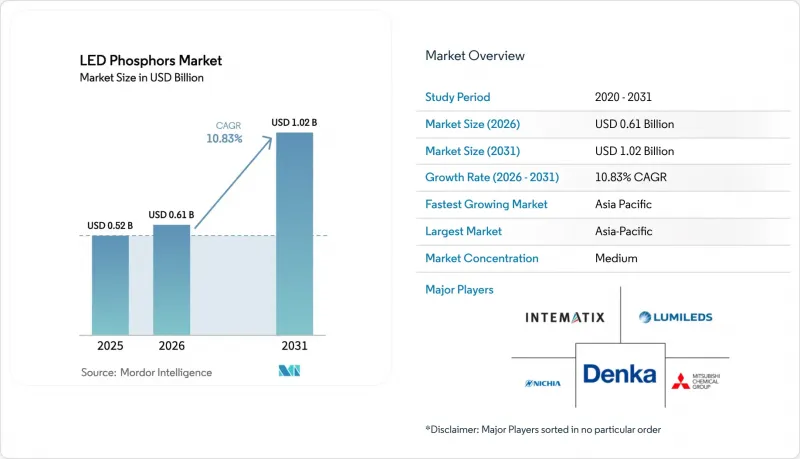
Mordor Intelligence에 의하면, LED 형광체 시장 규모는 2025년 5억 2,000만 달러에서 2026년에는 6억 1,000만 달러로 확대되어 2031년까지 10억 2,000만 달러에 이를 것으로 예상되고 있어 예측 기간(2026-2031년) CAGR은 10.83%를 나타낼 전망입니다.
본 보고서는 형광체 소재(질화물계, 규산염계 등),발광 색상(주백색, 전구색 등), 용도(스마트폰, LCD TV, 노트북 및 태블릿, 자동차용 조명 등), 최종 이용 산업(소비자용 전자기기 OEM, 자동차 OEM, 디스플레이 패널 제조업체 등), 그리고 지역별로 분류되어 있습니다. 시장 전망은 금액(달러) 기준으로 제시되어 있습니다.
전 세계 LED 형광체 시장 동향 및 인사이트
전 세계 스마트 조명 도입 급증
고압 나트륨 램프에서 연결형 LED 어레이로 전환하는 지자체들의 교체 작업에 따라, 2,700 K-6,500 K의 상관색온도를 실현하면서도 ‘딤 투 웜(Dimm-to-Warm)’ 제어 알고리즘에 대응 가능한 다중 형광체 블렌드의 수주가 확대되고 있습니다. 북미의 각 도시에서는 2024년에 850만 개 이상의 스마트 가로등 노드가 설치되어 전년 대비 34% 증가했습니다. 이와 유사한 움직임이 유럽과 아시아태평양에서도 확대되고 있습니다. 이러한 프로젝트로 인해 열 드리프트가 낮고 비닝 허용 오차가 좁은 형광체 수요가 증가하고 있으며, 이러한 특성은 현재 대부분의 공공 입찰 명세서에 포함되어 있습니다. 스마트 빌딩으로의 개조도 추가적인 수요를 견인하고 있으며, 지능형 조명 제어를 통해 2030년까지 전 세계 조명용 전력 소비량을 19% 절감할 수 있을 것으로 전망됩니다. 의료 및 호텔 업계의 조명 기구에서 자외선(UV) 소독 모듈이 표준 사양으로 채택됨에 따라, UV 대응 형광체의 재고가 부족해지고 있으며, 틈새 시장 공급업체에게는 유리한 가격 동향이 더욱 강화되고 있습니다.
고체 조명에 대한 정부의 에너지 효율 규제
2024년 이후 미국, 유럽, 중국에서 채택된 기준에서는 고변환 효율 형광체 시스템으로만 달성할 수 있는 발광 효율 수준이 요구되고 있습니다. 미국 상업용 조명 기구의 최저 기준은 2025년 1월에 150 lm/W로 상향 조정되어, 각 OEM 업체들은 스토크스 손실을 최소화하는 YAG Ce 및 질화물계 적색 블렌드로의 전환을 강요받고 있습니다. 유럽의 개정된 에코디자인 규정에서는 색상 품질 지표가 추가되어, 낮은 CRI를 가진 형광체 혼합물은 사실상 배제되었습니다. 한편, 중국에서는 보조금이 180 lm/W의 기준치에 연동됨에 따라, 협대역 녹색 및 적색 발광체에 대한 수요가 가속화되고 있습니다. 이러한 규제들이 맞물리면서, 저성능 화학 조성 시장 점유율은 축소되고 있으며, LED 형광체 시장은 고품질 배합으로의 전환을 가속화하고 있습니다.
희토류 산화물공급 및 가격 변동
2024년, 중국은 전 세계 희토류 생산량의 70%, 정제량의 90% 이상을 공급하고 있으며, 이러한 집중으로 인해 수출 할당량이 2025년 초 유로퓸 산화물의 현물 가격을 22% 끌어올렸습니다. 아시아 이외 지역의 형광체 제조업체들은 원자재 비용의 급등을 감당할 수밖에 없었고, 그 결과 이익률이 축소되거나 CRI가 낮은 배합으로 변경할 수밖에 없었습니다. 호주와 미국에서는 2026년 말까지 새로운 정제 프로젝트가 본격 가동될 예정이지만, 그 총 생산량은 예상 수요의 8% 미만을 충당할 뿐이어서 LED 형광체 시장은 여전히 지정학적 충격에 노출된 상태입니다.
부문 분석
2025년, 질화물계 소재는 LED 형광체 시장 점유율의 40.32%를 차지하며, 2031년까지 연평균 성장률(CAGR) 11.01%를 나타낼 것으로 전망됩니다. 질화물계 혼합 LED 형광체 시장 규모는 150°C를 초과하는 접합부 온도에서도 엄격한 파장 안정성이 요구되는 어댑티브 드라이빙 빔 헤드램프 및 고급 실내 조명 기구 수요를 배경으로 확대되고 있습니다. 가닛 YAG Ce는 성숙한 고수율 공정과 85% 이상의 양자 효율 덕분에 비용 효율을 중시하는 램프 분야에서 여전히 지배적인 위치를 유지하고 있습니다.
입자 크기 분포를 축소하고 PhOS-on-chip(PhOS-on-chip) 성막을 통합하는 공정 혁신을 통해 더 밝고 더 얇은 미니 LED 패키지가 실현되어 응용 범위가 넓어지고 있습니다. 2024년 유럽에서 시행된 RoHS의 카드뮴 규제로 인해, OEM 각사는 비용이 증가함에도 불구하고,기존의 규산염계 적색 형광체에서 카드뮴이 포함되지 않은 질화물계 대체품으로의 전환을 강요받았으며, 국경을 초월한 전체 제품 라인에서 질화물계 형광체의 우위가 더욱 강화되었습니다.
2025년 출하량에서 전구색 블렌드가 차지하는 비율은 36.81%로, 이는 주거용 및 사무용 조명에서의 보급 현황을 반영하고 있습니다. 그러나 적색 형광체는 생물학적 효능을 높이기 위해 600nm에서 700nm의 협대역 발광이 요구되는 제어 환경 농업 및 의료용 광선 요법 수요로 인해 연평균 성장률(CAGR) 11.92%로 확대될 것으로 예측됩니다. 따라서 적색 제품과 관련된 LED 형광체 시장 규모는 다른 어떤 색상 부문보다 빠르게 확대될 전망입니다.
2020년부터 2024년까지 바닥 면적이 28% 증가한 실내 농장에서는 와트당 광합성 광자속 밀도를 높이는 스펙트럼 최적화 조명 기구로의 전환이 진행되고 있습니다. 인간 중심 조명에서는 조절 가능한 백색 광원이 따뜻한 색조와 차가운 색조를 조합하고 적색의 휘도를 높임으로써 햇빛의 리듬을 재현하고 있습니다. 현재 2,700K-6,500K 범위에서 CRI 95 이상의 수준이 상업적으로 실현되고 있으며, 이는 특수 적색 LED 공급업체의 수익 증대 가능성을 강조하는 것입니다.
지역별 분석
아시아태평양은 2025년 매출의 51.07%를 차지하며, 연평균 성장률(CAGR) 13.09%로 확대될 전망이어서 LED 및 디스플레이 제조의 중심지로서의 입지를 더욱 공고히할 것입니다. 비용 면에서의 우위는 희토류 정제와 형광체 합성을 동일한 거점에서 수행하기 때문이며, 중국 생산자는 산화 유로퓸을 1kg당 340달러에 조달하는 반면, 북미 수입업체는 1kg당 465달러를 지불하고 있습니다. LG디스플레이와 삼성디스플레이의 미니 LED 백라이트 생산 확대에 따라 추가 수요가 흡수됨에 따라, 한국의 LED 형광체 시장 규모는 2028년까지 두 배로 증가할 전망입니다.
일본은 오랜 기간 축적된 재료 과학에 대한 깊은 지식을 활용하여 자동차용 및 프리미엄 조명이라는 틈새 시장을 대상으로 초협대역 질화물계 적색 발광체를 공급하고 있으며, 가격 프리미엄을 확보하고는 있지만 공급량은 제한적입니다. 북미와 유럽에서는 150 lm/W 미만의 조명 기구를 단계적으로 폐지하는 규제의 영향으로 수량 증가세는 완만하지만, 제품 구성은 고부가가치 제품 중심으로 변화하고 있습니다. 두 지역 모두 공급 리스크를 완화하기 위해 재활용을 추진하고 있으며, 유럽의 중요 원자재법에서는 2030년까지 폐기된 램프에서 희토류 함유량의 25%를 회수하는 것을 목표로 하고 있습니다.
중동 및 아프리카의 신흥 시장과 남미의 일부 지역에서는 대규모 가로등 및 인프라 개보수로 인해 공급량이 서서히 증가하고 있습니다. 아랍에미리트(UAE)는 2025년에 120만 개의 가로등을 LED로 전환을 완료하여 지자체의 에너지 사용량을 42% 절감했습니다. 수입 관세와 물류상의 복잡성이 여전히 라틴아메리카에서의 보급을 저해하고 있지만, 브라질과 아르헨티나의 인센티브 프로그램 덕분에 가격 격차는 점차 줄어들고 있습니다.
기타 혜택:
- 엑셀 형식 시장 예측(ME) 시트
- 3개월간의 애널리스트 지원
자주 묻는 질문
목차
제1장 서론
제2장 조사 방법
제3장 주요 요약
제4장 시장 구도
제5장 시장 규모와 성장 예측
제6장 경쟁 구도
제7장 시장 기회와 향후 전망
JHS 26.09.11According to Mordor Intelligence, the LED phosphors market size is expected to grow from USD 0.52 billion in 2025 to USD 0.61 billion in 2026 and reach USD 1.02 billion by 2031, at a CAGR of 10.83% during the forecast period (2026-2031).
This report is Segmented by Phosphor Material (Nitride-Based, Silicate Phosphors, and More), Emission Color (Cool White, Warm White, and More), Application (Smartphones, LCD Televisions, Laptops and Tablets, Automotive Lighting, and More), End-Use Industry (Consumer Electronics OEMs, Automotive OEMs, Display Panel Manufacturers, and More), and Geography. The Market Forecasts are Provided in Terms of Value (USD).
Global LED Phosphors Market Trends and Insights
Surge in Global Smart-Lighting Deployments
Municipal retrofits from high-pressure sodium to connected LED arrays are amplifying orders for multi-phosphor blends capable of delivering correlated color temperatures spanning 2 700 K-6 500 K while supporting dim-to-warm control algorithms. North American cities installed more than 8.5 million smart streetlight nodes in 2024, a 34% year-over-year increase, and similar initiatives are scaling across Europe and Asia Pacific. These projects elevate demand for phosphors with low thermal drift and tight binning tolerances, attributes now embedded into most public tender specifications. Smart-building upgrades add further pull, with intelligent lighting controls expected to cut global lighting electricity use 19% by 2030. As ultraviolet disinfection modules become standard in healthcare and hospitality fixtures, inventories of UV-capable phosphors have tightened, reinforcing a favorable price trend for niche suppliers.
Government Energy-Efficiency Mandates for Solid-State Lighting
Standards adopted in the United States, Europe, and China since 2024 require efficacy levels that only high-conversion phosphor systems can deliver. The U.S. floor for commercial luminaires moved to 150 lm/W in January 2025, pushing OEMs toward YAG:Ce and nitride red blends that minimize Stokes losses. Europe's updated Ecodesign rules added color-quality metrics, effectively sidelining low-CRI phosphor mixes, while China linked subsidies to 180 lm/W thresholds, accelerating demand for narrow-band green and red emitters. Collectively, these mandates compress the addressable space for low-performance chemistries and accelerate the LED phosphors market shift toward premium formulations.
Volatility in Rare-Earth Oxide Supply and Pricing
China supplied 70% of global rare-earth output and more than 90% of refining volume in 2024, a concentration that enabled export quotas to lift europium oxide spot prices 22% in early 2025. Phosphor makers outside Asia absorbed raw-material cost spikes that narrowed margins or forced reformulations with inferior CRI. Although new Australian and U.S. refining projects are scheduled for full capacity by late 2026, combined output covers less than 8% of forecast demand, leaving the LED phosphors market exposed to geopolitical shocks.
Other drivers and restraints analyzed in the detailed report include:
- Expanding Display-Panel Production Capacities in Asia
- Quantum-Dot/LED Phosphor Hybrid Solutions Gaining Traction
- High Cost of High-CRI Narrow-Band Red Phosphors
For complete list of drivers and restraints, kindly check the Table Of Contents.
Segment Analysis
Nitride materials controlled 40.32% of LED phosphors market share in 2025 and are projected to register an 11.01% CAGR through 2031. The LED phosphors market size for nitride blends is expanding on the back of adaptive-driving-beam headlamps and premium indoor fixtures that demand tight wavelength stability at junction temperatures above 150 °C. Garnet YAG:Ce remains dominant in cost-sensitive lamps thanks to mature high-yield processes and quantum efficiencies exceeding 85%.
Process innovations that shrink particle-size distributions and integrate phosphor-on-chip deposition enable brighter, thinner mini-LED packages, widening the application envelope. RoHS cadmium caps enacted in Europe during 2024 pushed OEMs to migrate from older silicate reds toward cadmium-free nitride equivalents despite higher costs, reinforcing nitride leadership across cross-border product lines.
Warm white blends held 36.81% of 2025 shipments, mirroring their ubiquity in residential and office lighting. However, red phosphors are forecast to expand at an 11.92% CAGR as controlled-environment agriculture and medical phototherapy specify narrow-band emissions between 600 nm and 700 nm to boost biological efficacy. The LED phosphors market size linked to red products is therefore set to grow faster than any other color segment.
Indoor farms, which added 28% more square footage between 2020 and 2024, are shifting toward spectra-optimized fixtures that elevate photosynthetic photon flux density per watt. In human-centric lighting, tunable white engines blend warm and cool packages alongside red boosts to emulate daylight rhythms; CRI levels above 95 across a 2 700 K-6 500 K range are now commercial reality, underlining the revenue upside for specialty red suppliers.
Complete Report Scope:
- By Phosphor Material
- Nitride-based Phosphors
- Garnet (YAG:Ce) Phosphors
- Silicate Phosphors
- Aluminate Phosphors
- Other Phosphor Materials
- By Emission Color
- Cool White
- Warm White
- Red
- Green
- Blue
- Ultraviolet
- By Application
- Smartphones
- LCD Televisions
- Laptops and Tablets
- Automotive Lighting
- General Lighting (Residential, Commercial, Industrial)
- Horticulture and Medical Lighting
- Other Applications
- By End-Use Industry
- Consumer Electronics OEMs
- Automotive OEMs
- Display Panel Manufacturers
- Lighting Fixture Manufacturers
- Specialty and Medical Device Manufacturers
- By Geography
- North America
- United States
- Canada
- Mexico
- South America
- Brazil
- Argentina
- Rest of South America
- Europe
- Germany
- United Kingdom
- France
- Italy
- Spain
- Rest of Europe
- Asia-Pacific
- China
- Japan
- India
- South Korea
- ASEAN
- Rest of Asia-Pacific
- Middle East
- Saudi Arabia
- United Arab Emirates
- Rest of Middle East
- Africa
- South Africa
- Nigeria
- Rest of Africa
- North America
Geography Analysis
Asia Pacific accounted for 51.07% of 2025 revenues and will expand at a 13.09% CAGR, reinforcing its status as the epicenter of LED and display manufacturing. Cost advantages stem from co-locating rare-earth refining and phosphor synthesis, with Chinese producers paying USD 340 per kg for europium oxide versus USD 465 per kg for North American importers. The LED phosphors market size in South Korea is poised to double by 2028 as mini-LED backlight ramps at LG Display and Samsung Display absorb incremental tonnage.
Japan leverages longstanding materials science depth to supply ultra-narrow nitride reds for automotive and premium lighting niches, commanding price premiums but limited volume. North America and Europe show slower unit growth yet richer mix, driven by mandates that phase out sub-150 lm/W luminaires. Both regions champion recycling to mitigate supply risk; the European Critical Raw Materials Act targets recovering 25% of rare-earth content from discarded lamps by 2030.
Emerging markets in the Middle East and Africa, alongside pockets of South America, add incremental volume via large-scale street-lighting and infrastructure retrofits. The United Arab Emirates completed LED upgrades on 1.2 million streetlights in 2025, trimming municipal energy use by 42%. Import tariffs and logistics complexity still temper Latin American uptake, but incentive programs in Brazil and Argentina are narrowing the affordability gap.
- Nichia Corporation
- Intematix Corporation
- Denka Company Limited
- Mitsubishi Chemical Group Corporation
- Lumileds Holding B.V.
- Cree LED, Inc.
- Citizen Electronics Co., Ltd.
- Beijing Yuji International Co., Ltd.
- Luming Technology Group Co., Ltd.
- PhosphorTech Corporation
- OSRAM GmbH
- Seoul Semiconductor Co., Ltd.
- Samsung Electronics Co., Ltd.
- Epistar Corporation
- LG Innotek Co., Ltd.
- Everlight Electronics Co., Ltd.
- Broadcom Inc.
- Bridgelux, Inc.
- Toyoda Gosei Co., Ltd.
- Sharp Corporation
- Merck KGaA
- TDK Corporation
- Lumichem Korea Co., Ltd.
Additional Benefits:
- The market estimate (ME) sheet in Excel format
- 3 months of analyst support
TABLE OF CONTENTS
1 INTRODUCTION
- 1.1 Study Assumptions and Market Definition
- 1.2 Scope of the Study
2 RESEARCH METHODOLOGY
3 EXECUTIVE SUMMARY
4 MARKET LANDSCAPE
- 4.1 Market Overview
- 4.2 Market Drivers
- 4.2.1 Surge In Global Smart-Lighting Deployments
- 4.2.2 Government Energy-Efficiency Mandates For Solid-State Lighting
- 4.2.3 Rapid Cost Reduction In High-Lumen LED Packages
- 4.2.4 Expanding Display Panel Production Capacities In Asia
- 4.2.5 OEM Demand For Circadian-Tunable Phosphor Blends
- 4.2.6 Quantum-Dot/LED Phosphor Hybrid Solutions Gaining Traction
- 4.3 Market Restraints
- 4.3.1 Volatility In Rare-Earth Oxide Supply And Pricing
- 4.3.2 High Cost Of High-Cri Narrow-Band Red Phosphors
- 4.3.3 Thermal-Quenching Performance Limits At High Drive Currents
- 4.3.4 Stricter ROHS Directives Curbing Some Legacy Phosphor Chemistries
- 4.4 Industry Value Chain Analysis
- 4.5 Regulatory Landscape
- 4.6 Porter's Five Forces Analysis
- 4.6.1 Bargaining Power of Suppliers
- 4.6.2 Bargaining Power of Buyers
- 4.6.3 Threat of New Entrants
- 4.6.4 Threat of Substitute Products
- 4.6.5 Degree of Competition
5 MARKET SIZE AND GROWTH FORECASTS (VALUE)
- 5.1 By Phosphor Material
- 5.1.1 Nitride-based Phosphors
- 5.1.2 Garnet (YAG:Ce) Phosphors
- 5.1.3 Silicate Phosphors
- 5.1.4 Aluminate Phosphors
- 5.1.5 Other Phosphor Materials
- 5.2 By Emission Color
- 5.2.1 Cool White
- 5.2.2 Warm White
- 5.2.3 Red
- 5.2.4 Green
- 5.2.5 Blue
- 5.2.6 Ultraviolet
- 5.3 By Application
- 5.3.1 Smartphones
- 5.3.2 LCD Televisions
- 5.3.3 Laptops and Tablets
- 5.3.4 Automotive Lighting
- 5.3.5 General Lighting (Residential, Commercial, Industrial)
- 5.3.6 Horticulture and Medical Lighting
- 5.3.7 Other Applications
- 5.4 By End-Use Industry
- 5.4.1 Consumer Electronics OEMs
- 5.4.2 Automotive OEMs
- 5.4.3 Display Panel Manufacturers
- 5.4.4 Lighting Fixture Manufacturers
- 5.4.5 Specialty and Medical Device Manufacturers
- 5.5 By Geography
- 5.5.1 North America
- 5.5.1.1 United States
- 5.5.1.2 Canada
- 5.5.1.3 Mexico
- 5.5.2 South America
- 5.5.2.1 Brazil
- 5.5.2.2 Argentina
- 5.5.2.3 Rest of South America
- 5.5.3 Europe
- 5.5.3.1 Germany
- 5.5.3.2 United Kingdom
- 5.5.3.3 France
- 5.5.3.4 Italy
- 5.5.3.5 Spain
- 5.5.3.6 Rest of Europe
- 5.5.4 Asia-Pacific
- 5.5.4.1 China
- 5.5.4.2 Japan
- 5.5.4.3 India
- 5.5.4.4 South Korea
- 5.5.4.5 ASEAN
- 5.5.4.6 Rest of Asia-Pacific
- 5.5.5 Middle East
- 5.5.5.1 Saudi Arabia
- 5.5.5.2 United Arab Emirates
- 5.5.5.3 Rest of Middle East
- 5.5.6 Africa
- 5.5.6.1 South Africa
- 5.5.6.2 Nigeria
- 5.5.6.3 Rest of Africa
- 5.5.1 North America
6 COMPETITIVE LANDSCAPE
- 6.1 Market Concentration
- 6.2 Strategic Moves
- 6.3 Market Share Analysis
- 6.4 Company Profiles (includes Global-level Overview, Market-level Overview, Core Segments, Financials as available, Strategic Information, Market Rank/Share, Products and Services, Recent Developments)
- 6.4.1 Nichia Corporation
- 6.4.2 Intematix Corporation
- 6.4.3 Denka Company Limited
- 6.4.4 Mitsubishi Chemical Group Corporation
- 6.4.5 Lumileds Holding B.V.
- 6.4.6 Cree LED, Inc.
- 6.4.7 Citizen Electronics Co., Ltd.
- 6.4.8 Beijing Yuji International Co., Ltd.
- 6.4.9 Luming Technology Group Co., Ltd.
- 6.4.10 PhosphorTech Corporation
- 6.4.11 OSRAM GmbH
- 6.4.12 Seoul Semiconductor Co., Ltd.
- 6.4.13 Samsung Electronics Co., Ltd.
- 6.4.14 Epistar Corporation
- 6.4.15 LG Innotek Co., Ltd.
- 6.4.16 Everlight Electronics Co., Ltd.
- 6.4.17 Broadcom Inc.
- 6.4.18 Bridgelux, Inc.
- 6.4.19 Toyoda Gosei Co., Ltd.
- 6.4.20 Sharp Corporation
- 6.4.21 Merck KGaA
- 6.4.22 TDK Corporation
- 6.4.23 Lumichem Korea Co., Ltd.
7 MARKET OPPORTUNITIES AND FUTURE OUTLOOK
- 7.1 White-space and Unmet-need Assessment