
|
시장보고서
상품코드
2123367
일당제 간호사 파견 시장 : 점유율 분석, 업계 동향과 통계, 성장 예측(2026-2031년)Per Diem Nurse Staffing - Market Share Analysis, Industry Trends & Statistics, Growth Forecasts (2026 - 2031) |
||||||
 Mordor Intelligence
Mordor Intelligence에 의하면, 일당제 간호사 파견 시장 규모는 2025년에 159억 9,000만 달러로 평가되었고 2026년 170억 8,000만 달러에서 2031년까지 237억 4,000만 달러에 이를 것으로 예측되며, 예측 기간(2026-2031년) CAGR은 6.79%를 나타낼 전망입니다.
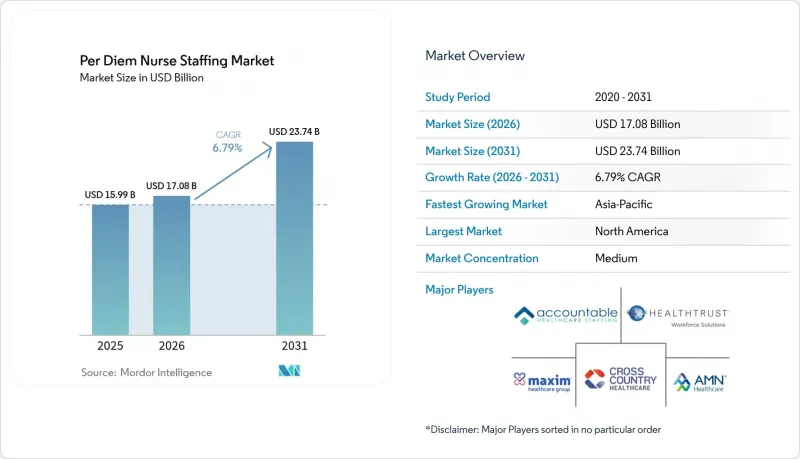
본 보고서는 최종 사용자(병원, 독립 클리닉 등), 간호사 유형(정규 간호사 등), 근무 시간(8시간 근무 등), 일정 관리 플랫폼(기존 파견 회사 등), 지역별(북미, 유럽, 아시아태평양, 중동 및 아프리카, 남미)로 분류되어 있습니다. 시장 전망은 금액(달러) 기준으로 제시되어 있습니다.
전 세계 일당제 간호사 파견 시장 동향 및 인사이트
전 세계 간호사 부족의 심화
WHO 데이터에 따르면, 2023년 전 세계 간호사 수는 2,980만 명에 달했으나, 그 중 78%가 전 세계 인구의 불과 49%를 차지하는 국가에서 근무하고 있어 심각한 지역 간 불균형이 드러나고 있습니다. 미국에서는 보건복지부가 2027년까지 정규 간호사 부족률이 10%에 육박할 것으로 예측하고 있으며, 이 수준에서는 많은 병원이 법적으로 의무화된 인력 배치 비율을 충족하지 못할 우려가 있습니다. 마찬가지로, 2025년 1월 유럽에서 출범한 간호 행동 이니셔티브(Nursing Action Initiative)도 EU 의료 전문직 전체에 걸쳐 1,800만 명의 인력 부족이 있음을 인정하고 있습니다. 이러한 인력 부족으로 인해 의료 제공업체들이 한정된 인력을 놓고 경쟁하는 가운데, 일당제 계약은 단순한 선택의 여지라기보다는 보다 구조적인 성격으로 변모하고 있습니다. 그 결과, 당연히 보수 인상이 진행되어 일당제 보수에 하한선이 설정되는 동시에, 자율성을 중시하는 임상의들을 유치하게 되었습니다.
병원 입원 환자 수 증가
팬데믹 이후 입원 환자 수는 만성 질환 유병률의 상승과 미뤄졌던 의료 수요가 겹치면서, 2019년 기준치보다 15-20% 높은 수준에서 안정적으로 유지되고 있습니다. 고령 환자 증가로 인해 평균 입원 일수가 길어지면서 병상당 간호사 근무 시간이 늘어나는 한편, 단기간 내 급격한 인력 보충에 대한 수요가 높아지고 있습니다. 응급실에서는 더욱 복잡한 다중 질환 병존 사례가 증가하고 있는 것으로 보고되고 있으며, 관리직은 정규직 채용에 수개월이 소요될 가능성이 있으므로 일당제 임시 채용이 유일한 즉각적인 해결책이라고 지적하고 있습니다. 미국 간호사 실무자 협회(NAP)는 2025년을 앞두고 가장 시급한 동향으로 고령자 의료 수요를 꼽고 있으며, 전문 간호사의 배치 필요성이 높아지고 있습니다. 그 결과, 급성기 의료 책임자들은 일당제 직원을 운영상의 충격 완충 장치로 간주하고 있습니다.
일과 소득의 불안정에 대한 인식
일당제 직무에는 일반적으로 보장된 근무 시간, 고용주가 제공하는 복리후생, 그리고 퇴직금 제도가 포함되지 않습니다. 고정적인 경제적 부담을 안고 있는 간호사들은 일당제 급여가 매력적이라 하더라도 안정적인 급여를 선호하는 경향이 있습니다. 배상책임보험도 큰 부담이 되고 있습니다. 의료 전문직 보험의 합산 비율은 2013년 이후 계속 100%를 상회하고 있으며, 이는 개인 계약자에게 보험료 인상으로 이어지고 있습니다. 경기 침체기에는 시설 측이 우선 재량에 따라 조정 가능한 근무 교대조를 줄이기 때문에 불안정성에 대한 인식이 더욱 강해집니다. 이러한 주저함은 병원 밀도가 낮고 근무 기회가 간헐적으로 나타나는 경향이 있는 지역에서 일당제 도입을 특히 제한하는 요인이 되고 있습니다.
부문 분석
병원은 2025년 매출의 58.10%를 차지하고 있으며, 그 방대한 규모와 환자 수 변동에 따른 급증 시 대응이 필요한 상황으로 인해 일당제 간호사 파견 시장의 기반을 형성하고 있습니다. 대부분의 3차 의료기관은 24-48시간 전에 일당제 간호사를 배정하는 일일 스케줄링 알고리즘에 의존하고 있어 예측 가능한 수요를 유지하고 있습니다. 독립 클리닉이나 외래 전문센터에서는 시술 피크 시간에 대응하기 위해 일당제 직원을 채용하고 있지만, 그 성장세는 여전히 완만합니다. 요양 시설 및 요양형 주거 시설 운영 사업자는 만성적인 인력 유출과 규제 당국의 감시에 직면해 있어, 안정적인 수요원이기는 하지만 시장에 기여하는 정도는 부차적인 수준에 그치고 있습니다.
연평균 성장률(CAGR) 8.34%로 성장하고 있는 재택치료 기관 부문은 지불 주체가 급성기 의료에서 지역 의료로 전환됨에 따라 간호사의 근무 시간이 어떻게 재분배되고 있는지를 보여줍니다. CMS가 2025년에 도입할, 의료 기관이 환급을 받기 전에 인력 배치의 적절성을 입증하도록 의무화하는 규정은 사실상 일당제 간호사 공급을 규정 준수 업무 프로세스에 통합하는 결과를 가져올 것입니다. 각 기관은 상처 흡인 요법 관리, 복잡한 투약 계획, 만성 질환 지도에 숙련된 간호사에게 종종 10-15%의 할증 임금을 지급하고 있으며, 이것이 이 부문의 매력을 높이고 있습니다. 원격 모니터링 기술이 보급됨에 따라, 온라인과 재택 간호를 결합한 하이브리드형 일당제 간호사에 대한 수요가 높아지고, 채용 대상 범위가 지역 통근권을 넘어 확대될 것입니다.
2025년에는 정규 간호사(RN)가 시장 점유율의 61.85%를 차지하며, 병동, 스텝다운 병동, 응급실 운영의 핵심을 담당했습니다. 병원들이 고정비 인상을 억제하면서 의무화된 간호사 배치 비율을 유지하려는 가운데, 일당제 간호사 파견 시장 규모는 꾸준히 확대될 전망입니다. 고도실무간호사(ARNP)는 절대 수로는 적지만, 각 주에서 업무 범위에 관한 법률을 확대하고 1차 진료 격차가 확대됨에 따라 2031년까지 연평균 성장률(CAGR) 8.87%로 성장할 전망입니다. 노동통계국(BLS)은 2023년부터 2033년까지 NP의 순 증가가 13만 5,500명에 달할 것으로 예측하고 있으며, 일당제 파견 업체들은 이미 이 인력 풀을 활용하기 시작했습니다.
준간호사는 장기 요양에서 필수적인 역할을 담당하며, 공인 간호 조무사는 기본적인 ADL(일상생활동) 지원을 보완하고 있습니다. 이러한 직종에 대해서는 독감 유행기나 감염병 발생 시 등 격리 프로토콜로 인해 인력 수요가 높아지는 시기에 파견 회사에 대한 수요가 급증합니다. 그러나 전문 요양 시설의 보수 상한선으로 인해 보수율의 유연성이 제한되어 있어, 중증도가 높은 카테고리와 비교하면 성장이 억제되고 있습니다.
지역별 분석
북미는 만성적인 인력 부족, 엄격한 인력 배치 요건, 그리고 확립된 일당제 생태계에 힘입어 2025년에는 전 세계 수익의 45.10%를 창출했습니다. 미국 내 일당제 간호사 파견 시장 점유율은 디지털 플랫폼의 급속한 보급과 졸업률을 상회하는 퇴직자 증가에 힘입어 계속해서 지배적인 위치를 유지할 전망입니다. 캐나다의 국민건강보험 모델과 고령화는 안정적인 수요를 뒷받침하고 있는 반면, 멕시코에서는 인프라 구축이 진행되면서 국경을 넘는 파견 회사의 비즈니스 기회가 생겨나고 있습니다.
유럽은 국민건강보험 제도가 잘 갖춰진 성숙한 시장이지만, 베이비붐 세대 간병인들이 은퇴함에 따라 간호사 부족 문제가 심각해지고 있습니다. EU가 자금을 지원하는 ‘Nursing Action’ 프로그램은 인력 채용, 정착 및 정신 건강 지원에 자원을 투입하고 있으며, 업무 부담의 유연성을 제공하는 일당제 솔루션 도입을 위한 기반을 마련하고 있습니다. 언어의 다양성과 엄격한 노동 보호 규정으로 인해 파견 회사의 자격 인증에 시간이 걸릴 수 있지만, 국경을 초월한 자격 인증 체계를 통해 인력의 유동성은 점차 개선되고 있습니다. 일과 삶의 균형을 최우선으로 여기는 북유럽 국가들에서는 단체 교섭 체계 내에서 일당제의 특성을 반영한 유연한 교대 근무 은행(shift bank) 제도의 시범 운영이 진행되고 있습니다.
연평균 성장률(CAGR) 7.41%의 성장이 예상되는 아시아태평양은 병원 건설 활성화, 중산층의 급증, 그리고 간호사 교육에 대한 꾸준한 투자의 혜택을 받고 있습니다. 국제간호사협회(ICN)는 특히 인도와 동남아시아에서 간호사와 환자 수의 비율이 심각하게 부족함을 지적하고 있으며, 이는 해당 지역의 파견 회사 및 해외 파견 프로그램에 기회로 작용하고 있습니다. 아세안(ASEAN) 회원국 간 간호사 면허 상호 인정은 인재의 유동성을 더욱 촉진하고 있습니다. 규제 시행 상황에 차이가 있거나 정규직 고용을 선호하는 문화적 경향과 같은 과제는 남아 있지만, 대도시권에서는 환자 수의 급증에 대응하기 위해 앱을 활용한 긱(gig)형 파견이 빠르게 도입되고 있습니다.
기타 혜택:
- 엑셀 형식 시장 예측(ME) 시트
- 3개월간의 애널리스트 지원
자주 묻는 질문
목차
제1장 서론
제2장 조사 방법
제3장 주요 요약
제4장 시장 구도
제5장 시장 규모와 성장 예측
제6장 경쟁 구도
제7장 시장 기회와 향후 전망
JHS 26.09.11According to Mordor Intelligence, the per diem nurse staffing market size was valued at USD 15.99 billion in 2025 and estimated to grow from USD 17.08 billion in 2026 to reach USD 23.74 billion by 2031, at a CAGR of 6.79% during the forecast period (2026-2031).
This report is Segmented by End User (Hospitals, Independent Clinics, and More), Nurse Type (Registered Nurses, and More), Shift Length (8-Hour Shifts, and More), Scheduling Platform (Traditional Staffing Agencies, and More), and Geography (North America, Europe, Asia-Pacific, Middle East & Africa, South America). The Market Forecasts are Provided in Terms of Value (USD).
Global Per Diem Nurse Staffing Market Trends and Insights
Escalating Global Nursing Shortage
WHO data confirm that the worldwide pool climbed to 29.8 million in 2023, yet 78% of nurses still practice in countries that host just 49% of the global population, exposing severe regional imbalances. In the United States, the Department of Health and Human Services projects registered-nurse gaps approaching 10% by 2027, a level that would leave many hospitals unable to meet legally mandated staffing ratios. Europe's January 2025 "Nursing Action" initiative likewise acknowledges an 18 million-worker deficit across EU health professions. These deficits are making per diem contracts less discretionary and more structural as providers compete for scarce hands. Rate escalation follows naturally, setting a floor under per diem compensation and attracting clinicians who prefer autonomy.
Accelerated Hospital Patient Admissions
Post-pandemic admissions are stabilizing at volumes 15-20% above 2019 baselines as chronic disease prevalence and deferred care converge. Older patients drive longer average lengths of stay, raising nurse-minutes per bed and heightening the call for short-notice coverage. Emergency departments report more complex multimorbidity cases, and administrators cite per diem recruits as the only immediate fix because full-time hires can require months to onboard. The American Association of Nurse Practitioners flags geriatric demand as the most urgent 2025 trend, intensifying specialist placement needs. Acute-care directors consequently view per diem rosters as operational shock absorbers.
Perceived Job and Income Instability
Per diem roles typically exclude guaranteed hours, employer-sponsored benefits, and retirement funding. Nurses with fixed financial obligations often favor stable salaries even when per diem premiums are attractive. Liability insurance also weighs heavily: combined ratios for medical professional coverage have stayed above 100% since 2013, translating to rising premiums for independent contractors. During economic slowdowns, facilities trim discretionary shifts first, reinforcing the instability narrative. This hesitancy particularly limits adoption in regions with sparse hospital density, where shift opportunities can be sporadic.
Other drivers and restraints analyzed in the detailed report include:
- Cost-Optimization Initiatives in Healthcare Facilities
- Shift Toward Flexible Workforce Models
- Regulatory Limitations on Agency Fees
For complete list of drivers and restraints, kindly check the Table Of Contents.
Segment Analysis
Hospitals captured 58.10% of 2025 billings, anchoring the per diem nurse staffing market through sheer volume and continual census swings that necessitate surge coverage. Most tertiary centers rely on daily scheduling algorithms that book per diem nurses 24-48 hours ahead, sustaining predictable demand. Independent clinics and outpatient specialty centers employ per diem staff to cover procedural peaks, though growth remains incremental. Nursing homes and assisted-living operators face persistent attrition and regulatory scrutiny, making them steady but secondary contributors.
The home-health agency segment, growing at 8.34% CAGR, illustrates how payors' shift from acute to community settings is redirecting nurse hours. CMS's 2025 mandate that agencies attest to staffing sufficiency before reimbursement effectively embeds per diem supply into compliance workflows. Agencies often pay 10-15% premiums for nurses skilled in wound vac management, complex medication regimens, and chronic-disease coaching, reinforcing segment attractiveness. As remote-monitoring technology spreads, demand for hybrid virtual-and-in-home per diem roles will rise, broadening recruitment pools beyond local commuting distances.
Registered nurses held 61.85% share in 2025, forming the operational backbone for floor coverage, step-down units, and emergency departments. The per diem nurse staffing market size for RNs is set to expand steadily as hospitals guard against fixed-cost inflation while preserving mandated ratios. Advanced practice registered nurses, though smaller in absolute count, will expand at 8.87% CAGR through 2031 as states broaden scope-of-practice laws and as primary-care gaps widen. The Bureau of Labor Statistics projects 135,500 net new NP roles from 2023 to 2033, a pipeline that per diem agencies are already tapping.
Licensed practical/vocational nurses fill essential long-term care functions, while certified nursing assistants round out basic ADL support. For these tiers, agency demand spikes during flu seasons and infection outbreaks when isolation protocols intensify staffing needs. Nonetheless, reimbursement ceilings in skilled-nursing facilities constrain rate flexibility, tempering growth compared with higher-acuity categories.
Complete Report Scope:
- By End User
- Hospitals
- Independent Clinics
- Nursing Homes
- Home Healthcare Agencies
- Other Long-Term Care Facilities
- By Nurse Type
- Registered Nurses (RN)
- Licensed Practical/Vocational Nurses (LPN/LVN)
- Certified Nursing Assistants (CNA)
- Advanced Practice Registered Nurses (APRN)
- By Shift Length
- 8-Hour Shifts
- 10-Hour Shifts
- 12-Hour Shifts
- Float Pool / On-Call
- By Scheduling Platform
- Traditional Staffing Agencies
- App-Based Marketplaces
- Internal Hospital Float Pools
- Geography
- North America
- United States
- Canada
- Mexico
- Europe
- Germany
- United Kingdom
- France
- Italy
- Spain
- Rest of Europe
- Asia-Pacific
- China
- Japan
- India
- Australia
- South Korea
- Rest of Asia-Pacific
- Middle East & Africa
- GCC
- South Africa
- Rest of Middle East & Africa
- South America
- Brazil
- Argentina
- Rest of South America
- North America
Geography Analysis
North America generated 45.10% of global revenue in 2025 driven by chronic workforce deficits, stringent staffing mandates, and established per diem ecosystems. The per diem nurse staffing market share for the United States will remain dominant, supported by rapid digital-platform uptake and continuing retirement-wave attrition that outpaces graduation rates. Canada's universal coverage model and aging demographic reinforce steady demand, while Mexico's infrastructure upgrades create cross-border agency opportunities.
Europe presents a mature landscape with universal health systems but escalating nurse shortages as baby-boomer caregivers retire. The EU-funded Nursing Action program funnels resources toward recruitment, retention, and mental-health supports, paving space for per diem solutions that offer workload flexibility. Language diversity and rigid labor protections can slow agency credentialing, yet cross-border recognition frameworks are easing mobility. Nordic countries, where work-life balance is paramount, are piloting flexible shift banks that mirror per diem dynamics within collective-bargaining frameworks.
Asia-Pacific, forecast to expand at 7.41% CAGR, benefits from aggressive hospital construction, burgeoning middle classes, and concerted nurse-education investments. The International Council of Nurses underscores severe ratio gaps, particularly in India and Southeast Asia, opening doors for regional agencies and expatriate programs. Mutual recognition of nursing licenses across ASEAN members further lubricates workforce flows. Challenges remain in uneven regulatory enforcement and cultural preference for permanent employment, but urban megacities are quickly adopting app-based gig staffing to handle patient surges.
- Accountable Healthcare Staffing
- AMN Healthcare
- ATC Healthcare
- Cross Country Healthcare
- Dedicated Nursing Associates
- Favorite Healthcare Staffing
- HealthTrust Workforce Solutions
- Interim HealthCare
- Maxim Healthcare
- Supplemental Health Care
- Aya Healthcare
- ShiftMed
- Nomad Health
- Trusted Health
- IntelyCare
- CareRev
- GHR Healthcare
- ProLink Healthcare
- Fastaff Travel Nursing
- Medical Solutions
Additional Benefits:
- The market estimate (ME) sheet in Excel format
- 3 months of analyst support
TABLE OF CONTENTS
1 Introduction
- 1.1 Study Assumptions & Market Definition
- 1.2 Scope of the Study
2 Research Methodology
3 Executive Summary
4 Market Landscape
- 4.1 Market Overview
- 4.2 Market Drivers
- 4.2.1 Escalating Global Nursing Shortage
- 4.2.2 Accelerated Hospital Patient Admissions
- 4.2.3 Cost Optimization Initiatives In Healthcare Facilities
- 4.2.4 Shift Toward Flexible Workforce Models
- 4.2.5 Rapid Adoption of Digital Staffing Platforms
- 4.2.6 Expansion of Outpatient and Post-Acute Care Networks
- 4.3 Market Restraints
- 4.3.1 Perceived Job and Income Instability
- 4.3.2 Regulatory Limitations on Agency Fees
- 4.3.3 Growing Use of Internal Staffing Pools
- 4.3.4 Rising Professional Liability Costs
- 4.4 Regulatory Landscape
- 4.5 Porter's Five Forces Analysis
- 4.5.1 Threat Of New Entrants
- 4.5.2 Bargaining Power Of Buyers
- 4.5.3 Bargaining Power Of Suppliers
- 4.5.4 Threat Of Substitutes
- 4.5.5 Competitive Rivalry
5 Market Size & Growth Forecasts (Value, USD)
- 5.1 By End User
- 5.1.1 Hospitals
- 5.1.2 Independent Clinics
- 5.1.3 Nursing Homes
- 5.1.4 Home Healthcare Agencies
- 5.1.5 Other Long-Term Care Facilities
- 5.2 By Nurse Type
- 5.2.1 Registered Nurses (RN)
- 5.2.2 Licensed Practical/Vocational Nurses (LPN/LVN)
- 5.2.3 Certified Nursing Assistants (CNA)
- 5.2.4 Advanced Practice Registered Nurses (APRN)
- 5.3 By Shift Length
- 5.3.1 8-Hour Shifts
- 5.3.2 10-Hour Shifts
- 5.3.3 12-Hour Shifts
- 5.3.4 Float Pool / On-Call
- 5.4 By Scheduling Platform
- 5.4.1 Traditional Staffing Agencies
- 5.4.2 App-Based Marketplaces
- 5.4.3 Internal Hospital Float Pools
- 5.5 Geography
- 5.5.1 North America
- 5.5.1.1 United States
- 5.5.1.2 Canada
- 5.5.1.3 Mexico
- 5.5.2 Europe
- 5.5.2.1 Germany
- 5.5.2.2 United Kingdom
- 5.5.2.3 France
- 5.5.2.4 Italy
- 5.5.2.5 Spain
- 5.5.2.6 Rest of Europe
- 5.5.3 Asia-Pacific
- 5.5.3.1 China
- 5.5.3.2 Japan
- 5.5.3.3 India
- 5.5.3.4 Australia
- 5.5.3.5 South Korea
- 5.5.3.6 Rest of Asia-Pacific
- 5.5.4 Middle East & Africa
- 5.5.4.1 GCC
- 5.5.4.2 South Africa
- 5.5.4.3 Rest of Middle East & Africa
- 5.5.5 South America
- 5.5.5.1 Brazil
- 5.5.5.2 Argentina
- 5.5.5.3 Rest of South America
- 5.5.1 North America
6 Competitive Landscape
- 6.1 Market Concentration
- 6.2 Market Share Analysis
- 6.3 Company Profiles (Includes Global Level Overview, Market Level Overview, Core Segments, Financials As Available, Strategic Information, Market Rank/Share, Products & Services, Recent Developments)
- 6.3.1 Accountable Healthcare Staffing
- 6.3.2 AMN Healthcare
- 6.3.3 ATC Healthcare
- 6.3.4 Cross Country Healthcare
- 6.3.5 Dedicated Nursing Associates (DNA)
- 6.3.6 Favorite Healthcare Staffing
- 6.3.7 HealthTrust Workforce Solutions (HCA)
- 6.3.8 Interim HealthCare
- 6.3.9 Maxim Healthcare Services
- 6.3.10 Supplemental Health Care
- 6.3.11 Aya Healthcare
- 6.3.12 ShiftMed
- 6.3.13 Nomad Health
- 6.3.14 Trusted Health
- 6.3.15 IntelyCare
- 6.3.16 CareRev
- 6.3.17 GHR Healthcare
- 6.3.18 ProLink Healthcare
- 6.3.19 Fastaff Travel Nursing
- 6.3.20 Medical Solutions
7 Market Opportunities & Future Outlook
- 7.1 White-Space & Unmet-Need Assessment