|
시장보고서
상품코드
2123371
구조적 심장질환 디바이스 시장 : 점유율 분석, 업계 동향과 통계, 성장 예측(2026-2031년)Structural Heart Devices - Market Share Analysis, Industry Trends & Statistics, Growth Forecasts (2026 - 2031) |
||||||
 Mordor Intelligence
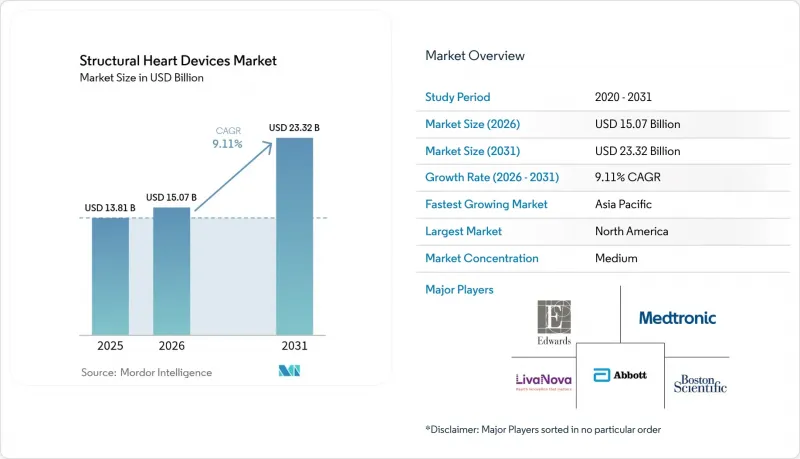
Mordor Intelligence에 의하면, 2026년 구조적 심장질환 디바이스 시장 규모는 150억 7,000만 달러로 추정되고 있어 2025년 138억 1,000만 달러에서 성장하여 2031년에는 233억 2,000만 달러에 이를 것으로 예측됩니다. 2026년부터 2031년까지 CAGR 9.11%로 성장할 전망입니다.
본 보고서는 제품별(심장 판막 디바이스, 폐쇄기 및 전달 시스템, 고리 성형술 및 지지 링 등), 시술별(치환술 및 수복술), 최종 사용자별(병원 및 심장 센터, 외래수술센터(ASC), 기타 최종 사용자), 지역별(북미, 유럽, 아시아태평양 등)로 분류되어 있습니다. 시장 전망은 금액(달러) 기준으로 제시되어 있습니다.
전 세계 구조적 심장질환 디바이스 시장 동향 및 인사이트
고소득 지역의 고령화에 따른 구조적 심장질환 유병률 증가
선진국의 평균 수명 연장으로 인해 석회화 대동맥판막 협착증 및 기능성 승모판 역류증의 위험군이 확대되고 있습니다. 최근 레지스트리 업데이트 데이터에 따르면, 75세 이상 환자의 시술 건수가 증가하고 있어 장기적인 수요 곡선을 뒷받침하고 있습니다. EARLY TAVR 임상시험을 통한 조기 중재의 증거에 따르면, 무증상 중증 대동맥판막 협착증을 증상이 나타나기 전에 치료함으로써 재입원률이 20% 감소하는 것으로 나타났으며, 잠재적 적응증 환자층이 확대되고 있습니다.
저위험 환자군에서의 경카테터 판막 치료 확산
저위험 환자를 대상으로 한 5년간의 추적 조사에 따르면, TAVR과 외과 수술 간에 전사인 사망률이 동등한 것으로 확인되어, 보험사 및 임상의들의 신뢰가 높아지고 있습니다. 이에 따라 상업적인 초점은 판막의 내구성, 판막 주위 누출 감소, 그리고 혈역학적 성능으로 옮겨가고 있습니다. 에드워즈사는 약 60%의 시장 점유율을 유지하고 있으며, 메드트로닉사는 28%를 차지하고 있습니다. 또한, 애보트사 등 신규 진출기업들은 ‘Navitor’ 시스템을 통해 입지를 강화하고 있어, 차별화 경쟁이 격화되고 있습니다.
신흥 시장인 아시아·아프리카의 숙련된 중재적 심장 전문의 부족
아시아와 아프리카의 저소득 지역에서는 여전히 류마티스성 심장병이 널리 관찰되지만, 시술 역량은 대도시권에 집중되어 있습니다. 복잡한 경카테터 승모판 치환술에는 신속하게 확대하기 어려운 광범위한 교육 체계가 필요합니다. 업계 차원의 교육 협력이 진행되고 있지만, 공급 격차로 인해 잠재 수요가 가장 높은 지역에서의 도입 속도가 계속해서 둔화되고 있습니다.
부문 분석
심장 판막 디바이스는 2025년 매출의 59.35%를 차지하며, 구조적 심장질환 디바이스 시장에서 핵심적인 역할을 하고 있음을 입증하고 있습니다. TAVR의 전 세계 매출은 70억 달러에 육박하고 있으며, 이는 미국의 연평균 10.0% 성장에 힘입은 결과입니다. 판막 개발 기업들은 장기적인 내구성을 향상시키는 저프로파일 전달 시스템, 항석회화 판막엽, 판막첨 정렬 기술에 주력하고 있습니다. 판막 플랫폼 분야의 구조적 심장질환 디바이스 시장 규모는 2025년에 CE 마크를 획득한 최초의 경대퇴 승모판막 교체 디바이스인 에드워즈사의 ‘SAPIEN M3’와 같은 차세대 시스템의 출시와 발맞추어 확대될 것으로 예측됩니다.
오클루더 및 전달 시스템은 특히 뇌졸중 예방 용도에서 시술 적용 범위가 급속히 확대되고 있습니다. 애보트(Abbott)의 ‘WATCHMAN FLX’ 포트폴리오는 피벗 지원 프레임과 전주 밀봉 기능을 통해 시술자들의 신뢰를 지속적으로 높이고 있습니다. 외래 치료에 대한 유리한 보험 환급 제도도 매출 성장을 뒷받침하고 있으며, 오클루더는 경카테터 치료 솔루션 중 가장 빠르게 성장하는 하위 카테고리가 되었습니다. 새로운 폴리머 프리 니티놀 제품군은 입원 기간을 더욱 단축시킬 것으로 예상되어, 2차 예방 대상 환자층에서의 도입 곡선에 추가적인 상승 압력을 가하고 있습니다. 이러한 동향들이 맞물리면서, 구조적 심장질환 디바이스 시장은 높은 한 자릿수 성장 궤도를 유지하고 있습니다.
지역별 분석
2025년, 북미는 전 세계 매출의 39.45%를 차지했습니다. 그 중심에는 미국이 있으며, 이 나라에서는 전 세계 TAVR(경카테터 대동맥판막 교체술) 이식 건수의 절반 이상이 이루어지고 있으며, 연간 약 10.0%의 수술 건수 증가율을 유지하고 있습니다. CMS(미국 의료보험서비스센터)에 의한 보험 적용 범위 확대와 ASC(외래수술센터)에서의 보급이 경카테터 수리 수술 건수의 지속적인 두 자릿수 성장을 뒷받침하고 있습니다. 캐나다의 승모판 클립 수술에 대한 보험 환급 제도 개혁은 2027년까지 추가적인 성장의 호재가 될 것입니다.
유럽은 매출액 기준 2위를 차지하고 있으며, 집중 조달 및 지역 간 CE 인증을 통해 신기술을 신속하게 도입하고 있습니다. 2025년 4월 SAPIEN M3가 CE 마크를 획득한 것은 이 지역이 대퇴동맥을 통한 승모판 솔루션의 조기 상용화 거점으로서의 역할을 하고 있음을 여실히 보여줍니다. 독일과 프랑스의 병원 네트워크에서는 클립 수술실을 확충하고 환자를 최소 침습 치료 경로로 분산시키는 노력이 진행되고 있어, 인구 동향이 정체되어 있음에도 불구하고 유럽의 구조적 심장질환 디바이스 시장 규모는 한 자릿수 중반대의 성장률을 유지하고 있습니다.
아시아태평양은 중국, 호주, 인도에서 수술 건수가 증가하고 있어 2031년까지 연평균 성장률(CAGR)이 10.98%로 가장 높은 성장세를 보이고 있습니다. 인도의 구조적 심장병 부문은 2024년에 불과 1,240만 달러에 그쳤으나, 국내 OEM 및 카테터실 수용 능력을 확대하고 있는 2급 사립 병원의 견인 덕분에 연평균 성장률(CAGR) 31%의 성장 궤도에 올랐습니다. 질환 프로파일의 다양성으로 인해, 지방의 류마티스성 심장병과 관련된 승모판 수복 수요부터 도시 지역의 퇴행성 대동맥판막 협착증에 이르기까지 임상적 우선순위도 다양하여, 차별화된 시장 진출 전략이 요구되고 있습니다. 일본에서는 고령화가 진행되면서 TAVR의 꾸준한 성장을 지속적으로 뒷받침하고 있는 반면, 한국의 3차 의료기관에서는 승모판 치료를 위한 AI 기반 크기 측정 기술의 시범 도입이 진행되고 있습니다.
기타 혜택:
- 엑셀 형식 시장 예측(ME) 시트
- 3개월간의 애널리스트 지원
자주 묻는 질문
목차
제1장 서론
제2장 조사 방법
제3장 주요 요약
제4장 시장 구도
제5장 시장 규모와 성장 예측
제6장 경쟁 구도
제7장 시장 기회와 향후 전망
JHS 26.09.07According to Mordor Intelligence, the structural heart devices market size in 2026 is estimated at USD 15.07 billion, growing from 2025 value of USD 13.81 billion with 2031 projections showing USD 23.32 billion, growing at 9.11% CAGR over 2026-2031.
This report is Segmented by Product (Heart Valve Devices, Occluders & Delivery Systems, Annuloplasty & Support Rings, and More), Procedure (Replacement Procedures and Repair Procedures), End User (Hospitals & Cardiac Centers, Ambulatory Surgical Centers, and Other End-Users), and Geography (North America, Europe, Asia-Pacific, and More). The Market Forecasts are Provided in Terms of Value (USD).
Global Structural Heart Devices Market Trends and Insights
Rising Prevalence of Structural Heart Diseases In Aging Populations of High-Income Regions
Longer life expectancy in developed economies has expanded the at-risk pool for calcific aortic stenosis and functional mitral regurgitation. Recent registry updates show escalating procedure volumes in patients aged >=75 years, reinforcing a long-run demand curve. Early-intervention evidence from the EARLY TAVR trial indicates a 20% reduction in rehospitalizations when asymptomatic severe aortic stenosis is treated before symptom onset, broadening the potential candidate base.
Expanding Adoption of Transcatheter Valve Therapies in Low-Risk Patient Cohorts
Five-year follow-up of low-risk patients confirms comparable all-cause mortality between TAVR and surgery, accelerating payer and clinician confidence. Commercial focus has therefore moved to valve durability, paravalvular leak reduction, and hemodynamic performance. Edwards maintains roughly 60% share, Medtronic 28%, and newer entrants such as Abbott are gaining traction with the Navitor system, intensifying differentiation battles.
Limited Access to Skilled Interventional Cardiologists In Emerging Asia & Africa
Rheumatic heart disease remains common in lower-income parts of Asia and Africa, yet procedure capacity is locked in metropolitan hubs. Complex transcatheter mitral replacement requires extensive proctoring that cannot be scaled quickly. Industry training collaborations are underway, but the supply gap continues to dampen adoption momentum in regions with the highest latent demand.
Other drivers and restraints analyzed in the detailed report include:
- Favorable Reimbursement Expansion for TAVR And TMVr Procedures
- Growth Of Ambulatory Cardiac Surgery Centers Enabling Same-Day Discharge
- Increasing Strategic Partnerships Between Device OEMs and AI-Enabled Imaging Firms for Pre-Op Planning
- High Up-Front Capital Expenditure for Hybrid Cath-Lab/Or Suites Constraining Smaller Hospitals
For complete list of drivers and restraints, kindly check the Table Of Contents.
Segment Analysis
Heart valve devices captured 59.35% of 2025 revenue, confirming their anchor role in the structural heart devices market. TAVR's worldwide revenue is approaching USD 7.0 billion, supported by 10.0% annual growth in the United States. Valve developers focus on lower profile delivery, anti-calcification leaflets, and commissural alignment technologies that improve long-term durability. The structural heart devices market size for valve platforms is projected to advance in lockstep with the rollout of next-generation systems such as Edwards SAPIEN M3, the first transfemoral mitral replacement to secure a CE Mark in 2025.
Occluders and delivery systems are witnessing rapid procedural expansion, particularly in stroke-prevention applications. Abbott's WATCHMAN FLX portfolio continues to gain operator confidence due to pivot-ready frames and full-circumference sealing. Sales growth is amplified by favorable outpatient reimbursement, making occluders the quickest expanding sub-category within transcatheter repair solutions. New polymer-free nitinol iterations promise even shorter in-hospital stays, placing additional upward pressure on adoption curves across secondary prevention populations. Collectively, these trends maintain the structural heart devices market on its high-single-digit trajectory.
Complete Report Scope:
- By Product
- Heart Valve Devices (TAVR, TMVR, Surgical)
- Occluders & Delivery Systems (ASD, VSD, PDA, LAA)
- Annuloplasty & Support Rings
- Other Products
- By Procedure
- Replacement Procedures
- Repair Procedures
- By End User
- Hospitals & Cardiac Centers
- Ambulatory Surgical Centers
- Other End-Users
- Geography
- North America
- United States
- Canada
- Mexico
- Europe
- Germany
- United Kingdom
- France
- Italy
- Spain
- Rest of Europe
- Asia-Pacific
- China
- Japan
- India
- South Korea
- Australia
- Rest of Asia-Pacific
- Middle-East and Africa
- GCC
- South Africa
- Rest of Middle East and Africa
- South America
- Brazil
- Argentina
- Rest of South America
- North America
Geography Analysis
North America generated 39.45% of global revenue in 2025, anchored by the United States, which performs more than half of all TAVR implants worldwide and maintains roughly 10.0% annual procedure growth. CMS coverage expansion and ASC penetration underpin continued double-digit growth in transcatheter repair volumes. Canadian reimbursement reforms for mitral clip procedures add incremental upside through 2027.
Europe ranks second in value and adopts new technologies swiftly because of centralized procurement and pan-regional CE approvals. The April 2025 CE Mark of the SAPIEN M3 highlights the region's role as an early commercialization hub for transfemoral mitral solutions. Hospital networks in Germany and France are broadening clip labs and triaging patients into minimally invasive pathways, helping the structural heart devices market size in Europe maintain mid-single-digit growth despite demographic plateauing.
Asia-Pacific posts the fastest CAGR at 10.98% through 2031 as procedure volumes accelerate in China, Australia, and India. India's structural heart segment, only USD 12.4 million in 2024, is on track for 31% CAGR, driven by domestic OEMs and tier-two private hospitals expanding cath-lab capacity. Diverse disease profiles create varied clinical priorities, from rheumatic-related mitral repair demand in rural areas to degenerative aortic stenosis in urban centers, requiring differentiated go-to-market strategies. Japan's aging population continues to underpin steady TAVR growth, while South-Korean tertiary centers pilot AI-guided sizing for mitral interventions.
- Abbott Laboratories
- Medtronic
- Edward Lifesciences
- Boston Scientific
- LivaNova
- Artivion Inc. (CryoLife)
- Lepu Medical
- Venus Medtech
- JenaValve Technology
- MicroPort
- AtriCure
- NuMed
- Kephalios
- Xeltis BV
- 4C Medical Technologies
- HighLife Medical
Additional Benefits:
- The market estimate (ME) sheet in Excel format
- 3 months of analyst support
TABLE OF CONTENTS
1 Introduction
- 1.1 Study Assumptions & Market Definition
- 1.2 Scope of the Study
2 Research Methodology
3 Executive Summary
4 Market Landscape
- 4.1 Market Overview
- 4.2 Market Drivers
- 4.2.1 Rising Prevalence of Structural Heart Diseases in Aging Populations of High-Income Regions
- 4.2.2 Expanding Adoption of Transcatheter Valve Therapies in Low-Risk Patient Cohorts
- 4.2.3 Favorable Reimbursement Expansion for TAVI and TMVr Procedures
- 4.2.4 Rapid Innovation in Next-Generation Biomaterials and Polymer-Free Nitinol Frames
- 4.2.5 Growth of Ambulatory Cardiac Surgery Centers Enabling Same-Day Discharge
- 4.2.6 Increasing Strategic Partnerships between Device OEMs & AI-Enabled Imaging Firms for Pre-Op Planning
- 4.3 Market Restraints
- 4.3.1 Limited Access to Skilled Interventional Cardiologists in Emerging Asia & Africa
- 4.3.2 High Up-Front Capital Expenditure for Hybrid Cath-Lab/OR Suites Constraining Smaller Hospitals
- 4.3.3 Durability Concerns & Re-Intervention Needs with Certain Transcatheter Valves
- 4.3.4 Supply-Chain Volatility of Medical-Grade Nitinol & PET Raising Production Costs
- 4.4 Regulatory Outlook
- 4.5 Porter's Five Forces Analysis
- 4.5.1 Threat of New Entrants
- 4.5.2 Bargaining Power of Buyers
- 4.5.3 Bargaining Power of Suppliers
- 4.5.4 Threat of Substitutes
- 4.5.5 Intensity of Competitive Rivalry
5 Market Size & Growth Forecasts (Value, USD)
- 5.1 By Product
- 5.1.1 Heart Valve Devices (TAVR, TMVR, Surgical)
- 5.1.2 Occluders & Delivery Systems (ASD, VSD, PDA, LAA)
- 5.1.3 Annuloplasty & Support Rings
- 5.1.4 Other Products
- 5.2 By Procedure
- 5.2.1 Replacement Procedures
- 5.2.2 Repair Procedures
- 5.3 By End User
- 5.3.1 Hospitals & Cardiac Centers
- 5.3.2 Ambulatory Surgical Centers
- 5.3.3 Other End-Users
- 5.4 Geography
- 5.4.1 North America
- 5.4.1.1 United States
- 5.4.1.2 Canada
- 5.4.1.3 Mexico
- 5.4.2 Europe
- 5.4.2.1 Germany
- 5.4.2.2 United Kingdom
- 5.4.2.3 France
- 5.4.2.4 Italy
- 5.4.2.5 Spain
- 5.4.2.6 Rest of Europe
- 5.4.3 Asia-Pacific
- 5.4.3.1 China
- 5.4.3.2 Japan
- 5.4.3.3 India
- 5.4.3.4 South Korea
- 5.4.3.5 Australia
- 5.4.3.6 Rest of Asia-Pacific
- 5.4.4 Middle-East and Africa
- 5.4.4.1 GCC
- 5.4.4.2 South Africa
- 5.4.4.3 Rest of Middle East and Africa
- 5.4.5 South America
- 5.4.5.1 Brazil
- 5.4.5.2 Argentina
- 5.4.5.3 Rest of South America
- 5.4.1 North America
6 Competitive Landscape
- 6.1 Market Concentration
- 6.2 Strategic Moves
- 6.3 Market Share Analysis
- 6.4 Company Profiles (includes Global-level Overview, Market-level Overview, Core Segments, Financials, Strategic Information, Market Rank/Share, Products & Services, Recent Developments)
- 6.4.1 Abbott Laboratories
- 6.4.2 Medtronic plc
- 6.4.3 Edwards Lifesciences Corporation
- 6.4.4 Boston Scientific Corporation
- 6.4.5 LivaNova PLC
- 6.4.6 Artivion Inc. (CryoLife)
- 6.4.7 Lepu Medical Technology
- 6.4.8 Venus Medtech (Hangzhou) Inc.
- 6.4.9 JenaValve Technology
- 6.4.10 MicroPort Scientific Corporation
- 6.4.11 AtriCure Inc.
- 6.4.12 NuMED Inc.
- 6.4.13 Kephalios
- 6.4.14 Xeltis BV
- 6.4.15 4C Medical Technologies
- 6.4.16 HighLife Medical
7 Market Opportunities & Future Outlook
- 7.1 White-space & Unmet-Need Assessment