

|
시장보고서
상품코드
2123375
ZigBee 시장 : 점유율 분석, 업계 동향과 통계, 성장 예측(2026-2031년)ZigBee - Market Share Analysis, Industry Trends & Statistics, Growth Forecasts (2026 - 2031) |
||||||
 Mordor Intelligence
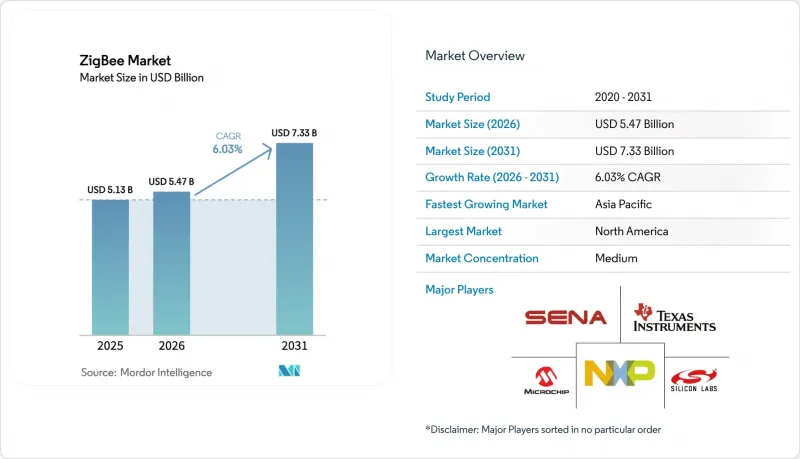
Mordor Intelligence에 의하면, ZigBee 시장 규모는 2025년에 51억 3,000만 달러로 평가되었고 2026년 54억 7,000만 달러에서 2031년까지 73억 3,000만 달러에 이를 것으로 예측되며, 예측 기간(2026-2031년) CAGR은 6.03%를 나타낼 전망입니다.
본 보고서는 구성 요소(칩셋, 모듈 등), 최종 사용자 산업(주택 자동화, 산업 자동화 등), 용도(조명 제어, HVAC 및 에너지 관리 등),표준/프로토콜 버전(ZigBee RF4CE 등), 디바이스 유형(코디네이터, 라우터 등), 지역별로 분류되어 있습니다. 시장 예측은 금액(달러) 기준으로 제시되어 있습니다.
세계 ZigBee 시장 동향 및 인사이트
전 세계적으로 급증하는 스마트 홈 기기 도입
2024년 전 세계 스마트 홈 기기 출하량은 11억 대에 달했으나, ZigBee 무선 기능을 탑재한 제품의 출하량은 18% 미만에 그쳤습니다. Matter 브리지 인증으로 인해 기존 ZigBee 센서의 수명이 연장되고 있으며, 커넥티비티 스탠다드 얼라이언스(CSA)는 2025년 11월까지 1,800종의 Matter 지원 제품을 인증했습니다. ZigBee 허브가 내장된 Echo 스마트 스피커는 아마존 북미 매출의 31%를 차지하며, 2023년 대비 9포인트 상승했습니다. 이는 단일 게이트웨이 구성에 대한 사용자 수요가 높음을 보여줍니다. 미국의 한 부동산 관리 회사에 따르면, ZigBee 조명 네트워크 도입 시 메쉬 네트워크의 자가 복구 기능 덕분에 현장 출장이 60% 감소하여 설치 작업 공수가 40% 줄었습니다고 합니다. 연방통신위원회(FCC)는 2.4GHz 대역 주파수를 5G 스몰 셀 용도로 재할당하는 방안을 검토하고 있으나, ZigBee 4.0에 규정된 적응형 주파수 호핑 알고리즘은 이러한 위험을 상쇄하도록 설계되었습니다.
브라운필드 공장에서의 인더스트리 4.0 개조 가속화
2015년 이전에 건설된 공장은 여전히 전 세계 바닥 면적의 78%를 차지하고 있으며, 그 대부분에는 무선 센서 그리드가 구축되어 있지 않습니다. 지멘스는 2025 회계연도에 ZigBee 기반 센서 매출로 3억 4,000만 유로(3억 8,000만 달러)를 기록했으며, 예측 유지보수 관련 수주에 힘입어 전년 대비 28% 증가했습니다. Texas Instruments의 무선 모듈 CC2652R7은 기존의 4-20 mA 루프에서 직접 신호를 샘플링하므로 설치 시간을 35% 단축할 수 있습니다. 2022년부터 2024년까지 Time-Sensitive Networking(TSN)이 추가된 산업용 이더넷 업그레이드에서는 현재 저우선순위 텔레메트리(telemetry)에 ZigBee를 활용하고 있으며, 이를 통해 모션 제어용 확정 대역폭을 확보하고 있습니다. IEC는 2024년 9월, IEC 62591 규격을 개정하여 프로토콜 간 간섭을 18dB 저감하는 ZigBee 주파수 호핑 테이블을 발표했습니다.
BLE, Wi-Fi 6, Matter에 의한 경쟁 심화
Matter는 물리 계층을 추상화하여, 단일 앱이 통합된 IP 스택을 통해 Thread, ZigBee, Wi-Fi 노드를 관리할 수 있게 함으로써, ZigBee가 기존에 안고 있던 락인 현상을 완화하고 있습니다. 애플이 iOS 18에서 ZigBee의 네이티브 지원을 중단함에 따라, 액세서리 제조업체들은 Matter 브리지를 추가하거나 Thread를 채택할 수밖에 없게 되었습니다. 블루투스 5.4의 확장 광고 기능은 동등한 배터리 수명과 4배의 처리량을 실현하고 있으며, 3달러 미만의 Wi-Fi 6E 칩셋이 대량 생산됨에 따라 비용 면에서 Zigbee 허브에 도전하고 있습니다. Matter 인증 제품의 68%가 이미 메시 홉에 Thread를 우선적으로 사용하고 있어, ZigBee는 구식 엔드포인트 프로토콜로 밀려날 위험이 있습니다.
부문 분석
2025년, ZigBee 시장 점유율의 44%를 칩셋이 차지했습니다. 이는 무선 부품이 여전히 BOM(부품표)에서 가장 가치가 높은 항목이기 때문입니다. 그러나 Telink와 EBYTE가 저가형 모듈을 시장에 대량으로 출시함에 따라 2024년 평균 판매 가격은 11% 하락했습니다. 각 벤더는 용도 프레임워크, 네트워크 분석기, 클라우드 프로비저닝을 무료 툴체인으로 통합하여 대응하고, 사용자 유지율 향상을 도모하고 있습니다. 게이트웨이와 허브는 2031년까지 연평균 성장률(CAGR) 6.72%로 성장하는 원동력이 되고 있습니다. 아마존의 Eero 6 라우터와 Tuya Smart의 Matter 허브는 ZigBee 변환 기능과 로컬에서 재실 감지를 수행하는 신경망 처리를 결합하여 클라우드 지연 시간을 85밀리초로 단축했습니다. 모듈은 무선, 안테나, 인증 기능이 패키지화되어 있어 RF 노하우가 없는 가전 제조업체들의 관심을 끌고 있으며, Telink는 2024년에 18억 위안(2억 5,000만 달러)의 모듈 매출을 기록했습니다. 개발용 소프트웨어는 NXP가 2025년 3월에 MCUXpresso SDK를 연간 499달러의 구독 플랜으로 전환한 사례에서 볼 수 있듯이, 영구 라이선스에서 구독 모델로 전환되고 있습니다.
게이트웨이, 라우터, 모듈은 해당 펌웨어를 통해 Matter 브리지 및 로컬 분석 기능을 구현하므로, 이익률 향상이 기대됩니다. 개발 소프트웨어의 구독화 전환은 수익의 평준화를 도모하고, 반도체 부문의 이익률 하락을 상쇄하며, 고객 시장 출시 기간을 단축시킵니다. 한편,각 칩 벤더들은 설계의 미래 경쟁력을 확보하기 위해 초광대역(UWB) 및 서브GHz 대역 옵션을 동일한 다이에 통합하고 있으며, 고객이 센티미터 단위의 위치 측정이나 장거리 백업 링크를 요구하게 됨에 따라 이러한 추세로 인해 2027년 이후에는 평균 판매 가격(Blended ASP)이 소폭 상승할 가능성이 있습니다.
ZigBee 시장의 홈 오토메이션은 2025년 매출의 38%를 차지하며, 그 주된 요인은 조명 및 HVAC(냉난방·환기) 개조이지만, 성숙한 단독주택 시장에서는 성장률이 정체되고 있습니다. 향후 성장은 기기 밀도가 낮은 공동 주택 및 신흥 경제국에 의존하게 될 것입니다. 스마트 미터가 분산형 에너지 자원(DER) 컨트롤러로 진화함에 따라, 에너지 및 공공 서비스 분야가 연평균 성장률(CAGR) 8.23%로 시장을 주도할 것으로 예측됩니다. PG 및 E에 의한 변압기 탑재 센서의 도입은 데이터 수집에서 그리드 에지에서의 작동으로의 전환을 나타냅니다. 매출 기여도 2위를 차지하는 산업 자동화 분야에서는 브라운필드 공장 내에서 ZigBee 라우터를 채택하여, 시간 민감형 네트워킹(TSN) 백본에서 비중요 데이터를 오프로드하고 있습니다. 의료 분야에서의 보급은 여전히 미미한데, 이는 미국 식품의약국(FDA)이 생명 유지에 필수적인 모니터링에는 라이선스가 필요한 주파수 대역을 권장하고 있기 때문입니다.
직접 IP 주소 지정이 가능한 공공 서비스 사업자들은 ZigBee IP를 선호하고 있으며, 이로 인해 소프트웨어의 가치가 독자 사양의 스택에서 오픈소스 미들웨어로 이동하고 있습니다. 기존 설비(브라운필드) 공장의 OEM 제조업체들은 진동 및 환경 모니터링을 지원하기 위해 ZigBee를 기존 PLC와 결합하고 있으며, 이를 통해 가동 중단 시간을 줄이고 자본 지출(CAPEX)을 최소화하고 있습니다. 전자 가격표와 같은 소매 및 디지털 상거래 분야의 활용 사례는 완만하게 확대되고 있는 반면, IT 및 통신 용도는 실외 환경에서 LoRaWAN으로의 전환이 진행되고 있어, ZigBee의 활용은 실내 환경으로 한정되고 있습니다.
지역별 분석
2025년 매출의 35%를 북미가 차지했습니다. 이는 2023년부터 2025년까지 캘리포니아주와 텍사스주에 설치된 1,800만 대의 ZigBee 지원 스마트 미터 단말기, 그리고 아마존의 임베디드 허브 대량 배포가 원동력이 되었습니다. 미국 에너지정보청(EIA)의 집계에 따르면, 가동 중인 스마트 미터는 1억 700만 대이며, 그 중 거의 절반이 홈 에어리어 네트워크에 ZigBee를 채택하고 있습니다. 캐나다에서는 에너지 규제가 주마다 다르기 때문에 보급률은 38%에 그치고 있습니다. 멕시코에서는 2027년까지 ZigBee 기반 수요 반응 기능을 통합한 210만 대의 스마트 미터기를 시범 운영 중이며, 여기에는 옥상 태양광 발전에 대한 인센티브도 결합되어 있습니다.
아시아태평양은 연평균 성장률(CAGR) 6.89%로, 각 지역 중 가장 높은 성장률을 보일 것으로 전망됩니다. 중국의 Tuya Smart는 3억 1,000만 대의 기기를 관리하고 있으며, 이 회사의 독자적인 SoC는 유럽 및 미국의 경쟁사 제품보다 35% 저렴합니다. 인도의 배전 부문 개혁 계획(Revamped Distribution Sector Scheme)에서는 2027년까지 2억 5,000만 대의 스마트 미터기 설치를 목표로 하고 있으며, 그 중 상당수는 가정용 디스플레이에 ZigBee를 탑재할 예정입니다. 일본의 건축기준법 개정에 따라 300제곱미터를 초과하는 모든 신축 주택에는 에너지 관리 시스템 도입이 의무화되었으며, 이로 인해 820만 호의 기존 주택에 대한 개보수가 촉진되고 있습니다. 한국의 송도 및 부산 스마트시티 프로젝트에서는 이미 140만 기의 ZigBee 지원 가로등 및 주차 센서가 설치되어, 이를 통해 지자체의 에너지 사용량을 22% 절감했습니다.
유럽은 2025년 전체의 28%를 차지하고 있으며, 그 중심에는 영국의 3,370만 대의 스마트 전력 계량기와 독일의 에너지 효율화 대출 프로그램이 있습니다. 영국은 2026년 12월까지 스마트 계량기 보급률 75%를 의무화하고 있는 반면, 독일은 연간 전력 소비량이 6,000kWh를 초과하는 가구에 대해 2028년까지 계량기 도입을 의무화하고 있어, 이로 인해 ZigBee 수요가 증가하고 있습니다. 프랑스에서는 백홀에 전력선 통신(PLC)을 채택하는 한편, 옵션인 실내 디스플레이에는 ZigBee를 유지하는 Linky 3,500만 대의 설치를 완료하여 타사 기기의 애프터마켓을 창출하고 있습니다.
남미, 중동 및 아프리카의 합계 점유율은 12%를 차지하고 있습니다. 브라질에서는 2025년 3월의 결정에 따라 2028년까지 ZigBee 홈 영역 네트워크를 탑재한 1,000만 대의 계량기 도입이 의무화되어 있으며, 모듈 시장 규모는 약 4억 2,000만 달러에 달할 것으로 예측됩니다. 사우디아라비아의 NEOM 도시에서는 이미 34만 개의 ZigBee 센서가 가동 중이며, 자원의 실시간 추적에 활용되고 있습니다. 남아프리카공화국은 2025년 1월, ZigBee 지원 계량기 120만 대에 대한 입찰을 실시했으며, 2027년까지 요하네스버그와 케이프타운에 이를 도입하는 것을 목표로 하고 있습니다.
기타 혜택:
- 엑셀 형식 시장 예측(ME) 시트
- 3개월간의 애널리스트 지원
자주 묻는 질문
목차
제1장 서론
제2장 조사 방법
제3장 주요 요약
제4장 시장 구도
제5장 시장 규모와 성장 예측
제6장 경쟁 구도
제7장 시장 기회와 향후 전망
JHS 26.09.11According to Mordor Intelligence, the ZigBee market size was valued at USD 5.13 billion in 2025 and is estimated to grow from USD 5.47 billion in 2026 to reach USD 7.33 billion by 2031, at a CAGR of 6.03% during the forecast period (2026-2031).

This report is Segmented by Component (Chipsets, Modules, and More), End-User Industry (Residential Automation, Industrial Automation, and More), Application (Lighting Control, HVAC and Energy Management, and More), Standard/Protocol Version (ZigBee RF4CE, and More), Device Type (Coordinator, Router, and More), and Geography. The Market Forecasts are Provided in Terms of Value (USD).
Global ZigBee Market Trends and Insights
Explosive Smart-Home Device Installations Worldwide
Global smart-home device shipments reached 1.1 billion units in 2024, but fewer than 18% shipped with ZigBee radios. Matter bridge certification is now extending the life of existing ZigBee sensors, and the Connectivity Standards Alliance confirmed 1,800 Matter-compatible products by November 2025. Echo smart speakers that embed a ZigBee hub made up 31% of Amazon's North American sales, a nine-point jump from 2023, showing user appetite for single-gateway setups. Property-management firms in the United States reported 40% lower installation labor when deploying ZigBee lighting networks because mesh self-healing cut truck rolls by 60%. Although the Federal Communications Commission is considering reallocating 2.4 GHz spectrum for 5G small cells, adaptive frequency-hopping algorithms specified in ZigBee 4.0 are designed to offset that risk.
Accelerating Industry 4.0 Retrofits in Brown-Field Factories
Factories erected before 2015 still account for 78% of global floor space, and most lack wireless sensor grids. Siemens logged EUR 340 million (USD 380 million) in ZigBee-based sensor revenue in fiscal 2025, up 28% year on year, driven by predictive-maintenance orders. The CC2652R7 radio from Texas Instruments samples legacy 4-20 mA loops directly, trimming installation time by 35%. Industrial Ethernet upgrades that added Time-Sensitive Networking between 2022 and 2024 now lean on ZigBee for low-priority telemetry, freeing deterministic bandwidth for motion control. The IEC amended its IEC 62591 standard in September 2024 to publish ZigBee frequency-hopping tables that shrink cross-protocol interference by 18 dB.
Intensifying Competition from BLE, Wi-Fi 6 and Matter
Matter treats the physical layer as abstract, letting one app supervise Thread, ZigBee, and Wi-Fi nodes over a unified IP stack, which blunts ZigBee's historical lock-in. Apple withdrew native ZigBee support in iOS 18, compelling accessory makers to add a Matter bridge or adopt Thread. Bluetooth 5.4 extended advertising now offers comparable battery life and quadruple throughput, and Wi-Fi 6E chipsets below USD 3.00 at scale challenge ZigBee hubs on cost. As 68% of Matter-certified products already prefer Thread for the mesh hop, ZigBee risks being relegated to a legacy endpoint protocol.
Other drivers and restraints analyzed in the detailed report include:
- Government-Backed Smart-Meter Roll-outs in North America and Europe
- Multi-Protocol SoCs Lowering BOM Cost (ZigBee + BLE + Thread)
- Persistent Interoperability Gaps Across Vendor Stacks
For complete list of drivers and restraints, kindly check the Table Of Contents.
Segment Analysis
Chipsets owned 44% ZigBee market share in 2025 because the radio continues to be the most valuable line item in the bill of materials. Average selling prices, however, declined 11% in 2024 as Telink and EBYTE flooded low-cost modules. Vendors are countering by folding application frameworks, network analyzers, and cloud provisioning into free toolchains to reinforce stickiness. Gateways and hubs are the growth engine at a 6.72% CAGR through 2031. Amazon's Eero 6 router and Tuya Smart's Matter hub combine ZigBee translation with neural processing that runs presence detection locally, cutting cloud latency to 85 milliseconds. Modules attract appliance makers without RF know-how because the radio, antenna, and certifications are prepackaged, and Telink reported module revenue of CNY 1.8 billion (USD 250 million) in 2024. Development software is migrating from perpetual to subscription, as seen when NXP moved the MCUXpresso SDK to a USD 499 annual plan in March 2025.
Gateways, routers, and modules are expected to capture incremental margin because their firmware unlocks Matter bridges and local analytics. Development software's subscription shift smooths revenue, offsets margin erosion on silicon, and shortens customer time-to-market. Meanwhile, chip vendors are folding ultra-wideband and sub-GHz options onto the same die to future-proof designs, a trend that could lift blended average selling prices slightly after 2027 as customers demand centimeter-grade positioning and long-range backup links.
Residential automation in the ZigBee Market delivered 38% of 2025 revenue, primarily from lighting and HVAC retrofits, but its growth rate is plateauing in mature single-family markets. Expansion now hinges on multi-unit dwellings and emerging economies where device density is lower. Energy and utilities are forecast to lead with an 8.23% CAGR as smart meters evolve into distributed-energy resource controllers. PG and E's rollout of transformer-mounted sensors illustrates the pivot from data collection to grid-edge actuation. Industrial automation, the second-largest revenue contributor, is adopting ZigBee routers within brown-field plants to offload non-critical data from Time-Sensitive Networking backbones. Healthcare uptake remains modest because the United States Food and Drug Administration favors licensed spectrum for life-critical monitoring.
Utilities conferring direct IP addressability favor ZigBee IP, which means software value migrates from proprietary stacks to open source middleware. Original-equipment makers in brown-field factories are bundling ZigBee with existing PLCs to support vibration and ambient monitoring, reducing downtime and minimizing CAPEX. Retail and digital commerce use cases such as electronic shelf labels are expanding moderately, while IT and telecommunications applications increasingly retreat to LoRaWAN in outdoor settings, confining ZigBee to indoor environments.
Complete Report Scope:
- By Component
- Chipsets
- Modules
- Gateways and Hubs
- Development Tools and Software
- By End-User Industry
- Residential Automation
- Industrial Automation
- IT and Telecommunication
- Healthcare
- Retail and Digital Commerce
- Energy and Utilities (Smart Metering / Smart Grid)
- By Application
- Lighting Control
- HVAC and Energy Management
- Security and Access Control
- Asset and Environmental Monitoring
- Other Applications (Consumer Electronics Peripherals, and More)
- By Standard / Protocol Version
- ZigBee RF4CE
- ZigBee PRO
- ZigBee 3.0
- ZigBee IP
- ZigBee Remote Control 2.0
- By Device Type
- Coordinators
- Routers
- End-Devices / Sensors
- By Geography
- North America
- United States
- Canada
- Mexico
- South America
- Brazil
- Argentina
- Rest of South America
- Europe
- United Kingdom
- Germany
- France
- Italy
- Russia
- Rest of Europe
- Asia-Pacific
- China
- Japan
- India
- South Korea
- Rest of Asia-Pacific
- Middle East
- Saudi Arabia
- United Arab Emirates
- Rest of Middle East
- Africa
- South Africa
- Egypt
- Rest of Africa
- North America
Geography Analysis
North America contributed 35% revenue in 2025, powered by 18 million ZigBee-enabled smart-meter endpoints installed across California and Texas from 2023 to 2025 and by Amazon's mass distribution of embedded hubs. The United States Energy Information Administration counted 107 million smart meters in service, and nearly half use ZigBee for home-area networks. Canadian adoption lags at 38% penetration because energy regulation remains provincial. Mexico is piloting 2.1 million smart meters through 2027 that integrate ZigBee demand-response links, paired with rooftop solar incentives.
Asia-Pacific is paced for a 6.89% CAGR, the highest among regions. China's Tuya Smart controls 310 million devices, and its proprietary SoC undercuts Western rivals by 35%. India's Revamped Distribution Sector Scheme aims to install 250 million smart meters by 2027, many of which will embed ZigBee for in-home displays. Japan's Building Standard Law amendment requires energy-management systems in all new homes larger than 300 square meters, spurring retrofits across 8.2 million existing dwellings. South Korea's smart-city projects in Songdo and Busan have already installed 1.4 million ZigBee streetlights and parking sensors, which curbed municipal energy use by 22%.
Europe held 28% of the 2025 total, anchored by the United Kingdom's 33.7 million smart electricity meters and Germany's energy-efficiency loan program. The United Kingdom mandated 75% smart-meter coverage by December 2026, while Germany requires households above 6,000 kWh to deploy meters by 2028, boosting ZigBee demand. France completed 35 million Linky installations that rely on power-line for backhaul but keep ZigBee for optional in-home displays, creating an aftermarket for third-party devices.
South America, Middle East, and Africa combine for 12% share. Brazil's March 2025 ruling requires 10 million meters by 2028 with ZigBee home-area networks, worth an estimated USD 420 million module market. Saudi Arabia's NEOM city already operates 340,000 ZigBee sensors for real-time resource tracking. South Africa issued a tender for 1.2 million ZigBee-capable meters in January 2025, targeting Johannesburg and Cape Town rollouts by 2027.
- Texas Instruments Incorporated
- Silicon Laboratories Inc.
- NXP Semiconductors N.V.
- Microchip Technology Inc.
- Digi International Inc.
- Nordic Semiconductor ASA
- Qualcomm Technologies Inc.
- Semiconductor Components Industries LLC (ON Semiconductor)
- Qorvo Inc.
- Telink Semiconductor (Shanghai) Co. Ltd.
- EBYTE Electronic Technology Co. Ltd.
- Tuya Smart
- Minew Technologies
- u-blox AG
- STMicroelectronics N.V.
- Renesas Electronics Corporation
- EnOcean GmbH
- GreenPeak Technologies (Qorvo)
- Telegesis Ltd. (Silicon Labs)
- Dresden Elektronik
Additional Benefits:
- The market estimate (ME) sheet in Excel format
- 3 months of analyst support
TABLE OF CONTENTS
1 INTRODUCTION
- 1.1 Study Assumptions and Market Definition
- 1.2 Scope of the Study
2 RESEARCH METHODOLOGY
3 EXECUTIVE SUMMARY
4 MARKET LANDSCAPE
- 4.1 Market Overview
- 4.2 Market Drivers
- 4.2.1 Explosive Smart-Home Device Installations Worldwide
- 4.2.2 Accelerating Industrial 4.0 Retrofits in Brown-Field Factories
- 4.2.3 Government-Backed Smart-Meter Roll-outs in North America and Europe
- 4.2.4 Multi-Protocol SoCs Lowering BOM Cost (ZigBee + BLE + Thread)
- 4.2.5 EV-Charger to Home-Energy-Hub Integration Using ZigBee
- 4.2.6 Utility Micro-Grid DER Orchestration Pilots Leveraging ZigBee Mesh
- 4.3 Market Restraints
- 4.3.1 Intensifying Competition from BLE, Wi-Fi 6 and Matter
- 4.3.2 Persistent Interoperability Gaps Across Vendor Stacks
- 4.3.3 Chronic Shortage of IEEE 802.15.4 Chip Foundry Capacity
- 4.3.4 Looming Re-allocation of 2.4 GHz ISM Spectrum in Urban Cores
- 4.4 Industry Value Chain Analysis
- 4.5 Regulatory Landscape
- 4.6 Technological Outlook
- 4.7 Impact of Macroeconomic Factors on the Market
- 4.8 Porter's Five Forces Analysis
- 4.8.1 Bargaining Power of Suppliers
- 4.8.2 Bargaining Power of Buyers
- 4.8.3 Threat of New Entrants
- 4.8.4 Threat of Substitutes
- 4.8.5 Intensity of Competitive Rivalry
5 MARKET SIZE AND GROWTH FORECASTS (VALUE)
- 5.1 By Component
- 5.1.1 Chipsets
- 5.1.2 Modules
- 5.1.3 Gateways and Hubs
- 5.1.4 Development Tools and Software
- 5.2 By End-User Industry
- 5.2.1 Residential Automation
- 5.2.2 Industrial Automation
- 5.2.3 IT and Telecommunication
- 5.2.4 Healthcare
- 5.2.5 Retail and Digital Commerce
- 5.2.6 Energy and Utilities (Smart Metering / Smart Grid)
- 5.3 By Application
- 5.3.1 Lighting Control
- 5.3.2 HVAC and Energy Management
- 5.3.3 Security and Access Control
- 5.3.4 Asset and Environmental Monitoring
- 5.3.5 Other Applications (Consumer Electronics Peripherals, and More)
- 5.4 By Standard / Protocol Version
- 5.4.1 ZigBee RF4CE
- 5.4.2 ZigBee PRO
- 5.4.3 ZigBee 3.0
- 5.4.4 ZigBee IP
- 5.4.5 ZigBee Remote Control 2.0
- 5.5 By Device Type
- 5.5.1 Coordinators
- 5.5.2 Routers
- 5.5.3 End-Devices / Sensors
- 5.6 By Geography
- 5.6.1 North America
- 5.6.1.1 United States
- 5.6.1.2 Canada
- 5.6.1.3 Mexico
- 5.6.2 South America
- 5.6.2.1 Brazil
- 5.6.2.2 Argentina
- 5.6.2.3 Rest of South America
- 5.6.3 Europe
- 5.6.3.1 United Kingdom
- 5.6.3.2 Germany
- 5.6.3.3 France
- 5.6.3.4 Italy
- 5.6.3.5 Russia
- 5.6.3.6 Rest of Europe
- 5.6.4 Asia-Pacific
- 5.6.4.1 China
- 5.6.4.2 Japan
- 5.6.4.3 India
- 5.6.4.4 South Korea
- 5.6.4.5 Rest of Asia-Pacific
- 5.6.5 Middle East
- 5.6.5.1 Saudi Arabia
- 5.6.5.2 United Arab Emirates
- 5.6.5.3 Rest of Middle East
- 5.6.6 Africa
- 5.6.6.1 South Africa
- 5.6.6.2 Egypt
- 5.6.6.3 Rest of Africa
- 5.6.1 North America
6 COMPETITIVE LANDSCAPE
- 6.1 Market Concentration
- 6.2 Strategic Moves
- 6.3 Market Share Analysis
- 6.4 Company Profiles (includes Global Level Overview, Market Level Overview, Core Segments, Financials as available, Strategic Information, Market Rank/Share for Key Companies, Products and Services, and Recent Developments)
- 6.4.1 Texas Instruments Incorporated
- 6.4.2 Silicon Laboratories Inc.
- 6.4.3 NXP Semiconductors N.V.
- 6.4.4 Microchip Technology Inc.
- 6.4.5 Digi International Inc.
- 6.4.6 Nordic Semiconductor ASA
- 6.4.7 Qualcomm Technologies Inc.
- 6.4.8 Semiconductor Components Industries LLC (ON Semiconductor)
- 6.4.9 Qorvo Inc.
- 6.4.10 Telink Semiconductor (Shanghai) Co. Ltd.
- 6.4.11 EBYTE Electronic Technology Co. Ltd.
- 6.4.12 Tuya Smart
- 6.4.13 Minew Technologies
- 6.4.14 u-blox AG
- 6.4.15 STMicroelectronics N.V.
- 6.4.16 Renesas Electronics Corporation
- 6.4.17 EnOcean GmbH
- 6.4.18 GreenPeak Technologies (Qorvo)
- 6.4.19 Telegesis Ltd. (Silicon Labs)
- 6.4.20 Dresden Elektronik
7 MARKET OPPORTUNITIES AND FUTURE OUTLOOK
- 7.1 White-Space and Unmet-Need Assessment


