|
시장보고서
상품코드
2123376
감염증 진단 시장 : 점유율 분석, 업계 동향과 통계, 성장 예측(2026-2031년)Infectious Disease Diagnostics - Market Share Analysis, Industry Trends & Statistics, Growth Forecasts (2026 - 2031) |
||||||
 Mordor Intelligence
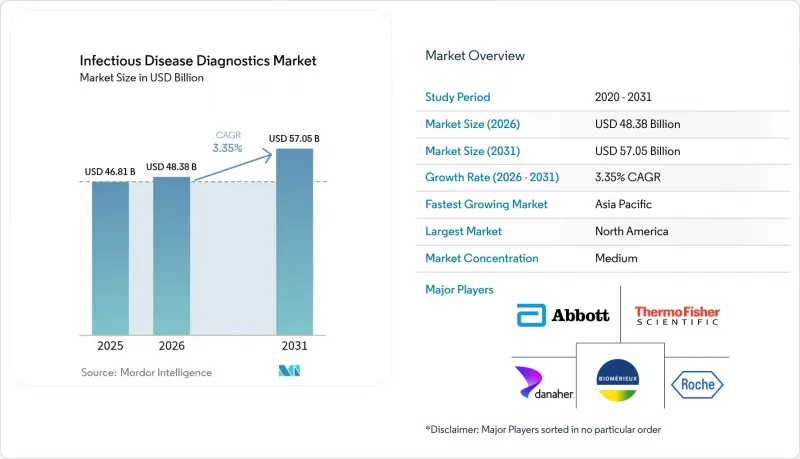
Mordor Intelligence에 의하면, 감염증 진단 시장 규모는 2025년에 468억 1,000만 달러로 평가되었고 2026년 483억 8,000만 달러에서 2031년까지 570억 5,000만 달러에 이를 것으로 추정되고 있어 예측 기간(2026-2031년) CAGR은 3.35%를 나타낼 전망입니다.
본 보고서는 용도별(간염, HIV 등), 제품 및 서비스별(분석법, 키트, 시약 등), 기술별(PCR 및 QPCR 등), 최종 사용자별(병원 및 임상 실험실 등), 검사 환경별(검사실 내 검사 등), 검체 유형별(소변, 대변 등),및 지역별로 분류되어 있습니다. 시장 예측은 금액(달러) 기준으로 제시되어 있습니다.
전 세계 감염증 진단 시장 동향 및 인사이트
감염증 확산 및 재유행
매개성 질환이 증가하고 있으며, 2025년 초에는 뎅기열 사례 수가 지난 5년간의 평균을 15% 상회했습니다. 기후 변화로 인해 모기의 서식 범위가 확대됨에 따라, 의료 기관에서는 과거에는 열대 지역으로 한정되었던 병원체에 대한 검사를 실시했습니다. 세계보건기구(WHO)는 2024년 8월, MPOX를 3단계 비상사태로 분류했으며, 이에 따라 검사 수요는 전년 대비 160% 급증했습니다. 항생제 내성도 추가적인 압박 요인으로 작용하고 있습니다. WHO의 2024년 우선순위 목록에는 신속한 진단이 필요한 15가지 내성균군이 포함되어 있습니다. 새로운 위협이 대두되는 가운데, 검사 기관은 검사 항목을 빈번하게 업데이트해야 하며, 이는 감염증 진단 시장 전반의 기업들에게 지속적인 수익원이 되고 있습니다.
현장 진단 및 자가 진단에 대한 수요 증가
규제 당국은 소비자용 검사 키트를 잇달아 승인하고 있습니다. 2024년 8월, FDA는 최초의 일반의약품(OTC) 매독 검사 키트를 승인하여, 소매 진단이 주류 의료 현장에 도입되는 계기가 되었습니다. 2018년부터 2022년까지 매독 발생률이 80% 증가함에 따라, 지역 약국과 온라인 쇼핑몰에서는 현재 신속 검사 키트를 취급하고 있습니다. 세페이드(Cefed)사의 손가락 채혈식 C형 간염 검사는 내원 당일에 바이러스 확인 검사를 가능하게 하여, 1차 진료 시설에서의 진료 공백을 메우고 있습니다. 보험사는 이후 의료비를 절감할 수 있는 조기 치료 개시를 중시하고 있어, 코딩의 복잡성이 여전히 남아 있음에도 불구하고 보험 환급 절차는 이를 따라잡고 있습니다.
단편적이고 불충분한 보상 체계
보험사는 청구를 승인하기 전에 엄격한 코딩을 요구하고 있으며, 이에 따른 업무 처리 증가가 소규모 검사실의 자금 사정을 압박하고 있습니다. 특히 저·중소득국의 정부 요금표는 첨단 분자진단 플랫폼의 전체 비용을 거의 충당하지 못해 그 보급을 제한하고 있습니다. 이러한 환경에 놓인 검사실은 기부자 프로그램에 의존하고 있으며, 명확한 임상적 필요성이 있음에도 불구하고 상업적 성장세가 주춤하고 있습니다. 지불 모델이 통일된다면 감염증 진단 시장 전반에 걸쳐 더 광범위한 도입이 가능해질 것입니다.
부문 분석
2025년 기준, 호흡기 패널은 감염증 진단 시장 점유율의 19.85%를 차지했으나, 매개성 질환 및 신종 병원체 시장은 2031년까지 연평균 성장률(CAGR) 5.52%로 성장할 전망입니다. 2024년부터 2025년까지 뎅기열 사례 수가 사상 최고치인 1,300만 건에 달함에 따라, 병원들은 검사 항목을 확대할 수밖에 없었습니다. Mpox, 간염, HIV 자가 진단 키트 및 AI를 활용한 결핵 검사가 임상 검사의 범위를 넓히고 있습니다. 전 세계적인 이동성의 변화와 기후 변화로 인해 감염 경로가 변화함에 따라, 매개체 유래 검사와 관련된 감염증 진단 시장 규모는 계속 확대될 것입니다.
성장의 원동력은 병원 내 감염을 위한 신속한 항생제 감수성 검사 도구와 성매개감염(STI) 자가 검사 키트에 대한 FDA의 OTC(일반의약품) 승인입니다. 검사 기관들은 WHO가 내성균 목록에 새로운 세균을 추가할 때 신속하게 업데이트되는 플랫폼을 중요하게 여기고 있으며, 이러한 유연성이 감염증 진단 시장에서 공급업체에 대한 신뢰도를 높이고 있습니다.
2025년, 감염증 진단 시장 규모 중 분석법, 키트, 시약이 52.90%를 차지했습니다. 이는 소모품이 지속적인 수익을 견인하고 있기 때문입니다. 소프트웨어 및 정보학 부문은 규모는 작지만, 검사실 워크플로우가 디지털화됨에 따라 5.48%라는 가장 높은 연평균 성장률(CAGR)을 나타낼 전망입니다. 현재 장비 부문에서는 단순한 처리 능력뿐만 아니라 자동화 수준, 검체 채취부터 결과 도출까지의 속도, AI와의 연동 측면에서 경쟁이 치열하게 펼쳐지고 있습니다.
병원들이 복잡한 시퀀싱이나 약물 내성 패널을 외부에 위탁함에 따라 수탁 검사 서비스가 확대되고 있습니다. 클라우드 기반 분석 기능을 통해 원시 데이터가 실용적인 보고서로 변환됨에 따라 검사 건당 가치가 높아지고 있습니다. 감염증 진단 시장 전체에서 하드웨어의 이익률이 축소되는 상황에서도, 시약과 인포매틱스를 세트로 판매하는 벤더는 시장 점유율을 유지하고 있습니다.
지역별 분석
북미는 확립된 환급 규정, 신속한 FDA 승인, 그리고 높은 정기 선별 검사 건수에 힘입어 2025년에는 전 세계 매출의 44.85%를 차지했습니다. 그러나 COVID-19 검사 매출이 감소하는 가운데, 이 지역은 현재 예산 삭감에 직면해 있으며, 검사실은 검사 항목 확대와 자동화 가속화를 추진해야 하는 상황에 놓여 있습니다.
아시아태평양은 인프라 투자와 감염증 부담 증가에 힘입어 2031년까지 연평균 성장률(CAGR) 5.20%를 나타낼 것으로 예측됩니다. 중국, 인도, 일본의 정부 프로그램에서는 뎅기열, MPOX, 항생제 내성에 대한 신속 검사 패널에 대한 보조금이 지급되고 있으며, 이는 도입 주기의 단축으로 이어지고 있습니다. 디지털 헬스 실증 사업에서는 원격 검사 키트와 원격 진료를 연계함으로써 농촌 지역으로의 서비스 제공 범위를 확대되고 있습니다.
유럽에서는 수요가 견조하게 유지되며, 증후군별 멀티플렉스 검사 도입을 주도하고 있습니다. 보험 환급 제도의 불균일성과 데이터 개인정보 보호에 관한 법규제가 국경을 초월한 디지털 헬스 확대를 지연시키고 있지만, 항생제 적정 사용 노력에 따라 병원에서는 신속 진단법 도입이 계속해서 요구되고 있습니다. 중동 및 아프리카 시장은 여전히 규모가 작지만, 기부금을 통해 시설 현대화가 진행되고 있어, 감염증 진단 시장에서 지리적 다각화를 목표로 하는 공급업체들에게 발판을 마련할 기회가 되고 있습니다.
기타 혜택:
- 엑셀 형식 시장 전망(ME) 시트
- 3개월간의 애널리스트 지원
자주 묻는 질문
목차
제1장 서론
제2장 조사 방법
제3장 주요 요약
제4장 시장 구도
제5장 시장 규모와 성장 예측
제6장 경쟁 구도
제7장 시장 기회와 향후 전망
JHS 26.09.07According to Mordor Intelligence, the infectious disease diagnostics market size was valued at USD 46.81 billion in 2025 and estimated to grow from USD 48.38 billion in 2026 to reach USD 57.05 billion by 2031, at a CAGR of 3.35% during the forecast period (2026-2031).

This report is Segmented by Application (Hepatitis, HIV, and More), by Product & Service (Assays, Kits, & Reagents, and More), by Technology (PCR & QPCR, and More), End User (Hospital & Clinical Laboratories, and More), Test Setting (Laboratory-Based Testing, and More), Sample Type(Urine, Stool and More) and Geography. The Market Forecasts are Provided in Terms of Value (USD).
Global Infectious Disease Diagnostics Market Trends and Insights
Escalating Prevalence and Resurgence of Infectious Diseases
Vector-borne illnesses are climbing, with dengue cases running 15% above the five-year average in early 2025.Climate change is widening mosquito habitats, so providers now test for pathogens once restricted to the tropics. The World Health Organization classified mpox as a grade 3 emergency in August 2024, prompting a 160% jump in test demand over the prior year. Antimicrobial resistance adds pressure: the WHO's 2024 priority list highlights 15 resistant bacterial families that need rapid diagnostics. As new threats surface, laboratories must refresh menus frequently, creating recurring revenue for firms across the infectious disease diagnostics market.
Growing Demand for Point-of-Care and At-Home Testing
Regulators are green-lighting consumer tests at pace. In August 2024 the FDA cleared the first OTC syphilis assay, ushering retail diagnostics into mainstream practice. Syphilis incidence rose 80% from 2018 to 2022, so community pharmacies and e-commerce portals now stock rapid kits. Cepheid's finger-stick hepatitis C test adds same-visit viral confirmation, closing care gaps in primary clinics. Payers value earlier therapy starts that reduce downstream costs, so reimbursement processes are catching up, even as coding complexity persists.
Fragmented and Inadequate Reimbursement Frameworks
Payers insist on stringent coding before honoring claims, and the added paperwork stretches cash cycles for smaller labs. Government fee schedules, especially in low- and middle-income countries, rarely cover the full cost of advanced molecular platforms, limiting uptake. Laboratories in such settings rely on donor programs, slowing commercial momentum despite clear clinical need. Harmonized payment models would unlock wider adoption across the infectious disease diagnostics market.
Other drivers and restraints analyzed in the detailed report include:
- Continuous Innovation in PCR/NGS Platforms and Chemistries
- AI-Driven Laboratory Workflows for Testing
- Budget Squeeze After COVID-19 Testing Wind-Down
For complete list of drivers and restraints, kindly check the Table Of Contents.
Segment Analysis
Respiratory panels held 19.85% of infectious disease diagnostics market share in 2025, yet vector-borne and emerging pathogens are set to climb at a 5.52% CAGR to 2031. A record 13 million dengue cases in 2024-2025 forced hospitals to expand test menus. Mpox, hepatitis, HIV self-tests, and AI-assisted tuberculosis assays broaden the clinical mix. The infectious disease diagnostics market size attached to vector-borne testing will keep rising as global mobility and climate change alter transmission zones.
Growth relies on rapid antimicrobial susceptibility tools for hospital-acquired infections and FDA OTC clearances for STI home kits. Laboratories value platforms that update quickly when the WHO adds bacteria to its resistance list; such flexibility strengthens vendor stickiness inside the infectious disease diagnostics market.
Assays, kits, and reagents contributed 52.90% of infectious disease diagnostics market size in 2025 because consumables drive recurring revenue. Software and informatics, though smaller, will post the quickest 5.48% CAGR as labs digitize workflows. Instruments now compete on automation depth, sample-to-answer speed, and AI tie-ins rather than raw throughput alone.
Contract-testing services grow when hospitals outsource complex sequencing or drug-resistance panels. Cloud-based analytics link raw data to actionable reports, enhancing value per test. Vendors bundling reagents with informatics maintain share even as hardware margins tighten across the infectious disease diagnostics market.
Complete Report Scope:
- By Application
- Hepatitis (A, B, C, D, E)
- HIV / AIDS
- CT/NG & Other STIs
- Tuberculosis
- Respiratory (Influenza, RSV, COVID-19, Others)
- Vector-borne & Emerging Pathogens (Dengue, Zika, Mpox)
- Hospital-Acquired Infections (MRSA, C. diff, etc.)
- Others (Malaria, Lyme, Toxoplasmosis)
- By Product & Service
- Assays, Kits & Reagents
- Instruments & Analyzers
- Software & Informatics
- Services & Contract Testing
- By Technology
- PCR & qPCR
- Isothermal NAAT (LAMP, INAAT, TMA)
- Immunodiagnostics (ELISA, CLIA, LFIA)
- DNA/RNA Sequencing & NGS
- Microarray & Multiplex Panels
- CRISPR-based Diagnostics
- Metagenomic & Shotgun Sequencing
- By End User
- Hospital & Clinical Laboratories
- Reference / Central Laboratories
- Point-of-Care / Decentralised Settings
- Home-care & OTC Consumers
- Academic & Research Institutes
- By Test Setting
- Laboratory-based Testing
- Point-of-Care Testing
- Over-the-Counter / At-Home Testing
- By Sample Type
- Blood / Plasma / Serum
- Swab (NP/OP, Saliva)
- Urine
- Stool
- Other Fluids (CSF, Sputum, etc.)
- By Geography
- North America
- United States
- Canada
- Mexico
- Europe
- Germany
- United Kingdom
- France
- Italy
- Spain
- Rest of Europe
- Asia-Pacific
- China
- Japan
- India
- Australia
- South Korea
- Rest of Asia-Pacific
- Middle East and Africa
- GCC
- South Africa
- Rest of Middle East and Africa
- South America
- Brazil
- Argentina
- Rest of South America
- North America
Geography Analysis
North America generated 44.85% of global revenue in 2025, supported by established reimbursement rules, fast FDA clearances, and high routine screening volume. However, the region is now confronting budget compression as COVID-19 testing revenues fade, prompting labs to broaden menus and accelerate automation.
Asia-Pacific is projected to grow at a 5.20% CAGR to 2031 owing to infrastructure investment and rising infectious-disease burdens. Government programs in China, India, and Japan subsidize rapid dengue, mpox, and antimicrobial-resistance panels, which shortens adoption cycles. Digital health pilots link remote kits to teleconsults, increasing reach in rural regions.
Europe maintains steady demand and leads syndromic multiplex adoption. Fragmented reimbursement and data-privacy legislation slow cross-border digital-health scaling, yet antimicrobial-stewardship initiatives keep pressure on hospitals to deploy rapid diagnostics. Middle East and Africa markets remain smaller but are receiving donor-funded upgrades that create footholds for suppliers seeking geographic diversification within the infectious disease diagnostics market.
- Abbott Laboratories
- Roche
- Danaher (Cepheid & Beckman Coulter)
- bioMerieux
- Thermo Fisher Scientific
- Beckton Dickinson
- Siemens Healthineers
- Bio-Rad Laboratories
- DiaSorin (Luminex)
- Quidel-Ortho
- Hologic
- QIAGEN
- Sysmex
- Seegene
- Quest Diagnostics
- Lucira Health
- GenMark Diagnostics
- Oxford Nanopore Technologies
- T2 Biosystems
- Sherlock Biosciences
Additional Benefits:
- The market estimate (ME) sheet in Excel format
- 3 months of analyst support
TABLE OF CONTENTS
1 Introduction
- 1.1 Study Assumptions and Market Definition
- 1.2 Scope of the Study
2 Research Methodology
3 Executive Summary
4 Market Landscape
- 4.1 Market Overview
- 4.2 Market Drivers
- 4.2.1 Escalating Prevalence & Resurgence Of Infectious Diseases
- 4.2.2 Growing Demand For Point-Of-Care & At-Home Testing
- 4.2.3 Continuous Innovation In Pcr/Ngs Platforms & Chemistries
- 4.2.4 Initiatives Taken By The Government For Prevention, Diagnosis, And Awareness Of Infectious Diseases
- 4.2.5 Expansion Of Molecular Diagnostics And Rapid Antigen Testing
- 4.2.6 AI-Driven Workflows For Testing
- 4.3 Market Restraints
- 4.3.1 Fragmented & Inadequate Reimbursement Frameworks
- 4.3.2 Budget Squeeze After Covid-19 Testing Wind-Down
- 4.3.3 Over-Capacity Of Swab/PCR Kit Manufacturing Assets
- 4.3.4 Regulatory Grey Zones For Multiplex CRISPR Assays
- 4.4 Value / Supply-Chain Analysis
- 4.5 Regulatory Landscape
- 4.6 Technology Outlook
- 4.7 Porter's Five Forces Analysis
- 4.7.1 Bargaining Power of Suppliers
- 4.7.2 Bargaining Power of Buyers
- 4.7.3 Threat of New Entrants
- 4.7.4 Threat of Substitutes
- 4.7.5 Intensity of Competitive Rivalry
5 Market Size and Growth Forecasts (Value-USD)
- 5.1 By Application
- 5.1.1 Hepatitis (A, B, C, D, E)
- 5.1.2 HIV / AIDS
- 5.1.3 CT/NG & Other STIs
- 5.1.4 Tuberculosis
- 5.1.5 Respiratory (Influenza, RSV, COVID-19, Others)
- 5.1.6 Vector-borne & Emerging Pathogens (Dengue, Zika, Mpox)
- 5.1.7 Hospital-Acquired Infections (MRSA, C. diff, etc.)
- 5.1.8 Others (Malaria, Lyme, Toxoplasmosis)
- 5.2 By Product & Service
- 5.2.1 Assays, Kits & Reagents
- 5.2.2 Instruments & Analyzers
- 5.2.3 Software & Informatics
- 5.2.4 Services & Contract Testing
- 5.3 By Technology
- 5.3.1 PCR & qPCR
- 5.3.2 Isothermal NAAT (LAMP, INAAT, TMA)
- 5.3.3 Immunodiagnostics (ELISA, CLIA, LFIA)
- 5.3.4 DNA/RNA Sequencing & NGS
- 5.3.5 Microarray & Multiplex Panels
- 5.3.6 CRISPR-based Diagnostics
- 5.3.7 Metagenomic & Shotgun Sequencing
- 5.4 By End User
- 5.4.1 Hospital & Clinical Laboratories
- 5.4.2 Reference / Central Laboratories
- 5.4.3 Point-of-Care / Decentralised Settings
- 5.4.4 Home-care & OTC Consumers
- 5.4.5 Academic & Research Institutes
- 5.5 By Test Setting
- 5.5.1 Laboratory-based Testing
- 5.5.2 Point-of-Care Testing
- 5.5.3 Over-the-Counter / At-Home Testing
- 5.6 By Sample Type
- 5.6.1 Blood / Plasma / Serum
- 5.6.2 Swab (NP/OP, Saliva)
- 5.6.3 Urine
- 5.6.4 Stool
- 5.6.5 Other Fluids (CSF, Sputum, etc.)
- 5.7 By Geography
- 5.7.1 North America
- 5.7.1.1 United States
- 5.7.1.2 Canada
- 5.7.1.3 Mexico
- 5.7.2 Europe
- 5.7.2.1 Germany
- 5.7.2.2 United Kingdom
- 5.7.2.3 France
- 5.7.2.4 Italy
- 5.7.2.5 Spain
- 5.7.2.6 Rest of Europe
- 5.7.3 Asia-Pacific
- 5.7.3.1 China
- 5.7.3.2 Japan
- 5.7.3.3 India
- 5.7.3.4 Australia
- 5.7.3.5 South Korea
- 5.7.3.6 Rest of Asia-Pacific
- 5.7.4 Middle East and Africa
- 5.7.4.1 GCC
- 5.7.4.2 South Africa
- 5.7.4.3 Rest of Middle East and Africa
- 5.7.5 South America
- 5.7.5.1 Brazil
- 5.7.5.2 Argentina
- 5.7.5.3 Rest of South America
- 5.7.1 North America
6 Competitive Landscape
- 6.1 Market Concentration
- 6.2 Market Share Analysis
- 6.3 Company profiles (includes Global level Overview, Market level overview, Core Segments, Financials as available, Strategic Information, Market Rank/Share for key companies, Products and Services, and Recent Developments)
- 6.3.1 Abbott Laboratories
- 6.3.2 F. Hoffmann-La Roche AG
- 6.3.3 Danaher (Cepheid & Beckman Coulter)
- 6.3.4 bioMerieux SA
- 6.3.5 Thermo Fisher Scientific
- 6.3.6 Becton, Dickinson and Company
- 6.3.7 Siemens Healthineers
- 6.3.8 Bio-Rad Laboratories
- 6.3.9 DiaSorin (Luminex)
- 6.3.10 Quidel-Ortho
- 6.3.11 Hologic Inc.
- 6.3.12 Qiagen N.V.
- 6.3.13 Sysmex Corporation
- 6.3.14 Seegene Inc.
- 6.3.15 Quest Diagnostics
- 6.3.16 Lucira Health
- 6.3.17 GenMark Diagnostics
- 6.3.18 Oxford Nanopore Technologies
- 6.3.19 T2 Biosystems
- 6.3.20 Sherlock Biosciences
7 Market Opportunities and Future Outlook
- 7.1 White-Space and Unmet-Need Assessment