
|
시장보고서
상품코드
2123377
전사체학 시장 : 점유율 분석, 업계 동향과 통계, 성장 예측(2026-2031년)Global Transcriptomics - Market Share Analysis, Industry Trends & Statistics, Growth Forecasts (2026 - 2031) |
||||||
 Mordor Intelligence
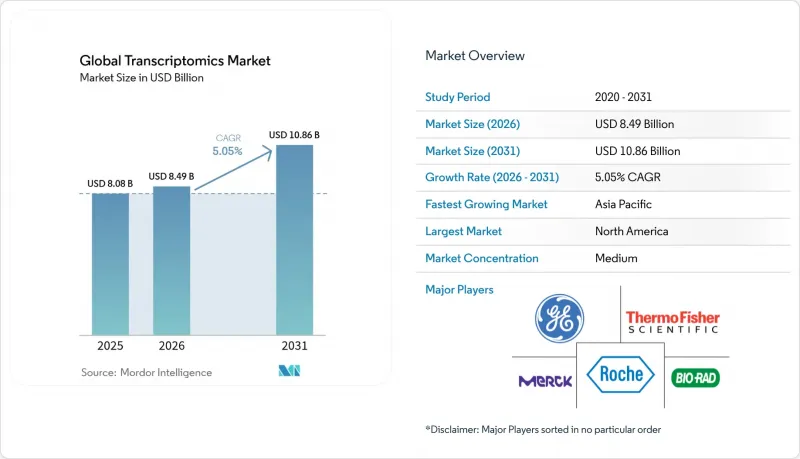
Mordor Intelligence에 의하면, 전사체학 시장 규모는 2025년 80억 8,000만 달러에서 2026년에는 84억 9,000만 달러로 확대되어 2026년부터 2031년까지 CAGR 5.05%로 성장을 지속하여, 2031년에는 108억 6,000만 달러에 이를 것으로 예측됩니다.
본 보고서에서는 업계를 기술별(마이크로어레이, 실시간 정량 중합효소연쇄반응(Q-PCR) 등), 제품별(소모품, 장비 등), 용도별(진단 및 질환 프로파일링, 신약 개발 등), 지역별로 분류하고 있습니다. 시장 규모 및 전망은 금액(달러) 단위로 제시되어 있습니다.
세계 트랜스크립토믹스 시장 동향 및 인사이트
RNA-Seq 플랫폼의 급속한 보급
2024년에 TruSight Oncology Comprehensive 등의 분석법이 FDA 승인을 받은 데 따라, 임상 실험실에서는 RNA 시퀀싱 워크플로우를 점점 더 많이 도입하고 있으며, 이로 인해 보험 환급의 확실성이 생겨 플랫폼의 보급이 가속화되고 있습니다. Oxford Nanopore 및 Pacific Biosciences의 롱 리드 기술은 스플라이스 변이 검출 문제를 해결했으며, 직접 RNA 시퀀싱에서 98.8%의 중앙값 리드 정확도를 보고하고 있습니다. 2023년에는 임상 시퀀싱 매출이 연구용 매출을 처음으로 넘어섰으며, 각 제조업체들은 처리량보다 자동화 및 분석 소프트웨어에 중점을 두게 되었습니다. 이러한 변화로 인해 품질 관리에 대한 기대가 높아지는 한편, 프리미엄 가격 책정이 가능해졌으며, 전사체학 시장의 지속적인 성장을 뒷받침하는 소모품 정기 구매 모델이 강화되고 있습니다.
트랜스크립토믹스에 기반한 신약 개발 확대
제약사들은 멀티오믹스 AI를 활용하여 scRNA-seq 데이터에서 신약 개발 표적을 추출함으로써 개발 기간을 단축하고 있습니다. Recursion Pharmaceuticals사의 접근 방식은 이러한 추세를 상징합니다. 공간 전사체학은 암 연구에 필수적인 미세환경의 맥락을 추가하며, 2024년 ‘Omics Days’ 컨퍼런스에서 발표된 FDA의 지침은 바이오마커 검증 과정을 명확히 하여 투자를 촉진했습니다. 그 결과, 중개 연구를 통해 발현 바이오마커가 발견 단계에서 3상 임상시험으로 더 신속하게 전환되고 있으며, 고처리량 시퀀싱 시약에 대한 수요가 증가하고 있습니다.
플랫폼 및 소모품의 높은 비용
scRNA-seq 실험 1회당 비용은 3,170달러에서 25,540달러에 달하여 연구 보조금에 부담을 주고 있으며, 소규모 임상 실험실의 경우 진입 장벽이 되고 있습니다. 플랫폼의 수명 기간 동안 소모품 비용은 장비 비용을 초과하지만, 공급업체 간의 경쟁이 제한적이어서 가격 하락세는 둔화되고 있습니다. 신생 기업인 Element Biosciences와 Ultima Genomics는 저비용 화학 시약을 약속하고 있지만, 널리 보급되기까지는 아직 2년 정도 걸릴 것으로 보입니다. 리스나 서비스 모델은 설비 투자를 상쇄하는 데 도움이 되지만, 수명 주기 비용을 상승시키고 워크플로우의 유연성을 저하시키는 요인이 됩니다.
부문 분석
2025년, 단일 세포 RNA 시퀀싱은 트랜스크립토믹스 시장에서 46.78%의 점유율을 차지하며, 벌크 방식에서는 간과되기 쉬운 세포의 이질성을 규명하는 데 있어 그 역할을 부각시켰습니다. 이 부문이 성숙기에 접어들면서, 혁신의 초점은 워크플로우의 처리량 향상과 비용 절감으로 이동하고 있습니다. 한편, 실험실이 조직 구조의 맥락을 모색함에 따라, 공간 플랫폼은 연평균 성장률(CAGR) 6.32%로 성장을 지속하고, 있습니다.
트랜스크립토믹스 시장은 scRNA-seq와 공간 바코딩을 융합한 멀티모달 솔루션으로 계속해서 기울고 있으며, 분해능을 희생하지 않고도 인사이트력을 심화하고 있습니다. 롱 리드 화학법은 복잡한 아이소폼을 포착하여 종양학 및 신경학 분야의 연구 범위를 확대되고 있습니다. 마이크로어레이는 점차 쇠퇴하고 있지만, 정량 PCR은 신속하고 저플렉스 분석에서 여전히 확고한 입지를 유지하고 있습니다. 이에 따라 각 벤더들은 다양한 수익원을 확보하기 위해 고컨텐츠 발견 도구와 표적형 임상 패널 사이에서 포트폴리오의 균형을 맞추고 있습니다.
2025년에는 전사체학 시장 규모의 53.74%를 소모품이 차지하며, 지속적인 현금 흐름을 보장하는 ‘면도기-면도날’ 모델의 위력이 두드러지고 있습니다. 주요 기능이 각 벤더 간에 수렴됨에 따라 장비 판매는 둔화되어 성장률이 6.55%에 그쳤습니다.
데이터의 복잡성이 증가함에 따라 소프트웨어 및 분석 서비스의 수익은 가속화되고 있으며, 전문 공급업체들은 실험실 시약 이외의 분야에서도 부가가치를 창출할 수 있게 되었습니다. 클라우드 네이티브 파이프라인을 통해 첨단 바이오정보학이 널리 이용 가능해졌지만, 임상 등급 키트의 높은 가격 책정으로 인해 이익률은 높은 수준을 유지하고 있습니다. 주요 연구 기관의 장비 도입 대수가 포화 상태에 도달함에 따라, 소모품 공급업체들은 신흥 시장 및 중규모 병원으로 사업을 전환하며 현지 예산에 맞추어 키트의 규모와 가격대를 조정하고 있습니다.
지역별 분석
2025년, 북미는 전사체학 시장 점유율의 44.96%를 차지했습니다. 이는 풍부한 벤처 캐피털, 밀집된 바이오의약품 클러스터, 그리고 임상 검증을 촉진하는 FDA의 동반 진단 승인 절차가 뒷받침하고 있습니다. ‘Cancer Moonshot’과 같은 민관 파트너십이 대규모 발현 아틀라스 프로젝트를 뒷받침하며, 국내 소모품 수요를 높은 수준으로 유지하고 있습니다. 캐나다는 단일 지불자 제도를 활용하여 인구 수준의 유전자 발현 연구를 수행하고 있는 반면, 멕시코는 저렴한 비용과 활발한 임상시험 활동을 통해 수탁 제조에 대한 투자를 유치하고 있습니다.
아시아태평양은 중국의 수십억 달러 규모 정밀의료 보조금과 일본의 공간 오믹스 진단 조기 도입에 힘입어 연평균 성장률(CAGR) 7.05%로 성장을 지속하고, 있습니다. 인도의 위탁 연구 생태계는 방대한 환자 풀과 트랜스크립토믹스 평가 지표를 점점 더 많이 도입하는 비용 효율적인 임상시험을 결합하고 있습니다. 호주 정부의 자금을 지원하는 ‘Genomics Australia’ 프로그램은 중개 오믹스 분야의 협력을 촉진하고, 학술적 돌파구를 상업적 검사법으로 연결하고 있습니다. 다양한 규제 체제는 여전히 기회이자 장애물이며, 신속 승인을 제공하는 시장이 있는 반면, 장기간에 걸친 현지 검증을 요구하는 시장도 있습니다.
유럽은 ‘Genome of Europe’과 같은 프로젝트를 통해 기초 연구 성과를 꾸준히 유지하고 있지만, 엄격한 일반 데이터 보호 규정(GDPR(EU 개인정보보호규정))으로 인해 새로운 진단법의 임상 적용까지 걸리는 기간이 길어지고 있습니다. 독일, 영국, 프랑스는 확립된 보험 급여 기준에 힘입어 검사 건수에서 선두를 달리고 있습니다. 스위스나 네덜란드 같은 소국들은 고밀도 단일 세포 분석 및 플랫폼 통합 컨설팅을 전문으로 하고 있습니다. 브렉시트 이후의 협력 체제를 통해 데이터 교환이 지속되고 있으며, 이 지역의 결속력 있는 연구개발 환경이 유지되고 있습니다.
기타 혜택:
- 엑셀 형식 시장 예측(ME) 시트
- 3개월간의 애널리스트 지원
자주 묻는 질문
목차
제1장 서론
제2장 조사 방법
제3장 주요 요약
제4장 시장 구도
제5장 시장 규모와 성장 예측
제6장 경쟁 구도
제7장 시장 기회와 향후 전망
JHS 26.09.07According to Mordor Intelligence, the transcriptomics market size is expected to grow from USD 8.08 billion in 2025 to USD 8.49 billion in 2026 and is forecast to reach USD 10.86 billion by 2031 at 5.05% CAGR over 2026-2031.
This report Segments the Industry Into by Technology (Microarray, Real-Time Quantitative Polymerase Chain Reaction (Q-PCR), and More), by Product (Consumables, Instruments, and More), by Application (Diagnostics and Disease Profiling, Drug Discovery, and More), and Geography. The Market Sizes and Forecasts are Provided in Terms of Value (USD).
Global Transcriptomics Market Trends and Insights
Rapid Adoption Of RNA-Seq Platforms
Clinical laboratories increasingly integrate RNA-sequencing workflows following 2024 FDA approvals of assays such as TruSight Oncology Comprehensive, creating reimbursement certainty and accelerating platform uptake . Long-read technologies from Oxford Nanopore and Pacific Biosciences have solved splice-variant detection, reporting median 98.8% read accuracy for direct RNA sequencing. Clinical sequencing revenues exceeded research use for the first time in 2023, pushing manufacturers to emphasize automation and interpretation software rather than throughput. The shift raises quality-control expectations but simultaneously unlocks premium pricing, reinforcing a recurring consumables model that underpins sustained transcriptomics market growth.
Expansion Of Transcriptomics-Based Drug Discovery
Pharmaceutical companies deploy multi-omics AI to mine scRNA-seq data for drug targets, cutting development timelines; Recursion Pharmaceuticals' approach exemplifies this trend. Spatial transcriptomics adds micro-environment context critical for oncology research, and FDA guidance from its 2024 Omics Days conference clarified biomarker-validation pathways, spurring investment. Resulting translational studies move expression biomarkers from discovery to pivotal trials faster, lifting demand for high-throughput sequencing reagents.
High Platform & Consumable Costs
A scRNA-seq run ranges from USD 3,170 to USD 25,540, straining research grants and discouraging small clinical labs. Consumables outpace instrument costs over a platform's life, yet limited supplier competition slows price declines. Emerging entrants Element Biosciences and Ultima Genomics promise lower-cost chemistries, but widespread adoption remains two years away. Leasing and service models help offset capital expenditure, though they raise lifecycle costs and reduce workflow flexibility.
Other drivers and restraints analyzed in the detailed report include:
- Rising Chronic Disease Burden & Precision Diagnostics Demand
- Emergence Of Spatial & Single-Cell Transcriptomics
- Bioinformatics Skill Gap & Data-Handling Complexity
For complete list of drivers and restraints, kindly check the Table Of Contents.
Segment Analysis
Single-cell RNA sequencing held 46.78% transcriptomics market share in 2025, underscoring its role in resolving cellular heterogeneity that bulk methods overlook . The segment's maturity redirects innovation toward workflow throughput and cost reduction, while spatial platforms record a 6.32% CAGR as laboratories seek tissue-structure context.
The transcriptomics market continues to tilt toward multimodal solutions that merge scRNA-seq with spatial barcoding, enhancing insight without sacrificing resolution. Long-read chemistries capture complex isoforms, broadening oncologic and neurologic study scope. Although microarrays fade, quantitative PCR maintains a foothold for rapid, low-plex assays. Vendors therefore balance portfolios between high-content discovery tools and targeted clinical panels to secure diverse revenue streams.
Consumables generated 53.74% of the transcriptomics market size in 2025, emphasizing the power of a razor-razorblade model that assures recurrent cash flow. Instrument sales slowed as core features converged across vendors, yielding only 6.55% growth.
Software and analytical-service revenues accelerate as data complexity grows, allowing specialized providers to capture value beyond wet-lab reagents. Cloud-native pipelines democratize advanced bioinformatics, yet premium prices for clinical-grade kits keep margins high. As the installed instrument base saturates top research centers, consumable vendors pivot to emerging markets and mid-tier hospitals, tailoring kit sizes and price points to local budgets.
Complete Report Scope:
- By Technology
- Microarray
- Real-time Quantitative PCR (qPCR)
- Next-Generation Sequencing (RNA-Seq)
- Single-cell RNA-Seq
- Spatial Transcriptomics
- In-situ Hybridization & Other Methods
- By Product
- Consumables & Reagents
- Instruments
- Software & Services
- By Application
- Drug Discovery & Development
- Diagnostics & Disease Profiling
- Biomarker & Target Identification
- Agriculture & Plant Science
- Others
- By End User
- Academic & Research Institutes
- Pharmaceutical & Biotechnology Companies
- Clinical & Diagnostic Laboratories
- Others
- By Geography
- North America
- United States
- Canada
- Mexico
- Europe
- Germany
- United Kingdom
- France
- Italy
- Spain
- Rest of Europe
- Asia-Pacific
- China
- Japan
- India
- Australia
- South Korea
- Rest of Asia-Pacific
- Middle East & Africa
- GCC
- South Africa
- Rest of Middle East & Africa
- South America
- Brazil
- Argentina
- Rest of South America
- North America
Geography Analysis
North America accounted for 44.96% transcriptomics market share in 2025, anchored by abundant venture capital, dense biopharma clusters, and FDA companion-diagnostic pathways that encourage clinical validation. Public-private partnerships such as the Cancer Moonshot sustain large-scale expression-atlas projects, keeping domestic consumables demand high. Canada leverages a single-payer system to run population-level gene-expression studies, while Mexico lures contract-manufacturing investment through lower costs and rising clinical-trial activity.
Asia-Pacific posts a 7.05% CAGR, propelled by China's multi-billion-dollar precision-medicine grants and Japan's early adoption of spatial-omic diagnostics. India's contract-research ecosystem couples vast patient pools with cost-efficient trials that increasingly include transcriptomic endpoints. Australia's government-funded Genomics Australia program encourages translational-omics collaborations, funneling academic breakthroughs into commercial assays. Diverse regulatory regimes remain both opportunity and obstacle, with some markets offering accelerated approvals and others demanding prolonged local validation.
Europe maintains strong basic-research output through projects like Genome of Europe, yet stringent General Data Protection Regulation (GDPR) rules lengthen time-to-clinic for novel diagnostics. Germany, the United Kingdom, and France dominate test volumes, supported by established reimbursement codes. Smaller nations such as Switzerland and the Netherlands specialize in high-content single-cell analytics and platform integration consulting. Post-Brexit collaboration frameworks ensure continued data exchange, preserving the region's cohesive R&D landscape.
- Illumina
- Thermo Fisher Scientific
- 10x Genomics
- Agilent Technologies
- BGI
- Bio-Rad Laboratories
- NanoString Technologies
- Pacific Biosciences of California
- QIAGEN
- Roche
- Merck KGaA (MilliporeSigma)
- PerkinElmer
- Standard BioTools (Fluidigm)
- Oxford Nanopore Technologies
- Dovetail Genomics
- Promega
- Guardant Health
- Takara Bio
- Danaher
- Beckton Dickinson
Additional Benefits:
- The market estimate (ME) sheet in Excel format
- 3 months of analyst support
TABLE OF CONTENTS
1 Introduction
- 1.1 Study Assumptions & Market Definition
- 1.2 Scope of the Study
2 Research Methodology
3 Executive Summary
4 Market Landscape
- 4.1 Market Overview
- 4.2 Market Drivers
- 4.2.1 Rapid Adoption Of RNA-Seq Platforms
- 4.2.2 Expansion Of Transcriptomics-Based Drug Discovery
- 4.2.3 Cloud-Native Ai Pipelines Are Democratizing Large-Scale Transcriptomic Data Analysis,
- 4.2.4 Rising Chronic Disease Burden & Precision Diagnostics Demand
- 4.2.5 Emergence Of Spatial & Single-Cell Transcriptomics
- 4.2.6 Agri-Genomics Programs In Food-Insecure Regions
- 4.3 Market Restraints
- 4.3.1 High Platform & Consumable Costs
- 4.3.2 Bioinformatics Skill Gap & Data-Handling Complexity
- 4.3.3 Stringent Data-Privacy / Clinical-Validation Regulations
- 4.3.4 Supply Bottlenecks For Single-Cell Reagents
- 4.4 Value / Supply-Chain Analysis
- 4.5 Regulatory Landscape
- 4.6 Technological Outlook
- 4.7 Porter's Five Forces Analysis
- 4.7.1 Threat of New Entrants
- 4.7.2 Bargaining Power of Buyers
- 4.7.3 Bargaining Power of Suppliers
- 4.7.4 Threat of Substitutes
- 4.7.5 Competitive Rivalry
5 Market Size & Growth Forecasts (Value, USD Million)
- 5.1 By Technology
- 5.1.1 Microarray
- 5.1.2 Real-time Quantitative PCR (qPCR)
- 5.1.3 Next-Generation Sequencing (RNA-Seq)
- 5.1.4 Single-cell RNA-Seq
- 5.1.5 Spatial Transcriptomics
- 5.1.6 In-situ Hybridization & Other Methods
- 5.2 By Product
- 5.2.1 Consumables & Reagents
- 5.2.2 Instruments
- 5.2.3 Software & Services
- 5.3 By Application
- 5.3.1 Drug Discovery & Development
- 5.3.2 Diagnostics & Disease Profiling
- 5.3.3 Biomarker & Target Identification
- 5.3.4 Agriculture & Plant Science
- 5.3.5 Others
- 5.4 By End User
- 5.4.1 Academic & Research Institutes
- 5.4.2 Pharmaceutical & Biotechnology Companies
- 5.4.3 Clinical & Diagnostic Laboratories
- 5.4.4 Others
- 5.5 By Geography
- 5.5.1 North America
- 5.5.1.1 United States
- 5.5.1.2 Canada
- 5.5.1.3 Mexico
- 5.5.2 Europe
- 5.5.2.1 Germany
- 5.5.2.2 United Kingdom
- 5.5.2.3 France
- 5.5.2.4 Italy
- 5.5.2.5 Spain
- 5.5.2.6 Rest of Europe
- 5.5.3 Asia-Pacific
- 5.5.3.1 China
- 5.5.3.2 Japan
- 5.5.3.3 India
- 5.5.3.4 Australia
- 5.5.3.5 South Korea
- 5.5.3.6 Rest of Asia-Pacific
- 5.5.4 Middle East & Africa
- 5.5.4.1 GCC
- 5.5.4.2 South Africa
- 5.5.4.3 Rest of Middle East & Africa
- 5.5.5 South America
- 5.5.5.1 Brazil
- 5.5.5.2 Argentina
- 5.5.5.3 Rest of South America
- 5.5.1 North America
6 Competitive Landscape
- 6.1 Market Concentration
- 6.2 Market Share Analysis
- 6.3 Company Profiles (includes Global level Overview, Market level overview, Core Segments, Financials as available, Strategic Information, Market Rank/Share for key companies, Products & Services, Recent Developments)
- 6.3.1 Illumina Inc.
- 6.3.2 Thermo Fisher Scientific
- 6.3.3 10x Genomics
- 6.3.4 Agilent Technologies Inc.
- 6.3.5 BGI Genomics
- 6.3.6 Bio-Rad Laboratories Inc.
- 6.3.7 NanoString Technologies
- 6.3.8 Pacific Biosciences of California
- 6.3.9 Qiagen NV
- 6.3.10 F. Hoffmann-La Roche AG
- 6.3.11 Merck KGaA (MilliporeSigma)
- 6.3.12 PerkinElmer Inc.
- 6.3.13 Standard BioTools (Fluidigm)
- 6.3.14 Oxford Nanopore Technologies
- 6.3.15 Dovetail Genomics
- 6.3.16 Promega Corporation
- 6.3.17 Guardant Health
- 6.3.18 Takara Bio Inc.
- 6.3.19 Danaher (Cytiva)
- 6.3.20 Becton, Dickinson & Co.
7 Market Opportunities & Future Outlook
- 7.1 White-space & Unmet-Need Assessment