

|
시장보고서
상품코드
2123384
기능 안전 시장 : 점유율 분석, 업계 동향과 통계, 성장 예측(2026-2031년)Functional Safety - Market Share Analysis, Industry Trends & Statistics, Growth Forecasts (2026 - 2031) |
||||||
 Mordor Intelligence
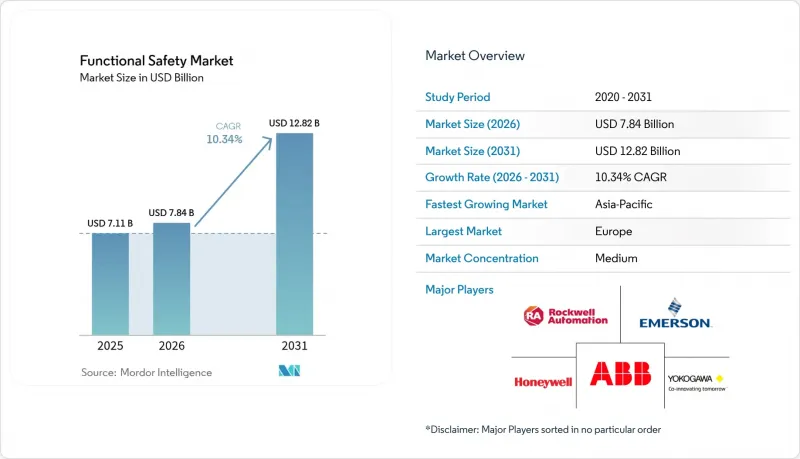
Mordor Intelligence에 의하면, 기능 안전 시장 규모는 2025년 71억 1,000만 달러에서 2026년에는 78억 4,000만 달러로 확대되어 2031년까지 128억 2,000만 달러에 이를 것으로 예상되고 있어 2026년부터 2031년까지 CAGR 10.34%로 성장할 전망입니다.
본 보고서는 장치 유형(안전 센서, 안전 스위치 등), 안전 시스템(버너 관리 시스템, 비상 정지 시스템 등), 서비스(시험·검사·인증, 설계·엔지니어링·유지보수 등), 최종 사용자 산업(석유 및 가스, 식품 및 음료, 자동차 등) 및 지역별로 분류되어 있습니다. 시장 전망은 금액(달러) 기준으로 제시되어 있습니다.
세계 기능 안전 시장 동향 및 인사이트
전 세계 안전 규제 및 표준의 강화
규제 요건은 신규 도입 및 개조의 주요 촉진요인으로 계속 작용하고 있습니다. IEC TS 61508-3-2, 2024에서는 모델 체크 및 정리 증명 기법이 공식적으로 규정되어 프로그래머블 안전 시스템의 인증 주기가 최대 20% 단축되었습니다. 2024년부터 2025년까지 배포된 ISO 26262 제3판 초안에서는 ASIL-D의 적용 범위가 레벨 3-4의 자율 주행 기능까지 확대되어, Tier 1 자동차 공급업체들 사이에서 칩셋 및 컨트롤러의 재설계가 진행되고 있습니다. 유럽 기계 규정(EU) 2023/1230에 따르면, 2027년부터 디지털 제품 여권이 도입되어 기존 설비의 업그레이드가 가속화되는 한편,OSHA가 2025년 3월에 발표한 29 CFR 1910.119 개정안에 따라, 미국 정유시설의 모든 SIL 평가 완료 루프에 대해 정량화된 위험 분석이 의무화됩니다.
인더스트리 4.0과 산업 자동화의 확대
엣지 컴퓨팅과 디지털 트윈의 도입으로 기능 안전 로직이 보다 광범위한 자동화 스택에 통합되고 있습니다. 지멘스는 2024년, Simatic Safety Integrated 제품군을 Industrial Edge와 연동하여 10밀리초 미만의 결정론적 응답 시간과 예측 정비를 위한 동기화된 클라우드 분석을 실현했습니다. 록웰 오토메이션은 FactoryTalk GuardLogix 5580 시리즈에서 표준 제어와 안전 제어를 통합하여, 이산 제조업체의 패널 설치 면적을 약 40% 줄였습니다. 2025년 페퍼르+푹스(Pepperl+Fuchs)가 출시한 IO-Link 지원 무선 안전 센서는 MES 플랫폼에 실시간 진단 데이터를 전송하여, 자동차 제조 현장의 라인 가동 중단 시간을 최대 25% 줄이고 있습니다. 중국의 ‘중국 제조 2025’ 로드맵과 인도의 ‘생산 연계 인센티브(PLI)’ 제도 덕분에 자동화 분야에 새로운 설비 투자가 유입되면서, 아시아태평양은 세계 평균을 상회하는 성장을 지속하고 있습니다.
SIL 인증 부품 및 시스템의 높은 초기 비용
SIL 인증 하드웨어는 표준 자동화 장비의 2-3배 가격에 판매되고 있어, 중견 기업의 설비 투자 예산을 압박하고 있습니다. ABB사의 AC 800M 하이 인티그리티 섀시의 정가는 18,000-25,000달러이지만, 안전 기능이 없는 모델의 경우 6,000-8,000달러입니다. 반면, SICK사의 deTec4 레이저 스캐너 가격은 약 4,500-6,000달러로, 기존 거리 센서보다 4배나 비쌉니다. 검증 조사에는 종종 6자리 수의 비용이 들기 때문에 동남아시아와 라틴아메리카의 많은 중소기업들은 업그레이드를 미루고, 대신 보험료 인상이나 유지보수 기간 연장을 선택하고 있습니다.
부문 분석
2025년에는 기존 시설(브라운필드)에서 전기 기계식 가드가 전자식 라이트 커튼, 레이저 스캐너, 자기 인터록으로 대체됨에 따라 안전 센서가 기능 안전 시장의 33.78%를 차지했습니다. 석유 및 가스 및 식품 가공 업계에서는 기계적 마모를 최소화하기 위해 비접촉식 센싱이 사업자들에게 선호되고 있어 수요가 견조합니다. 한편, 프로그래머블 안전 시스템은 용도 코드를 하드웨어에서 분리하고, 무결성을 훼손하지 않으면서 원격으로 매개변수를 업데이트할 수 있게 해주는 소프트웨어 정의 로직으로의 전환을 반영하여 연평균 성장률(CAGR) 11.78%를 나타낼 것으로 예측됩니다.
기능 안전 시장에서는 안전 입력, 로직 솔버, 최종 요소를 통합 플랫폼에 통합하는 추세가 계속되고 있습니다. Pilz사의 PSS 4000과 오므론사의 NX 시리즈 컨트롤러는 표준 자동화 기능에 더해 SIL 3 기능을 통합하여 하드웨어 품목 수를 3분의 1 가까이 줄였습니다. 비접촉식 RFID 스위치는 오작동을 약 45% 줄였으며, AI가 탑재된 자가 진단 센서는 잔여 수명 데이터를 전송함으로써 포장 라인 및 조립 라인에서 예상치 못한 가동 중지 시간을 줄이고 있습니다.
비상 정지 시스템은 정유시설, LNG 터미널, 석유화학 단지에 보편적으로 도입되어 2025년에는 기능 안전 시장 점유율의 28.67%를 차지했습니다. 동시에, 플레어링을 억제하고 밀폐형 과압 보호를 촉진하는 메탄 배출 규제의 뒷받침을 받아, 고신뢰성 압력 보호 시스템은 예측 기간 동안 연평균 성장률(CAGR) 11.73%로 성장할 전망입니다. 이러한 시스템은 운영 안전성과 환경 기준 준수를 보장하는 데 매우 중요한 역할을 하고 있으며, 다양한 산업 분야에서 채택이 더욱 촉진되고 있습니다.
현대적인 분산형 제어 아키텍처는 공정 제어와 안전의 경계를 모호하게 만들고 있습니다. Honeywell의 ‘Experion PKS’는 현재 SIL 인증을 받은 로직을 제어 루프와 동일한 환경에 통합하여 운영자의 상황 인식을 지원하고 있습니다. 에머슨의 무선 ‘DeltaV SIS’ 트랜스미터는 신규 LNG 플랜트 건설에서 루프당 500-1,000달러의 비용 절감을 실현하여, 비용 효율을 중시하는 중동 프로젝트에서의 도입을 촉진하고 있습니다. HIPPS 설계 단계에서 디지털 트윈을 활용함으로써 공장 인수 시험 소요 시간이 거의 절반으로 줄어들었고, 해상 유전에서의 첫 가스 생산까지 걸리는 기간이 단축되었습니다.
지역별 분석
2025년 기능 안전 시장 점유율 중 유럽은 34.89%를 차지했습니다. 이는 CE 마킹 법규와 높은 인건비가 자동화 투자를 뒷받침하고 있는 독일, 프랑스, 영국이 주도한 결과입니다. 시행이 임박한 기계 규정의 ‘디지털 여권’은 2027년까지 추가 개조 수요의 급증을 촉진할 것입니다. 남유럽에서는 경제 부양책이 보다 친환경적인 복합 사이클 발전소에 투입되고 있으며, 이는 SIL 인증을 받은 터보 기계 제어 시스템에 대한 신규 수주로 이어지고 있습니다.
아시아태평양은 2031년까지 연평균 성장률(CAGR) 11.39%를 나타낼 것으로 예측됩니다. 중국의 GB/T 20438 및 IEC 61508 준수, 그리고 ‘중국 제조 2025’에 따른 보조금 덕분에 전자기기 및 기계 공장에서 안전 제어 장치의 대량 도입이 진행되고 있습니다. 인도가 자동화를 위해 배정한 18억 달러 규모의 ‘생산 연계형 인센티브’는 제약 업계의 그린필드 프로젝트에서 이미 그 효과를 보이고 있습니다. 일본과 한국은 노동력의 고령화와 반도체 산업의 급속한 확장에 직면해 있으며, 로봇 공학 및 배터리 셀 생산 라인을 위해 SIL-2 이상의 안전 시스템을 규정하고 있습니다.
북미는 걸프 코스트와 캐나다의 오일샌드 시설에 있는 기존 설비의 개조를 배경으로, 전 세계 매출의 약 4분의 1을 차지하고 있습니다. OSHA에 의한 내압 시험 기간 단축, NERC의 배터리 저장 의무화, 그리고 BSEE의 해저 규정이 맞물려 비상 정지 및 HIPPS 패키지 도입을 뒷받침하고 있습니다. 멕시코와 브라질에서는 중류 부문의 확장과 프레스솔트 유전의 업그레이드를 통해 점진적인 성장이 예상되는 반면, 중동 및 아프리카에서는 초대형 정유시설 및 가스-투-리퀴드(GTL) 복합 시설을 위한 통합형 안전 계장 솔루션 수주가 지속적으로 증가하고 있습니다.
기타 혜택:
- 엑셀 형식 시장 예측(ME) 시트
- 3개월간의 애널리스트 지원
자주 묻는 질문
목차
제1장 서론
제2장 조사 방법
제3장 주요 요약
제4장 시장 구도
제5장 시장 규모와 성장 예측
제6장 경쟁 구도
제7장 시장 기회와 향후 전망
JHS 26.09.09According to Mordor Intelligence, the functional safety market size is expected to increase from USD 7.11 billion in 2025 to USD 7.84 billion in 2026 and reach USD 12.82 billion by 2031, growing at a CAGR of 10.34% over 2026-2031.
This report is Segmented by Device Type (Safety Sensors, Safety Switches, and More), Safety Systems (Burner Management Systems, Emergency Shutdown Systems, and More), Services (Testing, Inspection and Certification, Design, Engineering and Maintenance, and More), End-User Industry (Oil and Gas, Food and Beverage, Automotive, and More), and Geography. The Market Forecasts are Provided in Terms of Value (USD).
Global Functional Safety Market Trends and Insights
Stringent Global Safety Regulations and Standards
Regulatory mandates remain the prime catalyst for new installations and retrofits. IEC TS 61508-3-2:2024 formalized model-checking and theorem-proving techniques, cutting certification cycles for programmable safety systems by up to 20%. ISO 26262 Edition 3 draft texts circulated during 2024-2025 extend ASIL-D coverage to Level 3-4 automated-driving functions, pushing chipset and controller redesign among tier-one automotive suppliers. Europe's Machinery Regulation (EU) 2023/1230 introduces digital product passports from 2027, accelerating brownfield upgrades, while OSHA's March 2025 revision to 29 CFR 1910.119 requires quantified risk analysis for every SIL-rated loop in United States refineries.
Expansion of Industry 4.0 and Industrial Automation
Edge computing and digital twin rollouts are embedding functional safety logic into broader automation stacks. Siemens connected its Simatic Safety Integrated family to Industrial Edge in 2024, enabling deterministic response times below 10 milliseconds and synchronized cloud analytics for predictive maintenance. Rockwell Automation consolidated standard and safety control in the FactoryTalk GuardLogix 5580 line, trimming panel footprints by nearly 40% for discrete manufacturers. Wireless, IO-Link-enabled safety sensors launched by Pepperl+Fuchs in 2025 are feeding real-time diagnostics into MES platforms, cutting line downtime by up to 25% in automotive sites. China's Made-in-China 2025 roadmap and India's Production-Linked Incentive scheme channel new capex into automation, sustaining above-global growth in Asia-Pacific.
High Upfront Cost of SIL-Certified Components and Systems
SIL-rated hardware sells at two to three times the price of standard automation equipment, stretching capital budgets for mid-tier operators. ABB's AC 800M High Integrity chassis lists at USD 18,000-25,000, compared with USD 6,000-8,000 for the non-safety variant, while SICK's deTec4 laser scanners cost roughly USD 4,500-6,000, quadruple the cost of a conventional distance sensor. Validation studies frequently add six-figure fees, prompting many Southeast Asian and Latin American SMEs to defer upgrades in favor of higher insurance premiums or extended maintenance windows.
Other drivers and restraints analyzed in the detailed report include:
- Heightened Incident-Related Scrutiny in Oil and Gas and Power Sectors
- Integration of Functional Safety with Industrial Cybersecurity
- Complexity of Retrofitting Legacy Brownfield Facilities
For complete list of drivers and restraints, kindly check the Table Of Contents.
Segment Analysis
Safety sensors accounted for 33.78% of the functional safety market in 2025 as brownfield facilities replaced electromechanical guards with electronic light curtains, laser scanners, and magnetic interlocks. Demand is robust in oil and gas and food processing, where operators favor contactless sensing to minimize mechanical wear. Programmable safety systems, however, are projected to record an 11.78% CAGR, reflecting a pivot toward software-defined logic that decouples application code from hardware, allowing remote parameter updates without jeopardizing integrity.
The functional safety market continues to integrate safety inputs, logic solvers, and final elements into unified platforms. Pilz's PSS 4000 and Omron's NX-series controllers embed SIL 3 functions alongside standard automation, cutting hardware line items by nearly a third. Contactless RFID switches are reducing nuisance trips by roughly 45%, while AI-enabled self-diagnostic sensors transmit remaining useful life data, lowering unplanned downtime in packaging and assembly lines.
Emergency shutdown systems held 28.67% of the functional safety market share in 2025 owing to their universal deployment in refineries, LNG terminals, and petrochemical complexes. Simultaneously, driven by methane-emission regulations that deter flaring and promote enclosed overpressure protection, high-integrity pressure protection systems are poised for an 11.73% CAGR expansion during the forecast period. These systems play a critical role in ensuring operational safety and compliance with environmental standards, further driving their adoption across various industries.
Modern distributed control architectures blur boundaries between process control and safety. Honeywell's Experion PKS now embeds SIL-certified logic within the same environment as regulatory loops, aiding operator situational awareness. Emerson's wireless DeltaV SIS transmitters shave USD 500-1,000 per loop on greenfield LNG builds, encouraging adoption in cost-sensitive Middle East projects. Digital twins used during HIPPS design have cut factory-acceptance test time by nearly half, shortening time-to-first-gas for offshore fields.
Complete Report Scope:
- By Device Type
- Safety Sensors
- Safety Controllers/Modules/Relays
- Safety Switches
- Programmable Safety Systems
- Emergency Stop Devices
- Final Control Elements
- Other Device Types
- By Safety Systems
- Burner Management Systems
- Turbomachinery Control Systems
- High-Integrity Pressure Protection Systems
- Fire and Gas Monitoring Control Systems
- Emergency Shutdown Systems
- Supervisory Control and Data Acquisition Systems
- Distributed Control Systems
- By Services
- Testing, Inspection and Certification
- Design, Engineering and Maintenance
- Training and Consulting Services
- By End-User Industry
- Oil and Gas
- Power Generation
- Food and Beverage
- Pharmaceutical
- Automotive
- Other End-User Industries
- By Geography
- North America
- United States
- Canada
- Mexico
- South America
- Brazil
- Argentina
- Rest of South America
- Europe
- United Kingdom
- Germany
- France
- Italy
- Rest of Europe
- Asia Pacific
- China
- Japan
- India
- South Korea
- Rest of Asia Pacific
- Middle East and Africa
- Middle East
- United Arab Emirates
- Saudi Arabia
- Rest of Middle East
- Africa
- South Africa
- Egypt
- Rest of Africa
- Middle East
- North America
Geography Analysis
Europe accounted for 34.89% of the functional safety market share in 2025, led by Germany, France, and the United Kingdom, where CE marking laws and high labor costs sustain automation spending. The incoming Machinery Regulation's digital passports will catalyze another retrofit spike before 2027. Southern Europe is channeling stimulus into cleaner combined-cycle plants, translating into fresh orders for SIL-rated turbomachinery controls.
Asia-Pacific is projected to post an 11.39% CAGR through 2031. China's alignment with GB/T 20438 and IEC 61508, and subsidies under Made-in-China 2025, are driving the mass deployment of safety controllers in electronics and machinery plants. India's USD 1.8 billion Production-Linked Incentive allocation for automation is already visible in pharmaceutical greenfields. Japan and South Korea, faced with aging workforces and intense semiconductor expansion, are specifying SIL-2 or higher safety systems for robotics and battery cell lines.
North America represents roughly one-quarter of global revenue, underpinned by brownfield retrofits in Gulf Coast and Canadian oil sands facilities. OSHA's tighter proof-test windows, NERC's battery-storage mandates, and BSEE subsea rules converge to fuel the adoption of emergency shutdown and HIPPS packages. Mexico and Brazil provide incremental growth through midstream expansion and pre-salt field upgrades, while the Middle East and Africa continue to order integrated safety-instrumented solutions for mega-refineries and gas-to-liquids complexes.
- Rockwell Automation Inc.
- Emerson Electric Company
- Honeywell International Inc.
- ABB Ltd
- Yokogawa Electric Corporation
- Schneider Electric SE
- Siemens AG
- General Electric Company
- Omron Corporation
- SICK AG
- Panasonic Corporation
- Pepperl+Fuchs SE
- Banner Engineering Corporation
- Pilz GmbH and Co. KG
- HIMA Paul Hildebrandt GmbH
- Mitsubishi Electric Corporation
- Phoenix Contact GmbH and Co. KG
- Turck GmbH and Co. KG
- Balluff GmbH
- IDEC Corporation
Additional Benefits:
- The market estimate (ME) sheet in Excel format
- 3 months of analyst support
TABLE OF CONTENTS
1 INTRODUCTION
- 1.1 Study Assumptions and Market Definition
- 1.2 Scope of the Study
2 RESEARCH METHODOLOGY
3 EXECUTIVE SUMMARY
4 MARKET LANDSCAPE
- 4.1 Market Overview
- 4.2 Market Drivers
- 4.2.1 Stringent Global Safety Regulations and Standards (IEC 61508, ISO 26262)
- 4.2.2 Expansion of Industry 4.0 and Industrial Automation
- 4.2.3 Heightened Incident-Related Scrutiny in Oil and Gas, and Power Sectors
- 4.2.4 Integration of Functional Safety with Industrial Cybersecurity
- 4.2.5 Emergence of SIL-Certified AI/ML Shutdown Algorithms
- 4.2.6 Rise of Safety-as-a-Service Subscription Models for SMEs
- 4.3 Market Restraints
- 4.3.1 High Upfront Cost of SIL-Certified Components and Systems
- 4.3.2 Complexity of Retrofitting Legacy Brown-Field Facilities
- 4.3.3 Shortage of Certified Functional Safety Engineers
- 4.3.4 Liability Ambiguity for OTA Safety-Critical Software Updates
- 4.4 Industry Value Chain Analysis
- 4.5 Regulatory Landscape
- 4.6 Technological Outlook
- 4.7 Porter's Five Forces Analysis
- 4.7.1 Bargaining Power of Suppliers
- 4.7.2 Bargaining Power of Buyers
- 4.7.3 Threat of New Entrants
- 4.7.4 Threat of Substitutes
- 4.7.5 Intensity of Competitive Rivalry
- 4.8 Impact of Macroeconomic Factors on the Market
5 MARKET SIZE AND GROWTH FORECASTS (VALUE)
- 5.1 By Device Type
- 5.1.1 Safety Sensors
- 5.1.2 Safety Controllers/Modules/Relays
- 5.1.3 Safety Switches
- 5.1.4 Programmable Safety Systems
- 5.1.5 Emergency Stop Devices
- 5.1.6 Final Control Elements
- 5.1.7 Other Device Types
- 5.2 By Safety Systems
- 5.2.1 Burner Management Systems
- 5.2.2 Turbomachinery Control Systems
- 5.2.3 High-Integrity Pressure Protection Systems
- 5.2.4 Fire and Gas Monitoring Control Systems
- 5.2.5 Emergency Shutdown Systems
- 5.2.6 Supervisory Control and Data Acquisition Systems
- 5.2.7 Distributed Control Systems
- 5.3 By Services
- 5.3.1 Testing, Inspection and Certification
- 5.3.2 Design, Engineering and Maintenance
- 5.3.3 Training and Consulting Services
- 5.4 By End-User Industry
- 5.4.1 Oil and Gas
- 5.4.2 Power Generation
- 5.4.3 Food and Beverage
- 5.4.4 Pharmaceutical
- 5.4.5 Automotive
- 5.4.6 Other End-User Industries
- 5.5 By Geography
- 5.5.1 North America
- 5.5.1.1 United States
- 5.5.1.2 Canada
- 5.5.1.3 Mexico
- 5.5.2 South America
- 5.5.2.1 Brazil
- 5.5.2.2 Argentina
- 5.5.2.3 Rest of South America
- 5.5.3 Europe
- 5.5.3.1 United Kingdom
- 5.5.3.2 Germany
- 5.5.3.3 France
- 5.5.3.4 Italy
- 5.5.3.5 Rest of Europe
- 5.5.4 Asia Pacific
- 5.5.4.1 China
- 5.5.4.2 Japan
- 5.5.4.3 India
- 5.5.4.4 South Korea
- 5.5.4.5 Rest of Asia Pacific
- 5.5.5 Middle East and Africa
- 5.5.5.1 Middle East
- 5.5.5.1.1 United Arab Emirates
- 5.5.5.1.2 Saudi Arabia
- 5.5.5.1.3 Rest of Middle East
- 5.5.5.2 Africa
- 5.5.5.2.1 South Africa
- 5.5.5.2.2 Egypt
- 5.5.5.2.3 Rest of Africa
- 5.5.5.1 Middle East
- 5.5.1 North America
6 COMPETITIVE LANDSCAPE
- 6.1 Market Concentration
- 6.2 Strategic Moves
- 6.3 Market Share Analysis
- 6.4 Company Profiles (includes Global Level Overview, Market Level Overview, Core Segments, Financials as available, Strategic Information, Market Rank/Share, Products and Services, Recent Developments)
- 6.4.1 Rockwell Automation Inc.
- 6.4.2 Emerson Electric Company
- 6.4.3 Honeywell International Inc.
- 6.4.4 ABB Ltd
- 6.4.5 Yokogawa Electric Corporation
- 6.4.6 Schneider Electric SE
- 6.4.7 Siemens AG
- 6.4.8 General Electric Company
- 6.4.9 Omron Corporation
- 6.4.10 SICK AG
- 6.4.11 Panasonic Corporation
- 6.4.12 Pepperl+Fuchs SE
- 6.4.13 Banner Engineering Corporation
- 6.4.14 Pilz GmbH and Co. KG
- 6.4.15 HIMA Paul Hildebrandt GmbH
- 6.4.16 Mitsubishi Electric Corporation
- 6.4.17 Phoenix Contact GmbH and Co. KG
- 6.4.18 Turck GmbH and Co. KG
- 6.4.19 Balluff GmbH
- 6.4.20 IDEC Corporation
7 MARKET OPPORTUNITIES AND FUTURE OUTLOOK
- 7.1 White-Space and Unmet-Need Assessment


