|
시장보고서
상품코드
2123390
여성 건강진단 : 시장 점유율 분석, 업계 동향과 통계, 성장 예측(2026-2031년)Women´s Health Diagnostics - Market Share Analysis, Industry Trends & Statistics, Growth Forecasts (2026 - 2031) |
||||||
 Mordor Intelligence
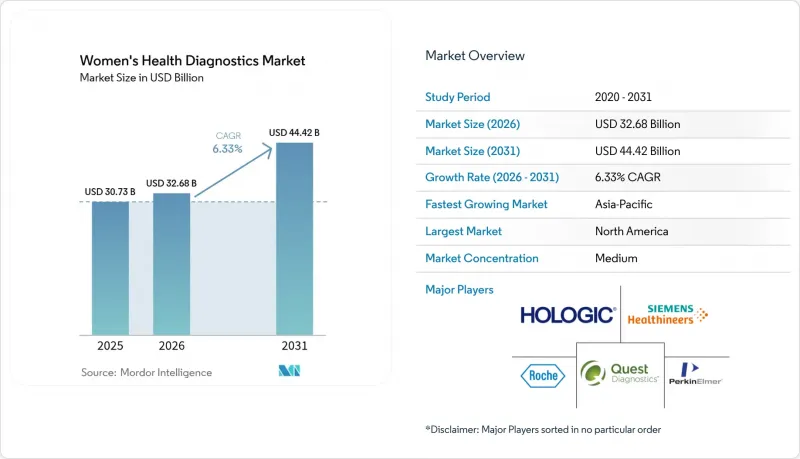
Mordor Intelligence에 의하면, 여성 건강진단 시장 규모는 2025년에 307억 3,000만 달러로 평가되었고, 2026년 326억 8,000만 달러에서 2031년까지 444억 2,000만 달러에 이를 것으로 예측되며, 예측 기간(2026-2031년) CAGR은 6.33%를 기록할 전망입니다.
본 보고서는 제품 유형(진단 기기, 진단 검사), 기술(면역 측정법, 분자진단, 영상 진단, AI를 활용한 분석), 용도(유방암 등), 최종 사용자(병원 및 진단센터 등), 지역(북미, 유럽, 아시아태평양, 중동 및 아프리카, 남미)별로 분류되어 있습니다. 시장 예측은 금액(달러) 기준으로 제시되어 있습니다.
전 세계 여성 건강 검진 시장 동향 및 인사이트
만성 질환 및 생활습관병 발병률 상승
비만, 당뇨병 및 호르몬 관련 암의 전 세계적 증가에 따라, 증상이 나타나기 전에 질환을 파악할 수 있는 조기 발견 도구에 대한 수요가 높아지고 있습니다. 심혈관 및 대사 위험 요인은 여성의 유방암 및 자궁내막암 발병 위험을 높이기 때문에 임상의들은 연령 기준에만 국한되지 않는 선별 검사 프로토콜의 확대를 요구받고 있습니다. 현재 유럽 및 북미의 보건부는 고위험군 여성을 대상으로 유방촬영술과 유전자 검사 패널의 병행 비용을 보험 적용하고 있으며, 이로 인해 병원 네트워크 전체의 검사 건수가 증가하고 있습니다. 대사 변화를 실시간으로 감지하기 위한 웨어러블 생체 센서가 시범적으로 도입되면서, 예측 알고리즘을 위한 새로운 데이터 세트가 생성되고 있습니다. 여성의 평균 수명이 늘어남에 따라 만성 질환을 조기에 관리해야 할 임상적 필요성이 앞으로도 여성 건강 관리 진단 시장을 계속 견인할 것입니다.
POC 및 신속 진단 검사의 도입 확대
포인트 오브 케어(POC) 플랫폼은 진단 주기를 며칠에서 몇 분으로 단축하여, 합병증이 발생하기 전에 감염증을 치료할 수 있도록 돕습니다. FDA가 2025년에 클라미디아, 임질, 트리코모나스증을 대상으로 한 최초의 OTC(일반의약품) 분자 검사를 승인함에 따라, 소비자는 집에서 3가지 병원체에 대한 선별 검사를 실시하고 30분 만에 결과를 확인할 수 있게 되었습니다. 미국 지방 카운티에서는 이동 진료소가 휴대용 PCR 장비를 도입하여 골반 내 염증성 질환에 대한 당일 치료를 실현하고 있습니다. 한편, 유럽의 약국에서는 CLIA 면제 임신 관련 자간전증 검사가 도입되고 있습니다. 신속한 결과 보고로 인해 후속 조치의 누락이 최소화되고, 항생제의 적정 사용이 촉진되며, 보험사 입장에서는 고액의 후기 개입을 피할 수 있어 여성 건강 검진 시장에 미치는 긍정적인 영향이 더욱 강화되고 있습니다.
영상 진단 시스템의 높은 비용
MRI나 첨단 초음파 진단 장비에 대한 설비 투자는 1대당 200만 달러를 초과하는 경우도 있어, 이 금액은 신흥 경제국 병원들에게 큰 과제가 되고 있습니다. 통화 약세와 수입 관세로 인해 구입 비용이 상승하고, 교체 주기가 지연되며, 도입 지역도 제한적입니다. 벤더의 융자나 민관 파트너십을 통해 예산상의 제약은 완화되고 있지만, 많은 시설에서는 여전히 AI 지원이 미흡한 아날로그 시스템이 운영되고 있습니다. 이처럼 높은 소유 비용이 최첨단 모달리티의 단기적 도입을 억제하고 있으며, 전 세계 여성 건강검진 시장의 연평균 성장률(CAGR)에 중등도의 부정적 영향을 미치고 있습니다.
부문 분석
2025년, 여성 건강 검진 시장의 매출 대부분은 진단 검사가 차지하여 전체 시장의 54.21%를 기록했습니다. 분자진단 플랫폼은 한 번의 검사로 성병, 유전성 암 돌연변이, 태아 기형을 다중 검출할 수 있어 널리 이용되고 있습니다. ‘샘플 투 앤서(Sample-to-Answer)’ 카트리지를 탑재한 고처리량 PCR 시스템은 현재 많은 검사 기관에서 표준 장비로 자리 잡고 있으며, 작업 시간을 단축하고 당일 내 치료 시작을 가능하게 하고 있습니다. 유전자 및 유전체 패널은 주로 BRCA 및 린치 증후군 선별 검사에 대한 보험 적용 범위 확대로 인해 연평균 성장률(CAGR) 9.10%를 기록하며 가장 빠르게 성장하고 있는 제품군입니다. 스마트폰 연동을 통해 생리 주기 추적 및 원격 상담 포털을 이용할 수 있게 됨에 따라, 디지털 임신 검사 및 배란 검사에 대한 수요는 안정적인 추세를 보이고 있습니다.
진단 기기는 나머지 45.79%의 점유율을 차지하고 있으며, AI 지원 유방촬영술, 초음파, 골밀도 측정 장치가 성장을 주도하고 있습니다. 자동 유방 초음파 시스템은 3D 재구성 및 밀도 점수 산정 기능을 통합하여 스캔 시간을 단축하고, 조작자에 따른 편차를 줄입니다. 생검 기구는 조직에 가해지는 부담을 줄여주는 진공 보조식 바늘 디자인으로 업그레이드되었으며, 내비게이션 소프트웨어의 지원을 통해 임상의는 1mm 미만의 정밀도로 병변에서 검체를 채취할 수 있게 되었습니다. 예측 기간 동안, 장비와 소프트웨어의 번들 판매를 통해 제조업체들은 분석 모듈의 교차 판매가 가능해져, 여성 건강 검진 시장에서의 지속적인 수익원이 강화될 전망입니다.
면역측정법은 호르몬, 종양학, 감염증 검사에서 높은 범용성을 인정받아 2025년에도 31.55%를 차지하며 가장 중요한 기술 분야로 자리매김했습니다. 화학발광 기질의 지속적인 개량을 통해 검사 시간이 15분 미만으로 단축되어, 응급 현장에서 실용적인 분류 도구로 자리 잡았습니다. 한편, AI를 활용한 분석 기술은 알고리즘을 통한 유방 밀도 및 위험도 점수에 대한 FDA 승인을 발판으로 연평균 성장률(CAGR) 8.22%를 기록하며 가장 빠르게 성장하고 있습니다. 클라우드 기반 머신러닝 파이프라인의 도입으로 소규모 진료소에서도 고가의 On-Premise형 하드웨어 없이도 영상 데이터를 처리할 수 있게 되어, 고급 분석 기술에 대한 접근성이 널리 확산되고 있습니다.
분산형 검사에 적합한 루프 매개 등온 증폭(LAMP) 및 CRISPR 기반 검출 방식 덕분에 분자진단은 여전히 주력 부문으로 자리 잡고 있습니다. 영상 진단 기술도 계속 진화하고 있으며, 각 벤더들은 더 낮은 방사선 피폭량으로 영상의 선명도를 향상시키는 딥러닝 기반 재구성 기능을 추가하고 있습니다. 이러한 발전들이 결합되어 임상 적용 범위가 확대되고 처리 능력이 향상되면서, 여성 건강 검진 시장의 성장세가 지속되고 있습니다.
지역별 분석
북미는 2025년 매출의 37.90%를 차지하며 시장을 주도했습니다. 이는 견고한 보험 환급 정책과, 다른 어떤 지역보다 신속하게 연구 단계에서 임상 현장으로 혁신을 이끄는 FDA의 꾸준한 승인 속도에 힘입은 결과입니다. 미국에서는 2024년 유방 밀도 보고 의무화가 시행됨에 따라, 각 보험사가 AI 지원 유방촬영술의 보험 적용 범위를 확대했습니다. 캐나다에서는 HPV 자가 채취 검사의 도입으로 의료 서비스가 충분히 제공되지 않는 계층의 자궁경부암 검진 수검률이 향상되고 있습니다.
아시아태평양은 연평균 성장률(CAGR) 9.60%로 지역별 가장 빠른 성장세를 기록하며, 그동안 광범위한 검진 인프라가 갖춰지지 않았던 인구 밀집 국가들로 여성 건강 검진 시장을 확대되고 있습니다. 중국에서는 농촌 지역의 이동식 영상 진단 차량에 대한 지원과 종양 유전체 프로파일링 연구에 대한 지원이 이루어지고 있으며, 일본의 대형 민간 보험사에서는 고밀도 유방 환자를 대상으로 한 AI 지원 초음파 검사의 보험 적용이 시작되었습니다. 인도에서는 현장 진단(Point-of-Care) PCR과 통합된 원격의료 플랫폼을 활용하여 오지 마을에 대한 의료 서비스 제공을 확대하고, 도시와 농촌 간의 검진율 격차를 줄이고 있습니다. 싱가포르, 한국, 호주의 스타트업들은 생리 건강 분석과 불임 평가에 주력하고 있으며, 제품 파이프라인에 지역별 특색을 반영하고 있습니다.
유럽에서는 확립된 국가 선별 검사 프로그램 덕분에 검사 건수가 안정적이며, 균형 잡힌 자세를 유지하고 있습니다. 독일과 영국은 AI 엔진과 연동된 클라우드 기반 PACS 도입을 주도하고 있는 반면, 프랑스에서는 공립 병원을 중심으로 유방암 및 난소암 유전자 선별 검사를 결합한 시범 사업이 진행되고 있습니다. 남유럽 국가들에서는 EU의 체외진단용 의료기기 규정(IVDR)으로의 전환을 염두에 두고, LDT(실험실 개발 검사) 검증 프로세스를 통일함으로써 환자 안전을 지키고 신뢰를 유지하고 있습니다. 이러한 노력들이 어우러져 유럽 전역의 여성 건강 검진 시장의 장기적인 회복력을 강화하고 있습니다.
기타 혜택:
- 엑셀 형식 시장 예측(ME) 시트
- 3개월간의 애널리스트 지원
자주 묻는 질문
목차
제1장 서론
제2장 조사 방법
제3장 주요 요약
제4장 시장 구도
제5장 시장 규모와 성장 예측
제6장 경쟁 구도
제7장 시장 기회와 향후 전망
LSH 26.09.04According to Mordor Intelligence, the women's health diagnostics market size was valued at USD 30.73 billion in 2025 and estimated to grow from USD 32.68 billion in 2026 to reach USD 44.42 billion by 2031, at a CAGR of 6.33% during the forecast period (2026-2031).
This report is Segmented by Product Type (Diagnostic Devices, Diagnostic Tests), Technology (Immunoassay, Molecular Diagnostics, Imaging, AI-Enabled Analytics), Application (Breast Cancer, and More), End User (Hospitals & Diagnostic Centres, and More), and Geography (North America, Europe, Asia-Pacific, Middle East & Africa, South America). The Market Forecasts are Provided in Terms of Value (USD).
Global Women's Health Diagnostics Market Trends and Insights
Rising Incidence of Chronic & Lifestyle Disorders
The global growth in obesity, diabetes, and hormone-related cancers is translating into greater demand for early detection tools that can identify disease before symptoms appear. Cardiometabolic risk factors elevate female vulnerability to breast and endometrial cancers, prompting clinicians to widen screening protocols beyond age-based criteria. Health ministries in Europe and North America now reimburse combined mammography and genetic panels for high-risk women, boosting test volumes across hospital networks. Wearable biosensors are being trialed to detect metabolic changes in real time, creating fresh datasets for predictive algorithms. As women's lifespans lengthen, the clinical imperative to manage chronic disease upstream will continue to propel the women's health diagnostics market.
Increased Adoption of POC & Rapid Diagnostic Tests
Point-of-care platforms shorten diagnostic cycles from days to minutes, making it easier to treat infections before complications arise. The FDA's 2025 clearance of the first OTC molecular test for chlamydia, gonorrhea, and trichomoniasis allows consumers to perform triple-pathogen screening at home and receive results in 30 minutes. Mobile clinics in rural U.S. counties now deploy portable PCR units for same-day pelvic inflammatory disease management, while European pharmacies have introduced CLIA-waived pregnancy-related preeclampsia assays. Fast turnaround times minimize follow-up loss, improve antimicrobial stewardship, and help payers avoid costly late-stage interventions, reinforcing the positive impact on the women's health diagnostics market.
High Cost of Diagnostic Imaging Systems
Capital expenditure for MRI and advanced ultrasound can exceed USD 2 million per unit, a figure that challenges hospitals in emerging economies. Currency depreciation and import tariffs inflate acquisition costs, slowing replacement cycles and limiting geographic coverage. Although vendor financing and public-private partnerships are easing budget constraints, many facilities still operate analog systems that lack AI readiness. Elevated ownership costs thus temper the near-term rollout of cutting-edge modalities, creating a moderate drag on the global women's health diagnostics market CAGR.
Other drivers and restraints analyzed in the detailed report include:
- Tele-Health Enabled At-Home Self-Collection Kits
- AI-Based Breast-Density Analytics Boosting Reimbursement
- Data-Privacy Concerns Over DTC Genetic Testing
For complete list of drivers and restraints, kindly check the Table Of Contents.
Segment Analysis
Diagnostic tests generated the majority of revenue, accounting for 54.21% of the women's health diagnostics market in 2025. Molecular platforms are popular because they deliver multiplex detection of sexually transmitted infections, hereditary cancer mutations, and prenatal anomalies in a single run. High-throughput PCR systems equipped with sample-to-answer cartridges are now standard in many reference labs, reducing hands-on time and supporting same-day therapy initiation. Genetic and genomic panels represent the quickest-expanding product line at a 9.10% CAGR, mainly due to broader insurance coverage for BRCA and Lynch syndrome screening. Demand for digital pregnancy and ovulation tests remains steady, as smartphone linkages offer cycle tracking and tele-consultation portals.
Diagnostic devices held the remaining 45.79% share, led by AI-capable mammography, ultrasound, and bone densitometry equipment. Automated breast ultrasound systems integrate 3D reconstruction and density scoring, cutting scan time and operator variability. Biopsy tools are upgrading to vacuum-assisted needle designs that limit tissue trauma, and guided navigation software helps clinicians sample lesions with sub-millimeter precision. Over the forecast window, bundled device-and-software sales will allow manufacturers to cross-sell analytics modules, reinforcing their recurring revenue streams within the women's health diagnostics market.
Immunoassays remained the most significant technology slice at 31.55% in 2025, valued for their versatility in hormone, oncology, and infectious disease testing. Continuous improvements in chemiluminescent substrates have shortened assay times to under 15 minutes, making them practical triage tools in emergency settings. Meanwhile, AI-enabled analytics is climbing fastest with an 8.22% CAGR, propelled by FDA clearances for algorithmic breast density and risk scoring. Deployment of cloud-based machine learning pipelines lets small clinics process imaging data without heavy on-premises hardware, democratizing access to advanced analytics.
Molecular diagnostics remains a powerhouse segment, thanks to loop-mediated isothermal amplification and CRISPR-based detection formats suited for decentralized testing. Imaging technology is not standing still: vendors are adding deep-learning reconstruction that improves image clarity at lower radiation doses. Together, these advances are widening clinical indications and boosting throughput, sustaining momentum in the women's health diagnostics market.
Complete Report Scope:
- By Product Type
- Diagnostic Devices
- Biopsy Devices
- Imaging & Monitoring Systems
- Digital & AI-enabled Imaging Workstations
- Diagnostic Tests
- Breast-cancer Testing
- PAP & HPV Tests
- Pregnancy & Ovulation Tests
- Infectious-disease Tests
- Genetic & Genomic Panels
- Other Tests
- Diagnostic Devices
- By Technology
- Immunoassay
- Molecular Diagnostics
- Imaging
- AI-enabled Analytics
- By Application
- Breast Cancer
- Infectious-disease Testing
- Osteoporosis
- Pregnancy & Fertility
- Sexually Transmitted Diseases
- Other Applications
- By End User
- Hospitals & Diagnostic Centres
- Home-care / Self-testing
- Corporate / Occupational Health Programs
- By Geography
- North America
- United States
- Canada
- Mexico
- Europe
- Germany
- United Kingdom
- France
- Italy
- Spain
- Rest of Europe
- Asia-Pacific
- China
- Japan
- India
- Australia
- South Korea
- Rest of Asia-Pacific
- Middle East & Africa
- GCC
- South Africa
- Rest of Middle East & Africa
- South America
- Brazil
- Argentina
- Rest of South America
- North America
Geography Analysis
North America led with 37.90% of 2025 revenue, underpinned by robust reimbursement policies and a steady cadence of FDA approvals that pull innovation from bench to bedside faster than any other region. United States insurers expanded coverage for AI-assisted mammography after mandated breast density reporting took effect in 2024. Canada's HPV self-collection launch is lifting cervical screening compliance among underserved groups.
Asia-Pacific posted the quickest regional climb at a 9.60% CAGR, extending the women's health diagnostics market into populous countries that previously lacked widespread screening infrastructure. China subsidizes rural imaging vans and genomic tumor-profiling grants, and Japan's top private insurers now cover AI-assisted ultrasound for dense-breast patients. India is leveraging telemedicine platforms integrated with point-of-care PCR to reach remote villages, narrowing the urban-rural detection gap. Startups across Singapore, South Korea, and Australia are focusing on menstrual health analytics and fertility assessment, injecting local flavor into product pipelines.
Europe maintains a balanced position with established national screening programs that keep test volumes steady. Germany and the United Kingdom are leading adopters of cloud-based PACS linked to AI engines, while France is piloting bundled breast and ovarian cancer genetic screening in public hospitals. Southern European countries are harmonizing LDT validation processes in anticipation of the EU In-Vitro Diagnostic Regulation transition, protecting patient safety and sustaining trust. Together, these initiatives reinforce the long-term resilience of the women's health diagnostics market across the continent.
- Abbott Laboratories
- Beckton Dickinson
- bioMerieux
- Carestream Health
- Roche
- GE Healthcare
- Hologic
- Koninklijke Philips
- Siemens Healthineers
- Fresenius
- Quest Diagnostics
- PerkinElmer
- Myriad Genetics
- Procter & Gamble
- Thermo Fisher Scientific
- Cepheid (Danaher)
- The Cooper Companies
- FUJIFILM
- LumiraDx
- Everlywell
- Mankind Pharma
- Butterfly Network
Additional Benefits:
- The market estimate (ME) sheet in Excel format
- 3 months of analyst support
TABLE OF CONTENTS
1 Introduction
- 1.1 Study Assumptions & Market Definition
- 1.2 Scope of the Study
2 Research Methodology
3 Executive Summary
4 Market Landscape
- 4.1 Market Overview
- 4.2 Market Drivers
- 4.2.1 Rising Incidence of Chronic & Lifestyle Disorders
- 4.2.2 Growing Number of Diagnostic & Imaging Centres
- 4.2.3 Increased Adoption of POC & Rapid Diagnostic Tests
- 4.2.4 Tele-Health Enabled At-Home Self-Collection Kits
- 4.2.5 AI-Based Breast-Density Analytics Boosting Reimbursement
- 4.2.6 Employer-Sponsored Fem-Tech Benefits Accelerating Demand
- 4.3 Market Restraints
- 4.3.1 High Cost of Diagnostic Imaging Systems
- 4.3.2 Stringent Regulatory Guidelines
- 4.3.3 Data-Privacy Concerns Over DTC Genetic Testing
- 4.3.4 Lack of Sex-Specific AI Training Datasets
- 4.4 Porter's Five Forces Analysis
- 4.4.1 Threat of New Entrants
- 4.4.2 Bargaining Power of Buyers
- 4.4.3 Bargaining Power of Suppliers
- 4.4.4 Threat of Substitutes
- 4.4.5 Competitive Rivalry
5 Market Size & Growth Forecasts (Value in USD)
- 5.1 By Product Type
- 5.1.1 Diagnostic Devices
- 5.1.1.1 Biopsy Devices
- 5.1.1.2 Imaging & Monitoring Systems
- 5.1.1.3 Digital & AI-enabled Imaging Workstations
- 5.1.2 Diagnostic Tests
- 5.1.2.1 Breast-cancer Testing
- 5.1.2.2 PAP & HPV Tests
- 5.1.2.3 Pregnancy & Ovulation Tests
- 5.1.2.4 Infectious-disease Tests
- 5.1.2.5 Genetic & Genomic Panels
- 5.1.2.6 Other Tests
- 5.1.1 Diagnostic Devices
- 5.2 By Technology
- 5.2.1 Immunoassay
- 5.2.2 Molecular Diagnostics
- 5.2.3 Imaging
- 5.2.4 AI-enabled Analytics
- 5.3 By Application
- 5.3.1 Breast Cancer
- 5.3.2 Infectious-disease Testing
- 5.3.3 Osteoporosis
- 5.3.4 Pregnancy & Fertility
- 5.3.5 Sexually Transmitted Diseases
- 5.3.6 Other Applications
- 5.4 By End User
- 5.4.1 Hospitals & Diagnostic Centres
- 5.4.2 Home-care / Self-testing
- 5.4.3 Corporate / Occupational Health Programs
- 5.5 By Geography
- 5.5.1 North America
- 5.5.1.1 United States
- 5.5.1.2 Canada
- 5.5.1.3 Mexico
- 5.5.2 Europe
- 5.5.2.1 Germany
- 5.5.2.2 United Kingdom
- 5.5.2.3 France
- 5.5.2.4 Italy
- 5.5.2.5 Spain
- 5.5.2.6 Rest of Europe
- 5.5.3 Asia-Pacific
- 5.5.3.1 China
- 5.5.3.2 Japan
- 5.5.3.3 India
- 5.5.3.4 Australia
- 5.5.3.5 South Korea
- 5.5.3.6 Rest of Asia-Pacific
- 5.5.4 Middle East & Africa
- 5.5.4.1 GCC
- 5.5.4.2 South Africa
- 5.5.4.3 Rest of Middle East & Africa
- 5.5.5 South America
- 5.5.5.1 Brazil
- 5.5.5.2 Argentina
- 5.5.5.3 Rest of South America
- 5.5.1 North America
6 Competitive Landscape
- 6.1 Market Concentration
- 6.2 Market Share Analysis
- 6.3 Company Profiles (includes Global level Overview, Market-level Overview, Core Segments, Financials, Strategic Info, Market Rank/Share, Products & Services, Recent Developments)
- 6.3.1 Abbott Laboratories
- 6.3.2 Becton, Dickinson & Co.
- 6.3.3 bioMerieux SA
- 6.3.4 Carestream Health
- 6.3.5 F. Hoffmann-La Roche AG
- 6.3.6 GE Healthcare
- 6.3.7 Hologic Inc.
- 6.3.8 Koninklijke Philips N.V.
- 6.3.9 Siemens Healthineers AG
- 6.3.10 Fresenius Kabi
- 6.3.11 Quest Diagnostics Inc.
- 6.3.12 PerkinElmer Inc.
- 6.3.13 Myriad Genetics
- 6.3.14 Procter & Gamble Co.
- 6.3.15 Thermo Fisher Scientific
- 6.3.16 Cepheid (Danaher)
- 6.3.17 CooperSurgical
- 6.3.18 Fujifilm Holdings
- 6.3.19 LumiraDx
- 6.3.20 Everlywell
- 6.3.21 Mankind Pharma
- 6.3.22 Butterfly Network
7 Market Opportunities & Future Outlook
- 7.1 White-space & Unmet-need Assessment