|
시장보고서
상품코드
2123414
자동화기 시장 : 점유율 분석, 업계 동향과 통계, 성장 예측(2026-2031년)Automatic Weapons - Market Share Analysis, Industry Trends & Statistics, Growth Forecasts (2026 - 2031) |
||||||
 Mordor Intelligence
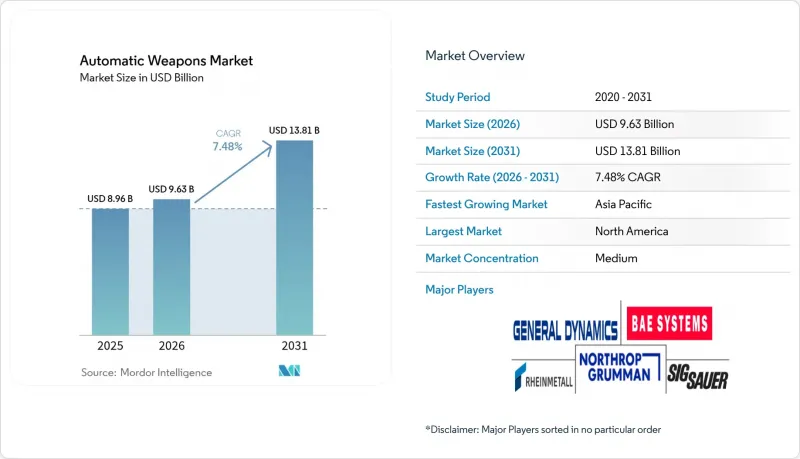
Mordor Intelligence에 의하면, 자동화기 시장 규모는 2025년 89억 6,000만 달러에서 2026년에는 96억 3,000만 달러로 확대되어 2026년부터 2031년까지 CAGR 7.48%로 성장을 지속하여, 2031년에는 138억 1,000만 달러에 이를 것으로 예측됩니다.
본 보고서는 유형(자동소총, 기관총, 자동 발사 장치, 자동포, 개틀링포), 플랫폼(육상, 항공, 해군),구경(소구경, 중구경 등), 최종 사용자(국방·법 집행 기관), 지역(북미, 유럽, 아시아태평양, 남미, 중동 및 아프리카)별로 분류되어 있습니다. 시장 예측은 금액(달러) 기준으로 제시되어 있습니다.
세계 자동화기 시장 동향 및 인사이트
고조되는 지정학적 긴장과 다영역 작전 교리
다중 영역 작전 교리에 따라 각국 군은 육·해·공 네트워크 간에 표적 데이터를 거의 실시간으로 교환할 수 있는 자동화기를 배치해야 합니다. 우크라이나의 ‘스카이 센티넬’ 포탑은 .50구경 M2 브라우닝 기관총을 사용하여 6대의 ‘샤헤드’ 드론을 격추했는데, 이는 기존 화력과 AI 센서의 새로운 융합을 보여주는 좋은 사례입니다. 동맹군도 유사한 위협을 인식하고 있으며, 현재 미 육군이 배치 중인 드론을 자동으로 추적하는 1,300만 달러 규모의 ‘SMASH 2000L’ 스코프와 같은 스마트 광학 장비를 통합하고 있습니다. 조달 담당관은 현재 요구 사항을 수립할 때 연결 프로토콜과 저지연 데이터 링크를 우선시하고 있습니다. 이와 병행하여 함대 사령관들은 저비용 회전식 탄약을 통해 요충지를 방어하기 위해 순찰정의 원격 무기 스테이션을 개조하고 있습니다. 이러한 조치들이 결합되면서 자동화기 시장은 단일 소형 무기에서 지휘통제망에 통합된 네트워크화된 효과기로 전환되고 있습니다.
구형 소형 무기 재고의 지속적인 갱신 주기
나토(NATO) 회원국들은 노후화된 M16 및 AK 시리즈 소총의 교체를 급속도로 추진하고 있습니다. 스웨덴은 지역적 긴장 고조에 따라 예비 병력을 강화하기 위해 6,400만 달러 상당의 콜트 M4 15,000정을 긴급 발주했습니다. 미 육군은 2025 회계연도에 6.8mm 탄약과 첨단 광학 장비를 결합한 ‘차세대 분대용 무기(Next Generation Squad Weapons)’에 3억 6,730만 달러를 배정했는데, 이는 지난 60년 동안 미국 소총 분야에서 가장 큰 규모의 전환을 의미합니다. 싱가포르는 40년간 사용된 ‘Ultimax 100’의 후속 모델로 콜트사의 ‘IAR6940E-SG’를 선정했으며, 이는 기술에 정통한 국가들조차 국내 개발 대신 수입을 선택하는 경우가 있음을 보여줍니다. 소총 외에도 이스라엘 웨폰 인더스트리즈(IWI)는 ‘아벨(Abel)’ 컴퓨터 제어 시스템을 발표하여, 시험에서 이동 표적의 90%를 명중시킴으로써 디지털 사격 관제가 정확도의 기준을 어떻게 재정의하고 있는지 입증했습니다.
첨단 센서 시스템의 고비용 통합
차세대 광학 장비는 기존 제품과 비교해 단가를 대폭 끌어올리고 있습니다. 현재 일부 미국 소총에 표준 장비로 장착된 ‘SMASH 2000L’은 막대한 훈련과 수명 주기 지원이 필요하여 소규모 군의 예산에 부담을 주고 있습니다. NGSW(차세대 소총)의 초기 생산분은 1정당 약 9,000달러로, 기존 카빈총보다 4배나 높은 비용이 듭니다. 제조업체들은 가격 급등을 상쇄하기 위해 경량화를 추진하고 있습니다. 지그 자우어(SIG Sauer)사의 ‘핏불(Pitbull)’ 원격 제어 스테이션은 무게를 500파운드에서 205파운드로 줄여 경차량에 탑재할 수 있게 했습니다. 그럼에도 불구하고 예산이 빠듯한 각국 국방부는 업그레이드를 미루고 있어 단기적인 도입 속도는 둔화되고 있습니다.
부문 분석
2025년에는 자동화기가 36.10%라는 최대 점유율을 차지하며, 보병의 주력으로서의 역할을 부각시켰습니다. 각 군이 모듈식이며 소음기 대응 설계를 표준화해 감에 따라, 자동화기 시장 규모는 꾸준히 확대될 것으로 예측됩니다. 자동포는 드론이나 경장갑차를 격파하기 위해 고에너지 탄환이 필요한 해군 및 방공 용도 덕분에 8.32%라는 가장 높은 연평균 성장률(CAGR)을 기록하고 있습니다.
포의 성장을 견인하고 있는 것은 미 해병대의 ACV용으로 발주된 30mm 포탑과, 공중폭파탄을 장착한 35mm 시스템을 도입하는 유럽의 프로그램입니다. 기관총은 교체 수요가 있는 분야이지만, 그다지 극적인 성장은 기대하기 어렵습니다. 한편, 자동 발사 장치는 도시 지역에서의 대무인항공기(UAS) 임무에서 중요성이 커지고 있습니다. 개틀링포는 틈새 시장 성격이 강하지만 근접 무기 시스템에는 필수적이며, 함재 레이더 데이터와 연동하기 위한 전자 장비 업그레이드가 진행 중이어서 2030년까지 생산이 지속될 전망입니다.
2025년 매출액 중 지상 시스템이 58.55%를 차지하며, 이는 장갑차 개량 및 보병 장비 현대화를 반영한 것입니다. 그러나 해군 장비는 연평균 성장률(CAGR) 9.05%를 기록하며, 함대가 고속으로 저공 비행하는 위협을 포착할 수 있는 원격 조종 스테이션을 도입함에 따라 자동화기 시장 전체를 상회하는 성장세를 보일 전망입니다. 지상 시스템의 자동화기 시장 점유율은 견조하지만, 장비의 성숙도에 따라 성장세는 완만해질 것입니다.
중요한 점은 해상 도입이 원양 해군을 넘어 확대되고 있다는 것입니다. 대만의 초계 프리깃함에는 대만 해협에서의 침입을 저지하기 위해 20mm XTR-102A2 시스템이 탑재될 예정입니다. 항공기 탑재형은 회전익기를 중심으로 전개되고 있으며, 수송 함대 호위 및 의료 수송 분야에서 도어건은 여전히 필수적인 역할을 수행하고 있습니다. 무인수상정 및 무인 지상 차량은 소형이며 안정화된 포탑을 탑재할 수 있는 새로운 선체와 섀시를 제공함으로써, 적용 가능한 플랫폼의 기반을 확대되고 있습니다.
지역별 분석
2025년, 북미는 전 세계 매출의 38.20%를 차지했으며, 그 중심에는 전 세계 무기 수출의 40% 가까이를 차지하는 미국이 있었습니다. NGSW 소총 및 원격 조종 포탑에 관한 다년간의 계약이 국내 생산을 뒷받침하는 한편, 캐나다의 NATO에 대한 공약과 멕시코의 국내 치안 관련 조달로 인해 추가적인 수요 증가가 예상됩니다. 지역 공급업체들은 최종 사용자와의 피드백 루프가 짧아 신속한 단계적 업그레이드가 가능하며, 이는 자동화기 시장의 경쟁력을 유지하는 반복적인 제품 개발을 촉진하고 있습니다.
아시아태평양은 중국의 3,140억 달러 규모의 국방 예산과 인도, 일본, 한국의 지출 증가에 힘입어 8.74%라는 가장 높은 연평균 성장률(CAGR)을 기록하고 있습니다. 일본은 국방비를 21% 증가한 553억 달러로 늘리며, 장거리 화력과 견고한 기지 방어를 중시하고 있습니다. 세계 최대의 무기 수입국인 인도는 기술 이전 조항을 포함한 소형 무기 생산 라인을 담은 현지 생산 파트너십을 추진하고 있습니다. 대만은 예산을 1.8% 증액하여 그 자금을 해군의 원거리 기지와 대드론용 소총에 투입하고 있으며, 이는 해당 지역이 해상 위협에 중점을 두고 있음을 여실히 보여줍니다. 전반적으로 다양한 작전 교리에 걸친 현대화로 인해 사양이 다양화되고 있으며, 이로 인해 전 세계 공급업체들에게 판매 기회가 확대되고 있습니다.
유럽에서는 2022년 러시아의 우크라이나 침공에 따라 조달을 가속화하고 있으며, 2019년부터 2024년까지 지역 전체의 수입액은 47% 증가했습니다. 탄약의 공동 생산을 촉진하는 EU의 노력은 리투아니아의 3,600만 달러 규모 미니미 기관총 구매와 같은 양자 간 거래를 보완하는 것입니다. 2024년 이스라엘이 사상 최대인 147억 달러의 방산 수출을 달성했으며, 그 대부분이 유럽으로 향한 것은 이 지역이 검증된 기성 솔루션을 중시하고 있음을 여실히 보여줍니다. 동시에 유럽 국가들은 대외 의존도를 낮추기 위해 국내 공장에 자금을 투입하고 있으며, 나토(NATO) 간 상호 운용성에 최적화된 스마트 탄약 및 AI 지원 사격 통제 시스템의 연구 개발을 촉진하고 있습니다.
기타 혜택:
- 엑셀 형식 시장 예측(ME) 시트
- 3개월간의 애널리스트 지원
자주 묻는 질문
목차
제1장 서론
제2장 조사 방법
제3장 주요 요약
제4장 시장 구도
제5장 시장 규모와 성장 예측
제6장 경쟁 구도
제7장 시장 기회와 향후 전망
JHSAccording to Mordor Intelligence, the automatic weapons market size is expected to grow from USD 8.96 billion in 2025 to USD 9.63 billion in 2026 and is forecast to reach USD 13.81 billion by 2031 at 7.48% CAGR over 2026-2031.
This report is Segmented by Type (Automatic Rifles, Machine Guns, Automatic Launchers, Automatic Cannons, and Gatling Gun), Platform (Land, Airborne, and Naval), Caliber (Small Caliber, Medium Caliber, and More), End-User (Defense and Law Enforcement), and Geography (North America, Europe, Asia-Pacific, South America, and the Middle East and Africa). The Market Forecasts are Provided in Terms of Value (USD).
Global Automatic Weapons Market Trends and Insights
Escalating Geopolitical Tensions and Multi-Domain Operations Doctrine
Multi-domain doctrine obliges armies to field automatic weapons able to exchange targeting data across land, sea, and air networks in near real time. Ukraine's Sky Sentinel turrets, which employed .50-caliber M2 Browning guns to down six Shahed drones, illustrate the new fusion of legacy firepower with AI sensors. Allied forces, noting similar threats, are integrating smart optics such as the USD 13 million SMASH 2000L scopes that auto-track drones, now fielded by the US Army. Procurement officers now prioritize connectivity protocols and low-latency data links when drafting requirements. In parallel, fleet commanders retrofit remote weapon stations on patrol craft to guard chokepoints against low-cost loitering munitions. Collectively, these measures move the automatic weapons market from stand-alone small arms toward networked effectors embedded in command-and-control webs.
Ongoing Replacement Cycle of Legacy Small-Arms Inventories
NATO members are fast-tracking replacements for aging M16- and AK-family rifles. Sweden rushed a USD 64 million order for 15,000 Colt M4s to bolster reserves amid regional tension. The US Army allotted USD 367.3 million in FY 2025 for Next Generation Squad Weapons that pair 6.8 mm rounds with advanced optics, marking the biggest US small-arms shift in six decades. Singapore chose Colt's IAR6940E-SG to replace the four-decade-old Ultimax 100, showing even tech-savvy nations sometimes import rather than develop locally. Beyond rifles, Israel Weapon Industries (IWI) rolled out the Arbel computerized system, hitting 90% of moving targets during trials, demonstrating how digital fire-control is redefining accuracy benchmarks.
High Integration Costs of Advanced Sensor Systems
Next-generation optics elevate unit prices far above legacy equivalents. The SMASH 2000L, now standard on some US rifles, demands significant training and lifecycle support, straining the budgets of smaller militaries. Early lots of NGSW weapons cost nearly USD 9,000 each, four times the cost of legacy carbines. Manufacturers seek weight savings to offset price hikes; Sig Sauer's Pitbull remote station dropped from 500 lb to 205 lb, making it feasible for light vehicles. Still, defense ministries with tight budgets defer upgrades, moderating near-term adoption rates.
Other drivers and restraints analyzed in the detailed report include:
- Rise in Asymmetric Warfare Requirements
- Advanced Fire-Control Electronics and AI Integration
- Supply-Chain Volatility for Critical Materials
For complete list of drivers and restraints, kindly check the Table Of Contents.
Segment Analysis
Automatic rifles held the largest share at 36.10% in 2025, underscoring their role as the infantry's backbone. The automatic weapons market size for rifles is projected to grow steadily as armies standardize on modular, suppressor-ready designs. Automatic cannons post the fastest 8.32% CAGR thanks to naval and air-defense applications that demand higher-energy projectiles to defeat drones and light armor.
Growth in cannons is propelled by 30 mm turrets ordered for US Marine ACVs and by European programs adding 35 mm systems with air-burst ammunition. Machine guns enjoy replacement demand but less dramatic growth, while Automatic Launchers gain relevance for counter-UAS tasks in urban environments. Gatling designs, niche yet indispensable for close-in weapon systems, receive electronics upgrades to link with ship radar feeds, ensuring continued production runs through 2030.
Land systems commanded 58.55% of 2025 revenue, reflecting armored vehicle retrofits and dismounted modernization. Yet naval installations will clock a 9.05% CAGR, outpacing the broader automatic weapons market as fleets install remote stations that can lock onto fast, low-flying threats. The automatic weapons market share for land systems is secure, but growth moderates as inventories mature.
Crucially, maritime uptake is widening beyond blue-water navies; Taiwan's patrol frigates will mount 20 mm XTR-102A2 systems to deter incursions in the Taiwan Strait. Airborne mounts concentrate on rotary platforms where door guns remain essential for convoy escort and medical evacuation. Uncrewed surface and ground vehicles open additional hulls and chassis for small, stabilized turrets, expanding the addressable platform base.
Complete Report Scope:
- By Type
- Automatic Rifles
- Machine Guns
- Automatic Launchers
- Automatic Cannons
- Gatling Gun
- By Platform
- Land
- Airborne
- Naval
- By Caliber
- Small Caliber
- Medium Caliber
- Large Caliber
- By End-User
- Defense
- Army
- Navy
- Air Force
- Special Operations Forces
- Law Enforcement
- Defense
- By Geography
- North America
- United States
- Canada
- Mexico
- Europe
- United Kingdom
- Germany
- France
- Russia
- Rest of Europe
- Asia-Pacific
- China
- India
- Japan
- South Korea
- Rest of Asia-Pacific
- South America
- Brazil
- Rest of South America
- Middle East and Africa
- Middle East
- Saudi Arabia
- United Arab Emirates
- Israel
- Rest of Middle East
- Africa
- South Africa
- Rest of Africa
- Middle East
- North America
Geography Analysis
North America commanded 38.20% of global revenue in 2025, anchored by the United States, which accounts for nearly 40% of worldwide arms exports. Ongoing multi-year contracts for NGSW rifles and remote turrets sustain domestic output, while Canada's NATO commitments and Mexico's internal security procurements add incremental volume. Regional suppliers benefit from short feedback loops with end-users, allowing rapid spiral upgrades and fostering iterative product development that keeps the automatic weapons market competitive.
Asia-Pacific posts the fastest 8.74% CAGR, driven by China's USD 314 billion defense budget and rising outlays by India, Japan, and South Korea. Japan lifted defense spending 21% to USD 55.3 billion, emphasizing long-range fires and hardened base defense. India, the world's top arms importer, promotes local build partnerships that include small arms lines with technology transfer clauses. Taiwan's incremental 1.8% budget hike channels funds into naval remote stations and counter-drone rifles, underscoring the region's seaborne threat focus. Collectively, modernization across diverse operational doctrines creates varied specifications, broadening sales opportunities for global suppliers.
Europe is accelerating procurement after Russia's 2022 invasion of Ukraine, with regional imports rising 47% between 2019 and 2024. EU initiatives to boost joint ammunition production complement bilateral deals such as Lithuania's USD 36 million Minimi machine-gun purchase. Israel's record USD 14.7 billion defense exports in 2024, a large portion to Europe, highlight the region's tilt toward proven off-the-shelf solutions. Simultaneously, European states channel funds into domestic plants to reduce external dependency, stimulating R&D in smart munitions and AI-assisted fire-control tailored for NATO interoperability.
- General Dynamics Corporation
- Northrop Grumman Corporation
- Rheinmetall AG
- Denel Land Systems (Denel SOC Ltd.)
- BAE Systems plc
- Sig Sauer, Inc.
- Israel Weapon Industries (IWI) Ltd.
- Singapore Technologies Engineering Ltd.
- Heckler & Koch GmbH
- FN HERSTAL (FN Browning Group)
- Kalashnikov Concern JSC
- Colt CZ Group SE (Ceska Zbrojovka)
- China North Industries Group Corporation Limited (NORINCO Group)
- Advanced Weapons & Equipment India Ltd. (AWEIL)
- PT Pindad
- STV GROUP a.s.
Additional Benefits:
- The market estimate (ME) sheet in Excel format
- 3 months of analyst support
TABLE OF CONTENTS
1 INTRODUCTION
- 1.1 Study Assumptions and Market Definition
- 1.2 Scope of the Study
2 RESEARCH METHODOLOGY
3 EXECUTIVE SUMMARY
4 MARKET LANDSCAPE
- 4.1 Market Overview
- 4.2 Market Drivers
- 4.2.1 Escalating geopolitical tensions and multi-domain doctrine
- 4.2.2 Replacement of legacy small-arms with modular platforms
- 4.2.3 Asymmetric warfare demand for lightweight, high-mobility weapons
- 4.2.4 Integration of AI-enabled fire-control electronics
- 4.2.5 Proliferation of unmanned and remotely-operated weapon stations
- 4.2.6 Shift to polymer-cased and caseless ammunition
- 4.3 Market Restraints
- 4.3.1 High integration cost of advanced electro-optical sensors and digital fire-control units
- 4.3.2 Supply-chain volatility for barrel-steel alloys, rare-earth magnets, and energetic chemicals
- 4.3.3 Stringent international arms-transfer rules and complex end-user certificate requirements
- 4.3.4 Duplicate integration-cost pressure on procurement cycles
- 4.4 Value Chain Analysis
- 4.5 Regulatory Outlook
- 4.6 Technological Outlook
- 4.7 Porter's Five Forces Analysis
- 4.7.1 Bargaining Power of Suppliers
- 4.7.2 Bargaining Power of Buyers/Consumers
- 4.7.3 Threat of New Entrants
- 4.7.4 Threat of Substitute Products
- 4.7.5 Intensity of Competitive Rivalry
5 MARKET SIZE AND GROWTH FORECASTS (VALUE)
- 5.1 By Type
- 5.1.1 Automatic Rifles
- 5.1.2 Machine Guns
- 5.1.3 Automatic Launchers
- 5.1.4 Automatic Cannons
- 5.1.5 Gatling Gun
- 5.2 By Platform
- 5.2.1 Land
- 5.2.2 Airborne
- 5.2.3 Naval
- 5.3 By Caliber
- 5.3.1 Small Caliber
- 5.3.2 Medium Caliber
- 5.3.3 Large Caliber
- 5.4 By End-User
- 5.4.1 Defense
- 5.4.1.1 Army
- 5.4.1.2 Navy
- 5.4.1.3 Air Force
- 5.4.1.4 Special Operations Forces
- 5.4.2 Law Enforcement
- 5.4.1 Defense
- 5.5 By Geography
- 5.5.1 North America
- 5.5.1.1 United States
- 5.5.1.2 Canada
- 5.5.1.3 Mexico
- 5.5.2 Europe
- 5.5.2.1 United Kingdom
- 5.5.2.2 Germany
- 5.5.2.3 France
- 5.5.2.4 Russia
- 5.5.2.5 Rest of Europe
- 5.5.3 Asia-Pacific
- 5.5.3.1 China
- 5.5.3.2 India
- 5.5.3.3 Japan
- 5.5.3.4 South Korea
- 5.5.3.5 Rest of Asia-Pacific
- 5.5.4 South America
- 5.5.4.1 Brazil
- 5.5.4.2 Rest of South America
- 5.5.5 Middle East and Africa
- 5.5.5.1 Middle East
- 5.5.5.1.1 Saudi Arabia
- 5.5.5.1.2 United Arab Emirates
- 5.5.5.1.3 Israel
- 5.5.5.1.4 Rest of Middle East
- 5.5.5.2 Africa
- 5.5.5.2.1 South Africa
- 5.5.5.2.2 Rest of Africa
- 5.5.5.1 Middle East
- 5.5.1 North America
6 COMPETITIVE LANDSCAPE
- 6.1 Market Concentration
- 6.2 Strategic Moves
- 6.3 Market Share Analysis
- 6.4 Company Profiles (includes Global level Overview, Market level overview, Core Segments, Financials as available, Strategic Information, Market Rank/Share for key companies, Products and Services, and Recent Developments)
- 6.4.1 General Dynamics Corporation
- 6.4.2 Northrop Grumman Corporation
- 6.4.3 Rheinmetall AG
- 6.4.4 Denel Land Systems (Denel SOC Ltd.)
- 6.4.5 BAE Systems plc
- 6.4.6 Sig Sauer, Inc.
- 6.4.7 Israel Weapon Industries (IWI) Ltd.
- 6.4.8 Singapore Technologies Engineering Ltd.
- 6.4.9 Heckler & Koch GmbH
- 6.4.10 FN HERSTAL (FN Browning Group)
- 6.4.11 Kalashnikov Concern JSC
- 6.4.12 Colt CZ Group SE (Ceska Zbrojovka)
- 6.4.13 China North Industries Group Corporation Limited (NORINCO Group)
- 6.4.14 Advanced Weapons & Equipment India Ltd. (AWEIL)
- 6.4.15 PT Pindad
- 6.4.16 STV GROUP a.s.
7 MARKET OPPORTUNITIES AND FUTURE OUTLOOK
- 7.1 White-space and Unmet-Need Assessment