
|
시장보고서
상품코드
2123415
IoT 전문 서비스 시장 : 점유율 분석, 업계 동향과 통계, 성장 예측(2026-2031년)IoT Professional Services - Market Share Analysis, Industry Trends & Statistics, Growth Forecasts (2026 - 2031) |
||||||
 Mordor Intelligence
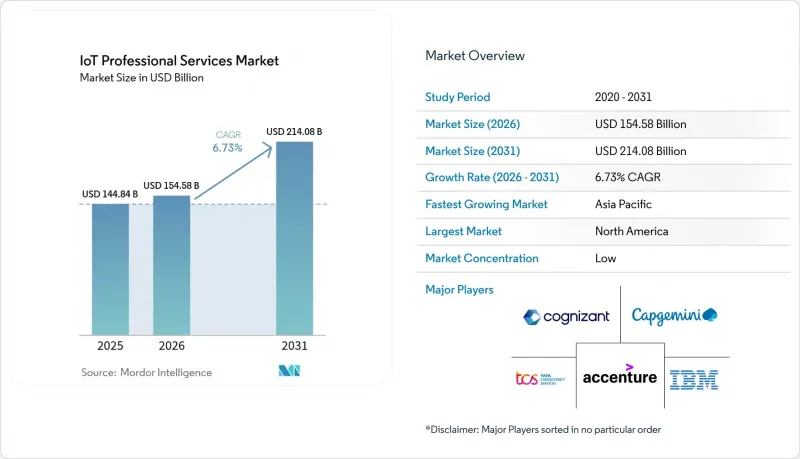
Mordor Intelligence에 의하면, IoT 전문 서비스 시장 규모는 2025년에 1,448억 4,000만 달러로 평가되었고 2026년 1,545억 8,000만 달러에서 2031년까지 2,140억 8,000만 달러에 이를 것으로 예측되며, 예측 기간(2026-2031년) CAGR은 6.73%를 나타낼 전망입니다.
본 보고서는 서비스 유형(IoT 컨설팅, IoT 인프라 서비스 등), 조직 규모(중소기업 및 대기업), 배포 방식(클라우드 기반, On-Premise형, 하이브리드형), 최종 사용자 산업(제조업, 소매업 등) 및 지역별로 분류되어 있습니다. 시장 예측은 금액(달러) 기준으로 제시되어 있습니다.
세계 IoT 전문 서비스 시장 동향 및 인사이트
연결 기기의 급증과 센서 비용의 하락
세계 연결 기기 수는 188억 대에 달하며, 다양한 하드웨어, 펌웨어, 통신 프로토콜을 관리하는 기업의 수용 능력이 한계에 다다르고 있습니다. 센서 가격 하락으로 대규모 배포가 경제적으로 가능해졌지만, 서로 다른 유형의 기기가 혼재함에 따라 라이프사이클 관리의 복잡성이 증가하고 있습니다. 따라서 전문 서비스 파트너에게는 다중 벤더 기기 군을 지원할 수 있는 프로비저닝, 설정 및 모니터링 프레임워크를 설계할 것이 요구되고 있습니다. 경량 M2M, 제로 터치 온보딩 및 보안 요소 인증이 모범 사례의 청사진으로 주목받고 있습니다. 2028년까지 총 3,780억 달러에 달할 것으로 예상되는 엣지 컴퓨팅에 대한 투자는 On-Premise 처리와 클라우드 분석의 균형을 맞추는 통합 서비스에 대한 수요를 더욱 높이고 있습니다.
기업의 디지털 전환 로드맵
이사회에서는 IoT 데이터를 전략적 자산으로 취급하는 경향이 강해지고 있으며, 연결된 기기 관련 프로젝트를 보다 광범위한 디지털 코어 프로그램에 통합하려는 움직임이 진행되고 있습니다. IBM은 디지털 전환 관련 컨설팅 수익으로 49억 6,000만 달러를 보고했으며, 이는 단발성 시범 프로젝트에서 전사적 현대화로의 전환을 뒷받침합니다. 서비스 제공업체는 현재 운영 KPI를 측정 가능한 ROI를 창출하는 센서 아키텍처 및 분석 파이프라인과 연계하는 능력을 바탕으로 평가받고 있습니다. 구매자가 가동 시간, 비용 절감 또는 수익 증대에 대한 보장을 요구함에 따라 성과 기반 가격 책정이 지지를 얻고 있습니다. 디지털 코어가 성숙해짐에 따라, 디바이스, 네트워크, 용도의 성능을 지속적으로 최적화하는 관리형 서비스에 대한 수요가 증가하고 있습니다.
데이터 개인정보 보호 및 사이버 보안에 대한 우려
Ordr사의 조사에 따르면, 의료 분야 IoT 환경의 82%에 적어도 하나의 중대한 취약점이 존재하며, 랜섬웨어, 안전 위험, 규제 당국의 벌금에 대한 이사회 차원의 우려가 커지고 있습니다. 따라서 기업에는 보안 부팅 칩부터 암호화된 데이터 파이프라인, 마이크로 세분화이 적용된 네트워크에 이르기까지 다층적인 방어 체제가 요구되고 있습니다. 필요한 기술은 임베디드 보안, OT 프로토콜, 클라우드 IAM에 걸쳐 있지만, 대부분의 IT 팀은 여전히 인력이 부족합니다. ‘SOC-as-a-service’, 레드팀 테스트, 제로 트러스트 참조 아키텍처에 투자하고 있는 서비스 제공업체들은 보안 우려를 수년에 걸친 리테이너 계약으로 전환하는 데 가장 유리한 위치에 있습니다.
부문 분석
2025년, IoT 컨설팅은 매출 점유율 32.10%를 유지했습니다. 이는 벤더 중립적 전략, ROI 모델링, 비즈니스 사례 검증에 대한 지속적인 수요를 반영한 것입니다. 한편, 시스템 설계 및 통합은 기업이 로드맵을 복잡한 미들웨어, 데이터 레이크 및 분석 오케스트레이션이 수반되는 실제 운영 환경으로 전환함에 따라 연평균 성장률(CAGR) 7.05%로 확대되고 있습니다. 각 제공업체는 도메인 액셀러레이터, 레퍼런스 아키텍처, 그리고 공장 현장의 가동률 및 에너지 효율 개선에 보상을 연계하는 성과 기반 계약을 통해 차별화를 꾀하고 있습니다. 5G 및 엣지 프로젝트가 시범 단계에서 본격적인 배포로 전환됨에 따라, 설계 및 통합 분야의 IoT 전문 서비스 시장 규모는 급속히 확대될 것으로 예측됩니다.
또한, 장치 모니터링, 예측 유지보수, 원격 업데이트 오케스트레이션을 결합한 매니지드 서비스에 대한 수요도 증가하고 있습니다. 공급업체들은 플랫폼 구독과 SLA(서비스 수준 계약)에 기반한 운영 센터를 묶어 제공함으로써 지속적인 수익을 확보하고 고객 락인을 강화하고 있습니다. 통합의 복잡성이 증가함에 따라, 펌웨어용 CI/CD(지속적 통합/지속적 배포), 디지털 트윈 시뮬레이션, AI 기반 테스트 자동화에 대한 도구 투자는 IoT 전문 서비스 시장에서 경쟁력을 유지하기 위한 필수 조건이 되고 있습니다.
대기업은 다각화된 포트폴리오, 세계 공급망, 그리고 대규모 현대화 예산을 바탕으로 2025년 지출의 63.05%를 차지하고 있습니다. 반면, 자본 지출을 줄이고 도입 기간을 단축하는 종량제 클라우드 플랫폼의 보급으로 중소기업(SME)은 연평균 성장률(CAGR) 7.28%로 가장 빠르게 성장하는 구매자층이 되었습니다. 중소기업을 대상으로 서비스 파트너는 패키지화된 스타터 키트, 모듈식 가격 책정, 그리고 비용을 단기 현금 흐름에 맞출 수 있도록 자금 조달 지원을 제공해야 합니다. 자원이 제한된 팀에 맞추어 거버넌스 템플릿, 보안 기준, ROI 대시보드를 맞춤화할 수 있는 공급자는 IoT 전문 서비스 시장의 이 급성장하는 하위 부문에서 결정적인 우위를 차지할 것입니다.
대규모 고객의 경우, 거래 규모가 확대됨에 따라 자문, 통합, 운영 관리 등 여러 영역에 걸친 복합적인 프로젝트가 발생합니다. 프로젝트에서는 하이브리드 전달 센터를 통해 조정되는 단계적인 세계 확장이 종종 나타납니다. 대조적으로, 중소기업 대상 프로젝트에서는 신속한 가치 실현, ERP 및 CRM과의 사전 설정된 통합, 그리고 콜드체인 모니터링 및 에너지 서브미터링과 같은 산업별 템플릿이 중시됩니다. 이러한 양극화로 인해 공급업체는 이중 시장 진출 전략을 펼칠 수밖에 없으며, 포춘 500대 기업 고객을 대상으로 전문성의 깊이를 유지하는 동시에, IoT 전문 서비스 시장 전체에서 중소기업을 대상으로 한 신속한 프로젝트 제공을 표준화해야 합니다.
지역별 분석
북미는 첨단 5G 네트워크의 보급, 견조한 벤처 자금 조달, NIST의 국가 IoT 전략 등 연방 정부 주도의 노력에 힘입어 2025년 매출의 36.95%를 차지했습니다. 미국 기업들은 제로 트러스트 보안과 AI 기반 분석을 우선시하며, 엔드투엔드 포트폴리오를 보유한 공급업체에 유리한 복잡한 멀티타워형 프로젝트를 추진하고 있습니다. 캐나다는 니어쇼어링 추세와 산업용 IoT 현대화의 혜택을 받고 있으며, 멕시코는 실시간 공급망 가시성에 의존하는 국경을 초월한 제조 회랑을 활용하고 있습니다.
아시아태평양은 연평균 성장률(CAGR) 7.88%로 가장 빠르게 성장하는 지역입니다. 중국은 스마트 시티에 막대한 예산을 할당하고, 제조업의 디지털화를 위한 산업용 인터넷(IIoT) 플랫폼을 추진하고 있습니다. 일본의 ‘Society 5.0’ 프로그램과 싱가포르의 ‘스마트 네이션’ 이니셔티브는 규정 준수가 완료되고 확장성이 뛰어난 솔루션에 대한 지역적 수요를 촉진하고 있습니다. 인도의 반도체 및 AI 정책은 대상 시장을 더욱 확대되고 있습니다. 공급업체들은 IoT 전문 서비스 시장에서 이러한 성장 동력을 활용하기 위해, 비용 경쟁력 있는 서비스 제공과 문화적 적합성 및 현지 언어 지원 간의 균형을 맞추어야 합니다.
유럽에서는 GDPR(EU 개인정보보호규정), EU 사이버 보안법, 그리고 각국의 ‘인더스트리 4.0’ 프레임워크에 힘입어 거버넌스 주도형 컨설팅 및 인증 지원에 대한 수요가 창출되며 꾸준한 성장을 유지하고 있습니다. 독일, 프랑스, 영국은 디지털 트윈 프로그램에 막대한 투자를 하고 있는 반면, 동유럽 국가들은 EU 자금을 활용하여 인프라 현대화를 추진하고 있습니다. 중동 및 아프리카은 여전히 발전 단계에 있지만, 걸프 국가들이 ‘비전 2030’에 기반한 스마트 시티 포트폴리오를 가속화하고 있어 턴키 방식의 전문 서비스 제공이 요구됨에 따라 미래가 밝을 것으로 기대됩니다.
기타 혜택:
- 엑셀 형식 시장 예측(ME) 시트
- 3개월간의 애널리스트 지원
자주 묻는 질문
목차
제1장 서론
제2장 조사 방법
제3장 주요 요약
제4장 시장 구도
제5장 시장 규모와 성장 예측
제6장 경쟁 구도
제7장 시장 기회와 향후 전망
JHS 26.09.09According to Mordor Intelligence, the IoT professional services market size was valued at USD 144.84 billion in 2025 and estimated to grow from USD 154.58 billion in 2026 to reach USD 214.08 billion by 2031, at a CAGR of 6.73% during the forecast period (2026-2031).
This report is Segmented by Service Type (IoT Consulting, Iot Infrastructure Services, and More), Organization Size (SMEs and Large Enterprises), Deployment Mode (Cloud-Based, On-Premises, and Hybrid), End-User Industry (Manufacturing, Retail, and More), and by Geography. The Market Forecasts are Provided in Terms of Value (USD).
Global IoT Professional Services Market Trends and Insights
Proliferation of Connected Devices and Falling Sensor Costs
Global connected-device volumes climbed to 18.8 billion units, stretching enterprise capacity to manage diverse hardware, firmware, and communication protocols. Lower sensor prices make large-scale rollouts financially viable, yet device heterogeneity magnifies lifecycle-management complexity. Professional-service partners are therefore asked to design provisioning, configuration, and monitoring frameworks that accommodate multivendor fleets. Lightweight M2M, Zero-Touch onboarding, and secure element authentication are gaining traction as best-practice blueprints. Edge-computing investment, projected to total USD 378 billion by 2028, further amplifies demand for integration services that balance on-premises processing with cloud analytics.
Enterprise Digital-Transformation Roadmaps
Boards increasingly treat IoT data as a strategic asset, folding connected-device projects into broader digital-core programs. IBM reported USD 4.96 billion in consulting revenue tied to digital-transformation engagements, underscoring the shift from isolated pilots to enterprise-wide modernization.Service providers are now evaluated on their ability to map operational KPIs to sensor architectures and analytics pipelines that deliver measurable ROI. Outcome-based pricing is gaining favor as buyers demand guarantees on uptime, cost savings, or revenue uplift. As digital cores mature, demand rises for managed-service wraps that continuously optimize device, network, and application performance.
Data-Privacy and Cyber-Security Concerns
Ordr found 82% of healthcare IoT environments host at least one serious vulnerability, fuelling board-level anxiety over ransomware, safety risks, and regulatory fines. Enterprises therefore require layered defenses ranging from secure-boot chips to encrypted data pipelines and micro-segmented networks. The skills needed cut across embedded security, OT protocols, and cloud IAM, yet most IT teams remain understaffed. Service providers investing in SOC-as-a-service, red-team testing, and zero-trust reference architectures are best placed to convert security fears into multi-year retainer contracts.
Other drivers and restraints analyzed in the detailed report include:
- 5G and Edge-Computing Rollout
- Regulatory Push for Industry 4.0 and Smart Infrastructure
- Interoperability and Standards Fragmentation
For complete list of drivers and restraints, kindly check the Table Of Contents.
Segment Analysis
IoT consulting retained 32.10% revenue share in 2025, reflecting sustained demand for vendor-neutral strategy, ROI modeling, and business-case validation. System design and integration, however, is expanding at a 7.05% CAGR as enterprises convert roadmaps into production rollouts that involve complex middleware, data lake, and analytics orchestration. Providers differentiate via domain accelerators, reference architectures, and outcome-based contracts that link fees to plant-floor uptime or energy-efficiency gains. The IoT professional services market size for design and integration is projected to widen sharply as 5G and edge projects graduate from pilot to scale.
Momentum is also building in managed-service wraps that combine device monitoring, predictive maintenance, and remote-update orchestration. Suppliers bundle platform subscriptions with SLA-backed operations centers to secure annuity revenue and deepen client lock-in. As integration complexity rises, tooling investments in CI/CD for firmware, digital twin simulation, and AI-driven test automation become table stakes for staying competitive in the IoT professional services market.
Large enterprises generated 63.05% of 2025 spending due to diversified portfolios, global supply chains, and sizeable modernization budgets. Yet SMEs are the fastest-growing buyer group at a 7.28% CAGR, enabled by pay-as-you-go cloud platforms that cut capital outlay and compress deployment timelines. For SMEs, service partners must offer packaged starter kits, modular pricing, and financing bridges that align costs with near-term cash flows. Providers that tailor governance templates, security baselines, and ROI dashboards to resource-constrained teams gain decisive advantage within this swelling sub-segment of the IoT professional services market.
In larger accounts, volume scale yields multi-tower engagements that span advisory, integration, and managed run operations. Projects often feature phased global rollouts coordinated through hybrid delivery centers. In contrast, SME deals emphasize rapid time to value, pre-configured integrations with ERP and CRM, and vertical templates such as cold-chain monitoring or energy sub-metering. This bifurcation forces suppliers to run dual go-to-market motions, preserving depth for Fortune 500 clients while industrializing delivery for high-velocity SME opportunities across the IoT professional services market.
Complete Report Scope:
- By Service Type
- IoT Consulting
- IoT Infrastructure Services
- System Design and Integration
- Others
- By Organization Size
- Small and Medium Enterprises (SMEs)
- Large Enterprises
- By Deployment Mode
- Cloud-based
- On-premises
- Hybrid
- By End-user Industry
- Manufacturing
- Retail
- Healthcare
- Energy and Utilities
- Transportation and Logistics
- Other Industries
- By Geography
- North America
- United States
- Canada
- Mexico
- South America
- Brazil
- Argentina
- Rest of South America
- Europe
- Germany
- United Kingdom
- France
- Italy
- Spain
- Russia
- Rest of Europe
- Asia-Pacific
- China
- Japan
- India
- South Korea
- Australia
- Rest of Asia-Pacific
- Middle East and Africa
- Middle East
- GCC
- Turkey
- Israel
- Rest of Middle East
- Africa
- South Africa
- Nigeria
- Rest of Africa
- Middle East
- North America
Geography Analysis
North America retained 36.95% of 2025 revenue, supported by advanced 5G coverage, robust venture funding, and federal initiatives such as NIST's national IoT strategy. Enterprises in the United States prioritize zero-trust security and AI-enabled analytics, driving complex multi-tower engagements that favor providers with end-to-end portfolios. Canada benefits from near-shoring trends and industrial IoT modernization, while Mexico leverages cross-border manufacturing corridors that rely on real-time supply-chain visibility.
Asia-Pacific is the fastest-growing region at an 7.88% CAGR. China allocates sizable smart-city budgets and promotes Industrial Internet platforms to digitize manufacturing. Japan's Society 5.0 program and Singapore's Smart Nation initiatives reinforce regional demand for compliance-ready, scalable solutions. India's semiconductor and AI policies further expand the addressable base. Providers must balance cost-competitive delivery with deep cultural alignment and local-language support to capitalize on this momentum in the IoT professional services market.
Europe maintains steady growth underpinned by GDPR, the EU Cybersecurity Act, and national Industry 4.0 frameworks that create governance-driven demand for consulting and certification support. Germany, France, and the United Kingdom invest heavily in digital-twin programs, while Eastern European economies leverage EU funds to modernize infrastructure. Middle East and Africa remain nascent but show promise as Gulf states accelerate Vision 2030 smart-city portfolios that require turnkey professional-service engagement.
- IBM Corporation
- Accenture PLC
- ATandT Inc.
- Oracle Corporation
- Cognizant Technology Solutions
- Capgemini SE
- General Electric Company
- DXC Technology Company
- Tata Consultancy Services
- Wipro Ltd.
- Virtusa Corp.
- Infosys Ltd.
- Huawei Technologies
- Siemens AG
- Bosch.IO GmbH
- Tech Mahindra Ltd.
- PwC
- HCLTech Ltd.
- KPMG International
- Deloitte
Additional Benefits:
- The market estimate (ME) sheet in Excel format
- 3 months of analyst support
TABLE OF CONTENTS
1 INTRODUCTION
- 1.1 Study Assumptions and Market Definition
- 1.2 Scope of the Study
2 RESEARCH METHODOLOGY
3 EXECUTIVE SUMMARY
4 MARKET LANDSCAPE
- 4.1 Market Overview
- 4.2 Market Drivers
- 4.2.1 Proliferation of connected devices and falling sensor costs
- 4.2.2 Enterprise digital-transformation roadmaps
- 4.2.3 5G and edge-computing rollout
- 4.2.4 Regulatory push for Industry 4.0 and smart infrastructure
- 4.2.5 Outcome-based pricing models for IoT services
- 4.2.6 AI-driven AIOps platforms creating integration demand
- 4.3 Market Restraints
- 4.3.1 Data-privacy and cyber-security concerns
- 4.3.2 Interoperability and standards fragmentation
- 4.3.3 Shortage of skilled IoT talent
- 4.3.4 Carbon-footprint scrutiny of hyperscale cloud workloads
- 4.4 Supply-Chain Analysis
- 4.5 Regulatory Landscape
- 4.6 IoT Ecosystem Analysis
- 4.7 Technological Outlook
- 4.8 Porter's Five Force Analysis
- 4.8.1 Bargaining Power of Suppliers
- 4.8.2 Bargaining Power of Buyers
- 4.8.3 Threat of New Entrants
- 4.8.4 Threat of Substitutes
- 4.8.5 Intensity of Competitive Rivalry
- 4.9 Impact of Macro Economic Factors on the Market
5 MARKET SIZE AND GROWTH FORECASTS (VALUE)
- 5.1 By Service Type
- 5.1.1 IoT Consulting
- 5.1.2 IoT Infrastructure Services
- 5.1.3 System Design and Integration
- 5.1.4 Others
- 5.2 By Organization Size
- 5.2.1 Small and Medium Enterprises (SMEs)
- 5.2.2 Large Enterprises
- 5.3 By Deployment Mode
- 5.3.1 Cloud-based
- 5.3.2 On-premises
- 5.3.3 Hybrid
- 5.4 By End-user Industry
- 5.4.1 Manufacturing
- 5.4.2 Retail
- 5.4.3 Healthcare
- 5.4.4 Energy and Utilities
- 5.4.5 Transportation and Logistics
- 5.4.6 Other Industries
- 5.5 By Geography
- 5.5.1 North America
- 5.5.1.1 United States
- 5.5.1.2 Canada
- 5.5.1.3 Mexico
- 5.5.2 South America
- 5.5.2.1 Brazil
- 5.5.2.2 Argentina
- 5.5.2.3 Rest of South America
- 5.5.3 Europe
- 5.5.3.1 Germany
- 5.5.3.2 United Kingdom
- 5.5.3.3 France
- 5.5.3.4 Italy
- 5.5.3.5 Spain
- 5.5.3.6 Russia
- 5.5.3.7 Rest of Europe
- 5.5.4 Asia-Pacific
- 5.5.4.1 China
- 5.5.4.2 Japan
- 5.5.4.3 India
- 5.5.4.4 South Korea
- 5.5.4.5 Australia
- 5.5.4.6 Rest of Asia-Pacific
- 5.5.5 Middle East and Africa
- 5.5.5.1 Middle East
- 5.5.5.1.1 GCC
- 5.5.5.1.2 Turkey
- 5.5.5.1.3 Israel
- 5.5.5.1.4 Rest of Middle East
- 5.5.5.2 Africa
- 5.5.5.2.1 South Africa
- 5.5.5.2.2 Nigeria
- 5.5.5.2.3 Rest of Africa
- 5.5.5.1 Middle East
- 5.5.1 North America
6 COMPETITIVE LANDSCAPE
- 6.1 Market Concentration
- 6.2 Strategic Moves
- 6.3 Market Share Analysis
- 6.4 Company Profiles (includes Global level Overview, Market level overview, Core Segments, Financials as available, Strategic Information, Market Rank/Share for key companies, Products and Services, and Recent Developments)
- 6.4.1 IBM Corporation
- 6.4.2 Accenture PLC
- 6.4.3 ATandT Inc.
- 6.4.4 Oracle Corporation
- 6.4.5 Cognizant Technology Solutions
- 6.4.6 Capgemini SE
- 6.4.7 General Electric Company
- 6.4.8 DXC Technology Company
- 6.4.9 Tata Consultancy Services
- 6.4.10 Wipro Ltd.
- 6.4.11 Virtusa Corp.
- 6.4.12 Infosys Ltd.
- 6.4.13 Huawei Technologies
- 6.4.14 Siemens AG
- 6.4.15 Bosch.IO GmbH
- 6.4.16 Tech Mahindra Ltd.
- 6.4.17 PwC
- 6.4.18 HCLTech Ltd.
- 6.4.19 KPMG International
- 6.4.20 Deloitte
7 MARKET OPPORTUNITIES AND FUTURE OUTLOOK
- 7.1 White-space and Unmet-Need Assessment