|
시장보고서
상품코드
2123416
플라스틱 필름 시장 : 점유율 분석, 업계 동향과 통계, 성장 예측(2026-2031년)Plastic Film - Market Share Analysis, Industry Trends & Statistics, Growth Forecasts (2026 - 2031) |
||||||
 Mordor Intelligence
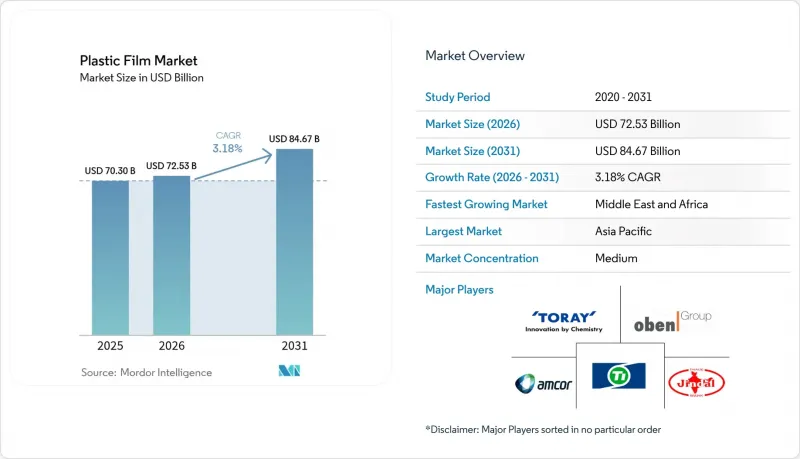
Mordor Intelligence에 의하면, 플라스틱 필름 시장 규모는 2025년 703억 달러에서 2026년에는 725억 3,000만 달러로 확대되어 2026년부터 2031년까지 CAGR 3.18%로 성장을 지속하여, 2031년에는 846억 7,000만 달러에 이를 것으로 예측됩니다.
본 보고서는 수지 유형(폴리프로필렌, 폴리에틸렌, BOPET, 폴리스티렌, 바이오플라스틱 등), 용도(랩 및 오버랩, 백 및 라이닝 등), 필름의 기능성(저배리어 단일 소재, 중배리어 메탈라이즈 등),최종 이용 산업(식품, 음료, 헬스케어 및 제약 등), 지역별로 분류되어 있습니다. 시장 예측은 금액(달러)으로 표시되어 있습니다.
세계 플라스틱 필름 시장 동향 및 인사이트력
소비자의 단일 소재 재활용 가능 필름 구조로의 전환
순환 경제 정책에 따라, 기존의 다층 구조가 성능을 저해하지 않으면서 재활용 기준을 충족하는 단일 소재 필름으로 빠르게 전환되고 있습니다. 2030년까지 완전한 재활용 가능성을 의무화하는 유럽의 규제에 따라, Uzel Plastik과 같은 컨버터들은 산소 차단성을 유지하면서 접착층용 접착제를 배제한 폴리에틸렌 소재의 반려동물사료용 필름 개발을 이미 추진하고 있습니다. 브랜드 소유주들은 지속가능성 지표와 연계된 다년간공급 계약을 통해 조기 도입 기업에 보상을 제공하고 있지만, 새로운 압출 성형 및 접착 시스템에 대한 초기 투자로 인해 단기적인 이익률은 압박을 받고 있습니다. 제약 업계도 마찬가지로 전환을 추진하고 있습니다. 크로크너 펜타플라스트(Klockner Pentaplast)는 엄격한 의료 규정 요건을 충족하면서 다운스트림 공정에서의 재활용을 간소화하는 단일 소재 블리스터 필름을 도입했습니다. 이러한 추세에 힘입어 단일 소재 시장 점유율은 2024년 60%에서 2030년까지 플라스틱 필름 시장의 3분의 2로 확대될 것으로 예측됩니다.
규제를 배경으로 한 생분해성 및 퇴비화 가능 필름의 채택 확대
주 및 국가 규제가 복잡하게 얽혀 있는 가운데, 특히 외식 산업 및 청과물 포장 분야에서 인증된 퇴비화 가능 필름에 대한 수요가 증가하고 있습니다. 워싱턴주의 표시 및 시설 인증에 관한 규정은 전 세계 공급업체들이 현재 준수해야 할 기술적 기준을 정하고 있습니다. 산업용 퇴비화에 대한 적합성을 의무화하는 미네소타주 법은 슈퍼마켓 체인의 자체 브랜드 사양에도 영향을 미치고 있습니다. DNP 그룹과 같이 탄탄한 연구개발 예산을 보유한 공급업체들은 스낵 과자를 보호하는 기체 차단성을 유지하면서 90일 이내에 분해 가능한 다층 구조의 퇴비화 가능 필름을 상품화하고 있습니다. 전 세계적으로 통일된 기준의 부재는 여전히 장벽으로 작용하고 있으며, 컨버터는 국가별로 다른 SKU를 생산할 수밖에 없어 규정 준수 비용 증가를 초래하고 있습니다.
폴리올레핀 및 PET 원료 가격 변동
PET 및 LDPE 현물 가격이 분기마다 15-20% 변동함에 따라, 특히 비통합형 기업의 경우 컨버터의 스프레드가 압박받고 있습니다. ChemOrbis의 데이터에 따르면, 2024년 PET 가격은 톤당 1,200-1,450달러 사이에서 변동하고 있어, 현물 수지에 의존하는 공급업체에게 장기 계약은 위험을 수반하고 있습니다. 아시아 BOPET 부문공급 과잉으로 인해 판매 가격은 사상 최저 수준까지 떨어졌습니다. Firsta Group에서는 마진이 15 루피/kg 아래로 떨어지는 사례가 기록되어, 일시적인 공장 가동 중단을 피할 수 없었습니다. 운송 시간의 장기화로 재고 관리가 더욱 복잡해졌으며, 가격이 다시 하락할 경우 중소규모의 가공업체들이 손실을 감수할 수밖에 없는 상황입니다.
부문별 분석
폴리에틸렌은 강성이나 투명성을 손상시키지 않으면서 필름 두께를 최대 20% 줄인 메탈로센 촉매 기술에 힘입어 2025년 판매량의 39.12%를 차지했습니다. 이러한 우위 덕분에 원유 가격에 연동된 원자재 비용이 급등했을 때에도 예측 가능한 현금 흐름을 확보할 수 있었습니다. 대조적으로, 바이오플라스틱은 기준선상으로는 규모가 작지만, 각 브랜드 소유사가 ESG 목표를 달성하기 위해 퇴비화 가능한 포장재의 시범 도입을 추진함에 따라 연평균 성장률(CAGR) 5.87%를 기록할 전망입니다. 사탕수수 바가스나 조류 유래 유지 등을 포함한 2세대 원료공급 증가로 인해 기존 수지에 비해 비용 프리미엄은 축소되고 있습니다. 다만, 가수분해 안정성의 제약으로 인해 높은 차단성이 요구되는 의료 및 전자기기 용도의 경우, 여전히 대부분의 바이오플라스틱으로는 대응하기 어려운 상황입니다.
바이오플라스틱 분야에 진출하려는 가공업체들은 가격 변동 위험을 헤지하기 위해 수지 스타트업 기업과 수년에 걸친 공급 계약을 협상하고 있습니다. 또한, EU나 북미의 퇴비화 시설을 중심으로 한 지역적 집적 현상도 공장 입지 결정에 영향을 미치고 있습니다. 폴리프로필렌은 내열성과 유지 방벽성이라는 특징을 살려, 레토르트 파우치 용도에서 계속해서 시장 점유율을 확대되고 있습니다. 한편, BOPET 제조업체들은 아시아에서공급 과잉을 피하기 위해 미국 등 시장에서 반덤핑 조치를 통한 보호를 요구하고 있습니다. 환상 올레핀 공중합체(COC) 등의 특수 폴리머는 의료 진단 분야에서 틈새 역할을 수행하고 있으며, 플라스틱 필름 시장에서 성능 주도형 차별화의 중요성이 부각되고 있습니다.
파우치 형태는 분량 관리의 편의성과 식품 폐기물을 줄여주는 밀봉 강도 덕분에 2025년 매출의 47.95%를 차지했습니다. 스낵 및 반려동물사료 공장에서 흔히 사용되는 자동 성형·충전·밀봉 라인은 해당 형태에 적합하며, 디지털 인쇄를 통해 단기 캠페인을 위한 고도로 맞춤화된 그래픽 구현이 가능해졌습니다. 한편, 랩 및 오버랩은 옴니채널 식료품 판매 및 밀키트 서비스 분야에서 고속 포장 로봇에 대응하는 내천자성 필름에 대한 수요가 증가함에 따라 연평균 성장률(CAGR) 4.56%를 나타낼 것으로 예측됩니다. 콜드체인 요건을 충족하기 위해 영하의 온도에서도 연성을 유지하는 방습층에 대한 수요가 증가하고 있으며, 이 분야에서는 BOPP 기반 라미네이트가 최근 주목을 받고 있습니다.
각 컨버터 업체들은 라스트 마일 배송 상황을 추적하기 위해 2차 포장 필름에 데이터 매트릭스 코드를 삽입함으로써, 소재 판매 그 자체를 넘어선 분석을 기반으로 한 수익원을 창출하고 있습니다. 라이너리스 라벨 필름과 멀티팩용 수축 밴딩은 여전히 중요하지만, 탄산음료 시장의 성숙화로 인해 그 성장세는 둔화되고 있습니다. 모든 용도에서 통기성을 조절하는 천공 처리된 농산물 포장 필름 등 자원 효율을 향상시키는 필름 형식은 소매업체의 지속가능성 노력과 부합하기 때문에 프리미엄 가격에도 불구하고 진열 공간을 확보하고 있습니다.
지역별 분석
아시아태평양은 규모의 경제와 급성장하는 국내 소비가 결합되어 2025년 플라스틱 필름 시장에서 37.98%의 점유율을 확보했습니다. 중국은 BOPET 및 BOPP 시장에서 우위를 유지하고 있지만, 생산 능력 확대가 연간 약 26만 톤의 국내 수요를 초과하여 이익률을 압박하고 있으며, 이는 중견 컨버터 간의 M&A를 촉진하고 있습니다. 인도는 메탈로센계 촉매 기술을 활용하여 개선된 파우치 형태에 대응하고 있으며, 새로운 BOPP 생산 라인을 빠른 속도로 도입하고 있습니다. 일본의 성숙해 가면서도 고도로 기술화된 생태계는 광학 필름 및 배터리용 분리막 필름 분야의 혁신을 뒷받침하고 있습니다.
북미 수요는 보다 안정적이며, 온쇼어링 동향과 전자상거래용 재생 가능한 PE 포장재를 장려하는 지속가능성 관련 규제에 힘입어 뒷받침되고 있습니다. 앨라배마주에서 폴리플렉스(Polyplex)사가 진행 중인 1억 달러 규모의 PET 필름 생산 확대는 무역 정책의 확실성과 연계된 지역 공급망의 매력을 보여줍니다. 각 컨버터 기업들은 리드 타임을 단축하기 위해 물류 허브 인근 입지를 더욱 확대하고 있으며, 이는 밀키트 및 의약품 출하에서 매우 중요한 요소가 되고 있습니다.
유럽은 계속해서 정책의 지표로서 역할을 수행하고 있습니다. 확대 생산자 책임(EPR) 제도에 따른 수수료가 재활용 불가능한 형태에 부과됨에 따라, 단일 소재로의 업그레이드를 위한 연구 개발비가 촉진되고 있습니다. 기계적 재활용 처리 능력 확충이 진행되고 있으며, 벤처 펀드는 경질·연질 소재가 혼합된 원료를 대상으로 한 화학적 재활용 시범 사업을 지원하고 있습니다.
중동 및 아프리카에서는 수입 대체 계획 및 규제상의 인센티브를 배경으로 2031년까지 연평균 성장률(CAGR) 7.86%가 예상됩니다. 이집트에서 5,480만 달러 규모의 재활용 폴리에스터 섬유 생산 라인을 건설하는 합작 사업은 순환형 솔루션에 대한 현지 수요가 증가하고 있음을 보여줍니다. 걸프협력회의(GCC) 회원국들은 탄화수소 산업의 통합을 활용하여 경쟁력 있는 가격의 폴리에틸렌(PE)을 공급하고 있으며, 지역의 식량 안보 프로그램 수요를 흡수하려는 하류 필름 산업 클러스터가 형성되고 있습니다. 사하라 이남 아프리카 수요 증가는 인구 증가와 일용소비재의 보급에 의해 주도되고 있지만, 폐기물 관리 인프라의 격차로 인해 고품질의 지속 가능한 필름 보급은 둔화될 가능성이 있습니다.
남미에서는 브랜드 식품 및 개인 위생 용품을 취급하는 다국적 기업들이 농촌 지역으로 소매망을 확대함에 따라 포장 수요가 증가하고 있어, 한 자릿수 중반의 성장이 예상됩니다. 메르코수르(Mercosur) 국가들 간의 통화 변동과 규제 차이로 인해 생산 능력 계획 수립이 복잡해지고 있지만, 가구 소득 증가로 인해 기초적인 소비는 유지되고 있습니다.
기타 혜택:
- 엑셀 형식 시장 예측(ME) 시트
- 3개월간의 애널리스트 지원
자주 묻는 질문
목차
제1장 서론
제2장 조사 방법
제3장 주요 요약
제4장 시장 구도
제5장 시장 규모와 성장 예측
제6장 경쟁 구도
제7장 시장 기회와 향후 전망
JHS 26.09.09According to Mordor Intelligence, the plastic film market size is expected to grow from USD 70.30 billion in 2025 to USD 72.53 billion in 2026 and is forecast to reach USD 84.67 billion by 2031 at 3.18% CAGR over 2026-2031.
This report is Segmented by Resin Type (Polypropylene, Polyethylene, BOPET, Polystyrene, Bioplastics, and More), Application (Wraps and Overwraps, Bags and Linings, and More), Film Functionality (Low-Barrier Mono-Material, Medium-Barrier Metallised, and More), End-Use Industry (Food, Beverages, Healthcare and Pharmaceutical, and More), and Geography. The Market Forecasts are Provided in Terms of Value (USD).
Global Plastic Film Market Trends and Insights
Consumer Shift Toward Mono-Material Recyclable Film Structures
Circular-economy policies are swiftly converting legacy multilayer formats into mono-material films that meet recyclability thresholds without sacrificing performance. European regulations mandating full recyclability by 2030 have already spurred converters such as Uzel Plastik to roll out polyethylene pet-food films that eliminate tie-layer adhesives while preserving oxygen barriers. Brand owners are rewarding early adopters with multi-year supply contracts linked to sustainability metrics, yet initial capital outlays for new extrusion and adhesive systems are trimming near-term margins. Pharmaceutical players are also transitioning; Klockner Pentaplast introduced a mono-material blister film that meets stringent medical compliance while simplifying downstream recycling. This momentum is expected to lift mono-material share from 60% in 2024 toward two-thirds of the plastic film market by 2030.
Growing Adoption of Biodegradable and Compostable Films Amid Regulations
A mosaic of state and national mandates is fueling demand for certified compostable films, particularly in food service and produce packaging. Washington State's labeling and facility-certification rules set a technical benchmark that global suppliers must now match. Minnesota's legislation requiring industrial-composting compatibility is influencing private-label specifications for supermarket chains. Suppliers with robust R&D budgets, such as DNP Group, are commercializing multilayer compostable structures capable of 90-day degradation while sustaining gas-barrier properties that protect snack foods. Lack of harmonized global standards remains a hurdle, forcing converters to produce country-specific SKUs and inflating compliance costs.
Volatility in Polyolefin and PET Feedstock Prices
Quarterly swings of 15-20% in PET and LDPE spot prices have compressed converter spreads, particularly among non-integrated players. ChemOrbis data show PET values oscillating between USD 1,200 and USD 1,450 per ton in 2024, making long-term contracts risky for suppliers dependent on spot resin. Overcapacity in Asia's BOPET segment has driven realizations to historical lows; Firsta Group recorded instances where margins dipped below INR 15/kg, triggering temporary plant shutdowns. Inventory management is further complicated by lengthy transit times, causing small converters to absorb losses during price retracements.
Other drivers and restraints analyzed in the detailed report include:
- Rising Demand for High-Barrier Films in Medical and Electronics Packaging
- Expansion of Agri-Film Usage in Vertical Farming and Greenhouse Automation
- Stringent Single-Use Plastic Bans in Emerging Economies
For complete list of drivers and restraints, kindly check the Table Of Contents.
Segment Analysis
Polyethylene retained 39.12% of 2025 volume, underpinned by metallocene catalyst technology that slashed film gauge by up to 20% without surrendering stiffness or clarity. This dominance supplied predictable cash flows even when oil-linked feedstock costs spiked. In contrast, bioplastics, though representing a modest baseline, are set to post a 5.87% CAGR as brand owners deploy compostable packaging pilots to meet ESG targets. Rising supply of second-generation feedstock, including sugarcane bagasse and algae oils, has clipped the cost premium to conventional resins. Still, high-barrier medical and electronics uses remain out of reach for most bioplastics due to hydrolytic-stability constraints.
Converters courting the bioplastic subsector are negotiating multi-year off-take pacts with resin start-ups to hedge price-volatility risk. Regional clustering around EU and North-American compost facilities also influences plant-location decisions. Polypropylene continues expanding within retort pouch applications, benefiting from heat-resistance and grease-barrier traits, while BOPET producers seek anti-dumping shelters in markets like the United States to escape Asian oversupply. Specialty polymers such as cyclic olefin copolymers fill niche roles in medical diagnostics, emphasizing the value of performance-led differentiation within the plastic film market.
The pouch format delivered 47.95% of 2025 sales thanks to portion-control convenience and seal-integrity that reduces food waste. Automated form-fill-seal lines, common in snack and pet-food factories, favor its geometry, while digital printing allows hyper-customized graphics for short campaigns. However, wraps and overwraps are forecast to grow at 4.56% CAGR as omnichannel grocery and meal-kit services demand puncture-resistant films compatible with high-speed bagging robots. Cold-chain compliance amplifies the need for moisture barriers that stay ductile at sub-zero temperatures, an area where BOPP-based laminates have recently gained traction.
Converters are integrating data-matrix codes into secondary wraps to track last-mile delivery conditions, creating analytics revenue streams beyond the material sale itself. Linerless label films and shrink-bundling for multipacks remain important, though growth is slower due to maturation in carbonated-drink markets. Across applications, film formats enabling resource efficiency such as perforated produce wraps that modulate respiration align with retailer sustainability pledges and thus secure shelf space despite premium pricing.
Complete Report Scope:
- By Resin Type
- Polypropylene (PP)
- Polyethylene (PE)
- Polyethylene-terephthalate (BOPET)
- Polystyrene (OPS)
- Bioplastics
- Other Material Types
- By Application
- Wraps and Overwraps
- Bags and Linings
- Pouches
- Other Applications
- By Film Functionality
- Low-Barrier Mono-material Films
- Medium-Barrier Metallised Films
- High-Barrier Multilayer Films
- Specialty Active and Antimicrobial Films
- By End-use Industry
- Food
- Candy and Confectionery
- Frozen Foods
- Fresh Produce
- Dairy Products
- Meat, Poultry and Seafood
- Pet Food
- Other Food Products
- Beverages
- Healthcare and Pharmaceutical
- Personal Care and Home Care
- Industrial Packaging
- Other End-use Industries
- Food
- By Geography
- North America
- United States
- Canada
- Mexico
- South America
- Brazil
- Argentina
- Chile
- Rest of South America
- Europe
- United Kingdom
- Germany
- France
- Spain
- Italy
- Rest of Europe
- Asia-Pacific
- China
- India
- Japan
- Australia
- South Korea
- Vietnam
- Rest of Asia-Pacific
- Middle East and Africa
- Middle East
- Saudi Arabia
- United Arab Emirates
- Turkey
- Rest of Middle East
- Africa
- South Africa
- Nigeria
- Egypt
- Rest of Africa
- Middle East
- North America
Geography Analysis
Asia-Pacific secured a 37.98% share of the plastic film market in 2025 by pairing scale economies with burgeoning domestic consumption. China maintains dominance in BOPET and BOPP, though capacity additions have outstripped local demand by roughly 260,000 t a year, pressing margins and catalyzing M&A among mid-tier converters. India leverages metallocene-catalyst technology to serve upgraded pouch formats and is onboarding new BOPP lines at a brisk pace. Japan's mature yet highly technical ecosystem sustains innovation in optical and battery-separator films.
North America's demand is steadier, buoyed by on-shoring trends and sustainability mandates that push recyclable PE wraps for e-commerce. Polyplex's USD 100 million PET-film expansion in Alabama illustrates the pull of regional supply chains aligned with trade-policy certainty. Converters increasingly co-locate with logistics hubs to shrink lead times, a factor critical for meal-kit and pharmaceutical shipments.
Europe continues to act as a policy bellwether; extended-producer-responsibility (EPR) fees penalize non-recyclable formats, driving R&D dollars into mono-material upgrades. Mechanical-recycling capacity additions are ramping, and venture funds are backing chemical-recycling pilots aimed at rigid-flexible feedstock mixes.
The Middle East and Africa is poised for a 7.86% CAGR through 2031 on the back of import-substitution plans and regulatory incentives. Egypt's joint venture to build a recycled-polyester fiber line worth USD 54.8 million signals rising local appetite for circular solutions. Gulf Cooperation Council members leverage hydrocarbon integration to supply competitively priced PE, spawning downstream film clusters that aim to capture regional food-security programs. Sub-Saharan Africa's demand growth is driven by population expansion and fast-moving consumer-goods uptake, though infrastructure gaps in waste management may moderate adoption of premium sustainable films.
South America delivers mid-single-digit growth as branded food and personal-care multinationals widen rural retail penetration, creating incremental packaging needs. Currency volatility and regulatory divergence between Mercosur nations complicate capacity planning, yet rising household incomes sustain baseline consumption.
- Amcor plc
- Toray Industries, Inc.
- Oben Holding Group S.A.
- Taghleef Industries LLC
- Jindal Poly Films Limited
- Cosmo First Limited
- Uflex Limited
- DuPont Teijin Films Japan Ltd.
- Sealed Air Corporation
- Mondi plc
- Huhtamki Oyj
- Polifilm GmbH
- CCL Industries Inc.
- Klckner Pentaplast Group
- Innovia Films Ltd.
- Mitsui Chemicals Tohcello, Inc.
- Inteplast Group Corporation
- AR Metallizing N.V.
- Guangdong Decro Film New Materials Co., Ltd.
Additional Benefits:
- The market estimate (ME) sheet in Excel format
- 3 months of analyst support
TABLE OF CONTENTS
1 INTRODUCTION
- 1.1 Study Assumptions and Market Definition
- 1.2 Scope of the Study
2 RESEARCH METHODOLOGY
3 EXECUTIVE SUMMARY
4 MARKET LANDSCAPE
- 4.1 Market Overview
- 4.2 Market Drivers
- 4.2.1 Consumer shift toward mono-material recyclable film structures
- 4.2.2 Growing adoption of biodegradable and compostable films amid regulations
- 4.2.3 Rising demand for high-barrier films in medical and electronics packaging
- 4.2.4 Expansion of agri-film usage in vertical farming and greenhouse automation
- 4.2.5 Film downgauging enabled by advanced metallocene catalysts
- 4.2.6 Surge in regional e-commerce cold-chain requiring specialty films
- 4.3 Market Restraints
- 4.3.1 Volatility in polyolefin and PET feedstock prices
- 4.3.2 Stringent single-use plastic bans in emerging economies
- 4.3.3 Supply tightness of medical-grade PVC resin
- 4.3.4 Capital intensity of synchronous biax orientation lines
- 4.4 Industry Value Chain Analysis
- 4.5 Porters Five Forces Analysis
- 4.5.1 Bargaining Power of Suppliers
- 4.5.2 Bargaining Power of Buyers/Consumers
- 4.5.3 Threat of New Entrants
- 4.5.4 Threat of Substitute Products
- 4.5.5 Intensity of Competitive Rivalry
- 4.6 Impact of Macroeconomic Factors on the Market
5 MARKET SIZE AND GROWTH FORECASTS (VALUE)
- 5.1 By Resin Type
- 5.1.1 Polypropylene (PP)
- 5.1.2 Polyethylene (PE)
- 5.1.3 Polyethylene-terephthalate (BOPET)
- 5.1.4 Polystyrene (OPS)
- 5.1.5 Bioplastics
- 5.1.6 Other Material Types
- 5.2 By Application
- 5.2.1 Wraps and Overwraps
- 5.2.2 Bags and Linings
- 5.2.3 Pouches
- 5.2.4 Other Applications
- 5.3 By Film Functionality
- 5.3.1 Low-Barrier Mono-material Films
- 5.3.2 Medium-Barrier Metallised Films
- 5.3.3 High-Barrier Multilayer Films
- 5.3.4 Specialty Active and Antimicrobial Films
- 5.4 By End-use Industry
- 5.4.1 Food
- 5.4.1.1 Candy and Confectionery
- 5.4.1.2 Frozen Foods
- 5.4.1.3 Fresh Produce
- 5.4.1.4 Dairy Products
- 5.4.1.5 Meat, Poultry and Seafood
- 5.4.1.6 Pet Food
- 5.4.1.7 Other Food Products
- 5.4.2 Beverages
- 5.4.3 Healthcare and Pharmaceutical
- 5.4.4 Personal Care and Home Care
- 5.4.5 Industrial Packaging
- 5.4.6 Other End-use Industries
- 5.4.1 Food
- 5.5 By Geography
- 5.5.1 North America
- 5.5.1.1 United States
- 5.5.1.2 Canada
- 5.5.1.3 Mexico
- 5.5.2 South America
- 5.5.2.1 Brazil
- 5.5.2.2 Argentina
- 5.5.2.3 Chile
- 5.5.2.4 Rest of South America
- 5.5.3 Europe
- 5.5.3.1 United Kingdom
- 5.5.3.2 Germany
- 5.5.3.3 France
- 5.5.3.4 Spain
- 5.5.3.5 Italy
- 5.5.3.6 Rest of Europe
- 5.5.4 Asia-Pacific
- 5.5.4.1 China
- 5.5.4.2 India
- 5.5.4.3 Japan
- 5.5.4.4 Australia
- 5.5.4.5 South Korea
- 5.5.4.6 Vietnam
- 5.5.4.7 Rest of Asia-Pacific
- 5.5.5 Middle East and Africa
- 5.5.5.1 Middle East
- 5.5.5.1.1 Saudi Arabia
- 5.5.5.1.2 United Arab Emirates
- 5.5.5.1.3 Turkey
- 5.5.5.1.4 Rest of Middle East
- 5.5.5.2 Africa
- 5.5.5.2.1 South Africa
- 5.5.5.2.2 Nigeria
- 5.5.5.2.3 Egypt
- 5.5.5.2.4 Rest of Africa
- 5.5.5.1 Middle East
- 5.5.1 North America
6 COMPETITIVE LANDSCAPE
- 6.1 Market Concentration
- 6.2 Strategic Moves
- 6.3 Market Share Analysis
- 6.4 Company Profiles (includes Global level Overview, Market level overview, Core Segments, Financials as available, Strategic Information, Market Rank/Share for key companies, Products and Services, and Recent Developments)
- 6.4.1 Amcor plc
- 6.4.2 Toray Industries, Inc.
- 6.4.3 Oben Holding Group S.A.
- 6.4.4 Taghleef Industries LLC
- 6.4.5 Jindal Poly Films Limited
- 6.4.6 Cosmo First Limited
- 6.4.7 Uflex Limited
- 6.4.8 DuPont Teijin Films Japan Ltd.
- 6.4.9 Sealed Air Corporation
- 6.4.10 Mondi plc
- 6.4.11 Huhtamki Oyj
- 6.4.12 Polifilm GmbH
- 6.4.13 CCL Industries Inc.
- 6.4.14 Klckner Pentaplast Group
- 6.4.15 Innovia Films Ltd.
- 6.4.16 Mitsui Chemicals Tohcello, Inc.
- 6.4.17 Inteplast Group Corporation
- 6.4.18 AR Metallizing N.V.
- 6.4.19 Guangdong Decro Film New Materials Co., Ltd.
7 MARKET OPPORTUNITIES AND FUTURE OUTLOOK
- 7.1 White-space and Unmet-Need Assessment