|
시장보고서
상품코드
2123420
자궁경 시장 : 점유율 분석, 업계 동향과 통계, 성장 예측(2026-2031년)Hysteroscope - Market Share Analysis, Industry Trends & Statistics, Growth Forecasts (2026 - 2031) |
||||||
 Mordor Intelligence
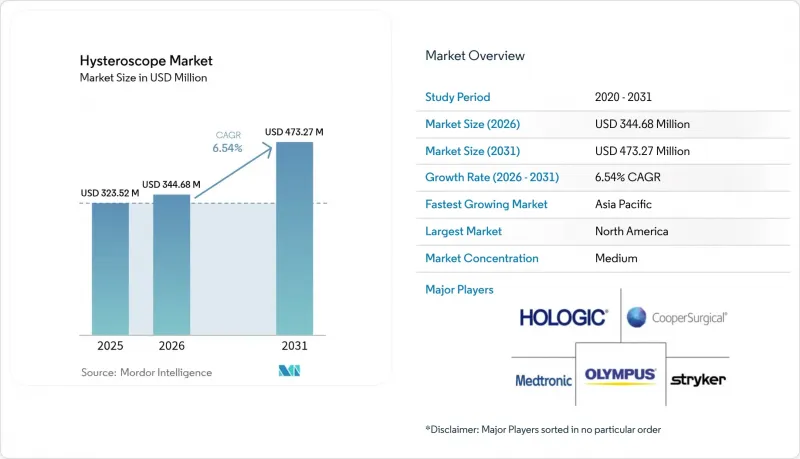
Mordor Intelligence에 의하면, 자궁경 시장 규모는 2025년에 3억 2,352만 달러로 평가되었고 2026년 3억 4,468만 달러에서 2031년까지 4억 7,327만 달러에 이를 것으로 예측되며, 예측 기간(2026-2031년) CAGR은 6.54%를 나타낼 전망입니다.
본 보고서는 제품별(경성 자궁경 등), 용도별(진단용 및 수술용), 구성 부품별(스코프 샤프트·광학계, 광원 등),용도(용종 절제, 근종 적출, 자궁내막 절제술 등), 최종 사용자(병원, 외래 수술 서비스 등), 지역(북미, 유럽, 아시아태평양 등)별로 분류되어 있습니다. 시장 예측은 금액(달러) 기준으로 제시되어 있습니다.
세계 자궁경 시장 동향 및 인사이트
저침습 부인과 수술에 대한 수요 증가
현재 임상의들은 회복 기간을 단축하고 합병증을 최소화하는 자궁 보존형이며 절개를 수반하지 않는 치료법을 선호하는 추세입니다. 전향적 연구 데이터에 따르면, 질을 통한 자연공 내시경 자궁 적출술은 복강경 수술에 비해 업무 복귀까지의 기간 중앙값을 3개월에서 2개월로 단축할 수 있는 것으로 나타났으며, 이러한 결과는 가치 기반 보상을 평가하는 보험사들에게도 공감을 얻고 있습니다. 메이요 클리닉은 자궁경 수술이 복부 절개를 피하고 입원 기간을 단축할 수 있다는 점에서 자궁 내 병변에 대한 1순위 치료법으로 꼽고 있습니다. 고강도 집속 초음파나 고주파 절제술과 같은 새로운 기술이 등장하며, 자궁선근증이나 자궁근종에 대한 새로운 치료 분야를 개척하고 있습니다. 로봇의 관절 가동성, AI를 활용한 표적 포착 및 시각화 기능의 향상으로 정밀도가 더욱 높아지면서, 수술용 자궁경은 기존의 개복 수술이나 복강경 수술을 대체하는 선택지로 시장 점유율을 확보해 가고 있습니다.
감염 관리 측면에서 일회용 자궁경의 급속한 보급
내시경 재처리 과정의 미비점에 대한 감시가 강화됨에 따라, 의료 기관은 재사용 가능한 기기의 위험과 이점의 균형을 재평가해야 할 압박을 받고 있습니다. FDA의 안전성 관련 공문에서는 특히 재처리 타당성 확인에 막대한 비용이 드는 소규모 의료기관에서 오염 위험이 강조되고 있습니다. ACOG는 결정적인 비용 대비 효과에 관한 조사가 부족함을 지적하면서도, 표면 결함이나 부적절한 오염 제거가 실패율을 높일 우려가 있다고 경고하고 있습니다. 미네르바 서지컬(Minerva Surgical)과 같은 제조업체들은 재처리 공정을 생략하면서도 재사용 가능한 내시경에 필적하는 광학 성능을 제공하는 완전 일회용 플랫폼을 개발하여 이에 대응하고 있습니다. 향후 메디케어(Medicare)의 지급 조정으로 1회 시술당 소모품 비용 증가분이 충당될 경우, 외래 진료 시설 전반에서 도입 곡선이 급격히 가팔라질 가능성이 있습니다.
재사용 가능한 자궁경으로 인한 감염 위험
복잡한 기기의 형태는 멸균 처리 팀에게 과제가 되고 있으며, 제조업체의 지침과 시설의 자원 간의 불일치가 재처리 실수를 초래하고 있습니다. ANSI/AAMI ST108 수질 지침은 인프라 비용을 상승시키고, 오염 사고에 대한 소송 위험에 대한 우려가 관리자들을 일회용 제품으로의 전환으로 몰아가고 있습니다. NYU Langone Health는 전담 부서 간 협업 팀을 구성하여 결함을 줄였지만, 자원 부담은 여전히 크며, 이는 단가가 높음에도 불구하고 소규모 의료 기관이 일회용 내시경을 채택하는 이유를 뒷받침합니다.
부문 분석
경성 자궁경(hysteroscope)은 2025년 매출의 45.02%를 차지하며, 복잡한 자궁 내 수술에서 뛰어난 광학 성능과 조작성을 반영하고 있습니다. 경성 플랫폼 자궁경 시장 규모는 3차 의료 기관의 높은 설비 가동률에 힘입어 2025년에는 1억 4,566만 달러에 달했습니다. 대조적으로, 일회용 스코프는 연평균 성장률(CAGR) 14.40%라는 가장 높은 성장 궤적을 기록하고 있으며, 재처리 능력이 제한적이고 배상 책임 보험료가 상승하고 있는 분야에서 빠르게 보급되고 있습니다. 진료소에서 환자의 편의성 향상과 더불어, 사례 간 처리 시간 단축이 더해져 처리 능력을 중시하는 클리닉에게 일회용 제품은 매력적인 선택지가 되고 있습니다.
재사용 가능한 영상 촬영 장치와 일회용 시스를 결합한 하이브리드 솔루션은 기존 제품의 경계를 모호하게 만들고, 비용과 감염 관리 목표 간의 균형을 맞추어 도입을 가속화할 가능성이 있습니다. 2024년 5월 FDA 승인을 획득한 메디트리나(Meditrina)사의 2세대 플랫폼은 경량 및 인체공학적 설계와 4K 화질을 융합한 혁신성을 두드러지게 보여주며, 경성 내시경과 연성 내시경 사이에 인식되던 성능 격차를 좁히고 있습니다. 유연 내시경은 여전히 틈새 시장으로 남아 있으며, 해부학적으로 어려운 사례나 환자의 내성이 최우선으로 고려되는 경우에 선호되지만, 도입 비용이 높고 적응증이 제한적이기 때문에 시장 점유율의 성장세는 완만한 수준에 그치고 있습니다.
2025년 총 시술 건수의 62.11%를 진단용 자궁경 검사가 차지하고 있으며, 이는 일선 자궁 평가에서 이 검사가 수행하는 보편적인 역할을 반영합니다. 임상의들은 직경이 작고 워크플로가 간소화되어 있기 때문에 진단용 내시경을 선호하며, 이는 마취가 필요 없는 외래 평가에 최적입니다. 연평균 성장률(CAGR) 9.60%로 확대되고 있는 수술적 시술은 한 번의 진료로 용종 절제, 근종 적출, 절제술을 가능하게 하는 조직 절제 시스템 및 에너지 장치의 혜택을 받고 있습니다. 2025년 코호트 연구에 따르면, 콜드 나이프를 이용한 자궁경하 박리술과 호르몬 요법의 병용으로 중증 자궁 내 유착에서 94.07%의 성공률을 달성하여, 기존의 표준 치료를 능가하는 성과를 보여주었습니다.
병원 및 첨단 외래 진료 센터에서는 복잡한 수술 워크플로우를 효율화하는 통합형 영상 진단 시스템과 AI를 활용한 가이던스에 대한 투자가 진행되고 있습니다. 이러한 설비 갱신은 설비 투자 예산을 증가시키는 한편, 진단과 치료를 결합한 세션을 통해 전체 치료 비용이 절감되므로 보험 급여 가능성도 높아집니다. 시뮬레이션 훈련과 원격 지도를 바탕으로 한 외과 의사의 숙련도 향상으로 인해, 선진국 및 신흥 지역을 막론하고 각 수술 하위 부문에서 두 자릿수의 수술 건수 증가세가 지속될 것으로 예측됩니다.
지역별 분석
북미는 선진적인 지불자 모델, 광범위한 세부 전문 분야 연수, 그리고 AI를 활용한 시각화 시스템의 급속한 보급에 힘입어 2025년에는 37.20%의 점유율로 1위를 차지했습니다. 미국은 수술 건수에서 압도적인 우위를 유지하고 있는 반면, 캐나다는 공적 의료보험 제도 하에서 유사한 기술을 도입하고 있습니다. 멕시코에서는 지속적으로 성장하는 민간 병원 부문과 의료 관광 노력이 최소 침습 치료를 원하는 지역 환자들을 끌어모으고 있습니다.
아시아태평양은 2031년까지 연평균 성장률(CAGR)이 9.63%를 나타낼 것으로 예측되어 가장 빠르게 성장하는 지역입니다. 가처분 소득 증가, 보험 적용 범위 확대, 그리고 부인과 질환의 높은 부담감이 수요의 기반이 되고 있습니다. 2025년 체계적 분석에 따르면, 특히 남아시아 전역에서 자궁경부암 및 자궁암 환자 수가 지속적으로 증가할 것으로 예측되며, 이에 따라 검진 및 수술 수요가 더욱 높아질 것으로 전망됩니다. 중국과 일본은 국내 의료기기 생산에 막대한 투자를 하고 있으며, 이를 통해 공급망을 단축하고 현지 도입을 지원하고 있습니다. 한편, 인도의 새로운 마케팅 규정은 규제 성숙도를 보여주고 있으며, 이로 인해 세계 공급업체 시장 진입이 가속화될 것으로 예측됩니다.
유럽에서는 전 세계 제조 기준에 영향을 미치는 엄격한 안전 및 환경 규제 속에서도 안정적인 성장을 유지하고 있습니다. 이 지역에서 라이프사이클 투명성을 위한 노력은 재활용 가능한 부품을 중심으로 한 설계 혁신을 촉진하고 있습니다. 반면, 중동 및 아프리카 및 라틴아메리카에서는 도시 지역의 사립 병원과 불임 치료 센터가 선도적인 역할을 하며 도입이 서서히 진행되고 있지만, 인력 부족과 보험 환급의 불균형이 더 광범위한 보급을 저해하고 있습니다. 대상을 좁힌 교육 협력과 클라우드를 활용한 원격 지도를 통해, 예측 기간 동안 역량 격차가 줄어들 것으로 전망됩니다.
기타 혜택:
- 엑셀 형식 시장 예측(ME) 시트
- 3개월간의 애널리스트 지원
자주 묻는 질문
목차
제1장 서론
제2장 조사 방법
제3장 주요 요약
제4장 시장 구도
제5장 시장 규모와 성장 예측
제6장 경쟁 구도
제7장 시장 기회와 향후 전망
JHS 26.09.07According to Mordor Intelligence, the hysteroscope market size was valued at USD 323.52 million in 2025 and estimated to grow from USD 344.68 million in 2026 to reach USD 473.27 million by 2031, at a CAGR of 6.54% during the forecast period (2026-2031).
This report is Segmented by Product (Rigid Hysteroscopes and More), Modality (Diagnostic and Operative), Component (Scope Shaft & Optics, Light Source, and More), Application (Polypectomy, Myomectomy, Endometrial Ablation, and More), End User (Hospitals, Ambulatory Surgical Services, and More) and Geography (North America, Europe, Asia Pacific, and More). The Market Forecasts are Provided in Terms of Value (USD).
Global Hysteroscope Market Trends and Insights
Growing Demand for Minimally Invasive Gynecologic Surgery
Clinicians now favor uterine-preserving, incision-free options that shorten recovery and limit complications. Prospective data show vaginal natural orifice transluminal endoscopic hysterectomy can cut median return-to-work from 3 months to 2 months compared with laparoscopy, a finding that resonates with payers evaluating value-based reimbursement. The Mayo Clinic cites hysteroscopic approaches as a first-line solution for intrauterine pathologies because they avoid abdominal incisions and reduce hospital stay. Emerging techniques, including high-intensity focused ultrasound and radiofrequency ablation, are opening new therapy segments for adenomyosis and fibroids. Robotic articulation, AI-enabled targeting, and enhanced visualization further improve precision, positioning operative hysteroscopy to capture share from traditional open or laparoscopic alternatives.
Rapid Adoption of Single-Use Hysteroscopes for Infection Control
Heightened scrutiny of endoscope reprocessing failures is prompting facilities to reevaluate the risk-benefit equation of reusable devices. FDA safety communications underscore contamination hazards, especially in low-volume centers where reprocessing validation is cost-prohibitive. ACOG notes the absence of definitive cost-effectiveness research but warns that surface defects and improper decontamination raise failure rates. Manufacturers such as Minerva Surgical have responded with fully disposable platforms that remove the reprocessing step while offering optics comparable to reusable scopes. If future Medicare payment adjustments cover higher per-procedure consumable costs, adoption curves could steepen quickly across ambulatory sites.
Infection Risk from Reusable Hysteroscopes
Complex device geometries challenge sterile-processing teams, and misalignment between manufacturer instructions and facility resources drives reprocessing errors. ANSI/AAMI ST108 water-quality guidelines raise infrastructure costs, while litigation fear over contamination events pushes administrators toward disposable options. NYU Langone Health reduced defects by deploying dedicated cross-functional teams, yet the resource burden is substantial, underscoring why smaller sites embrace single-use scopes despite higher unit costs.
Other drivers and restraints analyzed in the detailed report include:
- Technological Advances in Optics & Miniaturization
- Integration of AI-Guided Imaging & Cloud Analytics
- Sustainability Concerns Around Disposable Devices
For complete list of drivers and restraints, kindly check the Table Of Contents.
Segment Analysis
Rigid scopes held 45.02% of 2025 revenue, reflecting proven optical clarity and maneuverability during complex intrauterine surgery. The hysteroscope market size for rigid platforms reached USD 145.66 million in 2025, supported by high capital utilization rates inside tertiary centers. In contrast, single-use scopes recorded the highest growth trajectory at 14.40% CAGR, gaining rapid traction where reprocessing capacity is limited and liability insurance premiums are rising. Greater comfort for patients in office settings, coupled with reduced turnaround time between cases, makes disposables attractive for throughput-oriented clinics.
Hybrid solutions that combine a reusable imaging unit with disposable sheaths blur traditional product boundaries and may accelerate adoption by balancing cost and infection-control goals. Meditrina's second-generation platform, cleared by FDA in May 2024, highlights innovation that marries lightweight ergonomics with 4K visualization, narrowing the perceived performance gap between rigid and flexible formats. Flexible scopes remain niche, favored in anatomically difficult cases or where patient tolerance is paramount, yet higher acquisition costs and narrower procedure indications keep share growth moderate.
Diagnostic hysteroscopy represented 62.11% of total 2025 procedures, reflecting its universal role in first-line uterine assessment. Clinicians favor diagnostic scopes for their smaller diameter and simplified workflow, making them ideal for outpatient evaluation without anesthesia. Operative procedures, expanding at 9.60% CAGR, benefit from tissue-removal systems and energy devices that allow polypectomy, myomectomy, and ablation during a single encounter. Evidence from a 2025 cohort study shows cold-knife hysteroscopic separation plus hormonal therapy achieved a 94.07% success rate in severe intrauterine adhesion, outperforming historical standards.
Hospitals and advanced ambulatory centers are investing in integrated imaging stacks and AI-enabled guidance that streamline complex operative workflows. These upgrades increase capital budgets but also elevate reimbursement potential because combined diagnostic-therapeutic sessions reduce overall episode-of-care costs. Growing surgeon proficiency, aided by simulation training and telementoring, is expected to sustain double-digit procedure expansion in operative subsegments across both developed and emerging geographies.
Complete Report Scope:
- By Product
- Rigid Hysteroscopes
- Flexible Hysteroscopes
- Single-use / Disposable Hysteroscopes
- By Modality
- Diagnostic
- Operative
- By Component
- Scope Shaft & Optics
- Camera Head / Imaging System
- Light Source
- Distension Media & Pumps
- Accessories & Consumables
- By Application
- Polypectomy
- Myomectomy
- Endometrial Ablation
- Infertility Assessment & Treatment
- Adhesiolysis / Septum Resection
- Others
- By End User
- Hospitals
- Ambulatory Surgical Centers
- Office-based Gynecology Clinics
- Fertility Centers
- Geography
- North America
- United States
- Canada
- Mexico
- Europe
- Germany
- United Kingdom
- France
- Italy
- Spain
- Rest of Europe
- Asia-Pacific
- China
- Japan
- India
- South Korea
- Australia
- Rest of Asia-Pacific
- Middle East and Africa
- GCC
- South Africa
- Rest of Middle East and Africa
- South America
- Brazil
- Argentina
- Rest of South America
- North America
Geography Analysis
North America led with 37.20% share in 2025, buoyed by advanced payer models, extensive sub-specialty training, and rapid uptake of AI-enhanced visualization systems. The United States maintains dominant procedure volume, while Canada adopts similar technologies under its publicly funded healthcare scheme. Mexico's growing private hospital sector and medical tourism initiatives attract regional patients seeking minimally invasive care.
Asia-Pacific is the fastest-growing territory at a projected 9.63% CAGR to 2031. Rising disposable income, expanded insurance coverage, and high gynecological disease burden underpin demand. A systematic 2025 analysis forecasts persistent growth in cervical and uterine cancers, particularly across South Asia, intensifying screening and operative requirements. China and Japan invest heavily in domestic device production, shortening supply chains and supporting local installations, whereas India's new marketing code underscores regulatory maturation that should accelerate market entry for global suppliers.
Europe maintains stable growth amid stringent safety and environmental regulations that influence global manufacturing standards. The region's push toward life-cycle transparency encourages design innovation around recyclable components. Meanwhile, Middle East & Africa and Latin America see incremental adoption led by private hospitals and fertility centers in urban hubs, though workforce shortages and uneven reimbursement slow broader penetration. Targeted training collaborations and cloud-enabled remote mentoring are expected to narrow the capability gap over the forecast horizon.
- B. Braun
- Boston Scientific
- The Cooper Companies
- Gynesonics
- Hologic
- Karl Storz
- LiNA Medical
- MedGyn Products
- Medtronic
- Olympus
- Richard Wolf
- Smiths Group
- Sopro-Comeg (Acteon)
- Stryker
- XION Medical
- Cook Group
- Optomic Espana
- EndoChoice Holdings
- Omnitech Systems
- Alltion (Wuzhou)
- Shenzhen Shen Da Medical
Additional Benefits:
- The market estimate (ME) sheet in Excel format
- 3 months of analyst support
TABLE OF CONTENTS
1 Introduction
- 1.1 Study Assumptions & Market Definition
- 1.2 Scope of the Study
2 Research Methodology
3 Executive Summary
4 Market Landscape
- 4.1 Market Overview
- 4.2 Market Drivers
- 4.2.1 Increase In Incidence Of Uterine Diseases & Abnormalities
- 4.2.2 Growing Demand For Minimally-Invasive Gynecologic Surgery
- 4.2.3 Technological Advances In Optics & Miniaturization
- 4.2.4 Rapid Adoption Of Single-Use Hysteroscopes For Infection Control
- 4.2.5 Shift Toward Office-Based Hysteroscopy Lowering Total Cost Of Care
- 4.2.6 Integration Of AI-Guided Imaging & Cloud Analytics
- 4.3 Market Restraints
- 4.3.1 Infection Risk From Re-Usable Hysteroscopes
- 4.3.2 Shortage Of Trained Hysteroscopists In Emerging Markets
- 4.3.3 Sustainability Concerns Around Disposable Devices
- 4.3.4 Regulatory Scrutiny Of Morcellation & Fluid-Management Events
- 4.4 Porter's Five Forces
- 4.4.1 Threat of New Entrants
- 4.4.2 Bargaining Power of Buyers
- 4.4.3 Bargaining Power of Suppliers
- 4.4.4 Threat of Substitutes
- 4.4.5 Competitive Rivalry
5 Market Size & Growth Forecasts (Value, USD)
- 5.1 By Product
- 5.1.1 Rigid Hysteroscopes
- 5.1.2 Flexible Hysteroscopes
- 5.1.3 Single-use / Disposable Hysteroscopes
- 5.2 By Modality
- 5.2.1 Diagnostic
- 5.2.2 Operative
- 5.3 By Component
- 5.3.1 Scope Shaft & Optics
- 5.3.2 Camera Head / Imaging System
- 5.3.3 Light Source
- 5.3.4 Distension Media & Pumps
- 5.3.5 Accessories & Consumables
- 5.4 By Application
- 5.4.1 Polypectomy
- 5.4.2 Myomectomy
- 5.4.3 Endometrial Ablation
- 5.4.4 Infertility Assessment & Treatment
- 5.4.5 Adhesiolysis / Septum Resection
- 5.4.6 Others
- 5.5 By End User
- 5.5.1 Hospitals
- 5.5.2 Ambulatory Surgical Centers
- 5.5.3 Office-based Gynecology Clinics
- 5.5.4 Fertility Centers
- 5.6 Geography
- 5.6.1 North America
- 5.6.1.1 United States
- 5.6.1.2 Canada
- 5.6.1.3 Mexico
- 5.6.2 Europe
- 5.6.2.1 Germany
- 5.6.2.2 United Kingdom
- 5.6.2.3 France
- 5.6.2.4 Italy
- 5.6.2.5 Spain
- 5.6.2.6 Rest of Europe
- 5.6.3 Asia-Pacific
- 5.6.3.1 China
- 5.6.3.2 Japan
- 5.6.3.3 India
- 5.6.3.4 South Korea
- 5.6.3.5 Australia
- 5.6.3.6 Rest of Asia-Pacific
- 5.6.4 Middle East and Africa
- 5.6.4.1 GCC
- 5.6.4.2 South Africa
- 5.6.4.3 Rest of Middle East and Africa
- 5.6.5 South America
- 5.6.5.1 Brazil
- 5.6.5.2 Argentina
- 5.6.5.3 Rest of South America
- 5.6.1 North America
6 Competitive Landscape
- 6.1 Market Concentration
- 6.2 Market Share Analysis
- 6.3 Company Profiles (includes Global level Overview, Market level overview, Core Segments, Financials as available, Strategic Information, Market Rank/Share for key companies, Products & Services, and Recent Developments)
- 6.3.1 B. Braun SE
- 6.3.2 Boston Scientific Corp.
- 6.3.3 CooperSurgical Inc.
- 6.3.4 Gynesonics
- 6.3.5 Hologic Inc.
- 6.3.6 Karl Storz SE & Co. KG
- 6.3.7 LiNA Medical
- 6.3.8 MedGyn Products Inc.
- 6.3.9 Medtronic plc
- 6.3.10 Olympus Corporation
- 6.3.11 Richard Wolf GmbH
- 6.3.12 Smith & Nephew plc
- 6.3.13 Sopro-Comeg (Acteon)
- 6.3.14 Stryker Corp.
- 6.3.15 XION Medical
- 6.3.16 Cook Medical
- 6.3.17 Optomic Espana
- 6.3.18 EndoChoice Holdings
- 6.3.19 Omnitech Systems
- 6.3.20 Alltion (Wuzhou)
- 6.3.21 Shenzhen Shen Da Medical
7 Market Opportunities & Future Outlook
- 7.1 White-space & Unmet-Need Assessment