

|
시장보고서
상품코드
2123421
외과용 내비게이션 시스템 시장 : 점유율 분석, 업계 동향과 통계, 성장 예측(2026-2031년)Global Surgical Navigation Systems - Market Share Analysis, Industry Trends & Statistics, Growth Forecasts (2026 - 2031) |
||||||
 Mordor Intelligence
Mordor Intelligence에 의하면, 외과용 내비게이션 시스템 시장 규모는 2025년 95억 3,000만 달러에서 2026년에는 108억 3,000만 달러로 확대되어 2026년부터 2031년까지 CAGR 13.62%로 성장을 지속하여, 2031년에는 205억 1,000만 달러에 이를 것으로 예측됩니다.
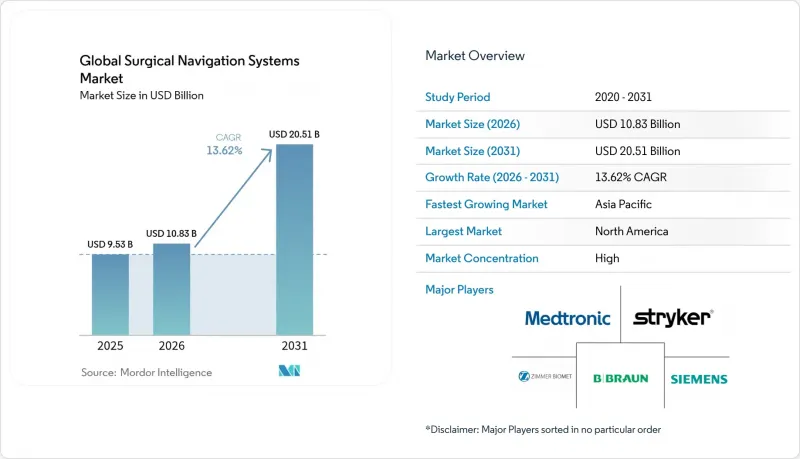
본 보고서는 기술별(전자기 내비게이션 시스템, 하이브리드 내비게이션 시스템 등), 용도별(신경외과, 정형외과, 이비인후과 등), 최종 사용자별(병원, 외래 진료 시설 등), 지역별(북미, 유럽, 아시아태평양 등)로 분류되어 있습니다. 시장 규모 및 전망은 금액(달러)으로 표시되어 있습니다.
전 세계 외과용 내비게이션 시스템 시장 동향 및 인사이트
복잡한 외과 수술 사례 증가
현재, 복잡한 척추 변형 수술의 84%가 등급 A의 나사 정밀도를 달성하기 위해 내비게이션에 의존하고 있으며, 이는 형광 투시 하에서 50-80%인 수치와 비교하여 높은 수치입니다. 이를 통해 1건당 평균 3만 3,939달러에 달하는 재수술 비용을 절감하고 있습니다. 다중 질환을 앓고 있는 고령 인구 증가로 인해 사례 수가 확대되고 있으며, 의료 제공업체들은 정밀한 안내가 합병증 발생률 감소 및 입원 기간 단축으로 이어진다는 점을 근거로 설비 투자의 정당성을 주장하고 있습니다. 그 결과, 예산이 빠듯한 상황에서도 수요는 견조한 추세를 보이고 있으며, 이것이 외과용 내비게이션 시스템 시장을 견인하고 있습니다. 오랜 기간의 임상 실적을 바탕으로 한 공급업체들은 외과의사의 신뢰를 더욱 높이고, 수술 건수가 많은 의료 기관에서의 장비 교체 주기를 가속화하고 있습니다.
최소 침습 수술 및 로봇 수술의 보급 확대
로봇 보조 인공 슬관절 전치환술은 이미 미국 수술 건수의 13%를 차지하고 있으며, 정확한 골 절제 및 임플란트 위치 조정에는 내비게이션이 필수적입니다. 외과의사는 일반적으로 로봇 수술을 12-17건만 수행해도 숙련도를 달성할 수 있으므로, 학습 곡선의 진입 장벽이 낮습니다. 외래 진료 시설은 외래 진료를 우대하는 메디케어의 보상 체계에 힘입어 이러한 수술을 도입하고 있으며, 2011년부터 2018년 사이에 287억 달러의 비용 절감을 가져왔습니다. 최소 침습 수술을 안전하게 수행하기 위해 정밀한 도구가 필수적인 가운데, 이러한 전환 추세는 외과용 내비게이션 시스템 시장에 수년 동안 지속적인 호재로 작용하고 있습니다.
높은 초기 투자 및 수명 주기 비용 요구 사항
내비게이션 기능이 탑재된 O-arm을 도입하는 데는 4년 동안 58만 9,205달러의 비용이 들 수 있으며, 척추 외과 의사의 77%가 도입의 가장 큰 장벽으로 가격을 꼽고 있습니다. 시술별 리스나 제조업체의 금융 패키지를 통해 부담을 줄이려고 노력하고 있지만, 소규모 병원이나 신흥 시장의 의료 기관에게는 여전히 큰 과제로 남아 있습니다. 비용에 대한 우려가 초기 도입을 억제하는 요인이 될 수 있지만, 고액의 재수술을 피할 수 있는 수술 건수가 많은 시설에서는 경제 모델상 긍정적인 수익성이 입증되었습니다. 각 벤더사는 모듈식 업그레이드를 도입하여 지출 곡선을 평탄화하고, 외과용 내비게이션 시스템 시장의 성장을 유지하는 것을 목표로 하고 있습니다.
부문 분석
전자기식 플랫폼은 시야가 가려지는 해부학적 상황에서도 입증된 성능이 높이 평가되어, 2025년에는 외과용 내비게이션 시스템 시장 점유율의 41.36%를 차지했습니다. 병원 측은 번거로운 반사판을 사용하지 않고 연조직을 통해 기구를 추적할 수 있는 점을 높이 평가했습니다. 그러나 광학식 솔루션도 빠르게 추격하고 있으며, 고속 카메라와 AI를 활용한 마커리스 추적 기술에 힘입어 연평균 성장률(CAGR) 8.12%로 성장을 지속하고, 있습니다. 이 부문의 부상은 수술실에서 좁은 수술 영역에서의 설정 신속화와 드리프트 오차 감소가 중요시되고 있음을 보여주며, 의료 기관 측은 추적 모드를 전환할 수 있는 듀얼 모달리티 수술실로의 전환을 추진하고 있습니다.
하이브리드 구성에서는 코일과 카메라를 통합된 카트 내에 조합함으로써, 외과의가 수술 도중 모달리티를 전환할 수 있게 됩니다. 투시법이나 CT에 기반한 내비게이션은 외상이나 복잡한 척추 수술 분야에서 틈새 수요를 확보하고 있지만, 방사선 피폭에 대한 엄격한 감시에 직면해 있습니다. 증강현실(AR) 헤드셋이나 MRI 호환 전자기 프로브와 같은 신흥 모달리티는 ‘기타’ 범주로 분류되며, 가격 및 규제 체계가 성숙해지면 비약적인 성장이 예상됩니다. 이러한 혁신은 외과용 내비게이션 시스템 시장의 장기적인 확장을 뒷받침하는 요인 중 하나입니다.
지역별 분석
북미는 넉넉한 보험 환급, 하이브리드 수술실의 광범위한 구축, 그리고 AI 모듈의 조기 도입에 힘입어 2025년 매출의 37.85%를 차지하고 있습니다. 미국은 척추 및 뇌 수술에 대한 정위 내비게이션 비용을 보상하는 CPT(진료 행위 분류) 제도의 뒷받침을 받아 지역 성장을 주도하고 있습니다. 한편, 캐나다에서는 장비 교체를 위한 주 정부의 재정 지원이 확대되고 있습니다. 멕시코의 국경을 초월한 의료기기 공급 계약 덕분에 사립 병원에서도 고급 콘솔을 더 쉽게 구할 수 있게 되었습니다. 그러나 대도시권 시장 포화로 인해 북미 외과용 내비게이션 시스템 시장은 신규 구매보다 교체 수요로 전환되고 있으며, 각 제조업체는 단순한 정밀도 향상보다 워크플로우 및 사이버 보안 업그레이드를 강조하고 있습니다.
아시아태평양은 2031년까지 연평균 성장률(CAGR) 7.76%를 기록하며 가장 빠르게 성장하는 시장입니다. 중국은 국내 신경 로봇 프로그램을 우선시하고 있으며, 국가약품감독관리국(NMPA)의 개혁으로 혁신적인 플랫폼의 승인 기간이 단축됨에 따라 국내외 진출기업 모두에게 호재가 되고 있습니다. 일본과 한국은 견고한 전자기기 공급망을 활용하여 OEM 파트너십을 가속화하고 있는 반면, 인도에서 급성장하고 있는 의료 관광 클러스터에서는 비용 효율성이 뛰어나면서도 고도의 내비게이션 콘솔이 요구되고 있습니다.
유럽에서는 다층적인 보험 환급 제도와 CE 마크 취득까지 소요되는 기간으로 인해 도입은 착실하게 진행되고 있으나, 그 속도는 제각각입니다. 독일과 프랑스에서는 병원 예산이 풍부하고 외과의사들의 로비 활동도 활발하여 조기 도입이 진행되고 있는 반면, 이탈리아와 스페인에서는 DRG 제도의 요금 체계가 모호한 점이 조달을 지연시키는 요인으로 작용하고 있습니다. 국경을 초월한 연구 컨소시엄이 혁신의 활력을 유지하는 한편, EU의 AI 법은 디지털 헬스케어 기준의 조화를 가져와 지역 전체 시장 출시를 원활하게 할 가능성이 있습니다. 중동 및 아프리카에서는 GCC 국가들과 남아프리카공화국에서의 지출 급증으로 공급업체들에게 새로운 기회가 열리고 있는 반면, 라틴아메리카에서는 거시경제의 변동으로 인해 브라질의 민간 네트워크 이외의 분야에서의 단기적 도입이 억제되고 있습니다. 예측 기간 동안 이러한 다양한 요인들이 복합적으로 작용하여 외과용 내비게이션 시스템 시장의 장기적인 성장을 뒷받침할 것입니다.
기타 혜택:
- 엑셀 형식 시장 예측(ME) 시트
- 3개월간의 애널리스트 지원
자주 묻는 질문
목차
제1장 서론
제2장 조사 방법
제3장 주요 요약
제4장 시장 구도
제5장 시장 규모와 성장 예측
제6장 경쟁 구도
제7장 시장 기회와 향후 전망
JHS 26.09.07According to Mordor Intelligence, the surgical navigation systems market size is expected to grow from USD 9.53 billion in 2025 to USD 10.83 billion in 2026 and is forecast to reach USD 20.51 billion by 2031 at 13.62% CAGR over 2026-2031.
This report is Segmented by Technology (Electromagnetic Navigation Systems, Hybrid Navigation Systems, and More), Application (Neurosurgery, Orthopedic Surgery, ENT Surgery, and More), End User (Hospitals, Ambulatory Settings, and More), and Geography (North America, Europe, Asia-Pacific, and More). The Market Sizes and Forecasts are Provided in Terms of Value (USD).
Global Surgical Navigation Systems Market Trends and Insights
Increasing Prevalence of Complex Surgical Cases
Eighty-four percent of complex spinal deformity operations now rely on navigation to achieve grade A screw accuracy versus 50-80% under fluoroscopy, cutting revision-surgery costs that average USD 33,939 per case. Aging populations with multi-morbidity enlarge case volumes, so providers justify the capital outlay by linking precision guidance to lower complication rates and shorter stays. Demand therefore stays resilient even in budget-tight environments, bolstering the surgical navigation systems market. Vendors bolstered by long clinical track records further raise confidence among surgeons, accelerating refresh cycles in high-volume centers.
Rising Adoption of Minimally Invasive and Robotic Procedures
Robotic-assisted total knee arthroplasty already represents 13% of US volume, and navigation is integral for accurate bone resection and implant alignment. Surgeons typically achieve proficiency after only 12-17 robotic cases, lowering the learning-curve barrier. Outpatient facilities capture these procedures, backed by Medicare rates that favor ambulatory settings and yielded USD 28.7 billion in savings between 2011 and 2018. This migration sustains multi-year tailwinds for the surgical navigation systems market as precision tools become essential for safe minimally invasive approaches
High Capital and Lifecycle Expenditure Requirements
Acquiring an O-arm with navigation can cost USD 589,205 over four years, and 77% of spine surgeons cite price as the top barrier to adoption. Pay-per-procedure leases and manufacturer financing packages attempt to soften the blow, but smaller hospitals and emerging-market providers still struggle. Cost anxiety may cap first-time installs, though economic models prove positive returns in high-volume centers that avoid expensive revision surgeries. As vendors introduce modular upgrades, they aim to flatten spending curves and defend growth in the surgical navigation systems market.
Other drivers and restraints analyzed in the detailed report include:
- Continuous Innovations in 3D Imaging and AI Algorithms
- Broader Reimbursement and Funding for Advanced OR Technologies
- Escalating Cybersecurity and Data-Privacy Concerns
For complete list of drivers and restraints, kindly check the Table Of Contents.
Segment Analysis
Electromagnetic platforms held 41.36% of the surgical navigation systems market share in 2025 due to their proven performance in anatomy, where line-of-sight is obstructed. Hospitals appreciate their ability to track instruments through soft tissue without cumbersome reflectors. However, optical solutions are catching up; aided by faster cameras and AI-based markerless tracking, they chart an 8.12% CAGR. The segment's ascent reveals that operating rooms value quicker set-up and lower drift errors in a crowded surgical field, nudging facilities toward dual-modality suites that can toggle between tracking modes.
Hybrid configurations combine coils and cameras within a unified cart, letting surgeons switch mid-procedure modalities. Fluoroscopy-based and CT-based navigation secure niche demand in trauma and complex spine but face radiation-exposure scrutiny. Emerging modalities such as augmented-reality headsets and MRI-adaptive electromagnetic probes sit in the "Others" bucket and promise step-change gains once price and regulatory paths mature. These innovations help sustain the long-run expansion of the surgical navigation systems market.
Complete Report Scope:
- By Technology
- Electromagnetic Navigation Systems
- Optical Navigation Systems
- Hybrid Systems
- Fluoroscopy-based Systems
- CT-based Systems
- Others
- By Application
- Neurosurgery
- Orthopedic & Trauma Surgery
- Spine Surgery
- ENT Surgery
- Cardiac & Thoracic Surgery
- Dental & Maxillofacial Surgery
- By End User
- Hospitals
- Ambulatory Surgical Centers (ASC)
- Others
- Geography
- North America
- United States
- Canada
- Mexico
- Europe
- Germany
- United Kingdom
- France
- Italy
- Spain
- Rest of Europe
- Asia Pacific
- China
- Japan
- India
- South Korea
- Australia
- Rest of Asia Pacific
- Middle East and Africa
- GCC
- South Africa
- Rest of Middle East and Africa
- South America
- Brazil
- Argentina
- Rest of South America
- North America
Geography Analysis
North America captures 37.85% of 2025 revenue, supported by strong reimbursement, widespread hybrid-OR buildouts and early uptake of AI modules. The United States leads regional growth, helped by CPT pathways that reimburse stereotactic navigation in spine and brain procedures, while Canada expands provincial funding for capital upgrades. Mexico's cross-border device-supply agreements make high-end consoles more accessible to private hospitals. Nonetheless, saturation in metropolitan centers steers the North American surgical navigation systems market toward replacement rather than first-time purchases, nudging manufacturers to highlight workflow and cybersecurity upgrades rather than raw accuracy gains.
Asia Pacific is the fastest-growing arena at an 7.76% CAGR through 2031. China prioritizes domestic neuro-robot programs, and National Medical Products Administration reforms have cut approval times for innovative platforms, encouraging local and foreign entrants alike. Japan and South Korea leverage robust electronics supply chains to accelerate OEM partnerships, while India's burgeoning medical-tourism clusters demand cost-efficient yet advanced navigation consoles.
Europe shows steady but variable uptake due to multi-layer reimbursement and CE-mark timelines. Germany and France adopt early owing to strong hospital budgets and surgeon lobbying, yet tariff ambiguities in DRG systems can delay procurement in Italy and Spain. Cross-border research consortia keep innovation vibrant, while the EU AI Act could harmonize digital-health standards, easing region-wide launches. Middle East & Africa's spending spurt in GCC states and South Africa opens fresh lanes for vendors, whereas Latin America's macro volatility tempers near-term installs outside Brazil's private network. Over the forecast period these mixed drivers collectively reinforce the long-run expansion of the surgical navigation systems market.
- Medtronic
- Stryker
- Brain Lab
- Siemens Healthineers
- Zimmer Biomet
- B. Braun (Aesculap)
- KARL STORZ SE
- Fiagon GmbH
- DePuy Synthes (J&J)
- CAScination AG
- Intuitive Surgical
- Smiths Group
- Globus Medical
- GE Healthcare
- Royal Philips
- Accuray
- Surgalign Holdings
- Scopis GmbH (Stryker)
- Synaptive Medical
- Elvation Medical
Additional Benefits:
- The market estimate (ME) sheet in Excel format
- 3 months of analyst support
TABLE OF CONTENTS
1 Introduction
- 1.1 Study Assumptions & Market Definition
- 1.2 Scope of the Study
2 Research Methodology
3 Executive Summary
4 Market Landscape
- 4.1 Market Overview
- 4.2 Market Drivers
- 4.2.1 Increasing Prevalence of Complex Surgical Cases
- 4.2.2 Rising Adoption of Minimally Invasive and Robotic Procedures
- 4.2.3 Continuous Innovations In 3D Imaging and AI Algorithms
- 4.2.4 Broader Reimbursement and Funding for Advanced OR Technologies
- 4.2.5 Rapid Infrastructure Expansion in Emerging Healthcare Markets
- 4.2.6 Integration Of Navigation Platforms with Hybrid Operating Rooms
- 4.3 Market Restraints
- 4.3.1 High Capital and Lifecycle Expenditure Requirements
- 4.3.2 Prolonged Multiregional Regulatory Approval Processes
- 4.3.3 Shortage Of Skilled Clinical and Technical Personnel
- 4.3.4 Escalating Cybersecurity and Data Privacy Concerns
- 4.4 Supply-Chain Analysis
- 4.5 Regulatory Landscape
- 4.6 Technological Outlook
- 4.7 Porter's Five Forces
- 4.7.1 Threat of New Entrants
- 4.7.2 Bargaining Power of Buyers
- 4.7.3 Bargaining Power of Suppliers
- 4.7.4 Threat of Substitutes
- 4.7.5 Competitive Rivalry
5 Market Size & Growth Forecasts (Value)
- 5.1 By Technology
- 5.1.1 Electromagnetic Navigation Systems
- 5.1.2 Optical Navigation Systems
- 5.1.3 Hybrid Systems
- 5.1.4 Fluoroscopy-based Systems
- 5.1.5 CT-based Systems
- 5.1.6 Others
- 5.2 By Application
- 5.2.1 Neurosurgery
- 5.2.2 Orthopedic & Trauma Surgery
- 5.2.3 Spine Surgery
- 5.2.4 ENT Surgery
- 5.2.5 Cardiac & Thoracic Surgery
- 5.2.6 Dental & Maxillofacial Surgery
- 5.3 By End User
- 5.3.1 Hospitals
- 5.3.2 Ambulatory Surgical Centers (ASC)
- 5.3.3 Others
- 5.4 Geography
- 5.4.1 North America
- 5.4.1.1 United States
- 5.4.1.2 Canada
- 5.4.1.3 Mexico
- 5.4.2 Europe
- 5.4.2.1 Germany
- 5.4.2.2 United Kingdom
- 5.4.2.3 France
- 5.4.2.4 Italy
- 5.4.2.5 Spain
- 5.4.2.6 Rest of Europe
- 5.4.3 Asia Pacific
- 5.4.3.1 China
- 5.4.3.2 Japan
- 5.4.3.3 India
- 5.4.3.4 South Korea
- 5.4.3.5 Australia
- 5.4.3.6 Rest of Asia Pacific
- 5.4.4 Middle East and Africa
- 5.4.4.1 GCC
- 5.4.4.2 South Africa
- 5.4.4.3 Rest of Middle East and Africa
- 5.4.5 South America
- 5.4.5.1 Brazil
- 5.4.5.2 Argentina
- 5.4.5.3 Rest of South America
- 5.4.1 North America
6 Competitive Landscape
- 6.1 Market Concentration
- 6.2 Market Share Analysis
- 6.3 Company Profiles (includes Global level Overview, Market level overview, Core Segments, Financials as available, Strategic Information, Market Rank/Share for key companies, Products & Services, and Recent Developments)
- 6.3.1 Medtronic plc
- 6.3.2 Stryker Corporation
- 6.3.3 Brainlab AG
- 6.3.4 Siemens Healthineers
- 6.3.5 Zimmer Biomet Holdings
- 6.3.6 B. Braun (Aesculap)
- 6.3.7 KARL STORZ SE
- 6.3.8 Fiagon GmbH
- 6.3.9 DePuy Synthes (J&J)
- 6.3.10 CAScination AG
- 6.3.11 Intuitive Surgical
- 6.3.12 Smith & Nephew
- 6.3.13 Globus Medical
- 6.3.14 GE Healthcare
- 6.3.15 Royal Philips
- 6.3.16 Accuray Inc.
- 6.3.17 Surgalign Holdings
- 6.3.18 Scopis GmbH (Stryker)
- 6.3.19 Synaptive Medical
- 6.3.20 Elvation Medical
7 Market Opportunities & Future Outlook
- 7.1 White-space & Unmet-need Assessment


