
|
시장보고서
상품코드
2123423
능동 이식형 의료기기 시장 : 점유율 분석, 업계 동향과 통계, 성장 예측(2026-2031년)Active Implantable Medical Devices - Market Share Analysis, Industry Trends & Statistics, Growth Forecasts (2026 - 2031) |
||||||
 Mordor Intelligence
Mordor Intelligence에 의하면, 2026년 능동 이식형 의료기기 시장 규모는 359억 5,000만 달러로 추정되고 있어 2025년 335억 달러에서 확대해, 2031년에는 511억 8,000만 달러에 이를 것으로 예측됩니다.
2026년부터 2031년까지 연평균 성장률(CAGR) 7.32%로 성장할 것으로 전망됩니다.
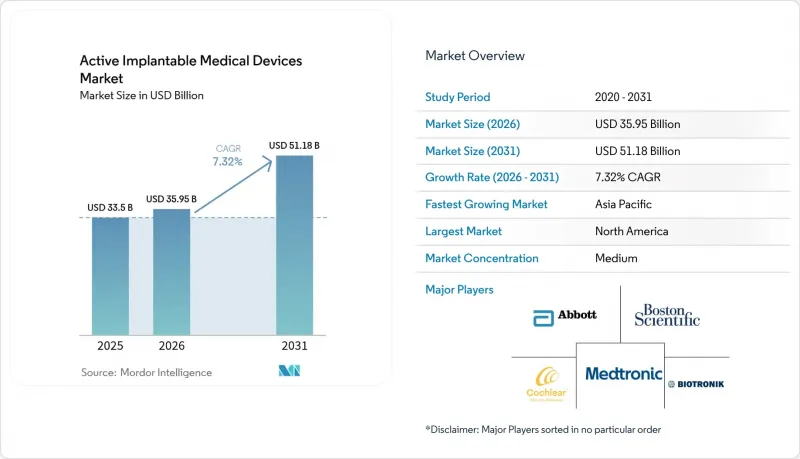
본 보고서는 제품 유형(심박조율기, 이식형 제세동기(ICD) 등), 용도(심혈관 질환, 신경 질환 등), 기술(기존 기기 등), 최종 사용자(병원 등), 지역(북미, 유럽 등)별로 분류되어 있습니다. 시장 전망은 금액(달러) 기준으로 제시되어 있습니다.
전 세계 능동 이식형 의료기기 시장 동향 및 인사이트
심혈관 질환, 신경 질환, 이비인후과 질환 유병률 증가
심부전은 전 세계적으로 6,400만 명 이상에게 영향을 미치고 있으며, 심방세동은 2030년까지 선진국 시장에서 1,790만 건에 달할 것으로 예상되어, 이에 따라 이식형 제세동기 및 재동기화 치료용 기기에 대한 수요가 증가하고 있습니다. 파킨슨병은 전 세계적으로 약 1,000만 명의 환자에게 영향을 미치고 있으며, 이는 치료를 실시간으로 조정하는 적응형 심부 뇌 자극 시스템의 도입을 촉진하고 있습니다. WHO의 예측에 따르면, 2050년까지 7억 명이 청력 손실로 고통받을 것으로 예상되며, 이러한 추세에 따라 완전 이식형 설계로 외관상의 장벽이 해소됨에 따라 인공 와우의 사용이 가속화되고 있습니다. 병행 질환의 비율도 증가 추세에 있어, 이로 인해 여러 의료기기의 동시 이식이 촉진되고 있으며, 이는 능동 이식형 의료기기 시장의 지속적인 성장을 뒷받침하고 있습니다.
급속한 소형화와 MRI 대응 리드리스 설계의 혁신
리드리스형 심박조율기는 10년의 배터리 수명을 유지하면서 부피를 1cm3 미만으로 축소했으며, 애보트(Abbott)사의 AVEIR 듀얼 챔버 시스템과 같은 기기는 경정맥 리드를 사용하지 않고 방실 페이싱을 동기화합니다. MRI 프로토콜은 3테슬라 스캔에 대해 ‘조건부’에서 ‘완전한 제한 없음’으로 발전하여, 기기를 착용한 환자에게 오랫동안 과제였던 영상 진단상의 장벽이 제거되었습니다. 머리카락 1,024가닥 정도 굵기의 전극을 갖춘 프리시전 뉴로사이언스(Precision Neuroscience)의 ‘Layer 7’ 대뇌 피질 인터페이스는 현재 실현 가능한 미세 제조 기술의 좋은 예입니다. 치료 완료 후 용해되는 생체 흡수성 심박조율기는 인간을 대상으로 한 첫 번째 타당성 시험을 완료했으며, 향후 제거 수술이 불필요해질 가능성을 시사하고 있습니다. 이러한 발전으로 인해 감염 위험이 감소하고, 시술이 간소화되며, 적용 가능한 환자층이 확대됨에 따라 능동 이식형 의료기기 시장의 성장세가 더욱 가속화되고 있습니다.
신흥 시장의 의료기기 및 시술 비용 부담
많은 저·중소득 지역에서는 임플란트 가격이 여전히 가구 연소득을 상회하고 있어, 그 보급은 부유한 도시 주민들에게만 국한되어 있습니다. 이 경제권 주민 중 기본적인 진단조차 받을 수 있는 사람은 고작 19%에 불과하여, 의료 체계 내의 체계적인 격차가 두드러지게 나타나고 있습니다. 통화 약세는 경화화로 표시된 의료기기의 수입 비용을 더욱 끌어올리고 있으며, 보험 적용 범위의 파편화로 인해 지불액의 대부분이 본인 부담으로 돌아가고 있습니다. 인도나 브라질의 현지 생산 정책에서는 세제 혜택이 제공되고 있지만, 고위험 임플란트 분야에는 전문적인 클린룸에서의 생산과 지적 재산권 포트폴리오가 필요하며, 이를 보유한 국내 기업은 극소수에 불과합니다. 임플란트 수술에는 전기생리학자나 이비인후과 외과 의사가 필요하지만, 이들은 여전히 주요 병원에 집중되어 있어 인재 양성의 부족이 장벽을 더욱 심화시키고 있습니다. 자금 조달 모델이 성숙해지기 전까지는 많은 신흥 지역에서 비용이 능동 이식형 의료기기 시장의 성장을 계속 억제할 것입니다.
부문 분석
이식형 제세동기(ICD)는 미국의 약 600만 명에 달하는 심부전 환자의 갑작스러운 심정지 예방에 있어 생명을 구하는 역할을 하고 있기 때문에 2025년에는 능동 이식형 의료기기 시장 규모의 30.85%를 차지했습니다. 피하형 및 리드리스형은 감염 위험을 줄이고 MRI 검사도 가능하게 하여 안정적인 교체 주기를 유지하고 있습니다. 심박조율기는 듀얼 챔버 리드리스 설계를 통해 정맥 내 리드를 사용하지 않고도 복잡한 부정맥을 교정할 수 있게 되었기 때문에 여전히 중요한 역할을 하고 있습니다. 심실 보조 장치(VAD)는 혈전증을 줄여주는 자기 부상식 펌프를 채택함으로써, 이전 세대에 비해 2년 생존율이 2배로 증가했습니다.
이식형 보청기는 완전 이식형 인공 와우가 3상 임상시험 단계에 진입하여 외부 프로세서 없이 24시간 청각 제공이 기대됨에 따라, 2031년까지 연평균 성장률(CAGR) 9.05%라는 가장 빠른 성장 궤도를 그리고 있습니다. MED-EL사의 TICI 타당성 연구 초기 데이터에 따르면, 표준 모델과 동등한 음성 인식 정확도가 나타났으며, 환자 만족도도 향상된 것으로 밝혀졌습니다. 또한, 신경 자극 장치는 과자극을 89% 저감하는 폐루프 기능의 혜택을 받고 있으며, 이식형 루프 레코더와 약물 주입 펌프는 개인 맞춤형 만성 질환 관리를 통해 이점을 얻고 있습니다. 이러한 동향이 맞물리면서 제품의 다양성이 더욱 심화되고, 능동 이식형 의료기기 시장 전망이 확고해지고 있습니다.
2025년, 심혈관 질환은 심부전 유병률의 상승과 전도계 페이싱 및 재동기화 요법의 적응증 확대에 힘입어 능동 이식형 의료기기 시장 규모의 54.90%를 계속 차지했습니다. 애보트(Abbott)사의 ‘TriClip’ 기기는 중등도 이상의 삼첨판 역류를 84% 감소시키고 캔자스시티 심근증 설문지(KCCQ) 점수를 개선함으로써, 구조적 심장 질환 분야에서의 비즈니스 기회를 부각시켰습니다. 신경학 분야의 응용은 적응형 심부 뇌 자극이 기존에는 치료 저항성이었던 파킨슨병의 아형에 대해서도 임상적 이점을 확대하고 있어 견조한 추세를 유지하고 있습니다.
청각 장애 치료 시장은 WHO가 7억 명의 환자 수를 예측함에 따라 2031년까지 연평균 성장률(CAGR) 10.15%로 확대되고 있으며, 완전 이식형 솔루션을 통해 오랫동안 지속되어 온 사회적 편견이 해소되고 있습니다. 만성 통증 관리 분야에서는 투여량을 자동 조절하는 AI 기반 척수 자극 장치의 도입이 진행되고 있어, 오피오이드 의존도를 낮추고 있습니다. 폐쇄 루프 방식의 인슐린 투여 등 내분비 분야의 활용 사례는 능동 이식형 의료기기 시장에 새로운 수요를 창출할 가능성이 있는 신흥 인접 분야입니다.
지역별 분석
북미는 2025년 매출의 38.10%를 차지하고 있으며, 이는 획기적인 의료기기에 대한 메디케어 적용 범위 확대와 학계, 산업계, 벤처 캐피탈을 연결하는 긴밀한 생태계에 힘입은 결과입니다. FDA의 ‘획기적 의료기기(Breakthrough Device)’ 제도에 따라 심장 및 신경계 의료기기의 승인 기간이 평균 150일 미만으로 단축되어, 임상 현장에서의 신속한 도입이 가능해졌습니다. 충실한 보험 환급 제도와 확립된 의뢰 네트워크 덕분에 리드리스 심박조율기 및 적응형 DBS 시스템의 수술 건수는 높은 수준을 유지하고 있습니다. 그러나 가치 기반 지불(VBP) 정책에 따라 공급업체는 장기적인 비용 절감 효과를 입증해야 하며, 능동 이식형 의료기기 시장의 가격 구조를 재편할 가능성이 있는 위험 분담 계약이 도입되고 있습니다.
아시아태평양은 중국의 VBP(가치 기반 지불)에 따른 비용 재설정 및 2017년 이후 국가의약품감독관리국(NMPA)에 의한 270건의 혁신적인 임플란트 승인 가속화로 인해, 2026년부터 2031년까지 연평균 성장률(CAGR) 8.32%로 성장할 전망입니다. 일본의 초고령화 사회는 소형이고 수명이 긴 의료기기에 대한 수요를 뒷받침하고 있는 반면, 한국은 첨단 제조 능력을 바탕으로 주요 수출 거점으로서의 위상을 확립하고 있습니다. 인도의 ‘생산 연계형 인센티브(PLI)’ 제도는 전 세계 OEM 제조업체를 유치하여 현지에서 최종 조립 거점을 설립하게 함으로써 물류 비용을 절감하고, 지역 전체의 접근성 확대를 지원하고 있습니다. 이러한 변화로 인해 능동 이식형 의료기기 시장에서 아시아태평양의 비중이 높아지면서, 세계 공급업체들에게 규모의 경제가 발생하고 있습니다.
유럽에서는 MDR(의료기기 규정)로의 전환에 따른 병목 현상으로 인증이 지연되고 있지만, 궁극적으로는 증거 기준의 조화가 이루어질 것입니다. 독일은 여전히 전기생리학 분야의 강호이며, 프랑스의 디지털 헬스 관련 보험 환급 체계는 AI 연동형 임플란트의 도입을 촉진하고 있습니다. 브렉시트로 인해 영국 고유의 승인 절차가 추가되면서, 두 지역에서 동시에 제품을 출시하기 위한 계획의 복잡성이 증가하고 있습니다. 그럼에도 불구하고, 유럽 대륙의 고령화와 국민건강보험 제도 덕분에 의료기기에 대한 안정적인 수요는 여전히 확보되어 있습니다. 인증 기관의 처리 능력이 정상화되면, 지연되었던 승인 건들이 해소되고 신제품 시장 출시가 진행되어, 능동 이식형 의료기기 시장에서 유럽의 입지가 더욱 강화될 것입니다.
기타 혜택:
- 엑셀 형식 시장 예측(ME) 시트
- 3개월간 애널리스트 지원
자주 묻는 질문
목차
제1장 서론
제2장 조사 방법
제3장 주요 요약
제4장 시장 구도
제5장 시장 규모와 성장 예측
제6장 경쟁 구도
제7장 시장 기회와 향후 전망
JHS 26.09.09According to Mordor Intelligence, active implantable medical devices market size in 2026 is estimated at USD 35.95 billion, growing from 2025 value of USD 33.50 billion with 2031 projections showing USD 51.18 billion, growing at 7.32% CAGR over 2026-2031.
This report is Segmented by Product Type (Pacemakers, Implantable Cardioverter-Defibrillators (ICD), and More), Application (Cardiovascular Disorders, Neurological Disorders, and More), Technology (Conventional Devices, and More), End User (Hospitals, and More), Geography (North America, Europe, and More). The Market Forecasts are Provided in Terms of Value (USD).
Global Active Implantable Medical Devices Market Trends and Insights
Rising Prevalence of Cardio-, Neuro- & Otologic Disorders
Heart failure impacts more than 64 million people worldwide and atrial fibrillation is expected to reach 17.9 million cases in developed markets by 2030, intensifying demand for implantable cardioverter-defibrillators and resynchronization devices. Parkinson's disease affects around 10 million patients globally, spurring adoption of adaptive deep-brain stimulation systems that modulate therapy in real time. WHO forecasts that hearing loss will affect 700 million people by 2050, a trend accelerating cochlear-implant usage as fully implantable designs erase cosmetic barriers. Co-morbid disease profiles are also becoming more common, prompting multi-device implantation and underpinning sustained growth in the Active implantable medical devices market.
Rapid Miniaturization & MRI-Safe Leadless Design Innovations
Leadless pacemakers have shrunk to volumes below 1 cm3 while retaining 10-year battery life, and devices like Abbott's AVEIR dual-chamber system synchronize atrioventricular pacing without transvenous leads. MRI protocols have progressed from conditional to fully unrestricted scanning at 3 Tesla, removing long-standing imaging barriers for device patients. Precision Neuroscience's Layer 7 cortical interface, hosting 1,024 hair-thin electrodes, exemplifies the fine-scale fabrication now achievable. Bio-resorbable pacemakers that dissolve after therapy completion have completed first-in-human feasibility trials, hinting at a future where explant surgery becomes unnecessary. These advances lower infection risks, simplify procedures, and widen patient selection, strengthening momentum in the Active implantable medical devices market.
High Device & Procedure Cost in Emerging Markets
In many low- and middle-income regions, implant prices still exceed annual household income, limiting penetration to wealthy urban populations. Only 19% of residents in these economies have access even to basic diagnostics, highlighting systemic care gaps. Currency depreciation further inflates import costs for devices priced in hard currencies, while fragmented insurance coverage pushes most payments out of pocket. Local manufacturing policies in India and Brazil offer tax incentives, yet high-risk implant categories require specialized cleanroom production and intellectual property portfolios that few domestic firms possess. Training deficits compound the barrier, as implant procedures demand electrophysiologists and otologic surgeons who remain concentrated in flagship hospitals. Until financing models mature, cost will continue to cap the Active implantable medical devices market in numerous emerging territories.
Other drivers and restraints analyzed in the detailed report include:
- Ageing Population Expanding Implant-Eligible Pool
- Favourable Reimbursement Expansion in OECD & China
- Stringent Cybersecurity & Regulatory Hurdles Lengthen Approvals
For complete list of drivers and restraints, kindly check the Table Of Contents.
Segment Analysis
Implantable cardioverter-defibrillators captured a 30.85% slice of the Active implantable medical devices market size in 2025 thanks to their life-saving role in sudden-cardiac-death prevention among roughly 6 million US heart-failure patients. Subcutaneous and leadless formats reduce infection risk and enable MRI access, sustaining steady replacement cycles. Pacemakers stay relevant because dual-chamber leadless designs now correct complex arrhythmias without transvenous leads. Ventricular assist devices profit from magnetically levitated pumps that cut thrombosis, doubling two-year survival compared with previous generations.
Implantable hearing devices post the fastest trajectory at a 9.05% CAGR through 2031 as totally implantable cochlear implants enter pivotal trials and promise round-the-clock sound without external processors. Early data from MED-EL's TICI feasibility study showed speech-recognition parity with standard models and higher patient satisfaction. Neurostimulators also benefit from closed-loop capabilities that cut overstimulation by 89%, while insertable loop recorders and drug-infusion pumps gain from personalized chronic-disease management. These dynamics collectively deepen product diversity and future-proof the Active implantable medical devices market.
Cardiovascular disorders retained 54.90% of the Active implantable medical devices market size in 2025 driven by escalating heart-failure prevalence and broadening indications for conduction-system pacing and resynchronization. Abbott's TriClip device reduced moderate-or-greater tricuspid regurgitation by 84% and improved Kansas City Cardiomyopathy Questionnaire scores, highlighting structural-heart opportunities. Neurological applications remain steady because adaptive deep-brain stimulation widens clinical benefit to previously refractory Parkinson's subtypes.
Hearing-loss treatment is growing at a 10.15% CAGR to 2031 as WHO projects 700 million affected individuals, and fully implantable solutions erase long-standing stigma. Chronic pain management sees rising adoption of AI-driven spinal cord stimulators that auto-calibrate dosing, reducing opioid reliance. Endocrine use cases, such as closed-loop insulin delivery, represent an emerging adjacency that could inject fresh volume into the Active implantable medical devices market.
Complete Report Scope:
- By Product Type
- Pacemakers
- Implantable Cardioverter-Defibrillators (ICD)
- Ventricular Assist Devices (VAD)
- Neurostimulators
- Spinal Cord Stimulators
- Deep Brain Stimulators
- Vagus Nerve Stimulators
- Sacral Nerve Stimulators
- Implantable Hearing Devices
- Cochlear Implants
- Bone-Anchored Hearing Systems
- Insertable Loop Recorders
- Implantable Drug-Infusion Pumps
- By Application
- Cardiovascular Disorders
- Neurological Disorders
- Hearing Loss
- Chronic Pain Management
- Endocrine & Metabolic (e.g., Diabetes)
- By End User
- Hospitals
- Ambulatory Surgery Centres
- Specialty & ENT Clinics
- Home-Care Settings
- By Technology
- MRI-Compatible Devices
- Conventional Devices
- Leadless / Wireless Implants
- Rechargeable / Bio-resorbable Power Systems
- Geography
- North America
- United States
- Canada
- Mexico
- Europe
- Germany
- United Kingdom
- France
- Italy
- Spain
- Rest of Europe
- Asia-Pacific
- China
- Japan
- India
- Australia
- South Korea
- Rest of Asia-Pacific
- Middle East & Africa
- GCC
- South Africa
- Rest of Middle East & Africa
- South America
- Brazil
- Argentina
- Rest of South America
- North America
Geography Analysis
North America held 38.10% of 2025 sales, fueled by Medicare coverage of breakthrough devices and a dense ecosystem linking academia, industry, and venture capital. The FDA Breakthrough Device pathway has compressed cardiac and neuro device approvals to under 150 days on average, allowing rapid clinician adoption. Robust reimbursement and established referral networks support high procedural volumes for leadless pacing and adaptive DBS systems. Yet value-based payment initiatives are pressuring suppliers to evidence longitudinal cost offsets, ushering in risk-sharing contracts that could reshape the Active implantable medical devices market's pricing structure.
Asia-Pacific is set to grow at 8.32% CAGR between 2026 and 2031 thanks to China's VoBP cost resets and accelerated National Medical Products Administration approvals of 270 innovative implants since 2017. Japan's super-aged society fuels demand for small, long-life devices, while South Korea's advanced fabrication capacity positions it as a leading export hub. India's Production Linked Incentive scheme is drawing global OEMs to set up local final assembly, trimming logistics costs and supporting broader regional access. These shifts elevate Asia-Pacific's weighting in the Active implantable medical devices market and create scale efficiencies for global suppliers.
Europe is navigating MDR transition bottlenecks that delay certification yet ultimately harmonize evidence standards. Germany remains a powerhouse in electrophysiology, and France's digital-health reimbursement framework incentivizes AI-linked implants. Brexit adds a parallel UK approval pathway, raising planning complexity for dual-region launches. Nonetheless, the continent's ageing demographic and universal coverage still assure steady device demand. Once notified-body capacity normalises, pent-up approvals could yield a release of new products and reinforce Europe's place within the Active implantable medical devices market.
- Medtronic
- Abbott Laboratories
- Boston Scientific
- Cochlear
- BIOTRONIK
- LivaNova
- Nevro
- Axonics Inc.
- Inspire Medical Systems
- Sonova (Advanced Bionics)
- MED-EL
- MicroPort CRM
- Terumo
- Abiomed
- Jarvik Heart
- Biotronik Neuro
- BlueWind Medical
- CVRx Inc.
- Mindray
- Lepu Medical
Additional Benefits:
- The market estimate (ME) sheet in Excel format
- 3 months of analyst support
TABLE OF CONTENTS
1 Introduction
- 1.1 Study Assumptions & Market Definition
- 1.2 Scope of the Study
2 Research Methodology
3 Executive Summary
4 Market Landscape
- 4.1 Market Overview
- 4.2 Market Drivers
- 4.2.1 Rising Prevalence of Cardio-, Neuro- & Otologic Disorders
- 4.2.2 Rapid Miniaturisation & MRI-Safe/Lead-Less Design Innovations
- 4.2.3 Ageing Population Expanding Implant-Eligible Pool
- 4.2.4 Favourable Reimbursement Expansion in OECD & China
- 4.2.5 AI-Enabled Remote Monitoring Algorithms Improving Real-World Outcomes
- 4.2.6 Breakthrough Bio-Resorbable Electronics Eliminating Explant Surgeries
- 4.3 Market Restraints
- 4.3.1 High Device & Procedure Cost in Emerging Markets
- 4.3.2 Stringent Cyber-Security / Regulatory Hurdles Lengthen Approvals
- 4.3.3 Semiconductor Supply Bottlenecks for Ultra-Miniature Components
- 4.3.4 Battery-Material Sustainability Pressures on Lithium-Iodine Chemistry
- 4.4 Regulatory Landscape
- 4.5 Porter's Five Forces Analysis
- 4.5.1 Threat of New Entrants
- 4.5.2 Bargaining Power of Suppliers
- 4.5.3 Bargaining Power of Buyers
- 4.5.4 Threat of Substitutes
- 4.5.5 Competitive Rivalry
5 Market Size & Growth Forecasts (Value, USD)
- 5.1 By Product Type
- 5.1.1 Pacemakers
- 5.1.2 Implantable Cardioverter-Defibrillators (ICD)
- 5.1.3 Ventricular Assist Devices (VAD)
- 5.1.4 Neurostimulators
- 5.1.4.1 Spinal Cord Stimulators
- 5.1.4.2 Deep Brain Stimulators
- 5.1.4.3 Vagus Nerve Stimulators
- 5.1.4.4 Sacral Nerve Stimulators
- 5.1.5 Implantable Hearing Devices
- 5.1.5.1 Cochlear Implants
- 5.1.5.2 Bone-Anchored Hearing Systems
- 5.1.6 Insertable Loop Recorders
- 5.1.7 Implantable Drug-Infusion Pumps
- 5.2 By Application
- 5.2.1 Cardiovascular Disorders
- 5.2.2 Neurological Disorders
- 5.2.3 Hearing Loss
- 5.2.4 Chronic Pain Management
- 5.2.5 Endocrine & Metabolic (e.g., Diabetes)
- 5.3 By End User
- 5.3.1 Hospitals
- 5.3.2 Ambulatory Surgery Centres
- 5.3.3 Specialty & ENT Clinics
- 5.3.4 Home-Care Settings
- 5.4 By Technology
- 5.4.1 MRI-Compatible Devices
- 5.4.2 Conventional Devices
- 5.4.3 Leadless / Wireless Implants
- 5.4.4 Rechargeable / Bio-resorbable Power Systems
- 5.5 Geography
- 5.5.1 North America
- 5.5.1.1 United States
- 5.5.1.2 Canada
- 5.5.1.3 Mexico
- 5.5.2 Europe
- 5.5.2.1 Germany
- 5.5.2.2 United Kingdom
- 5.5.2.3 France
- 5.5.2.4 Italy
- 5.5.2.5 Spain
- 5.5.2.6 Rest of Europe
- 5.5.3 Asia-Pacific
- 5.5.3.1 China
- 5.5.3.2 Japan
- 5.5.3.3 India
- 5.5.3.4 Australia
- 5.5.3.5 South Korea
- 5.5.3.6 Rest of Asia-Pacific
- 5.5.4 Middle East & Africa
- 5.5.4.1 GCC
- 5.5.4.2 South Africa
- 5.5.4.3 Rest of Middle East & Africa
- 5.5.5 South America
- 5.5.5.1 Brazil
- 5.5.5.2 Argentina
- 5.5.5.3 Rest of South America
- 5.5.1 North America
6 Competitive Landscape
- 6.1 Market Concentration
- 6.2 Market Share Analysis
- 6.3 Company Profiles (includes Global level Overview, Market level overview, Core Business Segments, Financials, Headcount, Key Information, Market Rank, Market Share, Products and Services, and analysis of Recent Developments)
- 6.3.1 Medtronic plc
- 6.3.2 Abbott Laboratories
- 6.3.3 Boston Scientific Corporation
- 6.3.4 Cochlear Limited
- 6.3.5 BIOTRONIK SE & Co. KG
- 6.3.6 LivaNova PLC
- 6.3.7 Nevro Corp
- 6.3.8 Axonics Inc.
- 6.3.9 Inspire Medical Systems
- 6.3.10 Sonova (Advanced Bionics)
- 6.3.11 MED-EL
- 6.3.12 MicroPort CRM
- 6.3.13 Terumo
- 6.3.14 Abiomed
- 6.3.15 Jarvik Heart Inc.
- 6.3.16 Biotronik Neuro
- 6.3.17 BlueWind Medical
- 6.3.18 CVRx Inc.
- 6.3.19 Shenzhen Mindray
- 6.3.20 Lepu Medical
7 Market Opportunities & Future Outlook
- 7.1 White-space & Unmet-Need Assessment