|
시장보고서
상품코드
2123424
클린룸 조명 시장 : 점유율 분석, 업계 동향과 통계, 성장 예측(2026-2031년)Cleanroom Lighting - Market Share Analysis, Industry Trends & Statistics, Growth Forecasts (2026 - 2031) |
||||||
 Mordor Intelligence
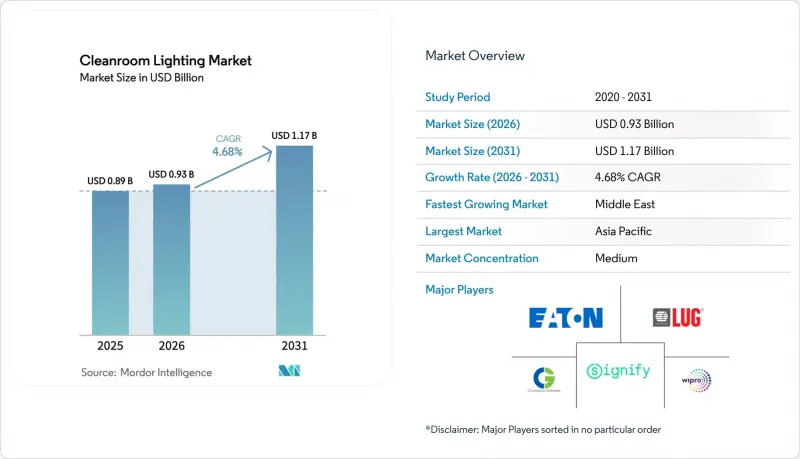
Mordor Intelligence에 의하면, 클린룸 조명 시장 규모는 2025년에 8억 9,000만 달러, 2026년에 9억 3,000만 달러가 되어, 2031년까지 11억 7,000만 달러에 이를 것으로 예측되며, 2026년부터 2031년까지 CAGR 4.68%로 성장할 전망입니다.
본 보고서는 광원(LED, 형광등, 유도등, UV), 조명 기구 설계(패널/트로퍼,랩어라운드/스트립, 다운라이트, 위험 지역용), 설치 유형(임베디드형, 표면 설치형, 펜던트형), 최종 사용자(반도체, 의료, 식품 및 음료, 조사 등), 판매 채널(OEM 직접 판매, 시스템 통합사업자, 유통업체), 지역별로 분류되어 있습니다. 시장 전망은 금액(달러) 단위로 표시됩니다.
세계 클린룸 조명 시장 동향 및 인사이트
동아시아의 300mm 반도체 팹 확장에 따라 ISO 클래스 1을 충족하는 조명 기구가 요구되고 있습니다.
동아시아의 반도체 제조업체들은 2025년에 여러 개의 300mm 생산 라인 건설에 착수했습니다. 각 라인은 가시형 밸러스트 하우징을 금지하고, 완전 밀폐형이며 아웃가스량이 적은 LED 패널의 사용을 의무화하는 ISO 클래스 1 또는 2의 오염 임계값에 맞추어 설계되었습니다. 형광등 트로파는 형광체 분진 발생 및 잦은 램프 교체가 우려되어 반도체 업계의 인증 공급업체 목록에서 제외되었으며, 사양은 50,000시간의 가동 시간을 보장하는 솔리드 스테이트 모듈로 전환되었습니다. ‘CHIPS법’ 및 ‘유럽 칩법’에 따른 보조금 조항에 따라, 이러한 클린룸 조명 기준은 애리조나주, 오하이오주 및 드레스덴의 신규 팹에도 적용되며, 수요는 아시아 이외의 지역으로도 확대되고 있습니다. 조명 기구 공급업체들은 말레이시아와 베트남의 클린룸 생산 능력을 확대하여 리드 타임을 18주에서 10주로 단축했습니다. 2나노미터 게이트 올 어라운드(GAA) 공정의 양산이 본격화됨에 따라, 클린룸 조명 시장에서는 RF에 민감한 포토리소그래피 베이를 지원하기 위해 Li-Fi 및 PoE 인터페이스를 탑재한 제품이 점점 더 늘어날 것입니다.
유럽 제약사에 대한 GMP 및 ISO 14644 준수 압박 고조
2025년 EU 부속서 1의 전면 시행에 따라 독일, 프랑스, 이탈리아의 무균 의약품 제조 시설에서 약 18억 유로(19억 6,000만 달러) 규모의 개조 붐이 일어났습니다. 감사관은 제3자 기관의 입자 방출 보고서가 없는 조명 기구를 부적합으로 판정했습니다. IP65 규격을 준수하는 스테인리스 스틸 케이스의 LED 패널이 표준이 되어, 형광등 트로퍼 프레임을 그대로 사용하는 개조 키트를 대체했습니다. 영국은 브렉시트에도 불구하고 이러한 요건을 반영하여, EU 고객에게 서비스를 제공하는 수탁 제조업체에게 유사한 조명 기구 시험 자료 준수를 의무화했습니다. 현재 각 공급업체는 ISO 14644, IEC 60598 및 EN 60529 인증서가 포함된 ‘검증 팩(Validation Pack)’을 제공하고 있으며, 이를 통해 인증 주기를 30% 단축할 수 있게 되었습니다. 미국 약전(USP)과의 규제 조화가 진행되고 있는 만큼, 북미의 충전 및 마감 라인에서도 유사한 조명 사양이 도입될 것으로 예측됩니다.
알루미늄과 폴리카보네이트의 가격 변동이 조명 기구의 BOM을 상승시킨다.
2025년, 런던 금속 거래소(LME)의 알루미늄 가격은 1미터톤당 평균 2,485달러를 기록했고, 폴리카보네이트 가격이 14% 급등함에 따라 조명 기구의 하우징 및 디퓨저에 대한 비용 압박이 더욱 심화되었습니다. 제조업체들은 가격 상승분의 약 절반을 흡수했으나, 그 결과 매출 총이익률은 최대 3퍼센트 포인트 축소되었습니다. 이에 대응하여 시공업체들은 12-24개월짜리 입찰 계약에 가격 상승 조항을 포함시키는 방식으로 대처했습니다. 한편, 일부 공급업체는 알루미늄 사용량을 줄이기 위해 내식성 코팅이 적용된 강철 하우징을 시범 도입했습니다. 그러나 강철 프레임은 무게가 늘어나기 때문에 운송 비용과 천장에 가해지는 하중이 증가하여 도입에 걸림돌이 되고 있습니다.
부문별 분석
LED 모듈은 2025년 매출의 82.40%를 차지하며, 이는 50,000-70,000시간의 수명으로 인해 오염 관리 구역 내 작업을 방해하는 램프 교체가 필요 없게 됨을 반영한 것입니다. 자외선(UV) 발광체는 연평균 성장률(CAGR) 4.99%로 가장 빠르게 성장하는 유형이며, 공기 중 병원균 제어를 위해 UV-C를 도입하는 걸프협력회의(GCC) 회원국 병원들이 이를 주도하고 있습니다. 한편, 유도형 및 잔류형 형광등 시스템은 단계적 폐지 시한이 다가옴에 따라 감소 추세를 보이고 있습니다.
의료 분야의 구매자들은 일주기 리듬에 맞추어 작업자의 피로를 줄이기 위해 조광 가능한 백색 LED를 점점 더 많이 지정하고 있습니다. 또한 공급업체들은 ISO 14644의 천장 온도 제한을 위반하지 않으면서 다이내믹 드라이버를 통합하고 있습니다. UV-C 어레이는 접합부 온도 상승에 따라 효과가 저하되므로 열적 문제를 안고 있습니다. 새로운 듀얼 챔버 하우징은 살균용 다이오드를 격리함으로써 소독 성능과 조명 성능을 모두 유지합니다. 또한 클린룸 조명 업계에서는 RF 통신이 제한되는 웨이퍼 제조 공장에서 가시광선 LED와 함께 Li-Fi 칩을 탑재하여 데이터를 전송하는 실험도 진행되고 있습니다.
패널형 및 트로퍼형 설계는 모듈식 천장 및 표준화된 600×600mm 설치 면적과의 호환성 덕분에 2025년 출하 대수의 47.80%를 차지했습니다. 위험 구역용 조명 기구는 배터리나 용제를 취급하는 라인에서 구역 1 및 구역 21의 안전 기준이 요구되기 때문에 2031년까지의 연평균 성장률(CAGR)이 7.12%로 가장 높습니다.
강화 유리와 스테인리스 스틸 클램프가 장착된 방폭 하우징은 표준 패널에 비해 55%-70%의 추가 비용이 발생하지만, ATEX 준수를 위해서는 필수적입니다. ISO 클래스 5 구역에서는 이식형 개구부가 층류를 방해하기 때문에 다운라이트 사용이 감소하는 추세이지만, 반면 표면 장착형 스트립 조명은 예산을 중시하는 유틸리티 복도에서 여전히 수요가 있습니다. 클린룸 조명 시장에서 패널 및 트로퍼 유닛의 점유율은 소폭 하락할 것으로 예상되지만, 2031년까지는 40%를 상회할 전망입니다.
지역별 분석
아시아태평양은 2025년에 전 세계 매출의 41.50%를 차지하며, 중국의 1,200억 위안 규모의 웨이퍼 팹 건설 계획과 한국의 광대역 메모리 생산 라인의 진전에 따라 연평균 성장률(CAGR) 4%대 중반을 유지할 것으로 예측됩니다. 대만의 일본 규슈 진출로 단일 팹에서 1만 4,200장의 밀폐형 LED 패널이 추가되면서, 이 지역에서 ISO 클래스 3 인증을 받은 조명 기구에 대한 수요가 높음을 보여주었습니다. 인도의 PLI(생산 연계형 인센티브)에 따른 API(반도체 제조) 공장이 수요를 더욱 확대하는 한편, 호주 및 뉴질랜드에서는 병원 개보수 공사가 수요를 견인하고 있습니다.
중동은 사우디아라비아의 국가 변혁 계획 및 UAE의 ‘오퍼레이션 3,000억’ 현지화 프로젝트에 힘입어 2031년까지 연평균 성장률(CAGR) 7.30%로 가장 높은 성장이 예상됩니다. 킹 압둘라 경제도시에 위치한 6억 8,000만 달러 규모의 무균 주사제 제조 시설에서는 6,800대의 ATEX 인증을 획득한 조명 기구가 발주되었으며, 줄파(Julfar)사는 3억 2,000만 달러 규모의 바이오의약품 공장에 UV-C 패널을 설치했습니다. 튀르키예의 수출 지향형 제약 사업 확장이 이 지역의 성장세를 뒷받침하고 있지만, 아프리카 전역에 걸친 설치 업체 부족으로 인해 시설 완공이 최대 1년 지연되는 사태가 계속되고 있습니다.
2025년에는 북미와 유럽이 각각 24% 가까이를 차지했습니다. 미국 내 세포 치료제 승인으로 120만 제곱피트 규모의 신규 클린룸이 건설되었으며, 부속서 1의 기한을 배경으로 독일에서는 34억 유로(37억 미 달러) 규모의 제약 공장 개보수가 진행되고 있습니다. 한편, 멕시코에서는 전자기기 및 전기차(EV) 공급망의 니어쇼어링이 진행되면서 케레타로주와 과나후아토주에 23개의 새로운 클린룸이 추가되었습니다. 또한, 남미는 약 6%의 점유율을 차지하며, 유제품 및 육류 가공 분야에서 활발한 설비 개보수가 진행되고 있습니다.
기타 혜택:
- 엑셀 형식 시장 예측(ME) 시트
- 3개월간의 애널리스트 지원
자주 묻는 질문
목차
제1장 서론
제2장 조사 방법
제3장 주요 요약
제4장 시장 구도
제5장 시장 규모와 성장 예측
제6장 경쟁 구도
제7장 시장 기회와 향후 전망
JHS 26.09.09According to Mordor Intelligence, the cleanroom lighting market size is projected to be USD 0.89 billion in 2025, USD 0.93 billion in 2026, and reach USD 1.17 billion by 2031, growing at a CAGR of 4.68% from 2026 to 2031.
This report is Segmented by Light Source (LED, Fluorescent, Induction, and UV), Fixture Design (Panel/Troffer, Wrap-Around/Strip, Downlights, and Hazardous-Location), Mounting Type (Recessed, Surface, and Pendant), End-User (Semiconductor, Healthcare, Food and Beverage, Research, and More), Sales Channel (Direct OEM, System Integrators, and Distributors), and Geography. Market Forecasts are in Value (USD).
Global Cleanroom Lighting Market Trends and Insights
Expansion Of 300 mm Semiconductor Fabs In East Asia Requiring ISO Class 1 Luminaires
East Asian chipmakers broke ground on multiple 300 millimeter lines in 2025, each engineered for ISO Class 1 or 2 contamination thresholds that prohibit visible ballast housings and mandate fully sealed, low-outgassing LED panels. Fluorescent troffers, prone to phosphor dust and frequent lamp changes, were removed from semiconductor approved-vendor lists, shifting specification toward solid-state modules rated for 50,000 operating hours. Subsidy clauses under the CHIPS and European Chips Acts extended these cleanroom lighting standards to new fabs in Arizona, Ohio, and Dresden, broadening demand beyond Asia. Fixture suppliers raised cleanroom production capacity in Malaysia and Vietnam to shorten lead times from 18 to 10 weeks. As 2-nanometer gate-all-around processes ramp, the cleanroom lighting market will increasingly bundle Li-Fi or PoE interfaces to support RF-sensitive photolithography bays.
Increasing GMP And ISO 14644 Compliance Pressure On European Pharma Manufacturers
Full enforcement of EU Annex 1 in 2025 triggered an estimated EUR 1.8 billion (USD 1.96 billion) retrofit wave across German, French, and Italian sterile-drug plants, with auditors rejecting fixtures that lacked third-party particulate-shedding reports. Stainless-steel-housed LED panels rated IP65 became the default, displacing retrofit kits that preserved fluorescent troffer frames. The United Kingdom mirrored these requirements despite Brexit, forcing contract manufacturers that serve EU clients to align with the same luminaire test dossiers. Suppliers now offer pre-filled validation packs containing ISO 14644, IEC 60598, and EN 60529 certifications to shorten qualification cycles by 30%. Ongoing regulatory harmonization with the United States Pharmacopoeia is expected to propagate identical lighting specifications to North American fill-finish suites.
Volatile Aluminium And Polycarbonate Prices Inflating Fixture BOMs
London Metal Exchange aluminum averaged USD 2,485 per metric ton in 2025, and a 14% spike in polycarbonate compounded pressure on luminaire housings and diffusers. Manufacturers absorbed roughly half the rise, narrowing gross margins by up to 3 percentage points. Contractors responded by inserting escalation clauses into 12- to 24-month bids, while some vendors trialed steel housings with corrosion-resistant coatings to cut aluminum usage. Nevertheless, heavier steel frames elevate shipping and ceiling load, tempering adoption.
Other drivers and restraints analyzed in the detailed report include:
- Growth Of Biologics And Cell-Therapy Facilities In North America Demanding Flicker-Free Sealed LEDs
- EU EcoDesign-2023 Retrofit Mandates Accelerating LED Replacement Of Legacy Fluorescent Fixtures
- Scarcity Of ATEX/IECEx-Certified Lights Delaying Middle-East Pharma Projects
For complete list of drivers and restraints, kindly check the Table Of Contents.
Segment Analysis
LED modules accounted for 82.40% of 2025 revenue, reflecting their 50,000-70,000 hour lifetimes that eliminate disruptive lamp changes inside contamination-controlled zones. Ultraviolet emitters are the fastest-advancing type at 4.99% CAGR, driven by Gulf Cooperation Council hospitals that integrate UV-C for airborne pathogen control, while induction and residual fluorescent systems decline as phase-out deadlines approach.
Healthcare buyers increasingly specify tunable-white LEDs to align circadian cycles and cut operator fatigue, and suppliers are integrating dynamic drivers without breaching ISO 14644 ceilings. UV-C arrays present thermal challenges because efficacy drops at elevated junction temperatures; new dual-chamber housings isolate germicidal diodes to preserve both disinfection and illumination performance. The cleanroom lighting industry is also experimenting with Li-Fi chips embedded alongside visible LEDs to transmit data in RF-restricted wafer fabs.
Panel and troffer designs dominated 47.80% of shipments in 2025 owing to their compatibility with modular ceilings and standardized 600 X 600 millimeter footprints. Hazardous-location fixtures show the highest 7.12% CAGR through 2031 as battery and solvent-handling lines require Zone 1 and Zone 21 safety.
Explosion-proof housings with tempered glass and stainless-steel clamps add 55%-70% cost over standard panels but remain unavoidable for ATEX compliance. Downlights face retreat in ISO Class 5 bays because recessed apertures disrupt laminar airflow, whereas surface-mount strips still appeal to budget-sensitive utility corridors. The cleanroom lighting market share of panel and troffer units is expected to erode marginally but will stay above 40% through 2031.
Complete Report Scope:
- By Light Source
- LED
- Fluorescent
- Induction
- UV
- By Fixture Design/Form Factor
- Panel/Troffer
- Wrap-Around/Strip
- Downlights
- Hazardous-Location Fixtures
- By Mounting Type
- Recessed
- Surface
- Pendant/Suspended
- By End-User Industry
- Semiconductor and Electronics
- Healthcare and Life Sciences
- Food and Beverage Processing
- Research and Academic Laboratories
- Aerospace and Defense
- Automotive Paint and Battery Manufacturing
- Other Industries
- By Sales Channel
- Direct OEM
- System Integrators
- Distributors
- By Geography
- North America
- United States
- Canada
- Mexico
- South America
- Brazil
- Argentina
- Rest of South America
- Europe
- Germany
- United Kingdom
- France
- Italy
- Spain
- Rest of Europe
- Asia Pacific
- China
- Japan
- South Korea
- India
- Australia
- New Zealand
- Rest of Asia-Pacific
- Middle East and Africa
- Middle East
- United Arab Emirates
- Saudi Arabia
- Turkey
- Rest of Middle East
- Africa
- South Africa
- Nigeria
- Kenya
- Rest of Africa
- Middle East
- North America
Geography Analysis
Asia-Pacific generated 41.50% of global revenue in 2025 and is expected to maintain a mid-4% CAGR as China's CNY 120 billion wafer-fab pipeline and South Korea's high-bandwidth memory lines progress. Taiwan's expansion into Kyushu, Japan, added 14,200 sealed LED panels in a single fab, illustrating the region's appetite for ISO Class 3-rated luminaires. India's PLI-backed API plants further widen demand, while Australia and New Zealand contribute hospital retrofits.
The Middle East is set for the fastest 7.30% CAGR through 2031, powered by Saudi national transformation and UAE Operation 300bn localization projects. A USD 680 million sterile-injectables site in King Abdullah Economic City ordered 6,800 ATEX-certified fixtures, and Julphar installed UV-C panels in its USD 320 million biologics plant. Turkey's export-oriented pharma expansions add regional momentum, although installer shortages across Africa continue to delay site completions by up to one year.
North America and Europe each contributed close to 24% in 2025. Cell-therapy approvals in the United States spurred 1.2 million square feet of new suites, and Annex 1 deadlines drove EUR 3.4 billion (USD 3.70 billion) in German pharma upgrades, while Mexico's nearshoring of electronics and EV supply chains is adding 23 new cleanrooms across Queretaro and Guanajuato. Furthermore, South America, at roughly 6%, is seeing brisk dairy and meat-processing retrofits.
- Signify Holding
- Cooper Lighting Solutions
- Wipro Lighting
- Eaton Lighting
- LUG Light Factory
- Terra Universal
- Solite Europe
- Paramount Industries
- Kenall Manufacturing
- AB Fagerhult
- Waldmann Lighting
- Glamox AS
- Hubbell Lighting
- Cree Lighting
- Philips Cleanroom Lighting
- H.E. Williams Inc.
- Clean Air Lighting LLC
- Admiral Lighting
- Boyd Cleanroom Lighting
- Hefei Kejia Purification
- Shenzhen Sansi Lighting
- Beghelli S.p.A.
Additional Benefits:
- The market estimate (ME) sheet in Excel format
- 3 months of analyst support
TABLE OF CONTENTS
1 INTRODUCTION
- 1.1 Study Assumptions and Market Definition
- 1.2 Scope of the Study
2 RESEARCH METHODOLOGY
3 EXECUTIVE SUMMARY
4 MARKET LANDSCAPE
- 4.1 Market Overview
- 4.2 Market Drivers
- 4.2.1 Increasing GMP and ISO 14644 Compliance Pressure on European Pharma Manufacturers
- 4.2.2 Expansion of 300 mm Semiconductor Fabs in East Asia Requiring ISO Class 1 Luminaires
- 4.2.3 Growth of Biologics and Cell-Therapy Facilities in North America Demanding Flicker-Free Sealed LEDs
- 4.2.4 Uptake of UV-C-Integrated Luminaires for Infection Control in Gulf Cooperation Council Countries Hospitals
- 4.2.5 EU EcoDesign-2023 Retrofit Mandates Accelerating LED Replacement of Legacy Fluorescent Fixtures
- 4.2.6 High-Speed F&B Packaging Lines in South America Needing IP65+ Shatter-Proof Lighting
- 4.3 Market Restraints
- 4.3.1 Volatile Aluminium and Polycarbonate Prices Inflating Fixture BOMs
- 4.3.2 Scarcity of ATEX/IECEx-Certified Lights Delaying Middle-East Pharma Projects
- 4.3.3 Thermal-Management Limits of High-Lumen LEDs in ISO Class 3 Environments
- 4.3.4 Shortage of Skilled Installers for Sealed Grid Luminaires in Africa
- 4.4 Industry Value-Chain Analysis
- 4.5 Regulatory Landscape
- 4.6 Technological Outlook
- 4.7 Porter's Five Forces Analysis
- 4.7.1 Bargaining Power of Buyers
- 4.7.2 Bargaining Power of Suppliers
- 4.7.3 Threat of New Entrants
- 4.7.4 Threat of Substitutes
- 4.7.5 Competitive Rivalry
5 MARKET SIZE AND GROWTH FORECASTS (VALUE)
- 5.1 By Light Source
- 5.1.1 LED
- 5.1.2 Fluorescent
- 5.1.3 Induction
- 5.1.4 UV
- 5.2 By Fixture Design/Form Factor
- 5.2.1 Panel/Troffer
- 5.2.2 Wrap-Around/Strip
- 5.2.3 Downlights
- 5.2.4 Hazardous-Location Fixtures
- 5.3 By Mounting Type
- 5.3.1 Recessed
- 5.3.2 Surface
- 5.3.3 Pendant/Suspended
- 5.4 By End-User Industry
- 5.4.1 Semiconductor and Electronics
- 5.4.2 Healthcare and Life Sciences
- 5.4.3 Food and Beverage Processing
- 5.4.4 Research and Academic Laboratories
- 5.4.5 Aerospace and Defense
- 5.4.6 Automotive Paint and Battery Manufacturing
- 5.4.7 Other Industries
- 5.5 By Sales Channel
- 5.5.1 Direct OEM
- 5.5.2 System Integrators
- 5.5.3 Distributors
- 5.6 By Geography
- 5.6.1 North America
- 5.6.1.1 United States
- 5.6.1.2 Canada
- 5.6.1.3 Mexico
- 5.6.2 South America
- 5.6.2.1 Brazil
- 5.6.2.2 Argentina
- 5.6.2.3 Rest of South America
- 5.6.3 Europe
- 5.6.3.1 Germany
- 5.6.3.2 United Kingdom
- 5.6.3.3 France
- 5.6.3.4 Italy
- 5.6.3.5 Spain
- 5.6.3.6 Rest of Europe
- 5.6.4 Asia Pacific
- 5.6.4.1 China
- 5.6.4.2 Japan
- 5.6.4.3 South Korea
- 5.6.4.4 India
- 5.6.4.5 Australia
- 5.6.4.6 New Zealand
- 5.6.4.7 Rest of Asia-Pacific
- 5.6.5 Middle East and Africa
- 5.6.5.1 Middle East
- 5.6.5.1.1 United Arab Emirates
- 5.6.5.1.2 Saudi Arabia
- 5.6.5.1.3 Turkey
- 5.6.5.1.4 Rest of Middle East
- 5.6.5.2 Africa
- 5.6.5.2.1 South Africa
- 5.6.5.2.2 Nigeria
- 5.6.5.2.3 Kenya
- 5.6.5.2.4 Rest of Africa
- 5.6.5.1 Middle East
- 5.6.1 North America
6 COMPETITIVE LANDSCAPE
- 6.1 Market Concentration
- 6.2 Strategic Moves
- 6.3 Market Share Analysis
- 6.4 Company Profiles (includes Global Level Overview, Market Level Overview, Core Segments, Financials as available, Strategic Information, Market Rank/Share, Products and Services, Recent Developments)
- 6.4.1 Signify Holding
- 6.4.2 Cooper Lighting Solutions
- 6.4.3 Wipro Lighting
- 6.4.4 Eaton Lighting
- 6.4.5 LUG Light Factory
- 6.4.6 Terra Universal
- 6.4.7 Solite Europe
- 6.4.8 Paramount Industries
- 6.4.9 Kenall Manufacturing
- 6.4.10 AB Fagerhult
- 6.4.11 Waldmann Lighting
- 6.4.12 Glamox AS
- 6.4.13 Hubbell Lighting
- 6.4.14 Cree Lighting
- 6.4.15 Philips Cleanroom Lighting
- 6.4.16 H.E. Williams Inc.
- 6.4.17 Clean Air Lighting LLC
- 6.4.18 Admiral Lighting
- 6.4.19 Boyd Cleanroom Lighting
- 6.4.20 Hefei Kejia Purification
- 6.4.21 Shenzhen Sansi Lighting
- 6.4.22 Beghelli S.p.A.
7 MARKET OPPORTUNITIES AND FUTURE OUTLOOK
- 7.1 White-Space and Unmet-Need Assessment