

|
시장보고서
상품코드
2123454
상업 인쇄 시장 : 점유율 분석, 업계 동향과 통계, 성장 예측(2026-2031년)Commercial Printing - Market Share Analysis, Industry Trends & Statistics, Growth Forecasts (2026 - 2031) |
||||||
 Mordor Intelligence
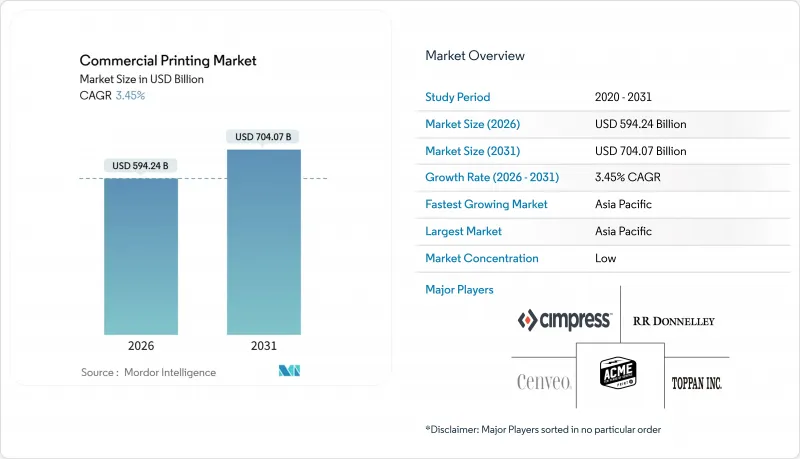
Mordor Intelligence에 의하면, 상업 인쇄 시장은 2026년에 5,942억 4,000만 달러에 이르고, 2031년까지 7,040억 7,000만 달러에 이를 것으로 예측되며, 예측 기간중은 CAGR 3.45%로 확대해 갈 전망입니다.
본 보고서는 인쇄 방식(오프셋 리소그래피, 디지털 잉크젯, 플렉소 인쇄 등), 용도(포장, 광고, 출판 등), 인쇄 소재(종이 및 골판지, 플라스틱·합성 기판, 천·섬유 등), 형식(대형 인쇄, 소형 인쇄 등) 및 지역별로 분류되어 있습니다. 시장 예측은 금액(달러) 기준으로 제시되어 있습니다.
세계 상업 인쇄 시장 동향 및 인사이트
주문형 포장 인쇄의 폭발적인 성장
현재 전자상거래 플랫폼에서는 몇 주가 아닌 며칠 내에 배송되는 소량 패키지 인쇄가 우선시되고 있으며, 이러한 동향은 판을 사용하는 오프셋 인쇄보다 고속 디지털 잉크젯 인쇄에 유리하게 작용하고 있습니다. 아마존의 ‘프러스트레이션 프리(Frustration-Free)’ 가이드라인과 각 지역 마켓플레이스의 유사한 요구 사항으로 인해, 특히 5,000개 미만의 로트에서 디지털 인쇄기의 단위당 비용이 저렴해지는 경제적 임계값이 낮아졌습니다. 싱글 패스 방식의 PageWide 라인에 투자한 각 컨버터 기업들은 수주에서 출하까지의 주기가 10일에서 48시간으로 단축되었다고 보고하고 있습니다. 이와 유사한 추세는 아시아태평양의 주문 처리 네트워크에서도 두드러지게 나타나며, 알리바바와 플립카트는 SKU별 아트워크를 현지 인쇄 거점으로 전송함으로써 운송 비용과 탄소 발자국을 줄이고 있습니다. 생산량이 세분화되는 가운데, 생산 분석에 따르면 준비 공정에서의 낭비가 최소화되었으며, 브랜드 측이 속도를 대가로 부담하는 박스당 프리미엄 가격 책정을 통해 매출 총이익률이 향상된 것으로 확인되었습니다.
개인화 마케팅에서 가변 데이터 인쇄의 도입 확대
직접 메일이나 카탈로그를 활용하는 마케팅 담당자들은 가변 데이터를 활용한 캠페인이 고정 디자인 자료에 비해 반응률의 측정 가능한 향상을 가져오기 때문에 인쇄 예산을 다시 늘리고 있습니다. 미국 우정공사(USPS)는 디지털 정보의 홍수에서 벗어나기 위해 예산을 인쇄 매체로 되돌린 금융 서비스 및 보험 회사들에 힘입어, 2025년에는 직접 메일 취급량이 안정화될 것이라고 밝혔습니다. varioPRINT iX나 컬러 잉크젯 웹 프레스를 도입한 인쇄 회사는 연간 수십억 장에 달하는 개인화된 인쇄물을 처리하고 있으며, 기존의 오프셋 인쇄에 필적하는 처리 능력을 발휘하면서도 판 비용을 절감하고 있습니다. 유럽의 GDPR(EU 개인정보보호규정)에서는 개인화된 접근 방식에 명시적인 동의가 필요하지만, 각 브랜드는 자사가 보유한 로열티 데이터와 물리적 경험 및 증강현실(AR) 경험을 융합한 QR 코드 지원 카탈로그를 활용하여 위험을 완화하고 있습니다. 이를 통해 인쇄물은 옴니채널 퍼널에서 어트리뷰션(효과 측정)이 풍부한 접점으로서의 위치를 확고히 하고 있습니다.
디지털 미디어 채널로의 지속적인 광고비 이동
2025년에는 프로그래매틱 동영상, 소셜 플랫폼, 커넥티드 TV의 광고 공간이 미국 광고비의 72%를 차지하여, 간행물 및 신문의 인쇄 수요 감소를 가속화했습니다. 출판사들은 수익 감소에 따라 웹 오프셋 인쇄 라인의 가동을 중단했으며, 유럽의 일부 잡지들은 종이 매체 발행을 완전히 중단했습니다. 직접 메일은 견조한 모습을 유지했으나, 인쇄 광고의 광범위한 축소로 인해 출판물을 전문으로 하는 상업 인쇄업자들에게 잠재 고객 기반은 전반적으로 축소되고 있습니다. 수익 감소를 만회하기 위해 많은 기업이 패키징 및 대형 그래픽 분야로 사업 다각화를 모색하고 있지만, 특히 시장 가격이 상품화되어 있는 분야에서는 기존의 고정비가 여전히 이익률을 압박하고 있습니다.
부문별 분석
2025년, 오프셋 리소그래피는 상업 인쇄 시장 점유율의 38.62%를 차지하고 있으며, 이러한 위상은 10,000 임프레션을 초과하는 인쇄량에서 발생하는 규모의 경제에 기인합니다. 그러나 디지털 잉크젯은 연평균 성장률(CAGR) 4.11%를 나타낼 것으로 예측되며, 고속화, 트림 손실 감소, 웹 투 프린트(Web-to-Print) 포털과의 긴밀한 연동을 통해 그 격차를 좁힐 것으로 보입니다. 예를 들어, 캐논의 ‘varioPRINT’를 도입하면 코팅지에서 오프셋 인쇄에 필적하는 품질을 실현하면서도 매 장마다 가변 데이터를 인쇄할 수 있으므로, 인쇄업자는 판 비용을 부담하지 않고도 개인화를 통한 수익 창출이 가능해집니다. 플렉소 인쇄는 수성 잉크와의 호환성으로 인해 플렉서블 패키지 분야에서 우위를 유지하고 있지만, 잉크젯 헤드와 플렉소 데크를 융합한 하이브리드 인쇄기에 의해 그 경계선은 점차 모호해지고 있습니다. 그라비아 인쇄는 실린더의 수명에 따라 수백만 미터 단위로 비용이 상각되는 초대량 생산 카탈로그나 장식용 라미네이트 분야에서 여전히 유효하지만, 정기 간행물의 감소에 따라 그 점유율은 축소될 전망입니다. 경쟁 측면에서의 전환점은 라벨 및 골판지 용도에서 가장 시급해 보입니다. 이러한 분야에서는 싱글패스 잉크젯 라인이 현재 분당 200미터의 인쇄 속도를 달성하고 있으며, 이러한 처리량은 총 소유 비용에 대한 가정을 완전히 바꾸어 놓아 조달 결정이 디지털 방식으로 기울어지게 하고 있습니다.
이와 동시에, 각 인쇄 서비스 제공업체들은 이미 투자한 부동산 자산을 보존하면서, 기판 및 마감 처리별로 주문을 일괄 처리하는 클라우드 기반 워크플로우 제품군을 활용하기 위해 기존 오프셋 인쇄 시설에 디지털화 개조를 진행하고 있습니다. 이 운영 모델에서는 파일 준비, 면배치, 색상 관리가 자동화된 규칙 기반 엔진에 의해 수행되므로 인력을 최소화하면서 가동 시간을 연장할 수 있습니다. 금융 관계자들은 잉크젯의 예측 가능한 페이지 단가와 모듈식 업그레이드 경로가 설비 투자 부담이 큰 오프셋 인쇄로의 전환보다 위험이 낮다고 보고 있으며, 이것이 상업 인쇄 시장 전체에서 도입의 추세를 뒷받침하고 있습니다.
2025년에는 패키징이 전 세계 매출의 45.74%를 차지하며, 연평균 성장률(CAGR) 4.54%를 기록하며 2031년까지 상업 인쇄 시장 규모 확대의 주요 원동력이 될 전망입니다. 전자상거래의 가속화, 위조 방지 규제, 그리고 매장 진열 요건으로 인해 소비재 브랜드들은 골판지, 접이식 상자 및 연포장재에 대한 예산 배분을 확대할 수밖에 없게 되었습니다. 한편, 출판 분야는 독자들이 디지털 화면으로 이동함에 따라 장기적인 감소 추세에 직면하고 있으며, 그 결과 기업 광고주들은 광고비 배분을 재검토하고 있습니다. 도서 인쇄는 주문형 인쇄의 경제성 덕분에 재고 위험 없이 롱테일 도서를 지속적으로 제공할 수 있어 여전히 두드러진 예외로 남아 있지만, 전자책과의 경쟁으로 인해 단가는 압박을 받고 있습니다. 명세서나 수표 등 기업용 거래 관련 인쇄는 여전히 종이 기록을 우선시하는 규제상의 의무 덕분에 혜택을 받고 있으며, 성숙 단계에 접어들었음에도 안정적인 수익원이 되고 있습니다. POS 디스플레이를 포함한 광고 및 판촉물은 여전히 고르지 않은 상황이지만, 체험형 소매용 프리미엄 대형 그래픽은 계속해서 높은 이익률을 유지하고 있습니다.
연포장 상업 인쇄 시장 점유율은 스낵, 반려동물사료, 퍼스널케어 제품 분야에서 스탠드업 파우치가 경질 용기를 대체함에 따라 광범위한 포장 카테고리 중에서 가장 빠르게 성장하고 있습니다. 이러한 필름 구조는 경량 운송과 360도 그래픽을 가능하게 하며, 그 결과 메탈릭 가공, 촉감 니스, 가변 코딩이 가능한 인쇄기가 요구되고 있습니다. 음료병의 ‘Direct-to-shape’ 프로젝트는 라벨 없는 브랜딩으로 가는 길을 제시하며, 디자인의 자유도가 재료 절감 요구와 어떻게 조화를 이루는지를 보여줍니다.
지역별 분석
아시아태평양은 2025년에 전 세계 매출의 38.73%를 차지하며, 소비자층 확대, 규제 기준 강화, 포장 라인의 니어쇼어링에 힘입어 2031년까지 연평균 성장률(CAGR) 4.55%로 성장할 것으로 전망됩니다. 중국은 ‘이중 순환’ 정책을 국내 인쇄 역량과 연계하여, Jinjia Group과 같은 주요 기업들이 수입 골판지를 대체할 고속 플렉소 인쇄 시스템을 도입하고 있습니다. 인도에서는 통합 상품·서비스세 도입과 식품 포장 표시 규제 강화로 인해, 다국어 레이아웃에 최적화된 디지털 잉크젯 라인에 대한 투자가 촉진되고 있습니다. 일본의 고도로 도시화된 인구는 Raksul의 클라우드 플랫폼의 혜택을 누리고 있습니다. 이 플랫폼은 당일 출력이 가능한 제휴 인쇄 업체에 작업을 배정하는 방식으로, 이 모델은 현재 서울과 타이베이에서도 채택되고 있습니다.
북미는 상업 인쇄 시장에서 성숙 단계에 접어들었음에도 견조한 점유율을 유지하고 있으며, 니어쇼어링 추세에 따라 골판지 및 접이식 상자 공장에 대한 투자가 가속화되고 있습니다. 웨스트록(Westlock)과 인터내셔널 페이퍼(International Paper)는 신속한 상자 보충을 요구하는 음료 제조업체 및 전자상거래 사업자에 대응하기 위해 조지아주와 텍사스주의 공장을 업그레이드했습니다. 이러한 전환으로 인해 신문 발행 부수가 감소하는 상황에서도 지역 인쇄량은 안정적으로 유지되고 있습니다. 유럽의 사업자들은 에너지 비용 급등과 엄격한 배출 규제를 헤쳐 나가면서도, 저VOC 잉크 세트와 녹색 에너지 인증서를 제공함으로써 지속가능성을 중시하는 소비재 제조업체(CPG)로부터 주문을 확보하고 있습니다. 독일에서 일어난 업계 재편의 물결로 인해 중규모 오프셋 인쇄 회사의 생산 능력이 축소되었으며, 그 인쇄 물량은 파일 처리를 일원화하고 생산을 제휴 거점으로 외주하는 Onlineprinters와 같은 디지털 인쇄 중개업체로 집약되고 있습니다.
남미, 중동 및 아프리카 및 일부 동남아시아 시장에서는 거시경제의 안정성, 환율 변동, 인프라의 견고성과 관련하여 시장 동향에 편차가 나타나고 있습니다. 아랍에미리트(UAE)는 국내 연포장 생산을 육성함으로써 식량 안보 노력을 추진하고 있으며, 그 일례로 Hotpack Global사가 할랄 식품 수출업체를 대상으로 광색역 플렉소 인쇄기를 가동하는 신규 라인을 도입한 것을 들 수 있습니다. 브라질에서는 잉크 수입 가격을 상승시키는 환율 압력이 과제로 대두되고 있지만, FMCG(일용소비재) 제조업체들이 합리적인 가격을 유지하기 위해 패키지 크기를 소형화하고 있어 플렉서블 파우치에 대한 수요는 여전히 지속되고 있습니다. 남아프리카에서는 전력망의 불안정성으로 어려움을 겪고 있으며, 이에 따라 각 컨버터 업체들은 가동 시간을 확보하고 탄소 배출량 공시를 줄이기 위해 옥상 태양광 발전 시스템에 대한 투자를 추진하고 있습니다.
전반적으로 지역별 차이로 인해 성장 추세는 제각각이며, 아시아태평양은 절대값 기준으로 상업 인쇄 시장 규모가 가장 크게 확대된 반면, 북미 및 유럽에서는 매출 구성이 포장 및 산업용 장식 분야로 전환되고 있습니다.
기타 혜택:
- 엑셀 형식 시장 예측(ME) 시트
- 3개월간의 애널리스트 지원
자주 묻는 질문
목차
제1장 서론
제2장 조사 방법
제3장 주요 요약
제4장 시장 구도
제5장 시장 규모와 성장 예측
제6장 경쟁 구도
제7장 시장 기회와 향후 전망
JHS 26.09.07According to Mordor Intelligence, the commercial printing market reached USD 594.24 billion in 2026 and is projected to attain USD 704.07 billion by 2031, advancing at a 3.45% CAGR during the forecast period.
This report is Segmented by Printing Type (Offset Lithography, Digital Inkjet, Flexographic, and More), Application (Packaging, Advertising, Publishing, and More), Print Material (Paper and Cardboard, Plastic and Synthetic Substrates, Fabric and Textiles, and More), Format (Large-Format Printing, Small-Format Printing, and More), and Geography. The Market Forecasts are Provided in Terms of Value (USD).
Global Commercial Printing Market Trends and Insights
Explosive Growth in On-Demand Packaging Print Runs
E-commerce platforms now prioritize shorter packaging runs that turn around in days rather than weeks, a dynamic favoring high-speed digital inkjet over plate-based offset. Amazon's frustration-free guidelines and similar mandates from regional marketplaces lowered the economic threshold at which digital presses become cheaper per unit, especially for batches under 5,000 units. Converters that invested in single-pass PageWide lines reported order-to-ship cycles shrinking from ten days to forty-eight hours. The same trend is evident in Asia-Pacific fulfillment networks, where Alibaba and Flipkart route SKU-specific artwork to localized print hubs to trim freight and carbon footprints. As volumes fragment, production analytics confirm higher gross margins due to minimized makeready waste and premium per-box pricing that brands absorb in exchange for speed.
Rising Adoption of Variable-Data Printing for Personalised Marketing
Direct-mail and catalog marketers are reviving print budgets because variable-data campaigns generate measurable lift in response rates versus static pieces. The United States Postal Service cited a stabilization of direct-mail volumes in 2025, driven by financial-services and insurance firms that shifted budgets back to print to escape digital clutter. Printers installing varioPRINT iX and color-inkjet web presses process billions of individualized impressions annually, demonstrating throughput that rivals conventional offset while eliminating plate costs. Although Europe's GDPR requires explicit consent for personalized outreach, brands mitigate the risk by leveraging first-party loyalty data and QR-enabled catalogs that merge physical and augmented-reality experiences, thereby positioning print as an attribution-rich touchpoint in omnichannel funnels.
Ongoing Shift of Advertising Spend to Digital Media Channels
Programmatic video, social platforms, and connected-TV inventory captured 72% of United States ad spend in 2025, accelerating the contraction of publication and newspaper print demand. Publishers idled web-offset lines as revenues fell, and several European magazine titles ceased print editions entirely. Although direct mail proved resilient, the broader erosion of print advertising shrinks the overall addressable base for commercial printers that specialize in publication work. To offset revenue losses, many have diversified into packaging and large-format graphics, but legacy fixed costs still weigh on margins, especially where market pricing remains commoditized.
Other drivers and restraints analyzed in the detailed report include:
- Sustained Demand for Promotional Print from Retail and CPG Brands
- Transition Toward Eco-Friendly Substrates and Vegetable-Based Inks
- Volatile Prices of Paper, Ink and Energy Inputs
For complete list of drivers and restraints, kindly check the Table Of Contents.
Segment Analysis
Offset lithography commanded 38.62% of commercial printing market share in 2025, a position rooted in scale economies at volumes above 10,000 impressions. Digital inkjet, however, is forecast to grow at a 4.11% CAGR, shrinking the differential through higher speed, lower makeready waste, and tight integration with web-to-print portals. Canon varioPRINT installations, for instance, achieve offset-comparable quality on coated stocks while delivering variable data on every sheet, enabling printers to monetize personalization without incurring plate charges. Flexographic printing maintains an edge in flexible packaging due to its compatibility with water-based inks, but hybrid presses that merge inkjet heads with flexo decks are blurring boundaries. Gravure remains viable for ultra-high-volume catalog work and decorative laminates where cylinder life amortizes costs across millions of meters, yet its share will likely erode as subscription publications decline. The competitive inflection point appears most imminent in label and corrugated applications where single-pass inkjet lines now print 200 meters per minute, a throughput that reshapes total cost of ownership assumptions and tilts procurement in favor of digital.
In parallel, print service providers are retrofitting legacy offset sites with digital retrofits to preserve sunk real estate investments while leveraging cloud-based workflow suites that batch orders by substrate and finish. This operational model allows lean staffing and extended uptime because file prep, imposition, and color management ride on automated rules-based engines. Financiers view inkjet's predictable cost per page and modular upgrade path as lower risk than capex-heavy offset replacements, reinforcing adoption momentum across the commercial printing market.
Packaging represented 45.74% of global revenue in 2025, and its 4.54% CAGR positions it as the principal driver of the commercial printing market size through 2031. E-commerce acceleration, anti-counterfeiting mandates, and shelf-ready display requirements compel consumer-goods brands to allocate larger budgets to corrugated, folding carton, and flexible formats. Meanwhile, publishing segments confront secular declines as readers migrate to screens, causing corporate advertisers to redirect spend. Book printing has remained a notable exception because print-on-demand economics allow perpetual availability of long-tail titles without inventory risk, yet unit prices are under pressure from e-book competition. Corporate transactional print, such as statements and checks, benefits from regulatory obligations that still favor paper trails, providing a stable albeit mature revenue stream. Advertising collateral, including point-of-sale displays, remains uneven, but premium large-format graphics for experiential retail continue to command high margins.
The commercial printing market share for flexible packaging is rising fastest within the broader packaging category as stand-up pouches replace rigid containers in snacks, pet food, and personal-care products. These film structures facilitate lightweight shipping and 360-degree graphics, which in turn demand presses capable of metallics, tactile varnish, and variable coding. Direct-to-shape beverage bottle projects illustrate the path toward label-free branding, demonstrating how design freedom dovetails with material reduction mandates.
Complete Report Scope:
- By Printing Type
- Offset Lithography
- Digital Inkjet
- Flexographic
- Screen
- Gravure
- Other Printing Types
- By Application
- Packaging
- Advertising
- Publishing
- Books
- Magazines
- Newspapers
- Other Publishing
- Corporate and Transactional Printing
- Other Applications
- By Print Material
- Paper and Cardboard
- Plastic and Synthetic Substrates
- Fabric and Textiles
- Metal and Foils
- Other Print Materials
- By Format
- Large-Format Printing
- Small-Format Printing
- Direct-to-Object Printing
- By Geography
- North America
- United States
- Canada
- Mexico
- South America
- Brazil
- Argentina
- Rest of South America
- Europe
- Germany
- United Kingdom
- France
- Italy
- Spain
- Rest of Europe
- Asia-Pacific
- China
- Japan
- India
- South Korea
- ASEAN
- Rest of Asia-Pacific
- Middle East and Africa
- Middle East
- Saudi Arabia
- United Arab Emirates
- Rest of Middle East
- Africa
- South Africa
- Nigeria
- Rest of Africa
- Middle East
- North America
Geography Analysis
Asia-Pacific controlled 38.73% of global sales in 2025 and is forecast to rise at a 4.55% CAGR through 2031, bolstered by consumer-class expansion, rising regulatory standards, and near-shoring of packaging lines. China aligns its dual-circulation policy with domestic print capacity, leading enterprises such as Jinjia Group to deploy high-speed flexographic systems that replace imported cartons. India's implementation of unified goods and service taxes and tighter food-package labeling drives investments in digital inkjet lines optimized for multi-language layouts. Japan's highly urban population benefits from Raksul's cloud platform that dispatches jobs to partner presses capable of same-day output, a model now emulated in Seoul and Taipei.
North America claims a mature yet resilient share of the commercial printing market with nearshoring trends accelerating investment in corrugated and folding carton plants. WestRock and International Paper upgraded mills in Georgia and Texas to support beverage and e-commerce shippers seeking rapid box replenishment, a pivot that stabilizes regional print volumes even as newspaper circulation declines. European operators navigate higher energy costs and stringent emission rules but win contracts from sustainability-driven CPGs by offering low-VOC ink sets and green energy certificates. Germany's consolidation wave trimmed capacity among mid-sized offset houses, funneling volume to digital forwarding entities like Onlineprinters that centralize file handling and outsource production to affiliated sites.
South America, the Middle East and Africa, and select Southeast Asian markets display heterogeneous momentum linked to macroeconomic stability, currency fluctuations, and infrastructure robustness. The United Arab Emirates advanced food-security initiatives by nurturing domestic flexible-packaging output, exemplified by Hotpack Global's new lines that run extended-color-gamut flexo units for halal food exporters. Brazil grapples with currency pressures that inflate imported ink prices, yet demand persists for flexible pouches as FMCG producers downsize pack sizes to preserve affordability. South Africa wrestled with grid instability, driving converters to invest in rooftop solar arrays that guarantee uptime and reduce carbon disclosures.
Overall, regional divergence creates a patchwork of growth vectors, with Asia-Pacific commanding the largest commercial printing market size increase in absolute terms, while North America and Europe transition revenue mixes toward packaging and industrial decoration.
- Dai Nippon Printing Co., Ltd.
- Toppan Inc.
- R.R. Donnelley and Sons Company
- Quad/Graphics Inc.
- TC Transcontinental Inc.
- Cenveo Worldwide Limited
- Cimpress plc
- Deluxe Corporation
- Shutterfly LLC
- LSC Communications LLC
- Mondi plc
- Printpack Inc.
- Multi-Color Corporation
- ACME Printing Company, Inc.
- O'Neil Printing Inc.
- Xerox Holdings Corporation (Print Services)
- WestRock Company (Print and Packaging)
- Berry Global Group, Inc. (Graphics Services)
- Seiko Epson Corporation (Commercial Inkjet Systems)
- HP Inc. (PageWide Industrial)
- Taylor Corporation
- Vistaprint B.V.
- Blurb, Inc.
- AlphaGraphics, Inc.
- Raksul Inc.
Additional Benefits:
- The market estimate (ME) sheet in Excel format
- 3 months of analyst support
TABLE OF CONTENTS
1 INTRODUCTION
- 1.1 Study Assumptions and Market Definition
- 1.2 Scope of the Study
2 RESEARCH METHODOLOGY
3 EXECUTIVE SUMMARY
4 MARKET LANDSCAPE
- 4.1 Market Overview
- 4.2 Market Drivers
- 4.2.1 Explosive growth in on-demand packaging print runs
- 4.2.2 Rising adoption of variable-data printing for personalised marketing
- 4.2.3 Sustained demand for promotional print from retail and CPG brands
- 4.2.4 Transition toward eco-friendly substrates and vegetable-based inks
- 4.2.5 Integration of printed electronics (RFID, NFC) into packaging and labels
- 4.2.6 Emergence of micro-factory "print-as-a-service" hubs close to customers
- 4.3 Market Restraints
- 4.3.1 Ongoing shift of advertising spend to digital media channels
- 4.3.2 Volatile prices of paper, ink and energy inputs
- 4.3.3 Stringent VOC and chemical-use regulations on conventional inks
- 4.3.4 Shortage of semiconductor components for new digital presses
- 4.4 Industry Value Chain Analysis
- 4.5 Regulatory Landscape
- 4.6 Technological Outlook
- 4.7 Porter's Five Forces Analysis
- 4.7.1 Bargaining Power of Suppliers
- 4.7.2 Bargaining Power of Buyers
- 4.7.3 Threat of New Entrants
- 4.7.4 Threat of Substitutes
- 4.7.5 Intensity of Competitive Rivalry
5 MARKET SIZE AND GROWTH FORECASTS (VALUE)
- 5.1 By Printing Type
- 5.1.1 Offset Lithography
- 5.1.2 Digital Inkjet
- 5.1.3 Flexographic
- 5.1.4 Screen
- 5.1.5 Gravure
- 5.1.6 Other Printing Types
- 5.2 By Application
- 5.2.1 Packaging
- 5.2.2 Advertising
- 5.2.3 Publishing
- 5.2.3.1 Books
- 5.2.3.2 Magazines
- 5.2.3.3 Newspapers
- 5.2.3.4 Other Publishing
- 5.2.4 Corporate and Transactional Printing
- 5.2.5 Other Applications
- 5.3 By Print Material
- 5.3.1 Paper and Cardboard
- 5.3.2 Plastic and Synthetic Substrates
- 5.3.3 Fabric and Textiles
- 5.3.4 Metal and Foils
- 5.3.5 Other Print Materials
- 5.4 By Format
- 5.4.1 Large-Format Printing
- 5.4.2 Small-Format Printing
- 5.4.3 Direct-to-Object Printing
- 5.5 By Geography
- 5.5.1 North America
- 5.5.1.1 United States
- 5.5.1.2 Canada
- 5.5.1.3 Mexico
- 5.5.2 South America
- 5.5.2.1 Brazil
- 5.5.2.2 Argentina
- 5.5.2.3 Rest of South America
- 5.5.3 Europe
- 5.5.3.1 Germany
- 5.5.3.2 United Kingdom
- 5.5.3.3 France
- 5.5.3.4 Italy
- 5.5.3.5 Spain
- 5.5.3.6 Rest of Europe
- 5.5.4 Asia-Pacific
- 5.5.4.1 China
- 5.5.4.2 Japan
- 5.5.4.3 India
- 5.5.4.4 South Korea
- 5.5.4.5 ASEAN
- 5.5.4.6 Rest of Asia-Pacific
- 5.5.5 Middle East and Africa
- 5.5.5.1 Middle East
- 5.5.5.1.1 Saudi Arabia
- 5.5.5.1.2 United Arab Emirates
- 5.5.5.1.3 Rest of Middle East
- 5.5.5.2 Africa
- 5.5.5.2.1 South Africa
- 5.5.5.2.2 Nigeria
- 5.5.5.2.3 Rest of Africa
- 5.5.5.1 Middle East
- 5.5.1 North America
6 COMPETITIVE LANDSCAPE
- 6.1 Market Concentration
- 6.2 Strategic Moves
- 6.3 Market Share Analysis
- 6.4 Company Profiles (includes Global level Overview, Market level overview, Core Segments, Financials as available, Strategic Information, Market Rank/Share for key companies, Products and Services, and Recent Developments)
- 6.4.1 Dai Nippon Printing Co., Ltd.
- 6.4.2 Toppan Inc.
- 6.4.3 R.R. Donnelley and Sons Company
- 6.4.4 Quad/Graphics Inc.
- 6.4.5 TC Transcontinental Inc.
- 6.4.6 Cenveo Worldwide Limited
- 6.4.7 Cimpress plc
- 6.4.8 Deluxe Corporation
- 6.4.9 Shutterfly LLC
- 6.4.10 LSC Communications LLC
- 6.4.11 Mondi plc
- 6.4.12 Printpack Inc.
- 6.4.13 Multi-Color Corporation
- 6.4.14 ACME Printing Company, Inc.
- 6.4.15 O'Neil Printing Inc.
- 6.4.16 Xerox Holdings Corporation (Print Services)
- 6.4.17 WestRock Company (Print and Packaging)
- 6.4.18 Berry Global Group, Inc. (Graphics Services)
- 6.4.19 Seiko Epson Corporation (Commercial Inkjet Systems)
- 6.4.20 HP Inc. (PageWide Industrial)
- 6.4.21 Taylor Corporation
- 6.4.22 Vistaprint B.V.
- 6.4.23 Blurb, Inc.
- 6.4.24 AlphaGraphics, Inc.
- 6.4.25 Raksul Inc.
7 MARKET OPPORTUNITIES AND FUTURE OUTLOOK
- 7.1 White-space and Unmet-need Assessment


