

|
시장보고서
상품코드
2123470
항균제 감수성 시험 시장 : 점유율 분석, 업계 동향과 통계, 성장 예측(2026-2031년)Antimicrobial Susceptibility Testing - Market Share Analysis, Industry Trends & Statistics, Growth Forecasts (2026 - 2031) |
||||||
 Mordor Intelligence
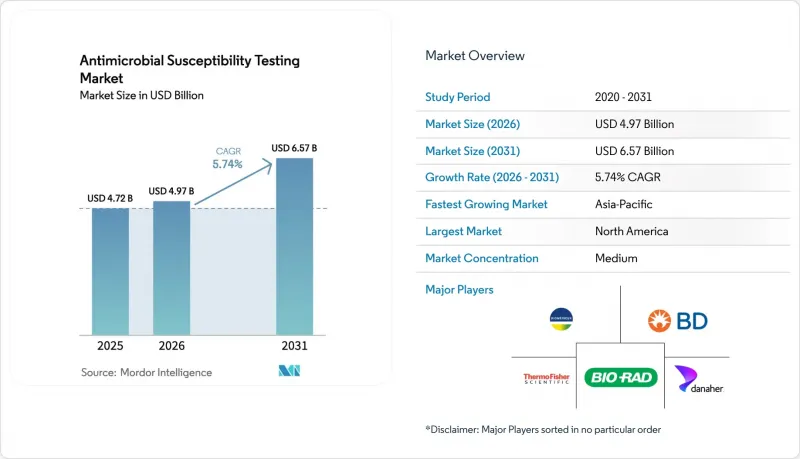
Mordor Intelligence에 의하면, 항균제 감수성 시험 시장 규모는 2025년 47억 2,000만 달러, 2026년 49억 7,000만 달러에서 2031년까지 65억 7,000만 달러로 확대된다고 예측되고 있어 2026년부터 2031년까지 연평균 복합 성장률(CAGR)은 5.74%를 나타낼 전망입니다.
본 보고서는 제품별(수동 AST 등), 검사 유형별(항균, 항진균 등), 용도별(임상 진단 등), 최종 사용자별(병원 검사실, 기준 검사실 등), 지역별(북미, 유럽, 아시아태평양, 중동 및 아프리카, 남미)로 분류되어 있습니다. 시장 전망은 금액(달러) 기준으로 제시되어 있습니다.
세계 항균제 감수성 검사 시장 동향 및 인사이트
전 세계적으로 심각해지는 항균제 내성의 부담
2024년 ‘세계 질병 부담(GBD)’조사에 따르면, 2021년에 AMR(항균제 내성)로 인한 직접적인 사망자 수가 114만 명에 달할 것으로 추정되며, 현재의 추세가 지속될 경우 2050년까지 누적 사망자 수가 3,900만 명에 이를 가능성이 있다고 경고하고 있습니다. WHO의 2025년판 GLASS 보고서에는 104개국에서 수집된 감수성 데이터가 기록되었습니다(2023년의 87개국에서 증가). 또한 2030년까지 회원국의 80%가 국내 진단 역량을 구축하는 것을 목표로 제시했습니다. 인도에서는 중환자실에서 뉴델리형 메탈로-β-락타마제(NDMBLA)의 유병률이 30% 이상의 것으로 보고되어, 카르바페넴계 항균제를 절약하기 위한 신속한 지침 마련을 요구하는 목소리가 높아지고 있습니다. 유럽의 EARS-Net은 2024년에 47만 4,364건의 침습성 분리주를 처리했으며, 최후의 수단이 되는 약제에 대한 내성을 추적하기 위해 세피데로콜 검사 패널의 시범 운영을 실시했습니다. 그러나 저소득 국가의 검사실 중 표준화된 항균제 감수성 검사(AST)를 실시할 수 있는 곳은 40% 미만에 그치고 있어, 합리적인 가격에 복잡성이 낮은 검사 플랫폼에 대한 수요가 여전히 남아 있습니다.
제약·바이오기술 분야의 AST 파이프라인 통합
Spero Therapeutics는 실시간 감수성 데이터를 활용하여 용량을 최적화하고, 심사 기간을 단축한 3상 임상시험을 거쳐 2024년 9월 테비페넴 HBr에 대한 FDA 승인을 획득했습니다. 글락소스미스클라인(GlaxoSmithKline)의 게포티다신 개발 프로그램에서는 고처리량 AST를 활용하여 내성 발생 상황을 파악하고, 2024년 CLSI에 브레이크포인트 제안을 지원했습니다. 같은 해 발간된 FDA 지침에서는 항균제와 동반 AST 분석법의 동시 제출을 권장하고 있으며, 이를 통해 시장 출시 시기를 맞출 수 있게 되었습니다. 계약 연구 기관(CRO)의 보고에 따르면, 투자자들이 2상 임상시험 자금 조달 라운드에 앞서 약력학적 증거를 요구함에 따라 2023년부터 2025년까지 생명공학 기업들의 AST 서비스 의뢰가 40% 증가했습니다.
초기 장비 도입 비용의 높음과 상환 경로의 제한성
자동 AST 시스템의 가격은 10만 달러를 초과하는 경우가 많으며, 소모품은 검사 1회당 15-30달러가 듭니다. 그러나 미국 메디케어에서는 신속 표현형 AST에 대한 환급액이 고작 18-22달러에 그치고 있어, 병원들은 이러한 손실을 감수할 수밖에 없는 상황입니다. 2025년 중반 시점에서 민간 보험사가 청구 금액의 50% 미만을 보장하고 있어, 학술 기관 이외의 도입이 제한되고 있습니다. 인도의 ‘아트마니르바르 바라트(Atmanirbhar Bharat)’ 프로그램은 12개 참조 검사실에 3,650만 달러를 지원했으나, 이는 추정 10만 곳의 검사실 중 불과 0.1%에 불과하기 때문에대부분의 시설에서는 여전히 18-24시간이 소요되는 디스크 확산법에 의존하고 있습니다. 2024년 사하라 이남 아프리카 전역에서 실시된 조사에 따르면, 장비가 기증된 경우에도 검사실의 60%가 자동 항균제 감수성 검사(AST) 교육을 받은 인력을 갖추지 못한 것으로 나타났습니다. 리스나 시약 대여 계약은 설비 투자(CAPEX) 부담을 줄여주지만, 비용을 운영 예산으로 전가하게 되어 벤더 종속 현상을 초래하고 있습니다.
부문 분석
이 부문은 2025년에 가장 큰 점유율을 차지했는데, 이는 자본 요건이 낮기 때문에 수동 절차가 여전히 항균제 감수성 검사 시장 매출의 51.25%를 차지했기 때문입니다. 그러나 검사 기관들이 신속한 검사 완료 시간과 데이터 통합을 요구함에 따라, 자동화 시스템은 연평균 성장률(CAGR) 7.54%로 확대될 것으로 예측됩니다. 2024년에 승인된 bioMerieux사의 ‘VITEK COMPACT PRO’는 CLSI AUTO15를 준수하는 자동 검증 기능을 기본으로 탑재하여 수기 전사로 인한 오류를 줄이고 있습니다. 소모품은 안정적인 수익원으로 자리 잡고 있으며, 검사실에서는 검사 1회당 패널, 배지, 대조군에 15-30달러를 지출하고 있습니다. Becton Dickinson사의 ‘EpiCenter’ 소프트웨어는 여러 병원에 걸친 검사 결과를 집계하여, 하드웨어의 한계를 넘어선 가치를 제공하는 적정 약물 사용 대시보드를 구현하고 있습니다.
자금 면의 제약이나 규제 지연으로 인해 수작업 운영이 장기화되고 있습니다. 특히 국가 지침에서 자동화를 의무화하지 않은 저소득 국가에서는 이러한 경향이 두드러집니다. 인력 부족으로 인해 인식도 변화하고 있습니다. 2024년 아프리카 전역에서 실시된 조사에 따르면, 검사실 책임자의 60%가 자동화를 ‘사치품’이 아닌 ‘인력 효율화 도구’로 인식하고 있는 것으로 나타났습니다. 각 벤더사는 동정 검사와 감수성 검사를 세트로 판매하는 움직임도 확대되고 있습니다. 브루커(Bruker)사는 MALDI-TOF 질량 분석법을 활용하여 카르바페네마제 생성을 검출할 수 있도록 했으며, 이를 통해 검사실은 두 검사를 세트로 구매하는 것을 정당화할 수 있게 되었습니다. 처리 속도 향상과 수작업 시간 단축이라는 이중의 이점으로 인해 도입이 가속화될 것으로 예상되지만, 성공의 열쇠는 초기 비용 부담을 경감시키는 자금 조달 모델에 달려 있습니다.
항균제 패널은 2025년 매출의 42.43%를 차지하며, 임상 현장에서의 그 중요성을 여실히 보여주고 있습니다. 그럼에도 불구하고, 항기생충 검사는 연평균 성장률(CAGR) 7.66%로 가장 빠르게 성장하는 하위 부문입니다. 이는 6개 아프리카 국가에서 아르테미시닌에 대한 부분적 내성이 확인되었다는 WHO의 보고서에 힘입은 것으로, 이로 인해 켈치 13(kelch13) 돌연변이의 표현형 확인이 요구되고 있습니다. 칸디다 오리스(Candida auris)의 집단 감염으로 인해 항진균 검사의 시급성이 높아지고 있습니다. CDC의 집계에 따르면, 2024년 미국의 임상 사례 수는 3,270건에 달하며, 이는 서모피셔(Thermo Fisher)사의 ‘Sensititre YeastOne’ 시스템이 병원에 도입되는 데 박차를 가하고 있습니다. 자동화된 항진균 패널은 여전히 보급률이 낮아, 공급업체들에게 미개척 시장으로 남아 있습니다. 항바이러스제 감수성 검사(AST)는 여전히 틈새 분야에 머물러 있으며, 주로 HIV 및 인플루엔자 감시에만 국한되어 있습니다.
마이코박테리아 검사는 WHO의 ‘세계 실험실 이니셔티브(Global Laboratory Initiative)’를 통해 독자적인 규제 체계 하에서 운영되고 있으며, MGIT 액체 배양에 의존하기 때문에 많은 지역 검사실에는 종종 부족한 생물안전 인프라가 필요합니다. 또한, 이 시장에서는 말라리아 및 기타 기생충을 대상으로 한 분자진단과 표현형 진단을 통합한 플랫폼이 부족하여, BARDA 및 웰컴 트러스트(Wellcome Trust)의 자금 지원을 받는 개발 기회가 열려 있습니다. 이러한 동향은 종합적으로, 성숙한 항균제 관련 제품으로부터의 수익원 다각화를 가져오고 있습니다.
지역별 분석
북미는 2025년 매출의 42.95%를 차지하고 있으며, 이는 CDC의 검사 의뢰 및 결과 디지털화 노력과 신속한 표현형 항균제 감수성 검사(AST)를 인정하는 CPT 코드가 원동력이 되고 있습니다. 그러나 검사 1회당 평균 20달러의 환급액은 전체 비용을 회수하기에는 부족하여, 도입은 3차 의료 기관으로 제한되고 있습니다. 캐나다에서는 외딴 지역을 지원하기 위해 주립 중앙 검사실 도입이 시범적으로 진행되고 있으나, 환급 규정 차이로 인해 전국적인 확대는 지연되고 있습니다. BARDA가 2024년에 Selux Diagnostics사에 지급한 보조금은 4시간 이내의 패혈증 검사에 대한 미국 연방 정부의 이니셔티브을 뒷받침하는 것입니다.
유럽에서는 EUCAST가 매년 갱신하는 컷오프 값(버전 15.0에서는 2025년에 8개의 병원체·약제 쌍이 추가되었습니다)과 474,364개의 분리주를 포괄하는 EARS-Net 감시 시스템이 활용되고 있습니다. EMA 규정에 따라 최우선 항균제를 처방하기 전에 수의학적 항균제 감수성 검사(AST) 실시가 의무화됨에 따라 고객 기반이 확대되고 있습니다. 그럼에도 불구하고, 보험 급여 격차는 여전히 존재합니다. 독일에서는 DRG 제도에 따라 신속 AST에 대한 보험 급여가 이루어지고 있지만, 남유럽 국가들에는 전용 코드가 없습니다. DARWIN EU의 실세계 데이터는 시판 후 조사를 지원하고 있지만, 지불 모델의 조화는 아직 이루어지지 않았습니다.
아시아태평양은 가장 빠르게 성장하고 있으며, 2031년까지 연평균 성장률(CAGR) 6.43%를 나타낼 것으로 예측됩니다. 인도 정부는 12곳의 첨단 미생물학 센터에 3,650만 달러를 배정했으며, 중국은 AST를 성(省) 수준의 항균제 내성(AMR) 감시 체계에 통합했습니다. 일본에서는 국민건강보험 제도에 따라 도입이 촉진되고 있으나, 병원 통합으로 인해 검사 건수가 중앙 검사실로 이동하고 있습니다. 한국은 2024년에 단계적 환급 제도를 도입하여 신속 항균제 감수성 검사(AST)에 더 높은 금액을 지급함으로써, 경제적 인센티브를 항균제 적정 사용 목표와 연계하고 있습니다. 그러나 지방 검사실에서는 여전히 인력 부족에 직면해 있으며, 이는 개발도상 지역에서 나타나는 문제와 공통점을 가지고 있습니다. 일부 신흥 시장의 국가 차원 AMR 대책 계획은 규모는 작지만 주목할 만한 성장 분야를 창출하고 있습니다.
기타 혜택:
- 엑셀 형식 시장 예측(ME) 시트
- 3개월간의 애널리스트 지원
자주 묻는 질문
목차
제1장 서론
제2장 조사 방법
제3장 주요 요약
제4장 시장 구도
제5장 시장 규모와 성장 예측
제6장 경쟁 구도
제7장 시장 기회와 향후 전망
JHS 26.09.09According to Mordor Intelligence, the antimicrobial susceptibility testing market size is projected to expand from USD 4.72 billion in 2025 and USD 4.97 billion in 2026 to USD 6.57 billion by 2031, registering a CAGR of 5.74% between 2026 to 2031.
This report is Segmented by Product (Manual AST, and More), Testing Type (Antibacterial, Antifungal, and More), Application (Clinical Diagnostics, and More), End User (Hospital Laboratories, Reference Laboratories, and More), and Geography (North America, Europe, Asia-Pacific, Middle East and Africa, and South America). The Market Forecasts are Provided in Terms of Value (USD).
Global Antimicrobial Susceptibility Testing Market Trends and Insights
Escalating Global Antimicrobial Resistance Burden
The 2024 Global Burden of Disease study attributed 1.14 million direct deaths to AMR in 2021 and warned that cumulative mortality could hit 39 million by 2050 if current trends persist. WHO's 2025 GLASS report logged susceptibility data from 104 countries, up from 87 in 2023, and set a 2030 goal for 80% of members to achieve national diagnostic capacity. In India, intensive-care units reported New Delhi metallo-B-lactamase prevalence above 30%, driving calls for rapid carbapenem-sparing guidance. Europe's EARS-Net processed 474,364 invasive isolates in 2024 and piloted cefiderocol panels to track resistance to last-resort agents. Yet fewer than 40% of labs in low-income countries can run standardized antimicrobial susceptibility testing (AST), leaving a gap for affordable, low-complexity platforms.
Pharmaceutical and Biotechnology Pipeline Integration of AST
Spero Therapeutics secured FDA approval in September 2024 for tebipenem HBr after Phase 3 trials that used real-time susceptibility data to refine dosing, trimming review timelines. GlaxoSmithKline's gepotidacin program employed high-throughput AST to map resistance emergence and support 2024 breakpoint proposals to CLSI. FDA guidance issued that same year encourages co-submission of antimicrobials and companion AST assays, enabling synchronized market entry. Contract research organizations reported a 40% increase in AST service requests from biotech clients between 2023 and 2025, as investors demanded pharmacodynamic evidence ahead of Phase 2 funding rounds.
High Upfront Instrumentation Costs and Limited Reimbursement Pathways
Automated AST systems often cost more than USD 100,000, while consumables run USD 15-30 per test; yet, U.S. Medicare reimburses rapid phenotypic AST at only USD 18-22, forcing hospitals to absorb these losses. As of mid-2025, private insurers covered fewer than 50% of claims, limiting uptake outside academic centers. India's Atmanirbhar Bharat program funded USD 36.5 million for 12 reference labs-barely 0.1% of its estimated 100,000 labs-so most facilities still rely on 18- to 24-hour disk diffusion. A 2024 survey across Sub-Saharan Africa showed 60% of labs lack staff trained in automated AST, even when instruments are donated. Leasing and reagent-rental contracts ease capital expenditures (CAPEX) but shift costs to operational budgets, creating vendor lock-in.
Other drivers and restraints analyzed in the detailed report include:
- Precision Medicine Movement Toward Targeted Antimicrobial Therapy
- Adoption of Rapid Phenotypic AST Platforms for Point-of-Care Decision Making
- Fragmented Global Regulatory and Breakpoint Harmonization Challenges
For complete list of drivers and restraints, kindly check the Table Of Contents.
Segment Analysis
The segment generated the largest share in 2025, when manual procedures still accounted for 51.25% of the antimicrobial susceptibility testing market revenue, due to their low capital requirements. However, automated systems are forecast to advance at a 7.54% CAGR as laboratories chase faster turnaround times and data integration. bioMerieux's VITEK COMPACT PRO, cleared in 2024, now ships with CLSI AUTO15-compliant autoverification, trimming errors tied to manual transcription. Consumables create sticky revenue; labs spend USD 15-30 per run on panels, media, and controls. Becton Dickinson's EpiCenter software aggregates outputs across multiple hospitals, delivering stewardship dashboards that extend value beyond the hardware.
Capital constraints and regulatory inertia prolong manual usage, especially in low-income settings where national guidelines do not compel automation. Workforce shortages are shifting opinions: a 2024 cross-Africa survey found that 60% of lab directors viewed automation as a labor multiplier rather than a luxury. Vendors are also bundling identification and susceptibility; Bruker is adapting MALDI-TOF mass spectrometry to flag carbapenemase production, allowing laboratories to justify combined purchases. The dual benefit of speed and reduced hands-on time is expected to accelerate adoption, but success hinges on financing models that ease upfront cost burdens.
Antibacterial panels accounted for 42.43% of 2025 revenue, underscoring their centrality to clinical practice. Nonetheless, antiparasitic assays are the fastest-growing sub-segment, with a 7.66% CAGR, driven by WHO reports of partial artemisinin resistance in six African nations, which demand phenotypic confirmation of kelch13 mutations. Antifungal testing is gaining urgency after Candida auris outbreaks; the CDC counted 3,270 clinical U.S. cases in 2024, fueling hospital adoption of Thermo Fisher's Sensititre YeastOne system. Automated antifungal panels remain under-penetrated, presenting a white space for vendors. Antiviral AST remains niche, primarily limited to HIV and influenza surveillance.
Mycobacterial testing operates in a separate regulatory lane through the WHO's Global Laboratory Initiative, relying on MGIT liquid culture and requiring biosafety infrastructure that is often absent in many local labs. The market also lacks integrated molecular-plus-phenotypic platforms for malaria and other parasites, opening development opportunities funded by BARDA and the Wellcome Trust. Collectively, these trends diversify revenue streams away from mature antibacterial offerings.
Complete Report Scope:
- By Product
- Manual AST
- MIC Strips
- Susceptibility Plates
- Disk Diffusion Kits
- Others
- Automated AST Instruments
- Semi-Automated Systems
- Fully Automated Systems
- Consumables and Reagents
- Software and Services
- Manual AST
- By Testing Type
- Antibacterial
- Antifungal
- Antiparasitic
- Antiviral AST
- Others
- By Application
- Clinical Diagnostics
- Drug Discovery and Development
- Epidemiology and Surveillance
- Veterinary Applications
- Environmental Monitoring
- By End User
- Hospital Laboratories
- Reference Laboratories
- Pharmaceutical & Biotechnology Companies
- Academic and Research Institutes
- Contract Research Organizations (CROs)
- Geography
- North America
- United States
- Canada
- Mexico
- Europe
- Germany
- United Kingdom
- France
- Italy
- Spain
- Rest Of Europe
- Asia-Pacific
- China
- Japan
- India
- Australia
- South Korea
- Rest Of Asia-Pacific
- Middle East And Africa
- GCC
- South Africa
- Rest Of Middle East And Africa
- South America
- Brazil
- Argentina
- Rest Of South America
- North America
Geography Analysis
North America accounted for 42.95% of 2025 revenue, driven by CDC efforts to digitize test orders and results, as well as CPT codes that recognize rapid phenotypic AST. Still, reimbursement averaging USD 20 per test lags full cost recovery, limiting adoption to tertiary centers. Canada is piloting centralized provincial labs to serve remote regions, but differing reimbursement rules are slowing the national rollout. BARDA's 2024 grant to Selux Diagnostics underlines the U.S. federal commitment to sub-4-hour sepsis testing.
Europe benefits from EUCAST's annually refreshed breakpoints-version 15.0 added eight organism-drug pairs in 2025-and from EARS-Net surveillance, which covers 474,364 isolates. EMA rules now compel veterinary AST before prescribing the highest-priority antimicrobials, widening the customer base. Nonetheless, reimbursement disparities persist; Germany reimburses rapid AST under DRG, while southern Europe lacks dedicated codes. DARWIN EU real-world evidence supports post-market surveillance but has yet to harmonize payment models.
The Asia-Pacific region is the fastest-growing, forecast to grow at a 6.43% CAGR through 2031. India's government allocated USD 36.5 million for 12 advanced microbiology centers, and China has integrated AST into provincial AMR surveillance. Japan's universal coverage eases adoption, though hospital consolidation is shifting volumes to central labs. South Korea introduced tiered reimbursement in 2024 that pays more for rapid AST, aligning financial incentives with stewardship goals. However, rural labs still face staff shortages, echoing challenges seen in less developed regions. National AMR action plans in select emerging markets create smaller but notable growth pockets.
- Accelerate Diagnostics, Inc.
- Alifax Srl
- Beckton Dickinson
- bioMerieux
- Bruker
- Creative Diagnostics
- Danaher
- HiMedia Laboratories
- Liofilchem S.r.l.
- Luminex
- Mast Group Ltd.
- Merck
- QIAGEN
- Resistell
- Seegene
- T2 Biosystems, Inc.
- Thermo Fisher Scientific
Additional Benefits:
- The market estimate (ME) sheet in Excel format
- 3 months of analyst support
TABLE OF CONTENTS
1 Introduction
- 1.1 Study Assumptions & Market Definition
- 1.2 Scope of the Study
2 Research Methodology
3 Executive Summary
4 Market Landscape
- 4.1 Market Overview
- 4.2 Market Drivers
- 4.2.1 Escalating Global Antimicrobial Resistance Burden
- 4.2.2 Pharmaceutical and Biotechnology Pipeline Integration of AST
- 4.2.3 Precision Medicine Movement Toward Targeted Antimicrobial Therapy
- 4.2.4 Adoption of Rapid Phenotypic AST Platforms for Point-of-Care Decision Making
- 4.2.5 Government-Funded Stewardship Mandates Linking Reimbursement to Diagnostic Confirmation
- 4.2.6 Cloud-Enabled AST Data Networks Powering Real-Time Resistance Surveillance
- 4.3 Market Restraints
- 4.3.1 High Upfront Instrumentation Costs and Limited Reimbursement Pathways
- 4.3.2 Fragmented Global Regulatory and Breakpoint Harmonization Challenges
- 4.3.3 Genotype-Phenotype Discordance Limiting Confidence in Rapid Molecular Assays
- 4.3.4 Laboratory Workforce Shortages in Low-Resource Settings
- 4.4 Regulatory Landscape
- 4.5 Technological Outlook
- 4.6 Porter's Five Forces Analysis
- 4.6.1 Threat of New Entrants
- 4.6.2 Bargaining Power of Buyers
- 4.6.3 Bargaining Power of Suppliers
- 4.6.4 Threat of Substitute Products
- 4.6.5 Intensity of Competitive Rivalry
5 Market Size & Growth Forecasts (Value, USD)
- 5.1 By Product
- 5.1.1 Manual AST
- 5.1.1.1 MIC Strips
- 5.1.1.2 Susceptibility Plates
- 5.1.1.3 Disk Diffusion Kits
- 5.1.1.4 Others
- 5.1.2 Automated AST Instruments
- 5.1.2.1 Semi-Automated Systems
- 5.1.2.2 Fully Automated Systems
- 5.1.3 Consumables and Reagents
- 5.1.4 Software and Services
- 5.1.1 Manual AST
- 5.2 By Testing Type
- 5.2.1 Antibacterial
- 5.2.2 Antifungal
- 5.2.3 Antiparasitic
- 5.2.4 Antiviral AST
- 5.2.5 Others
- 5.3 By Application
- 5.3.1 Clinical Diagnostics
- 5.3.2 Drug Discovery and Development
- 5.3.3 Epidemiology and Surveillance
- 5.3.4 Veterinary Applications
- 5.3.5 Environmental Monitoring
- 5.4 By End User
- 5.4.1 Hospital Laboratories
- 5.4.2 Reference Laboratories
- 5.4.3 Pharmaceutical & Biotechnology Companies
- 5.4.4 Academic and Research Institutes
- 5.4.5 Contract Research Organizations (CROs)
- 5.5 Geography
- 5.5.1 North America
- 5.5.1.1 United States
- 5.5.1.2 Canada
- 5.5.1.3 Mexico
- 5.5.2 Europe
- 5.5.2.1 Germany
- 5.5.2.2 United Kingdom
- 5.5.2.3 France
- 5.5.2.4 Italy
- 5.5.2.5 Spain
- 5.5.2.6 Rest Of Europe
- 5.5.3 Asia-Pacific
- 5.5.3.1 China
- 5.5.3.2 Japan
- 5.5.3.3 India
- 5.5.3.4 Australia
- 5.5.3.5 South Korea
- 5.5.3.6 Rest Of Asia-Pacific
- 5.5.4 Middle East And Africa
- 5.5.4.1 GCC
- 5.5.4.2 South Africa
- 5.5.4.3 Rest Of Middle East And Africa
- 5.5.5 South America
- 5.5.5.1 Brazil
- 5.5.5.2 Argentina
- 5.5.5.3 Rest Of South America
- 5.5.1 North America
6 Competitive Landscape
- 6.1 Market Concentration
- 6.2 Market Share Analysis
- 6.3 Company Profiles {(Includes Global Level Overview, Market Level Overview, Core Segments, Financials as Available, Strategic Information, Market Rank/Share for Key Companies, Products & Services, and Recent Developments)}
- 6.3.1 Accelerate Diagnostics, Inc.
- 6.3.2 Alifax Srl
- 6.3.3 Becton, Dickinson and Company
- 6.3.4 bioMerieux SA
- 6.3.5 Bruker Corporation
- 6.3.6 Creative Diagnostics
- 6.3.7 Danaher Corporation
- 6.3.8 HiMedia Laboratories
- 6.3.9 Liofilchem S.r.l.
- 6.3.10 Luminex Corporation
- 6.3.11 Mast Group Ltd.
- 6.3.12 Merck KGaA
- 6.3.13 QIAGEN N.V.
- 6.3.14 Resistell AG
- 6.3.15 Seegene Inc.
- 6.3.16 T2 Biosystems, Inc.
- 6.3.17 Thermo Fisher Scientific Inc.
7 Market Opportunities & Future Outlook
- 7.1 White-Space & Unmet Need Assessment


