

|
시장보고서
상품코드
2123473
다한증 치료 시장 : 점유율 분석, 업계 동향과 통계, 성장 예측(2026-2031년)Hyperhidrosis Treatment - Market Share Analysis, Industry Trends & Statistics, Growth Forecasts (2026 - 2031) |
||||||
 Mordor Intelligence
에 의하면, 다한증 치료 시장 규모는 2025년 6억 9,323만 달러에서 2026년에는 7억 3,177만 달러로 확대되어 2026년부터 2031년까지 CAGR 5.56%로 성장을 지속하여, 2031년에는 9억 5,912만 달러에 이를 것으로 예측됩니다.
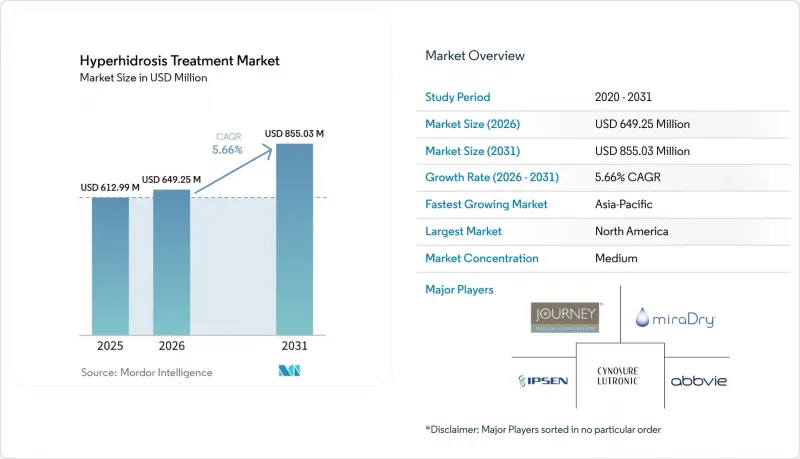
본 보고서는 치료 유형(외용 발한 억제제 및 항콜린제 등), 질환 유형(원발성 국소형 및 이차성 전신형), 부위(겨드랑이 등), 최종 사용자(병원 등), 유통 채널(병원 약국 등), 지역(북미, 유럽,아시아태평양 등)별로 분류되어 있습니다. 시장 예측은 금액(달러) 기준으로 제시되어 있습니다.
전 세계 다한증 치료 시장 동향 및 인사이트
다한증 유병률 및 진단 건수 증가
역학 데이터에 따르면, 발한 장애는 미국 인구의 4.8%(1,530만 명) 및 스웨덴 인구의 5.5%에 영향을 미치고 있으며, 고소득 시장에서 그 유병률이 높다는 점이 두드러지게 나타납니다. ‘다한증 질환 중증도 척도(Hyperhidrosis Disease Severity Scale)’와 같은 도구의 도입으로 보험사를 위한 문서 작성 과정이 효율화되었으며, 임상 증상 제시까지의 기간이 단축되었습니다. CARDIGAN 임상시험의 성공에 힘입어 FDA가 소프드라를 승인함에 따라, 객관적인 치료 효과 평가 지표가 보험 급여의 중요한 기준으로 확립되었습니다. 동시에, 환자 지원 활동이 환자의 참여를 촉진하고 있어, 다한증 치료 시장에서 미충족 의료 수요를 치료 완료 환자 수로 효과적으로 전환하고 있습니다.
저침습 및 비침습적 치료법에 대한 수요 증가
내시경 하 흉부 교감신경 절제술 후 보상성 발한율이 40%-89%로 높은 만큼, 환자들은 가역적인 치료 옵션을 찾고 있습니다. 칸데산토(Candesant)사의 FDA 승인 제품인 ‘브렐라(Brella) 패치’는 진료소에서 3분이라는 신속한 시술로 63.6%의 반응률을 달성하며, 전신에 대한 약물 노출을 필요로 하지 않습니다. 마찬가지로, MiraDry사의 이중 주파수 마이크로파 열분해법은 EU MDR 승인을 획득하여, 2025년까지 규제가 엄격한 유럽 시장 진출이 기대되고 있습니다. 이러한 기술적 진보는 효과적이고 비수술적이며 유지 관리가 간편한 치료법을 원하는 환자들의 요구에 부응함으로써 다한증 치료 시장의 성장을 견인하고 있습니다.
높은 치료비와 제한된 보험 적용 범위
Qbrexza의월비용은 580-700달러에 달하며, 사전 승인이 필요하기 때문에 일반 대중에게 널리 보급되는 데에는 한계가 있습니다. 보툴리눔툭신(보톡스)의 보험 환급은 사용량에 제한이 있으며, miraDry의 2,000-3,000달러에 달하는 치료비가 보험 적용되는 경우는 거의 없기 때문에 다한증 치료 시장에서는 가격에 민감한 현실이 부각되고 있습니다. 저소득 지역에서는 제네릭 알루미늄 클로라이드가 여전히 유일한 실용적인 선택지로 남아 있어, 단기적으로는 고가 치료법의 보급이 억제되고 있습니다.
부문 분석
보툴리눔툭신(보톡스) A 주사는 2025년 수요의 32.13%를 차지하며, 애브비(AbbVie)의 주력 제품 라인에 견실한 현금 흐름을 가져다주고 있습니다. 한편, 시그나(Signa)와 블루크로스(Blue Cross)는 염화알루미늄 치료가 효과를 보이지 않을 경우, 겨드랑이 부위 시술 비용을 보상하고 있습니다(3). 그러나 마이크로파 열분해 요법은 miraDry의 EU MDR 승인과 12개월간 발한 감소율 84%라는 데이터를 바탕으로, 자본 부담이 적고 1회 시술로 수익을 얻을 수 있는 치료법을 찾는 클리닉을 끌어모으며,연평균 성장률(CAGR) 7.54%로 다한증 치료 시장 규모를 상회하는 성장세를 보이고 있습니다.
Sofdra 등의 외용 항콜린제는 전신 노출을 줄여주며, Qbrexza가 남긴 안전성 격차를 메우고 있습니다. 한편, 9-10일 주기의 유효성 사이클로 검증된 가정용 이온토포레시스 기기는 손바닥·발바닥 다한증 환자에게 OTC(일반의약품)를 통한 대안을 제공하고 있지만, 치료 지속에 대한 피로감이 여전히 걸림돌로 작용하고 있습니다. 가역적인 기기 옵션이 보급됨에 따라 ETS(전기 자극 요법) 시술 건수는 더욱 감소하고 있으며, 다한증 치료 시장에서 수술은 축소되는 틈새 분야가 되고 있습니다.
원발성 국소 다한증은 확립된 진단 등급 분류와 여러 FDA 승인 치료법에 힘입어 2025년 매출의 75.35%를 차지했습니다. 각 보험사가 HDSS 점수 산정 방식에 합의함에 따라 보험 청구 워크플로가 원활해졌으며, 다한증 치료 시장에서 이 분야의 압도적인 점유율이 더욱 공고해졌습니다.
이차성 전신성 다한증은 암 치료 및 대사성 동반 질환으로 인한 환자 수 증가에 따라 연평균 성장률(CAGR) 7.43%로 확대되고 있습니다. 호르몬 요법을 받고 있는 환자의 30%-50%가 문제가 되는 발한을 경험하고 있어, 전신성 항콜린제 및 보조적인 외용제에 대한 수요가 발생하고 있습니다. 개발 초기 단계에 있는 선택적 M3 길항제는 부작용 부담을 줄일 가능성이 있어, 이미 확립된 경구용 약물과의 향후 경쟁을 예고하고 있습니다.
지역별 분석
2025년, 북미는 매출의 42.56%를 차지했습니다. 이는 유리한 보험 적용 정책, 높은 1인당 의료비, 그리고 생물학적 제제의 급속한 보급에 힘입은 결과입니다. Cigna사의 2024년 개정으로 인해, 주사제 승인에 앞서 요구되던 이온포레시스 시험 요건이 철폐되어 치료 시작 절차가 간소화되었습니다. 한편, 소프드라(Sofdra)사의 소비자 직접 판매는 온라인에서 탄력을 받고 있으며, 미국 소비자들은 멕시코로의 국경 간 의료 관광을 통해 본인 부담금 절감이라는 혜택을 누리고 있습니다. 이러한 동향으로 인해 다한증 치료 시장의 수익은 가속화되는 동시에 재분배되는 상황이 발생하고 있습니다.
유럽에서는 보툴리눔툭신(보톡스)의 보험 급여 평준화와 2025년 7월 독일, 프랑스, 이탈리아에서 마이크로파 열분해 요법이 EU MDR 승인을 획득함에 따라 큰 진전이 있었습니다. EMA에 의한 라벨 표시 표준화는 임상의들의 투여에 대한 확신을 높였습니다. 그러나 프랑스의 엄격한 비용 대비 효과 평가로 인해 고가의 외용약 시장 진입은 억제되었습니다. 이러한 과제에도 불구하고, 중증 환자에 대한 법정 보험 적용으로 인해 다한증 치료 분야에서 유럽의 중요한 역할은 확고해졌습니다.
아시아태평양은 일본을 선두로 연평균 성장률(CAGR) 6.43%로 성장할 전망입니다. 이곳에서는 마루호사의 글리코피로늄 토실산염 제제(농도 3.75%)가 후기 임상시험에서 51.6%의 반응률을 보였습니다. 중국 내 미용 수요 증가와 인도 온라인 약국 시장의 35%라는 급격한 성장이 시장 확대를 뒷받침하고 있습니다. 반면, 가구 소득이 비교적 낮기 때문에 처방률은 정체된 상황입니다. 한편, 호주와 한국에서는 민간 클리닉에서 수요가 급증하고 있으며, 이는 해당 지역이 다한증 치료 시장에서 가장 빠르게 성장하는 지역으로서의 위상을 확립하는 한 요인이 되고 있습니다.
기타 혜택:
- 엑셀 형식 시장 예측(ME) 시트
- 3개월간의 애널리스트 지원
자주 묻는 질문
목차
제1장 서론
제2장 조사 방법
제3장 주요 요약
제4장 시장 구도
제5장 시장 규모와 성장 예측
제6장 경쟁 구도
제7장 시장 기회와 향후 전망
JHS 26.09.07According to Mordor Intelligence, the hyperhidrosis treatment market size is expected to grow from USD 693.23 million in 2025 to USD 731.77 million in 2026 and is forecast to reach USD 959.12 million by 2031 at 5.56% CAGR over 2026-2031.
This report is Segmented by Treatment Type (Topical Antiperspirants & Anticholinergics, and More), Disease Type (Primary Focal and Secondary Generalised), Site (Axillary, and More), End User (Hospitals, and More), Distribution Channel (Hospital Pharmacies, and More), and Geography (North America, Europe, Asia-Pacific, and More). The Market Forecasts are Provided in Terms of Value (USD).
Global Hyperhidrosis Treatment Market Trends and Insights
Increasing Prevalence and Diagnosis of Hyperhidrosis
Epidemiological data indicate that sweating disorders affect 4.8% of the U.S. population, or 15.3 million individuals, and 5.5% of Sweden's population, underscoring their significant prevalence in high-income markets. The adoption of tools such as the Hyperhidrosis Disease Severity Scale has streamlined payer documentation processes and accelerated clinical presentation timelines. The FDA approval of Sofdra, following the successful CARDIGAN trial, has established objective responder endpoints as critical benchmarks for reimbursement. Simultaneously, advocacy initiatives are driving patient engagement, effectively converting unmet needs into treated prevalence within the hyperhidrosis treatment market.
Rising Demand for Minimally and Non-Invasive Treatment Modalities
High compensatory sweating rates of 40%-89% following endoscopic thoracic sympathectomy have driven patients toward reversible treatment options. Candesant's FDA-cleared Brella patch delivers a quick, three-minute, office-based solution with a 63.6% responder rate, eliminating the need for systemic drug exposure. Similarly, MiraDry's dual-frequency microwave thermolysis has received EU MDR clearance, positioning it to enter more stringent European markets by 2025. These advancements are driving growth in the hyperhidrosis treatment market by addressing patient demand for effective, non-surgical, and low-maintenance solutions.
High Treatment Costs and Limited Reimbursement Coverage
Monthly outlays of USD 580-700 for Qbrexza demand prior authorization, capping mainstream adoption. Botulinum toxin reimbursements are quantity-limited, and miraDry's USD 2,000-3,000 fee is seldom covered, painting a price-sensitive reality for the hyperhidrosis treatment market. In lower-income regions, generic aluminum chloride remains the only viable choice, muting near-term premium-therapy penetration.
Other drivers and restraints analyzed in the detailed report include:
- Regulatory Approvals of Innovative Topical and Device-Based Therapies
- Technological Advancements in Energy-Based and Digital Platforms
- Limited Long-Term Efficacy of Existing Therapies
For complete list of drivers and restraints, kindly check the Table Of Contents.
Segment Analysis
Botulinum toxin A injections captured 32.13% of 2025 demand, translating to robust cash flow for AbbVie's flagship product line, while Cigna and Blue Cross cover axillary administrations once aluminum chloride fails[3]. Yet microwave thermolysis outpaces the hyperhidrosis treatment market size with a 7.54% CAGR, leveraging miraDry's EU MDR clearance and 84% 12-month sweat-reduction data to attract clinics seeking capital-light, single-session revenue.
Topical anticholinergics such as Sofdra lessen systemic exposure, filling safety gaps left by Qbrexza. Meanwhile, home iontophoresis systems tested at 9-10-day efficacy cycles supply palmar and plantar sufferers with an OTC workaround, though regimen fatigue remains a headwind. ETS volumes slide further as reversible device options proliferate, leaving surgery a shrinking niche inside the hyperhidrosis treatment market.
Primary focal hyperhidrosis generated 75.35% of 2025 turnover, buoyed by established diagnostic grading and multiple FDA-approved modalities. Insurer alignment around HDSS scoring eases claim workflows, reinforcing its dominant share within the hyperhidrosis treatment market.
Secondary generalized hyperhidrosis is rising at 7.43% CAGR as oncology regimens and metabolic comorbidities swell patient counts; 30%-50% of hormone-therapy recipients experience problematic sweating, opening demand for systemic anticholinergics and adjunct topicals. Selective M3 antagonists in early pipelines could offer lower side-effect loads, signaling future competition for entrenched oral options.
Complete Report Scope:
- By Treatment Type
- Topical Antiperspirants & Anticholinergics
- Botulinum Toxin A Injections
- Iontophoresis Devices
- Microwave Thermolysis
- Endoscopic Thoracic Sympathectomy (ETS)
- Laser & Energy-Based Therapies
- Oral Medications
- Other Treatment Types
- By Disease Type
- Primary Focal Hyperhidrosis
- Secondary Generalised Hyperhidrosis
- By Site of Hyperhidrosis
- Axillary (Underarms)
- Palmar (Hands)
- Plantar (Feet)
- Craniofacial
- Other Site of Hyperhidrosis
- By End User
- Hospitals
- Dermatology & Aesthetic Clinics
- Ambulatory Surgical Centers
- Homecare & OTC Channels
- By Distribution Channel
- Hospital Pharmacies
- Retail Pharmacies & Drug Stores
- E-Commerce
- Geography
- North America
- United States
- Canada
- Mexico
- Europe
- Germany
- United Kingdom
- France
- Italy
- Spain
- Rest of Europe
- Asia-Pacific
- China
- Japan
- India
- Australia
- South Korea
- Rest of Asia-Pacific
- Middle East & Africa
- GCC
- South Africa
- Rest of Middle East & Africa
- South America
- Brazil
- Argentina
- Rest of South America
- North America
Geography Analysis
In 2025, North America captured 42.56% of sales, buoyed by favorable coverage policies, high per-capita spending, and a swift embrace of biologics. Cigna's 2024 update, which removed the requirement for iontophoresis trials prior to injectable authorizations, streamlined treatment initiation. Meanwhile, Sofdra's direct-to-consumer debut gained momentum online, and U.S. consumers are benefiting from reduced out-of-pocket expenses due to cross-border procedure tourism in Mexico. This dynamic creates a landscape where revenue in the hyperhidrosis treatment market is both accelerated and redistributed.
Europe made strides, bolstered by botulinum toxin reimbursement parity and the July 2025 EU MDR nod for microwave thermolysis in Germany, France, and Italy. The EMA's standardized labeling boosted clinician dosing confidence. However, France's stringent cost-effectiveness evaluations tempered the entry of premium topicals. Despite these challenges, statutory coverage for severe cases solidifies Europe's pivotal role in the hyperhidrosis treatment arena.
Asia-Pacific is set to expand at a 6.43% CAGR, spearheaded by Japan. Here, Maruho's glycopyrronium tosylate formulation, with a 3.75% concentration, boasted a 51.6% responder rate in late-stage trials. China's growing aesthetic demand and India's 35% boom in e-pharmacy broaden the market's reach, even as modest household incomes dampen prescription rates. Meanwhile, Australia and South Korea, driven by a surge in private clinic demand, contribute to the region's status as the fastest-growing in the hyperhidrosis treatment market.
- Abbvie
- Botanix Pharmaceuticals Ltd.
- Brickell Biotech
- Candesant Biomedical Inc.
- Carpe Lotions LLC
- Cynosure (Strathspey Crown Holdings)
- Dermadry Laboratories
- Dermata Therapeutics
- Dermavant Sciences Inc.
- Eli Lilly & Company (Dermira)
- Hidrex GmbH
- Hidroxa AB
- Merz Pharma
- RA Fischer Co.
- Revance Therapeutics
- Sientra Inc. / miraDry Inc.
- SweatBlock LLC
- TheraVida Inc.
Additional Benefits:
- The market estimate (ME) sheet in Excel format
- 3 months of analyst support
TABLE OF CONTENTS
1 Introduction
- 1.1 Study Assumptions & Market Definition
- 1.2 Scope of the Study
2 Research Methodology
3 Executive Summary
4 Market Landscape
- 4.1 Market Overview
- 4.2 Market Drivers
- 4.2.1 Increasing Prevalence and Diagnosis of Hyperhidrosis
- 4.2.2 Rising Demand for Minimally and Non-Invasive Treatment Modalities
- 4.2.3 Regulatory Approvals of Innovative Topical and Device-Based Therapies
- 4.2.4 Technological Advancements in Energy-Based and Digital Platforms
- 4.2.5 Growing Consumer Awareness and Quality-of-Life Focus
- 4.2.6 Expansion of Tele-Dermatology and Direct-to-Consumer Channels
- 4.3 Market Restraints
- 4.3.1 High Treatment Costs and Limited Reimbursement Coverage
- 4.3.2 Limited Long-Term Efficacy of Existing Therapies
- 4.3.3 Adverse Events and Safety Concerns With Surgical and Energy Devices
- 4.3.4 Supply Chain and Pricing Volatility of Key Therapeutic Inputs
- 4.4 Value / Supply-Chain Analysis
- 4.5 Regulatory Outlook
- 4.6 Technological Outlook
- 4.7 Porter's Five Forces Analysis
- 4.7.1 Threat of New Entrants
- 4.7.2 Bargaining Power of Buyers
- 4.7.3 Bargaining Power of Suppliers
- 4.7.4 Threat of Substitute Products
- 4.7.5 Intensity of Competitive Rivalry
5 Market Size & Growth Forecasts (Value, USD)
- 5.1 By Treatment Type
- 5.1.1 Topical Antiperspirants & Anticholinergics
- 5.1.2 Botulinum Toxin A Injections
- 5.1.3 Iontophoresis Devices
- 5.1.4 Microwave Thermolysis
- 5.1.5 Endoscopic Thoracic Sympathectomy (ETS)
- 5.1.6 Laser & Energy-Based Therapies
- 5.1.7 Oral Medications
- 5.1.8 Other Treatment Types
- 5.2 By Disease Type
- 5.2.1 Primary Focal Hyperhidrosis
- 5.2.2 Secondary Generalised Hyperhidrosis
- 5.3 By Site of Hyperhidrosis
- 5.3.1 Axillary (Underarms)
- 5.3.2 Palmar (Hands)
- 5.3.3 Plantar (Feet)
- 5.3.4 Craniofacial
- 5.3.5 Other Site of Hyperhidrosis
- 5.4 By End User
- 5.4.1 Hospitals
- 5.4.2 Dermatology & Aesthetic Clinics
- 5.4.3 Ambulatory Surgical Centers
- 5.4.4 Homecare & OTC Channels
- 5.5 By Distribution Channel
- 5.5.1 Hospital Pharmacies
- 5.5.2 Retail Pharmacies & Drug Stores
- 5.5.3 E-Commerce
- 5.6 Geography
- 5.6.1 North America
- 5.6.1.1 United States
- 5.6.1.2 Canada
- 5.6.1.3 Mexico
- 5.6.2 Europe
- 5.6.2.1 Germany
- 5.6.2.2 United Kingdom
- 5.6.2.3 France
- 5.6.2.4 Italy
- 5.6.2.5 Spain
- 5.6.2.6 Rest of Europe
- 5.6.3 Asia-Pacific
- 5.6.3.1 China
- 5.6.3.2 Japan
- 5.6.3.3 India
- 5.6.3.4 Australia
- 5.6.3.5 South Korea
- 5.6.3.6 Rest of Asia-Pacific
- 5.6.4 Middle East & Africa
- 5.6.4.1 GCC
- 5.6.4.2 South Africa
- 5.6.4.3 Rest of Middle East & Africa
- 5.6.5 South America
- 5.6.5.1 Brazil
- 5.6.5.2 Argentina
- 5.6.5.3 Rest of South America
- 5.6.1 North America
6 Competitive Landscape
- 6.1 Market Concentration
- 6.2 Market Share Analysis
- 6.3 Company Profiles {(Includes Global Level Overview, Market Level Overview, Core Segments, Financials as Available, Strategic Information, Market Rank/Share for Key Companies, Products & Services, and Recent Developments)}
- 6.3.1 AbbVie Inc.
- 6.3.2 Botanix Pharmaceuticals Ltd.
- 6.3.3 Brickell Biotech Inc.
- 6.3.4 Candesant Biomedical Inc.
- 6.3.5 Carpe Lotions LLC
- 6.3.6 Cynosure (Strathspey Crown Holdings)
- 6.3.7 Dermadry Laboratories Inc.
- 6.3.8 Dermata Therapeutics Inc.
- 6.3.9 Dermavant Sciences Inc.
- 6.3.10 Eli Lilly & Company (Dermira)
- 6.3.11 Hidrex GmbH
- 6.3.12 Hidroxa AB
- 6.3.13 Merz Pharma GmbH & Co. KGaA
- 6.3.14 RA Fischer Co.
- 6.3.15 Revance Therapeutics Inc.
- 6.3.16 Sientra Inc. / miraDry Inc.
- 6.3.17 SweatBlock LLC
- 6.3.18 TheraVida Inc.
7 Market Opportunities & Future Outlook
- 7.1 White-Space & Unmet-Need Assessment


