

|
시장보고서
상품코드
2123476
인공 힘줄 및 인대 시장 : 점유율 분석, 업계 동향과 통계, 성장 예측(2026-2031년)Artificial Tendons And Ligaments - Market Share Analysis, Industry Trends & Statistics, Growth Forecasts (2026 - 2031) |
||||||
 Mordor Intelligence
에 의하면, 2026년 인공 힘줄 및 인대 시장 규모는 5,053만 달러로 추정되고 있어 2025년 4,497만 달러에서 확대해, 2031년에는 9,047만 달러에 이를 것으로 예측됩니다.
2026년부터 2031년까지 연평균 성장률(CAGR) 12.36%로 성장할 것으로 전망됩니다.
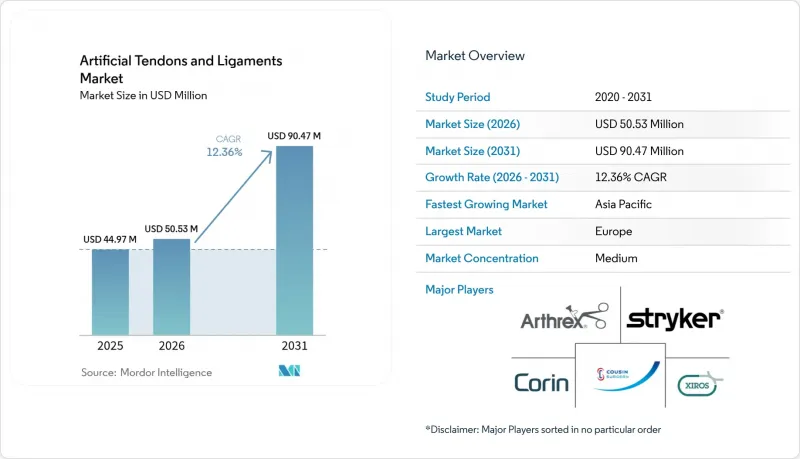
본 보고서는 용도(무릎 손상, 발·발목 손상 등), 임플란트 유형(합성 소재 등), 소재(폴리프로필렌, 탄소섬유 등), 시술(초기 재건술 및 재수술), 최종 사용자(외래수술센터(ASC) 등), 지역(북미, 유럽 등)별로 분류되어 있습니다. 시장 전망은 금액(달러) 기준으로 제시되어 있습니다.
전 세계 인공 힘줄 및 인대 시장 동향 및 인사이트
스포츠 관련 인대 손상의 전 세계 발생률 증가
전방십자인대(ACL) 재건 수술의 연간 건수는 현재 40만 건에 달하며, 이는 인구 10만 명당 18건의 부상에 해당하며, 운동선수들 사이에서는 더 높은 발생률을 보이고 있습니다. 경제적 부담은 재활 및 생산성 저하로까지 이어지며, 회복 기간을 단축하는 솔루션에 대한 수요를 촉진하고 있습니다. 북미 및 유럽에서는 조직적인 스포츠 참여와 인대 재건 수술 비용을 보상하는 보험 제도 덕분에 가장 강력한 수요가 발생하고 있습니다. 아시아태평양에서 부상하고 있는 신흥 스포츠 리그는 수술 건수 증가와 최종 단계에서의 성장을 가져오고 있습니다. 그 결과, 병원 및 외래수술센터(ASC)는 즉각적인 기계적 안정성과 경기 복귀 기간 단축을 실현하는 첨단 이식편 옵션에 대한 투자를 진행하고 있습니다.
최소 침습 수술에 대한 선호도 증가
현재 인대 재건술의 85% 이상이 관절경 수술로 이루어지고 있습니다. 2024년 임상 데이터에 따르면, 기존 수술법과 비교하여 자가 힘줄에 LARS 장치를 병용한 경우, 수술 후 1개월 및 3개월 검진에서 더 높은 기능 점수가 기록되었습니다. 외과의사들은 연조직 손상을 줄이고, 아편계 진통제 사용량을 감소시키며, 당일 퇴원을 가능하게 하는 ‘올 인사이드(All-Inside)’ 접근법을 선호하고 있습니다. 이에 반해, 기기 제조업체들은 싱글 포털용 기구에 대응하는 더 가늘고 미리 세팅된 합성 이식편을 제공함으로써, 수술 건수가 많은 ASC 네트워크 전반에 걸친 현재의 수술 동향을 뒷받침하고 있습니다.
과거의 실패로 인한 외과의사들의 뿌리 깊은 회의론
2024년 문헌 고찰에서 자세히 설명된 바와 같이, 초기 합성 이식편은 기계적 파손 및 활막염을 원인으로 시장에서 철수했습니다. 그 시기에 수련을 받은 외과의사들은 여전히 신중한 태도를 보이며, 10년간의 추적 조사 데이터를 확보할 때까지 도입을 미루고 있습니다. 교육 심포지엄과 레지스트리 보고서는 신뢰의 격차를 해소하는 것을 목표로 하고 있지만, 회의적인 시각은 여전히, 특히 지역 병원에서 도입 주기의 지연을 초래하고 있습니다.
부문 분석
2025년에는 전 세계적으로 약 40만 건의 전방십자인대(ACL) 수술이 시행됨에 따라, 무릎 관절 재건술이 인공 힘줄 및 인대 시장의 57.30%를 차지했습니다. 스포츠 의학 사례 수, 고령자의 활동량 증가, 재건 수술에서 PET-LARS 강화를 뒷받침하는 증거를 배경으로, 무릎 치료용 인공 힘줄 및 인대 시장 규모는 꾸준히 확대될 것으로 예측됩니다.
발 및 발목 손상 분야는 외측 인대 복합체를 위해 설계된 새로운 임플란트의 등장으로 연평균 성장률(CAGR) 13.62%를 기록하며 가장 빠르게 성장하고 있습니다. Medline사가 2025년 출시 예정인 ATFL 보강 장치는 이 분야의 상업적 성장세를 보여주고 있습니다. 외과의들은 자가 이식편 채취가 제한되는 상황에서 기계적 안정성을 향상시키는 합성 소재 옵션을 찾고 있습니다. 환자 수가 많은 족부 치료 센터가 있는 병원에서는 현재 발목 인대 복원술을 당일 재활 프로토콜과 결합하여 1건당 수익을 확대되고 있습니다.
어깨 재건술에서는 회전근개 재파열률을 해결하기 위한 합성 보강 솔루션이 효과를 보이고 있지만, 척추 및 고관절로의 적용은 여전히 틈새 분야에 머물러 있음에도 불구하고 특수한 3D 프린팅 설계를 통해 성장세를 보이고 있습니다. 전반적으로 무릎 이외의 용도는 인공 힘줄 및 인대 시장 전체의 폭을 넓히고, 제품 구성의 수익성을 향상시키고 있습니다.
합성 PET-LARS 임플란트는 40년에 걸친 기계적 신뢰성 데이터를 바탕으로 2025년에는 63.20%의 시장 점유율을 차지했습니다. PET 기기를 이용한 인공 힘줄 및 인대 시장 규모는 광범위한 규제 당국의 승인 및 외과의들의 익숙해짐에 따라 확대되고 있습니다. PET-LARS를 전방십자인대(ACL) 복원에 병용한 경우, 재파열의 오즈비는 0.17인 것으로 나타났습니다.
하이브리드 3D 프린팅 구조체는 2031년까지 연평균 성장률(CAGR) 16.85%를 나타낼 것으로 예측되며, 이는 즉각적인 강도와 생체 통합성을 겸비한 기기에 대한 수요를 반영합니다. 각 OEM 업체들은 조직 침투를 촉진하기 위해 다중 스케일의 생체 모방 다공성 건막 및 나노 하이브리드 콜라겐 모방 섬유를 채택하고 있습니다. 조기 도입 기업들은 기계적 안정성과 생체 적합성이 모두 중요한 재수술이나 복잡한 초회 수술에서 하이브리드 이식편을 채택하고 있습니다. 이 부문의 급속한 확대로 인해 연구 개발 예산과 인수 대상이 재료 과학 혁신 기업으로 재조정되고 있습니다.
지역별 분석
유럽은 합성 인대에 대한 역사적인 수용성과 고급 의료기기에 대한 자금 지원을 가능하게 하는 환급 제도의 뒷받침을 받아 37.60%의 점유율로 1위를 차지하고 있습니다. 프랑스나 독일 등에서는 LARS 이식술이 널리 시행되고 있지만, 새로운 MDR(의료기기 규정) 준수로 인해 규제 부담이 증가하고 있어, 이로 인해 신제품 출시가 지연될 가능성이 있습니다. 축구나 스키와 같은 스포츠와 고령화되는 운동선수 인구가 맞물려 수술 수요는 높은 수준을 유지하고 있습니다.
북미는 2위를 차지하고 있으며, 연간 약 20만 건의 전방십자인대(ACL) 재건술과 BEAR 임플란트의 채택이 가속화되고 있는 것이 그 배경입니다. 전략적 계획에서는 외래 진료로의 전환이 주류를 이루고 있으며, 정형외과 수술의 68%가 외래수술센터(ASC)에서 시행되고 있습니다. 조기 도입 채널을 통해 단일 포털법에 대응하는 저침습 하이브리드 이식편에 대한 수요가 증가하고 있습니다.
아시아태평양은 보험 적용 범위 확대, 스포츠 리그의 성장, 그리고 견조한 의료 관광을 배경으로 12.92%라는 가장 높은 연평균 성장률(CAGR)을 기록하고 있습니다. 중국 내 경쟁 기업들의 가격 압박이 높아지는 한편, 일본은 실크 유래 생체 재료 분야에서 획기적인 진전을 이루며 전 세계 파이프라인의 혁신을 주도하고 있습니다. 인도의 도시 지역에 위치한 스포츠 의학 클리닉은 여전히 가격에 민감한 편이지만, 어깨 및 발·발목 시장을 주도하고 있습니다.
남미 및 중동 및 아프리카에서는 주요 도시를 중심으로 완만한 성장이 관찰됩니다. 브라질에서는 열광적인 축구 문화가 전방십자인대(ACL) 수술 건수 증가를 뒷받침하고 있는 반면, GCC 국가에서는 국내 주민과 해외 의료 관광객 모두에게 서비스를 제공하는 스포츠 의학 센터에 정부 계열 펀드가 자금을 투자하고 있습니다. 환율 변동과 보험 접근성의 격차가 고급 임플란트 구매 결정에 영향을 미치고 있습니다.
기타 혜택:
- 엑셀 형식 시장 예측(ME) 시트
- 3개월간의 애널리스트 지원
자주 묻는 질문
목차
제1장 서론
제2장 조사 방법
제3장 주요 요약
제4장 시장 구도
제5장 시장 규모와 성장 예측
제6장 경쟁 구도
제7장 시장 기회와 향후 전망
JHS 26.09.09According to Mordor Intelligence, the artificial tendons and ligaments market size in 2026 is estimated at USD 50.53 million, growing from 2025 value of USD 44.97 million with 2031 projections showing USD 90.47 million, growing at 12.36% CAGR over 2026-2031.
This report is Segmented by Application (Knee Injuries, Foot & Ankle Injuries, and More), Implant Type (Synthetic, and More), Material (Polypropylene, Carbon Fiber and More), Procedure (Primary Reconstruction and Revision Reconstruction), End User (Ambulatory Surgical Centers, and More), and Geography (North America, Europe, and More). The Market Forecasts are Provided in Terms of Value (USD).
Global Artificial Tendons And Ligaments Market Trends and Insights
Rising Global Incidence of Sports-Related Ligament Trauma
Annual ACL reconstructions now reach 400,000, translating to 18 injuries per 100,000 population and higher incidence among athletes. The economic burden extends to rehabilitation and productivity losses, propelling demand for solutions that shorten recovery periods. North America and Europe feel the strongest pull due to organized sports participation and insurance coverage that reimburses ligament reconstruction. Emerging sports leagues in Asia-Pacific add new procedure volumes and last-mile growth. Consequently, hospitals and ASCs invest in advanced graft options that offer immediate mechanical stability and quicker return-to-play timelines.
Growing Preference for Minimally Invasive Techniques
Arthroscopic methods now constitute more than 85% of ligament reconstructions. Clinical evidence from 2024 shows higher functional scores at 1- and 3-month check-ups when autologous tendons are augmented with LARS devices compared with traditional techniques. Surgeons favor all-inside approaches that lessen soft-tissue disruption, reduce narcotic use, and enable same-day discharge. Device makers respond with thinner, pre-loaded synthetic grafts compatible with single-portal instrumentation, supporting current procedural trends across high-volume ASC networks.
Persistent Surgeon Skepticism from Historical Failures
Early synthetic grafts were withdrawn due to mechanical failure and synovitis, as detailed in 2024 literature reviews. Surgeons trained in that period remain cautious and delay adoption until 10-year follow-up data becomes available. Educational symposiums and registry reporting aim to bridge the trust gap, yet skepticism still slows purchasing cycles, particularly in community hospitals.
Other drivers and restraints analyzed in the detailed report include:
- Expansion of Outpatient Orthopedic Surgery Infrastructure
- High Implant and Procedure Costs in Cost-Sensitive Economies
For complete list of drivers and restraints, kindly check the Table Of Contents.
Segment Analysis
Knee reconstruction commanded 57.30% artificial tendons and ligaments market share in 2025 as roughly 400,000 ACL surgeries occurred worldwide. The artificial tendons and ligaments market size for knee treatments is forecast to climb steadily on the back of sports medicine volumes, rising older-adult activity, and evidence favoring PET-LARS augmentation in revision scenarios.
Foot and ankle injuries grow fastest at 13.62% CAGR, assisted by new implants tailored to lateral ligament complexes. Medline's 2025 ATFL augmentation device demonstrates the sector's commercial momentum. Surgeons seek synthetic options that improve mechanical stability where autograft harvest is limited. Hospitals in high-volume podiatry centers now bundle ankle ligament repairs with same-day rehabilitation protocols, expanding revenue per episode.
Shoulder repairs benefit from synthetic augmentation solutions that address rotator cuff re-tear rates, while spine and hip applications stay niche but gather momentum from specialized 3D-printed designs. Collectively, non-knee applications expand overall artificial tendons and ligaments market breadth and improve product mix profitability.
Synthetic PET-LARS implants held 63.20% share in 2025, supported by four decades of mechanical reliability data. The artificial tendons and ligaments market size for PET devices scales with broad regulatory clearance and surgeon familiarity. Evidence indicates a 0.17 odds ratio for re-rupture when PET-LARS augments ACL repair.
Hybrid 3D-printed constructs register a 16.85% CAGR to 2031, reflecting demand for devices combining immediate strength with biologic integration. OEMs employ multiscale biomimicry-porous tendon sheaths and nanohybrid collagen-mimetic fibers-to hasten tissue ingrowth. Early adopters situate hybrid grafts in revision and complex primary cases, where mechanical stability and biology both matter. This segment's rapid expansion realigns R&D budgets and acquisition targets toward materials science innovators.
Complete Report Scope:
- By Application
- Knee Injuries (ACL, PCL)
- Shoulder Injuries (RC, SLAP)
- Foot & Ankle Injuries (ATFL, Achilles)
- Spine Injuries
- Hip Injuries
- By Implant Type
- Synthetic (PET-LARS, Carbon-Fiber, UHMWPE)
- Biological Augmented (Collagen-Coated PET, Porcine SIS)
- Hybrid 3-D Printed Scaffolds
- By Material
- Polyethylene Terephthalate (PET)
- Polypropylene
- Carbon Fiber
- Silk & Other Bio-polymers
- By Procedure
- Primary Reconstruction
- Revision Reconstruction
- By End User
- Hospitals & Specialty Orthopedic Centers
- Ambulatory Surgical Centers
- Sports Medicine Clinics
- Defense & Military Hospitals
- By Geography
- North America
- United States
- Canada
- Mexico
- Europe
- Germany
- United Kingdom
- France
- Italy
- Spain
- Rest of Europe
- Asia-Pacific
- China
- Japan
- India
- South Korea
- Australia
- Rest of Asia-Pacific
- Rest of the World
- North America
Geography Analysis
Europe leads with 37.60% share, aided by historical openness to synthetic ligaments and reimbursement structures that fund premium devices. Countries such as France and Germany widely implant LARS grafts, while new MDR compliance adds regulatory workload that can slow novel product launches. Sports such as soccer and skiing, coupled with aging athlete populations, preserve high procedure demand.
North America places second, underpinned by roughly 200,000 ACL reconstructions annually and accelerating BEAR implant uptick. The outpatient shift dominates strategic planning, with ASCs performing 68% of orthopedic procedures. Early adoption channels foster demand for minimally invasive, hybrid grafts compatible with single-portal techniques.
Asia-Pacific marks the fastest 12.92% CAGR on broader insurance coverage, sports league growth, and robust medical tourism. China's domestic players increase pricing pressures, whereas Japan contributes silk-based biomaterial breakthroughs that feed global pipeline innovation. India's urban sports medicine clinics bolster shoulder and foot-ankle markets despite persistent price sensitivity.
South America and Middle East & Africa show moderate growth centered in major metros. Brazil leverages a passionate soccer culture that elevates ACL volumes, while GCC nations allocate sovereign funds to sports medicine centers serving both residents and inbound medical tourists. Currency fluctuations and unequal insurance access shape purchasing decisions for premium implants.
- Arthrex
- Stryker
- Corin Group
- Xiros Ltd. / Neoligaments
- Mathys
- Orthomed
- FH Orthopedics (Enovis)
- Cousin Biotech
- FX Solutions
- Shanghai PINE & POWER Biotech
- Artelon
- Smith+Nephew plc
- Zimmer Biomet
- Integra LifeSciences
- Miach Orthopaedics
- Bioretec Ltd.
- AlloSource
- MTF Biologics
Additional Benefits:
- The market estimate (ME) sheet in Excel format
- 3 months of analyst support
TABLE OF CONTENTS
1 Introduction
- 1.1 Study Assumptions & Market Definition
- 1.2 Scope of the Study
2 Research Methodology
3 Executive Summary
4 Market Landscape
- 4.1 Market Overview
- 4.2 Market Drivers
- 4.2.1 Rising global incidence of sports-related ligament trauma prompting reconstructive surgeries
- 4.2.2 Growing preference for minimally invasive, accelerated-rehab ligament repair techniques
- 4.2.3 Expansion of outpatient/ambulatory orthopedic surgery infrastructure lowering total treatment cost
- 4.2.4 Accumulating clinical evidence and regulatory clearances for next-generation artificial ligament devices
- 4.2.5 Escalating OEM investments and partnerships in hybrid bio-synthetic graft R&D
- 4.3 Market Restraints
- 4.3.1 Persistent surgeon skepticism stemming from historical synthetic graft failures and limited long-term data
- 4.3.2 High implant and procedure costs versus autograft alternatives in cost-sensitive economies
- 4.3.3 Tightening global regulatory requirements extending product time-to-market
- 4.4 Technological Outlook
- 4.5 Porter's Five Forces
- 4.5.1 Bargaining Power of Buyers
- 4.5.2 Bargaining Power of Suppliers
- 4.5.3 Threat of New Entrants
- 4.5.4 Threat of Substitutes
- 4.5.5 Intensity of Competitive Rivalry
5 Market Size & Growth Forecasts (Value, USD)
- 5.1 By Application
- 5.1.1 Knee Injuries (ACL, PCL)
- 5.1.2 Shoulder Injuries (RC, SLAP)
- 5.1.3 Foot & Ankle Injuries (ATFL, Achilles)
- 5.1.4 Spine Injuries
- 5.1.5 Hip Injuries
- 5.2 By Implant Type
- 5.2.1 Synthetic (PET-LARS, Carbon-Fiber, UHMWPE)
- 5.2.2 Biological Augmented (Collagen-Coated PET, Porcine SIS)
- 5.2.3 Hybrid 3-D Printed Scaffolds
- 5.3 By Material
- 5.3.1 Polyethylene Terephthalate (PET)
- 5.3.2 Polypropylene
- 5.3.3 Carbon Fiber
- 5.3.4 Silk & Other Bio-polymers
- 5.4 By Procedure
- 5.4.1 Primary Reconstruction
- 5.4.2 Revision Reconstruction
- 5.5 By End User
- 5.5.1 Hospitals & Specialty Orthopedic Centers
- 5.5.2 Ambulatory Surgical Centers
- 5.5.3 Sports Medicine Clinics
- 5.5.4 Defense & Military Hospitals
- 5.6 By Geography
- 5.6.1 North America
- 5.6.1.1 United States
- 5.6.1.2 Canada
- 5.6.1.3 Mexico
- 5.6.2 Europe
- 5.6.2.1 Germany
- 5.6.2.2 United Kingdom
- 5.6.2.3 France
- 5.6.2.4 Italy
- 5.6.2.5 Spain
- 5.6.2.6 Rest of Europe
- 5.6.3 Asia-Pacific
- 5.6.3.1 China
- 5.6.3.2 Japan
- 5.6.3.3 India
- 5.6.3.4 South Korea
- 5.6.3.5 Australia
- 5.6.3.6 Rest of Asia-Pacific
- 5.6.4 Rest of the World
- 5.6.1 North America
6 Competitive Landscape
- 6.1 Market Concentration
- 6.2 Market Share Analysis
- 6.3 Company Profiles (includes Global level Overview, Market level overview, Core Business Segments, Financials, Headcount, Key Information, Market Rank, Market Share, Products and Services, and analysis of Recent Developments)
- 6.3.1 Arthrex Inc.
- 6.3.2 Stryker Corp.
- 6.3.3 Corin Group
- 6.3.4 Xiros Ltd. / Neoligaments
- 6.3.5 Mathys AG Bettlach
- 6.3.6 Orthomed S.A.S.
- 6.3.7 FH Orthopedics (Enovis)
- 6.3.8 Cousin Biotech
- 6.3.9 FX Solutions
- 6.3.10 Shanghai PINE & POWER Biotech
- 6.3.11 Artelon
- 6.3.12 Smith+Nephew plc
- 6.3.13 Zimmer Biomet
- 6.3.14 Integra LifeSciences
- 6.3.15 Miach Orthopaedics
- 6.3.16 Bioretec Ltd.
- 6.3.17 AlloSource
- 6.3.18 MTF Biologics
7 Market Opportunities & Future Outlook
- 7.1 White-space & Unmet-Need Assessment


