

|
시장보고서
상품코드
2123477
무균 샘플링 시장 : 점유율 분석, 업계 동향과 통계, 성장 예측(2026-2031년)Aseptic Sampling - Market Share Analysis, Industry Trends & Statistics, Growth Forecasts (2026 - 2031) |
||||||
 Mordor Intelligence
에 의하면, 무균 샘플링 시장 규모는 2025년 12억 6,000만 달러에서 2026년에는 14억 1,000만 달러로 확대되어 2026년부터 2031년까지 CAGR 12.05%로 성장을 지속하여, 2031년에는 24억 9,000만 달러에 이를 것으로 예측됩니다.

본 보고서는 샘플링 유형(수동 무균 샘플링 및 자동 무균 샘플링), 샘플링 기법(온라인 샘플링 등), 용도(업스트림 공정 및 다운스트림 공정), 최종 사용자(생명공학 및 제약 제조업체 등),구성 재료(일회용 어셈블리 및 재사용 가능 시스템), 지역별로 분류되어 있습니다. 시장 전망은 금액(달러) 기준으로 제시되어 있습니다.
세계 무균 샘플링 시장 동향 및 인사이트
무균성 확보에 관한 엄격한 정부 규제
현재 전 세계 규제 당국은 무균 제조 과정에서 더 엄격한 샘플링 빈도와 추적성을 요구하고 있습니다. 개정된 FDA 지침은 적용 범위를 첨단 의료 제품으로 확대하여, 문서화된 검증과 함께 정기적인 환경 모니터링을 의무화하고 있습니다. 이와 동등한 EU GMP 부록 1의 개정을 통해 지역 간 기대치가 통일되었으며, 제조업체는 종이 로그를 모든 개입 사항을 기록하는 전자 감사 추적 시스템 및 자동화 장비로 대체하도록 권장받고 있습니다. 이러한 압력으로 인해 기존 공장의 업그레이드가 가속화되는 한편, 신규 건설 현장에서는 오염 위험을 최소화하기 위해 밀폐형 일회용 경로가 의무화되고 있습니다.
세포 및 유전자 치료 파이프라인의 급속한 규모 확대
자가 치료 및 동종 치료의 상용화에 따라, 각 환자용 배치에서 교차 오염에 대한 허용도가 제로이므로 무균성의 취약점이 드러나고 있습니다. 이에 따라 제조업체들은 보관 이력 문서화를 확보하고, 다양한 바이러스 벡터 및 세포 유형에 대응할 수 있는 자동화된 밀폐형 샘플링을 지정하고 있습니다. 2030년까지 승인될 치료법이 3,000건에 육박하는 가운데, 생산 능력 확충을 위해서는 장기간의 검증 주기가 필요 없이 다제품 대응 시설에 도입 가능한 모듈식 스키드가 요구되고 있습니다.
고분자 조립체에서의 용출물·추출물 위험
일회용 매니폴드에서는 유기산, 가소제 또는 미량 금속이 용출될 가능성이 있으며, 이는 고감도 바이오의약품의 안정성을 저해하므로 철저한 화학적 프로파일링이 필요합니다. 기업들은 종종 여러 온도 및 용매 조건에서 수 주간에 걸친 추출물 시험을 실시하고 있으며, 이는 비용 증가와 제품 출시 일정 지연을 초래하고 있습니다. 또한, 전 세계적으로 통일된 시험 기준이 존재하지 않는 점도 분석 작업의 부담을 가중시키고 있습니다.
부문 분석
2025년, 무균 샘플링 시장에서 수동 시스템은 71.62%의 점유율을 차지했습니다. 초기 투자 비용이 낮고 규정 준수 실적이 입증되어, 특히 인프라 변경이 가동 중단을 초래하기 쉬운 구형 플랜트에서 여전히 널리 사용되고 있습니다. 그러나 제조업체들이 작업자의 노출 저감과 데이터 무결성 강화를 중시함에 따라, 자동화 모듈은 17.72%라는 가장 높은 연평균 성장률(CAGR)을 보이고 있습니다. 자동화 스키드는 제조 실행 시스템(MES)과 연동되어 모든 샘플링을 기록하는 동시에, 감사 심사를 위해 결과를 즉시 아카이브합니다. 이 기능 덕분에 문서 작성 부담이 줄어들고, FDA 현장 조사 시 신뢰성이 높아집니다. 세포 치료 분야에서 배치 가치가 상승함에 따라 인적 개입을 완전히 배제하는 솔루션에 대한 수요가 증가하고 있으며, 무균 샘플링 시장에서 자동화를 향한 장기적인 추세가 더욱 강화되고 있습니다.
수동 키트는 초기 연구개발이나 처리 능력보다 예산이 우선시되는 소량 생산 바이오의약품과 같은 틈새 시장에서 여전히 사용되고 있습니다. 각 공급업체들은 현재 수동 조작이 가능하면서도 사용 간 멸균 공정을 자동화하는 하이브리드 플랫폼을 제안하고 있습니다. 이러한 과도기적 전략을 통해 가격에 민감한 구매자는 기존 프로토콜을 폐기하지 않고도 단계적으로 전환할 수 있게 됩니다. 예측 기간 동안 전자 기록 기준의 추가적인 조화가 진행됨에 따라, 무균 샘플링 시장의 상업 생산 라인 표준으로서 자동화 장치가 결정적인 전환점을 맞이할 것으로 전망됩니다.
온라인 장비는 실시간 피드백 기능을 통해 2025년 전 세계 매출의 46.05%를 차지했습니다. 이 장비들은 밀폐된 조건에서 미량의 시료를 지속적으로 채취하여 pH 및 영양소의 즉각적인 조정이 가능하게 합니다. 13.53%라는 높은 연평균 성장률(CAGR)을 기록하고 있는 앳라인(at-line)형 장치는 완전히 통합된 온라인 루프의 공학적 복잡성을 수반하지 않으면서 빈번한 분석을 원하는 운영자들의 지지를 얻고 있습니다. 앳라인 프로브는 용기 바로 옆에 설치되어 배관 길이를 짧게 유지하고 센서의 신속한 교체를 가능하게 합니다. 이를 통해 막힘 위험이 줄어들고 교정도 간소화됩니다.
오프라인 샘플링은 소형화가 불가능한 바이러스 제거 분석과 같은 고도의 분석에서 여전히 수행되고 있습니다. 그러나 오프라인 이송에는 매번 개방 작업이 수반되어 처리 시간이 길어질 뿐만 아니라 편차가 발생할 위험도 있습니다. PAT 지침 및 실시간 릴리스 시험이 성숙해짐에 따라, 앳라인 장비는 오프라인 워크플로우 시장 점유율을 점차 잠식해 나갈 것으로 예측됩니다. 표준화된 기계적 인터페이스와 일회용 유로 덕분에 기존 설비에 쉽게 후속 장착할 수 있어, 무균 샘플링 시장에서 중규모 공장의 도입이 촉진되고 있습니다.
지역별 분석
북미는 2025년에 매출의 41.35%를 차지하며, 탄탄한 바이오의약품 파이프라인, FDA 지침의 벤치마킹, 그리고 CDMO의 밀집도를 바탕으로 주도적 지위를 유지하고 있습니다. 미국은 상업용 세포 치료 시설의 대부분을 보유하고 있으며, PAT에 막대한 투자를 하고 있습니다. 캐나다는 목표가 명확한 연방 정부의 보조금 지원 하에 바이오시밀러 생산 능력을 확충하고 있는 반면, 멕시코에서는 비용 효율적인 노동력이 제네릭 의약품 생산을 뒷받침하고 있습니다. 높은 수준의 무균성이 요구되는 퍼스트-인-클래스 바이오의약품을 벤처 캐피탈이 지원하고 있어 수요는 더욱 증가하고 있습니다.
아시아태평양은 각국 정부가 생산 능력에 대한 보조금을 지급하고 품질 향상을 추진하고 있어 13.2%라는 가장 높은 연평균 성장률(CAGR)을 기록하고 있습니다. 한국의 SK 파마텍은 밀폐형 샘플러를 갖춘 펩타이드 합성 라인에 2억 6,000만 달러를 투자했습니다. 중국의 현지화 정책은 국내 공급의 안정화를 목표로 하고 있어, 초기부터 일회용 샘플링을 표준화한 새로운 바이오의약품 단지의 건설을 뒷받침하고 있습니다. 인도는 여전히 원료의약품(API)의 주요 생산지이며, 비용 효율을 중시하는 공장에서는 수작업과 일회용 키트를 병행하고 있습니다. 이러한 노력들이 맞물리면서 무균 샘플링 시장은 해당 지역에 더욱 확산되고 있으며, 세계 공급업체를 위한 현지 제조 거점이 확립되고 있습니다.
유럽은 독일의 엔지니어링 클러스터와 프랑스의 바이오의약품 분야 확장에 힘입어 안정적인 상황이 지속되고 있습니다. 브렉시트 이후 영국의 시설은 개정된 부속서 1을 준수하고 있으며, 자동 샘플링 로거의 개조가 진행되고 있습니다. 지속가능성에 관한 규제로 인해 제조업체들은 금속과 플라스틱을 결합한 하이브리드 매니폴드를 검토하고, 수명 주기 전반에 걸친 환경 영향을 문서화해야 합니다. 이탈리아와 스페인의 백신 제조업체들도 마찬가지로 팬데믹 대응 보조금을 확보하기 위해 설비를 업그레이드하고 있습니다. 이러한 투자는 극적이라고는 할 수 없지만 꾸준한 성장을 가져와, 이 지역을 무균 샘플링 시장의 혁신 허브로 유지하고 있습니다.
기타 혜택:
- 엑셀 형식 시장 예측(ME) 시트
- 3개월간의 애널리스트 지원
자주 묻는 질문
목차
제1장 서론
제2장 조사 방법
제3장 주요 요약
제4장 시장 구도
제5장 시장 규모와 성장 예측
제6장 경쟁 구도
제7장 시장 기회와 향후 전망
JHS 26.09.07According to Mordor Intelligence, the aseptic sampling market size is expected to grow from USD 1.26 billion in 2025 to USD 1.41 billion in 2026 and is forecast to reach USD 2.49 billion by 2031 at 12.05% CAGR over 2026-2031.
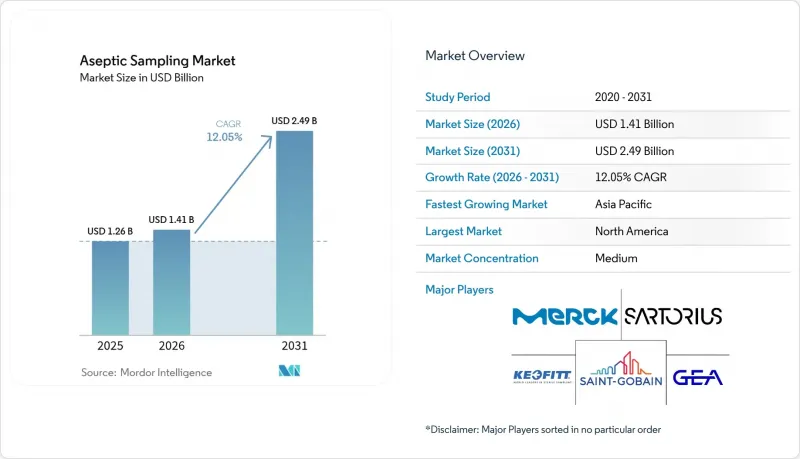
This report is Segmented by Type of Sampling (Manual Aseptic Sampling and Automated Aseptic Sampling), Sampling Technique (On-Line Sampling and More), Application (Upstream Process and Downstream Process), End-User (Biotechnology and Pharmaceutical Manufacturers and More), Component Material (Single-Use Assemblies and Reusable Systems), and Geography. The Market Forecasts are Provided in Terms of Value (USD).
Global Aseptic Sampling Market Trends and Insights
Stringent Government Regulations For Sterility Assurance
Global regulators now require tighter sampling frequency and traceability in aseptic production. The revised FDA guidance extends to advanced therapy medicinal products and mandates routine environmental monitoring with documented validation. Equivalent EU GMP Annex 1 revisions align expectations across regions, prompting manufacturers to replace paper logs with electronic audit trails and automated devices that record every intervention. This pressure accelerates upgrades in legacy plants and prescribes closed, single-use pathways in greenfield sites to minimize contamination risks.
Rapid Scale-Up Of Cell & Gene Therapy Pipelines
Commercialization of autologous and allogeneic therapies exposes sterility weak points, as each patient batch carries zero tolerance for cross-contamination. Producers therefore specify automated, closed sampling that secures chain-of-custody documentation and supports diverse viral vectors and cell types. As approvals approach 3,000 therapies by 2030, capacity build-outs demand modular skids that drop into multiproduct suites without lengthy validation cycles.
Leachables & Extractables Risk In Polymeric Assemblies
Disposable manifolds can release organic acids, plasticizers, or trace metals that destabilize sensitive biologics, requiring exhaustive chemical profiling. Firms often run multi-week extractables studies at several temperatures and solvents, adding cost and delaying product launch schedules. The absence of harmonized global test standards also multiplies analytical workloads.
Other drivers and restraints analyzed in the detailed report include:
- Shift Toward Closed-Loop, Single-Use Bioprocessing
- In-Line, At-Line PAT Adoption Improving Batch Yields
- High CAPEX Of Automated Aseptic Sampling Skids
For complete list of drivers and restraints, kindly check the Table Of Contents.
Segment Analysis
Manual systems commanded a 71.62% share of the aseptic sampling market in 2025. Their low capital outlay and proven compliance records maintain widespread usage, especially in legacy plants where infrastructure changes invite downtime. However, automated modules exhibit the fastest 17.72% CAGR as producers target lower operator exposure and stronger data integrity. Automated skids integrate with manufacturing execution systems to log every grab and immediately archive results for audit review. That capability relieves documentation fatigue and elevates confidence during FDA inspections. Rising batch values in cellular therapies sharpen demand for solutions that remove human interventions entirely, reinforcing the long-term tilt toward automation in the aseptic sampling market.
Manual kits still occupy niches such as early R&D or low-volume biologics where budget trumps throughput. Vendors now position hybrid platforms that accept manual triggers yet automate sterilization between uses. This bridge strategy helps price-sensitive buyers migrate gradually without scrapping existing protocols. Over the forecast window, wider harmonization of electronic records standards is set to catalyze a decisive inflection toward automated devices as the default for commercial production lines within the aseptic sampling market.
On-line instruments represented 46.05% of global revenue in 2025 due to their real-time feedback. They continuously pull micro-aliquots under closed conditions, enabling immediate pH or nutrient adjustments. At-line devices, posting the brisk 13.53% CAGR, attract operators who want frequent analytics without the engineering complexity of fully integrated on-line loops. At-line probes station adjacent to the vessel, keep tubing lengths short, and permit rapid sensor swaps. This reduces risk of clogging and simplifies calibrations.
Off-line grabs persist for advanced analytics such as viral clearance assays that cannot be miniaturized. Yet every off-line transfer involves open handling, elongates turnaround, and risks deviations. As PAT guidelines and real-time release testing mature, at-line units will likely siphon incremental share from off-line workflows. Standardized mechanical interfaces and disposable flow paths now make retrofits easier, bolstering adoption across mid-tier plants in the aseptic sampling market.
Complete Report Scope:
- By Type of Sampling
- Manual Aseptic Sampling
- Bags
- Bottles
- Other Containers
- Automated Aseptic Sampling
- Manual Aseptic Sampling
- By Sampling Technique
- On-line Sampling
- At-line Sampling
- Off-line Sampling
- By Application
- Upstream Process
- Downstream Process
- By End-User
- Biotechnology & Pharmaceutical Manufacturers
- Contract Research & Manufacturing Organizations
- Academic & Research Institutes
- By Component Material
- Single-Use Assemblies
- Reusable (Stainless-Steel-Based) Systems
- Geography
- North America
- United States
- Canada
- Mexico
- Europe
- Germany
- United Kingdom
- France
- Italy
- Spain
- Rest of Europe
- Asia-Pacific
- China
- Japan
- India
- South Korea
- Australia
- Rest of Asia-Pacific
- Middle East and Africa
- GCC
- South Africa
- Rest of Middle East and Africa
- South America
- Brazil
- Argentina
- Rest of South America
- North America
Geography Analysis
North America captured 41.35% revenue in 2025 and defends its lead through deep biopharmaceutical pipelines, benchmarking FDA guidance, and a density of CDMOs. The United States hosts most commercial cell therapy facilities and invests heavily in PAT. Canada builds biosimilar capacity under targeted federal grants, while Mexico's cost-effective labor spurs generic drug output. Demand rises further due to venture capital backing first-in-class biologics that demand heightened sterility.
Asia-Pacific records the strongest 13.2% CAGR as governments subsidize capacity and enforce quality uplift. South Korea's SK Pharmteco placed USD 260 million into peptide synthesis lines equipped with closed samplers. China's localization policies call for domestic supply security, fueling new biologics parks that standardize single-use sampling from the outset. India remains a powerhouse for active pharmaceutical ingredients, where cost-sensitive plants mix manual and disposable kits. Collectively, these programs push the aseptic sampling market deeper into the region and establish local manufacturing bases for global vendors.
Europe remains stable, anchored by Germany's engineering clusters and France's biologics expansions. Post-Brexit United Kingdom facilities align with updated Annex 1, driving retrofits of automated sampling loggers. Sustainability regulations pressure producers to explore hybrid metal-plastic manifolds and to document lifecycle impacts. Italian and Spanish vaccine manufacturers similarly upgrade equipment to secure pandemic preparedness grants. These investments deliver steady, if less dramatic, growth that keeps the region an innovation hub for the aseptic sampling market.
- Merck
- Sartorius
- Thermo Fisher Scientific
- Danaher Corp (Pall & Cytiva)
- Lonza Group
- Keofitt
- Saint-Gobain Life Sciences
- GEA Group
- Gemu Group
- Qualitru Sampling Systems
- W. L. Gore & Associates
- Avantor (VWR)
- Repligen Corp
- Solventum Corporation
- Parker Hannifin (domnick hunter)
- Colder Products Company (CPC)
- Mettler-Toledo
- PendoTECH
- Bbi-Biotech GmbH
- Advanced Microdevices Pvt Ltd
Additional Benefits:
- The market estimate (ME) sheet in Excel format
- 3 months of analyst support
TABLE OF CONTENTS
1 Introduction
- 1.1 Study Assumptions & Market Definition
- 1.2 Scope of the Study
2 Research Methodology
3 Executive Summary
4 Market Landscape
- 4.1 Market Overview
- 4.2 Market Drivers
- 4.2.1 Stringent Government Regulations For Sterility Assurance
- 4.2.2 Rapid Scale-Up Of Cell & Gene Therapy Pipelines
- 4.2.3 Shift Toward Closed-Loop, Single-Use Bioprocessing
- 4.2.4 In-Line, At-Line PAT Adoption Improving Batch Yields
- 4.2.5 AI-Driven Contamination Prediction Platforms
- 4.3 Market Restraints
- 4.3.1 Leachables & Extractables Risk In Polymeric Assemblies
- 4.3.2 High CAPEX Of Automated Aseptic Sampling Skids
- 4.3.3 Complex Validation For Multi-Use Connectors
- 4.4 Porter's Five Forces
- 4.4.1 Threat of New Entrants
- 4.4.2 Bargaining Power of Buyers
- 4.4.3 Bargaining Power of Suppliers
- 4.4.4 Threat of Substitutes
- 4.4.5 Intensity of Competitive Rivalry
5 Market Size & Growth Forecasts (Value, USD)
- 5.1 By Type of Sampling
- 5.1.1 Manual Aseptic Sampling
- 5.1.1.1 Bags
- 5.1.1.2 Bottles
- 5.1.1.3 Other Containers
- 5.1.2 Automated Aseptic Sampling
- 5.1.1 Manual Aseptic Sampling
- 5.2 By Sampling Technique
- 5.2.1 On-line Sampling
- 5.2.2 At-line Sampling
- 5.2.3 Off-line Sampling
- 5.3 By Application
- 5.3.1 Upstream Process
- 5.3.2 Downstream Process
- 5.4 By End-User
- 5.4.1 Biotechnology & Pharmaceutical Manufacturers
- 5.4.2 Contract Research & Manufacturing Organizations
- 5.4.3 Academic & Research Institutes
- 5.5 By Component Material
- 5.5.1 Single-Use Assemblies
- 5.5.2 Reusable (Stainless-Steel-Based) Systems
- 5.6 Geography
- 5.6.1 North America
- 5.6.1.1 United States
- 5.6.1.2 Canada
- 5.6.1.3 Mexico
- 5.6.2 Europe
- 5.6.2.1 Germany
- 5.6.2.2 United Kingdom
- 5.6.2.3 France
- 5.6.2.4 Italy
- 5.6.2.5 Spain
- 5.6.2.6 Rest of Europe
- 5.6.3 Asia-Pacific
- 5.6.3.1 China
- 5.6.3.2 Japan
- 5.6.3.3 India
- 5.6.3.4 South Korea
- 5.6.3.5 Australia
- 5.6.3.6 Rest of Asia-Pacific
- 5.6.4 Middle East and Africa
- 5.6.4.1 GCC
- 5.6.4.2 South Africa
- 5.6.4.3 Rest of Middle East and Africa
- 5.6.5 South America
- 5.6.5.1 Brazil
- 5.6.5.2 Argentina
- 5.6.5.3 Rest of South America
- 5.6.1 North America
6 Competitive Landscape
- 6.1 Market Concentration
- 6.2 Market Share Analysis
- 6.3 Company Profiles (includes Global level Overview, Market level overview, Core Segments, Financials as available, Strategic Information, Market Rank/Share for key companies, Products & Services, and Recent Developments)
- 6.3.1 Merck KGaA
- 6.3.2 Sartorius AG
- 6.3.3 Thermo Fisher Scientific
- 6.3.4 Danaher Corp (Pall & Cytiva)
- 6.3.5 Lonza Group
- 6.3.6 Keofitt A/S
- 6.3.7 Saint-Gobain Life Sciences
- 6.3.8 GEA Group
- 6.3.9 Gemu Group
- 6.3.10 Qualitru Sampling Systems
- 6.3.11 W. L. Gore & Associates
- 6.3.12 Avantor (VWR)
- 6.3.13 Repligen Corp
- 6.3.14 Solventum Corporation
- 6.3.15 Parker Hannifin (domnick hunter)
- 6.3.16 Colder Products Company (CPC)
- 6.3.17 Mettler-Toledo
- 6.3.18 PendoTECH
- 6.3.19 Bbi-Biotech GmbH
- 6.3.20 Advanced Microdevices Pvt Ltd
7 Market Opportunities & Future Outlook
- 7.1 White-space & Unmet-need Assessment


