|
시장보고서
상품코드
2123478
압출 폴리프로필렌(XPP) 폼 시장 : 점유율 분석, 업계 동향과 통계, 성장 예측(2026-2031년)Extruded Polypropylene (XPP) Foam - Market Share Analysis, Industry Trends & Statistics, Growth Forecasts (2026 - 2031) |
||||||
 Mordor Intelligence
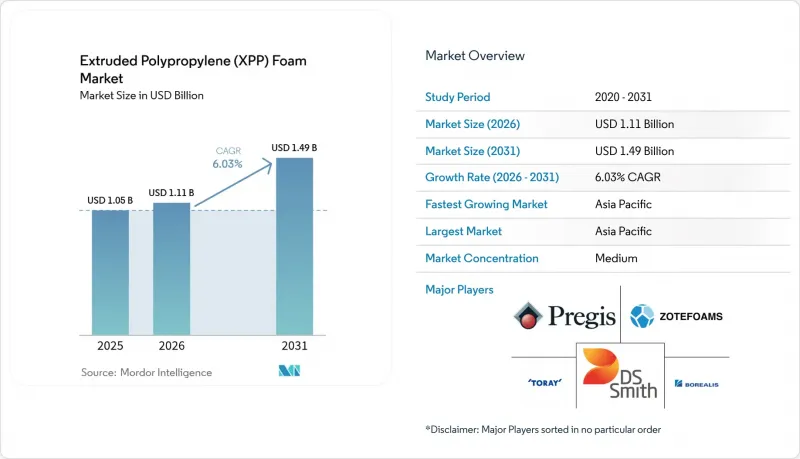
Mordor Intelligence에 의하면, 압출 폴리프로필렌(XPP) 폼 시장 규모는 2025년에 10억 5,000만 달러로 평가되었고 2026년 11억 1,000만 달러에서 2031년까지 14억 9,000만 달러에 이를 것으로 예측되며, 예측 기간(2026-2031년) CAGR은 6.03%를 나타낼 전망입니다.
본 보고서에서는 업계를 ‘유형’(저밀도 XPP 폼 및 고밀도 XPP 폼), ‘최종 사용자 산업’(자동차, 건축 및 건설, 포장 등), 그리고 ‘지역’(아시아태평양, 북미, 남미, 유럽, 중동 및 아프리카)별로 분류하고 있습니다. 시장 전망은 금액(달러) 기준으로 제시되어 있습니다.
전 세계 압출 폴리프로필렌(XPP) 폼 시장 동향 및 인사이트력
뛰어난 특성과 높은 재활용성
XPP 폼은 많은 기존 폴리머보다 뛰어난 에너지 흡수성, 방음성, 단열성을 갖춘 독립 기포 구조를 가지고 있습니다. 130°C까지의 온도 범위에서 치수 안정성을 유지하기 때문에 급격한 온도 상승에 노출되는 차량의 엔진룸이나 실내 부품에 필수적입니다. 열가소성 수지이기 때문에 가교 열화를 일으키지 않고 파쇄, 재펠릿화, 재압출이 가능하여 순환형 경제의 조달 방침을 충족합니다. 또한 습기, 용제, 자외선에 대한 내성으로 인해 제품 수명이 연장되고 총 비용을 절감할 수 있습니다. 전 세계적으로 재생 폴리프로필렌의 사용량은 지속적으로 증가하고 있으며, 이로 인해 가공업체의 원료 공급원이 확대되고, 압출 폴리프로필렌 폼 시장의 가치 제안이 더욱 강화되고 있습니다.
자동차 경량화 규제
미국의 ‘기업 평균 연비(CAFE)’ 규제, 유럽연합(EU)의 CO2 배출량 목표, 그리고 중국의 듀얼 크레딧 제도가 맞물려 자동차 제조업체들에게 차량 중량 감축을 요구하고 있습니다. 범퍼 코어, 도어 패널,배터리 인클로저의 경우, 무거운 플라스틱이나 금속 인서트를 XPP 폼으로 대체함으로써 충돌 시 에너지 흡수 성능을 유지하면서 부품 중량을 약 25% 줄일 수 있습니다. 화학 발포 기술을 통해 엄격한 치수 공차를 충족하는 미세한 셀 구조를 가진 얇은 두께의 부재 제조가 가능해집니다. 내장 트림 공급업체인 Grupo Antolin사가 발포 재생재를 활용한 20% 경량화 프로그램을 시행하고 있는 것에서도 알 수 있듯이, 자동차 제조업체들은 현재 재생재가 함유된 XPP 등급을 지정하고 있습니다.
압출 폴리프로필렌의 고가와 프로파일렌 원자재 가격 변동
2025년 초, 정유시설의 가동 중단으로 인해 공급이 부족해지면서 프로파일렌 현물 가격은 FOB 한국 기준 825-835달러/mt까지 상승했습니다. 이에 이어 북미의 폴리프로필렌 계약 가격도 생산자가 불가항력을 선언함에 따라 2025년 1분기에 9% 급등했습니다. 이러한 가격 변동은 특히 장기 계약을 통해 원자재 리스크를 헤지할 수 없는 중소기업 컨버터의 이익률을 압박하고 있으며, 생산 능력에 대한 투자를 지연시키고 있습니다. 수지 가격의 급등은 압출 폴리프로필렌 폼 시장에도 파급되어 완제품 가격을 끌어올리는 한편, 성능 요건이 허용하는 한 고객들의 저가 폼에 대한 단기적인 대체 수요를 유발하고 있습니다.
부문 분석
고밀도 등급은 압출 폴리프로필렌 폼 시장에서 가장 빠르게 성장하는 분야이며, 설계자들이 더 높은 압축 강도와 치수 강성을 추구하는 가운데 2031년까지 연평균 성장률(CAGR)은 7.65%를 기록할 전망입니다. 2025년 시점에서는 경량화가 구조적 하중보다 우선시되는 포장 및 자동차 내장재 용도 덕분에 저밀도 폼이 여전히 시장을 주도하며, 압출 폴리프로필렌 폼 시장 점유율의 50.72%를 차지하고 있습니다.
현재 공정 엔지니어들은 용융 프로파일 전체에 걸쳐 핵형성제를 조정함으로써, 단일 시트 내에서 밀도를 최적화하고, 완충성과 강성을 겸비한 멀티존 부재를 구현하고 있습니다. 초임계 CO2 발포법은 셀 크기 분포를 좁히고 기계적 강도를 향상시켜, 집중 하중을 받는 패널에 있어 획기적인 기술이 되고 있습니다. 그래핀 박편 첨가를 포함한 나노 필러 연구에 따르면, 필러 함량이 1 중량% 미만인 경우에도 탄성 계수가 최대 30% 향상되는 것이 입증되어, 이를 통해 건축용 단열 조립체에서 XPP의 적용 범위가 확대되고 있습니다. 건축 외피에 관한 규제가 엄격해지는 가운데, 건축가들은 질량이 절반에 불과하면서도 동등한 R값을 실현할 수 있다는 점 때문에 미네랄 울 대신 고밀도 XPP를 지정하고 있습니다. 저밀도 폼은 여전히 인라인식 재사용 포장재, 접이식 완충재 및 HVAC 덕트의 주요 소재로 활용되고 있습니다. 새로운 투명화제 마스터배치를 통해 열변형 온도가 8℃ 상승하고, 연속 온도가 110℃에 달하는 보닛 내부 기류 부품의 수명이 연장되었습니다. 시장을 선도하는 기업들은 저밀도 시트에 산업 폐기물과 버진 수지를 혼합하여, 물성을 유지하면서 수지 비용과 온실가스 배출 강도를 줄이고 있습니다. 재료 기술자들 사이에서는 압출 폴리프로필렌 폼 시장이 각 등급의 우수한 특성을 활용한 하이브리드 밀도 솔루션으로 전환될 것으로 예상되고 있습니다. 공압출 라미네이트 내부에서 고밀도 코어와 저밀도 스킨을 조합함으로써, 경량적이면서도 견고한 운송용 컨테이너 벽면을 구현할 수 있습니다. 이러한 새로운 구성은 특히 무게와 비용 절감이 요구되는 라스트 마일 물류용 인클로저 분야에서 고체 폴리프로필렌 보드나 알루미늄 허니콤 시장 점유율을 빼앗을 가능성이 높다고 여겨집니다.
지역별 분석
아시아태평양은 중국의 자동차 수출, 인도의 퀵 서비스 식품 배달 급증, 일본의 재활용 포장 조기 도입에 힘입어 2025년 매출의 54.12%를 차지하며 압출 폴리프로필렌 폼 시장의 중심이 되고 있습니다. 각 OEM 업체들이 전기차용 부품 생산을 현지화하고, 전자상거래의 보급이 주요 도시를 넘어 확대됨에 따라, 이 지역의 소비량은 2031년까지 연평균 성장률(CAGR) 7.18%로 증가할 것으로 예측됩니다. 경량 차량에 대한 정부의 리베이트 제도와 일회용 플라스틱에 대한 규제가 재활용 가능한 발포재에 대한 수요를 뒷받침하고 있습니다. 생산자들은 지역 내 프로파일렌 크래커로공급망이 짧기 때문에 비용 상승률을 세계 평균 이하로 억제하며 경쟁력 있는 가격 책정을 유지하고 있습니다.
북미는 대형 에너지 흡수 부품이 필요한 픽업 트럭 및 SUV 플랫폼에 힘입어 시장 점유율 2위를 차지하고 있습니다. 미국 에너지부의 경량 소재 컨소시엄은 발포 폴리올레핀 배터리 실드 연구에 대한 자금 지원을 지속하고 있어, 이 지역을 응용 공학의 최전선에 계속 위치시키고 있습니다. 텍사스주에서 바이오프로판으로부터 프로파일렌을 생산하는 공장의 가동은 원료의 안정적인 공급을 강화하고, 저탄소 발포재 등급의 실용화를 가능하게 하고 있습니다. 그러나 이 지역은 여전히 프로파일렌 가격 변동에 직면해 있으며, 공급이 중단될 경우 하류 부문에 대한 투자가 둔화될 가능성이 있습니다. 유럽에서는 엄격한 재활용 가능성 및 탄소 발자국 목표와 연계된 고부가가치 틈새 시장이 육성되고 있습니다. 독일과 프랑스의 자동차 제조업체들은 보행자 안전 시험을 통과하면서도 완전한 재활용성을 유지해야 하는 충돌 흡수 패드 구조에 XPP를 채택하고 있습니다. 소매용 식품 트레이의 경우, PPWR(폴리프로필렌 폐기물 규제) 준수로 인해 발포 폴리스티렌 대체가 가속화된다면, 2031년까지 해당 지역의 압출 폴리프로필렌 폼 시장 점유율은 3퍼센트 포인트 상승할 가능성이 있습니다. 유럽의 가공업체들은 폐쇄형 루프 프로그램을 위한 깨끗한 사용 후 제품 흐름을 보장하는 통합 폐기물 수거 제도의 혜택을 누리고 있지만, 에너지 가격 급등으로 인해 아시아에 비해 영업이익률에 대한 압박이 계속되고 있습니다.
기타 혜택:
- 엑셀 형식 시장 예측(ME) 시트
- 3개월간의 애널리스트 지원
자주 묻는 질문
목차
제1장 서론
제2장 조사 방법
제3장 주요 요약
제4장 시장 구도
제5장 시장 규모와 성장 예측
제6장 경쟁 구도
제7장 시장 기회와 향후 전망
JHS 26.09.07According to Mordor Intelligence, the extruded polypropylene (XPP) foam market size was valued at USD 1.05 billion in 2025 and estimated to grow from USD 1.11 billion in 2026 to reach USD 1.49 billion by 2031, at a CAGR of 6.03% during the forecast period (2026-2031).
This report Segments the Industry by Type (Low-Density XPP Foam and High-Density XPP Foam), End-User Industry (Automotive, Building and Construction, Packaging, and More), and Geography (Asia-Pacific, North America, South America, Europe, and Middle East and Africa). The Market Forecasts are Provided in Terms of Value (USD).
Global Extruded Polypropylene (XPP) Foam Market Trends and Insights
Superior Properties & High Recyclability
XPP foam delivers a closed-cell matrix that absorbs energy, dampens noise, and insulates heat better than many incumbent polymers. It maintains dimensional integrity up to 130 °C, vital for vehicle under-hood and cabin components that experience temperature spikes. Because it is thermoplastic, the material can be shredded, re-pelletized, and extruded again without cross-linking degradation, satisfying circular-economy procurement policies. Its resistance to moisture, solvents, and ultraviolet radiation lengthens product life and lowers total cost. Global recycled-polypropylene usage continues to rise, giving converters a growing pool of feedstock that reinforces the extruded polypropylene foam market value proposition.
Automotive Lightweighting Mandates
Corporate Average Fuel Economy rules in the United States, the European Union's CO2 fleet targets, and China's dual-credit system collectively pressure automakers to shed vehicle mass. Replacing heavy plastics or metal inserts with XPP foam in bumper cores, door panels, and battery enclosures cuts part weight by about 25% while keeping crash energy absorption intact. Chemical foaming enables thin-wall sections with fine cell morphology that meet strict dimensional tolerances. Automakers are now specifying recycled-content XPP grades, as demonstrated by interior-trim supplier Grupo Antolin's 20% weight-reduction program using foamed recyclate.
High Price of Extruded Polypropylene & Volatile Propylene Feedstock Costs
Spot propylene climbed to USD 825-835/mt FOB Korea in early 2025 after refinery outages tightened supply. North American polypropylene contracts followed, jumping 9% in Q1 2025 as producers declared force majeure. These price swings compress converter margins and delay capacity investments, especially for smaller firms that cannot hedge raw-material risk through long-term contracts. High resin costs ripple through the extruded polypropylene foam market, raising finished-product prices and prompting short-term customer substitution toward lower-priced foams when performance demands allow.
Other drivers and restraints analyzed in the detailed report include:
- Growing Demand from Packaging Industry
- Increasing Demand for Recyclable and Sustainable Foams
- Limited Large-Scale Extrusion Capacity in Several Regions
For complete list of drivers and restraints, kindly check the Table Of Contents.
Segment Analysis
High-density grades represent the fastest-advancing slice of the extruded polypropylene foam market, posting a 7.65% CAGR through 2031 as designers pursue higher compressive strength and dimensional rigidity. In 2025, Low-density foam remained the leader, holding 50.72% of the extruded polypropylene foam market share, thanks to packaging and interior auto uses where weight savings trump structural loads.
Process engineers now tailor density within a single sheet by modulating nucleating agents across the melt profile, achieving multi-zone parts that blend cushioning and stiffness. Supercritical CO2 foaming narrows cell-size distribution and lifts mechanical integrity, a breakthrough for panels subject to concentrated loads. Nanofiller research, including graphene platelet additions, demonstrates up to 30% modulus uplift at filler loadings below 1 wt%, broadening the suitability of XPP in construction thermal-break assemblies. Architects specify high-density XPP over mineral wool as building-envelope codes tighten due to comparable R-values at half the mass. Low-density foam still powers in-line returnable packaging, foldable dunnage, and HVAC ducts. New clarifier masterbatches raise heat-distortion temperatures by 8 °C, extending service life in under-hood airflow components where continuous temperatures reach 110 °C. Market leaders are combining post-industrial scrap with virgin resin for low-density sheets, keeping physical properties unchanged while lowering resin costs and greenhouse-gas intensity. Materials technologists expect the extruded polypropylene foam market to shift toward hybrid density solutions that exploit the best attributes of each grade. High-density cores paired with low-density skins inside one co-extruded laminate enable lightweight yet robust transport container walls. The new configurations are likely to capture share from solid polypropylene boards and aluminum honeycomb, especially in last-mile logistics enclosures seeking weight and cost reductions.
Complete Report Scope:
- Type
- Low-Density XPP Foam
- High-Density XPP Foam
- By End-User Industry
- Automotive
- Building and Construction
- Packaging
- Other End-User Industries (Consumer Goods and Toys, etc.)
- By Geography
- Asia-Pacific
- China
- Japan
- India
- South Korea
- ASEAN Countries
- Rest of Asia-Pacific
- North America
- United States
- Canada
- Mexico
- Europe
- Germany
- United Kingdom
- Italy
- France
- Rest of Europe
- South America
- Brazil
- Argentina
- Rest of South America
- Middle East and Africa
- Saudi Arabia
- South Africa
- Rest of Middle East and Africa
- Asia-Pacific
Geography Analysis
Asia-Pacific anchors the extruded polypropylene foam market with 54.12% of 2025 revenues, driven by China's automotive exports, India's surge in quick-service food delivery, and Japan's early adoption of circular packaging. Regional consumption is projected to climb 7.18% CAGR through 2031 as OEMs localize electric-vehicle component production and e-commerce penetration spreads beyond tier-one cities. Government rebate programs for lightweight vehicles and restrictions on single-use plastics reinforce demand for recyclable foams. Producers enjoy shorter supply chains to regional propylene crackers, keeping cost inflation below global averages and supporting competitive pricing.
North America holds the second-largest slice, propelled by pickup and SUV platforms that require large energy-absorbing components. The United States Department of Energy's Lightweight Materials Consortium continues to fund research into foamed polyolefin battery shields, keeping the region at the forefront of application engineering. Installations of bio-propane-to-propylene units in Texas bolster feedstock security and unlock low-carbon foam grades. However, the region still contends with propylene price volatility, which can slow downstream investment during supply disruptions. Europe fosters high-value niches tied to stringent recyclability and carbon-footprint targets. Automakers in Germany and France deploy XPP in crash-pad structures that must pass pedestrian-safety tests while remaining fully recyclable. The region's extruded polypropylene foam market share could rise three percentage points by 2031 if PPWR compliance accelerates conversion away from expanded polystyrene in retail food trays. European converters benefit from harmonized waste-collection schemes that secure clean post-consumer streams for closed-loop programs, but higher energy prices continue to pressure operating margins relative to Asia.
- BOREALIS GMBH
- Braskem
- DS Smith
- Furukawa Electric Co., Ltd.
- NMC International SA
- Pregis LLC
- Sekisui Voltek
- SPUR
- Sumitomo Chemical Co., Ltd.
- TORAY INDUSTRIES, INC.
- Zotefoams plc
Additional Benefits:
- The market estimate (ME) sheet in Excel format
- 3 months of analyst support
TABLE OF CONTENTS
1 Introduction
- 1.1 Study Assumptions & Market Definition
- 1.2 Scope of the Study
2 Research Methodology
3 Executive Summary
4 Market Landscape
- 4.1 Market Overview
- 4.2 Market Drivers
- 4.2.1 Superior properties & high recyclability
- 4.2.2 Automotive lightweighting mandates
- 4.2.3 Growing demand from packaging industry
- 4.2.4 Increasing demand for recyclable and sustainable foams
- 4.2.5 Drone & UAV protective packaging boom
- 4.3 Market Restraints
- 4.3.1 High price of extruded polypropylene
- 4.3.2 Volatile propylene feedstock costs
- 4.3.3 Limited large-scale extrusion capacity in several regions
- 4.4 Value-Chain Analysis
- 4.5 Porter's Five Forces
- 4.5.1 Bargaining Power of Suppliers
- 4.5.2 Bargaining Power of Buyers
- 4.5.3 Threat of New Entrants
- 4.5.4 Threat of Substitutes
- 4.5.5 Competitive Rivalry
5 Market Size & Growth Forecasts (Value)
- 5.1 Type
- 5.1.1 Low-Density XPP Foam
- 5.1.2 High-Density XPP Foam
- 5.2 By End-User Industry
- 5.2.1 Automotive
- 5.2.2 Building and Construction
- 5.2.3 Packaging
- 5.2.4 Other End-User Industries (Consumer Goods and Toys, etc.)
- 5.3 By Geography
- 5.3.1 Asia-Pacific
- 5.3.1.1 China
- 5.3.1.2 Japan
- 5.3.1.3 India
- 5.3.1.4 South Korea
- 5.3.1.5 ASEAN Countries
- 5.3.1.6 Rest of Asia-Pacific
- 5.3.2 North America
- 5.3.2.1 United States
- 5.3.2.2 Canada
- 5.3.2.3 Mexico
- 5.3.3 Europe
- 5.3.3.1 Germany
- 5.3.3.2 United Kingdom
- 5.3.3.3 Italy
- 5.3.3.4 France
- 5.3.3.5 Rest of Europe
- 5.3.4 South America
- 5.3.4.1 Brazil
- 5.3.4.2 Argentina
- 5.3.4.3 Rest of South America
- 5.3.5 Middle East and Africa
- 5.3.5.1 Saudi Arabia
- 5.3.5.2 South Africa
- 5.3.5.3 Rest of Middle East and Africa
- 5.3.1 Asia-Pacific
6 Competitive Landscape
- 6.1 Market Concentration
- 6.2 Strategic Moves
- 6.3 Market Share (%)/Ranking Analysis
- 6.4 Company Profiles (includes Global level Overview...Recent Developments)
- 6.4.1 BOREALIS GMBH
- 6.4.2 Braskem
- 6.4.3 DS Smith
- 6.4.4 Furukawa Electric Co., Ltd.
- 6.4.5 NMC International SA
- 6.4.6 Pregis LLC
- 6.4.7 Sekisui Voltek
- 6.4.8 SPUR
- 6.4.9 Sumitomo Chemical Co., Ltd.
- 6.4.10 TORAY INDUSTRIES, INC.
- 6.4.11 Zotefoams plc
7 Market Opportunities & Future Outlook
- 7.1 White-space & Unmet-Need Assessment