

|
시장보고서
상품코드
2123480
기저세포암 치료 시장 : 점유율 분석, 업계 동향과 통계, 성장 예측(2026-2031년)Basal Cell Carcinoma Treatment - Market Share Analysis, Industry Trends & Statistics, Growth Forecasts (2026 - 2031) |
||||||
 Mordor Intelligence
Mordor Intelligence에 의하면, 2026년 기저세포암 치료 시장 규모는 85억 3,000만 달러로 추정되고 있어 2025년 78억 2,000만 달러에서 성장하여 2031년에는 132억 1,000만 달러에 이를 것으로 예측됩니다.
2026년부터 2031년까지의 연평균 성장률(CAGR)은 9.12%를 나타낼 전망입니다.
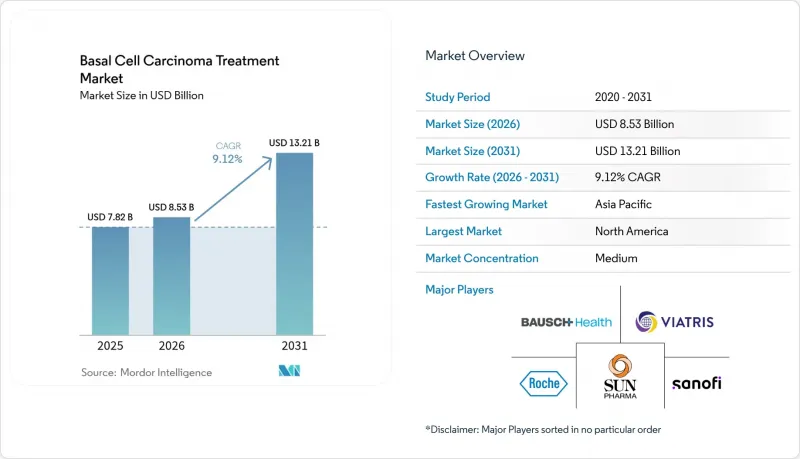
본 보고서는 치료법별(수술(외과적 절제 등), 방사선 치료 등), 병기별(표재성, 결절성 등), 최종 사용자별(병원, 전문 클리닉 등), 지역별(북미, 유럽, 아시아태평양 등)로 분류되어 있습니다. 시장 예측은 금액(달러) 단위로 표시되어 있습니다.
전 세계 기저세포암 치료 시장 동향 및 인사이트
피부암 유병률 증가
2021년 전 세계 기저세포암 신규 발병 건수는 440만 건에 달했으며, 이는 연령 조정 발병률로 10만 명당 51.71에 해당합니다. 피부과 의료의 확충과 1차 진료에서 영상 진단을 기반으로 한 분류 체계 도입으로 인해, 그동안 진단이 누락되었던 지역에서도 이전에는 파악되지 않았던 사례들이 드러나고 있습니다. 기후 모델 예측에 따르면, 오존층이 1% 감소할 때마다 기저세포암 발생률은 2.7% 상승하며, 기온이 2℃ 상승하면 2050년까지 환자 수가 11% 증가할 가능성이 있습니다. 일본에서는 인구 통계학적 가속화가 관찰되고 있으며, 현재 90세 이상의 환자가 진단 건수의 17%를 차지하고 있습니다. 야외 근로자의 직업적 노출은 여전히 높은 수준이며, 고용주는 자외선 차단 장비 및 정기 검진에 대한 투자를 추진하고 있습니다.
누적 자외선 노출량이 많은 고령화 사회
1989년부터 2021년까지 일본의 암 등록 데이터에서 70세 이상 환자의 비율은 44%에서 74%로 증가했습니다. 티민 이량체 형성에 의한 DNA 손상은 수십 년에 걸쳐 축적되기 때문에 고령자 집단은 특히 그 영향을 받기 쉽습니다. 이에 대응하여 의료 제도에서는 노인 피부과 설치나 고령자에 대한 검진 기준 완화 등의 조치가 이루어지고 있으며, 이를 통해 조기 발견이 촉진되어 비용 대비 효과의 향상으로 이어지고 있습니다.
고도의 약물 요법 및 수술의 고액 비용
비스모데기브와 세미프리마브의 월별 가격은 각각 1만 3,000달러 및 1만 달러로 책정되어 있어, 많은 본인 부담 환자들에게는 감당하기 어려운 가격입니다. 모스 현미경 하 수술은 5년 치유율이 98%를 초과함에도 불구하고, 표준 절제술에 비해 120-370% 더 높은 비용이 듭니다. 환자 1인당 평균 의료비는 2006년 1,000달러에서 2011년 1,600달러로 상승했으며, 현재도 계속 상승하고 있습니다. 저소득 국가에서는 시장 진입까지 최대 7년이나 지연되는 경우도 있어, 경제적 부담과 규제상의 과제가 부각되고 있습니다. SkinJect와 같은 패치형 접근 방식은 1,000달러라는 가격대를 목표로 하고 있으며, 경제적 부담의 격차를 해소하는 것을 목표로 하고 있습니다.
부문 분석
2025년 기저세포암 치료 시장 규모 중 외과적 시술이 35.78%를 차지하고 있어, 광범위 절제술 및 모스 현미경 수술 프로토콜에 대한 임상의들의 신뢰도가 높음을 알 수 있습니다. 모스 수술의 이용률은 1992년부터 2009년까지 700% 증가했으나, 고액의 비용으로 인해 지불 측의 면밀한 검토가 이루어지고 있습니다. 방사선 치료는 수술이 적합하지 않은 환자에서 80-92%의 국소 제어율을 기록하고 있습니다. 광역학 요법은 치료 기간이 짧고 미용상의 이점도 있어 연평균 성장률(CAGR) 10.74%로 가장 빠르게 성장하고 있는 치료법입니다. 5-플루오로우라실과 칼시포트리엔을 병용하는 외용 요법은 단일 요법 4주와 비교하여 7-14일 이내에 병변 소실이 달성되게 되었습니다. 헤지호그 경로 억제제와 체크포인트 억제 항체는 진행성 사례에서 생존 기간을 연장합니다. 세미프리마브는 국소 진행성 사례에서 29%, 전이성 사례에서 21%의 객관적 반응률을 보이고 있습니다. VP-315와 같은 새로운 종양 용해성 펩타이드들은 2상 임상시험에서 97%의 전체 반응률과 51%의 조직학적 완전 소실률을 달성하여, 비수술적 치료를 통한 혁신적인 미래를 시사하고 있습니다.
2세대 전달 플랫폼과 AI를 활용한 병변 매핑이 이러한 치료의 변혁을 보완하고 있습니다. 광간섭단층촬영(OCT)은 병변 중심부에서 95.5%의 정확도를 달성하여, 이를 통해 외과의사는 절제 마진을 최소화하고 정상 조직을 보존할 수 있습니다. 이러한 높은 정확도로 인해 수술 단계가 줄어들고, 환자 처리 속도가 향상되며, 시설 비용도 절감됩니다. 이 기술이 외래 진료 센터에 보급됨에 따라, 광역학 요법 및 외용제를 이용한 기저세포암 치료 시장 규모도 비례하여 확대될 것으로 예측됩니다.
지역별 분석
북미는 2025년 기저세포암 치료 시장 매출의 43.05%를 차지하며, 2031년까지 연평균 성장률(CAGR) 8.52%로 성장할 전망입니다. FDA 승인을 받은 DermaSensor와 같은 최첨단 진단 기술로 인해 1차 진료 역량은 확대되고 있지만, 모스 수술 비용이 표준 절제술보다 120-370% 높은 수준을 유지하고 있어 고액 본인 부담형 의료 보험 플랜이 치료 보급을 저해하고 있습니다. 규제 측면의 유연성은 혁신적인 기업에 유리하게 작용하고 있으며, 세미프리맙과 코시베리맙에 대한 ‘획기적인 치료법’ 지정이 그 증거이지만, 2024년 12월부터 2025년 7월에 걸쳐 발생한 EFUDEX공급 부족으로 인해,공급망의 취약성이 여실히 드러났습니다.
아시아태평양은 기저세포암 치료 시장에서 연평균 성장률(CAGR) 10.01%를 기록하며 가장 빠르게 성장하고 있는 지역입니다. 한국에서는 1999년부터 2019년까지 환자 수가 7배로 증가했으며, 기저세포암 진단 건수는 488건에서 3,908건으로 급증했습니다. 규제 당국은 80.9%의 정확도를 자랑하는 ‘카노피 MD SCAI’ AI 소프트웨어를 승인함으로써, 기술 주도형 도입이 진행되고 있음을 뒷받침하고 있습니다. 일본의 등록 데이터에 따르면, 90세 이상 환자가 전체 사례의 17%를 차지하게 되어 인구 통계학적 압박이 부각되고 있습니다. 조직학적 아형의 차이로 인해 지역별 지침이 필요해지고 있습니다. 이는 표재성 병변의 발생 빈도가 서유럽 코호트에 비해 낮기 때문입니다.
유럽에서는 국민건강보험 제도와 엄격한 자외선 노출 규제의 뒷받침을 받아 연평균 성장률(CAGR) 8.83%로 시장이 확대되고 있습니다. 유럽연합 집행위원회는 진행성 기저세포암에 대한 최초의 면역요법으로 세미프리마브를 승인하며 규제 환경의 유연성을 보여주었습니다. BF-200 ALA를 이용한 광역학 요법의 임상시험에서는 90.9%의 병변 소실률이 확인되어, 미용적 측면이 고려되어야 하는 치료 분야에서 유럽의 우위가 더욱 공고해졌습니다. 중동 및 아프리카은 민간 헬스케어의 확대와 정부의 임상시험 승인 진전을 발판으로 연평균 성장률(CAGR) 9.56%를 기록하며 성장하고 있습니다. 아랍에미리트(UAE)는 2025년 5월, 메디카스 파마(Medicas Pharma)사의 ‘SkinJect’ 마이크로니들 패치의 임상시험을 승인하며, 현지 임상 연구 역량으로의 전환을 상징했습니다. 그러나 지방 지역의 피부과 의료 접근성은 여전히 열악하여 원격 피부과 플랫폼 도입이 시급합니다. 남미는 9.21%의 성장률을 보이고 있지만, 새로운 생물학적 제제의 보험 환급과 관련된 과제에 직면해 있어, 비용 대비 효과가 높은 제네릭 의약품 및 원격 선별 검사의 시범 사업으로의 길이 열리고 있습니다.
기타 혜택:
- 엑셀 형식 시장 예측(ME) 시트
- 3개월간의 애널리스트 지원
자주 묻는 질문
목차
제1장 서론
제2장 조사 방법
제3장 주요 요약
제4장 시장 구도
제5장 시장 규모와 성장 예측
제6장 경쟁 구도
제7장 시장 기회와 향후 전망
JHS 26.09.07According to Mordor Intelligence, basal cell carcinoma treatment market size in 2026 is estimated at USD 8.53 billion, growing from 2025 value of USD 7.82 billion with 2031 projections showing USD 13.21 billion, growing at 9.12% CAGR over 2026-2031.
This report is Segmented by Treatment Type (Surgery [Surgical Excision and More], Radiation Therapy, and More), Disease Stage (Superficial, Nosular, and More), End-User (Hospitals, Specialty Clinics, and More), and Geography (North America, Europe, Asia-Pacific, and More). The Market Forecasts are Provided in Terms of Value (USD).
Global Basal Cell Carcinoma Treatment Market Trends and Insights
Rising prevalence of skin cancers
Global basal cell carcinoma incidence reached 4.4 million new cases in 2021, equal to an age-standardized rate of 51.71 per 100,000. Enhanced dermatology coverage and image-based triage in primary care expose historically hidden caseloads in underserved regions. Climate-model forecasts show that every 1% depletion of ozone could elevate basal cell carcinoma incidence by 2.7%, while a 2 °C temperature rise could add 11% more cases by 2050. Japan illustrates demographic acceleration, with individuals aged >= 90 now comprising 17% of diagnoses. Occupational exposure remains high among outdoor workers, prompting employers to invest in UV-protective gear and routine screenings.
Aging population with higher cumulative UV exposure
The share of patients older than 70 increased from 44% to 74% in Japanese cancer registries between 1989 and 2021. DNA damage due to thymine-dimer formation accumulates across decades, making geriatric cohorts especially susceptible. Healthcare systems have responded by adding geriatric dermatology divisions and lowering screening thresholds for senior citizens, which fosters earlier-stage identification and improves cost-effectiveness.
High cost of advanced drug therapies & surgeries
Vismodegib and cemiplimab list at USD 13,000 and USD 10,000 per month, respectively, placing them out of reach for many self-pay patients. Mohs micrographic surgery costs 120-370% more than standard excision, even though five-year cure rates exceed 98%. Average per-patient spending rose from USD 1,000 in 2006 to USD 1,600 in 2011 and continues to climb. Market entry lags can span up to seven years in lower-income economies, evidencing affordability and regulatory challenges. Patch-based approaches such as SkinJect target a USD 1,000 price point, aiming to close the affordability gap.
Other drivers and restraints analyzed in the detailed report include:
- AI-driven dermoscopy enabling earlier detection & treatment
- Environmental changes increasing average UV radiation
- Under-diagnosis in primary-care settings
For complete list of drivers and restraints, kindly check the Table Of Contents.
Segment Analysis
Surgical techniques accounted for 35.78% of the basal cell carcinoma treatment market size in 2025, underscoring clinician confidence in wide excision and Mohs micrographic protocols. Mohs utilization expanded 700% from 1992 to 2009, yet premium costs have triggered payer scrutiny. Radiation therapy records 80-92% local-control rates for patients unsuitable for surgery. Photodynamic therapy is the fastest-growing modality at an 10.74% CAGR, buoyed by short healing times and cosmetic advantages. Combination topical regimens-5-fluorouracil plus calcipotriene-now achieve clearance within seven-to-14 days compared with four-week monotherapy. Hedgehog-pathway inhibitors and checkpoint antibodies extend life in advanced cases: cemiplimab delivers 29% objective responses in locally advanced and 21% in metastatic cohorts. Novel oncolytic peptides such as VP-315 yielded 97% overall response and 51% complete histologic clearance in Phase 2, indicating a disruptive non-surgical future.
Second-generation delivery platforms and AI-guided lesion mapping complement these therapeutic shifts. Optical coherence tomography reaches 95.5% accuracy at lesion centers, allowing surgeons to limit excision margins and preserve healthy tissue. Such precision reduces operative stages, accelerating patient throughput and lessening facility costs. As technology penetrates outpatient centers, the basal cell carcinoma treatment market size for photodynamic and topical agents is projected to expand proportionally.
Complete Report Scope:
- By Treatment Type
- Surgery
- Surgical Excision
- Mohs Micrographic Surgery
- Electrodesiccation and Curettage (ED&C)
- Radiation Therapy
- Photodynamic Therapy
- Cryotherapy
- Topical Chemotherapy
- 5-fluorouracil (5-FU)
- Tirbanibulin
- Imiquimod
- Oral Medications
- Intravenous Medications
- Surgery
- By Disease Stage
- Superficial
- Nodular
- Infiltrative
- Metastatic
- By End-User
- Hospitals
- Specialty Clinics
- Ambulatory Surgical Centers
- Others
- By Geography
- North America
- United States
- Canada
- Mexico
- Europe
- Germany
- United Kingdom
- France
- Italy
- Spain
- Rest of Europe
- Asia-Pacific
- China
- India
- Japan
- Australia
- South Korea
- Rest of Asia-Pacific
- Middle East and Africa
- GCC
- South Africa
- Rest of Middle East and Africa
- South America
- Brazil
- Argentina
- Rest of South America
- North America
Geography Analysis
North America controls 43.05% of the basal cell carcinoma treatment market revenue in 2025 and is positioned for an 8.52% CAGR to 2031. Cutting-edge diagnostics such as FDA-approved DermaSensor widen primary-care capabilities, but high-deductible health plans temper therapy uptake as Mohs costs remain 120-370% above standard excision. Regulatory agility benefits innovators, evidenced by breakthrough designations for cemiplimab and cosibelimab, yet supply-chain fragilities surfaced via EFUDEX shortages from December 2024 to July 2025.
Asia-Pacific is the basal cell carcinoma treatment market's fastest-growing region at 10.01% CAGR. Korea saw cases climb seven-fold from 1999 to 2019, with basal cell carcinoma soaring from 488 to 3,908 diagnoses. Regulatory bodies green-lit canofyMD SCAI AI software at 80.9% accuracy, underscoring tech-forward adoption. Japan's registries show patients aged >= 90 now represent 17% of cases, spotlighting demographic pressure. Differences in histological subtypes mandate region-specific guidelines, as superficial lesions are less frequent than in Western cohorts.
Europe advances at 8.83% CAGR fueled by universal coverage and strict UV-exposure policies. The European Commission approved cemiplimab as the first immunotherapy for advanced basal cell carcinoma, showcasing a receptive regulatory landscape. Photodynamic therapy trials with BF-200 ALA register 90.9% clearance, reinforcing Europe's lead in cosmetically sensitive treatments. Middle East and Africa progress at 9.56% CAGR, catalyzed by expanding private healthcare and governmental trial approvals. The UAE authorized Medicus Pharma's SkinJect microneedle patch trials in May 2025, marking a shift toward local clinical research capacity. Yet rural dermatology access remains sparse, pressing teledermatology platforms into service. South America grows at 9.21% but faces reimbursement hurdles for newer biologics, paving the way for cost-effective generics and remote screening pilots.
- Abbvie
- Bausch Health
- BridgeBio Pharma Inc
- Bristol-Myers Squibb
- Castle Biosciences Inc.
- Eisai
- Roche
- Galderma
- Leo Pharma
- Medicus Pharma Ltd
- Medivir
- Merck
- Novartis
- Perrigo Company
- Pfizer
- Regeneron Pharmaceuticals
- Regeneron Pharmaceuticals
- Sanofi
- Sun Pharmaceuticals Industries
- Taro Pharmaceutical Industries
- Verrica Pharmaceuticals Inc.
- Viatris
Additional Benefits:
- The market estimate (ME) sheet in Excel format
- 3 months of analyst support
TABLE OF CONTENTS
1 Introduction
- 1.1 Study Assumptions & Market Definition
- 1.2 Scope of the Study
2 Research Methodology
3 Executive Summary
4 Market Landscape
- 4.1 Market Overview
- 4.2 Market Drivers
- 4.2.1 Rising prevalence of skin cancers
- 4.2.2 Aging population with higher cumulative UV exposure
- 4.2.3 AI-driven dermoscopy enabling earlier detection & treatment
- 4.2.4 Environmental changes increasing average UV radiation
- 4.2.5 Label expansions of Hedgehog-pathway inhibitors
- 4.2.6 Workplace sun-safety legislation boosting screening demand
- 4.3 Market Restraints
- 4.3.1 High cost of advanced drug therapies & surgeries
- 4.3.2 Under-diagnosis in primary-care settings
- 4.3.3 Reimbursement hurdles for checkpoint-inhibitor combinations
- 4.3.4 Safety concerns over long-term Hedgehog-inhibitor toxicity
- 4.4 Regulatory Landscape
- 4.5 Porter's Five Forces Analysis
- 4.5.1 Threat of New Entrants
- 4.5.2 Bargaining Power of Buyers
- 4.5.3 Bargaining Power of Suppliers
- 4.5.4 Threat of Substitutes
- 4.5.5 Intensity of Competitive Rivalry
- 4.6 Epidemiology Trends
5 Market Size & Growth Forecasts (Value)
- 5.1 By Treatment Type
- 5.1.1 Surgery
- 5.1.1.1 Surgical Excision
- 5.1.1.2 Mohs Micrographic Surgery
- 5.1.1.3 Electrodesiccation and Curettage (ED&C)
- 5.1.2 Radiation Therapy
- 5.1.3 Photodynamic Therapy
- 5.1.4 Cryotherapy
- 5.1.5 Topical Chemotherapy
- 5.1.5.1 5-fluorouracil (5-FU)
- 5.1.5.2 Tirbanibulin
- 5.1.5.3 Imiquimod
- 5.1.6 Oral Medications
- 5.1.7 Intravenous Medications
- 5.1.1 Surgery
- 5.2 By Disease Stage
- 5.2.1 Superficial
- 5.2.2 Nodular
- 5.2.3 Infiltrative
- 5.2.4 Metastatic
- 5.3 By End-User
- 5.3.1 Hospitals
- 5.3.2 Specialty Clinics
- 5.3.3 Ambulatory Surgical Centers
- 5.3.4 Others
- 5.4 By Geography
- 5.4.1 North America
- 5.4.1.1 United States
- 5.4.1.2 Canada
- 5.4.1.3 Mexico
- 5.4.2 Europe
- 5.4.2.1 Germany
- 5.4.2.2 United Kingdom
- 5.4.2.3 France
- 5.4.2.4 Italy
- 5.4.2.5 Spain
- 5.4.2.6 Rest of Europe
- 5.4.3 Asia-Pacific
- 5.4.3.1 China
- 5.4.3.2 India
- 5.4.3.3 Japan
- 5.4.3.4 Australia
- 5.4.3.5 South Korea
- 5.4.3.6 Rest of Asia-Pacific
- 5.4.4 Middle East and Africa
- 5.4.4.1 GCC
- 5.4.4.2 South Africa
- 5.4.4.3 Rest of Middle East and Africa
- 5.4.5 South America
- 5.4.5.1 Brazil
- 5.4.5.2 Argentina
- 5.4.5.3 Rest of South America
- 5.4.1 North America
6 Competitive Landscape
- 6.1 Market Concentration
- 6.2 Competitive Benchmarking
- 6.3 Market Share Analysis
- 6.4 Company Profiles (includes Global level Overview, Market level overview, Core Segments, Financials as available, Strategic Information, Market Rank/Share for key companies, Products & Services, and Recent Developments)
- 6.4.1 AbbVie (Allergan)
- 6.4.2 Bausch Health Companies Inc.
- 6.4.3 BridgeBio Pharma Inc
- 6.4.4 Bristol Myers Squibb Co.
- 6.4.5 Castle Biosciences Inc.
- 6.4.6 Eisai Co., Ltd.
- 6.4.7 F. Hoffmann-La Roche AG
- 6.4.8 Galderma S.A.
- 6.4.9 LEO Pharma A/S
- 6.4.10 Medicus Pharma Ltd
- 6.4.11 Medivir AB
- 6.4.12 Merck & Co., Inc.
- 6.4.13 Novartis AG
- 6.4.14 Perrigo Company plc
- 6.4.15 Pfizer Inc.
- 6.4.16 Regeneron Pharmaceuticals Inc.
- 6.4.17 Regeneron Pharmaceuticals Inc.
- 6.4.18 Sanofi S.A.
- 6.4.19 Sun Pharmaceutical Industries Ltd
- 6.4.20 Taro Pharmaceutical Industries Ltd
- 6.4.21 Verrica Pharmaceuticals Inc.
- 6.4.22 Viatris Inc.
7 Market Opportunities & Future Outlook
- 7.1 White-space & Unmet-Need Assessment


