

|
시장보고서
상품코드
2123481
근접치료 기기 시장 : 점유율 분석, 업계 동향과 통계, 성장 예측(2026-2031년)Brachytherapy Devices - Market Share Analysis, Industry Trends & Statistics, Growth Forecasts (2026 - 2031) |
||||||
 Mordor Intelligence
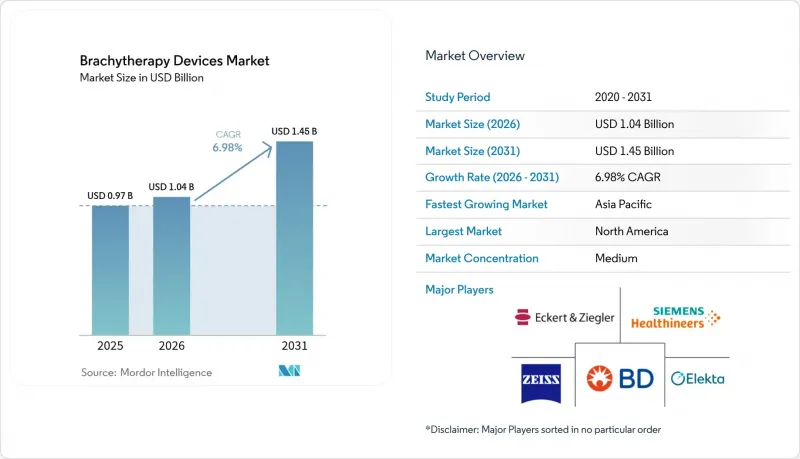
Mordor Intelligence에 의하면, 세계의 근접치료 기기 시장 규모는 2025년에 9억 7,000만 달러로 평가되었고 2026년 10억 4,000만 달러에서 2031년까지 14억 5,000만 달러에 이를 것으로 예측되며, 예측 기간(2026-2031년) CAGR은 6.98%를 나타낼 전망입니다.
본 보고서는 방식별(고선량률(HDR) 근접치료 기기 등), 제품 유형별(시드, 어플리케이터 및 애프터로더 등), 용도별(부인과암, 전립선암, 유방암 등), 최종 사용자별(병원, 외래수술센터(ASC) 등), 지역별(북미, 유럽 등)로 분류되어 있습니다. 시장 예측은 금액(달러) 기준으로 제시되어 있습니다.
전 세계 근접치료 기기 시장 동향 및 인사이트
암 발병률 증가에 따른 부담 확대
세계적으로 암 진단 건수가 지속적으로 증가하고 있는 것이 정밀하고 국소적인 방사선 치료에 대한 구조적인 수요의 배경이 되고 있습니다. 미국암협회(American Cancer Society)는 2025년에 미국에서 204만 1,910건의 신규 사례가 발생할 것으로 예측하고 있으며, 전립선암, 유방암, 부인과암이 근접방사선치료의 주요 임상 적응증이 되고 있습니다. 고령화가 진행되는 가운데, 종양 전문의들은 근접조치 요법의 높은 적응성과 장기 보존의 이점을 높이 평가했습니다. 간세포암에 관한 임상 데이터에 따르면, 고선량률 프로토콜을 적용했을 때 전체 반응률이 98.5%로 보고되어, 적응증 질환 확대를 위한 가능성을 시사하고 있습니다. 이러한 역학적 데이터와 치료 성과에 대한 증거가 결합되어 전 세계 근접치료 기기 시장의 장기적인 수요를 뒷받침하고 있습니다.
방사선 치료 접근성 확대를 위한 정부 및 보험사의 노력 활성화
정책 입안자들은 방사선 치료의 형평성을 공중보건상의 우선 과제로 간주하고 있습니다. 인도의 ‘내셔널 캔서 그리드(National Cancer Grid)’는 ‘Karknidon’ 원격 애프터로더 등 국산 HDR 플랫폼을 통해 국내에서 부족한 53대의 근접치료 기기 부족을 해소하고 도입 비용을 절감하고 있습니다. 미국에서는 메디케어의 ‘신기술에 대한 과도기적 적용(TCET)’ 제도를 통해 획기적인 의료기기의 적용 결정이 가속화되고 있으며, 연간 5건의 근접조사 요법 후보가 적용 대상이 될 가능성이 있습니다. 이러한 움직임은 환자층을 확대하고, 전 세계 근접치료 기기 시장에서 혁신에 따른 위험을 완화하고 있습니다.
훈련을 받은 근접치료 전문 종양 전문의 및 의료물리사 부족
미국 의료물리학자의 15%가 10년 이내에 은퇴할 의사를 밝힌 반면, 암 발생률은 연간 2%씩 증가하고 있어 인력 부족이 심화되고 있습니다. 연수 프로그램 책임자들은 사례 수가 제한적이라는 점이 실무 경험 기회를 저해하는 장벽이 되고 있다고 지적하며, 이는 향후 역량 육성을 방해하고 있습니다. 호주 및 뉴질랜드의 수련의들도 씨드 이식 건수 감소에 대한 우려를 공유하고 있어, 기술 상실이 우려됩니다. 시뮬레이션 워크숍을 통해 숙련도는 향상되고 있지만, 인력 공급은 여전히 전 세계 근접치료 기기 시장의 성장을 가로막는 병목 요인으로 남아 있습니다.
부문 분석
2025년, 고선량률(HDR) 시스템은 전 세계 근접치료 기기 시장에서 55.02%의 점유율을 차지했습니다. 이는 치료를 소수의 분할 세션으로 집중시켜 현대 외래 진료의 경제성에 부합할 수 있는 능력을 반영한 것입니다. ASTRO 2024에서 발표된 동료 심사 데이터를 통해 고선량률(HDR)군과 저선량률(LDR)군 모두에서 전체 생존율을 저해하지 않으면서 선량 증량의 이점이 확인되었습니다. 이 부문의 선도적 지위는 여전히 전립선암 및 부인과 분야 치료 워크플로우에 뿌리를 두고 있지만, 폐, 간, 두경부암 적응증에서도 수용이 확대되고 있어 전 세계 근접치료 기기 시장의 하드웨어 업데이트 주기를 뒷받침하고 있습니다.
펄스 선량률(PDR) 기술은 2031년까지 연평균 성장률(CAGR) 8.88%를 나타낼 것으로 예측되며, LDR의 방사선 생물학과 HDR의 인프라를 융합함으로써 사례 구성의 유연성을 확대합니다. AI를 활용한 치료 계획으로 각 모달리티 간의 치료 품질이 균일화되어, 신규 도입자의 학습 곡선이 완만해집니다. LDR은 1회의 세션으로 완료된다는 편의성이 환자의 희망과 부합하는 영구 시드 이식에서 여전히 중요한 역할을 하고 있습니다. 치료법의 다양화로 인해 임상의는 선량 동태를 종양의 생물학적 특성에 맞출 수 있게 되어, 임상적 신뢰성을 높이고 치료법 대체 위험을 경감시킵니다.
시드는 비뇨기과 분야에서 수십 년에 걸친 실적과 합리화된 재고 모델을 바탕으로, 2025년에는 전 세계 근접치료 기기 시장에서 43.05%의 점유율을 차지했습니다. 그러나 방사성 원료의 취급이 필요 없는 전자 근접 치료(eBx) 시스템은 2031년까지 연평균 성장률(CAGR) 14.39%로 성장할 전망입니다. eBx의 세계 근접치료 기기 시장 규모는 차폐실이 필요 없는 운영 방식 덕분에, 특히 피부 및 유방 치료 프로토콜 분야에서 소규모 병원이나 외래 진료 센터가 이 치료법을 도입함에 따라 확대될 것으로 예측됩니다.
어플리케이터 및 애프터로더는 HDR 및 PDR 워크플로우의 기계적 핵심을 이루고 있으며, 사례 수 증가와 선량률 기술 혁신에 따라 꾸준한 교체 수요가 유지되고 있습니다. 구독 모델로 제공되는 치료 계획 소프트웨어에는 강화 학습 스크립트가 내장되어 있어, 계획 반복 시간을 몇 시간에서 몇 분으로 단축합니다. 이로 인해 통합형 벤더에 대한 고객의 충성도가 높아지면서, 전 세계 근접치료 기기 시장 전체에서 전환 비용이 상승하고 있습니다.
지역별 분석
북미는 2025년에도 44.90%의 점유율을 유지했습니다. 이는 성숙한 보험 환급 제도, AI의 조기 도입, 그리고 밀집된 암 치료 네트워크가 치료 건수를 뒷받침하고 있기 때문입니다. TCET와 같은 연방 프로그램은 획기적인 근접치료 기기 시장 진입을 가속화하고 있지만, 물리학자의 은퇴율이 15%를 나타낼 것으로 전망됨에 따라 인재 확보가 과제로 대두되고 있습니다. Varian과 Ballad Health와 같은 제휴 관계는 장기적인 장비 및 서비스 계약을 통해 지방 지역의 접근성 격차를 해소하려는 노력을 보여주고 있습니다. 이러한 계약을 통해 얻는 공급업체의 서비스 수익은 전 세계 브래키테라피 장비 시장의 지역적 회복력을 뒷받침하고 있습니다.
유럽에서는 근거 기반의 도입과 국경을 초월한 연구 협력을 통해 꾸준한 성장이 예상됩니다. 독일, 프랑스, 영국은 MRI 유도 적응형 근접 치료의 선구자이며, AngioDynamics사의 AlphaVac F18 85와 같은 CE 마크를 획득한 혁신적인 제품이 급속히 보급되면서 규제의 예측 가능성을 높이고 있습니다. EU가 지원하는 아시아와의 연수 교류는 모범 사례의 확산을 촉진하고, 유럽 전역에서의 일관된 활용을 뒷받침하고 있습니다. 전 세계 근접치료 기기 시장은 유럽에서 진행되는 초기 단계 임상시험의 높은 밀도로부터 혜택을 받고 있으며, 이는 전 세계적인 구매 결정의 지침이 되고 있습니다.
아시아태평양은 암 의료 인프라 확장에 따라 2031년까지 9.08%라는 가장 높은 연평균 성장률(CAGR)을 나타낼 전망입니다. 인도에서는 연간 약 100만 건의 신규 암 사례가 보고되고 있으며, 국산 HDR 플랫폼을 통해 53대 분량의 근접치료 기기 부족을 해소하고 있습니다. 일본에서는 129대의 Ir-192 원격 애프터로더가 도입되었으며, 48%의 의료기관에서 3D 계획이 채택되고 있는 것으로 보고되어, 선진적인 진료 기법의 확산이 두드러지고 있습니다. 중국에서는 각 성의 의료기기 조달 프로그램과 중앙 정부의 보상 제도 개혁에 따라 환자의 접근성이 확대되고 있으나, 방사선 물리사 확보는 여전히 과제로 남아 있습니다. ‘아시아 방사선종양학회연합(FAORO)’을 통한 지역 협력은 치료의 질 향상을 목표로 하고 있으며, 전 세계 근접치료 기기 시장의 성장세를 유지하고 있습니다.
기타 혜택:
- 엑셀 형식 시장 예측(ME) 시트
- 3개월간 애널리스트 지원
자주 묻는 질문
목차
제1장 서론
제2장 조사 방법
제3장 주요 요약
제4장 시장 구도
제5장 시장 규모와 성장 예측
제6장 경쟁 구도
제7장 시장 기회와 향후 전망
JHS 26.09.09According to Mordor Intelligence, the global brachytherapy devices market size was valued at USD 0.97 billion in 2025 and estimated to grow from USD 1.04 billion in 2026 to reach USD 1.45 billion by 2031, at a CAGR of 6.98% during the forecast period (2026-2031).
This report is Segmented by Technique (High Dose Rate (HDR) Brachytherapy Devices, and More), Product Type (Seeds, Applicators & Afterloaders, and More), Application (Gynecologic Cancer, Prostate Cancer, Breast Cancer, and More), End User (Hospitals, Ambulatory Surgical Centers, and More), and Geography (North America, Europe, and More). The Market Forecasts are Provided in Terms of Value (USD).
Global Brachytherapy Devices Market Trends and Insights
Growing Burden of Cancer Incidence
Persistent growth in global cancer diagnoses underpins a structural need for precise, localized radiation. The American Cancer Society projects 2,041,910 new U.S. cases in 2025, with prostate, breast, and gynecologic cancers forming the core clinical settings for brachytherapy. As aging populations swell, oncologists value brachytherapy's high conformality and organ preservation advantages. Clinical data in hepatocellular carcinoma cite 98.5% overall response rates using high-dose-rate protocols, signaling opportunity for disease-site expansion. Together, epidemiology and outcome evidence reinforce long-run demand in the Global brachytherapy devices market.
Rising Government & Payer Initiatives to Expand Radiotherapy Access
Policy makers view radiotherapy equity as public-health priority. India's National Cancer Grid is closing a national shortfall of 53 brachytherapy units through indigenous HDR platforms, such as the 'Karknidon' remote after-loader, lowering acquisition costs. In the United States, Medicare's Transitional Coverage for Emerging Technologies (TCET) pathway accelerates breakthrough device coverage decisions, potentially welcoming five brachytherapy candidates each year. These moves broaden patient pools and de-risk innovation for the Global brachytherapy devices market.
Shortage of Trained Brachy-Oncologists & Medical Physicists
Fifteen percent of U.S. medical physicists signal retirement intentions within 10 years, while cancer incidence climbs 2% annually, magnifying staffing gaps. Residency directors cite limited caseloads as barriers to braid practical exposure, curtailing future competencies. Australian and New Zealand trainees echo concerns over shrinking seed-implant volumes, foreshadowing skills attrition. While simulation workshops raise proficiency, the talent pipeline remains a rate-limiter for the Global brachytherapy devices market.
Other drivers and restraints analyzed in the detailed report include:
- Technological Shift Toward HDR & Electronic Brachytherapy Systems
- Reimbursement Tail-Winds for Outpatient HDR Procedures
- Uneven Isotope Supply Chain & Export Controls
For complete list of drivers and restraints, kindly check the Table Of Contents.
Segment Analysis
High-dose-rate systems secured 55.02% share of the Global brachytherapy devices market in 2025, reflecting their capacity to condense treatment into few fractions and fit modern outpatient economics. Peer-reviewed data at ASTRO 2024 confirmed dose escalation benefits without overall-survival trade-offs across HDR and low-dose-rate (LDR) arms. The segment's leadership remains anchored in prostate and gynecologic workflows, yet lung, liver, and head-and-neck indications show acceptance, sustaining hardware refresh cycles in the Global brachytherapy devices market.
Pulsed-dose-rate (PDR) technology is projected to record 8.88% CAGR through 2031, blending LDR radiobiology with HDR infrastructure to expand case mix flexibility. AI-enabled planning equalizes quality between modalities, flattening the learning curve for new adopters. LDR retains relevance in permanent seed implants where single-session convenience aligns with patient preference. Technique diversification ensures clinicians match dose kinetics to tumor biology, reinforcing clinical confidence and mitigating modality substitution risk.
Seeds captured 43.05% share of the Global brachytherapy devices market in 2025, bolstered by decades of urology familiarity and streamlined inventory models. Yet electronic brachytherapy (eBx) systems-free of radioactive source handling-are on track for a 14.39% CAGR through 2031. The Global brachytherapy devices market size for eBx is projected to climb as unshielded-room operation invites smaller hospitals and ambulatory centers into the modality, especially for skin and breast protocols.
Applicators and after-loaders represent the mechanical backbone of HDR and PDR workflows, sustaining steady replacement demand as caseloads and dose-rate innovations evolve. Treatment-planning software, increasingly bundled in subscription models, embeds reinforcement learning scripts that cut plan iterations from hours to minutes, driving stickiness for integrated vendors and elevating switching costs across the Global brachytherapy devices market.
Complete Report Scope:
- By Technique
- High Dose Rate (HDR) Brachytherapy Devices
- Low Dose Rate (LDR) Brachytherapy Devices
- Pulsed Dose Rate (PDR) Brachytherapy Devices
- By Product Type
- Seeds
- Applicators & Afterloaders
- Electronic Brachytherapy Systems
- Software & Treatment-Planning Solutions
- By Application
- Prostate Cancer
- Gynecologic Cancer
- Breast Cancer
- Skin Cancer
- Head & Neck Cancer
- Others
- By End User
- Hospitals
- Oncology Centers & Specialty Clinics
- Ambulatory Surgical Centers
- Geography
- North America
- United States
- Canada
- Mexico
- Europe
- Germany
- United Kingdom
- France
- Italy
- Spain
- Rest of Europe
- Asia-Pacific
- China
- Japan
- India
- South Korea
- Australia
- Rest of Asia-Pacific
- Middle East and Africa
- GCC
- South Africa
- Rest of Middle East and Africa
- South America
- Brazil
- Argentina
- Rest of South America
- North America
Geography Analysis
North America retained 44.90% share in 2025 as mature reimbursement, early AI adoption, and a dense cancer-care network sustain procedure volumes. Federal programs such as TCET speed market access for breakthrough brachytherapy devices, while a looming 15% physicist retirement rate challenges workforce capacity. Partnerships like Varian-Ballad Health illustrate efforts to bridge rural access gaps via long-term equipment and service contracts. Vendor service revenues from these deals underpin regional resilience for the Global brachytherapy devices market.
Europe delivers steady growth through evidence-based adoption and cross-border research collaborations. Germany, France, and the United Kingdom pioneer MRI-guided adaptive brachytherapy, while CE-marked innovations such as AngioDynamics' AlphaVac F18 85 gain rapid uptake, reinforcing regulatory predictability. EU-backed training exchanges with Asia bolster best-practice dissemination and support consistent utilization across the continent. The Global brachytherapy devices market benefits from Europe's early-phase clinical trial density, informing global purchasing decisions.
Asia-Pacific will chart the highest 9.08% CAGR through 2031 as oncology infrastructure scales. India records nearly 1 million new cancer cases annually and addresses a 53-unit brachytherapy gap through indigenous HDR platforms. Japan hosts 129 Ir-192 remote after-loaders and reports 48% of centers employing 3D planning, underscoring advanced practice penetration. China's provincial equipment procurement programs and central reimbursement reforms are expanding patient access, but physics staffing remains constrained. Regional collaboration via the Federation of Asian Organizations for Radiation Oncology aims to elevate treatment quality, sustaining momentum for the Global brachytherapy devices market.
- Accuray
- Argon Medical Devices
- Beckton Dickinson
- Carl Zeiss
- CIVCO Medical solutions
- Eckert & Ziegler
- Elekta
- iCAD Inc.
- IsoRay
- Siemens Healthineers
- Theragenics
- ViewRay Inc.
- Panacea Medical Technologies
- C4 Imaging LLC
- Mevion Medical Systems
- Source Production & Equipment Co.
- IBt Bebig Belgium
- Advanced Oncology Solutions
Additional Benefits:
- The market estimate (ME) sheet in Excel format
- 3 months of analyst support
TABLE OF CONTENTS
1 Introduction
- 1.1 Study Assumptions & Market Definition
- 1.2 Scope of the Study
2 Research Methodology
3 Executive Summary
4 Market Landscape
- 4.1 Market Overview
- 4.2 Market Drivers
- 4.2.1 Growing Burden Of Cancer Incidence
- 4.2.2 Rising Government & Payer Initiatives To Expand Radiotherapy Access
- 4.2.3 Technological Shift Toward HDR & Electronic Brachytherapy Systems
- 4.2.4 Reimbursement Tail-Winds For Outpatient HDR Procedures
- 4.2.5 AI-Driven Treatment-Planning Improving Workflow Efficiency
- 4.2.6 Nano-Scale Radionuclide Carriers Enabling Organ-Sparing Salvage Therapy
- 4.3 Market Restraints
- 4.3.1 Shortage Of Trained Brachy-Oncologists & Medical Physicists
- 4.3.2 Uneven Isotope Supply Chain (Ir-192, I-125) & Export Controls
- 4.3.3 Declining Utilization Amid Competition From SBRT & Robotic Surgery
- 4.3.4 Regulatory Uncertainty Around Electronic Brachytherapy Devices (Class III)
- 4.4 Technological Outlook
- 4.5 Porter's Five Forces
- 4.5.1 Threat of New Entrants
- 4.5.2 Bargaining Power of Buyers/Consumers
- 4.5.3 Bargaining Power of Suppliers
- 4.5.4 Threat of Substitute Products
- 4.5.5 Intensity of Competitive Rivalry
5 Market Size & Growth Forecasts (Value, USD)
- 5.1 By Technique
- 5.1.1 High Dose Rate (HDR) Brachytherapy Devices
- 5.1.2 Low Dose Rate (LDR) Brachytherapy Devices
- 5.1.3 Pulsed Dose Rate (PDR) Brachytherapy Devices
- 5.2 By Product Type
- 5.2.1 Seeds
- 5.2.2 Applicators & Afterloaders
- 5.2.3 Electronic Brachytherapy Systems
- 5.2.4 Software & Treatment-Planning Solutions
- 5.3 By Application
- 5.3.1 Prostate Cancer
- 5.3.2 Gynecologic Cancer
- 5.3.3 Breast Cancer
- 5.3.4 Skin Cancer
- 5.3.5 Head & Neck Cancer
- 5.3.6 Others
- 5.4 By End User
- 5.4.1 Hospitals
- 5.4.2 Oncology Centers & Specialty Clinics
- 5.4.3 Ambulatory Surgical Centers
- 5.5 Geography
- 5.5.1 North America
- 5.5.1.1 United States
- 5.5.1.2 Canada
- 5.5.1.3 Mexico
- 5.5.2 Europe
- 5.5.2.1 Germany
- 5.5.2.2 United Kingdom
- 5.5.2.3 France
- 5.5.2.4 Italy
- 5.5.2.5 Spain
- 5.5.2.6 Rest of Europe
- 5.5.3 Asia-Pacific
- 5.5.3.1 China
- 5.5.3.2 Japan
- 5.5.3.3 India
- 5.5.3.4 South Korea
- 5.5.3.5 Australia
- 5.5.3.6 Rest of Asia-Pacific
- 5.5.4 Middle East and Africa
- 5.5.4.1 GCC
- 5.5.4.2 South Africa
- 5.5.4.3 Rest of Middle East and Africa
- 5.5.5 South America
- 5.5.5.1 Brazil
- 5.5.5.2 Argentina
- 5.5.5.3 Rest of South America
- 5.5.1 North America
6 Competitive Landscape
- 6.1 Market Concentration
- 6.2 Market Share Analysis
- 6.3 Company Profiles (includes Global level Overview, Market level overview, Core Segments, Financials as available, Strategic Information, Market Rank/Share for key companies, Products & Services, and Recent Developments)
- 6.3.1 Accuray Inc.
- 6.3.2 Argon Medical Devices Inc.
- 6.3.3 Becton, Dickinson and Company
- 6.3.4 Carl Zeiss Meditec AG
- 6.3.5 CIVCO Medical Solutions
- 6.3.6 Eckert & Ziegler BEBIG
- 6.3.7 Elekta AB
- 6.3.8 iCAD Inc.
- 6.3.9 Isoray Inc.
- 6.3.10 Siemens Healthineers AG
- 6.3.11 Theragenics Corporation
- 6.3.12 ViewRay Inc.
- 6.3.13 Panacea Medical Technologies
- 6.3.14 C4 Imaging LLC
- 6.3.15 Mevion Medical Systems
- 6.3.16 Source Production & Equipment Co.
- 6.3.17 IBt Bebig Belgium
- 6.3.18 Advanced Oncology Solutions
7 Market Opportunities & Future Outlook
- 7.1 White-space & Unmet-need Assessment


