

|
시장보고서
상품코드
2123482
살유충제 시장 : 점유율 분석, 업계 동향과 통계, 성장 예측(2026-2031년)Larvicides - Market Share Analysis, Industry Trends & Statistics, Growth Forecasts (2026 - 2031) |
||||||
 Mordor Intelligence
Mordor Intelligence에 의하면, 살유충제 시장 규모는 2025년에 9억 5,000만 달러로 평가되었고 2026년 10억 달러에서 2031년까지 13억 2,000만 달러에 이를 것으로 예측됩니다.
예측 기간(2026-2031년) 동안 연평균 성장률(CAGR)은 5.69%를 나타낼 것으로 전망됩니다.
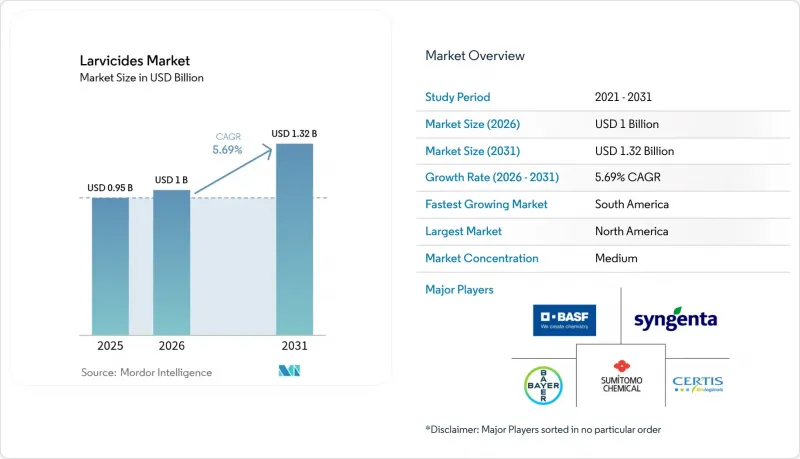
본 보고서는 방제 방법(생물학적 방제제, 화학적 방제제 등), 제품 유형(합성 살유충제, 생물학적 살유충제 등), 용도(농업용 및 비농업용),대상 해충(모기 등), 제형(과립제 등), 지역(북미, 유럽, 아시아태평양 등)별로 분류되어 있습니다. 시장 전망은 금액(달러) 기준으로 제시되어 있습니다.
전 세계 살유충제 시장 동향 및 인사이트
살충제 내성을 가진 성충 모기의 급증으로 인해 유충 단계에서의 대책 마련이 가속화되고 있습니다.
모기는 표적 부위의 감수성 저하나 대사를 통한 해독을 통해 살충제에 대한 내성을 획득합니다. 아노펠레스속 및 아에데스속 모기는 유전적 적응, 행동 변화, 그리고 대사적 내성을 통해 화학적 처리를 회피합니다. 현재 매개체 방제 프로그램은 고인 물이나 도시 지역의 저수지 등 번식지 내의 유충을 표적으로 삼아, 초기 단계에서의 개체 수 통제에 중점을 두고 있습니다. 이러한 접근 방식을 통해 모기가 성충으로 성장하는 것을 막고, 질병 전파 주기를 차단할 수 있습니다. 매개체 방제 프로그램에서는 개별 화학 물질군에 대한 선택 압력을 완화하기 위해, 서로 다른 유효 성분을 순환적으로 사용하는 통합적인 전략이 점점 더 많이 도입되고 있습니다. 이러한 변화는 피레스로이드계 살충제의 효과가 상실되어 긴급 살포 예산이 위협받은 지역에서 특히 두드러지며, 지자체는 성충이 대량으로 출현하기 전에 침수된 물웅덩이와 빗물 배수로를 관리하는 계절 내내 지속되는 유충 방제망에 대한 투자를 촉진하고 있습니다.
뎅기열 및 치쿤구니아열 예방 프로그램 전개
라틴아메리카의 대도시에서는 감염률 상승과 도시 지역 모기 개체 수 증가에 대응하여 뎅기열 및 치쿤구니아열 예방 프로그램을 강화하고 있습니다. 세계보건기구(WHO) 보고서에 따르면, 특히 볼리비아와 파라과이에서 환자 수가 크게 증가하고 있습니다. 예방 전략에는 네타이사마카 박멸, 시민 인식 제고 활동, 그리고 위생, 도시 계획, 교육을 결합한 통합적 접근 방식이 포함됩니다. 범미보건기구(PAHO)는 질병 전파를 줄이기 위한 지역사회 기반 대책의 실행에 대해 각 지역 정부에 지침을 제공합니다. 2024년 브라질에서 발생한 뎅기열 유행을 계기로, 세계 모기 대책 프로그램(WMP)은 피오크루즈(Fiocruz)와 협력하여 브라질 전역에서 모기 매개 질병 대책에 힘쓰고 있습니다. WMP는 네타이지마카 모기에 천연 박테리아를 도입하여 뎅기열, 지카열, 치쿤구니아열의 감염을 예방하는 ‘월바키아법’의 적용 범위를 확대되고 있습니다.
엄격한 수생생물 독성 임계치
2026년 농약 일반 허가에서는 시용자가 지표수를 처리할 때 투여량, 장소 및 비표적 종에 대한 모니터링을 기록할 의무가 있습니다. 테메포스를 포함한 유기인계 농약에 대한 규제 당국의 감시가 강화된 결과, 범람원 습지나 도시 지역의 빗물 집수구에서 사용 가능한 제제의 선택지가 줄어들었습니다. 규정 준수 비용 증가로 인해 각 카운티는 가격이 비싸더라도 고위험 화학 물질에서 생물학적 대체제로의 전환을 추진하고 있습니다. 종합적인 독성 데이터와 디지털 살포 기록을 제공하는 공급업체는 시장에서 우위를 유지하고 있지만, 진입 장벽이 소규모 사업자에게 영향을 미치며 해당 지역 내 화학 살유충제의 유통을 제한하고 있습니다.
부문 분석
2025년 현재, 합성 살유충제는 살유충제 시장 점유율의 44.30%를 차지하고 있습니다. 이 시장의 주도적 지위는 비용 면에서의 우위와 확립된 조달 계약에 기인합니다. 생물 유래 제품은 통합 매개체 관리 접근 방식을 추진하는 정부의 이니셔티브에 힘입어 8.16%라는 더 높은 연평균 성장률(CAGR)을 기록하며 성장하고 있습니다. 바실러스 튜링겐시스 이스라엘렌시스(Bti)는 모기 유충, 검은파리, 그리고 과실파리에 대해 특이적인 독성을 나타냅니다. 2023년, 카트만두 수도권(KMC)은 모기 유충을 표적으로 삼아 뎅기열 유행을 억제하기 위해 생물학적 유충 방제 프로그램을 시행했습니다. 이 유기농 해결책은 다른 생물을 보호하면서 모기 유충의 소화계를 파괴하여 방제합니다.
최종 시험 단계에 있는 RNAi 효모계 살유충제 개발은 비표적 종에 영향을 미치지 않으면서 유전자 특이적인 방제를 가능하게 하는 것으로, 시장의 변화를 예고할 수 있습니다. 각 제조업체는 제품의 내구성과 사용 편의성을 높이기 위해 마이크로캡슐화 기술 개선에 주력하고 있습니다. 2024년 조사에서는 작물 보호 분야에서 식물 유래 살유충제, 특히 마리골드 추출물의 유효성이 입증되었습니다. 방갈로르의 PES 대학이 실시한 조사에 따르면, Tagetes erecta 및 Tagetes patula에는 티오펜이 포함되어 있으며, 이 성분들은 작물 해충인 Spodoptera litura 및 Corcyra cephalonica에 대해 현저한 유충 구제 효과를 나타내는 것으로 밝혀졌습니다. 이러한 기술적 진보에 더해, 환경적으로 지속 가능한 제품에 대한 정부의 장려책이 맞물리면서 생물학적 살유충제는 더 많은 지자체와의 계약을 따낼 수 있게 되었습니다.
곤충 성장 조절제(IGR)는 특히 기존 살충제에 대한 내성 증가에 대응하는 수단으로서 효과적인 유충 방제법으로 부상해 왔습니다. IGR은 탈피, 번식, 변태를 저해하여 모기의 발육을 방해하고, 유충이 성충으로 자라는 것을 막습니다. 2025년에는 화학적 접촉 독이 매출의 54.10%를 차지했으나, 현장 조사에 따르면 내성 발생으로 인해 그 유효성이 저하되고 있는 것으로 나타났습니다. 주요 IGR 화합물인 메토프렌은 10 ppb 이하의 농도에서 유효성을 보이며, 수생 환경에서의 이동성은 최소화되어 있습니다.
피레스로이드계 및 유기인계 살충제에 대한 대사적·행동적 내성이 광범위하게 퍼져 있는 만큼, 매개체 방제 프로그램에서는 피리프로시펜이나 메토프렌을 포함한 IGR 기반의 해결책이 점점 더 많이 채택되고 있습니다. IGR은 잔류 효과가 길고, 환경에 미치는 영향이 적으며, 내성 발생 위험도 낮기 때문에 지속 가능한 모기 방제 프로그램의 필수적인 요소가 되고 있습니다.
지역별 분석
2024년에는 체계적인 매개체 관리 체계와 웨스트나일열 및 동부 말 뇌염에 대한 우려가 높아진 것을 배경으로, 북미가 지역별 매출액에서 1위를 기록했습니다. 북미에서 모기 및 유충 방제를 위한 살유충제를 주로 사용하는 국가는 미국입니다. 미국 질병통제예방센터(CDC) 및 각지의 모기 방제 구역은 전국적으로 매개체 방제 프로그램을 시행하고 있습니다. 이러한 프로그램에서는 웨스트나일 바이러스, 지카 바이러스 및 기타 모기 매개 질환을 예방하기 위해 통합 모기 관리(IMM) 전략의 일환으로 살유충제가 포함되어 있습니다.
환경보호청(EPA)은 유충의 초기 단계를 표적으로 하는 여러 가지 모기 유충 방제 방법을 권장하고 있습니다. 이러한 방법에는 다음이 포함됩니다. 유충의 소화 기능을 저해하는 세균성 살충제(바실러스 투린겐시스 이스라엘리엔시스 및 바실러스 스파에리쿠스) - 발육을 저해하는 메토프렌 등의 곤충 성장 억제제 - 유충을 익사시키는 표면 유막 또는 필름. 환경에 대한 우려로 인해 특정 방제 방법, 특히 유기인계 살충제의 사용이 중단되었습니다. 모든 방제 방법은 취약 계층을 보호하기 위한 규정을 준수해야 합니다. EPA의 ‘2026년 농약 일반 허가’에는 지표수로의 농약 살포에 관한 엄격한 요건이 규정되어 있으며, 이것이 북미 전역의 제품 개발 방향을 결정짓고 있습니다.
아시아 시장은 다양한 구성을 보이고 있습니다. 중국과 인도는 농업용도를 통해 판매량을 뒷받침하는 반면, 동남아시아 시장에서는 벼-물고기 공생 시스템에서 생물학적 살유충제 사용을 의무화하는 보조금 제도가 활용되고 있습니다. 동시에, 이집트모기(Aedes aegypti)의 유기인계 및 피레스로이드계 농약에 대한 내성으로 인해 인도네시아 지자체는 성장억제제(IGR)와 Bti의 조합을 순환하여 사용해야 하는 상황에 놓여 있으며, 이것이 단위 판매량의 점진적인 증가를 뒷받침하고 있습니다. 아시아의 살유충제 시장 점유율은 예측 기간 동안 매년 확대될 것으로 보이지만, 일부 경제권에서 가격 민감도가 높기 때문에 이익률은 계속해서 압박을 받을 가능성이 있습니다.
남미는 뎅기열 및 치쿤구니아열 유행에 따른 공중보건 위기의 영향으로 가장 높은 성장률을 보이고 있습니다. 브라질에서는 2024년에 725만 건의 뎅기열 사례가 보고되어 2023년 기록의 2배 이상에 달함에 따라, 연방 정부, 주 정부, 지방 자치 단체 전반에 걸쳐 Bti에 대한 투자가 증가하고 있습니다. 도시 위생 당국은 발생원 감소 대책과 매주 살유충제 살포를 병행함으로써 안정적인 제품 수요를 확보하고, 판매업체의 재고 수준을 유지하고 있습니다.
기타 혜택:
- 엑셀 형식 시장 예측(ME) 시트
- 3개월간의 애널리스트 지원
자주 묻는 질문
목차
제1장 서론
제2장 조사 방법
제3장 주요 요약
제4장 시장 구도
제5장 시장 규모와 성장 예측
제6장 경쟁 구도
제7장 시장 기회와 향후 전망
JHS 26.09.09According to Mordor Intelligence, the larvicides market size was valued at USD 0.95 billion in 2025 and estimated to grow from USD 1 billion in 2026 to reach USD 1.32 billion by 2031, at a CAGR of 5.69% during the forecast period (2026-2031).
This report is Segmented by Control Method (Biocontrol Agents, Chemical Agents, and More), by Product Type (Synthetic Larvicides, and Biological Larvicides), by Application (Agricultural and Non-Agricultural), by Target Insects (Mosquitoes and More), by Formulation (Granules, and More), and Geography (North America, Europe, Asia-Pacific, and More). The Market Forecasts are Provided in Terms of Value (USD).
Global Larvicides Market Trends and Insights
Surge in Insecticide-Resistant Adult Mosquitoes Accelerating Larval-Stage Intervention
Mosquitoes develop resistance to insecticides through target-site insensitivity and metabolic detoxification. Anopheles and Aedes mosquitoes avoid chemical treatments through genetic adaptations, behavioral changes, and metabolic resistance. Vector control programs now focus on early-stage population control by targeting larvae in breeding sites, including stagnant water bodies and urban reservoirs. This approach prevents mosquitoes from reaching adulthood and interrupts disease transmission cycles. Vector control programs increasingly implement integrated strategies that rotate different active ingredients to reduce selective pressure on individual chemical classes. This shift is most visible where pyrethroid failure jeopardized emergency spraying budgets, encouraging municipalities to invest in season-long larvicide grids that protect floodwater pools and storm drains before adult swarms emerge.
Roll-out of Dengue and Chikungunya Prevention Programs
Latin American megacities are strengthening their dengue and chikungunya prevention programs in response to increased infection rates and urban mosquito populations. The World Health Organization (WHO) reports a significant increase in cases, particularly in Bolivia and Paraguay. Prevention strategies include Aedes aegypti mosquito control, public awareness initiatives, and integrated approaches combining sanitation, urban planning, and education. The Pan American Health Organization (PAHO) guides regional governments on implementing community-based measures to reduce disease transmission. In response to the 2024 dengue outbreak in Brazil, the World Mosquito Program (WMP) has partnered with Fiocruz to address mosquito-borne diseases across the country. The WMP is expanding its Wolbachia method, which introduces a natural bacterium into Aedes aegypti mosquitoes to prevent the transmission of dengue, Zika, and chikungunya.
Stringent Aquatic-Toxicity Thresholds
The 2026 Pesticide General Permit requires applicators to document the dosage, location, and non-target species monitoring when treating surface waters. Regulatory oversight of organophosphates, including temephos, has reduced available formulation options for floodwater marshes and urban catch basins. The increased compliance costs have led counties to shift from high-risk chemicals to biorational alternatives, despite their higher prices. While suppliers providing comprehensive toxicological data and digital application records maintain market advantages, the entry barriers affect small operators and limit local chemical larvicide distribution.
Other drivers and restraints analyzed in the detailed report include:
- Climate-Induced Expansion of Mosquito Breeding Seasons in Temperate Regions
- Government Subsidies for Integrated Rice-Fish Farming
- Low Adoption of GIS Breeding-Site Mapping
For complete list of drivers and restraints, kindly check the Table Of Contents.
Segment Analysis
Synthetic larvicides account for 44.30% of the larvicides market share in 2025. Their market leadership stems from cost advantages and established procurement contracts. Biological products are growing at a higher rate of 8.16% CAGR, supported by government initiatives promoting integrated vector management approaches. Bacillus thuringiensis israelensis (Bti) demonstrates specific toxicity to mosquito larvae, blackflies, and fungus gnats. In 2023, the Kathmandu Metropolitan City (KMC) implemented bio-larvicide programs to control dengue outbreaks by targeting mosquito larvae. This organic solution eliminates mosquito larvae by disrupting their digestive systems while preserving other organisms.
The development of RNAi yeast larvicides in late-stage testing indicates potential market shifts, offering gene-specific control without affecting non-target species. Manufacturers are improving microencapsulation techniques to enhance product longevity and ease of use. Research in 2024 demonstrated the efficacy of botanical larvicides in crop protection, specifically marigold extracts. A study conducted by PES University in Bangalore revealed that Tagetes erecta and Tagetes patula contain thiophenes, which demonstrate significant larvicidal effects against crop pests Spodoptera litura and Corcyra cephalonica. These technological improvements, coupled with government incentives for environmentally sustainable products, enable biological larvicides to secure more municipal contracts.
Insect Growth Regulators (IGRs) have emerged as an effective larvicide control method, particularly in response to increasing resistance against conventional insecticides. IGRs disrupt mosquito development by inhibiting molting, reproduction, and metamorphosis, preventing larvae from reaching adulthood. While chemical contact poisons generated 54.10% of revenue in 2025, field studies indicate reduced effectiveness due to resistance development. Methoprene, a primary IGR compound, demonstrates effectiveness at concentrations of <= 10 ppb with minimal aquatic mobility.
Vector control programs are increasingly adopting IGR-based solutions, including pyriproxyfen and methoprene, due to widespread metabolic and behavioral resistance to pyrethroids and organophosphates. IGRs provide extended residual activity, reduced environmental impact, and lower resistance development risk, positioning them as integral components of sustainable mosquito control programs.
Complete Report Scope:
- By Product Type
- Synthetic Larvicides
- Biological Larvicides
- By Control Method
- Chemical Agents
- Biocontrol Agents
- Insect Growth Regulators (IGR)
- By Target Insect
- Mosquitoes
- Flies
- Beetles
- Ants
- By Application
- Agriculture
- Non Agriculture
- By Formulation
- Granules
- Liquids and Suspensions
- Pellets and Tablets
- Powders and Wettable Dusts
- By Geography
- North America
- United States
- Canada
- Mexico
- Rest of North America
- South America
- Brazil
- Argentina
- Rest of South America
- Europe
- United Kingdom
- Germany
- France
- Italy
- Spain
- Rest of Europe
- Africa
- South Africa
- Nigeria
- Egypt
- Rest of Africa
- Middle East
- Saudi Arabia
- United Arab Emirates
- Qatar
- Rest of Middle East
- Asia-Pacific
- China
- India
- Japan
- Australia
- Rest of Asia-Pacific
- North America
Geography Analysis
North America generated the largest regional revenue in 2024, supported by structured vector-management frameworks and rising concern over West Nile and Eastern equine encephalitis. The United States is the primary user of larvicides for mosquito and larva control in North America. The Centers for Disease Control and Prevention (CDC) and local mosquito control districts implement vector control programs across the country. These programs incorporate larvicides within integrated mosquito management (IMM) strategies to prevent diseases such as West Nile virus, Zika, and other mosquito-borne illnesses.
The Environmental Protection Agency (EPA) endorses multiple larval mosquito control methods that target immature mosquitoes in their early stages. These methods include:- Bacterial insecticides (Bacillus thuringiensis israelensis and Bacillus sphaericus) that disrupt larval digestion - Insect growth inhibitors like methoprene that prevent development - Surface oils and films that cause larvae to drown. Environmental concerns have resulted in the discontinuation of certain control methods, particularly organophosphate insecticides. All control methods must comply with regulations to protect vulnerable populations. The EPA's 2026 Pesticide General Permit has established strict requirements for pesticide applications to surface waters, which shape product development throughout North America.
Asia presents a diverse mix; China and India anchor volume through agricultural applications, while Southeast Asian markets leverage subsidies that mandate biological larvicides in rice-fish systems. Simultaneously, Aedes aegypti resistance to organophosphates and pyrethroids forces councils in Indonesia to rotate IGRs and Bti combinations, underpinning incremental unit growth. The larvicide market share attributable to Asia will expand each year of the outlook, yet margins may stay compressed given price sensitivity in several economies.
South America demonstrates the highest growth rate, driven by public health crises related to dengue and chikungunya outbreaks. Brazil reported 7.25 million dengue cases in 2024, exceeding twice the number recorded in 2023, prompting increased Bti investments across federal, state, and municipal governments. Urban sanitation departments combine source reduction initiatives with weekly larvicide applications, ensuring consistent product demand that maintains distributor inventory levels.
- BASF SE
- Bayer AG
- Syngenta AG
- Sumitomo Chemical Co.
- Clarke Mosquito Control Products Inc.
- Central Life Sciences
- Certis Biologicals
- UPL Ltd.
- FMC Corporation
- Russell IPM
Additional Benefits:
- The market estimate (ME) sheet in Excel format
- 3 months of analyst support
TABLE OF CONTENTS
1 Introduction
- 1.1 Study Assumptions and Market Definition
- 1.2 Scope of the Study
2 Research Methodology
3 Executive Summary
4 Market Landscape
- 4.1 Market Overview
- 4.2 Market Drivers
- 4.2.1 Surge in insecticide-resistant adult mosquitoes
- 4.2.2 Roll-out of dengue and chikungunya prevention programs
- 4.2.3 Climate-induced expansion of mosquito breeding seasons
- 4.2.4 Government subsidies for integrated rice-fish farming
- 4.2.5 Regulatory Policies on Larvicides
- 4.2.6 Rapid scale-up of drone-based aerial application of larvicides
- 4.3 Market Restraints
- 4.3.1 Stringent aquatic-toxicity thresholds limiting chemical formulations
- 4.3.2 Low adoption of GIS breeding-site mapping curbing commercial sales
- 4.3.3 Supply-chain volatility for Bacillus fermentation media
- 4.3.4 Public pressure against synthetic vector-control compounds
- 4.4 Value / Supply-Chain Analysis
- 4.5 Regulatory Landscape
- 4.6 Technological Outlook
- 4.7 Porters Five Forces
- 4.7.1 Threat of New Entrants
- 4.7.2 Bargaining Power of Suppliers
- 4.7.3 Bargaining Power of Buyers
- 4.7.4 Threat of Substitutes
- 4.7.5 Intensity of Competitive Rivalry
5 Market Size and Growth Forecasts
- 5.1 By Product Type
- 5.1.1 Synthetic Larvicides
- 5.1.2 Biological Larvicides
- 5.2 By Control Method
- 5.2.1 Chemical Agents
- 5.2.2 Biocontrol Agents
- 5.2.3 Insect Growth Regulators (IGR)
- 5.3 By Target Insect
- 5.3.1 Mosquitoes
- 5.3.2 Flies
- 5.3.3 Beetles
- 5.3.4 Ants
- 5.4 By Application
- 5.4.1 Agriculture
- 5.4.2 Non Agriculture
- 5.5 By Formulation
- 5.5.1 Granules
- 5.5.2 Liquids and Suspensions
- 5.5.3 Pellets and Tablets
- 5.5.4 Powders and Wettable Dusts
- 5.6 By Geography
- 5.6.1 North America
- 5.6.1.1 United States
- 5.6.1.2 Canada
- 5.6.1.3 Mexico
- 5.6.1.4 Rest of North America
- 5.6.2 South America
- 5.6.2.1 Brazil
- 5.6.2.2 Argentina
- 5.6.2.3 Rest of South America
- 5.6.3 Europe
- 5.6.3.1 United Kingdom
- 5.6.3.2 Germany
- 5.6.3.3 France
- 5.6.3.4 Italy
- 5.6.3.5 Spain
- 5.6.3.6 Rest of Europe
- 5.6.4 Africa
- 5.6.4.1 South Africa
- 5.6.4.2 Nigeria
- 5.6.4.3 Egypt
- 5.6.4.4 Rest of Africa
- 5.6.5 Middle East
- 5.6.5.1 Saudi Arabia
- 5.6.5.2 United Arab Emirates
- 5.6.5.3 Qatar
- 5.6.5.4 Rest of Middle East
- 5.6.6 Asia-Pacific
- 5.6.6.1 China
- 5.6.6.2 India
- 5.6.6.3 Japan
- 5.6.6.4 Australia
- 5.6.6.5 Rest of Asia-Pacific
- 5.6.1 North America
6 Competitive Landscape
- 6.1 Strategic Moves
- 6.2 Market Share Analysis
- 6.3 Company Profiles {(includes Global level Overview, Market level overview, Core Segments, Financials as available, Strategic Information, Market Rank/Share for key companies, Products and Services, and Recent Developments)}
- 6.3.1 BASF SE
- 6.3.2 Bayer AG
- 6.3.3 Syngenta AG
- 6.3.4 Sumitomo Chemical Co.
- 6.3.5 Clarke Mosquito Control Products Inc.
- 6.3.6 Central Life Sciences
- 6.3.7 Certis Biologicals
- 6.3.8 UPL Ltd.
- 6.3.9 FMC Corporation
- 6.3.10 Russell IPM


