
|
시장보고서
상품코드
2123488
내시경하 혈관 채취 시장 : 점유율 분석, 업계 동향과 통계, 성장 예측(2026-2031년)Endoscopic Vessel Harvesting - Market Share Analysis, Industry Trends & Statistics, Growth Forecasts (2026 - 2031) |
||||||
 Mordor Intelligence
Mordor Intelligence에 의하면, 내시경하 혈관 채취 시장 규모는 2025년 5억 2,200만 달러에서 2026년에는 5억 4,153만 달러로 확대되어 2026년부터 2031년까지 CAGR 3.74%로 성장을 지속하여, 2031년에는 6억 5,047만 달러에 이를 것으로 예측됩니다.
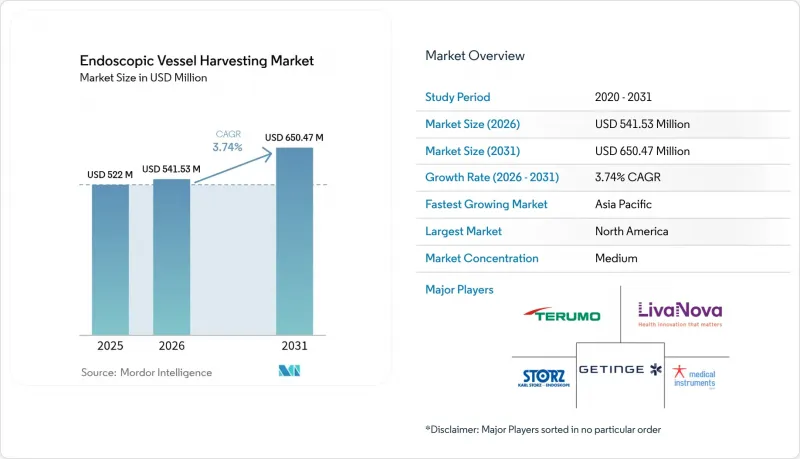
본 보고서는 제품 유형(내시경 혈관 채취 시스템 등), 혈관 유형(복재정맥 등), 사용 방법(일회용 및 재사용형), 적응증(관상동맥 질환 및 말초동맥 질환),최종 사용자(병원 등), 채취 기술(클로즈드 터널식 CO₂ 주입법 및 노터치법), 그리고 지역별로 분류되어 있습니다. 시장 예측은 금액(달러) 기준으로 제시되어 있습니다.
전 세계 내시경하 혈관 채취 시장 동향 및 인사이트
전 세계적으로 증가하는 심혈관 질환의 부담
심혈관 질환은 미국 성인의 거의 절반에게 영향을 미치고 있으며, 많은 신흥 경제국에서도 그 수가 계속 증가하고 있습니다. 수술 건수 증가에 따라 병상 부족이나 재입원 페널티에 직면한 외과 프로그램에서 효율적인 혈관 채취는 전략적 필수 요건이 되고 있습니다. 내시경하 기법을 채택한 병원에서는 상처 부위 감염이 감소하고 조기 보행이 가능해졌으며, 이러한 성과는 현대의 종합적 지불 제도의 인센티브와 부합합니다. 당뇨병이나 고혈압을 앓고 있는 고령층 사이에서는 여전히 부담이 특히 높으며, 내구성이 뛰어난 이식편과 합병증이 적은 접근 부위에 대한 필요성이 더욱 커지고 있습니다. 각국 정부는 심장 질환 치료를 전문으로 하는 의료 센터에 자금을 투자하고 있으며, 예측 가능한 학습 곡선과 직원 이직률 감소를 약속하는 통합형 EVH 플랫폼의 도입을 촉진하고 있습니다. 장기적인 이식편의 개존율과 비용 절감 효과를 입증할 수 있는 공급업체는 이러한 역학적 호재로부터 최대의 혜택을 누리게 될 것입니다.
저침습 채취법에 대한 지지 확대
전향적 연구 데이터에 따르면, 내시경하 접근법에서 하지 상처 합병증 발생률은 0.82%인 반면, 개복 적출술에서는 3%로 나타났습니다. 환자 보고 결과 지표(PRO)에서는 흉터가 최소화되고 조기 보행이 가능하다는 점이 일관되게 긍정적으로 평가되고 있으며, 이러한 지표들은 현재 많은 성과 연계형 보상(Pay-for-Performance) 대시보드에 포함되어 있습니다. ‘흉터를 최소화하는’ 프로그램을 내세우는 병원은 평판이 향상되며, 특히 경쟁이 치열한 도시 지역의 진료권에서 의뢰 환자 수 증가로 이어지고 있습니다. 가상현실(VR) 시뮬레이션의 광범위한 도입으로 인해 수술자의 숙련 곡선이 단축되었고, 투시 검사 시 방사선 노출 시간이 3분의 1 가까이 감소했습니다. 하지만 의료 기관 측은 외과의사의 자신감을 저해할 수 있는 초기 합병증의 빈발을 방지하기 위해 체계적인 교육 체계에 투자해야 합니다. 의료기기 설계자들은 숙련 곡선을 더욱 완만하게 만들기 위해 인체공학에 기반한 핸들 및 자동 절단 제어 기능 등의 개발을 추진하고 있습니다.
대체 혈관 재건 요법의 활용 가능성
복잡한 경피적 관상동맥 중재술(PCI) 기술의 급속한 발전으로 인해, 과거에는 관상동맥 우회술(CABG)이 당연한 선택지로 여겨졌던 다지병변 사례의 일부가 PCI로 전환되고 있습니다. 당뇨병 환자나 미만성 병변에 대해서는 CABG가 여전히 우위를 점하고 있지만, 특정 지역에서 개흉 수술 건수가 감소함에 따라 EVH의 매출이 위축될 가능성이 있습니다. 그러나 나머지 외과적 사례는 현재 고위험군에 편중되어 있으며, 이러한 경우 저침습적 우회로 혈관 채취가 현저한 이점을 제공합니다. 따라서 각 기기 제조업체들은 여전히 이식편이 필요한 환자층을 대상으로 EVH를 정밀한 도구로 포지셔닝하며, 개흉 수술과 비교했을 때의 개존율 및 상처 치유상의 이점을 강조하고 있습니다.
부문 분석
2025년, EVH 시스템은 3억 4,337만 달러의 매출을 창출하며, 이는 내시경하 혈관 채취 시장의 65.78%에 해당합니다. 병원은 이러한 자본 자산을 5-7년에 한 번씩 구매하기 때문에 장비 공급업체는 수년에 걸친 서비스 계약을 체결하게 됩니다. 부속품 및 일회용 소모품 부문은 절대 금액으로는 적지만, 수술 건수에 연동되는 연금형 수익 구조 덕분에 연평균 성장률(CAGR) 7.92%로 성장하고 있습니다. 블레이드, 스코프, CO2 라인을 세트로 구성한 키트는 수술 준비를 간소화하고 호환성을 보장하기 때문에 구매 담당자들이 그 편의성을 높이 평가했습니다.
반복적으로 사용되는 소모품은 병원 내 멸균 능력을 갖추지 못한 외래수술센터(ASC)에 특히 매력적입니다. 한편, 자본 설비 시스템에서의 경쟁 우위는 현재 영상 해상도, 인체공학에 기반한 핸드피스, 그리고 인증 목적으로 사용 통계를 기록하는 분석 대시보드에 좌우되고 있습니다. 게팅게(Getinge)사의 ‘Hemopro 3’ 출시는 과거 리콜 사태를 계기로 외과의사의 불안을 해소하기 위해 설계된, 안전성이 강화된 시스템으로의 전환을 상징합니다.
요골동맥 이식편은 특히 젊은 층과 당뇨병 환자에서 10년 개존율이 뛰어나 2025년 시장 규모의 42.12%를 차지했습니다. 외과의사들이 양측 요골동맥을 이용한 수술법을 점점 더 많이 채택함에 따라 시스템 가동률 향상에 기여하고 있습니다. 한편, 3곳 이상의 원위부 표적을 우회해야 하는 경우, 복재정맥 이식편은 여전히 필수적이며, 이것이 7.48%의 연평균 성장률(CAGR)이 예상되는 이유입니다. 정맥의 품질에 대한 초기 회의론은 비접촉식이며 혈관 주위 조직을 보존하는 채취법을 뒷받침하는 증거에 의해 완화되었습니다.
의료기기 업체들은 내피 손상을 줄이기 위해 더 얇은 내시경과 저압 공기 주입 프로토콜을 개발하고 있으며, 이로 인해 긴 이식편에 대해서는 여전히 개복 채취를 선호하는 회의론자들의 관심도 끌고 있습니다. 현재 병원에서는 높은 개존율이 요구되는 증례에는 요골 접근법을, 다중 이식편 증례에는 최적화된 복재정맥 접근법을 병행하여 시행하는 워크플로가 확립되어 있으며, 이러한 추세로 인해 범용성이 높은 시스템 플랫폼에 대한 수요가 증가하고 있습니다.
지역별 분석
북미는 2025년 매출의 42.25%를 차지하고 있으며, 이는 학술 의료 센터 및 지역 병원의 견실한 보험 환급과 높은 수술 시행률에 힘입은 것입니다. CMS(미국 의료보험센터)의 보험 적용 기준은 임상적으로 타당한 사유가 있는 경우 일관되게 EVH를 권장하고 있으며, 일괄 지급 제도의 시범 사업에서는 입원 일수 단축이 높이 평가되고 있습니다. 업그레이드된 시스템의 510(k) 승인을 포함하여 FDA와의 지속적인 협력을 통해 혁신 파이프라인이 활발하게 유지되고 있습니다. STS 및 AATS와 같은 교육 컨소시엄은 EVH 모듈을 수련의 교육 과정에 임베디드하여 광범위한 기술 습득을 강화하고 있습니다.
유럽에서는 데이터 기반 프로토콜과 국경을 초월한 임상시험에 힘입어 꾸준한 보급이 진행되고 있습니다. 그러나 단일 지불자 제도의 예산 상한선으로 인해 업데이트 주기가 지연되고 있어, 공급업체들은 비용 대비 효과를 강조할 수밖에 없는 상황에 처해 있습니다. 스칸디나비아 국가들의 병원은 환경 지침을 충족하기 위해 재사용 가능한 내시경을 조기에 도입했으며, 이 모델은 현재 독일과 프랑스에서도 채택되고 있습니다. 자본 예산 제약에 직면한 지중해 지역의 의료 시스템에서는 초기 장비 투자를 1회당 시술 요금으로 전환하는 서비스 리스 계약으로의 전환이 진행되고 있습니다.
아시아태평양은 2031년까지 연평균 성장률(CAGR)이 9.71%로 가장 빠르게 성장하는 지역이며, 그 원동력은 일본의 고령화, 중국의 중산층 확대, 그리고 3차 심장 의료 센터에 대한 정부 투자입니다. 일본의 외과의사들은 완전 내시경 하 로봇을 이용한 절제술을 적극적으로 도입하고 있으며, 지역 전체에서 칭송받는 성과 기준을 확립하고 있습니다. 중국의 규제 당국은 공중보건 목표에 필수적인 것으로 간주되는 심장 의료기기의 승인을 점점 더 신속하게 처리하고 있지만, 성별 보험 환급 현황에는 여전히 편차가 있습니다. 인도 및 동남아시아에서는 교육 체계의 병목 현상으로 인해 잠재적 수요가 제한되고 있습니다. 이에 따라 각 공급업체들은 의과대학과 제휴하여 심장 절제술 펠로우십 프로그램을 구축하고 있습니다.
남미에서는 대량의 관상동맥 우회술(CABG)을 시행하는 브라질의 공공 및 민간 병원 네트워크를 필두로 완만한 성장이 나타나고 있습니다. 수입 관세 및 환율 변동이 해외 진출 기업들에게 과제로 대두되면서, 현지 생산을 위한 제휴가 촉진되고 있습니다. 중동 및 아프리카에서는 걸프 국가들과 남아프리카의 주요 심장 전문 의료 기관과 관련된 틈새 시장이 존재하지만, 보험 적용 범위의 제한과 외과의사 부족으로 인해 광범위한 보급이 저해되고 있습니다.
기타 혜택:
- 엑셀 형식 시장 예측(ME) 시트
- 3개월간의 애널리스트 지원
자주 묻는 질문
목차
제1장 서론
제2장 조사 방법
제3장 주요 요약
제4장 시장 구도
제5장 시장 규모와 성장 예측
제6장 경쟁 구도
제7장 시장 기회와 향후 전망
JHS 26.09.09According to Mordor Intelligence, the endoscopic vessel harvesting market size is expected to grow from USD 522 million in 2025 to USD 541.53 million in 2026 and is forecast to reach USD 650.47 million by 2031 at 3.74% CAGR over 2026-2031.
This report is Segmented by Product (EVH Systems and More), Vessel Type (Saphenous Vein and More), Usability (Disposable and Reusable), Application (Coronary Artery Disease and Peripheral Artery Disease), End-User (Hospitals and More), Harvesting Technique (Closed-Tunnel CO2 Insufflation and No-Touch), and Geography. The Market Forecasts are Provided in Terms of Value (USD).
Global Endoscopic Vessel Harvesting Market Trends and Insights
Increasing Global Burden of Cardiovascular Diseases
Cardiovascular pathology affects nearly half of U.S. adults and continues to climb in many emerging economies. Growing procedure volumes make efficient conduit harvesting a strategic necessity for surgical programs managing tight bed capacity and readmission penalties. Hospitals adopting endoscopic techniques report fewer wound infections and faster ambulation, outcomes that align with modern bundled-payment incentives. The burden remains particularly high among aging cohorts with diabetes and hypertension, reinforcing the need for durable grafts and low-morbidity access sites. Governments are channeling funds into cardiac centers of excellence, catalyzing procurement of integrated EVH platforms that promise predictable learning curves and reduced staff turnover. Vendors able to document long-term graft patency and cost offsets stand to benefit most from these epidemiological tailwinds.
Growing Preference for Minimally-Invasive Harvesting
Prospective data show leg wound complications of 0.82% with endoscopic approaches versus 3% for open extraction. Patient-reported outcome measures consistently favor minimal scarring and quicker mobility, metrics now embedded in many pay-for-performance dashboards. Hospitals marketing "scar-sparing" programs gain reputational lift that translates into higher referral volumes, especially in competitive urban catchments. Widespread adoption of virtual-reality simulation has shortened operator learning curves and cut fluoroscopy exposure times by nearly one-third. Nonetheless, centers must invest in structured mentorship to avoid early complication clusters that can erode surgeon confidence. Device designers are responding with ergonomic handles and automated cutting controls to further flatten proficiency curves.
Availability of Alternative Revascularization Therapies
Rapid improvements in complex percutaneous coronary intervention techniques are siphoning off some multi-vessel cases that once defaulted to coronary artery bypass grafting. Although CABG retains superiority in diabetics and diffuse disease, declining open-heart volumes in certain geographies could curb EVH unit sales. Yet, the remaining surgical cases now skew toward higher-risk profiles where minimally invasive conduit harvest offers outsized benefits. Device makers therefore position EVH as a precision tool for the subset of patients who still require grafts, emphasizing patency and wound-healing advantages versus open techniques.
Other drivers and restraints analyzed in the detailed report include:
- Rising Adoption of Off-Pump CABG Surgeries
- Hospitals' Cost-Saving Shift from Open to EVH
- Unfavorable Reimbursement in Several Countries
For complete list of drivers and restraints, kindly check the Table Of Contents.
Segment Analysis
EVH systems generated USD 343.37 million in 2025, equal to 65.78% of the endoscopic vessel harvesting market. Hospitals purchase these capital assets once every 5-7 years, locking equipment vendors into multiyear service contracts. The accessories and disposables category, though smaller in absolute value, is growing at an 7.92% CAGR thanks to its annuity-style revenue that aligns with procedure counts. Bundled kits containing blades, scopes, and CO2 lines simplify case setup and ensure compatibility, a convenience that purchasing managers value.
Recurring consumables are particularly attractive to ambulatory surgical centers that lack onsite sterilization capacity. Meanwhile, competitive differentiation among capital systems now hinges on image resolution, ergonomic handpieces, and analytics dashboards that log usage statistics for credentialing purposes. Getinge's Hemopro 3 rollout exemplifies this pivot toward safety-enhanced systems designed to reassure surgeons following prior recalls.
Radial artery conduits captured 42.12% of 2025 volume owing to superior 10-year patency, especially in younger and diabetic patients. Surgeons increasingly adopt bilateral radial strategies, boosting system utilization. Conversely, saphenous vein grafting remains indispensable when three or more distal targets must be bypassed, explaining its projected 7.48% CAGR. Evidence supporting no-touch, perivascular-preserving harvest has mitigated early skepticism regarding vein quality.
Device vendors are developing slimmer scopes and lower-pressure insufflation protocols to reduce endothelial trauma, thereby appealing to skeptics who still prefer open harvest for long conduits. Hospitals now run parallel workflows: radial for high-patency needs and optimized saphenous for multi-graft cases, a trend that increases demand for versatile system platforms.
Complete Report Scope:
- By Product Type
- EVH Systems
- Endoscopes
- Accessories & Disposables
- By Vessel Type
- Saphenous Vein
- Radial Artery
- Others
- By Usability
- Disposable
- Re-usable
- By Application
- Coronary Artery Disease (CAD)
- Peripheral Artery Disease (PAD)
- By End-user
- Hospitals
- Ambulatory Surgical Centers
- Cardiac Specialty Clinics
- By Harvesting Technique
- Closed-tunnel CO? insufflation
- No-touch / CO?-free
- Geography
- North America
- United States
- Canada
- Mexico
- Europe
- Germany
- United Kingdom
- France
- Italy
- Spain
- Rest of Europe
- Asia-Pacific
- China
- Japan
- India
- South Korea
- Australia
- Rest of Asia-Pacific
- Middle East and Africa
- GCC
- South Africa
- Rest of Middle East and Africa
- South America
- Brazil
- Argentina
- Rest of South America
- North America
Geography Analysis
North America generated 42.25% of 2025 turnover, underpinned by robust reimbursement and high procedural density across academic centers and community hospitals. CMS coverage consistently endorses EVH when clinically justified, and bundled-payment pilots reward shorter length of stay. Ongoing FDA engagement, including 510(k) clearances for upgraded systems, keeps innovation pipelines active. Training consortia such as STS and AATS integrate EVH modules into resident curricula, reinforcing widespread competence.
Europe follows with steady uptake driven by data-driven protocols and cross-border trials. Yet, budget caps in single-payer systems delay refresh cycles, compelling vendors to emphasize cost-utility. Scandinavian hospitals pioneered reusable scopes to satisfy environmental directives, a model now emulated in Germany and France. Mediterranean health systems, facing constrained capital budgets, gravitate toward service-leasing contracts that convert upfront equipment outlays into per-procedure fees.
Asia-Pacific is the fastest-growing territory at 9.71% CAGR through 2031, fueled by Japan's aging population, China's expanding middle class, and government investments in tertiary cardiac centers. Japanese surgeons have embraced totally endoscopic robotic harvests, setting performance benchmarks admired across the region. Chinese regulators increasingly fast-track cardiac devices deemed essential to public-health goals, but provincial reimbursement remains uneven. India and Southeast Asia show latent demand limited by training bottlenecks; therefore, vendors partner with medical colleges to build harvesting fellowships.
South America records moderate growth, spearheaded by Brazil's public-private hospital network that undertakes high-volume CABG. Import taxes and currency volatility challenge foreign entrants, encouraging localized production partnerships. The Middle East and Africa present niche opportunities tied to flagship cardiac institutes in the Gulf and South Africa, yet widespread adoption is hampered by limited insurance coverage and surgeon shortages.
- Getinge
- Terumo Corp.
- LivaNova
- Karl Storz
- Saphena Medical Inc.
- Medical Instruments SpA
- Medtronic
- Olympus Corp.
- Conmed
- B. Braun
- Cardio Medical GmbH
- Valeriot GmbH
- LeMaitre Vascular
- Boston Scientific
- Ethicon (J&J)
- Smiths Group
- Stryker
- Teleflex
- CardiMedical Inc.
Additional Benefits:
- The market estimate (ME) sheet in Excel format
- 3 months of analyst support
TABLE OF CONTENTS
1 Introduction
- 1.1 Study Assumptions & Market Definition
- 1.2 Scope of the Study
2 Research Methodology
3 Executive Summary
4 Market Landscape
- 4.1 Market Overview
- 4.2 Market Drivers
- 4.2.1 Increasing Global Burden Of Cardiovascular Diseases
- 4.2.2 Growing Preference For Minimally-Invasive Harvesting
- 4.2.3 Rising Adoption Of Off-Pump CABG Surgeries
- 4.2.4 Hospitals Cost Saving Shift From Open To EVH
- 4.2.5 Immersive Simulator-Based Surgeon Training Uptake
- 4.2.6 Supply-Chain Driven Switch From Open Disposables
- 4.3 Market Restraints
- 4.3.1 Availability Of Alternative Revascularization Therapies
- 4.3.2 Unfavorable Reimbursement In Several Countries
- 4.3.3 Class-I Recalls Denting Surgeon Confidence
- 4.3.4 Steep Learning Curve & Harvester Shortage
- 4.4 Porter's Five Forces Analysis
- 4.4.1 Bargaining Power of Buyers
- 4.4.2 Bargaining Power of Suppliers
- 4.4.3 Threat of New Entrants
- 4.4.4 Threat of Substitute Products
- 4.4.5 Intensity of Competitive Rivalry
5 Market Size & Growth Forecasts (Value, USD)
- 5.1 By Product Type
- 5.1.1 EVH Systems
- 5.1.2 Endoscopes
- 5.1.3 Accessories & Disposables
- 5.2 By Vessel Type
- 5.2.1 Saphenous Vein
- 5.2.2 Radial Artery
- 5.2.3 Others
- 5.3 By Usability
- 5.3.1 Disposable
- 5.3.2 Re-usable
- 5.4 By Application
- 5.4.1 Coronary Artery Disease (CAD)
- 5.4.2 Peripheral Artery Disease (PAD)
- 5.5 By End-user
- 5.5.1 Hospitals
- 5.5.2 Ambulatory Surgical Centers
- 5.5.3 Cardiac Specialty Clinics
- 5.6 By Harvesting Technique
- 5.6.1 Closed-tunnel CO? insufflation
- 5.6.2 No-touch / CO?-free
- 5.7 Geography
- 5.7.1 North America
- 5.7.1.1 United States
- 5.7.1.2 Canada
- 5.7.1.3 Mexico
- 5.7.2 Europe
- 5.7.2.1 Germany
- 5.7.2.2 United Kingdom
- 5.7.2.3 France
- 5.7.2.4 Italy
- 5.7.2.5 Spain
- 5.7.2.6 Rest of Europe
- 5.7.3 Asia-Pacific
- 5.7.3.1 China
- 5.7.3.2 Japan
- 5.7.3.3 India
- 5.7.3.4 South Korea
- 5.7.3.5 Australia
- 5.7.3.6 Rest of Asia-Pacific
- 5.7.4 Middle East and Africa
- 5.7.4.1 GCC
- 5.7.4.2 South Africa
- 5.7.4.3 Rest of Middle East and Africa
- 5.7.5 South America
- 5.7.5.1 Brazil
- 5.7.5.2 Argentina
- 5.7.5.3 Rest of South America
- 5.7.1 North America
6 Competitive Landscape
- 6.1 Market Concentration
- 6.2 Market Share Analysis
- 6.3 Company Profiles (includes Global level Overview, Market level overview, Core Segments, Financials as available, Strategic Information, Market Rank/Share for key companies, Products & Services, and Recent Developments)
- 6.3.1 Getinge AB
- 6.3.2 Terumo Corp.
- 6.3.3 LivaNova PLC
- 6.3.4 KARL STORZ SE & Co. KG
- 6.3.5 Saphena Medical Inc.
- 6.3.6 Medical Instruments SpA
- 6.3.7 Medtronic plc
- 6.3.8 Olympus Corp.
- 6.3.9 Conmed Corp.
- 6.3.10 B. Braun Melsungen AG
- 6.3.11 Cardio Medical GmbH
- 6.3.12 Valeriot GmbH
- 6.3.13 LeMaitre Vascular Inc.
- 6.3.14 Boston Scientific Corp.
- 6.3.15 Ethicon (J&J)
- 6.3.16 Smith & Nephew plc
- 6.3.17 Stryker Corp.
- 6.3.18 Teleflex Inc.
- 6.3.19 CardiMedical Inc.
7 Market Opportunities & Future Outlook
- 7.1 White-space & Unmet-need Assessment