|
시장보고서
상품코드
2123491
브레인 컴퓨터 인터페이스 시장 : 점유율 분석, 업계 동향과 통계, 성장 예측(2026-2031년)Brain-computer Interface - Market Share Analysis, Industry Trends & Statistics, Growth Forecasts (2026 - 2031) |
||||||
 Mordor Intelligence
Mordor Intelligence에 의하면, 2026년 브레인 컴퓨터 인터페이스(BCI) 시장 규모는 14억 달러로 추정되고 있어 2025년 12억 7,000만 달러에서 확대해, 2031년에는 22억 6,000만 달러에 이를 것으로 예측됩니다.
2026년부터 2031년까지의 연평균 성장률(CAGR)은 10.1%가 될 것으로 전망됩니다.

본 보고서에서는 구성 요소별(하드웨어, 소프트웨어·알고리즘, 서비스), 인터페이스별(운동 기능 BCI, 통신 BCI 등), 용도별(신경 의수·의족, 운동 기능 회복 등), 최종 사용자별(병원 및 진료소, 연구·학술 기관 등),지역(북미, 유럽 등)별로 분류하고 있으며, 시장 예측은 금액(달러) 기준으로 제시되어 있습니다.
전 세계 뇌-컴퓨터 인터페이스(BCI) 시장 동향과 인사이트
의사소통 지원 기술에 대한 수요 급증
미국 국립보건원(NIH)의 지원을 받은 연구에 따르면, 마비 환자의 명확한 발화가 단어 수준에서 99%의 정확도로 회복되었습니다(2). 이후 Synchron사는 자사의 Stentrode 임플란트를 생성형 AI 모델과 연동하여 더 많은 사용자가 핸즈프리로 텍스트 입력을 할 수 있게 했습니다. 병원 측에서는 간병인의 근무 주기가 단축되고 환자의 자율성 점수가 향상되었다는 보고가 있었으며, 임상 적용 범위가 ALS를 넘어 외상성 척수 손상 및 뇌간 뇌졸중으로 확대되고 있습니다(사용자 데이터). 미국의 민간 보험사는 발화 해독용 임플란트의 조기 보험 적용 사례 심사를 시작했으며, 이는 삶의 질에 대한 보험사의 인식이 높아지고 있음을 보여줍니다. 유럽의 교육 병원에서는 현재 언어 모델을 강화한 BCI를 다학제적 협력을 통한 신경 재활 프로그램에 도입하고 있으며, 이 지역 전체에서 중기적인 보급이 촉진되고 있습니다.
EEG 기반 웨어러블 헤드셋의 급속한 보급
게임 스튜디오, e스포츠 주최사 및 소비자용 웰니스 브랜드는 건식 전극 방식의 헤드셋을 인터랙티브 게임 타이틀, 피트니스 프로그램, 명상 플랫폼에 통합하고 있습니다. 스트리머들은 신경 입력을 통한 게임 플레이의 완벽한 제어를 시연하는 한편, e스포츠 리그에서는 코칭을 위해 집중력 및 감정 상태 데이터를 활용하는 실험이 진행되고 있습니다. 이러한 도입으로 인해 저지연 신호 추출 알고리즘이 정교해지고 소형화가 가속화되는 동시에, 의료 관계자 이외의 일반 대중에게도 브레인 컴퓨터 상호작용이 일상생활에서 주는 이점이 널리 인식되고 있습니다. 출하 대수가 증가함에 따라 규모의 경제 효과로 단가가 하락하기 시작했고, 벤더들은 구독형 분석 서비스를 번들로 제공함으로써 사용자 1인당 수익을 확대할 수 있게 되었습니다.
수술적 위험 및 규제상의 과제
이식형 시스템은 뛰어난 신호 충실도를 제공하지만, 시행할 수 있는 의료기관이 제한된 두개내 또는 혈관 수술을 수반합니다. 전극의 변위, 감염증, 기기 제거와 관련된 보고로 인해 임상의와 보험사 사이에서 경계심이 확산되고 있습니다. 규제 당국은 장기적인 안전성 모니터링을 요구하고 있어, 시장 출시까지의 기간을 연장하고 임상시험 예산을 증가시키고 있습니다. 이러한 장애로 인해 조기 도입은 자금력이 있는 대학 병원이나 경제적으로 여유가 있는 자비 부담 환자로 한정되어, 광범위한 보급이 지연되고 있습니다. 각 벤더사는 스텐트와 같은 전달 도구의 개선이나 제거 가능한 임플란트 개발을 통해 대응하고 있지만, 그럼에도 불구하고 수년이 소요되는 승인 절차를 통과해야 합니다.
부문 분석
비침습형 헤드셋과 전극 어레이는 2025년 매출의 75.90%를 차지하며, 브레인 컴퓨터 인터페이스(BCI) 시장에서 많은 개발자들에게 진입점으로서의 역할을 하고 있음을 보여줍니다. 드라이 전극이나 저전력 블루투스를 채택한 제품의 출시로 설정 시간이 단축되고 착용감이 향상됨에 따라, 가상현실(VR) 게임이나 원격 신경 피드백과 같은 일상적인 사용 시나리오가 가능해졌습니다. 병원 측은 외과적 위험을 피할 수 있다는 점을 높이 평가하고 있으며, 소비자용 브랜드는 규제상의 장벽이 낮다는 점을 활용하여 시장 출시를 가속화하고 있습니다. 가격 하락과 신호 대 잡음비(SN비) 향상으로 인해 경쟁이 치열해지는 상황에서도 두 자릿수 성장이 지속되고 있습니다.
소프트웨어 및 알고리즘 분야는 연평균 성장률(CAGR) 0.88%로 확대되고 있으며, 헤드셋 1대가 도입될 때마다 지속적인 라이선스 수익 기회가 발생하기 때문에 그 성장 속도는 하드웨어 분야를 상회하고 있습니다. 트랜스포머 기반 디코더,전이 학습, 그리고 자가 보정 프레임워크 덕분에 정보 전송 속도는 3자리 수의 비율로 향상되고 있습니다. 이러한 진보로 인해 새로운 SaaS 하위 부문이 형성되고 있으며, 203년까지 3억 8,000만 달러에서 9억 7,000만 달러로 확대될 것으로 예측됩니다. 서비스 제공업체들도 이에 발맞추어, 사내에 전문가를 보유하고 있지 않은 의료 기관 구매자들에게 클라우드 대시보드, 전극 유지보수 계약, 규정 준수 감사 등을 제공합니다. 이러한 활동들이 결합되어 균형 잡힌 수익 구조를 유지하고 있으며, 이를 통해 벤더들은 하드웨어 단독의 이익률 압박으로부터 보호받고 있습니다.
2025년에는 모터/출력 플랫폼이 지출의 50.30%를 차지하며, 이는 마비 환자의 커서 제어, 휠체어 조작, 의수 조작 회복에 관한 임상적 우선순위를 반영한 것입니다. 1초 미만의 응답 속도를 실현하는 비침습형 딥러닝 디코더의 시연이 성공함에 따라, 그 매력은 중환자실(ICU)의 범위를 넘어 확산되고 있습니다. 소비자용 개발자들은 이러한 획기적인 기술을 증강현실(AR) 헤드셋 및 스마트 홈 기기를 위한 제스처 없는 입력에 적용하여 이 부문의 성숙도를 높이고 있습니다.
EEG, 근전도, 기능적 근적외선 분광법 또는 집속 초음파를 결합한 하이브리드 아키텍처는 연평균 성장률(CAGR) 3.34%를 나타낼 것으로 예측됩니다. 이러한 기술은 여러 신경 신호와 말초 신호를 융합하여 신뢰성을 높이고, 단일 모달리티 시스템을 방해하는 아티팩트를 보정합니다. 실험적인 뇌졸중 재활 장치가 그 이점을 보여주고 있습니다. 2주간의 하이브리드 뇌·근육 훈련 후, 환자의 83%가 측정 가능한 손 기능을 회복했습니다. 부품 비용이 하락함에 따라 하이브리드 회로는 연구실에서 모듈식 소비자용 액세서리로 전환될 것입니다.
지역별 분석
북미는 2025년 매출의 48.0%를 차지하며, 브레인 컴퓨터 인터페이스 시장의 핵심 지역으로 자리매김하고 있습니다. 미국 국립보건원(NIH)의 자금 지원, 풍부한 벤처 캐피탈, 전문 외과 팀이 음성 해독, 양방향 감각, 우울증에 대한 신경 조절에 이르는 지속적인 임상시험 파이프라인을 뒷받침하고 있습니다. 이 지역에서는 상환 관련 연구를 임상 워크플로우에 통합하여 보험사의 수용을 가속화하고 있는 얼리 어답터 의료 시스템이 이점을 제공합니다. 개인정보 보호 관련 법규는 급속히 진화하고 있으며, 안전한 데이터 아키텍처에 조기에 투자하는 기업에게는 규정 준수상의 부담이 되는 한편, 경쟁 우위도 가져다주고 있습니다.
아시아태평양은 중국 정부가 뇌-기계 인터페이스를 전략적 산업으로 지정한 데 힘입어 연평균 성장률(CAGR) 2.38%라는 가장 높은 성장률을 기록하고 있습니다. 국가 보조금을 통해 산학 컨소시엄이 촉진되는 한편, 새로운 표준화 기구들이 신호 수집 프로토콜 및 윤리 지침 마련에 나서고 있습니다. 중국의 스타트업들은 이미 표준 중국어 음성 해독에서 7%의 정확도를 달성하며 이 지역의 성장세를 뒷받침하고 있습니다. 일본의 고령화는 신경퇴행성 질환 관리에 대한 구조적 수요의 원동력이 되고 있으며, 한국의 주요 전자 기업들은 센서 소형화에 관한 전문 지식을 제공합니다.
유럽은 큰 시장 점유율을 차지하고 있으며, 공공 의료 제도가 기분 개선 임상시험이나 뇌졸중 회복 프로그램에 자금을 지원하고 있습니다. 영국 국민보건서비스(NHS)가 진행하는 650만 파운드 규모의 초음파 기반 BCI 임상시험은 정신 질환에 대한 비약물 치료에 대한 정책 차원의 노력을 뒷받침하고 있습니다. 곧 시행될 EU의 AI 법에 따라 AI가 탑재된 의료기기의 상당수가 고위험으로 분류될 것이며, 공급업체는 엄격한 사이버 보안 및 성능 검증 절차를 채택해야 하지만, 이는 다른 지역에서 경쟁상의 차별화 요소가 될 수 있습니다. 중동 및 아프리카 및 남미의 규모는 작지만 성장세가 두드러지는 시장에서는 모바일 연결 및 국경을 초월한 교육 파트너십을 활용하여 원격 재활 및 원격 신경 모니터링에 대한 투자가 진행되고 있습니다.
기타 혜택:
- 엑셀 형식 시장 예측(ME) 시트
- 3개월간의 애널리스트 지원
자주 묻는 질문
목차
제1장 서론
제2장 조사 방법
제3장 주요 요약
제4장 시장 구도
제5장 시장 규모와 성장 예측
제6장 6.경쟁 구도
제7장 시장 기회와 향후 전망
JHS 26.09.09According to Mordor Intelligence, brain-computer interface market size in 2026 is estimated at USD 1.4 billion, growing from 2025 value of USD 1.27 billion with 2031 projections showing USD 2.26 billion, growing at 10.1% CAGR over 2026-2031.
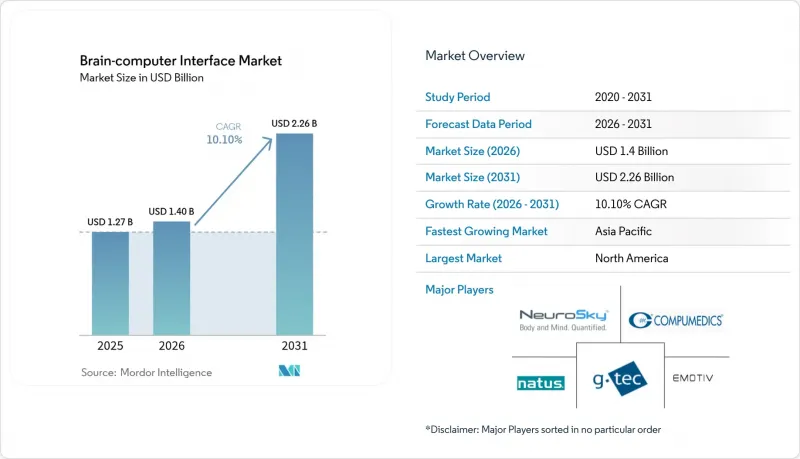
This report Segments by Component (Hardware, Software & Algorithm and Services), by Interface (Motor BCI, Communication BCI, and More), by Application (Neuro-Prosthetics & Motor Restoration and More), by End User (Hospitals & Clinics, Research & Academic Institutes, and Others) and by Geography ( Northa America, Europe and More) the Market Forecasts are Provided in Terms of Value (USD).
Global Brain-computer Interface Market Trends and Insights
Surging demand for assistive communication technologies
National Institutes of Health-backed research restored intelligible speech for a paralyzed patient with 99% word-level accuracy [2]. Synchron subsequently paired its Stentrode implant with a generative-AI model, enabling hands-free texting for additional users. Hospitals report shorter caregiver cycles and higher patient-autonomy scores, expanding the clinical addressable pool beyond ALS to traumatic spinal-cord injury and brain-stem stroke (user data). Private insurers in the United States have begun reviewing early reimbursement cases for speech-decoding implants, indicating growing payer recognition of durable quality-of-life gains. European teaching hospitals now integrate language-model-enhanced BCIs in multidisciplinary neuro-rehabilitation programs, reinforcing mid-term adoption across the region.
Rapid adoption of EEG-based wearable headsets
Gaming studios, e-sports organizers, and consumer-wellness brands integrate dry-electrode headsets into interactive titles, fitness programs, and meditation platforms. Streamers demonstrate full-gameplay control with neural inputs, while competitive leagues trial concentration and emotional-state data for coaching. These deployments sharpen algorithms for low-latency signal extraction, accelerate miniaturization, and educate non-medical audiences on everyday benefits of brain-computer interaction. As shipments grow, economies of scale begin to lower unit costs, allowing vendors to bundle subscription-based analytics that deepen revenue per user.
Surgical risks and regulatory hurdles
Implantable systems deliver superior signal fidelity yet involve cranial or vascular procedures that few centers can perform. Reports of electrode migration, infection, and device retrieval create caution among clinicians and insurers. Regulatory agencies require lengthy safety monitoring, stretching time-to-market and inflating trial budgets. These obstacles confine early adoption to well-funded academic hospitals and wealthy self-pay patients, slowing broad penetration. Vendors respond by refining stent-like delivery tools and developing reversible implants but must still navigate multi-year approval pathways.
Other drivers and restraints analyzed in the detailed report include:
- High VC funding in neuro-tech hubs
- Rising R&D activities by government
- Data-privacy concerns over neural data collection
For complete list of drivers and restraints, kindly check the Table Of Contents.
Segment Analysis
Non-invasive headsets and electrode arrays generated 75.90% of 2025 revenue, underscoring their role as the entry point for many developers in the Brain-Computer Interface market. Product launches with dry electrodes and low-energy Bluetooth have reduced setup times and improved comfort, enabling everyday usage scenarios such as virtual-reality gaming and remote neurofeedback. Hospitals appreciate the avoidance of surgical risk, and consumer brands leverage lower regulatory hurdles to speed shelf placement. Price declines and improved signal-to-noise ratios continue to support double-digit growth despite intensifying competition.
Software and algorithm layers are expanding at a .88% CAGR, a pace that outstrips hardware because every incremental headset installation yields recurring licensing opportunities. Transformer-based decoders, transfer learning, and self-calibrating frameworks raise information-transfer rates by triple-digit percentages. These advances create an emergent SaaS sub-segment forecast to climb from USD 0.38 billion to USD 0.97 billion by 203. Service providers follow close behind, offering cloud dashboards, electrode-maintenance contracts, and compliance audits to clinical buyers who lack in-house specialists. Together, these activities sustain a balanced revenue mix that shields vendors from pure hardware margin compression.
Motor/output platforms accounted for 50.30% of spending in 2025, reflecting clinical priorities around restoring cursor control, wheelchair navigation, and prosthetic manipulation for paralysis patients. Successful demonstrations of non-invasive deep-learning decoders capable of sub-second response rates have widened appeal beyond the intensive-care unit. Consumer developers adapt these breakthroughs to gesture-less input for augmented-reality headsets and smart-home devices, reinforcing the segment's maturity.
Hybrid architectures, combining EEG, electromyography, functional near-infrared spectroscopy, or focused ultrasound, are on course for 3.34% CAGR. They lift reliability by fusing multiple neural and peripheral signals, thereby compensating for artifacts that hamper single-modality systems. Experimental stroke-rehabilitation rigs illustrate the benefit: after two weeks of hybrid brain-muscle training, 83% of patients regained measurable hand function. As component costs fall, hybrid circuitry will migrate from the laboratory into modular consumer accessories.
Complete Report Scope:
- By Component (Value)
- Hardware
- Invasive
- Non-invasive
- Others
- Software & Algorithms
- Services
- Hardware
- By Interface Type (Value)
- Motor / Output BCI
- Communication BCI
- Passive / Monitoring BCI
- Hybrid BCI
- By Application (Value)
- Neuro-prosthetics & Motor Restoration
- Communication & Control
- Others
- By End-User (Value)
- Hospitals & Clinics
- Research & Academic Institutes
- Others
- By Geography (Value)
- North America
- United States
- Canada
- Mexico
- Europe
- Germany
- United Kingdom
- France
- Italy
- Spain
- Rest of Europe
- Asia-Pacific
- China
- Japan
- India
- South Korea
- Australia
- Rest of Asia- Pacific
- Middle East and Africa
- GCC
- South Africa
- Rest of Middle East and Africa
- South America
- Brazil
- Argentina
- Rest of South America
- North America
Geography Analysis
North America generated 48.0% of 2025 revenue and remains the anchor of the Brain-Computer Interface market. National Institutes of Health funding, deep venture pools, and specialized surgical teams underpin a continuous trial pipeline that spans speech decoding, bidirectional sensation, and neuromodulation for depression. The region benefits from early adopter health systems that integrate reimbursement studies into clinical workflows, accelerating payer acceptance. Privacy legislation is evolving rapidly, creating both compliance overhead and competitive advantage for firms that invest early in secure data architectures.
Asia-Pacific delivers the fastest 2.38% CAGR, propelled by Chinese government designation of brain-machine interfaces as a strategic industry. State grants encourage industrial-academic consortia, while new standards bodies tackle signal-acquisition protocols and ethical guidelines. Chinese start-ups have already demonstrated 7% accuracy in decoding Mandarin speech, underscoring regional momentum. Japan's aging demographics add a structural demand driver for neuro-degenerative disease management, and South-Korean electronics majors contribute sensor miniaturization expertise.
Europe holds a significant share, with public-health systems funding mood-enhancement trials and stroke-recovery programs. The National Health Service's GBP 6.5 million ultrasound-based BCI trial reinforces policy-level commitment to non-pharma approaches for mental-health conditions. The forthcoming EU AI Act classifies many AI-enabled medical devices as high-risk, compelling vendors to adopt rigorous cyber-security and performance-validation procedures that can become competitive differentiators in other regions. Smaller but growing markets in the Middle East, Africa, and South America invest in tele-rehabilitation and remote neuromonitoring, leveraging mobile connectivity and cross-border training partnerships.
- g.tec medical engineering
- Blackrock Neurotech
- Emotiv, Inc.
- NeuroSky, Inc.
- Kernel
- Paradromics, Inc.
- MindMaze SA
- Cognixion
- CTRL-Labs (Meta Platforms)
- NextMind (Snap Inc.)
- OpenBCI
- Synchron
- Neurable
- BrainCo, Inc.
- Interaxon Inc. (Muse)
- Bitbrain Technologies
- Cyberkinetics
- Nihon Kohden
- Compumedics
- Alea Neurotherapeutics
Additional Benefits:
- The market estimate (ME) sheet in Excel format
- 3 months of analyst support
TABLE OF CONTENTS
1 Introduction
- 1.1 Study Assumptions & Market Definition
- 1.2 Scope of the Study
2 Research Methodology
3 Executive Summary
4 Market Landscape
- 4.1 Market Overview
- 4.2 Market Drivers
- 4.2.1 Rapid adoption of EEG-based wearable headsets by eSports and gaming companies
- 4.2.2 High VC funding in neuro-tech hubs (Silicon Valley, Lausanne, Vienna) accelerating product commercialization timelines
- 4.2.3 Rising R&D Activities by Government to Improve the Brain-computer Interface Technology
- 4.2.4 Rising prevalence of neuro-degenerative disorders in ageing populations of Japan and EU spurring clinical trials
- 4.3 Market Restraints
- 4.3.1 Surgical risks and regulatory hurdles limiting adoption of implantable BCI systems
- 4.3.2 Data-privacy concerns over neural data collection
- 4.3.3 Scarcity of reimbursement codes for BCI-based rehabilitation therapies in public healthcare systems
- 4.3.4 Signal accuracy challenges due to hair & scalp impedance in mass-market EEG devices
- 4.4 Supply-Chain Analysis
- 4.5 Technological Outlook
- 4.6 Porter's Five Forces
- 4.6.1 Threat of New Entrants
- 4.6.2 Threat of Substitutes
- 4.6.3 Bargaining Power of Buyers
- 4.6.4 Bargaining Power of Suppliers
- 4.6.5 Industry Rivalry
5 Market Size & Growth Forecasts
- 5.1 By Component (Value)
- 5.1.1 Hardware
- 5.1.1.1 Invasive
- 5.1.1.2 Non-invasive
- 5.1.1.3 Others
- 5.1.2 Software & Algorithms
- 5.1.3 Services
- 5.1.1 Hardware
- 5.2 By Interface Type (Value)
- 5.2.1 Motor / Output BCI
- 5.2.2 Communication BCI
- 5.2.3 Passive / Monitoring BCI
- 5.2.4 Hybrid BCI
- 5.3 By Application (Value)
- 5.3.1 Neuro-prosthetics & Motor Restoration
- 5.3.2 Communication & Control
- 5.3.3 Others
- 5.4 By End-User (Value)
- 5.4.1 Hospitals & Clinics
- 5.4.2 Research & Academic Institutes
- 5.4.3 Others
- 5.5 By Geography (Value)
- 5.5.1 North America
- 5.5.1.1 United States
- 5.5.1.2 Canada
- 5.5.1.3 Mexico
- 5.5.2 Europe
- 5.5.2.1 Germany
- 5.5.2.2 United Kingdom
- 5.5.2.3 France
- 5.5.2.4 Italy
- 5.5.2.5 Spain
- 5.5.2.6 Rest of Europe
- 5.5.3 Asia-Pacific
- 5.5.3.1 China
- 5.5.3.2 Japan
- 5.5.3.3 India
- 5.5.3.4 South Korea
- 5.5.3.5 Australia
- 5.5.3.6 Rest of Asia- Pacific
- 5.5.4 Middle East and Africa
- 5.5.4.1 GCC
- 5.5.4.2 South Africa
- 5.5.4.3 Rest of Middle East and Africa
- 5.5.5 South America
- 5.5.5.1 Brazil
- 5.5.5.2 Argentina
- 5.5.5.3 Rest of South America
- 5.5.1 North America
6 6. Competitive Landscape
- 6.1 Market Concentration
- 6.2 Strategic Moves
- 6.3 Market Share Analysis
- 6.4 Company Profiles (includes Global level Overview, Market level overview, Core Segments, Financials as available, Strategic Information, Market Rank/Share, Products & Services, Recent Developments)
- 6.4.1 g.tec medical engineering GmbH
- 6.4.2 Blackrock Neurotech
- 6.4.3 Emotiv, Inc.
- 6.4.4 NeuroSky, Inc.
- 6.4.5 Kernel
- 6.4.6 Paradromics, Inc.
- 6.4.7 MindMaze SA
- 6.4.8 Cognixion
- 6.4.9 CTRL-Labs (Meta Platforms)
- 6.4.10 NextMind (Snap Inc.)
- 6.4.11 OpenBCI
- 6.4.12 Synchron Inc.
- 6.4.13 Neurable
- 6.4.14 BrainCo, Inc.
- 6.4.15 Interaxon Inc. (Muse)
- 6.4.16 Bitbrain Technologies
- 6.4.17 Cyberkinetics
- 6.4.18 Nihon Kohden Corporation
- 6.4.19 Compumedics Ltd
- 6.4.20 Alea Neurotherapeutics