

|
시장보고서
상품코드
2123502
벤조디아제핀계 약제 시장 : 점유율 분석, 업계 동향과 통계, 성장 예측(2026-2031년)Benzodiazepine Drugs - Market Share Analysis, Industry Trends & Statistics, Growth Forecasts (2026 - 2031) |
||||||
 Mordor Intelligence
Mordor Intelligence에 의하면, 2026년 벤조디아제핀계 약제 시장 규모는 28억 1,000만 달러로 추정되고 있어 2025년 27억 3,000만 달러에서 확대해, 2031년에는 32억 2,000만 달러에 이를 것으로 예측됩니다.
2026년부터 2031년까지 연평균 성장률(CAGR) 2.79%로 성장할 것으로 전망됩니다.
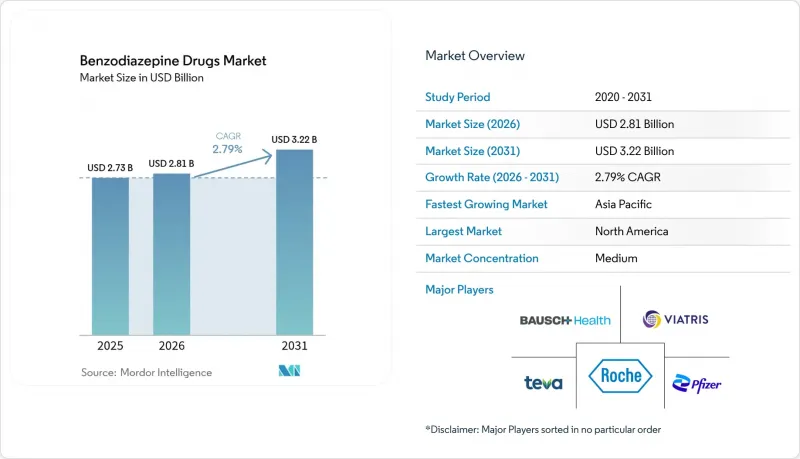
본 보고서는 제품별(알프라졸람, 디아제팜 등), 용도별(불안 장애, 발작 등),작용 시간별(초단시간 작용형, 단시간 작용형 등), 투여 경로별(경구, 비경구 등), 유통 채널별(병원 약국 등), 지역별(북미, 유럽 등)로 분류되어 있습니다. 시장 전망은 금액(달러) 기준으로 제시되어 있습니다.
전 세계 벤조디아제핀계 약제 시장 동향 및 인사이트
불안 장애 및 공황 장애 유병률 증가
세계 불안 장애의 유병률은 특히 BRICS 국가에서 지속적으로 상승하고 있습니다. 미국 데이터에 따르면, 2025년에는 성인의 18.2%가 불안 증상 선별 검사에서 양성 반응을 보일 것으로 예상되며, 이는 팬데믹 이전 기준치보다 증가한 수치입니다. 이러한 역학적 압박은 지침이 엄격해지고 있음에도 불구하고 처방 지속을 뒷받침하고 있습니다. 가임기 여성의 경우 약물 복용 순응도가 높은 것으로 보고되어, 이는 처방 건수 증가를 촉진하고 있습니다. 특히, 미국 마약단속국(DEA)이 특별 등록 규정에 따라 스케줄 III-V로 분류되는 벤조디아제핀계 약제의 전자 처방전을 허용함에 따라, 원격의료를 통한 의료 제공 범위가 확대되고 있습니다. 그럼에도 불구하고, 전문가 단체는 장기 복용자에게 단계적인 감량을 권장하고 있어, 필요성과 안전성 사이의 균형을 중시하고 있음을 알 수 있습니다.
여러 가지 동반 질환을 앓고 있는 고령화 사회
고령화 사회는 불안, 불면증, 발작을 동반하는 환자층을 끊임없이 양산하고 있습니다. 2024년 7개국에서 실시된 조사에 따르면, 65세 이상 유럽인의 14.9%가 벤조디아제핀계 약제를 사용하고 있으며, 크로아티아에서는 35.5%로 가장 높은 비율을 보였습니다. 처방 의사는 투여 관리를 단순화하기 위해 장시간 작용형 디아제팜을 선호하지만, 낙상이나 인지 기능 저하의 위험을 모니터링해야 합니다. 보건 당국은 처방 감축 캠페인을 추진하고 있지만, 복잡한 다중 질환 동반이라는 임상적 현실로 인해 벤조디아제핀은 여전히 노인 의학에서 치료 옵션으로 남아 있습니다.
의존, 남용, 부정 사용의 위험이 높음
합성 유사 약물에 의한 과다 복용 사망이 증가하고 있으며, 지난 15년간 141건의 사망이 이와 관련된 것으로 알려져 있습니다. 스코틀랜드 교도소의 선별 검사에서는 에티졸람이 빈번하게 검출되고 있어, 불법 유통이 만연함을 보여줍니다. 2008년 이후, 젊은 성인에 대한 처방률이 전반적인 감소 추세와 대조적으로 서서히 상승하고 있어 규제 당국은 감시를 강화하고 있습니다. 영국에서는 이미 15종의 신규 약물에 대해 C급 규제를 적용하자는 제안이 제기된 바 있습니다.
부문 분석
2025년에는 알프라졸람이 매출의 33.05%를 차지하며, 벤조디아제핀계 약제 시장 규모를 지탱하는 핵심 요소가 되었습니다. 이 약물 수요는 일선 불안 장애 치료 프로토콜과 처방 의사의 해당 약물에 대한 숙련도에 기반을 두고 있습니다. 디아제팜을 포함한 벤조디아제핀계 약제 시장 규모는 간질, 알코올 금단 증상, 소아용 비강 스프레이로의 적응증 확장에 힘입어 연평균 성장률(CAGR) 4.16%로 확대될 것으로 예측됩니다. 디아제팜은 158개국에서 보고된 결과 중 다시 한번 가장 널리 거래된 향정신성 약물로 나타났습니다. 2024년에는 클로나제팜과 로라제팜에서 공급 차질이 발생하면서, 제조가 집중되어 있을 때 공급 부족 위험이 얼마나 커지는지가 여실히 드러났습니다.
현재 제약사들은 투여 형태의 개선에 주력하고 있습니다. 2025년 4월, FDA는 2세 이상 소아를 대상으로 한 디아제팜 비강 스프레이를 승인했으며, Neurelis의 독점권 기간이 연장되었습니다. 이러한 전환점은 벤조디아제핀계 약제 시장에서 새로운 분자가 아닌 차별화된 제형이 이익률을 지탱하는 시대가 도래했음을 시사합니다.
2025년, 불안 장애는 벤조디아제핀계 약제 시장 점유율의 54.10%를 차지했으며, 이러한 위상은 여전히 높은 증상 유병률에 힘입은 것입니다. 알코올 금단 증상 관리는 규모는 작지만, 해독 프로그램의 확대와 발작 예방에 있어 벤조디아제핀계 약제의 유효성을 입증하는 증거에 힘입어 2031년까지 연평균 성장률(CAGR) 3.58%로 성장할 것으로 전망됩니다.
비강 내 투여형 디아제팜 및 미다졸람은 발작에 대한 응급 의료 대응 시간을 단축시켰습니다. 불면증에 대한 처방은 보험사의 비약물 요법 추진으로 인해 억제된 상태가 지속되고 있지만, 기술로 인한 수면장애로 인해 틈새 수요는 여전히 존재하고 있습니다. 근육 경련 완화 및 수술 전 진정 요법은 시장 규모를 서서히 확대되고 있습니다.
지역별 분석
북미는 2025년 매출의 40.10%를 차지하며, 연평균 성장률(CAGR) 2.32%로 성장할 전망입니다. 미국 성인의 불안 장애 유병률이 18.2%라는 사실은 수요가 지속되고 있음을 뒷받침합니다. 2024년에 발생한 크로나제팜 및 로라제팜공급 차질은 제조의 집중화에 따른 위험을 여실히 드러냈으나, 현재 원격 처방에 대해서는 DEA(마약단속국)의 3단계 규제가 적용되고 있습니다.
유럽은 2031년까지 연평균 성장률(CAGR) 2.70%로 성장할 전망입니다. 고령층에 대한 처방률은 크로아티아에서 35.5%, 스페인에서 33.5%에 달하며, 지역 내 편차가 뚜렷합니다. 로라제팜·맥큐어 등에 대한 유럽의약품청(EMA)의 중앙 집중 심사는 안전성 관련 정보 전달을 통일하고, 국경을 초월한 일관성을 확보하고 있습니다. 36유형의 신규 합성 유사 물질에 대한 감시를 통해 규제 당국의 경계 태세는 높은 수준을 유지하고 있습니다.
아시아태평양은 3.25%라는 가장 높은 연평균 성장률(CAGR)을 기록하고 있습니다. 인도에서는 지난 30년 동안 불안 장애 사례 수가 113.30% 급증했습니다. 중국에서 미다졸람이 제1류로 재분류됨에 따라 규정 준수(컴플라이언스)의 중요성이 높아지고 있습니다. 일본에서는 Aculys Pharma사의 희귀질환 치료제 신청을 받아, 조만간 국내 최초로 승인될 디아제팜 비강 스프레이가 출시될 가능성이 있습니다. 중동 및 아프리카 및 남미 시장은 정신 건강에 대한 인식 제고와 의료 시스템에 대한 자금 지원 확대를 배경으로 약 2.9%의 성장률을 보이고 있습니다.
기타 혜택:
- 엑셀 형식 시장 예측(ME) 시트
- 3개월간의 애널리스트 지원
자주 묻는 질문
목차
제1장 서론
제2장 조사 방법
제3장 주요 요약
제4장 시장 구도
제5장 시장 규모와 성장 예측
제6장 경쟁 구도
제7장 시장 기회와 향후 전망
JHS 26.09.09According to Mordor Intelligence, benzodiazepine drugs market size in 2026 is estimated at USD 2.81 billion, growing from 2025 value of USD 2.73 billion with 2031 projections showing USD 3.22 billion, growing at 2.79% CAGR over 2026-2031.
This report is Segmented by Product (Alprazolam, Diazepam, and More), Application (Anxiety Disorders, Seizures, and More), Time of Action (Ultra-Short Acting, Short Acting, and More), Route of Administration (Oral, Parenteral, and More), Distribution Channel (Hospital Pharmacies and More), and Geography (North America, Europe, and More). The Market Forecasts are Provided in Terms of Value (USD).
Global Benzodiazepine Drugs Market Trends and Insights
Rising Prevalence of Anxiety & Panic Disorders
Global anxiety incidence keeps climbing, especially in BRICS economies. U.S. data showed 18.2% of adults screened positive for anxiety symptoms in 2025, up from pre-pandemic baselines. This epidemiological pressure sustains prescriptions even as guidelines tighten. Reproductive-age women report higher medication adherence, amplifying script volumes. Telehealth now broadens reach, notably after the DEA allowed Schedule III-V benzodiazepine e-prescribing under special registration rules. Professional bodies nevertheless push gradual tapering for long-term users, underscoring the balancing act between need and safety.
Ageing Population with Multiple Comorbidities
Aging societies contribute a steady patient pool with anxiety, insomnia and seizure comorbidity. A 2024 seven-nation survey found 14.9% benzodiazepine use among Europeans aged 65+, peaking at 35.5% in Croatia. Prescribers prefer longer-acting diazepam for simplified dosing yet must monitor fall and cognition risks. Health agencies promote deprescribing campaigns, but the clinical reality of complex multimorbidity keeps benzodiazepines in geriatric toolkits.
High Risk of Dependence, Abuse & Diversion
Designer analogues fuel overdose deaths, with 141 fatalities linked in the last one and a half decades. Scottish prison screens frequently detect etizolam, illustrating illicit penetration. Young adult prescribing has crept upward since 2008, diverging from the overall decline, driving regulators to intensify monitoring. The UK has already proposed Class C controls on fifteen novel agents.
Other drivers and restraints analyzed in the detailed report include:
- Increasing Insomnia Linked to Digital-Lifestyle Fatigue
- Growing Adoption of Low-Cost Generics
- Intensifying Regulatory Scrutiny & Up-Scheduling Initiatives
For complete list of drivers and restraints, kindly check the Table Of Contents.
Segment Analysis
In 2025, alprazolam generated 33.05% of revenue, anchoring the benzodiazepine drugs market size. Demand stems from frontline anxiety protocols and prescriber familiarity. The benzodiazepine drugs market size for diazepam is projected to rise at a 4.16% CAGR, fueled by seizure, alcohol-withdrawal, and pediatric nasal-spray extensions. Diazepam was again the most widely traded psychotropic agent, reported by 158 nations. Supply interruptions hit clonazepam and lorazepam during 2024, exposing how concentrated manufacturing magnifies the risk of shortage.
Innovators now pursue delivery upgrades. In April 2025, the FDA cleared diazepam nasal spray for children down to age 2, stretching exclusivity for Neurelis. Such milestones signal an era where differentiated formats rather than new molecules sustain margins within the benzodiazepine drugs market.
Anxiety disorders accounted for 54.10% of the benzodiazepine drugs market share in 2025, a position underpinned by persistently high symptom prevalence. Alcohol-withdrawal management, though smaller, will exhibit a 3.58% CAGR through 2031, aided by detox program growth and evidence favoring benzodiazepines for seizure prophylaxis.
Intranasal diazepam and midazolam have improved emergency seizure care response times. Insomnia scripts remain controlled as payers push non-drug therapies, yet technology-induced sleep disruption keeps a niche need alive. Muscle spasm relief and pre-operative sedation add incremental volumes.
Complete Report Scope:
- By Product
- Alprazolam
- Diazepam
- Lorazepam
- Clonazepam
- Temazepam
- Others
- By Application
- Anxiety Disorders
- Seizures
- Insomnia
- Alcohol Withdrawal
- Other Applications
- By Time of Action
- Ultra-short Acting
- Short Acting
- Intermediate Acting
- Long Acting
- By Route of Administration
- Oral
- Parenteral
- Intranasal
- Others
- By Distribution Channel
- Hospital Pharmacies
- Retail Pharmacies
- Online Pharmacies
- By Geography
- North America
- United States
- Canada
- Mexico
- Europe
- Germany
- United Kingdom
- France
- Italy
- Spain
- Rest of Europe
- Asia-Pacific
- China
- India
- Japan
- Australia
- South Korea
- Rest of Asia-Pacific
- Middle East and Africa
- GCC
- South Africa
- Rest of Middle East and Africa
- South America
- Brazil
- Argentina
- Rest of South America
- North America
Geography Analysis
North America generated 40.10% of 2025 revenue and will grow at 2.32% CAGR. Anxiety prevalence of 18.2% in U.S. adults underscores continuing demand. Supply disruptions in clonazepam and lorazepam during 2024 revealed manufacturing concentration risks, while three-tier DEA rules now govern tele-prescribing.
Europe advances at 2.70% CAGR to 2031. Elderly prescription prevalence reaches 35.5% in Croatia, 33.5% in Spain, highlighting intra-region variance. EMA's centralised referrals, such as for lorazepam Macure, harmonise safety messaging and ensure cross-border consistency. Surveillance of 36 new designer analogues keeps regulatory vigilance high.
Asia-Pacific records the fastest 3.25% CAGR. India saw a 113.30% surge in anxiety cases over three decades. China's Category I reclassification of midazolam raises compliance stakes. Japan could soon launch the first locally approved diazepam nasal spray following Aculys Pharma's orphan-drug submission. Markets in the Middle East & Africa and South America grow at roughly 2.9% under improved mental-health recognition and broader health-system funding.
- Accord Healthcare
- Amneal Pharmaceuticals
- Apotex
- Aurobindo Pharma Ltd.
- Bausch Health
- Cipla
- Dr. Reddy's Laboratories
- Endo International
- Roche
- Fresenius
- Glenmark Pharmaceuticals
- Hikma Pharmaceuticals
- Lupin
- Neurelis Inc.
- Nichi-Iko Pharmaceutical Co. Ltd.
- Orion
- Pfizer
- Sandoz Group AG
- Sun Pharmaceuticals Industries
- Teva Pharmaceutical Industries
- Torrent Pharmaceuticals
- Viatris
Additional Benefits:
- The market estimate (ME) sheet in Excel format
- 3 months of analyst support
TABLE OF CONTENTS
1 Introduction
- 1.1 Study Assumptions & Market Definition
- 1.2 Scope of the Study
2 Research Methodology
3 Executive Summary
4 Market Landscape
- 4.1 Market Overview
- 4.2 Market Drivers
- 4.2.1 Rising prevalence of anxiety & panic disorders
- 4.2.2 Ageing population with multiple comorbidities
- 4.2.3 Growing adoption of low-cost generics
- 4.2.4 Increasing insomnia linked to digital-lifestyle fatigue
- 4.2.5 Expansion of palliative-care protocols using benzodiazepines
- 4.2.6 Shortages of alternative anti-anxiety APIs driving formulary substitution
- 4.3 Market Restraints
- 4.3.1 High risk of dependence, abuse & diversion
- 4.3.2 Intensifying regulatory scrutiny & up-scheduling initiatives
- 4.3.3 Emergence of non-benzo anxiolytics (e.g., Z-drugs, CBD-based)
- 4.3.4 API supply-chain vulnerabilities (China-India chokepoints)
- 4.4 Supply Chain Analysis
- 4.5 Regulatory Landscape
- 4.6 Porter's Five Forces Analysis
- 4.6.1 Threat of New Entrants
- 4.6.2 Bargaining Power of Buyers
- 4.6.3 Bargaining Power of Suppliers
- 4.6.4 Threat of Substitutes
- 4.6.5 Intensity of Competitive Rivalry
5 Market Size & Growth Forecasts (Value)
- 5.1 By Product
- 5.1.1 Alprazolam
- 5.1.2 Diazepam
- 5.1.3 Lorazepam
- 5.1.4 Clonazepam
- 5.1.5 Temazepam
- 5.1.6 Others
- 5.2 By Application
- 5.2.1 Anxiety Disorders
- 5.2.2 Seizures
- 5.2.3 Insomnia
- 5.2.4 Alcohol Withdrawal
- 5.2.5 Other Applications
- 5.3 By Time of Action
- 5.3.1 Ultra-short Acting
- 5.3.2 Short Acting
- 5.3.3 Intermediate Acting
- 5.3.4 Long Acting
- 5.4 By Route of Administration
- 5.4.1 Oral
- 5.4.2 Parenteral
- 5.4.3 Intranasal
- 5.4.4 Others
- 5.5 By Distribution Channel
- 5.5.1 Hospital Pharmacies
- 5.5.2 Retail Pharmacies
- 5.5.3 Online Pharmacies
- 5.6 By Geography
- 5.6.1 North America
- 5.6.1.1 United States
- 5.6.1.2 Canada
- 5.6.1.3 Mexico
- 5.6.2 Europe
- 5.6.2.1 Germany
- 5.6.2.2 United Kingdom
- 5.6.2.3 France
- 5.6.2.4 Italy
- 5.6.2.5 Spain
- 5.6.2.6 Rest of Europe
- 5.6.3 Asia-Pacific
- 5.6.3.1 China
- 5.6.3.2 India
- 5.6.3.3 Japan
- 5.6.3.4 Australia
- 5.6.3.5 South Korea
- 5.6.3.6 Rest of Asia-Pacific
- 5.6.4 Middle East and Africa
- 5.6.4.1 GCC
- 5.6.4.2 South Africa
- 5.6.4.3 Rest of Middle East and Africa
- 5.6.5 South America
- 5.6.5.1 Brazil
- 5.6.5.2 Argentina
- 5.6.5.3 Rest of South America
- 5.6.1 North America
6 Competitive Landscape
- 6.1 Market Concentration
- 6.2 Competitive Benchmarking
- 6.3 Market Share Analysis
- 6.4 Company Profiles (includes Global level Overview, Market level overview, Core Segments, Financials as available, Strategic Information, Market Rank/Share for key companies, Products & Services, and Recent Developments)
- 6.4.1 Accord Healthcare
- 6.4.2 Amneal Pharmaceuticals LLC
- 6.4.3 Apotex Inc.
- 6.4.4 Aurobindo Pharma Ltd.
- 6.4.5 Bausch Health Companies Inc.
- 6.4.6 Cipla Ltd.
- 6.4.7 Dr. Reddy's Laboratories Ltd.
- 6.4.8 Endo International plc
- 6.4.9 F. Hoffmann-La Roche AG
- 6.4.10 Fresenius Kabi
- 6.4.11 Glenmark Pharmaceuticals Ltd
- 6.4.12 Hikma Pharmaceuticals plc
- 6.4.13 Lupin Ltd.
- 6.4.14 Neurelis Inc.
- 6.4.15 Nichi-Iko Pharmaceutical Co. Ltd.
- 6.4.16 Orion Corporation
- 6.4.17 Pfizer Inc.
- 6.4.18 Sandoz Group AG
- 6.4.19 Sun Pharmaceutical Industries Ltd.
- 6.4.20 Teva Pharmaceutical Industries Ltd.
- 6.4.21 Torrent Pharmaceuticals Ltd.
- 6.4.22 Viatris Inc.
7 Market Opportunities & Future Outlook
- 7.1 White-space & Unmet-Need Assessment


