

|
시장보고서
상품코드
2123509
팽창 장치 시장 : 점유율 분석, 업계 동향과 통계, 성장 예측(2026-2031년)Inflation Devices - Market Share Analysis, Industry Trends & Statistics, Growth Forecasts (2026 - 2031) |
||||||
 Mordor Intelligence
에 의하면, 팽창 장치 시장 규모는 2025년 6억 4,348만 달러에서 2026년에는 6억 7,752만 달러로 확대되어 2026년부터 2031년까지 CAGR 5.29%로 성장을 지속하여, 2031년에는 8억 7,653만 달러에 이를 것으로 예측됩니다.
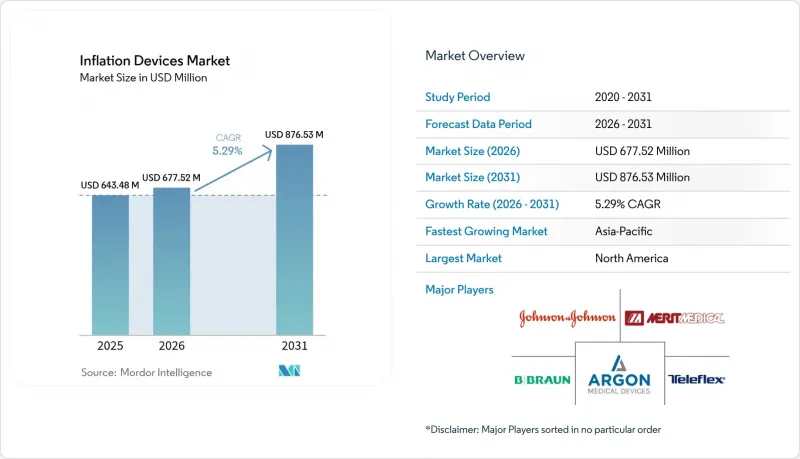
본 보고서는 제품 유형(아날로그식 팽창 장치, 디지털식 팽창 장치), 압력 범위(15기압 미만, 15-30기압, 30기압 초과), 용도(관상동맥 성형술, 말초혈관 성형술 등), 최종 사용자(병원, 외래수술센터(ASC) 등), 지역(북미, 유럽 등)별로 분류되어 있습니다. 시장 예측은 금액(달러) 기준으로 제시되어 있습니다.
세계 팽창 장치 시장 동향 및 인사이트
심혈관 질환 및 말초동맥 질환 유병률 증가
미국의 허혈성 심장 질환 환자 수는 2060년까지 2,900만 명을 넘어설 것으로 예측됩니다. 이러한 인구 급증은 팽창 장치 시장, 특히 현재 전 세계 수요의 58.27%를 차지하고 있는 15-30 아톰 등급 제품에 대한 지속적인 수요를 뒷받침하고 있습니다. 병원에서는 카테터실 수용 능력을 확대하고 있으며, 정밀한 압력 제어와 우수한 온도 안정성을 갖춘 게이지를 장착한 펌프가 선택되고 있습니다. 이에 따라 견고하고 직관적인 설계를 갖춘 공급업체는 고령화가 진행되는 경제권에서 고부가가치 계약을 확보할 수 있는 유리한 입장에 있습니다.
저침습 혈관 성형술 증가
12개월 시점에서 주요 유해사건을 11.1% 감소시킨 ‘AGENT 파클리탁셀 코팅 풍선 카테터’의 FDA 승인은 사례 수 확대에 있어 혁신이 차지하는 역할을 여실히 보여주고 있습니다. 메디케어 지출의 두 자릿수 성장에 힘입은 외래수술센터(ASC)에서는 기기의 신속한 설치와 디지털 모니터링이 우선시되고 있습니다. 이에 대응하여 팽창 장치 시장의 각 제조업체들은 당일 퇴원 프로토콜을 효율화하기 위한 자동 팽창 알고리즘이 탑재된 콘솔을 시장에 출시하고 있습니다.
디지털 팽창 장치의 높은 평균 판매 가격
디지털 콘솔의 정가는 아날로그 펌프보다 30-40% 높기 때문에 병원의 이익률이 여전히 낮은 시설에서는 도입이 제한되고 있습니다. 교정, 소프트웨어, 교육 등을 포함한 총 소유 비용(TCO)을 평가할 경우, 그 격차는 더욱 벌어질 가능성이 있습니다. 그 결과, 응급 카트에서는 여전히 아날로그 펌프가 사용되고 있어, 팽창 장치 시장의 고가 부문 성장을 둔화시키고 있습니다.
부문 분석
2025년, 아날로그 펌프는 팽창 장치 시장의 61.94%를 차지했으며, 그 신뢰성과 저렴한 단가로 인해 지지를 받았습니다. 환자 수가 많은 병원에서는 기술자들이 이미 해당 워크플로우에 익숙하기 때문에 아날로그 펌프 구매가 계속되고 있습니다. 그럼에도 불구하고, 의료 기관이 감사에 대응할 수 있는 데이터 수집을 요구하는 가운데, 디지털 기기는 2031년까지 연평균 성장률(CAGR) 6.15%로 1억 3,160만 달러 시장 규모 확대를 보일 것으로 전망됩니다. 팽창 및 수축 주기를 모두 기록하는 무선 콘솔은 인증 요건을 충족하기 때문에 팽창 장치 시장 내에서의 전환 의지를 높이고 있습니다.
디지털 시스템은 압력 그래프, 자동 조정 알고리즘, 원격 진단 기능을 통합하여 생체의학 엔지니어의 출동 횟수를 대폭 줄여줍니다. 트레이드인 크레딧 및 리스 플랜을 통해 고액의 구매 비용 부담이 경감되어, 독립형 외래수술센터(ASC)가 구식 기술을 단숨에 뛰어넘을 수 있게 됩니다. 아날로그 장비는 여전히 뿌리 깊은 존재이지만, 팽창 장치 시장의 전략적 방향성은 데이터 중심 플랫폼이 표준이 될 것임을 보여줍니다.
관상동맥 성형술이 여전히 시술 건수의 대부분을 차지하고 있지만, 신경혈관 중재술은 6.38%라는 가장 높은 연평균 성장률(CAGR)을 기록하고 있습니다. 몇 분의 1 기압 단위로 증감이 가능한 마이크로 프로파일 펌프는 신경 중재 시술 의사들 사이에서 수요가 높으며, 팽창 장치 시장의 기술적 정교함이 확대되고 있음을 여실히 보여줍니다.
말초 혈관 성형술은 중증 하지 허혈에 대한 인식이 확산됨에 따라 안정적인 환자 수를 유지하고 있습니다. 소화기내과 의사들로부터 양성 식도 협착에 대한 약물 코팅 풍선의 사용 성공률이 88.9%에 달했다는 보고가 있었으며, 이에 따라 소화기과에서는 전용 팽창 키트의 비축이 진행되고 있습니다. 또한, 전립선 동맥 색전술을 시행하는 비뇨기과 의사들도 압력 안정성이 뛰어난 장치를 활용한 초고해상도 영상 진단을 도입하고 있습니다. 이를 종합해 볼 때, 팽창 장치 시장의 시술 대상 범위는 더욱 다양해지고 있습니다.
지역별 분석
북미는 높은 시술 밀도와 지원적인 보험 환급 제도의 뒷받침을 받아 2025년에 전 세계 매출의 41.95%를 차지했습니다. CMS에 의한 2.93%의 요금표 인상은 의료 제공업체에게 예측 가능한 수익을 확보해 주며, 차세대 콘솔에 대한 설비 투자를 촉진하고 있습니다. 캐나다의 검사실은 FDA 승인과 기기 상호 인정의 혜택을 받아 미국의 구매 패턴을 따르고 있는 반면, 멕시코는 민관 자금을 통해 심장 의료 인프라 구축을 추진하고 있습니다.
유럽은 종합적인 보험 적용 범위와 엄격한 MDR(의료기기 규정)에 따른 감독으로 2위 자리를 유지하고 있으며, 이로 인해 로그 파일 내보내기가 가능한 펌프에 대한 수요가 증가하고 있습니다. 독일, 프랑스, 영국 3개국에서는 연간 60만 건 이상의 PCI(경피적 관상동맥 성형술) 및 말초 혈관 시술이 이루어지고 있어, 팽창 장치 시장의 최소 처리량을 보장하고 있습니다. 비용 균형을 중시하는 남유럽 국가들에서는 더 낮은 설비 투자 비용으로 규정 준수 요건을 충족하는 아날로그와 디지털을 결합한 하이브리드 구성이 종종 선택되고 있습니다.
아시아태평양은 연평균 7.06%의 성장이 예상되며, 이는 팽창 장치 시장에서 가장 높은 성장 속도입니다. 중국은 2023년에 1만 2,213건의 의료기기를 승인했으며, 그 중 절반 이상이 클래스 III로 분류되어 규제 당국이 혁신을 신속하게 추진하려는 태도를 반영하고 있습니다. 인도의 국내 생산 촉진으로 수입 의존도가 낮아지고 있으며, 2,000달러 미만의 아날로그 제품 부문이 개척되고 있습니다. 일본과 한국은 모두 급속한 고령화가 진행되고 있어 복잡한 신경혈관 질환의 사례 수가 계속 증가하고 있으며, 고가 의료기기 시장이 형성되고 있습니다. 동남아시아 국가 정부들은 카테터실 도입에 공동 출자를 하고 있으며, 이를 통해 초기 구매가 가능해지면서 팽창 장치 시장에 대한 지역적 수요가 확대되고 있습니다.
기타 혜택:
- 엑셀 형식 시장 예측(ME) 시트
- 3개월간의 애널리스트 지원
자주 묻는 질문
목차
제1장 서론
제2장 조사 방법
제3장 주요 요약
제4장 시장 구도
제5장 시장 규모와 성장 예측
제6장 경쟁 구도
제7장 시장 기회와 향후 전망
JHS 26.09.07According to Mordor Intelligence, the inflation devices market size is expected to grow from USD 643.48 million in 2025 to USD 677.52 million in 2026 and is forecast to reach USD 876.53 million by 2031 at 5.29% CAGR over 2026-2031.

This report is Segmented by Product Type (Analog Inflation Devices, Digital Inflation Devices), Pressure Range (less Than 15 Atm, 15 - 30 Atm, More Than 30 Atm), Application (Coronary Angioplasty, Peripheral Angioplasty, and More), End User (Hospitals, Ambulatory Surgical Centers, and More), and Geography (North America, Europe, and More). The Market Forecasts are Provided in Terms of Value (USD).
Global Inflation Devices Market Trends and Insights
Rising prevalence of cardiovascular & peripheral arterial diseases
Ischemic-heart-disease patients in the United States are projected to top 29 million by 2060. This demographic surge underpins recurrent demand in the Inflation devices market, particularly for units rated 15-30 atm that now satisfy 58.27% of global requirement. Hospitals are scaling cath-lab capacity and choosing pumps that offer granular pressure control and temperature-stable gauges, positioning suppliers with robust, intuitive designs to win high-value contracts in aging economies.
Growth in minimally-invasive angioplasty procedures
FDA clearance of the AGENT Paclitaxel-Coated Balloon Catheter, which cut major adverse events 11.1% at 12 months, illustrates innovation's role in expanding case volumes. ASCs, buoyed by double-digit Medicare spending growth, prioritize rapid device setup and digital monitoring. In response, manufacturers of the Inflation devices market roll out consoles with auto-inflation algorithms to streamline same-day discharge protocols.
High average selling price of digital inflation devices
Digital consoles list 30-40% higher than analog pumps, limiting uptake where hospital margins remain thin. Cost-of-ownership assessments-which include calibration, software, and training-may widen that gap. Analogue pumps therefore persist in emergency carts, tempering growth in the premium tier of the Inflation devices market.
Other drivers and restraints analyzed in the detailed report include:
- Favourable reimbursement reforms for catheter-based interventions
- Integration of digital pressure-sensing & data logging
- Stringent Class III regulatory pathway in key markets
For complete list of drivers and restraints, kindly check the Table Of Contents.
Segment Analysis
Analog pumps generated 61.94% of the Inflation devices market in 2025, favored for reliability and low unit cost. High-volume hospitals continue to buy analog because technicians already master the workflow. Still, digital devices are projected to add USD 131.6 million by 2031 on a 6.15% CAGR as centers seek audit-ready data capture. Wireless consoles that log every inflation-deflation cycle satisfy accreditation mandates, raising switching incentives inside the Inflation devices market.
Digital systems integrate pressure graphs, auto-adjust algorithms, and remote diagnostics, slashing biomedical engineer call-outs. Trade-in credits and leasing plans dilute sticker shock, enabling independent ASCs to leapfrog older technology. Although analog remains entrenched, the strategic direction inside the Inflation devices market points to data-centric platforms becoming the reference standard.
Coronary angioplasty still dominates volume, but neurovascular interventions register the fastest CAGR at 6.38%. Micro-profile pumps capable of fractional-atmosphere increments are in high demand among neuro-interventionalists, highlighting the expanding technical sophistication of the Inflation devices market.
Peripheral angioplasty enjoys steady patient inflow as awareness of critical-limb ischemia spreads. Gastroenterologists report an 88.9% success rate using drug-coated balloons for benign esophageal strictures, encouraging GI units to stock dedicated inflation kits. Urologists engaged in prostate-artery embolization likewise recruit ultra-high-resolution imaging that benefits from pressure-stable devices. Combined, these applications enlarge the procedurally diverse base of the Inflation devices market.
Complete Report Scope:
- By Product Type (Value)
- Analog Inflation Devices
- Digital Inflation Devices
- By Pressure Range (Value)
- less than 15 atm
- 15 - 30 atm
- more than 30 atm
- By Application (Value)
- Coronary Angioplasty
- Peripheral Angioplasty
- Neurovascular Procedures
- Gastroenterology & ERCP
- Urology & Others
- By End User (Value)
- Hospitals
- Ambulatory Surgical Centers
- Specialty Clinics & Cath Labs
- By Geography (Value)
- North America
- United States
- Canada
- Mexico
- Europe
- Germany
- United Kingdom
- France
- Italy
- Spain
- Rest of Europe
- Asia-Pacific
- China
- India
- Japan
- South Korea
- Australia
- Rest of Asia-Pacific
- South America
- Brazil
- Argentina
- Rest of South America
- Middle East and Africa
- GCC
- South Africa
- Rest of Middle East and Africa
- North America
Geography Analysis
North America generated 41.95% of global revenue in 2025, underpinned by high procedural density and supportive reimbursement. CMS's 2.93% fee-schedule uplift secures predictable returns for providers, fueling capital expenditure on next-generation consoles. Canadian labs, benefiting from device reciprocity with FDA approvals, follow U.S. buying patterns, while Mexico upgrades cardiac infrastructure through public-private funding.
Europe maintains second position through comprehensive insurance coverage and stringent MDR oversight, which elevates demand for pumps with exportable log files. Germany, France, and the United Kingdom together perform more than 600,000 PCI and peripheral procedures per year, guaranteeing baseline throughput for the Inflation devices market. Southern Europe, seeking cost balance, often opts for hybrid analog-digital configurations that meet compliance at lower capital cost.
Asia-Pacific is forecast to expand 7.06% annually, the sharpest pace in the Inflation devices market. China approved 12,213 medical devices in 2023, over half in Class III, reflecting regulator willingness to fast-track innovation. India's domestic manufacturing push is narrowing import gaps, opening sub-USD 2,000 analog segments. Japan and South Korea, both aging rapidly, sustain complex neurovascular case growth, creating premium device pockets. Southeast Asian governments co-finance cath-lab rollouts, enabling first-time purchases and widening regional demand for the Inflation devices market.
- Merit Medical Systems
- Cook Group
- B. Braun
- Terumo
- Boston Scientific
- Medtronic
- Abbott Laboratories
- Teleflex
- Atrion Corporation
- Argon Medical Devices
- Cardinal Health
- Penumbra
- Nipro
- Olympus
- Smiths Group
- Shenzhen SCW Medicath Ltd.
- Lepu Medical
- Integra LifeSciences
- Acandis
Additional Benefits:
- The market estimate (ME) sheet in Excel format
- 3 months of analyst support
TABLE OF CONTENTS
1 Introduction
- 1.1 Study Assumptions & Market Definition
- 1.2 Scope of the Study
2 Research Methodology
3 Executive Summary
4 Market Landscape
- 4.1 Market Overview
- 4.2 Market Drivers
- 4.2.1 Rising prevalence of cardiovascular & peripheral arterial diseases
- 4.2.2 Growth in minimally-invasive angioplasty procedures
- 4.2.3 Favourable reimbursement reforms for catheter-based interventions
- 4.2.4 Integration of digital pressure-sensing & data logging in inflation devices
- 4.2.5 Adoption in neurovascular & structural-heart interventions
- 4.2.6 Shift toward single-use sterile inflation devices for infection control
- 4.3 Market Restraints
- 4.3.1 High average selling price of digital inflation devices
- 4.3.2 Stringent Class III regulatory pathway in key markets
- 4.3.3 Supply-chain vulnerability for precision pressure gauges & syringes
- 4.3.4 Growing catheter designs that eliminate separate inflation devices
- 4.4 Value / Supply-Chain Analysis
- 4.5 Regulatory Landscape
- 4.6 Technological Outlook
- 4.7 Porter's Five Forces
- 4.7.1 Threat of New Entrants
- 4.7.2 Bargaining Power of Buyers
- 4.7.3 Bargaining Power of Suppliers
- 4.7.4 Threat of Substitutes
- 4.7.5 Competitive Rivalry
5 Market Size & Growth Forecasts
- 5.1 By Product Type (Value)
- 5.1.1 Analog Inflation Devices
- 5.1.2 Digital Inflation Devices
- 5.2 By Pressure Range (Value)
- 5.2.1 less than 15 atm
- 5.2.2 15 - 30 atm
- 5.2.3 more than 30 atm
- 5.3 By Application (Value)
- 5.3.1 Coronary Angioplasty
- 5.3.2 Peripheral Angioplasty
- 5.3.3 Neurovascular Procedures
- 5.3.4 Gastroenterology & ERCP
- 5.3.5 Urology & Others
- 5.4 By End User (Value)
- 5.4.1 Hospitals
- 5.4.2 Ambulatory Surgical Centers
- 5.4.3 Specialty Clinics & Cath Labs
- 5.5 By Geography (Value)
- 5.5.1 North America
- 5.5.1.1 United States
- 5.5.1.2 Canada
- 5.5.1.3 Mexico
- 5.5.2 Europe
- 5.5.2.1 Germany
- 5.5.2.2 United Kingdom
- 5.5.2.3 France
- 5.5.2.4 Italy
- 5.5.2.5 Spain
- 5.5.2.6 Rest of Europe
- 5.5.3 Asia-Pacific
- 5.5.3.1 China
- 5.5.3.2 India
- 5.5.3.3 Japan
- 5.5.3.4 South Korea
- 5.5.3.5 Australia
- 5.5.3.6 Rest of Asia-Pacific
- 5.5.4 South America
- 5.5.4.1 Brazil
- 5.5.4.2 Argentina
- 5.5.4.3 Rest of South America
- 5.5.5 Middle East and Africa
- 5.5.5.1 GCC
- 5.5.5.2 South Africa
- 5.5.5.3 Rest of Middle East and Africa
- 5.5.1 North America
6 Competitive Landscape
- 6.1 Market Concentration
- 6.2 Market Share Analysis
- 6.3 Company Profiles (includes Global level Overview, Market level overview, Core Segments, Financials as available, Strategic Information, Market Rank/Share for key companies, Products & Services, and Recent Developments)
- 6.3.1 Merit Medical Systems Inc.
- 6.3.2 Cook Medical LLC
- 6.3.3 B. Braun Melsungen AG
- 6.3.4 Terumo Corporation
- 6.3.5 Boston Scientific Corporation
- 6.3.6 Medtronic plc
- 6.3.7 Abbott Laboratories
- 6.3.8 Teleflex Incorporated
- 6.3.9 Atrion Corporation
- 6.3.10 Argon Medical Devices Inc.
- 6.3.11 Cordis (Cardinal Health)
- 6.3.12 Penumbra Inc.
- 6.3.13 Nipro Corporation
- 6.3.14 Olympus Corporation
- 6.3.15 Smiths Medical
- 6.3.16 Shenzhen SCW Medicath Ltd.
- 6.3.17 Lepu Medical Technology
- 6.3.18 Integra LifeSciences
- 6.3.19 Acandis GmbH
7 Market Opportunities & Future Outlook
- 7.1 White-space & Unmet-Need Assessment


