|
시장보고서
상품코드
2123510
스마트 플러그 시장 : 점유율 분석, 업계 동향과 통계, 성장 예측(2026-2031년)Smart Plug - Market Share Analysis, Industry Trends & Statistics, Growth Forecasts (2026 - 2031) |
||||||
 Mordor Intelligence
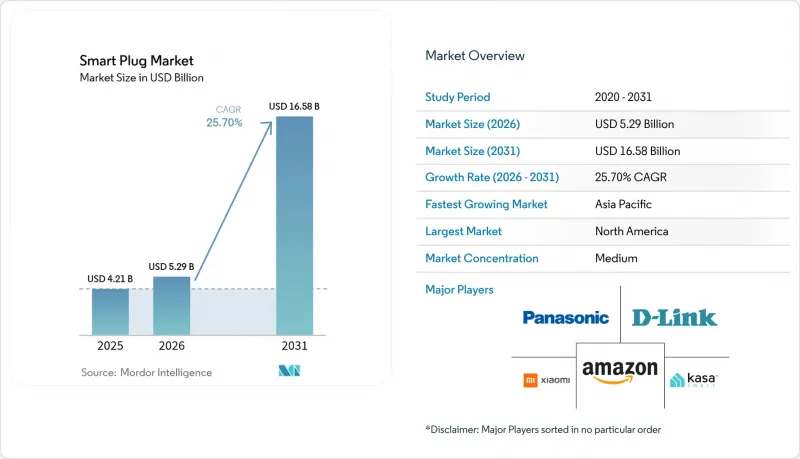
Mordor Intelligence에 의하면, 2026년 스마트 플러그 시장 규모는 52억 9,000만 달러로 추정되고 있어 2025년 42억 1,000만 달러에서 확대해, 2031년에는 165억 8,000만 달러에 이를 것으로 예측됩니다.
2026년부터 2031년까지 연평균 성장률(CAGR) 25.70%로 성장할 것으로 전망됩니다.
본 보고서는 기술별(블루투스, Wi-Fi 등), 용도별(가정용, 업무용 등), 판매 채널별(온라인 및 오프라인), 플러그 형태별(벽면 콘센트 어댑터, 벽면 이식형 콘센트 등), 그리고 지역별로 분류되어 있습니다. 시장 전망은 금액(달러)으로 표시되어 있습니다.
세계 스마트 플러그 시장 동향 및 인사이트
음성 어시스턴트 생태계의 급속한 확산
아마존의 보고서에 따르면, 인도 내 연결형 스마트 홈 기기 수가 3년 동안 200% 급증함에 따라 음성 제어는 단순한 신기함에서 필수품으로 변화했습니다. 2025년에 Prime에 번들로 제공될월19.99달러의 생성형 AI 서비스 ‘Alexa+’는 가치 제안을 단순한 켜기/끄기에서 여러 기기를 연동한 장면 제어로 재정의합니다. 구독 경제는 더 깊은 사용자 참여를 촉진하며, 스마트 플러그를 음성 비서의 적용 범위를 기존 가전제품까지 확대하는 기반이 되는 핵심 요소로 자리매김하고 있습니다. Alexa 카탈로그에는 14만 대 이상의 호환 기기가 등록되어 있으며, 네트워크 효과로 인해 도입 장벽이 낮아지면서 모든 소득층에서 도입률이 향상되고 있습니다. Google과 Apple의 유사한 전략은 음성 제어 기능이 이제 모든 새로운 플러그인 기기에 대한 기본적인 기대 사항이 되었다는 인식을 강화하고 있습니다.
Wi-Fi 칩셋의 평균 판매 가격(ASP) 하락
Silicon Labs사의 SiWx917 MCU는 연결 시 슬립 전류를 22마이크로암페어로 낮추어 부품 비용을 절감하는 동시에, 에너지 소비 보고 기능을 저해하지 않으면서 소매 가격을 15달러 미만으로 억제할 수 있게 합니다. Synaptics와 중국의 신생 기업 AIC Micro는 32억 달러 규모의 초저전력 IoT SoC 시장에 진출하여 가격 경쟁을 심화시키고, 공급업체의 선택 폭을 넓히고 있습니다. 대량 생산이 가능해짐에 따라 ODM 업체들은 Matter 지원 펌웨어를 유지하면서 컴팩트한 케이스에 Wi-Fi/BLE 듀얼 모듈을 탑재할 수 있게 되었습니다. 신흥국이 가장 큰 혜택을 보고 있으며, 단위당 경제성이 중산층 가구의 예산에 부합하게 됨에 따라 도입 기반이 얼리 어답터의 범위를 넘어 확대되고 있습니다.
끊임없는 기기 사이버 보안 침해
2024년에는 스마트 기기에 대한 사이버 공격이 2배 이상 증가했고, 주요 브랜드에서 주목받는 결함이 표면화되면서 소비자의 신뢰가 훼손되고 있습니다. TP-Link의 로컬 통신 취약점 발견과 27억 건의 IoT 기록이 유출된 Mars Hydro 사건은 체계적인 위험을 여실히 드러내고 있습니다. 아마존과 구글이 지원하는 미국 연방통신위원회(FCC)의 새로운 ‘사이버 트러스트 마크(Cyber Trust Mark)’는 보다 명확한 표시를 약속하고 있지만, 최종 규정은 아직 시행되지 않았습니다. 감전 위험으로 인해 Emporia Energy가 8만 개의 스마트 플러그를 리콜한 사례는 불충분한 보안 대책이 초래하는 경제적 손실을 여실히 보여주고 있습니다. 인증 제도가 의무화되기 전까지는 특히 엄격한 IT 정책을 갖춘 전문적으로 관리되는 시설에서 뿌리 깊은 우려가 초기 구매의 걸림돌이 될 가능성이 있습니다.
부문 분석
2025년, 블루투스는 스마트 플러그 시장 점유율에서 31.12%로 1위를 유지했으나, Zigbee/스레드 프로토콜은 매터 인증의 기세에 힘입어 연평균 성장률(CAGR) 26.15%로 급성장하고 있습니다. Thread 1.4에서 인증 정보 공유 기능이 강화되어 엔터프라이즈급 도입이 가능해짐에 따라, Thread 지원 모델의 스마트 플러그 시장 규모는 급격히 확대될 것으로 예측됩니다. Tuya의 15일 만에 완료되는 턴키 모듈 프로그램은 표준화가 시장 출시까지의 시간을 단축하고 엔지니어링상의 장벽을 낮춘다는 점을 보여줍니다. Wi-Fi는 비용 면에서의 우위 덕분에 널리 보급되어 있으며, 고해상도 에너지 계측 등 대역폭을 많이 필요로 하는 이용 사례에 탁월하지만, Z-Wave는 미국의 레거시 보안 시스템에 뿌리 깊게 자리 잡고 있습니다. 소비자들이 크로스 플랫폼 구매 보장을 요구함에 따라, 독자적인 표준 스택은 구식이 될 위험에 직면해 있습니다.
Thread의 실시간 에너지 보고 기능은 전력 회사 수요 반응(Demand Response)에 명확한 이점을 제공합니다. Matter 1.3에서는 스마트 플러그가 실시간 소비 데이터를 보다 광범위한 가정용 에너지 관리 대시보드로 전송할 수 있게 되었습니다. 그 결과, 전력 회사의 리베이트 제도에서 Thread 지원 하드웨어가 대상으로 선정되기 시작했으며, 이는 설치 업체에게 Wi-Fi 전용 SKU에서 전환하도록 유도하는 인센티브가 되고 있습니다. Thread의 저지연 메시 네트워크 위에 에너지 분석 기능을 추가로 제공하는 벤더는 프리미엄 평균 판매 가격(ASP)을 책정할 수 있으며, 상품화가 진행되는 카테고리에서 발생하는 이익률 하락을 완화할 수 있습니다.
주거용 시장은 음성 어시스턴트와의 번들링 및 DIY의 편의성에 힘입어 2025년 스마트 플러그 시장 규모의 55.74%를 계속 차지하고 있습니다. 그러나 시설 관리자들이 정량화된 투자 수익률을 추구하는 가운데, 산업용 및 상업용 건물 시장은 연평균 성장률(CAGR) 27.05%로 성장할 전망입니다. 현장 조사에 따르면, IoT 기반 스케줄링을 적용할 경우 1개 지점당 연간 36.8 kW의 플러그 부하 절감 효과가 확인되었습니다. 하네웰이 기업용 빌딩 관리 시스템을 위해 제공하는 플러그 부하 모듈은 데이터 기반의 에너지 규정 준수로의 전환을 상징합니다.
공장이나 창고에서는 산업용 등급의 스마트 플러그에 전용 커버가 장착되어 있으며, 주거용 제품에는 없는 과열 보호 기능과 과전류 분석 기능이 추가되어 있습니다. 병원이나 노인 요양 시설에서는 고령화 사회에 따른 원격 모니터링 지원 보조금 프로그램의 혜택을 받아, 의료기기의 가동 시간을 확인하고 예기치 않은 전원 차단을 방지하기 위해 스마트 플러그가 도입되고 있습니다. SLA(서비스 수준 계약)에 기반한 하드웨어에 대한 상업적 수요가 증가함에 따라 고가 제품도 호응을 얻고 있으며, 전문 OEM 제조업체에게 있어 스마트 플러그의 총 잠재 시장 규모가 확대되고 있습니다.
지역별 분석
북미는 Energy Star SHEMS(스마트 홈 에너지 관리 시스템) 규제와 광대역 보급을 배경으로 2025년에도 31.74%의 점유율을 유지했습니다. 이 지역에서는 전력 회사가 수요 반응(Demand Response) 인증 플러그 구매에 대해 리베이트를 제공합니다. 또한, 이 지역에서 음성 비서의 보급이 확대되면서 생태계 락인(lock-in)이 촉진되고, 고객 이탈이 감소하며, 주택 전체의 개조를 뒷받침하고 있습니다. 캐나다의 개정된 에너지 효율 규정은 미국 기준과 일치하여, 제조업체들에게 통일된 북미 인증 로드맵을 제공합니다.
아시아태평양은 연평균 성장률(CAGR) 27.60%를 나타낼 것으로 예측되며, 스마트 플러그 시장에서 가장 빠르게 성장하는 지역이 될 전망입니다. 인도에서는 현지 언어를 지원하는 음성 어시스턴트와 경쟁력 있는 가격 정책 덕분에 2022년 이후 Alexa 탑재 기기 수가 3배로 증가했습니다. 중국의 국내 칩셋 생산은 BOM(부품 원가) 변동을 억제하고 화이트 라벨 브랜드의 보급을 가능하게 하고 있습니다. 일본과 한국에서는 정부 자금을 통한 스마트 시티 시범 사업에서 플러그 단위의 에너지 모니터링이 지역 전체의 탄소 대시보드에 통합되어, Thread 메쉬 도입에 대한 기관 수요의 씨앗이 뿌려지고 있습니다.
유럽의 상황은 복잡합니다. WEEE 지침 2024/884에 따라 제품 수명 종료 시 발생하는 모든 비용이 제조업체에 부과되어, 매출 총이익률에 압박이 가해지고 있습니다. 한편, 영국의 2025년 스마트 가전 규정에 따라 전력망 연동 기능이 의무화됨에 따라, Matter 호환 스마트 플러그를 통한 사후 개조를 통해 혜택을 누릴 수 있는 기기의 범위가 확대되고 있습니다. Tuya가 런던에서 개최한 사후 개조 포럼에서는 노후화된 주택 재고의 넷제로 목표 달성에 있어 저비용 플러그가 수행하는 역할이 강조되었습니다.
남미 및 중동 및 아프리카은 도입 대수 면에서는 뒤처져 있지만, 5G 확산으로 지연 시간이 단축되고 통신 범위가 확대됨에 따라 두 자릿수 성장을 기록하고 있습니다. 높은 수입 관세는 여전히 장벽으로 작용하고 있어, 지역 자유무역지대를 활용한 현지 조립 합작 사업이 촉진되고 있습니다. 개발사는 걸프협력회의(GCC) 회원국의 호텔 체인과 제휴하여 중앙 집중식 에너지 대시보드의 시범 운영을 실시했습니다. 이는 스마트 플러그가 보다 광범위한 IoT 인프라로의 진입점이 되는 제품임을 보여줍니다.
기타 혜택:
- 엑셀 형식 시장 예측(ME) 시트
- 3개월간의 애널리스트 지원
자주 묻는 질문
목차
제1장 서론
제2장 조사 방법
제3장 주요 요약
제4장 시장 구도
제5장 시장 규모와 성장 예측
제6장 경쟁 구도
제7장 시장 기회와 향후 전망
JHS 26.09.09According to Mordor Intelligence, the smart plug market size in 2026 is estimated at USD 5.29 billion, growing from 2025 value of USD 4.21 billion with 2031 projections showing USD 16.58 billion, growing at 25.70% CAGR over 2026-2031.
This report is Segmented by Technology (Bluetooth, Wi-Fi, and More), Application (Residential, Commercial, and More), Sales Channel (Online and Offline), Plug Form Factor (Wall-Plug Adapter, In-Wall Outlet, and More), and by Geography. The Market Forecasts are Provided in Terms of Value (USD).
Global Smart Plug Market Trends and Insights
Soaring Adoption of Voice-Assistant Ecosystems
Voice control has shifted from novelty to necessity as Amazon reports a 200% jump in connected smart-home devices in India within three years. The 2025 debut of the USD 19.99-per-month Alexa+ generative-AI service, bundled into Prime, redefines the value proposition from simple on/off switching to multi-device scene orchestration. Subscription economics incentivize deeper engagement, positioning smart plugs as foundational nodes that extend voice-assistant reach to legacy appliances. With more than 140,000 compatible devices in the Alexa catalogue, network effects reduce adoption friction and lift attach rates across income bands. Comparable strategies from Google and Apple reinforce the perception that voice-ready control is now the baseline expectation for every new plug-in device.
Falling ASPs of Wi-Fi Chipsets
Silicon Labs' SiWx917 MCU trims connected-sleep current to 22 micro amp, slicing component costs and enabling sub-USD 15 retail pricing without sacrificing energy reporting features. Synaptics and Chinese newcomer AIC Micro have entered the USD 3.2 billion ultra-low-power IoT SoC arena, intensifying price competition and widening vendor choice. Mass-market volumes allow ODMs to package dual Wi-Fi/BLE modules inside compact casings while retaining Matter-ready firmware. Emerging economies benefit most, as unit economics now align with middle-income household budgets, expanding the install base beyond early adopters.
Persistent Device Cybersecurity Breaches
Smart-device cyberattacks more than doubled in 2024, eroding consumer trust as high-profile flaws surfaced in major brands. TP-Link's exposure of local-communication vulnerabilities and the Mars Hydro incident that leaked 2.7 billion IoT records underscore systemic risk. The U.S. FCC's upcoming Cyber Trust Mark, backed by Amazon and Google, promises clearer labeling but final rules are not yet in force. Product recalls such as Emporia Energy's withdrawal of 80,000 smart plugs due to shock hazards illustrate the financial toll of insufficient security controls. Until certification regimes become mandatory, lingering doubts may slow first-time purchases, especially in professionally managed facilities with stricter IT policies.
Other drivers and restraints analyzed in the detailed report include:
- Government Energy-Efficiency Mandates for Plug-Load Control
- Matter 1.3 Interoperability Push
- Fragmented RF Spectrum in Emerging Markets
For complete list of drivers and restraints, kindly check the Table Of Contents.
Segment Analysis
Bluetooth retained the largest 31.12% slice of smart plug market share in 2025, but Zigbee/Thread protocols are accelerating at a 26.15% CAGR on the back of Matter certification momentum. The smart plug market size for Thread-enabled models is projected to swell sharply as enhanced credential-sharing in Thread 1.4 unlocks enterprise-grade deployments. Tuya's 15-day turnkey module program signals how standardization compresses time-to-market and lowers engineering hurdles. Wi-Fi enjoys cost-led ubiquity and excels in bandwidth-heavy use-cases such as high-resolution energy metering, while Z-Wave remains entrenched in legacy US security systems. Proprietary stacks risk obsolescence as consumers align around cross-platform purchase assurance.
Thread's real-time energy-reporting offers clear advantages in utility demand-response. Matter 1.3 now lets smart plugs feed instantaneous consumption data to broader home-energy-management dashboards. Consequently, utility rebates are beginning to single out Thread-capable hardware, incentivizing installers to pivot away from Wi-Fi-only SKUs. Vendors that overlay energy analytics atop Thread's low-latency mesh can charge premium ASPs, cushioning margin erosion in a commoditizing category.
Residential premises still represent 55.74% of the 2025 smart plug market size, buoyed by voice-assistant bundling and DIY convenience. Yet industrial and commercial buildings are set to expand at a 27.05% CAGR as facility managers chase quantified returns; field studies show 36.8 kW of annual plug-load savings per site when IoT scheduling is applied. Honeywell's plug-load module for enterprise building-management systems exemplifies the pivot to data-driven energy compliance.
In factories and warehouses, skinned industrial-grade smart plugs add thermal-overload protection and over-current analytics that residential units lack. Hospitals and elder-care facilities deploy smart plugs to verify medical-device uptime and prevent unplanned disconnection, aided by subsidy programs for remote monitoring in aging societies. The commercial appetite for SLA-backed hardware supports higher price points, widening the total addressable smart plug market for specialist OEMs.
Complete Report Scope:
- By Technology
- Wi-Fi
- Bluetooth
- Zigbee / Thread
- Z-Wave
- Others
- By Application
- Residential
- Commercial
- Industrial
- Others (Hospitality, Healthcare)
- By Sales Channel
- Online
- Offline
- By Plug Form Factor
- Wall-Plug Adapter
- In-Wall Outlet
- Power Strip
- Others
- By Geography
- North America
- United States
- Canada
- Mexico
- South America
- Brazil
- Argentina
- Rest of South America
- Europe
- Germany
- United Kingdom
- France
- Italy
- Rest of Europe
- Asia-Pacific
- China
- Japan
- South Korea
- India
- Rest of Asia-Pacific
- Middle East and Africa
- GCC
- Turkey
- South Africa
- Rest of Middle East and Africa
- North America
Geography Analysis
North America retained 31.74% leadership in 2025 on the strength of Energy Star SHEMS rules and broadband ubiquity, with utilities offering rebates for demand-response-certified plugs. The region's mature voice-assistant penetration fosters ecosystem lock-in that reduces churn and encourages whole-home retrofits. Canada's updated Energy Efficiency Regulations mirror U.S. standards, giving manufacturers a unified North American certification roadmap.
Asia Pacific is projected to clock a 27.60% CAGR, making it the fastest-expanding territory of the smart plug market. Localized voice-assistant dialect support and competitive pricing have tripled the Alexa device count in India since 2022. China's domestic chipset output curbs BOM volatility and allows white-label brands to proliferate. Government-funded smart-city pilots in Japan and South Korea integrate plug-level energy monitoring into district-wide carbon dashboards, seeding institutional demand for Thread-mesh deployments.
Europe presents a mixed picture. WEEE Directive 2024/884 places full end-of-life costs on manufacturers, pressuring gross margins. Conversely, the UK's 2025 smart-appliance rules require grid-aware functionality, widening the pool of devices that can benefit from retrofitting with Matter-ready smart plugs. Tuya's London retrofit forum underscored the role that low-cost plugs play in hitting net-zero targets for aging housing stock.
South America and the Middle East-Africa trail in installed base but register double-digit growth as 5G rollouts improve latency and coverage. High import duties remain a hurdle, prompting local assembly joint ventures that leverage regional free-trade zones. Developers tapped into hotel chains in the Gulf Cooperation Council to trial centralized energy dashboards, illustrating how smart plugs serve as a gateway product for broader IoT infrastructure.
- TP-Link Technologies
- Belkin (WeMo)
- Xiaomi
- D-Link
- Panasonic
- Amazon (First-Party)
- Broadlink
- Ankuoo
- EDIMAX
- Vesync (Etekcity, Levoit, Cosori)
- Lenovo
- Leviton
- Wipro
- Sariana (Satechi)
- Sonoff (ITEAD)
- Shelly
- Gosund / Nooie
- Eve Systems
- Aeotec
- Sengled
- Wyze Labs
Additional Benefits:
- The market estimate (ME) sheet in Excel format
- 3 months of analyst support
TABLE OF CONTENTS
1 INTRODUCTION
- 1.1 Study Assumptions and Market Definition
- 1.2 Scope of the Study
2 RESEARCH METHODOLOGY
3 EXECUTIVE SUMMARY
4 MARKET LANDSCAPE
- 4.1 Market Overview
- 4.2 Market Drivers
- 4.2.1 Soaring adoption of voice-assistant ecosystems
- 4.2.2 Falling ASPs of Wi-Fi chipsets
- 4.2.3 Government energy-efficiency mandates for plug-load control
- 4.2.4 Matter 1.3 interoperability push
- 4.2.5 Subsidy programs for senior-care tele-monitoring
- 4.2.6 Rising demand for outdoor weather-proof plugs
- 4.3 Market Restraints
- 4.3.1 Persistent device cybersecurity breaches
- 4.3.2 Fragmented RF spectrum in emerging markets
- 4.3.3 EU WEEE recycling costs hitting margins
- 4.3.4 Inaccurate energy-metering claims triggering recalls
- 4.4 Supply-Chain Analysis
- 4.5 Regulatory Landscape
- 4.6 Technological Outlook
- 4.7 Porter's Five Force Analysis
- 4.7.1 Bargaining Power of Suppliers
- 4.7.2 Bargaining Power of Buyers
- 4.7.3 Threat of New Entrants
- 4.7.4 Threat of Substitutes
- 4.7.5 Intensity of Competitive Rivalry
- 4.8 Assesment of Macroeconomic Trends on Market
5 MARKET SIZE AND GROWTH FORECASTS
- 5.1 By Technology
- 5.1.1 Wi-Fi
- 5.1.2 Bluetooth
- 5.1.3 Zigbee / Thread
- 5.1.4 Z-Wave
- 5.1.5 Others
- 5.2 By Application
- 5.2.1 Residential
- 5.2.2 Commercial
- 5.2.3 Industrial
- 5.2.4 Others (Hospitality, Healthcare)
- 5.3 By Sales Channel
- 5.3.1 Online
- 5.3.2 Offline
- 5.4 By Plug Form Factor
- 5.4.1 Wall-Plug Adapter
- 5.4.2 In-Wall Outlet
- 5.4.3 Power Strip
- 5.4.4 Others
- 5.5 By Geography
- 5.5.1 North America
- 5.5.1.1 United States
- 5.5.1.2 Canada
- 5.5.1.3 Mexico
- 5.5.2 South America
- 5.5.2.1 Brazil
- 5.5.2.2 Argentina
- 5.5.2.3 Rest of South America
- 5.5.3 Europe
- 5.5.3.1 Germany
- 5.5.3.2 United Kingdom
- 5.5.3.3 France
- 5.5.3.4 Italy
- 5.5.3.5 Rest of Europe
- 5.5.4 Asia-Pacific
- 5.5.4.1 China
- 5.5.4.2 Japan
- 5.5.4.3 South Korea
- 5.5.4.4 India
- 5.5.4.5 Rest of Asia-Pacific
- 5.5.5 Middle East and Africa
- 5.5.5.1 GCC
- 5.5.5.2 Turkey
- 5.5.5.3 South Africa
- 5.5.5.4 Rest of Middle East and Africa
- 5.5.1 North America
6 COMPETITIVE LANDSCAPE
- 6.1 Market Concentration
- 6.2 Strategic Moves
- 6.3 Market Share Analysis
- 6.4 Company Profiles (includes Global level Overview, Market level overview, Core Segments, Financials as available, Strategic Information, Market Rank/Share for key companies, Products and Services, and Recent Developments)
- 6.4.1 TP-Link Technologies
- 6.4.2 Belkin (WeMo)
- 6.4.3 Xiaomi
- 6.4.4 D-Link
- 6.4.5 Panasonic
- 6.4.6 Amazon (First-Party)
- 6.4.7 Broadlink
- 6.4.8 Ankuoo
- 6.4.9 EDIMAX
- 6.4.10 Vesync (Etekcity, Levoit, Cosori)
- 6.4.11 Lenovo
- 6.4.12 Leviton
- 6.4.13 Wipro
- 6.4.14 Sariana (Satechi)
- 6.4.15 Sonoff (ITEAD)
- 6.4.16 Shelly
- 6.4.17 Gosund / Nooie
- 6.4.18 Eve Systems
- 6.4.19 Aeotec
- 6.4.20 Sengled
- 6.4.21 Wyze Labs
7 MARKET OPPORTUNITIES AND FUTURE OUTLOOK
- 7.1 White-space and Unmet-Need Assessment