

|
시장보고서
상품코드
2123513
인공호흡기(MV) 시장 : 점유율 분석, 업계 동향과 통계, 성장 예측(2026-2031년)Mechanical Ventilators - Market Share Analysis, Industry Trends & Statistics, Growth Forecasts (2026 - 2031) |
||||||
 Mordor Intelligence
에 의하면, 인공호흡기(MV) 시장 규모는 2025년 53억 3,000만 달러에서 2026년에는 55억 9,000만 달러로 확대되어 2026년부터 2031년까지 CAGR 4.9%로 성장을 지속하여, 2031년까지 71억 달러에 이를 것으로 예측됩니다.
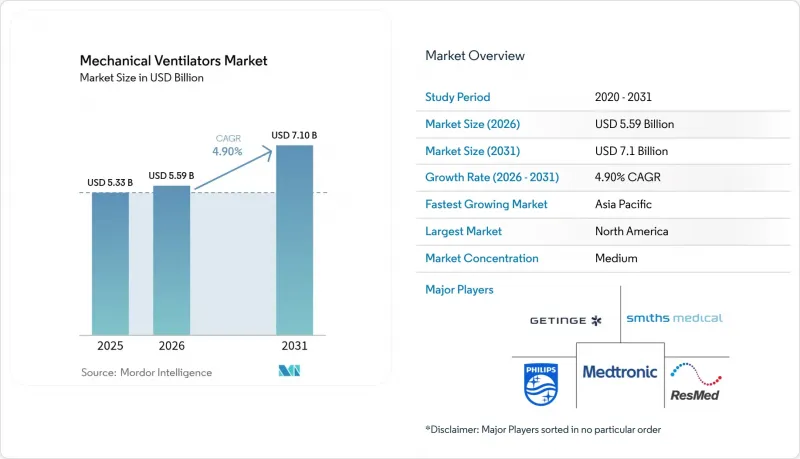
본 보고서는 기동성(중환자용 인공호흡기, 휴대용 인공호흡기 등), 인터페이스(침습적 인공호흡 및 비침습적 인공호흡), 환자(성인, 소아, 신생아), 최종 사용자(병원, 재택치료, 외래수술센터(ASC)) 및 지역별로 분류되어 있습니다. 시장 규모 및 전망은 위에서 언급한 각 부문별로 금액(달러) 단위로 제시되어 있습니다.
전 세계 인공호흡기(MV) 시장 동향 및 인사이트
COPD 유병률 증가
세계 COPD 환자 수는 계속 증가하고 있으며, 이는 침습적 및 비침습적 기기에 대한 기본적인 수요를 뒷받침하고 있습니다. 메디케어·메디케이드 서비스 센터(CMS)는 PaCO2가 52 mmHg 이상인 경우, 2025년부터 재택 인공호흡기에 대한 보험 적용 범위를 확대했습니다. 이에 따라 COPD 치료 대상 환자층이 확대되고 있습니다. 비만성 저환기 증후군 및 폐쇄성 수면 무호흡 증후군과의 중복으로 인해 1.560%의 유병률 집단이 형성되었으며, 이 집단의 대부분은 가정에서 인공호흡기를 통한 호흡 지원이 필요합니다. 가정 치료는 주간 호흡 곤란이 지속되는 경우에도 재입원율을 낮추고 혈액가스 교환을 개선합니다. 이러한 성과가 보험사 측의 수용을 뒷받침하고 있으며, 제조업체가 소형이고 유지보수 부담이 적은 비침습형 모델을 개발하는 원동력이 되고 있습니다. 또한, 질환의 부담이 고령층에 집중됨에 따라 만성 동반 질환 관리를 위한 광범위한 인구 동태 변화와 맞물려 수요도 확대되고 있습니다.
고령화와 중환자실 수용 능력 확대
호주에서는 이미 고령자가 인구의 22%를 차지하고 있으며, 유럽과 북미에서도 유사한 경향이 나타나고 있습니다. 병원협회는 만성 질환 증가에 따라 2030년까지 미국의 입원 일수가 1억 7,000만 일에 달할 것으로 예측했습니다. 인공호흡기 사용 기간이 장기화됨에 따라 장비 교체 수요가 높아지는 한편, 중환자 치료 전문의의 만성적인 부족으로 인해 병원들은 수동 조정을 줄이는 스마트한 방식에 대한 투자를 추진하고 있습니다. 프랑스에서는 현재 중환자실(ICU)의 3분의 2에서 적어도 한 개의 의사 자리가 공석인 것으로 보고되어, 자동화의 가치가 더욱 높아지고 있습니다. 중국 등 일부 국가들은 21세기 중반까지 1인당 의료 지출을 10배 이상 늘릴 수 있는 대폭적인 지출 증대를 계획하고 있으며, 이는 지속적인 수용 능력 확충을 시사합니다. 코로나19 팬데믹은 지역 간 불균형을 부각시켰지만, 기술 공급업체들은 모듈식이며 신속하게 배치 가능한 유닛을 통해 이러한 불균형을 해소하는 데 기여할 수 있습니다.
높은 장비 및 유지보수 비용
지정학적 충격으로 부품 가격이 상승하는 가운데, 공급망 전체 비용은 장비 매출의 최대 20%를 차지하고 있습니다. 인공호흡기는 메디케어의 ‘빈번하고 상당한 정비(Frequent and Substantial Servicing)’ 범주에 속하기 때문에 정기적인 유지보수가 의무화되어 있으며, 이로 인해 소유 비용이 상승하고 있습니다. FDA의 2026년 품질 규정 준수로 인해, 특히 AI 소프트웨어 업데이트와 관련하여 문서화 및 검증에 드는 비용이 더욱 증가하게 될 것입니다. 중환자실(ICU) 병상 밀도가 평균보다 낮은 신생 병원에서는 고가 모델의 자금 조달이 어려워, 재생 제품이나 현지 조립 장치로 눈을 돌리고 있습니다. 이에 대응하여 공급업체들은 중증도 수준에 관계없이 부품을 공유할 수 있는 모듈식 설계를 제공함으로써 물류 비용을 절감하고자 하고 있습니다.
부문 분석
2025년에는 중환자실(ICU)이 인공호흡기(MV) 시장 점유율의 54.42%를 차지하며 시장을 주도하고 있습니다. ICU의 구매 결정은 공급업체의 연구개발(R&D)을 주도하여, 적응형 폐쇄 루프 모드 및 저소음 터빈이 개발되었고, 이후 이송용 모델에도 채택되고 있습니다. 소프트웨어의 발전으로 측정 가능한 품질 향상이 이루어지면, 병원은 중증도가 낮은 시설보다 신속하게 장비를 업데이트하기 때문에 ICU용 인공호흡기(MV) 시장 규모는 전체 매출을 상회하는 속도로 계속 성장할 것으로 예측됩니다. 휴대용 기기는 크기가 작고, 응급 서비스 및 재난 대응 팀이 배터리 구동 시간과 견고한 외장을 우선시하기 때문에 2031년까지 연평균 성장률(CAGR) 5.26%로 성장이 가속화될 것으로 전망됩니다. ‘HAMILTON-C6’는 ICU 등급의 알고리즘을 무게 10kg 미만의 휴대용 케이스에 탑재함으로써, 부문 간 기술 이전의 좋은 사례가 되고 있습니다. 또한, 특히 북미에서는 시설 간 이송 중 청구 비용을 인정하는 상환 코드가 도입됨에 따라 이송 현장에서의 도입도 증가하고 있습니다.
아급성기 병동을 위한 하이브리드 제품 카테고리가 등장하고 있으며, 고가의 ICU용 하드웨어 도입을 피하기 위해 이탈 지원 도구와 중간 수준의 유량 기능을 결합한 제품이 제공되고 있습니다. 플릿 관리자는 본체 제품군 간 소모품이 공통화된 점을 높이 평가하고 있으며, 이를 통해 재고 감축으로 이어집니다. 이동성 등급 간에 공통된 사용자 인터페이스를 설계하는 공급업체는 교육을 간소화하고 사용자의 조작 실수를 줄이고 있습니다. 이러한 가치 제안을 통해 공공 입찰에서 ‘최저 비용이자 요건을 충족하는 입찰’이 중시되는 상황에서도 프리미엄 가격을 유지할 수 있게 됩니다.
2025년에는 중증 급성 호흡곤란 증후군(ARDS) 및 외과 수술에서 여전히 기관 내 삽관이 필요하기 때문에 침습적 인공호흡이 매출의 63.72%를 차지할 것으로 전망됩니다. 침습형 시스템과 관련된 인공호흡기(MV) 시장 규모는 완만하게 확대되는 반면, 재택 이용 확대 및 조기 개입 프로토콜로 인해 비침습형 제품 라인은 2031년까지 연평균 성장률(CAGR) 5.58%를 기록할 전망입니다. ‘IntelliTrig’와 같은 누기 보상 소프트웨어는 환자와의 호흡 동기화를 높여 삽관으로의 전환을 줄여줍니다. 병원에서는 의료진이 하드웨어를 교체하지 않고도 모드를 전환할 수 있도록 듀얼 모드 장치의 도입이 진행되고 있으며, 이를 통해 설비 투자 부담이 경감됩니다.
비침습적 치료의 확대는 소아 및 신생아 분야에서의 응용 확대에도 기인합니다. 좁은 기도와 얼굴 구조에 맞춘 인터페이스를 통해 피부 손상을 줄이면서 장시간 치료가 가능해집니다. 마스크가 밀실공포증을 유발하는 경우, 헬멧이나 마우스피스를 이용한 환기가 대안으로 활용됩니다. 고유량 비강 캐뉼라에 대한 규제 당국의 승인으로 경증 저산소혈증 사례도 치료 범위에 포함되게 되었으며, 기존 NIV(비침습적 환기) 시장에 새로운 경쟁사들이 진입하고 있습니다. 각 제조업체는 모듈식 매니폴드 커넥터와 센서 어레이를 활용하여 제품 포트폴리오의 폭과 재고 관리의 복잡성 사이에서 균형을 맞추고 있습니다.
지역별 분석
2025년에 인공호흡기(MV) 시장 점유율의 42.44%를 차지한 북미는 잘 갖춰진 ICU 인프라, 연방 정부의 비축 물자, 그리고 지원적인 환급 체계의 혜택을 받고 있습니다. 현재 공공 조달 정책은 중앙 집중식 비축 구매와 병원의 장비 교체 보조금을 결합한 형태로, 2020년부터 2022년에 걸친 수요 급증 이후의 발주 패턴을 평준화하고 있습니다. 또한, FDA의 사이버 보안 지침 준수는 검증된 소프트웨어 라이프사이클을 갖춘 국내 공급업체에 유리하게 작용하고 있습니다.
유럽은 성숙해 가면서도 혁신적인 수요 지역으로서 그 뒤를 잇고 있습니다. 이 지역에서는 엄격한 에코디자인 및 데이터 보호 규정이 시행되고 있어, 공급업체들은 에너지 효율이 높은 터빈과 암호화된 클라우드 커넥터를 도입해야 하는 상황에 처해 있습니다. 일부 국가에서는 응급 의료를 위한 국가 AI 로드맵이 전개되고 있으며, 시범 도입을 위한 자금이 지원되고 있습니다. 시장 규모는 안정적이며, 매출 성장은 평균 판매 가격 상승과 소프트웨어 구독에 기인합니다.
아시아태평양은 중소득 국가에서 인구 10만 명당 5개 이상의 중환자실 병상 밀도 달성을 목표로 하는 의료 인프라 구축 노력에 힘입어, 2031년까지 연평균 성장률(CAGR) 6.45%로 가장 높은 성장세를 기록하고 있습니다. 다만, 지역 내 편차는 큽니다. 일본 등 고소득 국가에서는 5년 주기의 갱신 주기가 정착된 반면, 저소득 국가에서는 보조금을 통한 자금 조달에 의존하고 있습니다. 공급업체들은 벽걸이형 및 압축기형 산소 공급원 모두를 지원하는 확장성이 뛰어난 플랫폼을 제공함으로써 성공을 거두고 있습니다.
중국이 2009년에 중환자 치료를 전문 분야로 인정함에 따라, 프로토콜 표준화 및 의료기기 입찰을 가속화하는 전문 학회 네트워크가 형성되었습니다. 현지 기업들은 수입 관세를 회피하기 위해 유럽과 미국의 터빈 기술 공동 라이선스를 취득하여 다국적 기업에 가격 면에서 압박을 가하고 있습니다. 인도와 인도네시아는 국내 부가가치율 30% 이상을 조건으로 하는 ‘국내 생산(Make-in-Country)’ 제도를 우선시하고 있습니다.
라틴아메리카에서는 코로나19 감염 확산에 따라 긴급한 제조 붐이 나타났습니다. 현재 각국 정부는 임시로 설치된 시설의 일부를 영구적인 중환자실로 전환하고 있어, 중급형 인공호흡기에 대한 기본적인 수요가 유지되고 있습니다. 다만, 환율 변동으로 인해 자본 수입이 복잡해지고 있어 리스 모델이 인기를 얻고 있습니다.
중동 및 아프리카은 보급률 면에서는 뒤처져 있지만, 장기적인 잠재력을 지니고 있습니다. 석유 자원이 풍부한 걸프 국가들은 고성능 중환자실(ICU)에 자금을 지원하고 있으며, 일산화질소 공급 기능을 통합한 고급 의료기기를 요구하고 있습니다. 반면, 자원이 부족한 국가들은 기부자로부터의 자금 지원에 의존하고 있으며, 먼지가 많은 환경이나 불안정한 전력 공급에도 견딜 수 있는 견고한 장비를 필요로 하고 있습니다. 공급업체들은 NGO와 제휴하여 교육 프로그램을 패키지화함으로써 도입을 촉진하고 있습니다.
미국은 북미 인공호흡기(MV) 시장을 독점하고 있으며, 2025년에는 해당 지역 시장 점유율의 약 44.62%를 차지할 것으로 전망됩니다. 미국 시장의 주도적 지위는 첨단 중환자 치료 시설을 갖춘 5,000개 이상의 병원으로 구성된 광범위한 의료 네트워크에 의해 뒷받침되고 있습니다. 주요 제조업체의 존재, 견고한 의료 인프라, 그리고 높은 의료비 지출이 해당 시장에서의 입지를 더욱 공고히 하고 있습니다. 미국 시장은 만성 호흡기 질환 유병률의 상승과 장기적인 인공호흡 지원이 필요한 고령 인구 증가를 배경으로, 중환자용 인공호흡기와 휴대용 인공호흡 솔루션 모두에 대한 수요가 활발한 것이 특징입니다.
캐나다는 북미에서 가장 빠르게 성장하는 시장으로 부상하고 있으며, 2026년부터 2031년까지 약 6.78%의 성장률이 예상됩니다. 이 나라 시장 성장은 의료비 증가, 재택치료 솔루션의 보급 확대, 그리고 호흡 관리에 대한 인식 제고에 의해 주도되고 있습니다. 캐나다의 의료시설에서는 환자의 예후를 개선하기 위해 첨단 인공호흡 기술에 대한 투자를 점점 더 늘리고 있습니다. 정부의 의료 지원 정책과 응급 의료 인프라 강화에 대한 집중이 시장 확대에 기여하고 있습니다. 또한, 캐나다에서는 특히 외딴 지역의 의료 현장과 재택 간호 분야에서 휴대용 인공호흡기에 대한 수요도 활발합니다.
유럽의 인공호흡기(MV) 시장은 독일, 영국, 프랑스, 이탈리아, 스페인의 확립된 의료 제도에 힘입어 뚜렷한 강세를 보이고 있습니다. 이 지역 시장은 첨단 의료 기술의 높은 보급률과 주요 인공호흡기 제조업체들의 강력한 입지가 특징입니다. 유럽 각국은 의료기기에 대해 엄격한 규제 기준을 유지하면서 의료 인프라 개선에 지속적으로 투자하고 있습니다. 이 시장은 재택치료 솔루션에 대한 관심이 높아지고 있으며, 휴대용 인공호흡기에 대한 수요가 증가하고 있는 점으로부터 혜택을 받고 있습니다.
독일은 유럽 인공호흡기 시장을 주도하고 있으며, 2025년에는 해당 지역 시장 점유율의 약 19.74%를 차지할 것으로 전망됩니다. 독일 시장의 주도적 지위는 견고한 의료 제도, 막대한 의료비 지출, 그리고 강력한 국내 제조 능력에 기인합니다. 독일의 병원들은 고도의 중환자 치료 시설을 높은 수준으로 유지하고 있어, 첨단 인공호흡 솔루션에 대한 안정적인 수요가 나타나고 있습니다. 주요 제조업체와 연구 기관의 존재가 인공호흡 기술의 지속적인 혁신에 기여하는 한편, 독일의 인구 고령화가 시장의 지속적인 성장을 견인하고 있습니다.
영국은 유럽에서 중요한 시장이며, 2026년부터 2031년까지 약 6.82%의 성장률이 예측됩니다. 영국의 의료 시스템은 응급 의료 인프라의 현대화와 첨단 호흡 관리 솔루션에 대한 접근성 확대를 위한 투자를 지속하고 있습니다. 재택치료 서비스에 대한 중요성이 높아지고 있는 것을 배경으로, 영국에서는 휴대용 및 재택용 인공호흡기 솔루션의 도입이 확대되고 있습니다. 영국의 의료시설은 환자 치료 성과와 운영 효율을 향상시키기 위해 새로운 인공호흡기 기술을 적극적으로 도입하고 있습니다.
아시아태평양의 인공호흡기(MV) 시장은 중국, 일본, 인도, 한국, 호주에 걸친 다양한 의료 시장을 아우르며 견실한 성장 가능성을 보이고 있습니다. 이 지역에서는 의료 인프라 구축이 진행되고 있으며, 의료비 증가와 호흡기 치료에 대한 인식이 높아지고 있습니다. 급속한 도시화, 대기 오염의 심화, 호흡기 질환 발생률의 상승이 이들 국가에서 시장 확대를 뒷받침하고 있습니다. 또한, 이 지역에서는 국내 제조 능력 향상과 첨단 의료 기술의 도입 확대도 호재로 작용하고 있습니다.
중국은 아시아태평양의 인공호흡기(MV) 시장에서 최대의 위상을 유지하고 있습니다. 중국의 광범위한 의료 시스템 현대화, 방대한 환자 수, 그리고 국내 제조 능력 향상 등이 시장 성장을 견인하고 있습니다. 중국의 의료시설은 중환자 치료 역량을 지속적으로 확충하고 있으며, 재택치료 솔루션에 대한 관심이 높아짐에 따라 새로운 시장 기회가 창출되고 있습니다. 의료 인프라에 대한 투자와 의료기기 제조 자급자족을 위한 집중적인 노력이 중국 시장 지위를 공고히 하고 있습니다.
한국은 아시아태평양에서 가장 빠르게 성장하는 시장으로 부상하고 있습니다. 한국의 선진적인 의료 시스템, 강력한 기술력, 그리고 의료 혁신에 대한 관심 증대가 시장 확대를 주도하고 있습니다. 한국의 의료시설에서는 첨단 인공호흡기 기술 도입률이 높으며, 또한 한국의 인구 고령화가 지속적인 수요를 창출하고 있습니다. 이 시장은 강력한 국내 제조 능력과 의료 인프라 개발에 대한 지속적인 투자의 혜택을 받고 있습니다.
중동 및 아프리카의 인공호흡기(MV) 시장은 지역별로 큰 차이가 있지만, 유망한 성장 가능성을 보여주고 있습니다. GCC 국가들은 대규모 의료 투자와 현대적인 의료시설의 혜택을 받아 지역 시장을 주도하고 있습니다. 남아프리카 또한 중요한 시장 중 하나로, 의료 인프라 구축이 진전되면서 첨단 의료 기술의 도입이 증가하고 있습니다. 이 지역에서는 응급의료시설의 개선과 첨단 호흡기 치료 솔루션에 대한 접근성 확대에 대한 관심이 높아지고 있으며, GCC 국가들은 이 지역에서 가장 크고 가장 빠르게 성장하는 시장으로 부상하고 있습니다.
남미의 인공호흡기(MV) 시장은 지속적으로 진화하고 있으며, 브라질과 아르헨티나가 이 지역의 주요 시장으로 자리 잡고 있습니다. 이 시장은 지속적인 의료 인프라 확충, 의료비 증가, 그리고 호흡 관리에 대한 인식 제고로 인해 혜택을 받고 있습니다. 브라질은 이 지역 최대 시장으로서의 위상을 유지하고 있는 반면, 아르헨티나는 가장 높은 성장 잠재력을 보이고 있습니다. 이 지역에서는 의료 투자 확대와 첨단 의료 기술에 대한 접근성 확대를 바탕으로 중환자 치료용 및 휴대용 인공호흡기 솔루션의 도입이 확대되고 있습니다.
기타 혜택:
- 엑셀 형식 시장 예측(ME) 시트
- 3개월간의 애널리스트 지원
자주 묻는 질문
목차
제1장 서론
제2장 조사 방법
제3장 주요 요약
제4장 시장 구도
제5장 시장 규모 및 성장 예측(금액 및 수량)
제6장 경쟁 구도
제7장 시장 기회와 향후 전망
JHS 26.09.09According to Mordor Intelligence, the mechanical ventilator market size is expected to grow from USD 5.33 billion in 2025 to USD 5.59 billion in 2026 and is forecast to reach USD 7.1 billion by 2031 at 4.9% CAGR over 2026-2031.
This report is Segmented by Mobility (Intensive Care Ventilators, Portable Ventilators, and More), Interface (Invasive Ventilation and Non-Invasive Ventilation), Patient (Adult, Pediatric, and Neonatal) End User (Hospitals, Home Healthcare, and Ambulatory Surgical Centers), and Geography. The Market Size and Forecasts are Provided in Terms of Value (USD) for the Above Segments.
Global Mechanical Ventilators Market Trends and Insights
Rising COPD prevalence
Global COPD cases continue climbing, reinforcing baseline demand across invasive and non-invasive devices. The Centers for Medicare & Medicaid Services broadened 2025 coverage for home ventilation when PaCO2 remains at or above 52 mmHg, which expands the treated COPD population.Overlap with obesity hypoventilation syndrome and obstructive sleep apnea has produced a 1.560% prevalence pool that often requires domiciliary ventilatory support. Home therapy lowers readmissions and improves blood-gas exchange, even though daytime dyspnea persists. These outcomes underpin payer acceptance and spur manufacturers to tailor compact, low-maintenance non-invasive models. As the disease burden skews older, demand also converges with the broader demographic shift toward chronic comorbidity management.
Aging population and ICU capacity expansion
Older adults already make up 22% of Australia's population and similar trajectories exist across Europe and North America. Hospital associations project 170 million inpatient days in the United States by 2030 as chronic conditions rise. Longer ventilation courses drive equipment turnover, while persistent intensivist shortages prompt hospitals to invest in smarter modes that reduce hands-on adjustments. In France, two-thirds of ICUs now report at least one physician vacancy, magnifying the value of automation. Nations such as China plan large expenditure increases that could lift per-capita health spending more than 10-fold by mid-century, signaling sustained capacity buildouts. The COVID-19 pandemic exposed geographic imbalances that technology suppliers can help correct through modular, rapidly deployable units.
High device and maintenance costs
Total supply-chain expenses absorb up to 20% of device revenue as geopolitical shocks raise component prices. Ventilators fall under Medicare's Frequent and Substantial Servicing category, obligating regular upkeep that inflates ownership costs. Compliance with the FDA's 2026 quality rule will further increase documentation and validation spending, particularly for AI software updates. Emerging hospitals with below-average ICU bed density struggle to finance premium models, steering them toward refurbished or locally assembled units. Suppliers respond with modular designs that share parts across acuity tiers to curb logistics overhead.
Other drivers and restraints analyzed in the detailed report include:
- Government pandemic-preparedness stockpiles
- AI-driven closed-loop ventilation adoption
- Home NIV growth for obesity hypoventilation
- Micro-turbine and battery efficiency advances
- Ventilator-associated pneumonia
- Semiconductor supply-chain volatility
- Reimbursement cuts for long-term home use
For complete list of drivers and restraints, kindly check the Table Of Contents.
Segment Analysis
Intensive care units dominate with 54.42% mechanical ventilator market share in 2025. Their purchasing decisions steer supplier R&D, producing adaptive closed-loop modes and low-noise turbines that then migrate into transport variants. The mechanical ventilator market size for ICU models is projected to continue outpacing overall revenue because hospitals refresh fleets faster than lower-acuity sites when software advances push measurable quality gains. Portable devices, though starting from a smaller base, accelerate on 5.26% CAGR through 2031 as emergency services and disaster-response teams prioritize battery runtime and rugged housings. The HAMILTON-C6 illustrates cross-segment technology transfer by packaging ICU-grade algorithms in a moveable chassis that weighs under 10 kg. Transport adoption also rises when reimbursement codes permit billing during inter-facility transfers, particularly in North America.
A hybrid product class for sub-acute wards has emerged, blending weaning tools with moderate flow capabilities to avoid full-price ICU hardware. Fleet managers appreciate common consumables across chassis families, which lowers inventory. Suppliers that design shared user interfaces across mobility classes simplify training and cut user error. These value propositions help defend premium pricing even as public tenders emphasize lowest cost compliant bids.
Invasive ventilation accounts for 63.72% of revenue in 2025 because severe ARDS and surgical procedures still require endotracheal access. The mechanical ventilator market size linked to invasive systems will expand modestly, while non-invasive lines post 5.58% CAGR through 2031 thanks to domiciliary uptake and early intervention protocols. Leakage-compensation software such as IntelliTrig enhances patient synchrony, reducing escalation to intubation. Hospitals increasingly deploy dual-mode devices so clinicians can switch without swapping hardware, which lowers capital intensity.
Non-invasive gains also stem from growing pediatric and neonatal applications. Interfaces tailored to small airways and facial structures reduce skin injuries while enabling prolonged therapy. Helmets and mouthpiece ventilation deliver alternatives where masks trigger claustrophobia. Regulatory approvals for high-flow nasal cannula add competitors to conventional NIV by covering mild hypoxemia cases. Manufacturers balance portfolio breadth with inventory complexity through modular manifold connectors and sensor arrays.
Complete Report Scope:
- By Mobility
- Intensive-Care (ICU) Ventilators
- Transport / Portable Ventilators
- Sub-acute & Long-term Care Ventilators
- By Interface
- Invasive Ventilation
- Non-Invasive Ventilation (NIV)
- By Patient Age
- Adult
- Pediatric
- Neonatal
- By End-User
- Hospitals
- Home Healthcare
- Ambulatory Surgical Centers
- By Geography
- North America
- United States
- Canada
- Mexico
- Europe
- Germany
- United Kingdom
- France
- Italy
- Spain
- Rest of Europe
- Asia-Pacific
- China
- Japan
- India
- Australia
- South Korea
- Rest of Asia-Pacific
- Middle East & Africa
- GCC
- South Africa
- Rest of Middle East & Africa
- South America
- Brazil
- Argentina
- Rest of South America
- North America
Geography Analysis
North America, with 42.44% mechanical ventilator market share in 2025, benefits from extensive ICU infrastructure, federal stockpiles, and supportive reimbursement frameworks . Public procurement policy now blends centralized reserve purchases with hospital fleet refresh subsidies, smoothing order patterns after the 2020-2022 demand spike. Adherence to FDA cybersecurity guidance also favors domestic suppliers with validated software lifecycles.
Europe follows as a mature yet innovative buyer. The region enforces strict eco-design and data-protection rules that push vendors toward energy-efficient turbines and encrypted cloud connectors. Several countries roll out national AI roadmaps for critical care, making funding available for pilot deployments. Market volume remains steady; revenue growth arises from higher average selling prices and software subscriptions.
Asia-Pacific records the fastest 6.45% CAGR through 2031, powered by health infrastructure initiatives that aim to lift critical-care bed density above 5 per 100,000 population in middle-income nations . Variance within the region is high. High-income economies such as Japan sustain upgrade cycles every five years, whereas low-income countries rely on grant financing. Suppliers succeed by offering scalable platforms that accept both wall and compressor oxygen sources.
China's recognition of intensive care as a specialty in 2009 ignited a network of professional societies that standardize protocols and accelerate equipment tendering. Local firms co-licensed western turbine technology to bypass import tariffs, putting price pressure on multinationals. India and Indonesia prioritize Make-in-Country schemes that favor domestic value addition above 30%.
Latin America saw emergency manufacturing booms during COVID-19. Governments now convert some pop-up facilities into permanent critical-care wards, sustaining baseline demand for mid-tier ventilators. Currency volatility nevertheless complicates capital imports, so lease models gain popularity.
The Middle East and Africa trail in penetration yet hold long run potential. Oil-rich Gulf states fund high-spec ICUs, demanding premium devices with integrated nitric oxide delivery. Resource-poorer nations depend on donor funding and require rugged units capable of dusty environments and variable power supply. Suppliers partner with NGOs to bundle training, easing adoption.
The United States dominates the North American mechanical ventilators market, accounting for approximately 44.62% of the regional ventilator market share in 2025. The country's market leadership is supported by its extensive healthcare network comprising over 5,000 hospitals with advanced intensive care facilities. The presence of leading manufacturers, robust healthcare infrastructure, and high healthcare expenditure further strengthen its market position. The US market is characterized by strong demand for both intensive care ventilators and portable ventilation solutions, driven by the rising incidence of chronic respiratory diseases and an aging population requiring long-term ventilation support.
Canada emerges as the fastest-growing market in North America, with a projected growth rate of approximately 6.78% during 2026-2031. The country's market growth is driven by increasing healthcare expenditure, growing adoption of home healthcare solutions, and rising awareness about respiratory care management. Canadian healthcare facilities are increasingly investing in advanced ventilation technologies to improve patient outcomes. The government's supportive healthcare policies and focus on enhancing critical care infrastructure contribute to market expansion. The country also shows strong demand for portable ventilators, particularly in remote healthcare settings and home care applications.
The European mechanical ventilators market demonstrates significant strength, supported by well-established healthcare systems across Germany, the United Kingdom, France, Italy, and Spain. The region's market is characterized by high adoption rates of advanced medical technologies and a strong presence of major ventilator manufacturers. European countries maintain strict regulatory standards for medical devices while continuously investing in healthcare infrastructure improvement. The market benefits from an increasing focus on home healthcare solutions and rising demand for portable ventilation devices.
Germany leads the European mechanical ventilators market, holding approximately 19.74% of the regional ventilator market share in 2025. The country's market leadership is attributed to its robust healthcare system, substantial healthcare spending, and strong domestic manufacturing capabilities. German hospitals maintain high standards of intensive care facilities and demonstrate consistent demand for advanced ventilation solutions. The presence of major manufacturers and research institutions contributes to continuous innovation in ventilation technologies, while the country's aging population drives sustained market growth.
The United Kingdom represents a significant market in Europe, with a projected growth rate of approximately 6.82% during 2026-2031. The UK's healthcare system continues to invest in modernizing its critical care infrastructure and expanding access to advanced respiratory care solutions. The country shows increasing adoption of portable and home ventilation solutions, driven by a growing emphasis on home healthcare services. British healthcare facilities are actively incorporating new ventilation technologies to improve patient care outcomes and operational efficiency.
The Asia-Pacific mechanical ventilators market demonstrates robust growth potential, encompassing diverse healthcare markets across China, Japan, India, South Korea, and Australia. The region experiences increasing healthcare infrastructure development, rising healthcare expenditure, and growing awareness about respiratory care. Rapid urbanization, increasing pollution levels, and rising incidence of respiratory diseases drive market expansion across these countries. The region also benefits from growing domestic manufacturing capabilities and increasing adoption of advanced medical technologies.
China maintains its position as the largest market for mechanical ventilators in the Asia-Pacific region. The country's extensive healthcare system modernization, large patient population, and growing domestic manufacturing capabilities drive market growth. Chinese healthcare facilities continue to expand their critical care capabilities, while increasing focus on home healthcare solutions creates new market opportunities. The country's investment in healthcare infrastructure and emphasis on medical device manufacturing self-sufficiency strengthens its market position.
South Korea emerges as the fastest-growing market in the Asia-Pacific region. The country's advanced healthcare system, strong technological capabilities, and increasing focus on healthcare innovation drive market expansion. Korean healthcare facilities demonstrate high adoption rates of advanced ventilation technologies, while the country's aging population creates sustained demand. The market benefits from strong domestic manufacturing capabilities and continuous investment in healthcare infrastructure development.
The Middle East & Africa mechanical ventilators market shows promising growth potential, with significant variations across different regions. The GCC countries lead the regional market, benefiting from substantial healthcare investments and modern medical facilities. South Africa represents another key market, with growing healthcare infrastructure development and increasing adoption of advanced medical technologies. The region demonstrates an increasing focus on improving critical care facilities and expanding access to advanced respiratory care solutions, with the GCC emerging as both the largest and fastest-growing market in the region.
The South American mechanical ventilators market continues to evolve, with Brazil and Argentina representing key markets in the region. The market benefits from ongoing healthcare infrastructure development, increasing healthcare expenditure, and rising awareness about respiratory care. Brazil maintains its position as the largest market in the region, while Argentina shows the fastest growth potential. The region demonstrates increasing adoption of both intensive care and portable ventilation solutions, supported by growing healthcare investments and expanding access to advanced medical technologies.
- Medtronic
- Getinge
- GE HealthCare Technologies Inc.
- Dragerwerk
- Koninklijke Philips
- Smiths Group
- Resmed
- Mindray Medical Intl.
- Nihon Kohden Corp.
- Zoll Medical Corp.
- Fisher & Paykel Healthcare
- Hamilton Medical
- Allied Healthcare Products
- Vyaire Medical
- Bunnell Inc.
- Airon Corp.
- Shenzhen SiareSys
- Lowenstein Medical
- Magnamed
- Bio-Med Devices
- Timpel S/A
Additional Benefits:
- The market estimate (ME) sheet in Excel format
- 3 months of analyst support
TABLE OF CONTENTS
1 Introduction
- 1.1 Study Assumptions & Market Definition
- 1.2 Scope of the Study
2 Research Methodology
3 Executive Summary
4 Market Landscape
- 4.1 Market Overview
- 4.2 Market Drivers
- 4.2.1 Rising COPD prevalence
- 4.2.2 Aging population & ICU capacity expansion
- 4.2.3 Government pandemic-preparedness stockpiles
- 4.2.4 AI-driven closed-loop ventilation adoption
- 4.2.5 Home NIV growth for obesity hypoventilation
- 4.2.6 Micro-turbine & battery efficiency advances
- 4.3 Market Restraints
- 4.3.1 High device & maintenance costs
- 4.3.2 Ventilator-associated pneumonia (VAP)
- 4.3.3 Semiconductor supply-chain volatility
- 4.3.4 Reimbursement cuts for long-term home use
- 4.4 Value / Supply-Chain Analysis
- 4.5 Regulatory Landscape
- 4.6 Technological Outlook
- 4.7 Porter's Five Forces Analysis
- 4.7.1 Bargaining Power of Suppliers
- 4.7.2 Bargaining Power of Buyers
- 4.7.3 Threat of New Entrants
- 4.7.4 Threat of Substitutes
- 4.7.5 Competitive Rivalry
5 Market Size & Growth Forecasts (Value & Units)
- 5.1 By Mobility
- 5.1.1 Intensive-Care (ICU) Ventilators
- 5.1.2 Transport / Portable Ventilators
- 5.1.3 Sub-acute & Long-term Care Ventilators
- 5.2 By Interface
- 5.2.1 Invasive Ventilation
- 5.2.2 Non-Invasive Ventilation (NIV)
- 5.3 By Patient Age
- 5.3.1 Adult
- 5.3.2 Pediatric
- 5.3.3 Neonatal
- 5.4 By End-User
- 5.4.1 Hospitals
- 5.4.2 Home Healthcare
- 5.4.3 Ambulatory Surgical Centers
- 5.5 By Geography
- 5.5.1 North America
- 5.5.1.1 United States
- 5.5.1.2 Canada
- 5.5.1.3 Mexico
- 5.5.2 Europe
- 5.5.2.1 Germany
- 5.5.2.2 United Kingdom
- 5.5.2.3 France
- 5.5.2.4 Italy
- 5.5.2.5 Spain
- 5.5.2.6 Rest of Europe
- 5.5.3 Asia-Pacific
- 5.5.3.1 China
- 5.5.3.2 Japan
- 5.5.3.3 India
- 5.5.3.4 Australia
- 5.5.3.5 South Korea
- 5.5.3.6 Rest of Asia-Pacific
- 5.5.4 Middle East & Africa
- 5.5.4.1 GCC
- 5.5.4.2 South Africa
- 5.5.4.3 Rest of Middle East & Africa
- 5.5.5 South America
- 5.5.5.1 Brazil
- 5.5.5.2 Argentina
- 5.5.5.3 Rest of South America
- 5.5.1 North America
6 Competitive Landscape
- 6.1 Market Concentration
- 6.2 Market Share Analysis
- 6.3 Company Profiles (includes Global level Overview, Market level overview, Core Segments, Financials as available, Strategic Information, Market Rank/Share, Products & Services, Recent Developments)
- 6.3.1 Medtronic plc
- 6.3.2 Getinge AB
- 6.3.3 GE HealthCare Technologies Inc.
- 6.3.4 Dragerwerk AG & Co. KGaA
- 6.3.5 Koninklijke Philips N.V.
- 6.3.6 Smiths Medical (ICU Medical)
- 6.3.7 ResMed Inc.
- 6.3.8 Mindray Medical Intl.
- 6.3.9 Nihon Kohden Corp.
- 6.3.10 Zoll Medical Corp.
- 6.3.11 Fisher & Paykel Healthcare
- 6.3.12 Hamilton Medical AG
- 6.3.13 Allied Healthcare Products
- 6.3.14 Vyaire Medical
- 6.3.15 Bunnell Inc.
- 6.3.16 Airon Corp.
- 6.3.17 Shenzhen SiareSys
- 6.3.18 Lowenstein Medical
- 6.3.19 Magnamed
- 6.3.20 Bio-Med Devices
- 6.3.21 Timpel S/A
7 Market Opportunities & Future Outlook
- 7.1 White-space & Unmet-need Assessment


