

|
시장보고서
상품코드
2123518
웹캠 시장 : 점유율 분석, 업계 동향과 통계, 성장 예측(2026-2031년)Webcams - Market Share Analysis, Industry Trends & Statistics, Growth Forecasts (2026 - 2031) |
||||||
 Mordor Intelligence
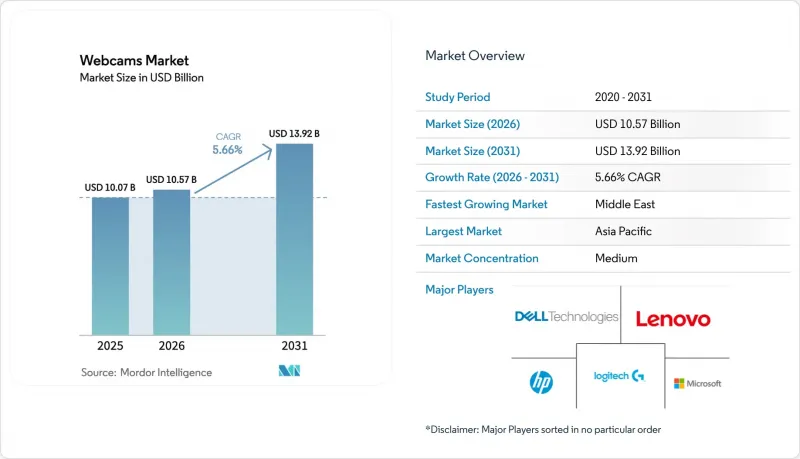
Mordor Intelligence에 의하면, 웹캠 시장 규모는 2025년에 100억 7,000만 달러로 평가되었고 2026년 105억 7,000만 달러에서 2031년까지 139억 2,000만 달러에 이를 것으로 추정되고 있어 이것은 예측 기간(2026-2031년) CAGR 5.66%를 반영하고 있습니다.
본 보고서는 웹캠 유형(외장형 및 내장형), 센서 해상도(720p를 초과하는 HD, 1080p의 Full HD등), 최종 사용자(일반 소비자/가정, 기업/법인, 의료·원격의료, 교육, 기타), 판매 채널(온라인, 오프라인), 지역(북미, 유럽, 아시아태평양, 남미, 기타)별로 분류되어 있습니다. 시장 예측은 금액(달러) 기준으로 제시되어 있습니다.
세계 웹캠 시장 동향 및 인사이트
기업용 화상 회의 솔루션의 급속한 보급
2025년, 기업용 화상 회의 솔루션은 단순한 편의성 향상 도구에서 업무에 필수적인 인프라로 전환되었습니다. Zoom에 따르면, 연간 경상 수익이 10만 달러를 초과하는 고객사는 4,274개사에 달하며, 이 계층에서는 이사회 수준의 화질을 확보하기 위해 외부 연결형 4K 웹캠이 표준으로 장착되어 있습니다. 대기업들은 2025년에 회의 공간의 27%-35%를 업그레이드하여, 광학 줌 기능이나 저조도 환경에서 성능이 부족한 노트북 내장 카메라를 교체했습니다. 회의 중 지속적으로 발생하는 마찰(세션당 평균 6분의 생산성 손실)이 특히 Microsoft Teams Rooms 및 Zoom Rooms에서의 이러한 도입을 가속화했습니다. 비동기형 비디오 메시징으로의 전환 또한 직원들이 정교한 컨텐츠를 녹화하기 위해 전용 웹캠을 필요로 하기 때문에 수요를 더욱 증폭시키고 있습니다. 이러한 요인들이 결합되어 기업용 출하 대수를 끌어올리고, 프리미엄 인증 생태계를 강화하고 있습니다.
하이브리드 및 원격 근무 모델이 웹캠 사용을 정착시킨다.
2025년에는 하이브리드 근무가 주류 고용 형태로 자리 잡았으며, 미국 직원의 28%는 부분 재택근무를, 9%는 완전 원격 근무를 하게 되었습니다. 노동통계국의 집계에 따르면, 미국의 재택근무자 수는 3,550만 명에 달하고, 2024년 대비 510만 명 증가했습니다. 이와 유사한 추세는 직원의 45%가 현재 사무실과 재택근무를 병행하고 있는 영국, 전문직의 81%가 원격근무 승인을 받은 중동에서도 나타납니다. 하이브리드 근로자의 85%에게 기술의 질은 업무 만족도에 기여하는 상위 5대 요인 중 하나이므로, 기업들은 재택 근무를 위한 업무용 웹캠 예산을 확보하고 있습니다. 이러한 구조적 변화로 인해 웹캠은 단순한 선택적 주변기기에서 생산성을 높이는 필수 자산으로 위상이 높아졌으며, 지역을 불문하고 장기적인 수요의 기반이 되고 있습니다.
뿌리 깊은 개인정보 보호 및 사이버 보안에 대한 우려(웹캠 해킹)
소비자의 75%는 카메라에 대한 무단 접근을 우려하고 있으며, 61%는 사용하지 않을 때 웹캠을 물리적으로 가리고 있습니다. FBI의 2024년 권고에서는 LED 표시등이 켜지지 않은 상태에서 웹캠을 작동시키는 악성코드가 지적된 것은 물론, CVE-2024-5028 및 CVE-2024-31320과 같은 심각도가 높은 취약점이 플래그십 모델에 영향을 미쳤습니다. Pwn2Own에서 시연된 취약점 공격은 제조업체들이 보안 감사보다 기능을 우선시하고 있다는 인식을 강화시켰습니다. 이러한 불신은 충동 구매를 억제하고, 구매자들이 보다 명확한 규제상의 보호 조치를 기다리는 동안 교체 주기를 장기화시키고 있습니다. 곧 시행될 EU 사이버 복원력 법은 신뢰를 회복시킬 가능성이 있지만, 소규모 브랜드에게는 규정 준수 비용 증가로 이어질 것입니다.
부문 분석
2025년에는 외부 설치형 모델이 매출의 54.57%를 차지하며, 2031년까지 연평균 성장률(CAGR) 6.68%로 확대될 것으로 전망되어, 기업용 도입에서의 우위가 부각되고 있습니다. 이러한 주도적 지위는 시선 높이에 설치 가능한 모듈형 카메라, 뛰어난 광학 성능, 교체 가능한 렌즈를 필요로 하는 기업 및 의료 분야 사용자를 반영한 것입니다. 외부 장치는 회의 플랫폼과 원활하게 통합되고 케이블 관리도 용이하기 때문에 허들룸이나 원격 의료용 카트에서의 설치 속도를 향상시킵니다. 벤더들은 4K 센서, 빔포밍 마이크, 내장 스피커를 세트로 판매하는 경우가 늘어나고 있어, 구성 요소의 난립과 IT 관련 오버헤드를 줄이고 있습니다. 한편, 내장형 노트북 카메라는 신형 노트북의 95%에 탑재되어 있지만, 고정된 각도와 소형 센서 때문에 임원 회의실에서의 사용에는 적합하지 않습니다. 하이브리드 근무가 정착됨에 따라, 많은 비즈니스맨들은 노트북에 1080p 웹캠이 탑재되어 있더라도 자택에 외부 카메라를 추가로 설치하여 작업 공간에 관계없이 일관된 화질을 확보하고 있습니다. Full HD모델이 100달러 미만, 4K 모델이 200달러 미만으로 가격이 급격히 하락함에 따라, 예산 제약이 있는 중소기업도 외부 카메라 솔루션을 대규모로 도입할 수 있게 되어 웹캠 시장에서 이 카테고리의 우위가 더욱 강화되고 있습니다.
내장 카메라는 널리 보급되어 있으며, 그 비용이 기기 전체의 부품 원가에 포함되어 있기 때문에 매출 점유율은 출하 대수에 비해 낮은 임베디드니다. 소비자용 화상 통화, 온라인 교육, 캐주얼 게임에서는 여전히 내장 하드웨어가 사용되고 있지만, 이러한 용도에서는 별도로 구매하는 것이 거의 정당화되지 않습니다. 대조적으로, 의료 기관에서는 진단 정확도 가이드라인을 충족하기 위해 외장형 4K 카메라가 지정되어 있으며, 컨텐츠 크리에이터들은 노트북 덮개로는 구현할 수 없는 유연한 삼각대나 링 라이트 마운트를 선호합니다. 내장형의 편의성과 외장형의 성능 간의 균형은 앞으로도 지속될 전망이지만, AI를 활용한 프레임 조정이나 광학 줌과 같은 외장형 제품의 혁신 덕분에 이 부문은 예측 기간 동안 웹캠 시장에서 주도적인 위치를 유지할 것으로 예측됩니다.
Full HD해상도는 10년에 걸친 플랫폼 표준화와 100달러 미만의 가격대라는 이점을 바탕으로 2025년 매출의 45.72%를 차지했습니다. 그럼에도 불구하고 크리에이터, 임상의, 경영진의 업그레이드 추세가 가속화됨에 따라 4K UHD는 가장 빠르게 성장하는 부문으로, 2031년까지 연평균 성장률(CAGR) 6.02%를 기록할 전망입니다. 높은 화소 밀도는 라이브 방송 중 여러 사람을 한 화면에 담거나 섬세한 크롭 샷을 촬영하는 데 필수적인 무손실 디지털 팬·틸트·줌을 가능하게 하여, 이를 통해 해상도 향상과 AI 기능의 효율성을 결합하고 있습니다. Elgato Facecam Pro나 Logitech MX Brio와 같은 4K60 모델의 상용화로 인해, 화질을 경쟁적 차별화 요소로 여기는 프로슈머의 진입 장벽이 낮아졌습니다. 의료 분야의 구매자들은 진화하는 원격 의료 지침에 앞으로도 대응할 수 있도록 4K 카메라를 도입하고 있지만, 8K는 대역폭 제약과 플랫폼 지원이 제한적이어서 여전히 틈새 시장에 머물러 있습니다.
앞으로 첨단 코덱을 통한 비트레이트 요구 사항이 낮아짐에 따라, 대역폭에 제약이 있는 사용자들 사이에서도 4K의 보급이 가속화될 전망입니다. YouTube나 Twitch와 같은 컨텐츠 플랫폼이 4K 스트리밍을 지원하게 됨에 따라, 크리에이터들이 1080p에서 4K로 전환할 동기가 생겼습니다. 몰입형 협업 솔루션을 시범 도입하고 있는 기업들에게도 4K 웹캠이 AR 오버레이를 위해 더 정밀한 공간적 디테일을 포착할 수 있다는 점에서 이점이 있습니다. 1080p 모델은 저가형 시장에서 여전히 수요가 있겠지만, 출하 구성은 점점 더 4K로 쏠릴 것이며, 이 해상도가 웹캠 시장의 새로운 표준으로 자리 잡을 것입니다.
지역별 분석
2025년, 아시아태평양은 전 세계 매출의 36.64%를 차지했습니다. 이는 중국의 제조 규모, 인도의 IT 서비스 붐, 그리고 일본에서의 AI 지원 회의 시스템 조기 도입이 원동력이 되고 있습니다. 급속한 도시화와 정부 주도의 디지털화 프로그램이 기업 내 비디오 도입을 가속화하는 한편, 대만과 한국에 집적된 CMOS 센서 클러스터가 부품 물류를 효율화하고 있습니다. 일본무선주식회사 등의 기업은 1분기 동안 로지텍 제품을 도입한 회의실 77곳을 표준화하여, 도입 속도가 빠르다는 것을 알 수 있습니다. 동시에, 2025년 오사카 엑스포에서 파나소닉의 얼굴 인식 시스템 도입이 상징하듯이, 카메라를 통한 신원 확인에 대한 문화적 수용도가 높아지면서 사생활 보호를 이유로 한 거부감이 완화되고, 지역적 수요를 뒷받침하고 있습니다.
중동은 연평균 성장률(CAGR) 6.12%로 가장 빠르게 성장하는 지역이며, 다국적 기업의 본사가 두바이나 리야드로 이전하고 있는 점과 디지털 서비스 제공을 의무화하는 정부 정책이 이를 뒷받침하고 있습니다. 아랍에미리트(UAE)에서는 광대역 보급률이 98%를 넘어섰고, 사우디아라비아에서도 비슷한 수준에 근접하고 있어 디지털 문해력이 높은 노동력이 형성되고 있습니다. 조사 결과에 따르면, 중동 전문직의 81%가 원격 근무에 대해 고용주의 승인을 받았으며, 이로 인해 1인당 웹캠 도입률이 상승하고 있습니다.
북미와 유럽은 성숙했지만 여전히 활기찬 업그레이드 시장입니다. 미국에서는 2025년에 510만 명의 재택근무자가 증가할 것으로 예상되며, 영국에서는 하이브리드 근무 보급률이 45%에 달한 것으로 보고되고 있습니다. 교체 주기는 현재 4K 60 지원 기능이나 AI를 활용한 프레임링 기능으로 전환되고 있으며, 한 자릿수 중반대의 성장률을 유지하고 있습니다. EU의 WEEE 지침이나 RoHS 지침 등 엄격한 규정 준수 요건으로 인해 소규모 브랜드의 운영 비용이 상승하고 있으며, 그 결과 확고한 입지를 가진 공급업체에 의한 시장 점유율 집중이 진행되고 있습니다. 브라질과 아르헨티나를 중심으로 한 남미 수요는 수입 관세와 환율 변동의 영향을 상쇄하기 위해 이전 세대 모델이나 리퍼브 제품에 중점을 두는 등 가성비를 중시하는 경향을 보이고 있습니다. 이러한 지역별 동향이 맞물리면서 웹캠 시장은 지리적으로 분산된 확장을 확실하게 추진하고 있습니다.
기타 혜택:
- 엑셀 형식 시장 예측(ME) 시트
- 3개월간의 애널리스트 지원
자주 묻는 질문
목차
제1장 서론
제2장 조사 방법
제3장 주요 요약
제4장 시장 구도
제5장 시장 규모와 성장 예측
제6장 경쟁 구도
제7장 시장 기회와 향후 전망
JHS 26.09.09According to Mordor Intelligence, the webcams market size was valued at USD 10.07 billion in 2025 and is estimated to grow from USD 10.57 billion in 2026 to reach USD 13.92 billion by 2031, reflecting a 5.66% CAGR over the forecast period (2026-2031).
This report is Segmented by Webcams Type (External, and Embedded), Sensor Resolution (HD Greater Than 720p, Full HD 1080p, and More), End-User (Consumer/Residential, Enterprise/Corporate, Healthcare and Tele-Medicine, Education, and More), Distribution Channel (Online, and Offline), and Geography (North America, Europe, Asia-Pacific, South America, and More). The Market Forecasts are Provided in Terms of Value (USD).
Global Webcams Market Trends and Insights
Exploding Adoption of Enterprise Video-Conferencing Solutions
Corporate video-conferencing suites transitioned from convenience tools to mission-critical infrastructure in 2025. Zoom reported 4,274 customers producing more than USD 100,000 in annual recurring revenue, a cohort that standardizes on external 4K webcams to ensure board-level image fidelity. Large employers upgraded 27%-35% of meeting spaces in 2025, replacing embedded laptop cameras that lack optical zoom and low-light prowess. Persistent meeting friction, averaging 6 minutes of lost productivity per session, accelerated these deployments, especially for Microsoft Teams Rooms and Zoom Rooms. The shift toward asynchronous video messaging further amplifies demand, as employees need dedicated webcams to record polished content. Collectively, these factors lift enterprise volume shipments and reinforce premium certification ecosystems.
Hybrid and Remote Work Models Normalizing Webcam Usage
Hybrid schedules hardened into the dominant employment pattern in 2025, with 28% of United States staff working partly from home and 9% fully remote. The Bureau of Labor Statistics counted 35.5 million U.S. teleworkers, a 5.1 million rise from 2024. Similar adoption is visible in the United Kingdom, where 45% of employees now split time between office and home, and in the Middle East, where 81% of professionals secured remote-work approval. Because technology quality ranks among the top five contributors to job satisfaction for 85% of hybrid workers, enterprises budget for professional-grade webcams across home offices. This structural shift elevates webcams from optional peripherals to essential productivity assets, anchoring long-run demand across regions.
Persistent Privacy and Cyber-Security Concerns (Webcam Hacking)
Seventy-five percent of consumers worry about unauthorized camera access, and 61% physically cover webcams when idle. The FBI's 2024 advisory cited malware that activates webcams without LED indicators, while high-severity vulnerabilities such as CVE-2024-5028 and CVE-2024-31320 affected flagship devices. Live exploits at Pwn2Own reinforced the perception that manufacturers prioritize features over security audits. This mistrust dampens impulse purchases and elongates replacement intervals as buyers await clearer regulatory safeguards. The forthcoming EU Cyber Resilience Act could restore confidence but will add compliance costs for smaller brands.
Other drivers and restraints analyzed in the detailed report include:
- AI-enabled Smart Webcams Fueling Prosumer Upgrade Cycles
- Accelerating Growth of Live-Streaming and Content-Creator Economy
- CMOS Sensor Supply-Chain Volatility Impacting Inventories
For complete list of drivers and restraints, kindly check the Table Of Contents.
Segment Analysis
External models captured 54.57% revenue in 2025 and are projected to advance at a 6.68% CAGR through 2031, highlighting their dominance in professional deployments. This leadership reflects enterprise and healthcare users who require modular cameras with eye-level mounting, superior optics, and interchangeable lenses. External devices integrate seamlessly with conferencing platforms and allow straightforward cable management, boosting installation speed in huddle rooms and tele-medicine carts. Vendors increasingly bundle 4K sensors, beamforming microphones, and integrated speakers, reducing component sprawl and IT overhead. While embedded laptop cameras ship in 95% of new notebooks, their fixed angles and small sensors limit suitability for boardroom settings. As hybrid policies mature, many professionals add an external unit at home even when their laptops include 1080p webcams, ensuring consistent image quality across workspaces. Rapid price declines below USD 100 for Full HD and under USD 200 for 4K enable budget-constrained SMEs to adopt external solutions at scale, thereby reinforcing the dominance of this category within the webcams market.
Despite embedded cameras' ubiquity, their revenue share trails units shipped because costs are subsumed into broader device bills of material. Consumer video calling, online education, and casual gaming continue to rely on embedded hardware, but these contexts rarely justify standalone purchases. In contrast, healthcare organizations specify external 4K cameras to satisfy diagnostic accuracy guidelines, and content creators favor flexible tripods and ring-light mounts that laptop lids cannot match. The balancing act between embedded convenience and external performance should continue, yet external unit innovation-such as AI-directed framing and optical zoom-positions the segment to preserve leadership within the webcams market across the forecast horizon.
Full HD resolution accounted for 45.72% of 2025 revenue, benefiting from decade-long platform standardization and a sub-USD 100 price point. Nonetheless, 4K UHD is the fastest-growing tier, registering a 6.02% CAGR through 2031 as creators, clinicians, and executives upgrade. High pixel density enables lossless digital pan-tilt-zoom, critical for multi-person framing and tight crop shots during live streams, thereby linking resolution improvements to AI feature efficacy. Retail availability of 4K60 models, such as Elgato Facecam Pro and Logitech MX Brio, has lowered entry thresholds for prosumers who view visual quality as a competitive differentiator. Healthcare buyers adopt 4K cameras to future-proof against evolving telehealth guidelines, while 8K remains niche due to bandwidth constraints and limited platform support.
Looking forward, falling bit-rate demands from advanced codecs mean 4K adoption will accelerate even among bandwidth-restricted users. Content platforms such as YouTube and Twitch have enabled 4K streaming, incentivizing creators to migrate from 1080p. Enterprises experimenting with immersive collaboration solutions also benefit, as 4K webcams capture finer spatial detail for AR overlays. Although 1080p models will maintain relevance in budget segments, shipment mix will increasingly tilt toward 4K, cementing this resolution as the new baseline of the webcams market.
Complete Report Scope:
- By Webcams Type
- External Webcams
- Embedded Webcams
- By Sensor Resolution
- HD (Greater than 720p)
- Full HD (1080p)
- 4K UHD
- 8K and Above
- By End-User
- Consumer/Residential
- Enterprise/Corporate
- Healthcare and Tele-Medicine
- Education
- Broadcasting and Content Creation
- Security and Surveillance
- By Distribution Channel
- Online (E-Commerce, Direct)
- Offline (Retail Chains, Value-Added Resellers)
- By Geography
- North America
- United States
- Canada
- Mexico
- South America
- Brazil
- Argentina
- Rest of South America
- Europe
- Germany
- United Kingdom
- France
- Italy
- Spain
- Rest of Europe
- Asia-Pacific
- China
- Japan
- India
- South Korea
- ASEAN
- Rest of Asia-Pacific
- Middle East
- Saudi Arabia
- United Arab Emirates
- Rest of Middle East
- Africa
- South Africa
- Nigeria
- Rest of Africa
- North America
Geography Analysis
Asia-Pacific accounted for 36.64% of global revenue in 2025, driven by China's manufacturing scale, India's IT services boom, and Japan's early embrace of AI-enabled conference systems. Rapid urbanization and government digitization programs are accelerating corporate video adoption, while CMOS sensor clusters in Taiwan and South Korea are streamlining component logistics. Enterprises such as Japan Radio Company standardized 77 Logitech-equipped rooms within a single quarter, evidencing deployment velocity. Simultaneously, cultural comfort with camera-based identification- highlighted by Panasonic's facial recognition rollout at Expo 2025 Osaka- reduces privacy-driven resistance, reinforcing regional demand.
The Middle East is the fastest-rising region, with a 6.12% CAGR, propelled by multinational headquarters relocating to Dubai and Riyadh and by government mandates for digital service delivery. Broadband penetration surpasses 98% in the United Arab Emirates and approaches that level in Saudi Arabia, creating a digitally literate workforce. Survey results show that 81% of Middle Eastern professionals received their employer's approval for remote work, lifting per-capita webcam adoption.
North America and Europe remain mature yet vibrant upgrade markets. The United States added 5.1 million teleworkers in 2025, and the United Kingdom reported 45% hybrid work penetration. Replacement cycles now pivot toward 4K60 capability and AI-enabled framing, sustaining mid-single-digit growth rates. Strict compliance regimes, such as the EU's WEEE and RoHS directives, elevate operating costs for smaller brands, thereby consolidating share with established vendors. South American demand, led by Brazil and Argentina, skews value-oriented, focusing on prior-generation or refurbished models to offset import tariffs and currency volatility. Collectively, these regional dynamics ensure geographically diversified expansion for the webcams market.
- Logitech International S.A.
- Microsoft Corporation
- Lenovo Group Limited
- HP Inc.
- Dell Technologies Inc.
- Razer Inc.
- Creative Technology Ltd.
- Shenzhen Teng Wei Video Technology Co., Ltd.
- Ausdom Inc.
- Sakar International Inc. (Vivitar)
- A4Tech Co., Ltd.
- KYE Systers Corp. (Genius)
- Cisco Systems, Inc.
- Canon Inc.
- Sony Group Corporation
- GoPro, Inc.
- Anker Innovations Limited (AnkerWork)
- Corsair Gaming, Inc. (Elgato)
- Aver Information Inc.
- Huddly AS
- Lumens Digital Optics Inc.
- Hangzhou Hikvision Digital Technology Co., Ltd.
- Zhejiang Dahua Technology Co., Ltd
Additional Benefits:
- The market estimate (ME) sheet in Excel format
- 3 months of analyst support
TABLE OF CONTENTS
1 INTRODUCTION
- 1.1 Study Assumptions and Market Definition
- 1.2 Scope of the Study
2 RESEARCH METHODOLOGY
3 EXECUTIVE SUMMARY
4 MARKET LANDSCAPE
- 4.1 Market Overview
- 4.2 Market Drivers
- 4.2.1 Exploding Adoption of Enterprise Video-Conferencing Solutions
- 4.2.2 Hybrid/Remote Work Models Normalising Webcam Usage
- 4.2.3 Accelerating Growth of Live-Streaming and Content-Creator Economy
- 4.2.4 Rapid Decline in ASPs of HD/FHD Webcams
- 4.2.5 AI-enabled 'Smart' Webcams Fuelling Prosumer Upgrade Cycles
- 4.2.6 Tele-Health Demand for 4K/8L Clinical -Grade Cameras
- 4.3 Market Restraints
- 4.3.1 Widespread Availability of Embedded Laptop and Mobile Cameras
- 4.3.2 Persistent Privacy and Cyber-Security Concerns (Webcam Hacking)
- 4.3.3 CMOS Sensor Supply-Chain Volatility Impacting Inventories
- 4.3.4 Compliance Costs from Stricter e-waste/RoHS Regulations
- 4.4 Industry Value Chain Analysis
- 4.5 Regulatory Landscape
- 4.6 Technological Outlook
- 4.7 Porter's Five Forces Analysis
- 4.7.1 Bargaining Power of Suppliers
- 4.7.2 Bargaining Power of Buyers
- 4.7.3 Threat of New Entrants
- 4.7.4 Threat of Substitutes
- 4.7.5 Intensity of Competitive Rivalry
5 MARKET SIZE AND GROWTH FORECASTS (VALUE)
- 5.1 By Webcams Type
- 5.1.1 External Webcams
- 5.1.2 Embedded Webcams
- 5.2 By Sensor Resolution
- 5.2.1 HD (Greater than 720p)
- 5.2.2 Full HD (1080p)
- 5.2.3 4K UHD
- 5.2.4 8K and Above
- 5.3 By End-User
- 5.3.1 Consumer/Residential
- 5.3.2 Enterprise/Corporate
- 5.3.3 Healthcare and Tele-Medicine
- 5.3.4 Education
- 5.3.5 Broadcasting and Content Creation
- 5.3.6 Security and Surveillance
- 5.4 By Distribution Channel
- 5.4.1 Online (E-Commerce, Direct)
- 5.4.2 Offline (Retail Chains, Value-Added Resellers)
- 5.5 By Geography
- 5.5.1 North America
- 5.5.1.1 United States
- 5.5.1.2 Canada
- 5.5.1.3 Mexico
- 5.5.2 South America
- 5.5.2.1 Brazil
- 5.5.2.2 Argentina
- 5.5.2.3 Rest of South America
- 5.5.3 Europe
- 5.5.3.1 Germany
- 5.5.3.2 United Kingdom
- 5.5.3.3 France
- 5.5.3.4 Italy
- 5.5.3.5 Spain
- 5.5.3.6 Rest of Europe
- 5.5.4 Asia-Pacific
- 5.5.4.1 China
- 5.5.4.2 Japan
- 5.5.4.3 India
- 5.5.4.4 South Korea
- 5.5.4.5 ASEAN
- 5.5.4.6 Rest of Asia-Pacific
- 5.5.5 Middle East
- 5.5.5.1 Saudi Arabia
- 5.5.5.2 United Arab Emirates
- 5.5.5.3 Rest of Middle East
- 5.5.6 Africa
- 5.5.6.1 South Africa
- 5.5.6.2 Nigeria
- 5.5.6.3 Rest of Africa
- 5.5.1 North America
6 COMPETITIVE LANDSCAPE
- 6.1 Market Concentration
- 6.2 Strategic Moves
- 6.3 Market Share Analysis
- 6.4 Company Profiles (includes Global level Overview, Market Level Overview, Core Segments, Financials as Available, Strategic Information, Market Rank/Share for Key Companies, Products and Services, and Recent Developments)
- 6.4.1 Logitech International S.A.
- 6.4.2 Microsoft Corporation
- 6.4.3 Lenovo Group Limited
- 6.4.4 HP Inc.
- 6.4.5 Dell Technologies Inc.
- 6.4.6 Razer Inc.
- 6.4.7 Creative Technology Ltd.
- 6.4.8 Shenzhen Teng Wei Video Technology Co., Ltd.
- 6.4.9 Ausdom Inc.
- 6.4.10 Sakar International Inc. (Vivitar)
- 6.4.11 A4Tech Co., Ltd.
- 6.4.12 KYE Systers Corp. (Genius)
- 6.4.13 Cisco Systems, Inc.
- 6.4.14 Canon Inc.
- 6.4.15 Sony Group Corporation
- 6.4.16 GoPro, Inc.
- 6.4.17 Anker Innovations Limited (AnkerWork)
- 6.4.18 Corsair Gaming, Inc. (Elgato)
- 6.4.19 Aver Information Inc.
- 6.4.20 Huddly AS
- 6.4.21 Lumens Digital Optics Inc.
- 6.4.22 Hangzhou Hikvision Digital Technology Co., Ltd.
- 6.4.23 Zhejiang Dahua Technology Co., Ltd
7 MARKET OPPORTUNITIES AND FUTURE OUTLOOK
- 7.1 White-space and Unmet-Need Assessment


