

|
시장보고서
상품코드
2123522
엘라스토그래피 이미징 시장 : 점유율 분석, 업계 동향과 통계, 성장 예측(2026-2031년)Elastography Imaging - Market Share Analysis, Industry Trends & Statistics, Growth Forecasts (2026 - 2031) |
||||||
 Mordor Intelligence
Mordor Intelligence에 의하면, 2026년 엘라스토그래피 이미징 시장 규모는 50억 7,000만 달러로 추정되고 있어 2025년 47억 7,000만 달러에서 성장하여 2031년에는 68억 8,000만 달러에 이를 것으로 예측됩니다.
2026년부터 2031년까지의 연평균 성장률(CAGR)은 6.30%를 나타낼 전망입니다.
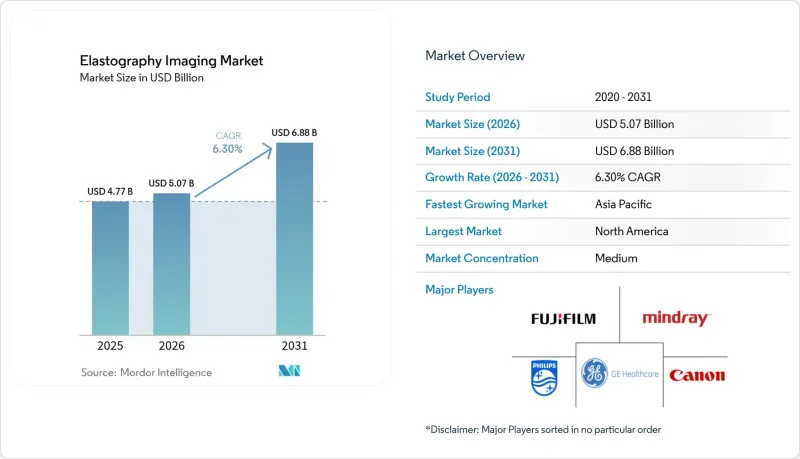
본 보고서는 모달리티(초음파 엘라스토그래피 등), 기술 유형(변형 엘라스토그래피 등), 영상화 기법(2차원 영상화, 3차원/4차원 영상화), 휴대성(트롤리식 시스템, 휴대용 시스템), 용도(방사선과 등), 최종 사용자(병원 등) 및 지역별로 분류되어 있습니다. 시장 전망은 금액(달러) 기준으로 제시되어 있습니다.
전 세계 엘라스토그래피 이미징 시장 동향 및 인사이트
만성 질환 및 유방암 유병률 증가
대사 기능 장애와 관련된 지방간 질환의 유병률 증가로 인해 간 경도 측정의 일상적인 도입이 진행되고 있으며, 2차원 전단파 엘라스토그래피에서는 14.4 kPa의 컷오프 값으로 94%의 정확도를 달성하고 있습니다. 초음파 유도 하에서 감쇠 매개변수와 전단파 데이터를 결합함으로써, MASLD 환자를 생명을 위협하는 사건의 위험도에 따라 계층화할 수 있습니다. 유방 엘라스토그래피 이미징은 현재 고밀도 유방 선별검사에 활용되고 있으며, 62 kPa의 임계값에서 악성 미세석회화를 88%의 민감도와 86.7%의 특이도로 식별합니다. 종양학 분야에서의 도입 확대에 따라 방사선과 내 장비 이용률이 향상되고 있습니다. 이 두 장기 수요 동향에 힘입어, 엘라스토그래피는 생검을 대체할 수 있는 바람직한 비침습적 검사법으로서의 입지를 확고히 하고 있습니다.
저침습 수술로의 전환
전단파 엘라스토그래피 이미징은 재건술 전에 회전근개 힘줄의 질을 예측하여, 외과의가 수술 전략을 보다 정확하게 수립할 수 있도록 합니다. 로봇 수술 시스템에는 3D ARFI 이미징이 통합되어 있어, 다매개변수 MRI와 동등한 일치율로 전립선 수술을 안내합니다. AI 강화형 엘라스토그래피는 생검 대상을 자동으로 식별하여, 샘플링 오류와 수술 시간을 줄여줍니다. Hologic사의 3억 5,000만 달러 규모 Sonata 인수를 비롯한 전략적 인수 사례는 초음파 유도 하에 자궁근종에 특화된 저침습 플랫폼의 상업적 매력을 부각시키고 있습니다. 이 기술의 수술 중 역할은 간에서 근골격계 및 부인과 분야 시술로 확대되고 있습니다.
불리한 보험 지급 체계
메디케어는 CPT 76981/76982의 적용 범위를 특정 만성 간 질환의 진행성 간섬유증으로 한정하고 있어, 보다 광범위한 선별 검사 용도를 제한하고 있습니다. 에트나(Etna)사는 간 이외의 용도에 대한 엘라스토그래피 초음파 검사를 ‘연구 단계’로 간주하고 있어, 심장학 및 근골격계 분야에서의 보험 급여가 정체되어 있습니다. 사전 승인 절차의 장벽으로 인해 행정 처리 주기가 길어지며, 일상적인 검사 의뢰가 저해되고 있습니다. 심장 엘라스토그래피에 대한 표준화된 지급 기준이 없어, 가이드라인에의 채택이 지연되고 있습니다. 근거에 기반한 보험 적용 범위 확대는 대규모 결과 연구를 통해 비용 절감 효과가 입증된 후에야 기대할 수 있을 전망입니다.
부문 분석
2025년에는 초음파 엘라스토그래피가 매출의 62.30%를 차지할 것으로 전망됩니다. 이는 MR 플랫폼에 비해 워크플로우와의 통합성이 뛰어나고 비용이 저렴하다는 점을 반영한 것입니다. 이 점유율은 2025년 엘라스토그래피 이미징 시장 규모 중 29억 7,000만 달러에 해당합니다. MR 엘라스토그래피는 섬유화 병기 분류에 있어 골드 스탠다드로서의 정확도에 힘입어 연평균 성장률(CAGR) 7.19%로 성장하고 있지만, 도입 비용이 높기 때문에 그 보급은 3차 의료 기관으로 한정되어 있습니다. 지속적인 연구 개발을 통해 비평면 모니터링에 대응하는 유연한 초음파 기기가 제공되는 한편, AI를 통한 자동화로 인해 조작자의 숙련도에 관계없이 재현성이 향상되고 있습니다.
MR 엘라스토그래피의 정확도는 복잡한 간 질환 진료 현장 수요를 뒷받침하고 있지만, 설비 투자 장벽으로 인해 일상적인 경과 관찰은 초음파로 대응하고, 판단이 어려운 증례만 MR에 맡기는 하이브리드 도입 전략이 촉진되고 있습니다. 벤더들은 AI 재구성 기술을 통합함으로써 MR 스캔 시간을 단축하고, 검사당 비용을 절감하고 있습니다. 임상적 골드 스탠다드로서의 지위와 경제적 현실 사이의 균형이 장기적인 모달리티 구성을 형성하고 있습니다.
2025년 매출에서 전단파법이 차지하는 비중은 45.10%에 달하며, 그 정량적 우위와 조작자 편향의 낮음이 두드러집니다. 변형 엘라스토그래피 이미징의 연평균 성장률(CAGR) 7.55%는 최소한의 비용으로 기존 스캐너를 업그레이드할 수 있는 소프트웨어 개선에 기인하며, 이는 지역 병원에 매력적인 가치 제안을 제공합니다. 전단파법이 엘라스토그래피 이미징 시장에서 점유율 1위를 유지하고 있는 것은 간 섬유증 및 갑상선 결절 평가에 관한 진료 지침의 권고가 배경에 있습니다.
일회성 엘라스토그래피는 NASH 모니터링에서 틈새 시장을 차지하고 있는 반면, ARFI는 바늘 삽입 중에 실시간 경도 정보를 제공함으로써 중재적 방사선학에 기여하고 있습니다. 시어웨이브와 ARFI를 융합한 하이브리드 솔루션이 종양학 분야의 시술 지침을 충족하기 위해 등장하고 있습니다. 머신러닝에 기반한 경도 추정을 통한 진단 성능의 향상은 기술 유형 간의 경계를 점점 더 모호하게 만들고 있습니다.
지역별 분석
2025년, 북미는 40.75%의 점유율로 매출을 주도했습니다. 간 엘라스토그래피 이미징에 대한 유리한 보험 환급 제도와 AI 소프트웨어의 신속한 승인이 수용적인 규제 환경을 조성하고 있습니다. 미국에서는 NASH 치료제 개발 과정에서 엘라스토그래피를 활용한 평가 지표를 측정하는 다기관 공동 임상시험이 시작되어, 간 전문의들 사이에서 수요가 확고해지고 있습니다.
유럽에서는 각국의 의료 제도가 비용 대비 효과를 중시하고 있어 도입이 안정적인 수준을 유지하고 있습니다. 또한 휴대용 기기는 지방 병원의 총 소유 비용 절감으로 이어지고 있습니다. 이 지역의 영상진단 학회는 조화로운 프로토콜을 공표하여 국가 간 비교 가능성과 벤더 중립성이 향상되고 있습니다.
아시아태평양에서는 의료비 증가, 다수의 당뇨병 환자, 합리적인 가격의 초음파 칩의 국내 생산에 힘입어 연평균 성장률(CAGR) 8.12%로 성장을 지속하고, 있습니다. 중국의 국가의약품감독관리국(NMPA)은 2024년에 3등급 영상진단 지침 개정판을 발간하여 국내 제품 등록을 가속화하고, 지역 내 경쟁을 촉진했습니다. 인도의 현장 진단(PoC) 프로그램에서는 1차 의료 현장에서 지방간 질환 선별 검사를 위해 휴대용 엘라스토그래피 이미징 기기가 도입되고 있습니다.
중동 및 아프리카에서는 민간 병원 그룹이 첨단 진단 서비스에 투자하고 있어 도입이 점차 확대되고 있습니다. 남미에서는 특히 브라질과 아르헨티나에서 공중보건 캠페인이 비침습적 간경변 검출을 중시하고 있어 꾸준한 성장이 나타나고 있습니다.
기타 혜택:
- 엑셀 형식 시장 예측(ME) 시트
- 3개월간의 애널리스트 지원
자주 묻는 질문
목차
제1장 서론
제2장 조사 방법
제3장 주요 요약
제4장 시장 구도
제5장 시장 규모와 성장 예측
제6장 경쟁 구도
제7장 시장 기회와 향후 전망
JHS 26.09.07According to Mordor Intelligence, elastography imaging market size in 2026 is estimated at USD 5.07 billion, growing from 2025 value of USD 4.77 billion with 2031 projections showing USD 6.88 billion, growing at 6.30% CAGR over 2026-2031.
This report is Segmented by Modality (Ultrasound Elastography, and More), Technology Type (Strain Elastography, and More), Imaging Technique (2-D Imaging, 3-D/4-D Imaging), Portability (Trolley-Based Systems, Portable Systems), Application (Radiology, and More), End-User (Hospitals, and More), and Geography. The Market Forecasts are Provided in Terms of Value (USD).
Global Elastography Imaging Market Trends and Insights
Rising incidence of chronic diseases & breast cancer
Escalating metabolic-dysfunction-associated steatotic liver disease prevalence drives routine liver stiffness measurement adoption, where two-dimensional shear-wave elastography achieves 94% accuracy at a 14.4 kPa cutoff . Combining ultrasound-guided attenuation parameters with shear-wave data stratifies MASLD patients by life-threatening event risk. Breast elastography now supports dense-breast screening, distinguishing malignant microcalcifications with 88% sensitivity and 86.7% specificity at a 62 kPa threshold. Growing oncology adoption bolsters equipment utilization in radiology suites. The dual-organ demand profile solidifies elastography as a preferred non-invasive alternative to biopsy.
Shift toward minimally invasive surgeries
Shear-wave elastography predicts rotator-cuff tendon quality before repair, enabling surgeons to tailor operative strategy more accurately. Robotic systems incorporate 3-D ARFI imaging to guide prostate procedures with agreement levels comparable to multiparametric MRI. AI-enhanced elastography automatically pinpoints biopsy targets, lowering sampling errors and procedure times. Strategic acquisitions, such as Hologic's USD 350 million Sonata buy-out, highlight the commercial appeal of ultrasound-guided, fibroid-specific minimally invasive platforms. The technology's intraoperative role is widening from liver to musculoskeletal and gynecological interventions.
Unfavorable reimbursement frameworks
Medicare restricts CPT 76981/76982 coverage to advanced hepatic fibrosis in defined chronic liver diseases, limiting broader screening uses. Aetna deems elastography investigational outside liver applications, stalling cardiology and musculoskeletal reimbursement. Prior-authorization hurdles lengthen administrative cycles and discourage routine ordering. The absence of standardized payment for cardiac elastography delays guideline endorsements. Evidence-based coverage expansions are expected only after large-scale outcome studies demonstrate cost savings.
Other drivers and restraints analyzed in the detailed report include:
- Adoption of elastography for NASH-related fibrosis staging
- AI-enabled point-of-care ultrasound elastography
- High capital cost of MRI-based systems
For complete list of drivers and restraints, kindly check the Table Of Contents.
Segment Analysis
Ultrasound elastography captured 62.30% revenue in 2025, reflecting superior workflow integration and lower cost relative to MR platforms. That share equates to USD 2.97 billion of the elastography imaging market size in 2025. MR elastography advances at a 7.19% CAGR, underpinned by gold-standard accuracy for fibrosis staging, but uptake is limited to tertiary centers due to high acquisition costs. Continuous R&D delivers conformable ultrasound electronics for non-planar monitoring, while AI automation enhances repeatability across operator skill levels.
MR elastography's precision sustains demand in complex hepatology practices, yet capital barriers spur hybrid purchasing strategies where ultrasound handles routine follow-up and MR is reserved for equivocal cases. Equipment vendors integrate AI reconstruction to shorten MR scan times and reduce per-exam cost. The balancing act between clinical gold-standard status and economic realities shapes long-term modality mix.
Shear-wave techniques represented 45.10% of 2025 sales, underlining their quantitative advantage and lower operator bias. Strain elastography's 7.55% CAGR owes to software upgrades that convert existing scanners at minimal cost-a value proposition compelling in community hospitals. The elastography imaging market share leadership of shear-wave is reinforced by guideline endorsements for liver fibrosis and thyroid nodule assessment.
Transient elastography holds a niche in NASH monitoring, whereas ARFI benefits interventional radiology by providing real-time stiffness cues during needle placement. Hybrid solutions that fuse shear-wave with ARFI emerge to satisfy oncology procedural guidance. Diagnostic performance gains from machine-learning-based stiffness estimation continue to blur boundaries among technology types.
Complete Report Scope:
- By Modality
- Ultrasound Elastography
- Magnetic Resonance Elastography
- By Technology Type
- Strain Elastography
- Shear-Wave Elastography
- Transient Elastography
- Acoustic Radiation Force Impulse (ARFI)
- By Imaging Technique
- 2-D Imaging
- 3-D / 4-D Imaging
- By Portability
- Cart / Trolley-based Systems
- Portable / Handheld Systems
- By Application
- Radiology
- Cardiology
- Urology
- Vascular
- Obstetrics & Gynecology
- Orthopedic & Musculoskeletal
- Rheumatology
- Physical Medicine & Rehabilitation
- By End-User
- Hospitals
- Ambulatory Surgical Centers
- Diagnostic Imaging Centers
- Specialty Clinics
- By Geography
- North America
- United States
- Canada
- Mexico
- Europe
- Germany
- United Kingdom
- France
- Italy
- Spain
- Rest of Europe
- Asia-Pacific
- China
- Japan
- India
- Australia
- South Korea
- Rest of Asia-Pacific
- Middle East & Africa
- GCC
- South Africa
- Rest of Middle East & Africa
- South America
- Brazil
- Argentina
- Rest of South America
- North America
Geography Analysis
North America dominated revenue with a 40.75% share in 2025. Favorable reimbursement for liver elastography and rapid AI software clearance create a receptive regulatory environment. The United States initiated multi-center trials measuring elastography endpoints in NASH drug development, anchoring demand among hepatologists.
Europe maintains stable adoption as national health systems emphasize cost-effectiveness; portable devices offer lower total cost of ownership for district hospitals. The region's imaging societies publish harmonized protocols, improving cross-country comparability and vendor neutrality.
Asia-Pacific delivers an 8.12% CAGR, fueled by expanding healthcare spending, large diabetic populations, and domestic manufacturing of affordable ultrasound chips. China's NMPA issued updated Class III imaging guidelines in 2024, expediting domestic product registrations and spurring local competition. India's point-of-care programs incorporate handheld elastography to screen fatty-liver disease in primary care.
The Middle East and Africa witness incremental adoption through private hospital groups investing in premium diagnostic services. South America shows steady growth as public health campaigns emphasize non-invasive cirrhosis detection, particularly in Brazil and Argentina.
- Canon
- Esaote
- FUJIFILM
- GE Healthcare
- Supersonic Imagine
- Hologic
- Koninklijke Philips
- Mindray
- Resoundant Inc.
- Samsung Medison Co. Ltd.
- Siemens Healthineers
- Hitachi
- Butterfly Network Inc.
- Clarius Mobile Health Corp.
- Echosens SA
- BK Medical ApS
- Terason Corporation
- Verasonics Inc.
- Shenzhen Wisonic Medical Tech.
- Alpinion Medical Systems
- Ultrasonix Medical Corp.
Additional Benefits:
- The market estimate (ME) sheet in Excel format
- 3 months of analyst support
TABLE OF CONTENTS
1 Introduction
- 1.1 Study Assumptions & Market Definition
- 1.2 Scope of the Study
2 Research Methodology
3 Executive Summary
4 Market Landscape
- 4.1 Market Overview
- 4.2 Market Drivers
- 4.2.1 Rising Incidence Of Chronic Diseases & Breast Cancer
- 4.2.2 Shift Toward Minimally-Invasive Surgeries
- 4.2.3 Adoption Of Elastography For Nash-Related Liver Fibrosis Staging
- 4.2.4 Ai-Enabled Point-Of-Care Ultrasound Elastography
- 4.2.5 Robotic-Assisted Elastography-Guided Biopsy Platforms
- 4.2.6 Commercial Rollout Of Handheld Shear-Wave Probes
- 4.3 Market Restraints
- 4.3.1 Unfavorable Reimbursement Frameworks
- 4.3.2 High Capital Cost Of MRI-Based Systems
- 4.3.3 Operator-Dependence Limiting Reproducibility
- 4.3.4 Supply-Chain Shortage Of High-Frequency Piezo Crystals
- 4.4 Value / Supply-Chain Analysis
- 4.5 Regulatory Landscape
- 4.6 Technological Outlook
- 4.7 Porter's Five Forces Analysis
- 4.7.1 Threat of New Entrants
- 4.7.2 Bargaining Power of Buyers/Consumers
- 4.7.3 Bargaining Power of Suppliers
- 4.7.4 Threat of Substitute Products
- 4.7.5 Intensity of Competitive Rivalry
5 Market Size & Growth Forecasts (Value)
- 5.1 By Modality
- 5.1.1 Ultrasound Elastography
- 5.1.2 Magnetic Resonance Elastography
- 5.2 By Technology Type
- 5.2.1 Strain Elastography
- 5.2.2 Shear-Wave Elastography
- 5.2.3 Transient Elastography
- 5.2.4 Acoustic Radiation Force Impulse (ARFI)
- 5.3 By Imaging Technique
- 5.3.1 2-D Imaging
- 5.3.2 3-D / 4-D Imaging
- 5.4 By Portability
- 5.4.1 Cart / Trolley-based Systems
- 5.4.2 Portable / Handheld Systems
- 5.5 By Application
- 5.5.1 Radiology
- 5.5.2 Cardiology
- 5.5.3 Urology
- 5.5.4 Vascular
- 5.5.5 Obstetrics & Gynecology
- 5.5.6 Orthopedic & Musculoskeletal
- 5.5.7 Rheumatology
- 5.5.8 Physical Medicine & Rehabilitation
- 5.6 By End-User
- 5.6.1 Hospitals
- 5.6.2 Ambulatory Surgical Centers
- 5.6.3 Diagnostic Imaging Centers
- 5.6.4 Specialty Clinics
- 5.7 By Geography
- 5.7.1 North America
- 5.7.1.1 United States
- 5.7.1.2 Canada
- 5.7.1.3 Mexico
- 5.7.2 Europe
- 5.7.2.1 Germany
- 5.7.2.2 United Kingdom
- 5.7.2.3 France
- 5.7.2.4 Italy
- 5.7.2.5 Spain
- 5.7.2.6 Rest of Europe
- 5.7.3 Asia-Pacific
- 5.7.3.1 China
- 5.7.3.2 Japan
- 5.7.3.3 India
- 5.7.3.4 Australia
- 5.7.3.5 South Korea
- 5.7.3.6 Rest of Asia-Pacific
- 5.7.4 Middle East & Africa
- 5.7.4.1 GCC
- 5.7.4.2 South Africa
- 5.7.4.3 Rest of Middle East & Africa
- 5.7.5 South America
- 5.7.5.1 Brazil
- 5.7.5.2 Argentina
- 5.7.5.3 Rest of South America
- 5.7.1 North America
6 Competitive Landscape
- 6.1 Market Concentration
- 6.2 Market Share Analysis
- 6.3 Company Profiles (includes Global level Overview, Market level overview, Core Segments, Financials as available, Strategic Information, Market Rank/Share for key companies, Products & Services, and Recent Developments)
- 6.3.1 Canon Medical Systems Corporation
- 6.3.2 Esaote SpA
- 6.3.3 Fujifilm Holdings Corporation
- 6.3.4 GE HealthCare
- 6.3.5 Supersonic Imagine
- 6.3.6 Hologic Inc.
- 6.3.7 Koninklijke Philips N.V.
- 6.3.8 Mindray Medical International Ltd.
- 6.3.9 Resoundant Inc.
- 6.3.10 Samsung Medison Co. Ltd.
- 6.3.11 Siemens Healthineers AG
- 6.3.12 Hitachi Ltd.
- 6.3.13 Butterfly Network Inc.
- 6.3.14 Clarius Mobile Health Corp.
- 6.3.15 Echosens SA
- 6.3.16 BK Medical ApS
- 6.3.17 Terason Corporation
- 6.3.18 Verasonics Inc.
- 6.3.19 Shenzhen Wisonic Medical Tech.
- 6.3.20 Alpinion Medical Systems
- 6.3.21 Ultrasonix Medical Corp.
7 Market Opportunities & Future Outlook
- 7.1 White-space & Unmet-Need Assessment


