

|
시장보고서
상품코드
2123523
전기 자극 기기 시장 : 점유율 분석, 업계 동향·통계, 성장 예측(2026-2031년)Electrical Stimulation Devices - Market Share Analysis, Industry Trends & Statistics, Growth Forecasts (2026 - 2031) |
||||||
 Mordor Intelligence
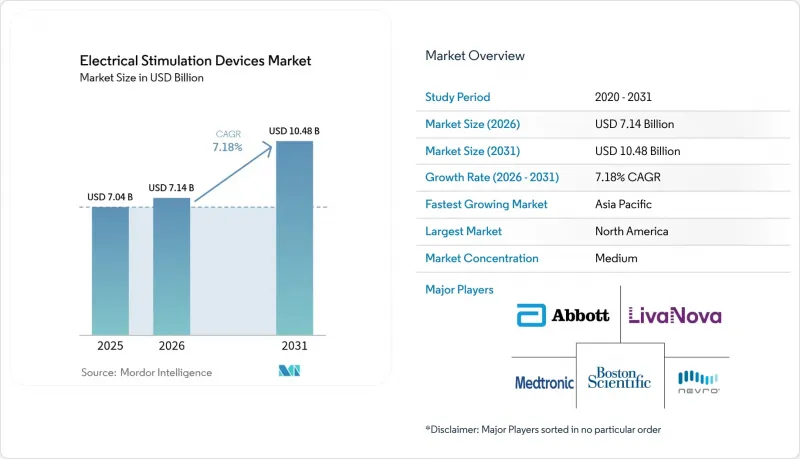
Mordor Intelligence에 의하면, 전기 자극 기기 시장 규모는 2025년 70억 4,000만 달러, 2026년 71억 4,000만 달러에서 2031년까지 104억 8,000만 달러로 확대된다고 예측되고 있어 2026년부터 2031년까지 연평균 복합 성장률(CAGR)은 7.18%를 나타낼 전망입니다.
본 보고서는 제품 유형(NMES, TENS, FES, SCS, DBS, VNS, 골반저), 용도(통증 관리, 신경 질환, 근골격계 질환, 요실금, 미용, 상처 치유),최종 사용자(병원 등), 기술(이식형 등), 지역(북미 등)별로 분류되어 있습니다. 시장 전망은 금액(달러) 기준으로 제시되어 있습니다.
전 세계 전기 자극 기기 시장 동향 및 인사이트
만성 통증 및 근골격계 질환 유병률 증가
만성 통증은 전 세계 성인의 5분의 1에게 영향을 미치고 있으며, 2024년에 발표된 세계보건기구(WHO)의 질병 부담 지표에 따르면 근골격계 질환이 장애의 주요 원인으로 1위를 차지하고 있습니다. 전기 자극 요법은 오피오이드 의존성이나 비스테로이드성 항염증제(NSAID)에 수반되는 위장계 부작용을 피할 수 있는 약물을 사용하지 않는 대체 요법입니다. 미국 재향군인부는 2025년에 TENS 기기를 처방약 목록에 추가하여, 통증 관리 프로그램에 등록된 120만 명의 재향군인을 대상으로 규제 약물 의존도를 줄이는 것을 목표로 하고 있습니다. 요통은 미국 기업에 연간 1,000억 달러 이상의 생산성 손실을 초래하고 있기 때문에 고용주들은 TENS 장치를 웰니스 플랜에 포함시키고 있습니다. 현재, 보존적 치료가 효과를 보이지 않을 경우, 6개월 이내에 척수 자극 요법이 치료 과정에 포함되게 되었습니다. 이러한 프로토콜 변경으로 인해 적응증이 되는 환자층이 확대되었으며, 장기적인 예후를 악화시키는 중추 감작을 예방할 수 있게 되었습니다.
신경 질환을 앓는 고령 인구 증가
유엔의 예측에 따르면, 2050년까지 65세 이상 인구는 16억 명에 달하고, 파킨슨병 유병자 수는 2배인 1,290만 명으로 증가할 것으로 예측됩니다. 레보도파의 효과가 저하되었을 때의 골드 스탠다드는 심부 뇌 자극 요법이지만, 적격 환자 중 수술을 받는 비율은 고작 15%에 불과합니다. 2024년에 승인된 애보트(Abbott)사의 방향성 리드 기술 덕분에 프로그래밍 세션 소요 시간이 90분에서 30분 미만으로 단축되어, 운동 장애 클리닉의 업무 부담이 경감됩니다. 일본에서는 요양보험을 통해 뇌심부자극술에 대한 보조가 이루어지고 있으며, 대상 파킨슨병 환자의 기기 비용 및 수술비의 최대 70%가 지원됩니다. 약물 저항성 간질에 대한 미주신경 자극 요법은 고령자 사이에서 보급이 확대되고 있으며, 리바노바사의 ‘SenTiva’ 시스템은 심박 변동을 기반으로 출력을 자동 조정하므로, 수동 프로그래밍에 어려움을 겪는 사용자의 치료 순응도를 향상시키고 있습니다.
이식형 자극 기기의 높은 초기 비용
척수 자극 요법 1건당 비용은 3만-5만 달러로, 이는 대부분의 중소득 국가에서 1인당 연간 의료비를 상회합니다. 충전식 시스템은 5,000-8,000달러의 추가 비용이 들지만, 수명을 15년으로 연장할 수 있어, 이러한 비용 대비 효과에 대해 예산 제약이 있는 보험사들 사이에서 논의가 이루어지고 있습니다. 인도의 ‘아유슈만 바라트’ 프로그램은 심장 박동기는 지원 대상에 포함되지만, 신경 자극 요법은 제외되어 있어 환자들은 비용을 스스로 부담하거나, 연간 500건 미만으로 제한되는 자선 이식 수술에 의존할 수밖에 없습니다. 유럽의 시범 사업에서는 현재 환급을 치료 성과와 연계하고 있으며, 12개월 시점에서 통증이 50% 감소한 경우에만 기기 비용이 보장되는 구조로 되어 있어, 이로 인해 재무적 위험이 제조업체 측으로 이전되고 있습니다. 많은 관할 구역에서 이식형 하드웨어의 제3자 소유가 금지되어 있어, 리스 제도는 여전히 드물며 지불 모델의 혁신이 정체되어 있습니다.
부문 분석
심부 뇌 자극 기기는 적응증이 우울증 및 강박 장애로 확대됨에 따라 2031년까지 연평균 성장률(CAGR) 9.45%를 나타낼 것으로 예측됩니다. 척수 자극 기기는 Nevro사의 10kHz 플랫폼과 독립적인 전류 제어 기능을 갖춘 Boston Scientific사의 ‘WaveWriter Alpha’ 덕분에 2025년 매출의 33.66%를 차지했습니다. 2025년에 출시된 오므론의 스마트폰 연동형 TENS(경피적 전기 신경 자극) 등 시판용 경피 자극 기기는 소비자의 이용 범위를 넓히고 있습니다. 신경근 시스템은 스포츠 의학 분야에서 주목을 받고 있으며, 하수족에 대한 기능적 전기 자극은 뇌졸중 환자의 보행 속도 회복을 돕고 있습니다. 골반저 자극 기기는 요실금 치료에 사용되고 있으며, Axonics사의 충전식 ‘F15’는 2024년 출시 후 18개월 만에 미국 시장의 25%를 점유했습니다. 미주신경 자극 기기는 여전히 틈새 시장이지만, 난치성 간질 치료에는 필수적입니다.
규제상의 장벽은 제품에 따라 크게 다릅니다. 경피형 기기는 FDA의 510(k) 승인 절차를 거치지만, 척수나 뇌 심부용 시스템은 비용이 많이 드는 시판 전 승인 절차를 거쳐야 합니다. 평균 판매 가격은 이식형이 15,000-25,000달러인 반면, 체외 장착형은 200-500달러로 폭이 넓어 바벨형 수익 구조를 형성하고 있습니다. 수술을 결정하기 전에 환자가 체외 리드선을 시험해 볼 수 있는 하이브리드형 접근 방식은 통증 완화가 불충분하여 발생하는 10-15%의 제거율을 억제하는 것을 목표로 합니다.
2025년 매출액 중 통증 관리가 44.23%를 차지했으나, 미용·코스메톨로지 분야의 적응증은 2031년까지 연평균 성장률(CAGR) 11.38%로 성장할 것으로 전망됩니다. BTL사의 ‘Emsculpt Neo’(2024년 승인)는 고강도 전자기 자극과 RF 가열을 결합하여 4회의 시술로 근육량을 25% 증가시키고 지방을 30% 감소시키는 효과가 있으며, 미국에서 5억 달러 규모의 비급여 진료 틈새 시장을 주도하고 있습니다. 신경 질환(파킨슨병, 본태성 진전, 간질, 우울증)의 경우, 지속적인 증상 관리를 위해 이식형 기기가 필수적입니다. 근골격계 치료에서는 재활 중 TENS(경피적 전기 신경 자극)나 신경근 자극이 사용되고 있으며, 천골 신경 조절은 Axonics사의 충전식 시스템을 통해 대변 실금 치료 분야로 확대되고 있습니다. 상처 치유에서는 저강도 전류를 사용하여 당뇨병성 궤양의 상처 봉합을 촉진하고 있습니다. 보험 환급은 여전히 편차가 있습니다. 메디케어는 만성 통증에 대한 자극 요법을 승인하고 있지만, 미용 목적의 사용은 대상에서 제외하고 있습니다. 한편, 유럽의 보험사들 사이에서는 FDA의 승인에도 불구하고 우울증에 대한 보험 적용 여부에 대해 견해가 엇갈리고 있습니다. 각 제조업체들은 연구개발비용을 분산시키고 보험 급여 위험을 헤지하기 위해 다중 적응증 플랫폼을 전개하고 있습니다.
지역별 분석
북미는 2025년 매출의 39.34%를 차지했습니다. 이는 메디케어의 적용 범위 확대와 연간 5만 건 이상의 척수 자극술을 시행하는 밀집된 중재적 통증 치료 네트워크에 힘입은 결과입니다. CMS는 2024년에 고주파 파형에 대한 보상 범위를 확대하고, 심리 평가로 인한 지연을 해소했습니다. 캐나다에서는 심부 뇌 자극 요법에 공적 자금이 지원되지만, 비암성 통증에 대한 척수 자극 기기에는 적용되지 않아 그 차액은 민간 보험이 보전하게 됩니다. 멕시코의 공적 의료보험 제도에서는 신경 자극 요법이 보장 대상에서 제외되어 있어, 자선 프로그램을 통해 연간 약 200건의 이식 수술로만 제한되고 있습니다.
유럽에서는 독일, 프랑스, 영국이 주도적인 역할을 하고 있습니다. 독일에서는 치료 저항성 우울증에 대한 심부 뇌 자극 요법의 비용이 보상되며, 기기 비용과 수술비로 2만 5,000유로(2만 7,000달러)가 지급됩니다. EU 의료기기 규정에 따라 제조업체는 기존 제품의 임상 데이터를 입증하거나 EU 시장에서 철수해야만 합니다. 프랑스는 천골 신경 조절 요법의 적용 범위를 대변 실금까지 확대하여 환자 수를 30% 증가시켰습니다. 스페인과 이탈리아는 지역 예산 상한선으로 인해 뒤처지고 있으며, DBS 대기 목록이 18개월에 달하고 있습니다.
아시아태평양은 2031년까지 9.05%라는 가장 높은 성장률을 기록할 전망입니다. 일본의 PMDA는 2025년에 충전식 천골 신경 조절기를 승인했으며, 요양보험 제도 하에서 파킨슨병에 대한 DBS에 보조금을 지급하고 있습니다. 중국의 신속 승인 절차는 현지 데이터 규제로 인해 여전히 평균 24개월이 소요되고 있습니다. 인도의 국민건강보험에서는 신경 자극 요법이 보장 대상에서 제외되어 있어, 14억 인구에 비해 척수 자극기 연간 이식 건수는 500건 미만에 그치고 있습니다. 한국에서는 척수 자극 기기의 비용 80%가 보험 적용되지만, 환급액에 상한선이 설정되어 있어 환자는 고가 모델의 비용을 본인 부담해야만 합니다. 호주의 의약품 급여 제도(PBS)에서는 현재 Axonics사의 천골 신경 조절 장치 비용의 75%가 보험 적용을 받아 도입이 촉진되고 있습니다.
걸프 국가들에서는 특별 사용 제도를 통해 기기를 수입하고 있으며, 연간 100건 미만의 척수 자극 기기 이식이 이루어지고 있습니다. 남아프리카의 민간 보험사는 등 수술 후 증후군에 대한 척수 자극 요법 비용을 부담하고 있지만, 공립 병원에는 예산과 훈련을 받은 인력이 부족합니다. 브라질에서는 파킨슨병에 대한 심부 뇌 자극 요법(DBS) 비용이 보험 적용 대상이지만, 척수 자극 기기는 대상에서 제외되어 상파울루와 리우데자네이루에서는 민간 부문에 의한 틈새 시장이 형성되어 있습니다. 아르헨티나에서는 통화 규제 및 수입 허가 제도로 인해 납기일이 6개월 연장되고 있습니다.
기타 혜택:
- 엑셀 형식 시장 예측(ME) 시트
- 3개월간의 애널리스트 지원
자주 묻는 질문
목차
제1장 서론
제2장 조사 방법
제3장 주요 요약
제4장 시장 구도
제5장 시장 규모와 성장 예측
제6장 경쟁 구도
제7장 시장 기회와 향후 전망
JHS 26.09.09According to Mordor Intelligence, the electrical stimulation devices market size is projected to expand from USD 7.04 billion in 2025 and USD 7.14 billion in 2026 to USD 10.48 billion by 2031, registering a CAGR of 7.18% between 2026 to 2031.
This report is Segmented by Product Type (NMES, TENS, FES, SCS, DBS, VNS, Pelvic Floor), Application (Pain Management, Neurological Disorders, Musculoskeletal Disorders, Incontinence, Aesthetic, Wound Healing), End User (Hospitals, and More), Technology (Implantable, and More), and Geography (North America, and More). Market Forecasts are Provided in Terms of Value (USD).
Global Electrical Stimulation Devices Market Trends and Insights
Rising Prevalence of Chronic Pain & Musculoskeletal Disorders
Chronic pain affects one-fifth of adults worldwide, with musculoskeletal diseases ranking as the leading source of disability in World Health Organization burden-of-disease metrics published in 2024. Electrical stimulation offers a drug-free alternative that sidesteps opioid dependence and gastrointestinal side effects tied to non-steroidal anti-inflammatory drugs. The U.S. Department of Veterans Affairs added TENS devices to its formulary in 2025, targeting 1.2 million veterans enrolled in pain-management programs and trimming reliance on controlled substances. Employers are embedding TENS units into wellness plans because low-back pain costs U.S. businesses more than USD 100 billion annually in lost productivity. Spinal cord stimulation now enters the treatment pathway within six months of failed conservative care, a protocol shift that enlarges the eligible pool and prevents central sensitization that worsens long-term outcomes.
Growing Geriatric Population with Neurological Conditions
United Nations forecasts show that people aged 65 and older will number 1.6 billion by 2050, with Parkinson's prevalence doubling to 12.9 million. Deep brain stimulation is the gold standard when levodopa falters, yet only 15% of qualifying patients undergo surgery. Abbott's directional-lead technology, cleared in 2024, trims programming sessions from 90 minutes to under 30 minutes, easing the workload at movement-disorder clinics. Japan subsidizes deep brain stimulation through its long-term care insurance, covering up to 70% of device and surgery costs for eligible Parkinson's patients. Vagus-nerve stimulation for drug-resistant epilepsy gains traction among older adults, with LivaNova's SenTiva system auto-adjusting output based on heart-rate variability, lifting adherence for users who struggle with manual programming.
High Upfront Cost of Implantable Stimulators
A spinal cord stimulation episode costs USD 30,000-50,000, exceeding annual per-capita health spending in most middle-income countries. Rechargeable systems add USD 5,000-8,000 yet stretch life to 15 years, a value equation that cost-constrained payers debate. India's Ayushman Bharat program covers pacemakers but not neurostimulation, so patients self-fund or rely on charitable implants that total fewer than 500 per year. European pilots now tie reimbursement to outcomes-covering devices only when pain drops 50% at 12 months-shifting financial risk to manufacturers. Leasing schemes remain rare because many jurisdictions forbid third-party ownership of implanted hardware, stalling payment-model innovation.
Other drivers and restraints analyzed in the detailed report include:
- Increasing Adoption of Minimally-Invasive Neurostimulation Therapies
- Favorable Reimbursement for Neurostimulation Implants
- Stringent Regulatory Approval Processes
For complete list of drivers and restraints, kindly check the Table Of Contents.
Segment Analysis
Deep brain stimulators are expected to post a 9.45% CAGR through 2031 as regulatory labels expand into depression and obsessive-compulsive disorder. Spinal cord stimulators accounted for 33.66% of 2025 revenue, thanks to Nevro's 10 kHz platform and Boston Scientific's WaveWriter Alpha with independent current control. Over-the-counter transcutaneous units, such as Omron's smartphone-linked TENS launched in 2025, widen consumer reach. Neuromuscular systems attract sports medicine, while functional electrical stimulation for foot drop helps stroke survivors restore gait speed. Pelvic-floor stimulators treat incontinence, with Axonics' rechargeable F15 capturing 25% of the U.S. market within 18 months of its 2024 debut. Vagus-nerve stimulators remain niche but vital for refractory epilepsy.
Regulatory hurdles differ widely: transcutaneous devices clear FDA 510(k) pathways, while spinal and deep brain systems navigate costly pre-market approvals. Average selling prices range from USD 15,000-25,000 for implants to USD 200-500 for external wearables, creating a barbell revenue structure. Hybrid approaches that let patients trial external leads before committing to surgery aim to curb the 10-15% explant rate due to inadequate pain relief.
Pain management delivered 44.23% of 2025 revenue, but aesthetic and cosmetology indications are slated for an 11.38% CAGR to 2031. BTL's Emsculpt Neo, cleared in 2024, combines high-intensity electromagnetic stimulation with RF heating to deliver 25% muscle gain and 30% fat loss over four visits, fueling a USD 500 million U.S. cash-pay niche. Neurological disorders-Parkinson's, essential tremor, epilepsy, depression-depend on implantable devices for durable symptom control. Musculoskeletal therapy uses TENS and neuromuscular stimulation during rehab, while sacral neuromodulation expands to fecal incontinence with Axonics' rechargeable system. Wound healing employs low-intensity currents to speed closure of diabetic ulcers. Reimbursement remains fragmented: Medicare backs chronic-pain stimulation but excludes cosmetic uses, while European payers differ on depression coverage despite FDA approval. Manufacturers respond with multi-indication platforms to spread R&D costs and hedge reimbursement risks.
Complete Report Scope:
- By Product Type
- Neuromuscular Electrical Stimulation (NMES) Devices
- Transcutaneous Electrical Nerve Stimulation (TENS) Devices
- Functional Electrical Stimulation (FES) Devices
- Spinal Cord Stimulation (SCS) Devices
- Deep Brain Stimulation (DBS) Devices
- Vagus Nerve Stimulation (VNS) Devices
- Pelvic Floor Electrical Stimulation Devices
- By Application
- Pain Management
- Neurological Disorders Management
- Musculoskeletal Disorders
- Incontinence & Pelvic Organ Prolapse
- Aesthetic & Cosmetology
- Wound Healing
- By End User
- Hospitals & Clinics
- Rehabilitation Centers
- Home Care Settings
- Sports Medicine & Fitness Centers
- Research Institutes
- By Technology
- Implantable Devices
- External Wearable Devices
- Percutaneous Devices
- By Geography
- North America
- United States
- Canada
- Mexico
- Europe
- Germany
- France
- United Kingdom
- Italy
- Spain
- Rest of Europe
- Asia-Pacific
- China
- Japan
- India
- South Korea
- Australia
- Rest of Asia-Pacific
- Middle East & Africa
- GCC
- South Africa
- Rest of Middle East & Africa
- South America
- Brazil
- Argentina
- Rest of South America
- North America
Geography Analysis
North America captured 39.34% of 2025 revenue, propelled by Medicare coverage and a dense interventional-pain network that performs more than 50,000 spinal cord stimulations a year. CMS expanded reimbursement to high-frequency waveforms in 2024, removing psychological-evaluation delays. Canada funds deep brain stimulation but not spinal cord stimulators for non-cancer pain, leaving private insurance to fill gaps. Mexico's public plan excludes neurostimulation, limiting implants to about 200 a year through charity programs.
Europe, with Germany, France, and the U.K. leading. Germany reimburses deep brain stimulation for treatment-resistant depression, paying EUR 25,000 (USD 27,000) for devices plus surgery. The EU Medical Device Regulation forces makers to substantiate clinical data for legacy products or exit the bloc. France widened sacral neuromodulation coverage to fecal incontinence, boosting patient pools by 30%. Spain and Italy lag due to regional budget caps, causing 18-month DBS waitlists.
Asia-Pacific will post the fastest growth at 9.05% through 2031. Japan's PMDA approved rechargeable sacral neuromodulators in 2025 and subsidizes DBS for Parkinson's under long-term care insurance. China's fast-track channel still averages 24 months due to local data rules. India's national insurance excludes neurostimulation, leaving annual spinal cord stimulator implants below 500 for its 1.4 billion people. South Korea covers 80% of spinal stimulators but caps reimbursement, compelling patients to self-pay for premium models. Australia's Pharmaceutical Benefits Scheme now covers 75% of Axonics' sacral neuromodulator cost, spurring uptake.
Gulf states import devices through compassionate-use corridors, implanting under 100 spinal stimulators annually. South Africa's private insurers fund spinal stimulation for failed back surgery syndrome, but public hospitals lack budget and trained staff. Brazil reimburses DBS for Parkinson's yet excludes spinal stimulators, fostering a private-sector niche in Sao Paulo and Rio de Janeiro. Argentina's currency controls and import licenses extend delivery times by six months.
- Abbott Laboratories
- Aleva Neurotherapeutics
- Axonics Modulation Technologies
- BioMedical Life Systems
- Bioness
- Boston Scientific
- Cogentix Medical (Laborie)
- DJO Global
- EMS Physio Ltd.
- LivaNova
- Medtronic
- MicroPort Scientific Corp.
- MicroTransponder Inc.
- NeuroMetrix
- Nevro
- OMRON
- Saluda Medical
- Soterix Medical
- Stimwave Technologies
- Zynex Medical
Additional Benefits:
- The market estimate (ME) sheet in Excel format
- 3 months of analyst support
TABLE OF CONTENTS
1 Introduction
- 1.1 Study Assumptions & Market Definition
- 1.2 Scope of the Study
2 Research Methodology
3 Executive Summary
4 Market Landscape
- 4.1 Market Overview
- 4.2 Market Drivers
- 4.2.1 Rising Prevalence of Chronic Pain & Musculoskeletal Disorders
- 4.2.2 Growing Geriatric Population with Neurological Conditions
- 4.2.3 Increasing Adoption of Minimally-Invasive Neurostimulation Therapies
- 4.2.4 Favorable Reimbursement for Neurostimulation Implants
- 4.2.5 Integration of Closed-Loop Adaptive Stimulation Algorithms
- 4.2.6 Surge In Tele-Rehabilitation Programs Using Home-Based Stimulators
- 4.3 Market Restraints
- 4.3.1 High Upfront Cost of Implantable Stimulators
- 4.3.2 Stringent Regulatory Approval Processes
- 4.3.3 Battery-Longevity Concerns Limiting Home-Use Adherence
- 4.3.4 Cyber-Security Vulnerabilities in Wireless Neurostim Devices
- 4.4 Value / Supply-Chain Analysis
- 4.5 Regulatory Landscape
- 4.6 Technological Outlook
- 4.7 Porter's Five Forces Analysis
- 4.7.1 Threat of New Entrants
- 4.7.2 Bargaining Power of Suppliers
- 4.7.3 Bargaining Power of Buyers
- 4.7.4 Threat of Substitutes
- 4.7.5 Intensity of Competitive Rivalry
5 Market Size & Growth Forecasts (Value in USD)
- 5.1 By Product Type
- 5.1.1 Neuromuscular Electrical Stimulation (NMES) Devices
- 5.1.2 Transcutaneous Electrical Nerve Stimulation (TENS) Devices
- 5.1.3 Functional Electrical Stimulation (FES) Devices
- 5.1.4 Spinal Cord Stimulation (SCS) Devices
- 5.1.5 Deep Brain Stimulation (DBS) Devices
- 5.1.6 Vagus Nerve Stimulation (VNS) Devices
- 5.1.7 Pelvic Floor Electrical Stimulation Devices
- 5.2 By Application
- 5.2.1 Pain Management
- 5.2.2 Neurological Disorders Management
- 5.2.3 Musculoskeletal Disorders
- 5.2.4 Incontinence & Pelvic Organ Prolapse
- 5.2.5 Aesthetic & Cosmetology
- 5.2.6 Wound Healing
- 5.3 By End User
- 5.3.1 Hospitals & Clinics
- 5.3.2 Rehabilitation Centers
- 5.3.3 Home Care Settings
- 5.3.4 Sports Medicine & Fitness Centers
- 5.3.5 Research Institutes
- 5.4 By Technology
- 5.4.1 Implantable Devices
- 5.4.2 External Wearable Devices
- 5.4.3 Percutaneous Devices
- 5.5 By Geography
- 5.5.1 North America
- 5.5.1.1 United States
- 5.5.1.2 Canada
- 5.5.1.3 Mexico
- 5.5.2 Europe
- 5.5.2.1 Germany
- 5.5.2.2 France
- 5.5.2.3 United Kingdom
- 5.5.2.4 Italy
- 5.5.2.5 Spain
- 5.5.2.6 Rest of Europe
- 5.5.3 Asia-Pacific
- 5.5.3.1 China
- 5.5.3.2 Japan
- 5.5.3.3 India
- 5.5.3.4 South Korea
- 5.5.3.5 Australia
- 5.5.3.6 Rest of Asia-Pacific
- 5.5.4 Middle East & Africa
- 5.5.4.1 GCC
- 5.5.4.2 South Africa
- 5.5.4.3 Rest of Middle East & Africa
- 5.5.5 South America
- 5.5.5.1 Brazil
- 5.5.5.2 Argentina
- 5.5.5.3 Rest of South America
- 5.5.1 North America
6 Competitive Landscape
- 6.1 Market Concentration
- 6.2 Market Share Analysis
- 6.3 Company Profiles (includes Global level Overview, Market level overview, Core Segments, Financials as available, Strategic Information, Market Rank/Share for key companies, Products and Services, and Recent Developments)
- 6.3.1 Abbott Laboratories
- 6.3.2 Aleva Neurotherapeutics
- 6.3.3 Axonics Modulation Technologies
- 6.3.4 BioMedical Life Systems
- 6.3.5 Bioness Inc.
- 6.3.6 Boston Scientific Corp.
- 6.3.7 Cogentix Medical (Laborie)
- 6.3.8 DJO Global
- 6.3.9 EMS Physio Ltd.
- 6.3.10 LivaNova PLC
- 6.3.11 Medtronic plc
- 6.3.12 MicroPort Scientific Corp.
- 6.3.13 MicroTransponder Inc.
- 6.3.14 NeuroMetrix Inc.
- 6.3.15 Nevro Corp.
- 6.3.16 Omron Corporation
- 6.3.17 Saluda Medical
- 6.3.18 Soterix Medical
- 6.3.19 Stimwave Technologies
- 6.3.20 Zynex Medical
7 Market Opportunities & Future Outlook
- 7.1 White-space & Unmet-need Assessment


