|
시장보고서
상품코드
2123524
지혈 밸브 시장 : 점유율 분석, 업계 동향과 통계, 성장 예측(2026-2031년)Hemostasis Valve - Market Share Analysis, Industry Trends & Statistics, Growth Forecasts (2026 - 2031) |
||||||
 Mordor Intelligence
Mordor Intelligence에 의하면, 지혈 밸브 시장 규모는 2025년 1억 9,375만 달러에서 2026년에는 2억 390만 달러로 확대되어 2026년부터 2031년까지 CAGR 5.24%로 성장을 지속하여, 2031년에는 2억 6,318만 달러에 이를 것으로 예측됩니다.
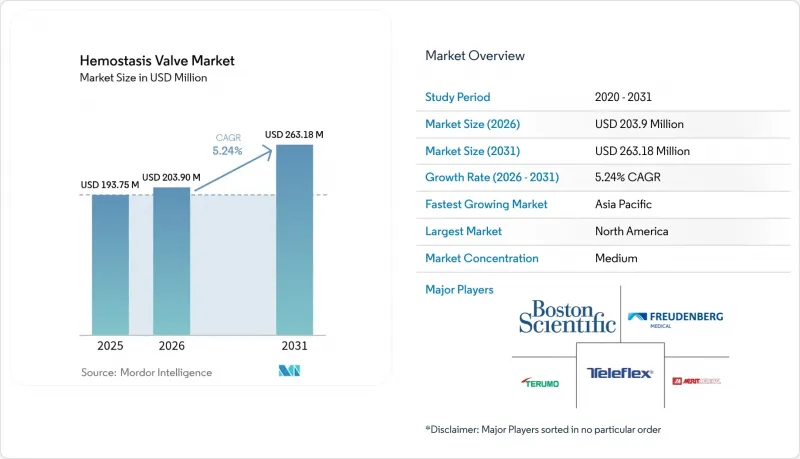
본 보고서는 제품 유형(지혈 밸브 Y 커넥터, 더블 Y 커넥터 밸브, 한 손 조작식 지혈 밸브 등), 용도(혈관 조영술, 혈관 성형술 등), 최종 사용자(병원, 외래수술센터(ASC), 전문 클리닉 등),지역(북미, 유럽, 아시아태평양 등)별로 분류되어 있습니다. 시장 예측은 금액(달러) 기준으로 제시되어 있습니다.
전 세계 지혈 밸브 시장 동향 및 인사이트
심장 중재술 및 방사선 중재술 시술 건수의 급증
2025년 1분기 결과에 따르면, 카테터 검사 건수 증가로 인해 보스턴 사이언티피크의 매출은 전년 동기 대비 20.9% 증가했습니다. 복잡한 시술에서는 여러 기기를 교체해야 하므로, 출혈을 최소화할 수 있는 신뢰성 높은 지혈 밸브에 대한 수요가 높아지고 있습니다. 현재 의료진은 고위험 신경 중재술에서 고품질 밀봉 제품을 선호하고 있으며, 중경막동맥 색전술 시술 건수는 2029년까지 7만 9,483건에 달할 것으로 전망됩니다. 시술 건수 증가는 일회용 밸브에 대한 지속적인 수요로 직결됩니다. 또한, 미국의 지원적인 보험 환급 제도는 요골동맥 접근을 지속적으로 장려하고 있어 기기 사용을 촉진하고 있습니다. 이러한 요인들이 결합되어 예상 연평균 성장률(CAGR)에 1.8포인트의 상승 효과를 가져오고 있습니다.
심혈관 질환 및 만성 대사성 질환의 전 세계적 부담 증가
사망률은 감소하고 있지만, 연령 조정된 허혈성 심장 질환의 유병률은 여전히 높아, 환자의 평생 재시술 건수 증가로 이어지고 있습니다. 아시아에서는 이미 인구 10만 명당 722.45건의 심부전 사례가 기록되어 카테터 치료에 대한 수요가 증가하고 있습니다. 고혈압 환자 수 증가는 전기생리학적 시술 건수를 더욱 끌어올리고 있으며, 전문적인 지혈 솔루션의 도입을 촉진하고 있습니다. 만성 질환 모니터링을 목적으로 한 반복적인 시술은 지속적인 성장의 기반을 마련하고 있습니다. 신흥 시장을 겨냥한 저비용 일회용 키트가 접근성 확대에 기여하고 있습니다. 이러한 복합적인 효과로 인해 성장 궤도는 1.2퍼센트 포인트 상승할 것으로 예측됩니다.
처리 능력이 높은 카테터실의 운영상 복잡성과 감독상의 과제
의사들은 현재 연간 100건 이상의 시술을 수행하고 있으나, 사례의 복잡성이 증가함에 따라 의료진의 피로와 방사선 피폭에 대한 우려가 커지고 있습니다. 인력 부족으로 인해 역량을 유지하기 위해서는 맞춤형 교육 프로그램이 필수적입니다. 실시간 인식 시스템은 자동화를 약속하고 있지만, 여전히 실험 단계에 머물러 있습니다. 다양한 시스 크기에 대응하는 다양한 밸브 재고를 유지하는 것은 물류를 복잡하게 만들고 시술 지연을 초래할 가능성이 있습니다. 이러한 운영상의 과제들이 복합적으로 작용하여 예상 연평균 성장률(CAGR)을 0.7포인트 끌어내리고 있습니다.
부문 분석
지혈 밸브용 Y 커넥터는 2025년에도 지혈 밸브 시장에서 43.05%의 점유율을 유지하며, 진단용 혈관조영술의 듀얼 포트 접근 방식에서 확고한 입지를 구축한 것으로 확인되었습니다. 이 부문의 안정성은 재구매를 보장하는 대규모 도입 기반에 의해 뒷받침되고 있습니다. 그러나 시술자들의 피드백에 따르면, 교체 시간을 단축하기 위한 한 손 조작이 점점 더 선호되고 있어, 2031년까지 연평균 성장률(CAGR) 9.10%를 나타낼 것으로 예측되는 ‘한 손 조작형 지혈 밸브’의 급속한 보급을 촉진하고 있습니다. 이러한 변화는 효율성 지표가 면밀히 추적되는 교육 병원의 조달 정책에도 영향을 미치고 있습니다.
한 손 조작형 밸브에는 WATCHDOG 시스템에서 볼 수 있듯이, 고압 하에서도 밀폐성을 유지하는 크로스 슬릿 씰이 채택되어 있습니다. 더블 Y 커넥터는 가이드와이어와 마이크로카테터의 동시 접근이 필요한 틈새 시술을 대상으로 하는 반면, 통합형 연장 라인 밸브는 만성 완전 폐색(CTO) 치료 분야에서 그 입지를 넓혀가고 있습니다. 푸시-풀 방식의 설계는 기존 설정에서 여전히 사용되고 있지만, 자사 제품 간의 경쟁에 직면해 있습니다. 고경도 실리콘을 비롯한 소재의 발전으로 인해 장시간 회전식 아테렉토미 시술 시 밸브의 피로가 경감되어, 워크플로우 효율화를 중시하는 다량 진료 기관에서의 채택이 더욱 촉진되고 있습니다.
지역별 분석
북미는 높은 시술 건수와 선진적인 보험 환급 제도의 뒷받침을 받아 2025년에는 지혈 밸브 시장의 37.55%를 차지했습니다. 방사형 카테터법의 광범위한 보급과 고령화가 진행되는 인구 구조가 맞물려 안정적인 수요가 유지되고 있습니다. 유럽은 이에 이어 안정적인 지출이 예상되지만, EU-MDR(의료기기 규정) 준수에 따른 비용 측면의 역풍으로 인해 단기적인 성장이 둔화될 가능성이 있습니다.
아시아태평양은 특히 두드러지며, 해당 지역의 가격 민감도에 맞춘 비용 효율적인 밸브 생산을 국내 제조업체들이 확대하고 있어 연평균 성장률(CAGR) 8.18%가 예상됩니다. 인도네시아와 필리핀에서 정부 자금을 통해 카테터실을 구축함에 있어 당일 수술 수용 능력이 중시되고 있어, 멸균 주기를 견딜 수 있는 내구성이 높은 밸브에 대한 수요가 발생하고 있습니다. 일본과 한국은 계속해서 품질 기준을 확립하고 있으며, 현지 공급업체들이 고정밀 성형 기술 도입을 촉진하고 있습니다. 따라서 아시아태평양의 지혈판 시장 규모는 향후 10년 말경 약 8,860만 달러에 달할 것으로 예측되며, 시장 점유율이 크게 확대될 것으로 전망됩니다.
중동 및 아프리카은 사우디아라비아와 아랍에미리트에서 전개되고 있는 국가 심장 센터 프로그램을 중심으로 잠재적인 성장 가능성을 보이고 있습니다. 남미에서는 브라질이 자본재 수입 장벽을 철폐함에 따라 시장이 서서히 확대되고 있으나, 환율 변동이 그 성장세를 둔화시키고 있습니다. 전반적으로, 이들 지역은 포화 상태에 이른 선진국 시장의 위험을 회피하려는 다국적 기업들에게 사업 다각화의 기회를 제공합니다.
기타 혜택:
- 엑셀 형식 시장 예측(ME) 시트
- 3개월간의 애널리스트 지원
자주 묻는 질문
목차
제1장 서론
제2장 조사 방법
제3장 주요 요약
제4장 시장 구도
제5장 시장 규모와 성장 예측
제6장 경쟁 구도
제7장 시장 기회와 향후 전망
JHS 26.09.07According to Mordor Intelligence, the hemostasis valve market size is expected to grow from USD 193.75 million in 2025 to USD 203.9 million in 2026 and is forecast to reach USD 263.18 million by 2031 at 5.24% CAGR over 2026-2031.
This report is Segmented by Product Type (Hemostasis Valve Y-Connectors, Double Y-Connector Valves, One-Handed Hemostasis Valves, and More), Application (Angiography, Angioplasty, and More), End-User (Hospitals, Ambulatory Surgical Centers, Specialty Clinics, and More), and Geography (North America, Europe, Asia-Pacific, and More). The Market Forecasts are Provided in Terms of Value (USD).
Global Hemostasis Valve Market Trends and Insights
Surging Volume of Interventional Cardiology & Radiology Procedures
Q1 2025 results showed a 20.9% year-over-year sales rise for Boston Scientific attributable to higher catheterization activity. Complex procedures require multiple device exchanges, elevating the need for reliable hemostasis valves that minimize blood loss. Operators now favor premium seals for high-risk neuro-interventions, where middle meningeal artery embolization volumes could hit 79,483 cases by 2029. Increased procedure counts translate directly into recurring demand for disposable valves. In addition, supportive reimbursement schemes in the United States continue to reward radial access, sustaining device utilization. These factors collectively add 1.8 percentage points to the anticipated CAGR.
Rising Global Burden of Cardiovascular & Chronic Metabolic Diseases
Age-standardized ischemic heart disease prevalence remains high even as mortality declines, leading to more repeat interventions over a patient's lifetime. Asia already records 722.45 heart-failure cases per 100,000 population, intensifying catheter-based therapy needs. A growing hypertensive population further drives electrophysiology volumes, pushing adoption of specialized hemostasis solutions. Procedure repetitions for chronic disease monitoring secure a durable growth runway. Lower-cost disposable kits aimed at emerging markets broaden access. The combined effect raises the growth trajectory by 1.2 percentage points.
Operational Complexity & Supervision Challenges in High-Throughput Cath-Labs
Physicians now execute more than 100 procedures each year, but case complexity climbs, raising staff fatigue and radiation exposure concerns. Workforce shortages oblige tailored education programs to sustain competencies. Real-time perception systems promise automation yet remain experimental. Maintaining diverse valve inventories for varied sheath sizes complicates logistics and can delay procedures. Collectively, these operational hurdles shave 0.7 percentage points off expected CAGR growth.
Other drivers and restraints analyzed in the detailed report include:
- Growing Adoption of Minimally-Invasive Endovascular Surgeries
- Rapid Shift to Radial Access & Lower-French Devices
- Availability of Alternative Vascular Closure Technologies
For complete list of drivers and restraints, kindly check the Table Of Contents.
Segment Analysis
Hemostasis Valve Y-Connectors retained a 43.05% hemostasis valve market share in 2025, confirming their entrenched role in dual-port access for diagnostic angiography. The segment's stability underpins a sizable installed base that ensures repeat purchases. Operator feedback, however, increasingly favors single-handed manipulation to cut exchange times, triggering rapid adoption of One-Handed Hemostasis Valves that post a 9.10% CAGR through 2031. The shift influences procurement policies at teaching hospitals where efficiency metrics are closely tracked.
One-Handed valves incorporate cross-slit seals that maintain integrity at elevated pressures, exemplified by the WATCHDOG system. Double Y-Connectors target niche procedures needing simultaneous guidewire and microcatheter access, whereas Integrated Extension-Line valves gain momentum for chronic total occlusion work. Push-Pull designs survive in legacy setups but face cannibalization. Material advances, including high-durometer silicone, reduce valve fatigue during lengthy rotational atherectomy, further boosting adoption among high-volume centers keen on workflow streamlining.
Complete Report Scope:
- By Product Type
- Hemostasis Valve Y-Connectors
- Double Y-Connector Valves
- One-Handed Hemostasis Valves
- Integrated Extension-Line Valves
- Push-Pull Hemostasis Valves
- Others
- By Application
- Angiography
- Angioplasty
- Electrophysiology Procedures
- Neuro-interventional Procedures
- Peripheral Vascular Interventions
- Other Applications
- By End User
- Hospitals
- Ambulatory Surgical Centers
- Catheterization Laboratories
- Specialty Clinics
- Other End Users
- Geography
- North America
- United States
- Canada
- Mexico
- Europe
- Germany
- United Kingdom
- France
- Italy
- Spain
- Rest of Europe
- Asia-Pacific
- China
- Japan
- India
- South Korea
- Australia
- Rest of Asia-Pacific
- Middle East and Africa
- GCC
- South Africa
- Rest of Middle East and Africa
- South America
- Brazil
- Argentina
- Rest of South America
- North America
Geography Analysis
North America captured 37.55% of the hemostasis valve market in 2025, bolstered by high procedural volumes and advanced reimbursement structures. Extensive radial adoption combined with an aging population maintains steady unit demand. Europe follows with consistent spending, although EU-MDR compliance introduces cost headwinds that may temper near-term growth.
Asia-Pacific is the standout, poised for an 8.18% CAGR as domestic manufacturers scale production of cost-effective valves aligned with regional price sensitivities. Government-funded cath-lab rollouts in Indonesia and the Philippines emphasize day-case capacity, creating demand for durable valves that tolerate sterilization cycles. Japan and South Korea continue to set quality benchmarks, spurring local suppliers to adopt high-precision molding technologies. The hemostasis valve market size for Asia-Pacific is therefore projected to close the decade at roughly USD 88.6 million, representing meaningful share gains.
The Middle East and Africa show latent potential, hinged on national cardiac-center programs emerging in Saudi Arabia and the United Arab Emirates. South America gradually advances as Brazil lifts capital-equipment import barriers, yet currency volatility moderates momentum. Collectively, these regions provide diversification opportunities for multinationals hedging against saturated developed markets.
- Boston Scientific
- Merit Medical Systems
- Teleflex
- Terumo
- Freudenberg
- Argon Medical Devices
- B. Braun
- Antmed
- Abbott Laboratories
- DeRoyal Industries
- Minivalve International
- Asahi Intecc Co. Ltd.
- Cook Group
- Medtronic
- Nipro
- Qosina Corp.
- Galt Medical Corp.
- Becton Dickinson & Co.
- Cardionovum
- Nordson Medical
- Smiths Group
Additional Benefits:
- The market estimate (ME) sheet in Excel format
- 3 months of analyst support
TABLE OF CONTENTS
1 Introduction
- 1.1 Study Assumptions & Market Definition
- 1.2 Scope of the Study
2 Research Methodology
3 Executive Summary
4 Market Landscape
- 4.1 Market Overview
- 4.2 Market Drivers
- 4.2.1 Surging Volume of Interventional Cardiology & Radiology Procedures
- 4.2.2 Rising Global Burden of Cardiovascular & Chronic Metabolic Diseases
- 4.2.3 Growing Adoption of Minimally-Invasive Endovascular Surgeries
- 4.2.4 Rapid Shift To Radial Access & Lower-French Devices Boosting Demand For Low-Profile Valves
- 4.2.5 Proliferation of Day-Case Cath-Labs In Emerging Economies Requiring Reusable Kits
- 4.2.6 Commercialization of Pressure-Responsive Smart Hemostasis Valves Enabling Real-Time Monitoring
- 4.3 Market Restraints
- 4.3.1 Operational Complexity & Supervision Challenges In High-Throughput Cath-Labs
- 4.3.2 Availability of Alternative Vascular Closure Technologies
- 4.3.3 Volatile Supply of Medical-Grade Silicone & Polycarbonate Resins
- 4.3.4 Cost Escalation Linked To EU-MDR Class-Iib/III Re-Certification
- 4.4 Porter's Five Forces Analysis
- 4.4.1 Threat of New Entrants
- 4.4.2 Bargaining Power of Buyers
- 4.4.3 Bargaining Power of Suppliers
- 4.4.4 Threat of Substitutes
- 4.4.5 Intensity of Competitive Rivalry
5 Market Size & Growth Forecasts (Value, USD)
- 5.1 By Product Type
- 5.1.1 Hemostasis Valve Y-Connectors
- 5.1.2 Double Y-Connector Valves
- 5.1.3 One-Handed Hemostasis Valves
- 5.1.4 Integrated Extension-Line Valves
- 5.1.5 Push-Pull Hemostasis Valves
- 5.1.6 Others
- 5.2 By Application
- 5.2.1 Angiography
- 5.2.2 Angioplasty
- 5.2.3 Electrophysiology Procedures
- 5.2.4 Neuro-interventional Procedures
- 5.2.5 Peripheral Vascular Interventions
- 5.2.6 Other Applications
- 5.3 By End User
- 5.3.1 Hospitals
- 5.3.2 Ambulatory Surgical Centers
- 5.3.3 Catheterization Laboratories
- 5.3.4 Specialty Clinics
- 5.3.5 Other End Users
- 5.4 Geography
- 5.4.1 North America
- 5.4.1.1 United States
- 5.4.1.2 Canada
- 5.4.1.3 Mexico
- 5.4.2 Europe
- 5.4.2.1 Germany
- 5.4.2.2 United Kingdom
- 5.4.2.3 France
- 5.4.2.4 Italy
- 5.4.2.5 Spain
- 5.4.2.6 Rest of Europe
- 5.4.3 Asia-Pacific
- 5.4.3.1 China
- 5.4.3.2 Japan
- 5.4.3.3 India
- 5.4.3.4 South Korea
- 5.4.3.5 Australia
- 5.4.3.6 Rest of Asia-Pacific
- 5.4.4 Middle East and Africa
- 5.4.4.1 GCC
- 5.4.4.2 South Africa
- 5.4.4.3 Rest of Middle East and Africa
- 5.4.5 South America
- 5.4.5.1 Brazil
- 5.4.5.2 Argentina
- 5.4.5.3 Rest of South America
- 5.4.1 North America
6 Competitive Landscape
- 6.1 Market Concentration
- 6.2 Market Share Analysis
- 6.3 Company Profiles (includes Global level Overview, Market level overview, Core Segments, Financials as available, Strategic Information, Market Rank/Share for key companies, Products & Services, and Recent Developments)
- 6.3.1 Boston Scientific Corporation
- 6.3.2 Merit Medical Systems
- 6.3.3 Teleflex Incorporated
- 6.3.4 Terumo Corporation
- 6.3.5 Freudenberg Medical
- 6.3.6 Argon Medical Devices
- 6.3.7 B. Braun Melsungen AG
- 6.3.8 Antmed Corporation
- 6.3.9 Abbott Laboratories
- 6.3.10 DeRoyal Industries Inc.
- 6.3.11 Minivalve International
- 6.3.12 Asahi Intecc Co. Ltd.
- 6.3.13 Cook Medical
- 6.3.14 Medtronic plc
- 6.3.15 Nipro Corporation
- 6.3.16 Qosina Corp.
- 6.3.17 Galt Medical Corp.
- 6.3.18 Becton Dickinson & Co.
- 6.3.19 Cardionovum GmbH
- 6.3.20 Nordson Medical
- 6.3.21 Smiths Medical (ICU Medical)
7 Market Opportunities & Future Outlook
- 7.1 White-space & Unmet-Need Assessment