

|
시장보고서
상품코드
2123530
배지 시장 : 점유율 분석, 업계 동향·통계, 성장 예측(2026-2031년)Culture Media - Market Share Analysis, Industry Trends & Statistics, Growth Forecasts (2026 - 2031) |
||||||
 Mordor Intelligence
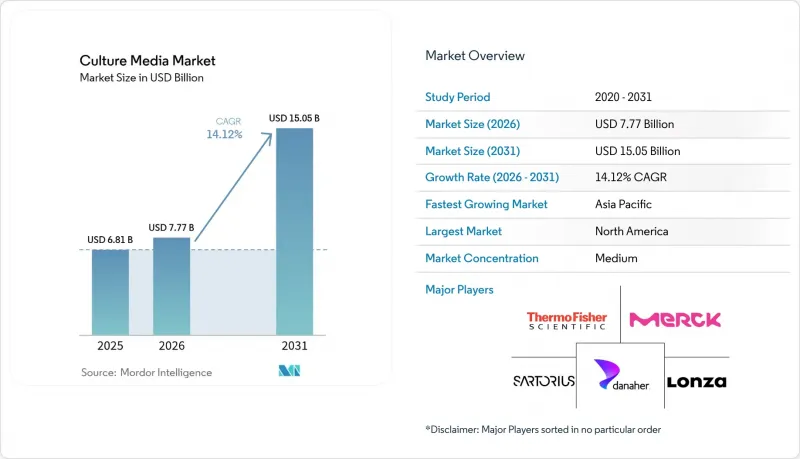
Mordor Intelligence에 의하면, 배지 시장 규모는 2025년 68억 1,000만 달러에서 2026년에는 77억 7,000만 달러로 확대되어 2031년까지 150억 5,000만 달러에 이를 것으로 예상되고 있어 2026년부터 2031년까지 CAGR 14.12%로 성장할 전망입니다.
본 보고서는 배지 유형(발색성 배지 등), 제형(혈청 기반 배지 등), 물리적 상태(액체 배지 등), 최종 사용자(학술·연구 기관 등), 배지 조제 자동화(수동 배지 조제 등), 바이오프로세스 용도(단일클론 항체 등), 지역별로 분류되어 있습니다. 시장 전망은 금액(달러) 기준으로 제시되어 있습니다.
전 세계 배지 시장 동향 및 인사이트
혈청 기반 배지에서 동물 유래 성분을 포함하지 않는 배지로의 전환이 공급업체 구도를 완전히 바꾸고 있습니다.
규제 당국은 현재 외래 인자에 의한 위험을 줄이기 위해 화학적으로 정의된 제제를 권장하고 있으며, 이로 인해 라인당 비용이 200만 달러를 초과하는 경우가 있음에도 불구하고 각 기업은 기존 공정의 재검증을 요구받고 있습니다. 혈청 공급의 불안정성과 엄격한 지침으로 인해 그 채택이 가속화되고 있으며, 단일 클론 항체 및 백신 제조 시설에서 새로운 세포주의 적용의 60% 이상이 무혈청 또는 화학적으로 정의된 배지에 의해 지원되고 있습니다. 규정 준수 측면뿐만 아니라, 성분 관리의 엄격화로 인해 당사슬 구조의 일관성이 향상되고 응집체 형성이 억제됨으로써 치료 효과가 직접적으로 높아집니다. 턴키 플랫폼을 제공하는 공급업체인 서모피셔(Thermo Fisher)의 Gibco OpTmizer와 머크(Merck)의 Cellvento는 시장 점유율을 대폭 확대한 반면, CellGenix와 같은 틈새 시장 업체들은 CAR-T 및 iPSC 워크플로우에 맞추어 GMP 등급 혼합물을 맞춤화하고 있습니다.
mRNA·바이러스 벡터 백신 생산 능력의 급속한 확대가 배지 수요를 뒷받침하고 있습니다.
팬데믹 이후의 인프라는 종양학 및 감염병 파이프라인으로 재분배되고 있으며, 고밀도 현탁 배지의 소비량은 높은 수준을 유지하고 있습니다. 모더나(Moderna)사가 18억 달러를 투자한 멜버른 거점은 영양분이 풍부한 제제의 다년 공급 계약을 공고히 하기 위한 제조 거점 확충을 상징합니다. 바이러스 벡터를 이용한 유전자 치료 플랜트에서는 고농도의 포도당, 지질, 글루타민이 요구되므로, 독자적인 공급 전략을 가진 공급업체에게는 전문적인 틈새 시장이 형성되고 있습니다. 1밀리리터당 1억 개 이상의 세포를 처리하는 관류 시스템에서는 삼투압의 급격한 상승을 최소화하는 장기 사용 가능한 배지가 요구되지만, 이 기술적 과제는 FDA의 ‘신기술 프로그램(Emerging Technology Program)’ 하에서 검증된, 대사 산물의 균형이 잡힌 배합을 통해 해결되었습니다.
의약품 등급 원자재 가격의 급등이 이익률을 압박하고, 생산 능력 확대를 지연시키고 있습니다.
2023년부터 2025년까지 중국의 화학 플랜트 생산 제한과 유럽의 오염으로 인한 가동 중단이 공급에 타격을 주어, 아미노산 가격은 최대 40%까지 급등했습니다. 이로 인해 공급업체는 계약 재협상을 할 수밖에 없게 되었고, 비용을 하류 단계로 전가하게 되었습니다. 재조합 성장 인자 시장은 머크, 서모피셔, 시노바이오로지컬이 주도하는 과점 상태가 지속되고 있어, 소규모 공급업체의 투입 가격 리스크를 가중시키고 있습니다. 아지노모토의 태국 발효 설비 확장에 대표되는 수직 통합은 공급 안정화를 목표로 하고 있으나, 가격 형성에 영향을 미치기에는 시간이 걸릴 것으로 보입니다.
부문별 분석
2025년 배지 시장에서 탈수 분말이 51.55%의 점유율을 차지했습니다. 이는 24개월의 보관 기간에 더해, 연구 기관 및 진단 시설에서의 입고 비용이 30-40% 저렴하다는 점이 뒷받침되었습니다. 한편, 조제된 액상 제품은 CDMO 및 대형 제약 기업들이 오염 위험을 제로에 가깝게 줄이고, 직접 커넥트 백 시스템과 자동 혼합기를 통합하고 있어 2031년까지 연평균 성장률(CAGR) 15.25%를 나타낼 것으로 전망됩니다. 즉시 사용형 백은 배치 조제 시간을 8시간 단축하고 미생물 기준 편차를 추정 60% 감소시킴으로써, 규제 당국의 요건을 충족하면서도 인력을 더 높은 부가가치를 창출하는 업무에 재배치할 수 있게 해줍니다.
임상 미생물학 분야의 발색 플레이트 수요로 인해 반고체형 제품이 부활하고 있지만, 콜드체인의 불안정성으로 인해 현장에서의 재구성을 선호하는 신흥 경제국에서는 탈수 제품이 여전히 지지를 받고 있습니다. 최종 농도까지 희석하는 농축액과 고점도 액체의 하이브리드 제품은 비용과 편의성의 격차를 메우고 있으며, 중견 CDMO는 즉시 사용 가능한 제품에 지불해야 할 전액의 프리미엄을 지불하지 않고도 무균 필터의 제약을 피할 수 있게 되었습니다. 연속 제조가 보급됨에 따라, 예측 가능한 적시(JIT) 액체 공급이 조제 완료 제품의 부상을 뒷받침하고, 배지 시장 전체의 조달 주기를 재구성하게 될 것입니다.
2025년에는 무혈청 혼합 배지가 47.53%의 점유율을 차지하며, 대부분의 단일클론 항체 및 백신 제조에서 동물 유래 보충 성분으로부터의 전환이 진행되었습니다. 그러나 규제 당국이 첨단 치료법에 대해 완벽한 추적 가능성과 비동물성 성분 사용을 요구함에 따라, 화학적으로 정의된 배지는 연평균 성장률(CAGR) 15.75%로 확대되고 있으며, 이는 혈청 기반 배지의 성장률보다 3배 이상 높은 수치입니다. 아미노산 균형과 지질 운반체의 개선을 통해 화학적으로 정의된 배지는 혈청 첨가 배지와 동등하거나 그 이상의 역가를 실현할 수 있게 되었으며, 공정 엔지니어들 사이에서 성능에 대한 우려가 점차 사라지고 있습니다.
줄기세포 및 오가노이드 연구 분야는 GMP 등급의 소량 주문이 주류를 이루는 고수익성 틈새 시장입니다. FUJIFILM Irvine Scientific 등공급업체는 여러 다능성 세포주에서 인증된 제제에 대해 이 분야에서 프리미엄 가격을 책정하고 있습니다. 범용 바이오의약품의 경우, 혈청 기반의 기존 생산 라인이 여전히 존재하지만, 생산 능력 확대나 기술 이전에 따른 각 시설의 가동 중단 때마다 화학적으로 정의된 공정이 도입되는 사례가 증가하고 있어, 배지 시장은 추적 가능한 성분으로 영구적으로 전환되고 있습니다.
지역별 분석
2025년, 북미는 배지 시장에서 38.23%의 점유율을 차지하며 시장을 주도했습니다. 이 지역에는 대규모 바이오의약품 시설이 집중되어 있으며, 연속 바이오프로세스 도입에서도 선구적인 역할을 하고 있습니다. 미국 연방 정부의 첨단 치료 이니셔티브와 견고한 벤처 캐피탈 생태계가 수요를 더욱 뒷받침하고 있으며, 확고한 입지를 가진 공급업체에 유리한 다년간공급 계약이 정착되어 있습니다. 캐나다는 온타리오주와 브리티시컬럼비아주의 재생의학 클러스터를 통해 틈새 수요를 창출하고 있으며, 이 지역에서는 주 정부의 보조금을 통해 초기 단계의 줄기세포 프로그램이 지원되고 있습니다.
유럽은 EMA(유럽의약품청)의 엄격한 품질 기준과 아일랜드에서 독일을 거쳐 스위스에 이르는 고밀도 CDMO(위탁 개발·제조) 회랑을 활용하여, 성숙해 가면서도 꾸준한 성장을 유지하고 있습니다. 이 지역의 그린 바이오 제조에 대한 노력 또한 탄소 발자국을 줄인 배지 제제에 대한 관심을 높여, 식물 유래 가수분해물 대체재에 대한 조달 시범 프로젝트의 시작으로 이어지고 있습니다. 팬데믹 대응을 위한 정부의 인센티브로 인해 mRNA 백신의 생산 능력이 유지되고 있으며, 이는 액체 배지의 기초 소비량을 뒷받침하고 있습니다.
아시아태평양은 국내 조달을 의무화하는 중국의 자급자족 정책과, 유럽 및 미국 기업과의 계약 수주에 성공하고 있는 인도의 비용 경쟁력 있는 CDMO 부문에 힘입어 연평균 성장률(CAGR) 15.42%로 세계에서 가장 빠른 성장세를 보이고 있습니다. 한국의 대기업인 삼성바이오로직스와 셀트리온은 퍼퓨전 설비를 확장하고 있으며, 이로 인해 영양이 풍부한 배지에 대한 수요가 증가하고 있습니다. 할랄 인증의 기회를 발판으로 동남아시아 제조업체들이 두각을 나타내고 있는 한편, 호주의 모더나 공장은 오세아니아 지역의 중요성을 확고히 하고 있습니다. 중동 및 아프리카에서는 걸프협력회의(GCC)의 다각화 프로그램과 북아프리카 전역의 병원체 검사 능력 향상에 따라 점차 도입이 진행되고 있습니다. 브라질을 필두로 한 라틴아메리카에서는 바이오시밀러 생산 능력을 확대하고 있지만, 환율 변동의 영향으로 구매 주기가 위축되고 있습니다.
기타 혜택:
- 엑셀 형식 시장 예측(ME) 시트
- 3개월간의 애널리스트 지원
자주 묻는 질문
목차
제1장 서론
제2장 조사 방법
제3장 주요 요약
제4장 시장 구도
제5장 시장 규모와 성장 예측
제6장 경쟁 구도
제7장 시장 기회와 향후 전망
JHS 26.09.09According to Mordor Intelligence, the culture media market size is expected to increase from USD 6.81 billion in 2025 to USD 7.77 billion in 2026 and reach USD 15.05 billion by 2031, growing at a CAGR of 14.12% over 2026-2031.
This report is Segmented by Media Type (Chromogenic Culture Media, and More), Formulation (Serum-Based Media, and More), Physical State (Liquid Media, and More), End User (Academic & Research Institutes, and More), Preparation Automation (Manual Media Preparation, and More), Bioprocess Application (Monoclonal Antibodies, and More) and Geography. The Market Forecasts are Provided in Terms of Value (USD).
Global Culture Media Market Trends and Insights
Shift From Serum-Based to Animal-Component-Free Media Reshapes Supplier Landscape
Regulators now recommend chemically-defined formulations to mitigate adventitious agent risk, prompting companies to re-validate legacy processes despite per-line costs that can exceed USD 2 million. Serum volatility and stringent guidelines have accelerated adoption, with serum-free or chemically-defined preparations supporting more than 60% of new cell line adaptations in monoclonal antibody and vaccine facilities. Beyond compliance, the tighter component control improves glycosylation consistency and reduces aggregate formation, directly enhancing therapeutic efficacy. Suppliers with turnkey platforms-Thermo Fisher's Gibco OpTmizer and Merck's Cellvento-have captured sizable gains, while niche players such as CellGenix tailor GMP-grade mixes for CAR-T and iPSC workflows.
Rapid mRNA and Viral-Vector Vaccine Capacity Expansions Sustain Media Demand
Post-pandemic infrastructure is redeploying toward oncology and infectious-disease pipelines, maintaining elevated consumption of high-density suspension media. Moderna's USD 1.8 billion Melbourne site exemplifies the manufacturing build-out that locks in multi-year supply contracts for nutrient-rich formulations. Viral-vector gene therapy plants require elevated glucose, lipid, and glutamine profiles, creating specialized niches for suppliers with proprietary feed strategies. Perfusion systems operating above 100 million cells per milliliter demand long-duration media that minimize osmolarity spikes, an engineering challenge now addressed through metabolite-balanced recipes validated under the FDA's Emerging Technology Program.
Pharmaceutical-Grade Raw-Material Inflation Squeezes Margins and Delays Capacity Expansions
Amino acid prices spiked up to 40% from 2023-2025 as Chinese chemical-plant curbs and a European contamination shutdown hit supply, forcing vendors to renegotiate contracts and pass costs downstream. Recombinant growth factors remain an oligopoly led by Merck, Thermo Fisher, and Sino Biological, amplifying input price risk for smaller suppliers. Vertical integration-exemplified by Ajinomoto's Thai fermentation expansion-aims to stabilize access but will require time to influence pricing.
Other drivers and restraints analyzed in the detailed report include:
- Biosimilar Manufacturing Boom Generates Bulk-Media Demand in Emerging Markets
- Adoption of Fully-Automated Media-Preparation Systems Reduces Contamination and Labor Costs
- Batch-to-Batch Variability in Complex Media Delays Regulatory Filings
For complete list of drivers and restraints, kindly check the Table Of Contents.
Segment Analysis
Dehydrated powders held 51.55% of the culture media market in 2025, buoyed by 24-month shelf lives and 30-40% lower landed costs for research labs and diagnostics facilities. Prepared liquids, however, post a 15.25% CAGR to 2031 as CDMOs and Big Pharma push contamination risk toward zero and integrate direct-connect bag systems with automated mixers. Ready-to-use bags shorten batch prep by eight hours and cut microbial excursions by an estimated 60%, satisfying regulators while freeing headcount for higher-value tasks.
Demand for chromogenic plates in clinical microbiology is reviving semi-solid variants, yet dehydrated products keep traction in emerging economies where cold-chain uncertainty favors on-site reconstitution. Hybrid concentrates-thick liquids that dilute to final strength-are bridging cost and convenience divides, letting mid-tier CDMOs sidestep sterile-filter constraints without paying full ready-to-use premiums. As continuous manufacturing proliferates, predictable just-in-time liquid feeds will reinforce the ascent of prepared products, reshaping procurement cycles across the culture media market.
Serum-free mixes captured 47.53% share in 2025, transitioning most monoclonal antibody and vaccine suites away from animal-derived supplements. Chemically-defined recipes, though, are expanding at 15.75% CAGR-more than triple serum-based growth-as agencies demand full traceability and xeno-free status for advanced therapies. Improvements in amino acid balance and lipid carriers now let chemically-defined media match or exceed serum-supplemented titers, shrinking performance hesitation among process engineers.
Stem-cell and organoid research provides a high-margin niche where GMP-grade, small-batch orders prevail; vendors such as FUJIFILM Irvine Scientific leverage premium pricing here for formulations certified across multiple pluripotent lines. For commodity biologics, serum-based legacy lines persist, but each facility shutdown for capacity expansion or technology transfer increasingly emerges with a chemically-defined process, permanently tilting the culture media market toward traceable components.
Complete Report Scope:
- By Media Type
- Chromogenic Culture Media
- Dehydrated Culture Media
- Prepared / Ready-to-use Culture Media
- By Formulation
- Serum-based Media
- Serum-free Media
- Chemically-defined Media
- Stem-cell Culture Media
- Specialty / Custom Media
- By Physical State
- Liquid Media
- Powdered Media
- Semi-solid / Gel Media
- By End User
- Pharmaceutical & Biotechnology Companies
- Contract Development & Manufacturing Organisations (CDMOs)
- Academic & Research Institutes
- Clinical & Diagnostic Laboratories
- Other End Users
- By Preparation Automation
- Manual Media Preparation
- Automated Media-Preparation Systems
- By Bioprocess Application
- Monoclonal Antibodies
- Vaccines (mRNA, viral-vector, sub-unit)
- Cell & Gene Therapy
- Recombinant Proteins & Enzymes
- Geography
- North America
- United States
- Canada
- Mexico
- Europe
- Germany
- United Kingdom
- France
- Italy
- Spain
- Rest of Europe
- Asia-Pacific
- China
- India
- Japan
- Australia
- South Korea
- Rest of Asia-Pacific
- Middle East and Africa
- GCC
- South Africa
- Rest of Middle East and Africa
- South America
- Brazil
- Argentina
- Rest of South America
- North America
Geography Analysis
North America led the culture media market with 38.23% share in 2025, concentrating large-scale biologics facilities and pioneering continuous bioprocessing adoption. The U.S. federal advanced-therapy initiatives and a robust venture capital ecosystem further insulate demand, anchoring multi-year supply contracts that favor established vendors. Canada contributes niche demand via regenerative-medicine clusters in Ontario and British Columbia, where provincial grants support early-stage stem-cell programs.
Europe maintains mature but steady growth, leveraging stringent EMA quality standards and a dense CDMO corridor stretching from Ireland through Germany to Switzerland. The region's push toward green biomanufacturing also stimulates interest in media formulations with reduced carbon footprints, opening procurement pilots for plant-based hydrolysate alternatives. Government incentives for pandemic-preparedness keep mRNA vaccine capacity online, buttressing baseline liquid-media consumption.
Asia-Pacific advances at 15.42% CAGR-the fastest worldwide-driven by China's self-reliance policies mandating domestic sourcing and India's cost-competitive CDMO sector securing Western contract wins. South Korean majors, Samsung Biologics and Celltrion, expand perfusion suites, compounding nutrient-rich media requirements. Southeast Asian manufacturers, incentivized by halal certification opportunities, are emerging, while Australia's Moderna plant cements Oceania's relevance. The Middle East and Africa experience gradual adoption, tied to diversification programs in the Gulf Cooperation Council and rising pathogen-testing capabilities across North Africa. Latin America, led by Brazil, scales biosimilar capacity yet faces currency volatility that tempers purchasing cycles.
- Ajinomoto Co. Inc.
- Avantor Inc.
- Beckton Dickinson
- Bio-Rad Laboratories
- Caisson Laboratories
- CellGenix
- Corning
- Danaher Corp. (Cytiva)
- Eppendorf
- FUJIFILM Holdings (Irvine Scientific)
- GE Healthcare
- HiMedia Laboratories Pvt. Ltd.
- KOHJIN Bio Co. Ltd.
- Lonza Group Ltd.
- Merck KGaA (MilliporeSigma)
- MP Biomedicals LLC
- PAN-Biotech GmbH
- PeproTech
- PromoCell
- Sartorius
- Takara Bio
- Thermo Fisher Scientific
Additional Benefits:
- The market estimate (ME) sheet in Excel format
- 3 months of analyst support
TABLE OF CONTENTS
1 Introduction
- 1.1 Study Assumptions & Market Definition
- 1.2 Scope of the Study
2 Research Methodology
3 Executive Summary
4 Market Landscape
- 4.1 Market Overview
- 4.2 Market Drivers
- 4.2.1 Shift from serum-based to animal-component-free media
- 4.2.2 Rapid, large-scale mRNA / viral-vector vaccine capacity expansions
- 4.2.3 Biosimilar manufacturing boom creating bulk-media demand
- 4.2.4 Adoption of fully-automated media-preparation systems in CDMOs & Big Pharma
- 4.2.5 Intensified perfusion bioreactors driving high-nutrient media innovation
- 4.2.6 Region-specific halal / kosher certification opening new market pockets
- 4.3 Market Restraints
- 4.3.1 Pharmaceutical-grade raw-material inflation & supply-chain fragility
- 4.3.2 Batch-to-batch variability hampers regulatory approvals for complex media
- 4.3.3 Global shortage of skilled media-optimisation scientists
- 4.3.4 End-user reluctance to validate media for continuous-processing GMP runs
- 4.4 Supply-Chain Analysis
- 4.5 Regulatory Landscape
- 4.6 Technological Outlook
- 4.7 Porter's Five Forces
- 4.7.1 Threat of New Entrants
- 4.7.2 Bargaining Power of Buyers
- 4.7.3 Bargaining Power of Suppliers
- 4.7.4 Threat of Substitutes
- 4.7.5 Competitive Rivalry
5 Market Size & Growth Forecasts (Value, USD)
- 5.1 By Media Type
- 5.1.1 Chromogenic Culture Media
- 5.1.2 Dehydrated Culture Media
- 5.1.3 Prepared / Ready-to-use Culture Media
- 5.2 By Formulation
- 5.2.1 Serum-based Media
- 5.2.2 Serum-free Media
- 5.2.3 Chemically-defined Media
- 5.2.4 Stem-cell Culture Media
- 5.2.5 Specialty / Custom Media
- 5.3 By Physical State
- 5.3.1 Liquid Media
- 5.3.2 Powdered Media
- 5.3.3 Semi-solid / Gel Media
- 5.4 By End User
- 5.4.1 Pharmaceutical & Biotechnology Companies
- 5.4.2 Contract Development & Manufacturing Organisations (CDMOs)
- 5.4.3 Academic & Research Institutes
- 5.4.4 Clinical & Diagnostic Laboratories
- 5.4.5 Other End Users
- 5.5 By Preparation Automation
- 5.5.1 Manual Media Preparation
- 5.5.2 Automated Media-Preparation Systems
- 5.6 By Bioprocess Application
- 5.6.1 Monoclonal Antibodies
- 5.6.2 Vaccines (mRNA, viral-vector, sub-unit)
- 5.6.3 Cell & Gene Therapy
- 5.6.4 Recombinant Proteins & Enzymes
- 5.7 Geography
- 5.7.1 North America
- 5.7.1.1 United States
- 5.7.1.2 Canada
- 5.7.1.3 Mexico
- 5.7.2 Europe
- 5.7.2.1 Germany
- 5.7.2.2 United Kingdom
- 5.7.2.3 France
- 5.7.2.4 Italy
- 5.7.2.5 Spain
- 5.7.2.6 Rest of Europe
- 5.7.3 Asia-Pacific
- 5.7.3.1 China
- 5.7.3.2 India
- 5.7.3.3 Japan
- 5.7.3.4 Australia
- 5.7.3.5 South Korea
- 5.7.3.6 Rest of Asia-Pacific
- 5.7.4 Middle East and Africa
- 5.7.4.1 GCC
- 5.7.4.2 South Africa
- 5.7.4.3 Rest of Middle East and Africa
- 5.7.5 South America
- 5.7.5.1 Brazil
- 5.7.5.2 Argentina
- 5.7.5.3 Rest of South America
- 5.7.1 North America
6 Competitive Landscape
- 6.1 Market Concentration
- 6.2 Market Share Analysis
- 6.3 Company Profiles (includes Global-level Overview, Market-level Overview, Core Segments, Financials, Strategic Information, Market Rank/Share, Products & Services, Recent Developments)
- 6.3.1 Ajinomoto Co. Inc.
- 6.3.2 Avantor Inc.
- 6.3.3 Becton, Dickinson and Company
- 6.3.4 Bio-Rad Laboratories Inc.
- 6.3.5 Caisson Laboratories Inc.
- 6.3.6 CellGenix GmbH
- 6.3.7 Corning Incorporated
- 6.3.8 Danaher Corp. (Cytiva)
- 6.3.9 Eppendorf SE
- 6.3.10 FUJIFILM Holdings (Irvine Scientific)
- 6.3.11 GE HealthCare
- 6.3.12 HiMedia Laboratories Pvt. Ltd.
- 6.3.13 KOHJIN Bio Co. Ltd.
- 6.3.14 Lonza Group Ltd.
- 6.3.15 Merck KGaA (MilliporeSigma)
- 6.3.16 MP Biomedicals LLC
- 6.3.17 PAN-Biotech GmbH
- 6.3.18 PeproTech Inc.
- 6.3.19 PromoCell GmbH
- 6.3.20 Sartorius AG
- 6.3.21 Takara Bio Inc.
- 6.3.22 Thermo Fisher Scientific Inc.
7 Market Opportunities & Future Outlook
- 7.1 White-space & Unmet-need Assessment


