

|
시장보고서
상품코드
2123554
휴대용 산소발생기 시장 : 점유율 분석, 업계 동향과 통계, 성장 예측(2026-2031년)Global Portable Oxygen Concentrators - Market Share Analysis, Industry Trends & Statistics, Growth Forecasts (2026 - 2031) |
||||||
 Mordor Intelligence
에 의하면, 휴대용 산소발생기 시장 규모는 2025년 20억 1,000만 달러에서 2026년에는 21억 8,000만 달러로 확대되어 2026년부터 2031년까지 CAGR 8.28%로 성장을 지속하여, 2031년에는 32억 4,000만 달러에 이를 것으로 예측됩니다.
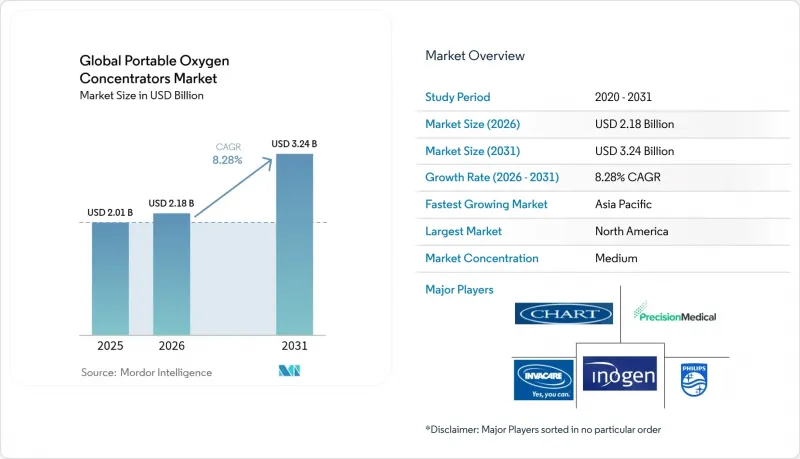
본 보고서는 기술별(연속 유량, 펄스 유량, 기타),용도별(만성 폐쇄성 폐질환(COPD), 천식 등), 최종 사용자별(병원, 재택 간호 시설 등), 유통 채널별(내구성 의료장비(DME) 판매점 등), 판매 채널별(직접 판매 등), 지역별(북미, 유럽, 아시아태평양 등)로 분류되어 있습니다.
전 세계 휴대용 산소발생기 시장 동향 및 인사이트
재택 산소 요법에 대한 보험 적용 범위 확대
메디케어는 월별 임대 기간을 최대 36개월로 제한하고 있으며, 그 이후에는 의학적 필요성이 지속되는 한 공급업체는 기기 제공을 계속해야 합니다. 이를 통해 의료 제공업체에게는 예측 가능한 수익이 창출되는 한편, 지불자의 지출은 절감됩니다. 2024년 HCPCS 코드 업데이트로 청구 절차가 간소화되어 임상의와 DME 공급업체의 행정적 부담이 경감되었습니다. 가정 산소 요법이 재입원률을 낮춘다는 증거가 늘어나면서 민간 보험사들도 이러한 체계를 따르고 있습니다. COVID-19 기간 동안 처음 허용되어 현재는 영구화된 원격 의료 평가를 통해, 지방에 거주하거나 이동이 제한된 환자도 대면 진료 없이 자격 요건을 충족할 수 있습니다. 이러한 정책 전환은 대상 환자층을 확대하고 휴대용 산소발생기 시장을 강화하고 있습니다.
소형화와 배터리 밀도의 획기적인 향상
리튬-제올라이트 컬럼은 산소의 순도를 높이는 동시에 캐니스터 크기를 축소하여, 제조업체는 유량을 저하시키지 않으면서도 장치의 무게를 3파운드 미만으로 줄일 수 있게 되었습니다. Inogen사의 ‘Rove 4’는 최대 840 ml/min의 산소를 공급하며, 배터리 1회 충전으로 5시간 45분 동안 사용할 수 있어 에너지 효율의 급속한 향상을 반영하고 있습니다. 임상시험에서 OXFO 시스템은 연속 유량 공급에 비해 92.3%의 산소를 절약했습니다. FAA(미국 연방항공청) 기준을 준수하는 전자 기기를 통해 고도 10,000피트까지 기내에서 안전하게 사용할 수 있게 되어, 산소에 의존하는 여행객의 이동 선택지가 넓어졌습니다. Arduino 플랫폼을 기반으로 구축된 실시간 순도 센서는 현재 사용 현황 분석 데이터를 제공하여 예방적 유지보수를 지원하고, 장치의 신뢰성을 높이고 있습니다.
리튬 이온 배터리에 대한 수입 관세
미국은 중국산 제품에 125%의 관세를 부과하고 있으며, 이는 중국산 의료기기의 75%와 많은 POC용 배터리 팩에 영향을 미치고 있습니다. 병원은 예산의 10.5%를 의료 용품에 할당하고 있기 때문에 관세로 인한 가격 급등은 조달 예산을 압박하고 있습니다. 각 제조업체는 비용 관리를 위해 조립을 멕시코로 이전하거나 듀얼 소싱 전략을 추진하고 있습니다. 이익률 하락을 방지하기 위해서는 이전 가격 재검토 및 관세 평가액 최적화가 권장됩니다. 단기적인 가격 변동으로 인해 휴대용 산소발생기 시장의 단기 성장은 둔화될 가능성이 있으나, 장기적인 수요의 펀더멘털은 여전히 견고합니다.
부문 분석
2025년, 연속 유량형 장치는 휴대용 산소발생기 시장의 53.20%를 차지하며 시장 규모에서 가장 큰 점유율을 기록했습니다. 이는 중증 저산소혈증 시에도 공급이 중단되지 않는다는 점이 임상의들에게 선호되는 데 기인합니다. 첨단 압축기 설계와 고효율 시브 덕분에 저소음 수준에서 분당 산소 공급량(L)이 지속적으로 향상되고 있습니다. 펄스 플로우 방식 장치는 경량화된 본체와 정교한 호흡 감지 알고리즘이 활동적인 사용자의 요구를 충족시킴으로써 9.29%의 연평균 성장률(CAGR)을 기록하고 있습니다. 5시간을 넘는 배터리 사용 시간 덕분에 펄스형 모델은 하루 종일 외출할 때도 실용적인 선택지가 되고 있습니다. 업계가 사용자 중심의 설계를 중시하는 가운데, 환자들은 처방 매개변수뿐만 아니라 자신의 라이프스타일에 맞는 기기를 선택하는 경향이 강해지고 있습니다.
휴대용 산소발생기 시장에서는 연속 공급과 펄스 공급을 자동으로 전환하는 하이브리드 모드가 등장하고 있습니다. 알고리즘에 의한 펄스 변조를 통해 수면 중 사용자를 깨우지 않고도 산소를 절약할 수 있어, 고정형 시스템과의 임상적 격차가 점차 좁혀지고 있습니다. 텍사스 A&M 대학의 연구에서는 실시간 가속도 센서 데이터를 기반으로 유량 요구량을 예측하는 머신러닝 모델이 검증되었으며, 이는 수동 조정을 최소화하는 적응형 기기의 등장을 예고하고 있습니다. 이러한 혁신을 통해, 기존에는 무거운 고정형 기기에 의존하던 중등도 질환 환자층에서 휴대용 산소발생기 업계 시장 점유율이 확대될 것으로 전망됩니다.
2025년, 만성폐쇄성폐질환(COPD)는 휴대용 산소발생기 시장의 62.10%를 차지하며, 확립된 장기 치료 프로토콜 덕분에 시장 규모의 주요 견인차 역할을 했습니다. 여성의 진단율 상승과 고령화 진행에 따라 COPD 부문은 안정적인 성장을 유지하고 있습니다. 호흡곤란 증후군은 임상의들이 휴대용 치료의 적용 범위를 만성기 치료에서 급성기 후 초기 회복기까지 확대함에 따라 9.88%라는 가장 높은 연평균 성장률(CAGR)을 기록하고 있습니다. COVID-19 감염 후 섬유증 사례에서는 간헐적이긴 하지만 이동 가능한 산소 공급이 필요하기 때문에 새로운 환자층이 추가되고 있습니다.
천식과 간질성 폐질환은 합쳐서 휴대용 산소발생기 시장에서 중규모이면서도 중요한 비중을 차지하고 있습니다. 현재 섬유화를 동반한 간질성 폐질환(ILD) 환자의 약 38%가 산소 요법을 시작하고 있으며, 특히 특발성 폐섬유증 환자에서 이러한 경향이 두드러집니다. 2024년 무작위 대조 시험 결과에 따르면, 24시간 산소 요법과 15시간 산소 요법 간에 예후에 차이가 나타나지 않았으며, 이는 휴대용 기기를 선호하는 단시간 투여 요법이 표준이 될 가능성을 시사합니다. 이러한 연구 결과는 다양한 폐 질환에 대한 휴대용 기기에 대한 의료진의 신뢰를 더욱 강화할 것으로 보입니다.
지역별 분석
북미는 2025년 휴대용 산소발생기 시장 매출의 43.25%를 차지했습니다. 이는 메디케어(Medicare)의 예측 가능한 지급 상한선과, 승인된 기종을 사용한 국내 항공 여행을 원활하게 가능하게 하는 FAA(연방항공청)의 종합적인 규정에 힘입은 결과입니다. 미국공급업체는 현재 다기능 호흡기 기기를 위한 개정판 CMS-855S 양식 카테고리에 등록해야 하며, 이를 통해 더욱 엄격한 감독과 인증 기준이 확보되고 있습니다. 캐나다에서는 재택 산소 요법에 대한 주 정부의 보조금이 확대되어, 구성 부품의 국경 간 거래가 촉진되고 있습니다. 한편, 멕시코는 관세의 영향을 받기 쉬운 리튬 이온 어셈블리의 대체 생산 거점으로서의 입지를 다지고 있습니다.
아시아태평양은 연평균 성장률(CAGR) 11.02%로 가장 빠르게 성장하고 있으며, 2031년까지 휴대용 산소발생기 시장 규모 확대에 가장 크게 기여할 것으로 예측됩니다. 중국에서는 규제 당국이 심사 절차를 가속화한 결과, 2023년 의료기기 등록 건수가 25.4% 증가했습니다. 인도의 경우 2025년까지 의료기기 시장 규모가 500억 달러에 달할 것으로 예상되지만, 여전히 기기의 70%를 수입에 의존하고 있어 서유럽의 기술과 현지 조립을 결합한 합작 사업에 큰 여지가 생기고 있습니다. 일본에서는 고령화 사회와 로봇 기술을 활용한 재택 간호가 맞물려 소형화된 기기의 조기 도입이 앞서고 있으며, 한국에서는 실린더와의 보험 급여 동등화로 인해 POC(휴대용 산소발생기)의 보급이 가속화되고 있습니다.
유럽에서는 의료기기 규정(MDR)의 틀에 따라 안전 기준이 통일되어 꾸준한 보급이 이루어지고 있지만, 공급망은 에너지 비용과 원자재 가격의 급등으로 인해 이익률 압박을 받고 있습니다. 중동 및 아프리카에서는 걸프 국가들이 국내 원격의료 플랫폼에 투자하고, 사하라 이남 국가들이 팬데믹의 교훈을 바탕으로 산소 공급 인프라를 정비하고 있어 수요가 증가하고 있습니다. 남미에서는 완만한 성장이 나타나고 있으며, 브라질에서는 민관 협력 조달 체계를 활용해 지방 진료소에 휴대용 장비를 공급하고, 아르헨티나에서는 통화 변동의 영향을 상쇄하기 위해 현지 생산을 추진하고 있습니다. 지역별 상황이 다르기 때문에 직접 수입, 위탁 생산, 전략적 제휴를 조합한 유연한 시장 진출 전략이 요구됩니다.
기타 혜택:
- 엑셀 형식 시장 예측(ME) 시트
- 3개월간의 애널리스트 지원
자주 묻는 질문
목차
제1장 서론
제2장 조사 방법
제3장 주요 요약
제4장 시장 구도
제5장 시장 규모와 성장 예측
제6장 경쟁 구도
제7장 시장 기회와 향후 전망
JHS 26.09.07According to Mordor Intelligence, the portable oxygen concentrators market size is expected to grow from USD 2.01 billion in 2025 to USD 2.18 billion in 2026 and is forecast to reach USD 3.24 billion by 2031 at 8.28% CAGR over 2026-2031.
This report is Segmented by Technology (Continuous Flow, Pulse Flow, Others), by Application (Chronic Obstructive Pulmonary Disease (COPD), Asthma, and More), by End-User (Hospitals, Home-Care Settings, and More), by Distribution Channel (Durable Medical Equipment (DME) Stores, and More), by Sales Channel (Direct Sales, and More), by Geography (North America, Europe, Asia-Pacific, and More).
Global Portable Oxygen Concentrators Market Trends and Insights
Reimbursement expansion in home oxygen therapy
Medicare caps monthly rentals at 36 months, after which suppliers must keep devices in service for the duration of medical need, giving providers predictable revenue while reducing payer outlays.HCPCS code updates in 2024 simplified billing and trimmed administrative friction for clinicians and DME suppliers. Commercial insurers are mirroring this framework as evidence mounts that home oxygen lowers readmissions. Telehealth assessments, first allowed during COVID-19 and now permanent, let rural or mobility-limited patients qualify without in-person visits. These policy shifts enlarge the addressable patient pool and reinforce the portable oxygen concentrators market.
Miniaturization and battery-density breakthroughs
Lithium-zeolite columns improve oxygen purity while shrinking canister size, letting manufacturers cut device weight below 3 pounds without compromising flow. Inogen's Rove 4 produces up to 840 ml/min and lasts 5 hours 45 minutes on a single battery, reflecting rapid gains in energy efficiency. The OXFO system conserved 92.3% oxygen compared with continuous flow delivery during clinical testing. FAA-compliant electronics allow safe in-flight use up to 10,000 feet, widening mobility options for oxygen-dependent travelers. Real-time purity sensors built on Arduino platforms now deliver usage analytics, supporting preventive maintenance and boosting device reliability.
Import tariffs on lithium-ion cells
The United States imposed 125% duties on Chinese goods, affecting 75% of Chinese-made medical devices and many POC battery packs. Hospitals devote 10.5% of budgets to medical supplies, so tariff-driven price hikes tighten procurement budgets. Manufacturers are moving assembly to Mexico and pursuing dual-sourcing strategies to manage costs. Transfer-pricing reviews and customs-valuation optimization are recommended to avoid margin erosion. Short-run price volatility may slow near-term growth in the portable oxygen concentrators market, yet long-term demand fundamentals remain intact.
Other drivers and restraints analyzed in the detailed report include:
- Rising prevalence of chronic respiratory diseases
- Adventure and wellness travel adoption
- Counterfeit low-cost POCs eroding trust
For complete list of drivers and restraints, kindly check the Table Of Contents.
Segment Analysis
Continuous flow units accounted for 53.20% of portable oxygen concentrators market share in 2025 and generated the largest slice of the portable oxygen concentrators market size, supported by clinician preference for uninterrupted delivery during severe hypoxemia. Advanced compressor designs and higher-efficiency sieves continue to raise L per minute output at lower noise levels. Pulse flow devices are posting a 9.29% CAGR as lighter casings and smarter breath-detection algorithms satisfy active users. Battery runtimes exceeding five hours make pulse models viable for day-long excursions. Industry emphasis on user-centric design means patients increasingly select devices that match lifestyle rather than just prescription parameters.
Hybrid modes that switch automatically between continuous and pulse delivery are emerging in the portable oxygen concentrators market. Algorithm-driven pulse modulation conserves oxygen during sleep without waking users, narrowing the clinical gap with stationary systems. Research at Texas A&M demonstrates machine-learning models that predict flow needs based on real-time accelerometer data, foreshadowing adaptive devices that minimize manual adjustments. These innovations should expand the portable oxygen concentrators industry footprint among moderate disease cohorts who previously relied on heavier stationary equipment.
COPD represented 62.10% of portable oxygen concentrators market share in 2025 and formed the core contributor to portable oxygen concentrators market size because of well-established long-term therapy protocols. Rising diagnosis rates in women and aging populations keep the COPD segment stable. Respiratory distress syndrome is registering the fastest 9.88% CAGR as clinicians extend portable therapy beyond chronic care into early post-acute recovery. Post-COVID fibrosis cases require intermittent yet mobile oxygen, adding new cohorts.
Asthma and interstitial lung disease together form a moderate but important slice of the portable oxygen concentrators market. Nearly 38% of fibrosing ILD patients now initiate oxygen therapy, especially those with idiopathic pulmonary fibrosis. Evidence from a 2024 randomized trial suggests no outcome difference between 24-hour versus 15-hour oxygen use, implying shorter dosing regimens that favor portable units could become standard. Such findings are likely to reinforce physician confidence in mobile devices for diverse pulmonary conditions.
Complete Report Scope:
- By Technology
- Continuous Flow
- Pulse Flow
- Others
- By Application
- Chronic Obstructive Pulmonary Disease (COPD)
- Asthma
- Respiratory Distress Syndrome
- Others
- By End-User
- Hospitals
- Home-care Settings
- Ambulatory Surgical Centers
- Long-Term Care Facilities
- Emergency Medical Services (EMS)
- By Distribution Channel
- Durable Medical Equipment (DME) Stores
- Direct-to-Consumer (Online)
- Hospital Pharmacies
- Others
- By Geography
- North America
- United States
- Canada
- Mexico
- Europe
- Germany
- United Kingdom
- France
- Italy
- Spain
- Rest of Europe
- Asia-Pacific
- China
- Japan
- India
- Australia
- South Korea
- Rest of Asia-Pacific
- Middle East and Africa
- GCC
- South Africa
- Rest of Middle East and Africa
- South America
- Brazil
- Argentina
- Rest of South America
- North America
Geography Analysis
North America generated 43.25% of 2025 revenue for the portable oxygen concentrators market, supported by Medicare's predictable payment ceilings and comprehensive FAA rules that enable unhindered domestic air travel with approved models. U.S. suppliers must now enroll in the revised CMS-855S form category for multifunction respiratory devices, ensuring tighter oversight and credentialing standards. Canada is expanding provincial funding for home oxygen and fostering cross-border trade in subcomponents, while Mexico positions itself as an alternative manufacturing hub for tariff-sensitive lithium-ion assemblies.
Asia-Pacific is the fastest-growing region at an 11.02% CAGR, contributing the largest incremental gain to portable oxygen concentrators market size through 2031. China recorded a 25.4% jump in medical device registrations in 2023 as regulators accelerated review pathways. India expects its medical-device market to hit USD 50 billion by 2025, yet still imports 70% of its devices, creating scope for joint ventures that combine Western technology with local assembly. Japan leads early adoption of miniaturized devices as an aging society aligns with robotics-enabled home care, and South Korea's reimbursement parity with cylinders accelerates POC penetration.
Europe shows steady uptake as the Medical Device Regulation framework harmonizes safety standards, although supply chains feel margin pressure from energy costs and raw-material inflation. Middle East and Africa experience rising demand as Gulf states invest in national telehealth platforms and sub-Saharan countries build oxygen infrastructure in response to pandemic lessons. South America registers moderate growth, with Brazil leveraging public-private procurement frameworks to supply portable units to rural clinics and Argentina encouraging local production to offset currency volatility. Regional heterogeneity necessitates flexible go-to-market strategies that mix direct imports, contract manufacturing, and strategic partnerships.
- Koninklijke Philips
- CAIRE Inc. (Chart Industries)
- Inogen Inc.
- Invacare
- Drive DeVilbiss Healthcare
- Resmed
- O2 CONCEPTS
- Precision Medical
- Nidek Medical Products Inc.
- GCE Group
- Besco Medical
- Yuwell Jiangsu Medical
- OxyGo LLC
- Foshan Keyhub Electronic Industries
- Beijing North Star Sci-Tech
- Longfian Scitech
Additional Benefits:
- The market estimate (ME) sheet in Excel format
- 3 months of analyst support
TABLE OF CONTENTS
1 Introduction
- 1.1 Study Assumptions & Market Definition
- 1.2 Scope of the Study
2 Research Methodology
3 Executive Summary
4 Market Landscape
- 4.1 Market Overview
- 4.2 Market Drivers
- 4.2.1 Re-imbursement expansion in home oxygen therapy
- 4.2.2 Miniaturisation & battery-density breakthroughs
- 4.2.3 Increasing prevalence of chronic respiratory diseases
- 4.2.4 Growth in adventure & wellness travel requiring portable oxygen
- 4.2.5 Ageing population with higher oxygen-dependency
- 4.2.6 Post-COVID home-based long-term oxygen therapy demand
- 4.3 Market Restraints
- 4.3.1 Risk of bacterial contamination from poor maintenance
- 4.3.2 Adverse dermatological effects from prolonged cannula use
- 4.3.3 Import tariffs on lithium-ion cells raising BOM costs
- 4.3.4 Counterfeit low-cost POCs eroding brand trust
- 4.4 Value / Supply-Chain Analysis
- 4.5 Regulatory Landscape
- 4.6 Technological Outlook
- 4.7 Porter's Five Forces Analysis
- 4.7.1 Threat of New Entrants
- 4.7.2 Bargaining Power of Buyers
- 4.7.3 Bargaining Power of Suppliers
- 4.7.4 Threat of Substitutes
- 4.7.5 Intensity of Competitive Rivalry
5 Market Size & Growth Forecasts (Value, USD million)
- 5.1 By Technology
- 5.1.1 Continuous Flow
- 5.1.2 Pulse Flow
- 5.1.3 Others
- 5.2 By Application
- 5.2.1 Chronic Obstructive Pulmonary Disease (COPD)
- 5.2.2 Asthma
- 5.2.3 Respiratory Distress Syndrome
- 5.2.4 Others
- 5.3 By End-User
- 5.3.1 Hospitals
- 5.3.2 Home-care Settings
- 5.3.3 Ambulatory Surgical Centers
- 5.3.4 Long-Term Care Facilities
- 5.3.5 Emergency Medical Services (EMS)
- 5.4 By Distribution Channel
- 5.4.1 Durable Medical Equipment (DME) Stores
- 5.4.2 Direct-to-Consumer (Online)
- 5.4.3 Hospital Pharmacies
- 5.4.4 Others
- 5.5 By Geography
- 5.5.1 North America
- 5.5.1.1 United States
- 5.5.1.2 Canada
- 5.5.1.3 Mexico
- 5.5.2 Europe
- 5.5.2.1 Germany
- 5.5.2.2 United Kingdom
- 5.5.2.3 France
- 5.5.2.4 Italy
- 5.5.2.5 Spain
- 5.5.2.6 Rest of Europe
- 5.5.3 Asia-Pacific
- 5.5.3.1 China
- 5.5.3.2 Japan
- 5.5.3.3 India
- 5.5.3.4 Australia
- 5.5.3.5 South Korea
- 5.5.3.6 Rest of Asia-Pacific
- 5.5.4 Middle East and Africa
- 5.5.4.1 GCC
- 5.5.4.2 South Africa
- 5.5.4.3 Rest of Middle East and Africa
- 5.5.5 South America
- 5.5.5.1 Brazil
- 5.5.5.2 Argentina
- 5.5.5.3 Rest of South America
- 5.5.1 North America
6 Competitive Landscape
- 6.1 Market Concentration
- 6.2 Market Share Analysis
- 6.3 Company Profiles (includes Global level Overview, Market level overview, Core Segments, Financials as available, Strategic Information, Market Rank/Share for key companies, Products & Services, and Recent Developments)
- 6.3.1 Koninklijke Philips N.V.
- 6.3.2 CAIRE Inc. (Chart Industries)
- 6.3.3 Inogen Inc.
- 6.3.4 Invacare Corporation
- 6.3.5 Drive DeVilbiss Healthcare
- 6.3.6 ResMed Inc.
- 6.3.7 O2 Concepts LLC
- 6.3.8 Precision Medical Inc.
- 6.3.9 Nidek Medical Products Inc.
- 6.3.10 GCE Group
- 6.3.11 Besco Medical
- 6.3.12 Yuwell Jiangsu Medical
- 6.3.13 OxyGo LLC
- 6.3.14 Foshan Keyhub Electronic Industries
- 6.3.15 Beijing North Star Sci-Tech
- 6.3.16 Longfian Scitech
7 Market Opportunities & Future Outlook
- 7.1 White-space & Unmet-needs Assessment


